Improving Web 2.0 Opinion Mining Systems Using Text Normalisation
Techniques
Alejandro Mosquera
University of Alicante [email protected]
Paloma Moreda
University of Alicante [email protected]
Abstract
A basic task in opinion mining deals with determining the overall polarity orienta-tion of a document about some topic. This has several applications such as detecting consumer opinions in on-line product re-views or increasing the effectiveness of so-cial media marketing campaigns. How-ever, the informal features of Web 2.0 texts can affect the performance of auto-mated opinion mining tools. These are usually short and noisy texts with pres-ence of slang, emoticons and lexical vari-ants which make more difficult to extract contextual and semantic information. In this paper we demonstrate that the use of lexical normalisation techniques can be used to enhance polarity detection results by replacing informal lexical variants with their canonical version. We have carried out several polarity classification experi-ments using English texts from different Web 2.0 genres and we have obtained the best result with microblogs where normal-isation contribution to the classification model can be up to 6.4%.
1 Introduction
Nowadays, Web 2.0 applications provide some of the most popular forms of communication be-tween users on the Internet such as blogging, so-cial networks or short text messaging platforms. This large daily amount of generated information contains valuable insights about user opinions and sentiments regarding almost any topic.
A basic task in opinion mining deals with deter-mining the overall polarity orientation of a docu-ment about some topic. The polarity information extracted from user comments and consumer feed-back from on-line product reviews can be used to
increase the effectiveness of social media market-ing campaigns, discover new market threats and opportunities or react faster to customer issues. Also, microblogging platforms such as Twitter in-clude rich metadata about interactions which pro-vides a way to measure the reputation of their users based on the number of followers or the publication popularity by counting the number of times one message has been shared.
However, the language used in social me-dia is very informal, containing elements such as misspellings, slang, lexical variants, inconsis-tent punctuations, URLs or emoticons (Thurlow, 2003). Also, the presence of genre-specific ter-minology such as,RT forre-tweet and#hashtags
can make any Natural Language Processing (NLP) task challenging. For this reason, a way to handle such challenges is needed in order to automatically understand the opinions and sentiments that peo-ple are communicating on the Internet. The use of lexical normalisation techniques has recently been the subject of research applied to short and noisy texts such as tweets or SMS, improving the perfor-mance of NLP tools that need to extract contextual and semantic information from this type of infor-mal texts.
Moreover, not all Web 2.0 genres have the same level of informality, microblog posts have to be short so they tend to contain SMS-style contrac-tions while blog entries are usually larger and more elaborated (Santini, 2006). For this reason, in this study we evaluate the contribution of text normalisation techniques to an opinion mining ap-plication using corpora from three different Web 2.0 genres, demonstrating that it can enhance the polarity classification of microblogs by a 6.4%.
This article is organised as follows: In Section 2 we review the state of the art. Section 3 describes the normalisation process. The polarity classifica-tion is explained in Secclassifica-tion 4. In Secclassifica-tion 5, the obtained results are analysed. Finally, our main
Informal English text Normalised English text
a) Gotta buy this asap I am going to buy this as soon as possible. b) I will nevooor buy tis again :( I will never buy this again I’m sad. c) Greeeeeeat product!!! Great product!
d) I dnt wnt to cmplain but reply me plz I do not want to complain but reply me please.
Table 1: Example of raw and normalised pairs of English Web 2.0 texts.
corpus.
Product reviews: The phones sub-set of the EmotiBlog5corpus
5 Results
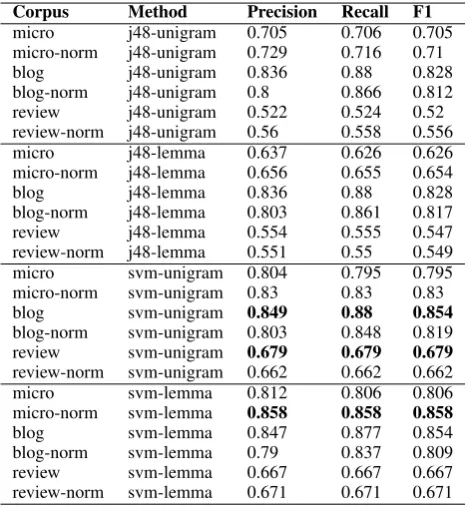
The polarity classification system has been eval-uated using a ten-fold cross validation, see Table 2, before and after applying normalisation tech-niques. Analysing the results we can observe that the overall best classification is achieved using the SVM algorithm. For the microblog genre there are improvements when using the dataset normalised with TENOR and these are higher when using lemmas instead of unigrams with a 6.4% improve-ment over the original dataset. However, there is almost no improvement or even the performance is decreased in some cases when applying TENOR to both blogs and reviews genres. These contain a very low amount of lexical variants and mis-spellings, and because of that using lexical nor-malisation techniques can lead to false positives in the substitution process, thus decreasing the per-formance of the polarity classifier. On the other hand, the microblog dataset is substantially more informal, so the application of normalisation tech-niques has a positive impact in the classification results.
6 Conclusions and Future Work
In this paper we have presented the evaluation of the contribution of a text normalisation tool to an opinion mining system using corpora from three different Web 2.0 genres. The application of lex-ical normalisation techniques to short and very noisy texts such as tweets obtained a relatively 6.4% better F1 results than the classification base-line. On the other hand, it has been shown the need to determine the level of informality before apply-ing normalisation techniques in order to avoid the
5It is an EmotiBlog extension with reviews of mobiles phones
Corpus Method Precision Recall F1
micro j48-unigram 0.705 0.706 0.705 micro-norm j48-unigram 0.729 0.716 0.71
blog j48-unigram 0.836 0.88 0.828
blog-norm j48-unigram 0.8 0.866 0.812 review j48-unigram 0.522 0.524 0.52 review-norm j48-unigram 0.56 0.558 0.556
micro j48-lemma 0.637 0.626 0.626
micro-norm j48-lemma 0.656 0.655 0.654
blog j48-lemma 0.836 0.88 0.828
blog-norm j48-lemma 0.803 0.861 0.817 review j48-lemma 0.554 0.555 0.547 review-norm j48-lemma 0.551 0.55 0.549 micro svm-unigram 0.804 0.795 0.795 micro-norm svm-unigram 0.83 0.83 0.83
blog svm-unigram 0.849 0.88 0.854
blog-norm svm-unigram 0.803 0.848 0.819 review svm-unigram 0.679 0.679 0.679
review-norm svm-unigram 0.662 0.662 0.662
micro svm-lemma 0.812 0.806 0.806
micro-norm svm-lemma 0.858 0.858 0.858
blog svm-lemma 0.847 0.877 0.854
blog-norm svm-lemma 0.79 0.837 0.809 review svm-lemma 0.667 0.667 0.667 review-norm svm-lemma 0.671 0.671 0.671
Table 2: Polarity classification results before and after normalisation using corpora from three dif-ferent Web 2.0 genres.
loss of information when dealing with less infor-mal genres. The use of inforinfor-mality analysis and exploring different polarity classification systems are left to a future work.
Acknowledgments
This paper has been partially supported by Ministerio de Ciencia e Innovacion - Spanish Government (grant no. TIN2009-13391-C04-01), and Conselleria d’Educacion - Generalitat Valenciana (grant no. PROMETEO/2009/119, ACOMP/2010/286 and ACOMP/2011/001)
References
sen-Peter D. Turney. 2002. Thumbs up or thumbs down?: semantic orientation applied to unsupervised classi-fication of reviews. InProceedings of the 40th An-nual Meeting on Association for Computational Lin-guistics, ACL ’02, pages 417–424, Stroudsburg, PA, USA. Association for Computational Linguistics.
Vladimir Vapnik. 1997. The support vector method. In Wulfram Gerstner, Alain Germond, Martin Hasler, and Jean-Daniel Nicoud, editors, ICANN, volume 1327 ofLecture Notes in Computer Science, pages 263–271. Springer.