Term and collocation extraction
by means of complex linguistic web services
Ulrich Heid
1, Fabienne Fritzinger
1, Erhard Hinrichs
2, Marie Hinrichs
2, Thomas Zastrow
21Universit¨at Stuttgart Universit¨at T¨ubingen
Institut f¨ur maschinelle Sprachverarbeitung Seminar f¨ur Sprachwissenschaft
Azenbergstr. 12 Wilhelmstr. 19
D 70174 Stuttgart D 72074 T¨ubingen
[heid,fritzife]ims.uni-stuttgart.de [eh,meh]sfs.uni-tuebingen.de
Abstract
We present a web service-based environment for the use of linguistic resources and tools to address issues of terminology and language varieties. We discuss the architecture, corpus representation formats, components and a chainer supporting the combination of tools into task-specific services. Integrated into this environment, single web services also become part of complex scenarios for web service use. Our web services take for example corpora of several million words as an input on which they perform preprocessing, such as tokenisation, tagging, lemmatisation and parsing, and corpus exploration, such as collocation extraction and corpus comparison. Here we present an example on extraction of single and multiword items typical of a specific domain or typical of a regional variety of German. We also give a critical review on needs and available functions from a user’s point of view. The work presented here is part of ongoing experimentation in the D-SPIN project, the German national counterpart of CLARIN.
1.
Introduction
This paper presents a web-based service environment for the use of linguistic resources and tools, focusing on early results of a part of the German D-SPIN project1.
The scenario underlying the present study is targeted at linguists, philologists, terminologists and translators inter-ested in an analysis of text resources they may have col-lected, with a view to lexis: single and multiword items typical of the specialised language of a given domain, or typical of a regional variety of German.
Identifying such lexical specificities is a complex task, which involves several computational linguistic processing steps and the combination of tools which not every user may have available. Thus, an objective of D-SPIN, as of the EU project CLARIN, is (i) to make the necessary tools available in aservice-orientedarchitecture, (ii) to provide an environment which allows the user to apply them to his/her own texts (or to corpora made available for the pur-pose), and (iii) to combine them as needed.
In this paper, we present some exemplary corpus prepro-cessing tools, the retrieval of lexical collocations, and the comparison of data from two corpora. These functions are useful for finding specialised terminology and/or for iden-tifying lexical regionalisms. Obviously, many more types of linguistic, terminological and philological analyses can in principle be supported by the tools.
In section 2., we sketch the application scenarios and illus-trate the kinds of data to be extracted from texts. We dis-tinguish between corpus preprocessing (tokenisation, tag-ging/lemmatisation and possibly parsing) and corpus
ex-1D-SPIN stands for Deutsche SPrachressourcen-INfrastruktur;
the D-SPIN project is financed by the German Federal Min-istry of Research and Education, BMBF; it is a national German complement to the EU-project CLARIN. See the URLshttp:
//www.sfs.uni-tuebingen.de/dspin and http://
www.clarin.eufor details.
ploration (data extraction). Section 3. is devoted to our pre-processing web services: architecture, formats used for text encoding, and in particular WebLicht, the web-based lin-guistic tool chainer (cf. (Hinrichs et al., 2009), (Hinrichs et al., 2010)) which allows the user to combine pipelines of linguistic processing modules without need for installing or adapting existing tools. We present its infrastructure func-tion, its user interface and the range of preprocessing op-tions at hand. In section 4., we turn to terminology and variety analyses, and discuss web service pipelines for col-location extraction and corpus comparison (e.g. Swiss vs. German news texts). Section 5. is a critical review of the current state, from the user’s point of view: available func-tions vs. needs for future improvements.
2.
Scenarios and targeted phenomena
Term candidate extraction targets both single word and multiword items (e.g. Rechtsbeschwerde ‘appeal’,
Recht-snachfolger‘legal successor’,Recht(e) geltend machen
‘as-sert one’s rights’). Similarly, our comparison of regional varieties also targets single words and multiwords, in this case mainly collocations: in line with the pluricentricity hypothesis (cf. (Ammon, 2001)), we check Swiss (CH) and Austrian (AT) newspaper texts for region-specific lexis (not dialects). Examples of single words include ATKrida
‘bankrupcy’ for DE Bankrott, Insolvenz, or CH Zustupf
‘(financial) contribution’ for DE Zuschuss. These spe-cific items may be part of multiwords (betr¨ugerische Krida
‘fraudulent bankrupcy’, Zustupf leisten ‘give a contribu-tion’). But also non-specific lexical items present in all varieties may occur in region-specific collocations (e.g.
CHmarkanter Anstieg‘marked increase’ for DEdeutlicher
Anstieg).
amount of preprocessing of the texts, as well as additional steps: extraction by syntactic patterns (e.g. noun + adjec-tive, verb + object noun, noun + genitive complement) – frequency counts and a calculation of cooccurrence signif-icance – a frequency-based comparison of data from two corpora, e.g. specialised vs. general, or Swiss vs. German. In the following sections, we discuss to what extent the tools needed for these tasks and the work flows resulting from their combination can be supported by linguistic web services.
3.
Linguistic Web Services for German
Linguistic web services can be word-oriented or text-oriented. Word-oriented web services rely on lexical or corpus resources; users query the web service with a par-ticular item and get back all data associated with the item in the respective resource (see e.g. Wortschatz2).We will in the following sections concentrate on text-oriented web services: the user uploads a text (corpus) and the service calls one or more computational linguistic tools which are applied to the text (corpus) and deliver annotation results. As a variant, the tools may perform calculations (e.g. of frequency or significance) and deliver the results to the user.
Obviously, web services may be called interactively or via APIs, from tools. We focus on the former interaction, here, even though both are possible in our setup.
In our experiments, we implement an architecture consist-ing of four layers (cf. Fig. 1, from bottom to top): (i) tools, (ii) wrappers, services and converters, (iii) the web service infrastructure, as well as (iv) clients.
Composition Webservice
Tools XML Wrappers
Infrastructure Clients
Web Service Infrastructure
Wrapper Wrapper Wrapper
Wrapper Transformer
Application Application
Service
Tool A Tool B
Res. Res.
Figure 1: Layers of the web service architecture
Tools and resources are embedded each in a wrapper, which acts as an interface for their input and output and thereby supports communication between different tools in a pipeline. By using wrappers, we ensure that the tools and
2http://wortschatz.uni-leipzig.de/axis/
servlet/ServiceOverviewServlet, an extensive
linguistic database of the University of Leipzig.
resources themselves need not be modified with respect to their stand-alone versions when being used in the web ser-vice setup. So far, we have integrated linguistic corpus pro-cessing tools provided by four German research institutes (see section 3.2.1., below). Wrappers may interact with service components: e.g. when a tool provided by one in-stitution uses a resource provided by another one.
Components of the infrastructural layer are used, among others, to call converters, e.g. for transforming the D-SPIN-internal text corpus format into an exchange format (see be-low, section 3.1.). User interaction, as well as calls of the web services from applications (e.g. other linguistic pro-cessing tools) are directed to the infrastructure layer. In our setup, interactive calls are channeled through the WebLicht tool (Hinrichs et al., 2009), a linguistic tool chainer for composing task-specific web services. The chain builder function will be presented below, in section 3.2..
The implementation uses both Perl/Python and Java com-ponents; it is based on the REST architecture3(Richardson
and Ruby, 2007), and on an Apache web server. As the whole setup is experimental, we have so far not worked in detail on authentification, access rights, billing, etc. The EU project CLARIN has an ongoing work package devoted to these issues, the results of which will be used, before our web services will be made available at large.
3.1. Formats used internally and for exchange
Internal communication. For communication between different web services, we use an XML-based text cor-pus format which is defined by an XML schema expressed in Relax NG. It uses additional constraints expressed in Schematron. A sample encoding taken from the current im-plementation is reproduced in Figure 2.
Basically, the format contains both a metadata section, to encode sources, tools, the language of the document, etc., and a multi-layered token and region annotation. Figure 2 shows a part of the internal encoding of the sentencedie
zweite Studie lieferte ¨ahnliche Ergebnisse4parsed with the
BitPar constituent parser (Schmid, 2004); we reproduce only some tokens and nodes of the parse tree, skipping metadata and lemmas (cf. the dependency tree in Figure 5, below).
Exchange formats – long-term view. The current text corpus format was designed with a view to efficiency: in our tests, we processed among others the 10 million words EMEA corpus together with a 40 million words newspaper corpus (Frankfurter Rundschau, 1992/93) through one in-stance of the pipeline (see section 4.). The annotated results lead to rather large amounts of data which have to be trans-ported through the web based pipeline. Thus, the definition of the D-SPIN text corpus format aims at keeping the XML overhead low (for details, see (Heid et al., 2010)).
Obviously, there exist standard proposals for corpus encod-ing formats, e.g. from the language resources standard-isation work groups of ISO5. The ISO proposals cover a
3
Implemented on Apache Web server and Tomcat application server.
4
EN: the second study provided similar results.
5
<D-Spin> <MetaData/>
<TextCorpus lang=”de” tokens=”yes” parsing=”TigerTB”> <text>Die zweite Studie lieferte ¨ahnliche Ergebnisse</text> <tokens>
<token ID=”t2”>Die</token> <token ID=”t3”>zweite</token> <token ID=”t4”>Studie</token> ...
</tokens> <parsing> <parse> <node cat=”TOP”>
<node cat=”S-TOP”> <node cat=”NP-SB”>
<node cat=”ART*” tokID=”t2”>Die</node> <node cat=”ADJA*” tokID=”t3”>zweite</node> <node cat=”NN*” tokID=”t4”>Studie</node> </node>
... </node> </node> </parse> </parsing> </TextCorpus> </D-Spin>
Figure 2: XML structure of constituent parsing
general graph-based metastandard for any kind of annota-tion LAF6, (cf. (Ide and Romary, 2004)), as well as
def-initions of syntactic and morphosyntactic annotation for-mats, SynAF and MAF7. We have started to build
convert-ers that are able to translate the D-SPIN text corpus format into MAF and vice versa. A mapping of the tagset STTS (Schiller et al., 1995), which is a de facto standard for Ger-man, onto the data categories defined inISOcat, accord-ing to ISO 126208, is under way. For unambiguous
syn-tactic representations, a full mapping from the D-SPIN text corpus format to MAF/SynAF9will be provided, at least in an experimental way, by the end of 2009.
In the medium to long term, we expect the web services to be able to convert the D-SPIN internal format to the ISO proposals. The extent to which these can serve as an inter-nal format themselves remains to be explored.
3.2. WebLicht: A Tool Chainer
The user interface layer and part of the infrastructure of our architecture is implemented through a tool chainer named WebLicht10 (cf. (Hinrichs et al., 2009), (Hinrichs et al.,
2010)). It is implemented as a web application so that there is no need for users to install any software on their own computers or to concern themselves with the technical de-tails involved in building tool chains.
6
ISO/DIS 24612,http://www.tc37sc4.org/new doc/
ISO TC 37 SC4 N311 Linguistic%20Annotation%20Framework.pdf
7
SynAF: ISO/DIS 24615, MAF: ISO/DIS 24611
8
www.isocat.org/
9
Note that SynAF does not yet address the issue of ity; similarly, LAF also does not yet deal explicitly with ambigu-ity. For a proposal to include ambiguity handling into LAF, see (Kountz et al., 2008).
10http://clarin.sfs.uni-tuebingen.de:
8080/WebLicht0/, developed at the University of
Tue-bingen.
3.2.1. WebLicht: infrastructural aspects
WebLicht infrastructure functions. In its infrastructure functions, WebLicht allows the integration and use of dis-tributed web services with standardised APIs. The nature of these open and standardised APIs makes it possible to access the web services from nearly any programming lan-guage, shell script or workflow engine (UIMA, Gate etc.).
WebLicht Preprocessing Tools. Currently, WebLicht offers linguistic resource and tool services that were developed independently at the Institut f¨ur Informatik, Abteilung Automatische Sprachverarbeitung of the Univer-sity of Leipzig, at the Institut f¨ur Maschinelle Sprachver-arbeitung at the University of Stuttgart, at the Berlin-Brandenburgische Akademie der Wissenschaften and at the Seminar f¨ur Sprachwissenschaft/Computerlinguistik of the University of T¨ubingen.
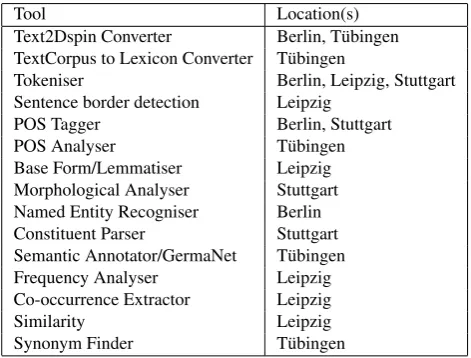
The tools mainly serve for preprocessing of corpora (to-kenisers, taggers, parsers), but also for lexical-semantic an-notation (GermaNet11, synonym finder) and for frequency
calculation. Although we only discuss tools for the Ger-man language, it should be noted that some tools are either language independent (e.g. the trainable tokeniser) or exist for other languages as well (e.g. taggers for EN, FR, IT, inter alia). Table 1 provides a listing of all currently imple-mented tools in WebLicht.
Tool Location(s)
Text2Dspin Converter Berlin, T¨ubingen TextCorpus to Lexicon Converter T¨ubingen
Tokeniser Berlin, Leipzig, Stuttgart Sentence border detection Leipzig
POS Tagger Berlin, Stuttgart POS Analyser T¨ubingen Base Form/Lemmatiser Leipzig Morphological Analyser Stuttgart Named Entity Recogniser Berlin Constituent Parser Stuttgart Semantic Annotator/GermaNet T¨ubingen Frequency Analyser Leipzig Co-occurrence Extractor Leipzig
Similarity Leipzig
Synonym Finder T¨ubingen
Table 1: WebLicht tool overview
3.2.2. WebLicht Preprocessing Workflows
To get experience with multiple web service components, we have not only integrated several preprocessing and ex-traction steps which form a pipeline (tokenising, tagging, parsing, etc.): we also provide several alternative tools for some of the tasks, to choose from. Having different tools for the same purpose available makes sense when individ-ual tools are known to differ with respect to the underlying philosophy, coverage, etc.
11http://www.sfs.uni-tuebingen.de/
GermaNet/, the German WordNet by the University of
(a) Only EMEA (not FR).
term candidates f (abs.)
Durchstechflasche 5638
Injektionsstelle 3489
Pharmakokinetik 3426
H¨amoglobinwert 3395
Fertigspritze 3271
Ribavirin 3234
Gebrauchsinformation 2801
Dosisanpassung 2580
Epoetin 2302
Hydrochlorothiazid 2128
(b) EMEA and FR
term candidates weirdness f (abs.)
Filmtablette 25522 6389
Injektionsl¨osung 19854 4970
Packungsbeilage 14710 7365
Niereninsuffizienz 14233 3563
Verkehrst¨uchtigkeit 13558 3394
Leberfunktion 8385 2099
Hypoglyk¨amie 8353 2091
Toxizit¨at 7957 1992
Einnehmen 7035 7045
Hypotonie 6823 1708
Table 2: Single word term candidates – Top 10
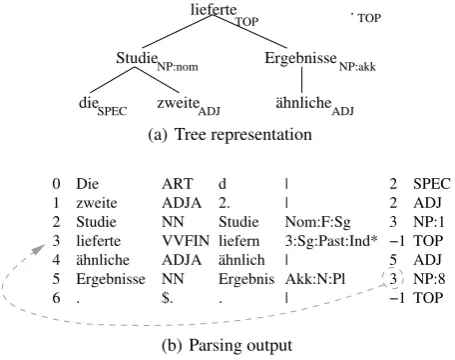
lemma. The fifth column contains the morphosyntactic fea-tures of the word form, e.g. case, number, person, etc. Columns 6 and 7 are to be interpreted together: the num-ber indicates the position of the word’s governor, and the last column indicates the grammatical relation between the word and its governor. Thus, in Figure 5, the word form
Ergebnisseis coded as plural accusative (line 5, col. 5) and
as an accusative object (NP:8, col. 7) of the verbliefern
(col. 7: value “3”, pointing to lieferte, which is on line 3). The actual collocation extraction is implemented as a pattern-matching over FSPar-output, e.g. for verbs and their objects, (e.g. Perl/Python scripts).
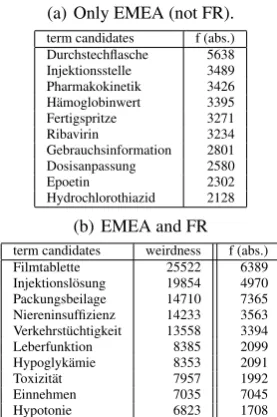
Extraction of prominent single word items. The identi-fication of typical single word items, be it from specialised or regional texts, relies on an implementation of Ahmad et al. (1992)’s “weirdness” measure (Ahmad et al., 1992). The intuition is that terms from the specialised language of a given domain are much more frequent in the domain specific text than elsewhere. Some specialised items do not show up at all in general language, others are found in both, but more frequently in the specialised text. A tool for identifying specialised items in this way simply has to determine the relative frequency of each item from the spe-cialised text (RS), calculate its relative frequency in a gen-eral text used for comparison (RG), and determine the re-lationship between both (RS/RG). It produces two kinds of term candidate output: a list of words never found in the general texts (cf. Table 2 (a) for an example from a phar-maceutical corpus, we indicate absolute frequency in the specialized corpus), and a list of words found more often in the specialised than in the general texts (cf. Table 2 (b) for examples from the same corpus, with the weirdness figure RS/RG and absolute frequency in the specialized text).
4.2. Corpus data used for experimentation and sample results
Corpus data. For the terminology extraction work, we use the German part of the multilingual corpus of test
re-ports for pharmaceuticals, made available by EMEA, the European Medicines Agency (ca. 10 million words). The data have been collected by J¨org Tiedemann and made available on his OPUS web site12This corpus is compared
to newspaper text ofFrankfurter Rundschau, consisting of ca. 40 million words, in order to identify specialised termi-nology.
In the experiments on the regional varieties of German, we use newspaper texts from the DeReKo corpus, Deutsches
Referenzkorpus13. These are grouped according to
coun-tries. We use Austrian and Swiss material and compare it with newspaper texts from Germany, such as
Frank-furter Allgemeine Zeitung, Frankfurter Rundschau, Die
Zeit,Stuttgarter Zeitung,Handelsblatt.
Sample results. Table 2, above, contains a few typical single word candidates from the EMEA corpus: items only contained in EMEA (part (a)) and items significantly more frequent in EMEA than in theFrankfurter Rundschau, used as a “general language” text, for comparison purposes. The items are sorted by frequency (2(a)) and by the RS/RG quo-tient (2(b)), i.e. in decreasing order of relevance for the specialised text.
Table 3 contains a few verb + object collocations which are found in Swiss news texts but not in German news.
Abkl¨arung treffen 96 Abkl¨arung vornehmen 91 Anlaß besuchen 73 Anlaß durchf¨uhren 199 Anlaß organisieren 367 Beschwerde gutheißen 88 Bilanz deponieren 82 Busse aussprechen 72 Defizit budgetieren 94 Einsitz nehmen 295 Einsprache erheben 262 Entscheid f¨allen 79 Gegensteuer geben 143 Gesuch bewilligen 90
Table 3: Typical CH verb+object pairs
An adjective + noun case of the same type is tiefer Preis
‘low price’. In German texts from Germany, we find this combination almost never; manual inspection shows that instead, German texts contain niedriger Preis. The tools provide the most significant collocations withtiefin texts from Switzerland (Table 4 (a)) and those from texts from Germany (Table 4 (b)), with their absolute frequency in both corpora. Whiletiefer Zins‘low interest’,tiefer Preis,
tiefe Inflationare prominent in Swiss texts, these
combina-tions are rare in texts from Germany. However, the (figura-tive) use oftiefin texts from Germany, which is top ranked
12
http://urd.let.rug.nl/tiedeman/OPUS/
13
This corpus was collected jointly byInstitut f¨ur deutsche
Sprache, Mannheim, and by the Universities of T¨ubingen
and Stuttgart, in the framework of a project financed by the Land Baden-W¨urttemberg, http://www.ids-mannheim.
by frequency in our corpora (tiefe Krise‘deep crisis’,tiefer
Einschnitt ‘deep cut’), is not absent from the Swiss data.
The Swiss standard seems to have an additional sense of
tief.
(a) Typical CH Noun fCH fDE
Inflation 64 1
Preis 110 2
Zinsniveau 72 2 Zinssatz 26 1
Zins 252 12
¨
Olpreis 18 1
(b) Rather DE Noun fCH fDE
Krise 108 307 Einschnitt 20 143 Mißtrauen 20 135
Spur 51 132
Loch 64 125
Graben 78 123
Table 4: Nouns with the collocatetief
(equal size of corpora)
4.3. Web services for corpus comparison
The web services discussed in section 3. are all charac-terised by the fact that they take one input (file) and pro-duce one output. For corpus comparison, as exploited in the experiments described in section 4.2., we need to be able to process two corpora. The user can provide these ei-ther separately or in one file. Internally, the two texts are kept separate, processed individually and then compared. Figure 6 symbolises a pipeline abstracted over both tasks, term and variant extraction.
This pipeline also includes the collocation extraction pipeline from above (Fig. 4). A first comparison is carried out, when single words from corpus I (specialised, regional) are compared for relative frequency with their respective occurrences in corpus II (general). As we want to obtain collocations for exactly the relevant single word items from the specialised/regional corpus, the results of the first com-parison are used to filter the collocation candidates obtained on the specialised/regional corpus: thereby those colloca-tions which belong to both varieties are removed.
Tagging
Corpus II
Parsing
Tagging Corpus II (tagged)
Collocation Extraction
Corpus I (parsed)
Corpus I (tagged)
Filtering
Collocations Relevant
Comparison
Single Words Relevant Corpus I
Collocations
Figure 6: Extraction of specialised collocations
4.4. A format for multiword data
For the web-service-internal encoding of multiword data, as produced by the term candidate and the collocation ex-traction services, we devised an XML encoding which is inspired by the same principles as our corpus encoding for-mat. It is also meant to be a “slim” XML format, which can in the long run be mapped onto LMF (ISO 24613:2008), the Lexical Markup Framework. An example of the encoding of two word pairs is displayed in figure 7.
<D-Spinversion=”0.4”> ...
<Lexicon lang=”de”> <lemmas>
<lemma ID=”l1”>Brise</lemma> <lemma ID=”l2”>halten</lemma> <lemma ID=”l3”>Rede</lemma> <lemma ID=”l4”>steif</lemma> </lemmas>
<word-relations type=”collocation”> <word-relation func=”Adj-Noun” freq=”5”>
<sig measure=”log-likelihood”>3.5</sig> <sig measure=”t-score”>3.7</sig> <term lemID=”l4”>steife</term> <term lemID=”l1”>Brise</term> </word-relation>
<word-relation func=”Verb-Object” freq=”17”> <sig measure=”log-likelihood”>2.7</sig> <sig measure=”t-score”>2.8</sig> <term lemID=”l2”>halten</term> <term lemID=”l3”>Rede</term> </word-relation>
</word-relations> </Lexicon>
</D-Spin>
Figure 7: Encoding of two word pairs
The example contains a lemma list (under<lemmas>), the type of relation (here: collocation, but the format would also accommodate, e.g. hypernyms, synonyms, etc.), the grammatical properties of the collocation (under func) and its frequency in the corpus, as well as one or more sig-nificance figures calculated by means of association mea-sures.
5.
Conclusion – New requirements
We have discussed a series of linguistic web services, a gen-eral architecture, formats and components, as well as a few non-trivial use cases. As of summer 2009, the implemen-tation of the latter is still experimental. It seems obvious, however, that possibilities to chain several linguistic web services, as offered by WebLicht, for interactive work or as predefined complex services in the more complex use cases discussed in section 4., are vital for a broader use of web service-based linguistic analysis tools in realistic eHuman-ities applications.
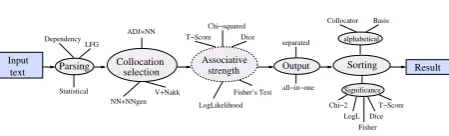
Input
Statistical
Associative strength Output
separated
all−in−one LFG
NN+NNgen
ADJ+NN Chi−squared T−Score Dice
Fisher’s Test LogLikelihood V+Nakk
Chi−2 LogL
Fisher T−Score Dice
Basis
Parsing text
Dependency
Collocation selection
alphabetical
Sorting Result
Significance Collocator
Figure 8: Possible points for user interaction
Finally, we have shown the need for and the usefulness of web services that can take more than one input. Future work will elaborate on the challenges mentioned here, be-sides the inclusion of additional tools, work towards full standards compatibility and more extensive experimenta-tion with web service-based linguistic processing chains.
Acknowledgements
We gratefully acknowledge the support of the BMBF for the D-SPIN project. We should also like to thank our col-leagues from Leipzig and Berlin for making their tools available for integration into WebLicht, and for discussing related issues with us. Special thanks to Helmut Schmid and Max Kisselew (IMS Stuttgart) for their helpful com-ments on components and procedures described in sections 3 and 4.
6.
References
Khurshid Ahmad, Andrea Davies, Heather Fulford, and Margaret Rogers. 1992. What is a term? the semi-automatic extraction of terms from text. In Mary Snell-Hornby, Franz P¨ochhacker, and Klaus Kaindl, editors,
Translation Studies - an interdiscipline.John Benjamins,
Amsterdam/Philadelphia.
Ulrich Ammon. 2001. Die Plurizentrizit¨at des Deutschen, oder: Wer sagt, was gutes Deutsch ist? In Kurt Egger and Franz Lanthaler, editors, Die deutsche Sprache in
S¨udtirol: Einheitssprache oder regionale Vielfalt, pages
11–26. Folio, Wien/Bozen.
Sabine Bartsch. 2004. Structural and functional properties of collocations in English. In A corpus study of
lexi-cal and pragmatic constraints on lexilexi-cal co-occurrence.
Narr, T¨ubingen.
Stefan Evert. 2005. The statistics of word cooccurrences:
word pairs and collocations. Ph.D. thesis, Universit¨at
Stuttgart.
Fabienne Fritzinger, Max Kisselew, Ulrich Heid, Andreas Madsack, and Helmut Schmid. 2009. Werkzeuge zur extraktion von signifikanten wortpaaren als web service.
In GSCL-Symposium Sprachtechnologie und
eHumani-ties, Technischer Bericht Nr.2009-01, Universit¨at
Duis-burg Essen, Duisburg.
Ulrich Heid, Helmut Schmid, Kerstin Eckart, and Erhard Hinrichs. 2010. A Corpus Representation Format for Linguistic Web Services: the D-SPIN Text Corpus For-mat and its Relationship with ISO Standards. In
Pro-ceedings of LREC 2010, Malta.
Erhard Hinrichs, Marie Hinrichs, Thomas Zastrow, Ger-hard Heyer, Volker Boehlke, Uwe Quasthoff, Helmut Schmid, Ulrich Heid, Fabienne Fritzinger, Alexander
Siebert, and J¨org Didakowski. 2009. Weblicht: Web-based LRT services for German. In Workshop on
lin-guistic processing pipelines, GSCL Jahrestagung 2009,
Potsdam.
Marie Hinrichs, Thomas Zastrow, and Erhard Hinrichs. 2010. WebLicht: Web-based LRT Services in a Dis-tributed eScience Infrastructure. In Proceedings of
LREC 2010, Malta.
Nancy Ide and Laurent Romary. 2004. International stan-dard for a linguistic annotation framework. Journal of
Natural Language Engineering, 10:3–4.
Kremena Ivanova, Ulrich Heid, Sabine Schulte im Walde, Adam Kilgarriff, and Jan Pomik´alek. 2008. Evaluating a German Sketch Grammar: A case study on noun phrase case. In Proceedings of the VIth International Confer-ence on Language Resources and Evaluation (LREC
2008), Marrakesh, Morocco. CD-ROM.
Manuel Kountz, Ulrich Heid, and Kerstin Eckart. 2008. A LAF/GrAF based encoding scheme for underspeci-fied representations of dependency structures. In Pro-ceedings of the VIth International Conference on
Lan-guage Resources and Evaluation (LREC 2008),
Mar-rakesh, Morocco. CD-ROM.
Leonard Richardson and Sam Ruby. 2007. RESTful Web
Services. O’Reilly.
Michael Schiehlen. 2003. A cascaded finite-state parser for German. InProceedings of the Research Note Sessions of the 10th Conference of the European Chapter of the
Association for Computational Linguistics (EACL’03),
Budapest, April.
Anne Schiller, Simone Teufel, Christine St¨ockert, and Christine Thielen. 1995. Vorl¨aufige Guidelines f¨ur das Tagging deutscher Textcorpora mit STTS. Technical report, Universit¨at Stuttgart, Institut f¨ur maschinelle Sprachverarbeitung, and Seminar f¨ur Sprachwis-senschaft, Universit¨at T¨ubingen.
Helmut Schmid. 2004. Efficient parsing of highly ambigu-ous context-free grammars with bit vectors. In Proceed-ings of the 20th International Conference on
Computa-tional Linguistics (COLING 2004), Geneva, Switzerland.