638
Compositional Hyponymy with Positive Operators
Martha Lewis
ILLC, University of Amsterdam [email protected]
Abstract
Language is used to describe concepts, and many of these concepts are hierarchical. Moreover, this hierarchy should be compati-ble with forming phrases and sentences. We use linear-algebraic methods that allow us to encode words as collections of vectors. The representations we use have an ordering, re-lated to subspace inclusion, which we interpret as modelling hierarchical information. The word representations built can be understood within a compositional distributional seman-tic framework, providing methods for compos-ing words to form phrase and sentence level representations. The resulting representations give competitive results on simple sentence-level entailment datasets.
1 Introduction
Distributional semantics (Harris, 1954; Firth, 1957) is effective and important within the area of computational modelling of language, partic-ularly as regards to synonymy and paraphrasing. Within the field, at least two additional properties are desirable. Firstly, we would like a method by which we can compose vectors to form rep-resentations above the word level. Secondly, we would like a notion of lexical entailment, or hy-ponymy, with which we can capture a sense of the generality of concepts, and the notion of one concept being an instance of another. Further-more, we would like these two properties to inter-act nicely with one another, so that the hyponymy relation is not lost when words are composed. In Bankova et al. (2019) the authors provide the-ory describing a notion of hyponymy that inter-acts well with compositionality, but do not pro-vide experimental support. InBalkır et al.(2016) the authors suggest a measure of hyponymy based on entropy which also interacts well with compo-sitionality and provide experimental support. A
compositional version of the distributional inclu-sion hypothesis (DIH) (Geffet and Dagan, 2005) is examined inKartsaklis and Sadrzadeh (2016). In the current paper, we use the framework of Bankova et al.(2019) to build positive operators that represent words. The operators are built us-ing GloVe vectors (Pennington et al., 2014) and information about hyponym-hypernym relation-ships, which may be sourced either from human-curated resources like WordNet (Miller,1995), or unsupervised sources, via the use of pattern-based methods. We give two new measures for graded hyponymy that provide a wider range of compar-isons than the entropy-derived measure developed in Balkır et al. (2016) or the eigenvalue-related measure ofBankova et al.(2019).
We test our word representations and measures on a range of datasets. Three of the datasets are single-word entailment and have been de-signed to test directionality (BLESS) (Baroni and Lenci,2011), detection (WBLESS) (Weeds et al., 2014), and both directionality and direction to-gether (BIBLESS) (Kiela et al., 2015). We also test our models on the compositional dataset of Kartsaklis and Sadrzadeh (2016). This dataset provides a test for entailment at the phrase and sentence level. We find that our model performs fairly well on BLESS and its variants, and very well on the compositional dataset.
2 Background and Related Work
network methods, as seen inSocher et al.(2013); Bowman et al.(2014), simpler element-wise com-bination methods (Mitchell and Lapata, 2010), and tensor-based methods (Baroni and Zampar-elli, 2010; Coecke et al., 2010; Paperno et al., 2014). Tensor-based methods operate by mod-elling words of different grammatical types in dif-ferent vector spaces, and viewing relational words such as verbs and adjectives as linear maps that operate on their arguments. This allows methods from formal semantics to be more easily mapped onto vector space representations, and thereby gives us mechanisms for composing words, in line with their grammatical types, to form phrases and sentences.
We use an extension of the tensor-based ap-proach, based on the methods given in Piedeleu et al. (2015);Bankova et al. (2019); Balkır et al. (2016). We represent nouns aspositive operators, which can be considered as representing collec-tions of vectors. Functional words like adjectives and verbs are now represented ascompletely posi-tive maps, i.e. linear maps which preserve the pos-itivity of their arguments. These can be thought of as linear maps which take valid collections of vec-tors to valid collections of vecvec-tors.
2.1 Related Work
Entailment is an important and thriving area of research within distributional semantics. The PASCAL Recognising Textual Entailment Chal-lenge (Dagan et al., 2006) has attracted a large number of researchers in the area and generated a number of approaches. Previous lines of research on entailment for distributional semantics investi-gate the development of directed similarity mea-sures which can characterize entailment (Weeds et al., 2004; Kotlerman et al., 2010; Lenci and Benotto, 2012). Geffet and Dagan (2005) intro-duce a pair ofdistributional inclusion hypotheses, where if a word v entails another word w, then all the typical features of the wordvwill also oc-cur with the wordw. Conversely, if all the typi-cal features ofv also occur withw,v is expected to entailw. Clarke(2009) defines a vector lattice for word vectors, and a notion of graded entail-ment with the properties of a conditional proba-bility. Rimell (2014) explores the limitations of the distributional inclusion hypothesis by exam-ining the properties of those features that are not shared between words. An interesting approach
inKiela et al.(2015) is to incorporate other modes of input into the representation of a word. Mea-sures of entailment are based on the dispersion of a word representation, together with a similarity measure. All of these look at entailment at the word level. Related to the current work are the ideas inBalkır(2014);Balkır et al.(2016). In this work, the authors develop a graded form of en-tailment based on von Neumann entropy and with links to the distributional inclusion hypotheses de-veloped by Geffet and Dagan (2005). The au-thors show how entailment at the word level car-ries through to entailment at the sentence level.
More recent approaches involve specialising word vectors for entailment Vuli´c and Mrkˇsi´c (2018), using non-Euclidean geometries Nickel and Kiela (2017);Nguyen et al.(2017);Le et al. (2019), and using pattern-based hyponymy extrac-tionRoller et al.(2018);Le et al.(2019).
Most approaches, however, provide only word-word hyponymy. To test hyponymy in a composi-tional setting, we refer to the dataset ofKartsaklis and Sadrzadeh(2016) where a number of sentence and phrase-level hyponymy relationships are built from WordNet (Miller,1995)
Another approach to detecting lexical entail-ment is via the identification of certain text pat-terns which indicate a hyponym-hypernym rela-tionship. Examples are:y such as x,x is a type of y, which allow us to pick out pairs(x, y)which stand in the relationxis-ay. This approach was first outlined in Hearst (1992) and has been recently used inRoller et al.(2018) to build vectors able to encode the required hierarchical relationships.
3 Methods
We model words as collections of vectors, as fol-lows. For a given vector~v∈V,1we can ‘lift’ this vector into the larger spaceV ⊗V, by taking the outer product of the vector with itself. We use the following notation:
¯
v:=~v~v> (1)
When~v is a unit vector, the resulting matrix ¯vis a projection operator. Multiplying another vector ~
x by v¯projects ~x onto the one-dimensional sub-space spanned by~v. A matrix of the formv¯can be thought of as a collection of just one vector, giving sharp, unambiguous information.
To represent collections of more than one vec-tor, we sum together their matrix representations, resulting in another matrix:
{~v, ~w, ~x} 7→¯v+ ¯w+ ¯x∈V ⊗V
=~v~v>+w ~~w>+~x~x>∈V ⊗V
Matrices M built in this way are called positive operatorsand have the following two properties:
• ∀v∈V.h~v, M~vi ≥0
• Mis self-adjoint.
If we additionally impose thatMhas trace 1, then we can understand M as encoding a probability distribution over ~v ∈ V (Nielsen and Chuang, 2010). In the present work, we do not impose this condition, instead viewingM as representing a collection of vectors.
The eigenvectors and eigenvalues of M can be thought of as providing a summary of the infor-mation contained in M. A matrix of the form ¯
v =~v~v> will have one non-zero eigenvalue, cor-responding to the normalized eigenvector~v/||~v||. When multiple vectors have been included in the collection, the matrixM will have more than one non-zero eigenvalue, and these will represent the weights for their corresponding eigenvectors.
We take a kind of extensional stance. We con-sider words to be modelled as collections of their instances. To model a noun, we can consider the collection of nouns that are hyponyms of that noun, and form the matrix representation corre-sponding to that collection.
1Throughout the paper, we assume that vector spaces are
Rn
Example 1(Nouns). Consider the noun pet, and suppose we have three types of pet: a pug, a gold-fish, and a tabby cat. We give these values in a distributional space spanned by the basis vectors
{−−→furry,−−−−−→domestic,−−−−−→working,−−−−→aquatic}as follows:
pug goldfish tabby
furry 3 0 5
domestic 4 5 5 working 0 0 0 aquatic 0 6 0
We form the representation of the noun pet by summing over the matrix representations of each vector:
JpetK=pug+goldfish+tabby
=−→pug−→pug>+−−→gfish−−→gfish>+−−−→tabby−−−→tabby>
=
34 37 0 0
37 66 0 30
0 0 0 0
0 30 0 36
Each of the matrices pug, goldfish, and tabby has just one non-zero eigenvalue, which is||−→v||, and corresponds to the normalised eigenvector
−
→v /||−→v||, for −→v = −→pug, −−−−→goldfish, and −−−→tabby
re-spectively.
The matrix JpetK, however, has three non-zero eigenvalues of 100.52, 35.21, and 0.25, each cor-responding to a combination of the basis vectors
−−→
furry,−−−−−→domestic,−−−−→aquatic. The basis vector−working−−−−→ has an eigenvalue of 0, indicating thatJpetKis or-thogonal to the vector−working−−−−→.
3.1 Ordering Positive Operators
The set of positive operators on a vector space has an ordering introduced by L¨owner (1934). For positive operatorsAandB, we define:
AvB ⇐⇒ B−Ais positive
InBankova et al.(2019) the authors introduce a notion of graded hyponymy. The hyponymy rela-tion may be true up to some error term, as follows. IfAvB, thenB−A=D, whereDis some pos-itive operator. If this does not hold, it is possible to add in some error termEso thatAvB+E. This is viewed as saying thatAentailsB to the extent E. We wish to find the smallest such error term.
sists of a set of word pairsP ={(xi, yi)}iwhich
are in a hyponym-hypernym relationship, together with the count w(x, y) of the number of times that relationship has been seen in the text. As de-scribed in Le et al.(2019), the relationships thus extracted are both noisy and sparse, containing cycles and inconsistencies. As one example of this, the dataset contains the pair (rome,european country). To mitigate these phenomena, we apply a ppmi weighting to the counts. The weighting is as described inRoller et al.(2018), specifically
ppmi(x, y) = max
0,log p(x, y)
p−(x)p+(y)
,
where, lettingW =P
(x,y)∈P, we have:
p(x, y) =w(x, y)/W
p−(x) = X (x,y)∈P
w(x, y)/W
p+(x) = X (y,x)∈P
w(y, x)/W
These equations give, respectively, the probability that the pair (x, y) is chosen fromP, the proba-bility thatxappears as a hyponym, and the proba-bility thatx appears as a hypernym. This sets the weighting of various unwanted pairs, such as the aforementioned (rome,european country), to 0.
To collect the set of hyponyms of a noun, we use only those hyponyms with a non-zero ppmi weighting, and take one transitive step. So the set of hyponyms of a given word x is the union of the sets {yi|ppmi(x, yi) > 0}i and
{zij|ppmi(yi, zij) > 0}ij. We limit to one
tran-sitive step to again mitigate the noisiness of the dataset.
4.2 Verbs
WordNet contains verb hyponymy relationships, and therefore we can use similar methods to ex-tract lists of hyponyms. However, we cannot use Hearst patterns to collate verb hyponymy relation-ships. As a proxy, we represent verbs as col-lections of their arguments. The intuition behind this is that of the extensional approach in formal semantics, mapped to distributional semantics in Grefenstette and Sadrzadeh(2011). We can think of both nouns and verbs as predicates, and con-sider the instances that the predicate applies to.
To collect the arguments of the verbs, we use the concatenation of the dependency parsed ukWaC
and WaCky corpora (Ferraresi et al., 2008), and collect those arguments that appear at least 300 times in the corpus.
4.3 Building Matrices
Finally, having collected instances of nouns and verbs, we take the vectors −→wi corresponding to
each of these instances, take the outer product of each with itself, and add these together, i.e.:
JwK= X
i
− →w
i−→w>i ∈W ⊗W (10)
We have discarded weighting information. Words which have more instances are both more widely dispersed in terms of their eigenvalues, and also larger in terms of their matrix norm.
4.4 Datasets
We evaluate single word representations on the non-compositional BLESS hyponymy subset ( Ba-roni and Lenci, 2011), WBLESS (Weeds et al., 2014), and BIBLESS (Kiela et al.,2015) datasets. We test our models using the hypernymy suite pro-vided byRoller et al.(2018). The BLESS dataset requires the model to infer the direction of a hy-pernym pair. All pairs in the model are indeed in the hyponym-hypernym relationship, and the model must identify that this is the case. WB-LESS consists of a set of pairs which may be in the hyponym-hypernym relationship, or unrelated. Each pair is assigned a value of 1 or 0 based on whether or not there is a hyponymy relationship. The software provided performs 1000 random it-erations in which 2% of the data is used as a val-idation set to learn a classification threshold, and tests on the remainder of the data. Average ac-curacy across all iterations is reported. The BIB-LESS dataset assigns values of 1, 0, and -1 based on whether the first word is a hyponym of the sec-ond, whether there is no relationship, or whether the second is a hyponym of the first. The soft-ware firstly tunes a threshold using 2% of the data, identifying whether a pair exhibits hypernymy in either direction. Secondly, the relative comparison of scores determines which direction is predicted. Again, the average accuracy over 1000 iterations is reported.
paired sentences consisting of a subject and a verb. In half the cases the first sentence entails the sec-ond, and in the other half of cases, the order of the sentences is reversed. For example, we have:
summer finish, season end, T
season end, summer finish, F
The first sentence is marked as entailing, whereas the second is marked as not entailing. The dataset is created by selecting nouns and verbs from WordNet that stand in the correct relationship.
To test our models, we build the basic word representations as in equation (10). We then use the compositional methods outlined in section3.2 to create the sentence representations. We calcu-late the graded entailment value between the com-posed sentence representations, and in results re-port area under ROC curve for comparison with previous literature. In particular, we compare with the best model from Kartsaklis and Sadrzadeh (2016), which uses a metric based on the distribu-tional inclusion hypothesis, together with a tensor-based compositional model.
4.5 Significance Testing
To test significance of our results, we use boot-strappingEfron(1979) to calculate 100 values of the test statistic (either accuracy or AUC) drawn from the distribution implied by the data. We com-pare with figures from the literature using a one-sample t-test, and compare between models using a paired t-test. We apply the Bonferroni correction to compensate for multiple model comparisons.
5 Results
5.1 BLESS Variants
We present results on variants of the BLESS dataset in terms of accuracy, for comparison with other models, presented in table 2. Our best per-foming model is the WordNet based model with metric kE. Althoough this model does not
out-perform the best supervised model (the differences in score are significant), the differences are fairly minimal (0.01 accuracy). Our methods (and those of others) outperform the symbolic baseline for the BLESS dataset. Our WordNet-based model does outperform the earlier model HyperVec with sig-nificance. Hearst-pattern based representations do not perform so strongly.
Table 2: Accuracy on the variants of the BLESS dataset. HyperVec figures are from Nguyen et al.
(2017), Hearst from Roller et al.(2018), HypeCones fromLe et al. (2019), LEAR fromVuli´c and Mrkˇsi´c
(2018). Entries tagged with WN use WordNet.
Model BLESS WBLESS BIBLESS
HyperVec - WN 0.92 0.87 0.81
Hearst 0.96 0.87 0.85
HypeCones 0.94 0.90 0.87
LEAR - WN 0.96 0.92 0.88
Symb - WN 0.91 0.93 0.91
kBA- WN 0.95 0.88 0.84 kE- WN 0.95 0.91 0.87
kBA- Hearst 0.91 0.84 0.76
kE- Hearst 0.91 0.86 0.80
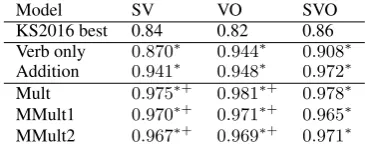
Table 3: Area under ROC curve on the KS2016 datasets usingkEand WordNet derived hyponyms. For the SV
and VO datasets, MMult1 refers to the model described in equation (5) and MMult2 refers to the model de-scribed in equation (6). For SVO, MMult1 refers to the model described in equation (8) and MMult2 refers to the model described in equation (9).∗indicates statisti-cally significantly higher than the previous best perfor-manceKartsaklis and Sadrzadeh(2016). +indicates significantly higher than the additive baseline.
Model SV VO SVO
KS2016 best 0.84 0.82 0.86 Verb only 0.870∗ 0.944∗ 0.908∗ Addition 0.941∗ 0.948∗ 0.972∗ Mult 0.975∗+ 0.981∗+ 0.978∗ MMult1 0.970∗+ 0.971∗+ 0.965∗ MMult2 0.967∗+ 0.969∗+ 0.971∗
Table 4: Area under ROC curve on the KS2016 datasets, usingkBAand WordNet derived hyponyms.
Refer to Table3for explanations.
Model SV VO SVO
KS2016 best 0.84 0.82 0.86 Verb only 0.902∗ 0.967∗ 0.931∗ Addition 0.970∗ 0.964∗ 0.978∗ Mult 0.974∗ 0.984∗+ 0.982∗ MMult1 0.987∗+ 0.985∗+ 0.995∗+
MMult2 0.987∗+ 0.985∗+ 0.995∗+
Table 5: Area under ROC curve on the KS2016 datasets, using kE and Hearst-pattern derived
hy-ponyms. Refer to Table3for explanations.
Model SV VO SVO
Table 6: Area under ROC curve on the KS2016 datasets, usingkBAHearst-pattern derived hyponyms.
Refer to Table3for explanations.
Model SV VO SVO
KS2016 best 0.84 0.82 0.86 Verb only 0.719 0.819 0.716 Addition 0.880∗ 0.811 0.909∗ Mult 0.867∗ 0.792 0.843 MMult1 0.909∗+ 0.842∗+ 0.930∗+ MMult2 0.904∗+ 0.830∗+ 0.924∗+
5.2 Compositional Datasets
On the KS2016 compositional datasets results are reported in terms of area under ROC curve. Our measures perform particularly well with WordNet derived hypernyms (Tables3and4). This is likely to be due to the fact that both the dataset and our word representations were constructed from WordNet, and hence the high performance is to be expected. More interestingly, the word represen-tations built using unsupervised methods also out-perform previous best scores on this dataset, (ta-bles5and6), based on a form of the distributional inclusion hypothesis for tensor-based composition (Kartsaklis and Sadrzadeh,2016), despite not per-forming so strongly on the single-word datasets.
6 Discussion and Further Work
We have suggested a mechanism for building the positive operators needed for the theory presented inBankova et al.(2019), together with two novel measures of graded hyponymy. We tested these representations and measures on a number of well-known datasets, looking at similarity at the word level, hyponymy at the word level and one of which gives hyponymy at the phrase and sen-tence level. The representations and the mea-sures we have developed perform competitively on these datasets. We have used both human-curated information and unsupervised methods to build the word representations. Unsurprisingly, human-curated information gives better performance.
A nice comparison is with the symbolic model. The fact that our WordNet-based models outper-form this baseline shows that the models we pro-pose can provide a ‘smoothed’ representation that allows hyponymy relationships to be inferred. For example, one of the hyponymy relationships not picked up in WordNet is (oven, device). How-ever, there are a number of other instances such as (electric appliance, device)that are similar enough to oventhat devicecan be understood as
includ-ingoven. What cannot be remedied, however, is where a term has no hyponyms in WordNet. For example,herbivorehas no hyponyms in WordNet. This means that the WordNet-based tions have no way of forming a wide representa-tion ofherbivorethatincludes any of its instances. As well as performing well on single-word hy-ponymy datasets, the representations we build sit within a compositional framework that allows us to form phrases and sentences and to reason about their entailment relationships. The WordNet-based representations behaved particularly well on this dataset, due to the fact that the dataset is built from WordNet. However, it is still an interesting set of results in that our graded measures interact well with the compositional methods we have pro-posed. Note that the measures we propose result in high baseline values to beat - i.e. for the verb-only and addition models. Again, this is likely due to the construction of the dataset. The dataset is formed from upwardly-monotone contexts, so computing entailment based only on the verb will still perform extremely well. Again, although this is due to the construction of the dataset, is is inter-esting to note that the measures and word repre-sentations we developed can model this structure so well. Furthermore the Hearst-pattern derived representations also outperformed previous work, indicating that these representations interact nicely with compositionality.
Similarities to our approach can be found in the notion of words being represented as Gaussians (Jameel and Schockaert,2017;Vilnis and McCal-lum,2014). The positive operators we build have the same structure as covariance matrices and, if appropriately normalized, are interpreted as rep-resenting a probability distribution over vectors. Representing words as Gaussians does not come with a given mechanism for composing words as we do. Exploring these connections is an area of further work.
Finally, a crucial extension to this whole ap-proach is to be able to model hyponymy, compo-sition, and their interaction in more contexts, for example using the natural logic introduced in Bar-wise and Cooper(1981).
Acknowledgements
References
Esma Balkır. 2014. Using density matrices in a compo-sitional distributional model of meaning. Master’s thesis, University of Oxford.
Esma Balkır, Mehrnoosh Sadrzadeh, and Bob Coecke. 2016. Distributional sentence entailment using den-sity matrices. In Topics in Theoretical Computer Science, pages 1–22. Springer.
Dea Bankova, Bob Coecke, Martha Lewis, and Dan Marsden. 2019. Graded hyponymy for composi-tional distribucomposi-tional semantics. Journal of Language Modelling, 6(2):225–260.
Marco Baroni and Alessandro Lenci. 2011. How we blessed distributional semantic evaluation. In Pro-ceedings of the GEMS 2011 Workshop on
GEomet-rical Models of Natural Language Semantics, pages
1–10. Association for Computational Linguistics.
Marco Baroni and Roberto Zamparelli. 2010. Nouns are vectors, adjectives are matrices: Representing adjective-noun constructions in semantic space. In
Proceedings of the 2010 Conference on Empirical
Methods in Natural Language Processing, pages
1183–1193. Association for Computational Linguis-tics.
Jon Barwise and Robin Cooper. 1981. Generalized quantifiers and natural language. InPhilosophy, lan-guage, and artificial intelligence, pages 241–301. Springer.
Piotr Bojanowski, Edouard Grave, Armand Joulin, and Tomas Mikolov. 2017. Enriching word vectors with subword information. Transactions of the Associa-tion for ComputaAssocia-tional Linguistics, 5:135–146.
Samuel R Bowman, Christopher Potts, and Christo-pher D Manning. 2014. Recursive neural net-works can learn logical semantics. arXiv preprint arXiv:1406.1827.
Elia Bruni, Gemma Boleda, Marco Baroni, and Nam-Khanh Tran. 2012. Distributional semantics in tech-nicolor. In Proceedings of the 50th Annual Meet-ing of the Association for Computational LMeet-inguis-
Linguis-tics: Long Papers-Volume 1, pages 136–145.
Asso-ciation for Computational Linguistics.
Daoud Clarke. 2009. Context-theoretic semantics for natural language: an overview. In Proceedings of the Workshop on Geometrical Models of Natural
Language Semantics, pages 112–119. ACL.
Bob Coecke, Mehrnoosh Sadrzadeh, and Stephen Clark. 2010. Mathematical foundations for a compositional distributional model of meaning.
arXiv:1003.4394.
Ido Dagan, Oren Glickman, and Bernardo Magnini. 2006. The PASCAL recognising textual entailment challenge. In Machine learning challenges. evalu-ating predictive uncertainty, visual object classifica-tion, and recognising tectual entailment, pages 177– 190. Springer.
B. Efron. 1979. Bootstrap methods: Another look at the jackknife.Ann. Statist., 7(1):1–26.
Manaal Faruqui and Chris Dyer. 2014. Community evaluation and exchange of word vectors at word-vectors.org. In Proc. of ACL: System Demonstra-tions.
Adriano Ferraresi, Eros Zanchetta, Marco Baroni, and Silvia Bernardini. 2008. Introducing and evaluating ukwac, a very large web-derived corpus of english.
InProceedings of the 4th Web as Corpus Workshop
(WAC-4) Can we beat Google, pages 47–54.
Lev Finkelstein, Evgeniy Gabrilovich, Yossi Matias, Ehud Rivlin, Zach Solan, Gadi Wolfman, and Ey-tan Ruppin. 2002. Placing search in context: The concept revisited. ACM Transactions on informa-tion systems, 20(1):116–131.
John R Firth. 1957. A synopsis of linguistic theory, 1930-1955. Studies in linguistic analysis.
Maayan Geffet and Ido Dagan. 2005. The distribu-tional inclusion hypotheses and lexical entailment.
InProceedings of the 43rd Annual Meeting on ACL,
pages 107–114. ACL.
Daniela Gerz, Ivan Vuli´c, Felix Hill, Roi Reichart, and Anna Korhonen. 2016. SimVerb-3500: A Large-Scale Evaluation Set of Verb Similarity. InEMNLP.
Edward Grefenstette and Mehrnoosh Sadrzadeh. 2011. Experimental support for a categorical composi-tional distribucomposi-tional model of meaning. In Proceed-ings of the Conference on Empirical Methods in
Natural Language Processing, EMNLP ’11, pages
1394–1404, Stroudsburg, PA, USA. ACL.
Zellig S Harris. 1954. Distributional structure. Word, 10(2-3):146–162.
Marti A Hearst. 1992. Automatic acquisition of hy-ponyms from large text corpora. InProceedings of the 14th conference on Computational
linguistics-Volume 2, pages 539–545. Association for
Compu-tational Linguistics.
Felix Hill, Roi Reichart, and Anna Korhonen. 2015. Simlex-999: Evaluating semantic models with (gen-uine) similarity estimation. Computational Linguis-tics, 41(4):665–695.
Shoaib Jameel and Steven Schockaert. 2017. Model-ing context words as regions: An ordinal regression approach to word embedding. In Proceedings of the 21st Conference on Computational Natural
Lan-guage Learning (CoNLL 2017), pages 123–133.
Dimitri Kartsaklis, Mehrnoosh Sadrzadeh, and Stephen Pulman. 2012. A unified sentence space for categor-ical distributional-compositional semantics: Theory and experiments. In In Proceedings of COLING: Posters, pages 549–558.
Douwe Kiela, Laura Rimell, Ivan Vulic, and Stephen Clark. 2015. Exploiting image generality for lexi-cal entailment detection. InProceedings of the 53rd
Annual Meeting of the ACL. ACL.
Lili Kotlerman, Ido Dagan, Idan Szpektor, and Maayan Zhitomirsky-Geffet. 2010. Directional distribu-tional similarity for lexical inference. Natural
Lan-guage Engineering, 16(04):359–389.
Matt Le, Stephen Roller, Laetitia Papaxanthos, Douwe Kiela, and Maximilian Nickel. 2019. Inferring con-cept hierarchies from text corpora via hyperbolic embeddings. arXiv preprint arXiv:1902.00913.
Alessandro Lenci and Giulia Benotto. 2012. Identify-ing hypernyms in distributional semantic spaces. In
Proceedings of the First Joint Conference on Lexical
and Computational Semantics, pages 75–79. ACL.
Karl L¨owner. 1934. ¨Uber monotone Matrixfunktionen.
Mathematische Zeitschrift, 38(1):177–216.
George A. Miller. 1995. Wordnet: A lexical database for english.Commun. ACM, 38(11):39–41.
George A Miller and Walter G Charles. 1991. Contex-tual correlates of semantic similarity. Language and cognitive processes, 6(1):1–28.
Jeff Mitchell and Mirella Lapata. 2010. Composition in distributional models of semantics. Cognitive sci-ence, 34(8):1388–1429.
Kim Anh Nguyen, Maximilian K¨oper, Sabine Schulte im Walde, and Ngoc Thang Vu. 2017. Hierarchi-cal embeddings for hypernymy detection and direc-tionality. InProceedings of the 2017 Conference on Empirical Methods in Natural Language Process-ing, pages 233–243.
Maximillian Nickel and Douwe Kiela. 2017. Poincar´e embeddings for learning hierarchical representa-tions. InAdvances in neural information processing systems, pages 6338–6347.
Michael A Nielsen and Isaac L Chuang. 2010.
Quan-tum Computation and QuanQuan-tum Information.
Cam-bridge University Press.
Denis Paperno, Marco Baroni, et al. 2014. A prac-tical and linguisprac-tically-motivated approach to com-positional distributional semantics. InProceedings of the 52nd Annual Meeting of the Association for Computational Linguistics (Volume 1: Long Pa-pers), volume 1, pages 90–99.
Jeffrey Pennington, Richard Socher, and Christo-pher D. Manning. 2014. Glove: Global vectors for word representation. InEmpirical Methods in
Nat-ural Language Processing (EMNLP), pages 1532–
1543.
Robin Piedeleu. 2014. Ambiguity in categorical mod-els of meaning. Master’s thesis, University of Ox-ford.
Robin Piedeleu, Dimitri Kartsaklis, Bob Coecke, and Mehrnoosh Sadrzadeh. 2015. Open system categor-ical quantum semantics in natural language process-ing.arXiv:1502.00831.
Laura Rimell. 2014. Distributional lexical entailment by topic coherence. InProceedings of the 14th Con-ference of the European Chapter of the Association for Computational Linguistics, pages 511–519.
Stephen Roller, Douwe Kiela, and Maximilian Nickel. 2018. Hearst patterns revisited: Automatic hy-pernym detection from large text corpora. arXiv preprint arXiv:1806.03191.
Herbert Rubenstein and John B Goodenough. 1965. Contextual correlates of synonymy. Communica-tions of the ACM, 8(10):627–633.
Richard Socher, Alex Perelygin, Jean Wu, Jason Chuang, Christopher D Manning, Andrew Ng, and Christopher Potts. 2013. Recursive deep models for semantic compositionality over a sentiment tree-bank. In Proceedings of the 2013 conference on
empirical methods in natural language processing,
pages 1631–1642.
Luke Vilnis and Andrew McCallum. 2014. Word rep-resentations via gaussian embedding.arXiv preprint arXiv:1412.6623.
Ivan Vuli´c and Nikola Mrkˇsi´c. 2018. Specialising word vectors for lexical entailment. InProceedings of the 2018 Conference of the North American Chapter of the Association for Computational Linguistics: Hu-man Language Technologies, Volume 1 (Long Pa-pers), volume 1, pages 1134–1145.
Julie Weeds, Daoud Clarke, Jeremy Reffin, David Weir, and Bill Keller. 2014. Learning to distinguish hyper-nyms and co-hypohyper-nyms. In Proceedings of COL-ING 2014, the 25th International Conference on Computational Linguistics: Technical Papers, pages 2249–2259. Dublin City University and Association for Computational Linguistics.
Julie Weeds, David Weir, and Diana McCarthy. 2004. Characterising measures of lexical distributional similarity. In Proceedings of the 20th
interna-tional conference on Computainterna-tional Linguistics,
page 1015. ACL.