52
Supervised Morphological Segmentation Using Rich Annotated Lexicon
Ebrahim Ansari,†‡ Zdenˇek ˇZabokrtsk´y,†
Mohammad Mahmoudi,‡Hamid Haghdoost‡and Jon´aˇs Vidra† †
Institute of Formal and Applied Linguistics, Faculty of Mathematics and Physics, Charles University ‡
Department of Computer Science and Information Technology, Institute for Advanced Studies in Basic Sciences
{ansari,m.mahmodi,hamid.h}@iasbs.ac.ir
{zabokrtsky,vidra}@ufal.mff.cuni.cz
Abstract
Morphological segmentation of words is the process of dividing a word into smaller units called morphemes; it is tricky es-pecially when a morphologically rich or polysynthetic language is under question. In this work, we designed and evaluated several Recurrent Neural Network (RNN) based models as well as various other ma-chine learning based approaches for the morphological segmentation task. We trained our models using annotated seg-mentation lexicons. To evaluate the effect of the training data size on our models, we decided to create a large hand-annotated morphologically segmented corpus of Per-sian words, which is, to the best of our knowledge, the first and the only seg-mentation lexicon for the Persian lan-guage. In the experimental phase, using the hand-annotated Persian lexicon and two smaller similar lexicons for Czech and Finnish languages, we evaluated the effect of the training data size, different hyper-parameters settings as well as different RNN-based models.
1 Introduction
Morphological analysis must be tackled somehow in all natural language processing tasks, such as machine translation, speech recognition, and in-formation retrieval. Morphological segmentation of words is the process of dividing a word into smaller units called morphemes. Morphological segmentation task is harder for those languages which are morphologically rich and complex like Persian, Arabic, Czech, Finnish or Turkish, espe-cially when there are not enough annotated data
for those languages. In this paper, we designed and evaluated various supervised setups to per-form morphological segmentation using a hand-annotated segmented lexicon for training.
The efficiency of supervised approaches (espe-cially of deep neural network models) is naturally highly dependent on the size of training data. In order to evaluate the effect of the training data size on our segmentation models, we created a rich Persian hand-annotated segmentation lexicon, which is, as far as we know, the first and the only such computer-readable dataset for Persian. Per-sian (Farsi) is one of the languages of the Indo-European language family within the Indo-Iranian branch and is spoken in Iran, Afghanistan, Tajik-istan and some other regions related to ancient Persian. In addition, we evaluated our models on Czech and Finnish, however, the amount of anno-tated data for them is substantially lower.
Automatic morphological segmentation was firstly introduced by Harris (1970). More re-cent research on morphological segmentation has been usually focused on unsupervised learning (Goldsmith,2001;Creutz and Lagus,2002;Poon et al., 2009; Narasimhan et al., 2015; Cao and Rei, 2016), whose goal is to find the segmenta-tion boundaries using an unlabeled set of word forms (or possibly a corpus too). Probably the most popular unsupervised systems are LINGUIS-TICA (Goldsmith,2001) and MORFESSOR, with a number of variants (Creutz and Lagus, 2002;
Creutz et al., 2007; Gr¨onroos et al., 2014). An-other version of the latter which includes a semi-supervised extension was introduced by (Kohonen et al.,2010). Poon et al.(2009) presented a log-linear model which uses overlapping features for unsupervised morphological segmentation.
segmented training data is available, then the en-tirely unsupervised systems tend not to be com-petitive. Furthermore, unsupervised segmenta-tion still has considerable weaknesses, including over-segmentation of roots and erroneous segmen-tation of affixes (Wang et al., 2016). To deal with those limitations, recent works show a grow-ing interest in semi-supervised and supervised approaches (Kohonen et al., 2010; Ruokolainen et al., 2013, 2014; Sirts and Goldwater, 2013;
Wang et al.,2016;Kann and Sch¨utze,2016;Kann et al.,2018;Cotterell and Sch¨utze,2017;Gr¨onroos et al.,2019) which employ annotated morpheme boundaries in the training phase.
In our work we designed and evaluated various machine learning models and trained them using only the annotated lexicon in a supervised manner. Our models do not leverage the unannotated data nor context information and only use the primary hand-annotated segmentation lexicons.
Experimental results show that our Bi-LSTM model perform slightly better than other models in boundary prediction for our hand-segmented Per-sian lexicon, while KNN (K-Nearest Neighbors al-gorithm) performs better when the whole word ac-curacy is under question.
The paper is organized as follows: Section 2
addresses the related work on morphological seg-mentation. Section 3 describes the methodology and machine learning models used in this work. Section4introduces our hand-segmented Persian lexicon as well as related preprocessing phases. Section 5 presents the experiment results com-pared to some other baseline systems and finally Section6concludes the paper.
2 Related Work
Supervised morphological segmentation, i.e. us-ing a lexicon (or a corpus) with annotated mor-pheme boundaries in the training phase, has at-tracted increasing attention in recent years. One of the most recent successful research directions on supervised morphological segmentation is the work of (Ruokolainen et al., 2013), whose au-thors employ CRF (Conditional Random Fields), a popular discriminative log-linear model to predict morpheme boundaries given their local sub-string contexts instead of learning a morpheme lexicon. (Ruokolainen et al., 2014) extended their work to semi-supervised learning version by exploiting some available unsupervised segmentation
tech-niques into their CRF-based model via a feature set augmentation. (Ruokolainen et al.,2014)
Long Short Term Memory (LSTM) networks (Hochreiter and Schmidhuber,1997) have recently achieved great success in sequence learning tasks, including outstanding results on sequential tasks such as machine translation (Sutskever et al.,
2014). Wang et al. (2016) proposed three types of window-based LSTM neural network models named Window LSTM, Multi-window LSTMs and Bidirectional Multi-Window LSTMs, in or-der to automatically learn sequence structures and predict morphological segmentations of words in a raw text. They used only word boundary informa-tion without any need for extra feature engineer-ing in the trainengineer-ing phase. The authors compared their models with selected supervised models as well as with an LSTM architecture (Wang et al.,
2016), and similarly to the work ofRuokolainen et al. (2013), their architecture is based on the whole text and context information instead of us-ing only the lexicon.Cotterell and Sch¨utze(2017) increased the segmentation accuracy by employ-ing semantic coherence information in their mod-els. They used RNN (Recurrent Neural Network) to design a composition model. They also found that using RNN with dependency vector has the best results on vector approximation (Cotterell and Sch¨utze,2017).
bet-ter than other strong baselines for polysynthetic languages in a minimal-resource setting. Their suggested neural seq2seq models constitute the state of the art for morphological segmentation in high-resource settings and for (mostly) European languages (Kann et al.,2018).
The main studied language in our work is Per-sian, which belongs to morphologically rich lan-guages and which is powerful and versatile in word building. Having many affixes to form new words (over a hundred), and the ability to build af-fixes and especially preaf-fixes from nouns, the Per-sian language is considered as an agglutinative language since it also frequently uses derivational agglutination to form new words from nouns, ad-jectives, and verbal stems. Hesabi(1988) claimed that Persian can derive more than 226 million words (Hesabi,1988).
To the best of our knowledge, the research on morphology of the Persian language is very limited. Rasooli et al. (2013) claimed that per-forming morphological segmentation in the pre-processing phase of statistical machine transla-tion could improve the quality of translatransla-tions for morphology rich and complex languages. Al-though they segmented very low portion of Per-sian words (only some PerPer-sian verbs), the qual-ity of their machine translation system increases by 1.9 points of BLEU score. Arabsorkhi and Shamsfard(2006) proposed a Minimum Descrip-tion Length (MDL) based algorithm with some improvements for discovering the morphemes of Persian language through automatic analysis of corpora.
3 Our Machine Learning Models
In this work we decided to evaluate selected ma-chine learning models including those feature-based machine learning approaches in which the task of word segmentation is reformulated as a classification task, as well as various deep-learning (DL for short) neural network models.
Because of huge number of learned parame-ters in DL, having enough training data is critical. The fact that we decided to create a large hand-annotated dataset for Persian allows evaluating the effect of the training data size on a relatively wide scale, as described in Section4.
We convert all segmentations into a simple string format in which letters “B” and “L” en-code the presence of the boundary letter and
the continuation letter, respectively. For exam-ple for word “goes”, the encoded segmentation is “LLBL”, which shows that there is a segmen-tation boundary in front of the third letter (“e”). While in our model we consider only morpholog-ically segmented lexicon and we do not employ any other information like corpus contexts or lists of unannotated words, this encoding is sufficient and make the specification of boundary location easy.
In the case of presence of a semi-space let-ter (a feature specific for the Persian written lan-guage), the semi-space letter is always considered as a boundary letter. An experiments focused on this feature is described in Subsection5.2.3, which shows that our models could perform better when this information exists in the annotated lexicon.
3.1 Classification-Based Segmentation Models
In the first setup, we convert the segmentation task (the task of segmenting a word into a sequence morphemes) simply to a set of independent bi-nary decisions capturing the presence or absence of a segmentation boundary in front of each let-ter in the word. For this task, we use various standard off-the-shelf classifiers available in the Scikit-learn toolkit (Pedregosa et al.,2011).
So far, we provide the classifiers only with fea-tures that are extractable from the word alone. More specifically, we use only character-based features. These character-based features include letters and letter sequences (and their combina-tions) before and after under the character under question, which is subsequently assigned one out of two classes: “B” for boundary characters, and “L” which stands for continuation characters. The main task of these methods is then to train a classi-fication model to classify all characters in the word into those two classes, given binary features based on surrounding characters. For example, for the fifth character of word “hopeless”, some of our features could be: “e”, “le”, and “ope”. The classi-fication predictions are performed independently.
3.2 Deep Neural Network Based Models
similar to the model described in (Gr¨onroos et al.,
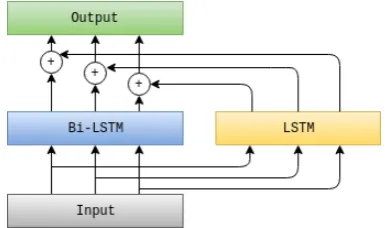
2019). The last presented model is an attention based model, which is shown in Figure3. In this model, we use Bi-LSTM as encoder and LSTM as attention layer, and finally, outputs of encoder and attention layers are added together.
Figure 1: The schema of the LSTM/GRU models used in this experiments.
Figure 2: The schema of the Bi-LSTM model used in this experiments.
Figure 3: The schema of the Bi-LSTM with the attention mechanism model used in this experi-ments.
4 Morphological Segmentation Lexicons
In this section, the rich Persian hand-annotated dataset and the existing Finnish datasets from the Morpho-Challenge shared task 2010 (Virpioja
et al.,2011) as well as the Czech dataset used in our experiments are described.
4.1 Persian Hand-Annotated Morphological Segmentation Dataset
We extracted our primary word list from three dif-ferent corpora. The first corpus contains sentences extracted from the Persian Wikipedia (Karimi et al., 2018). The second one is popular Persian mono-lingual corpus BijanKhan (Bijankhan et al.,
2011), and the last one is Persian-NER1(Poostchi et al.,2018).
For all introduced corpora, using Hazm tool-set (Persian preprocessing and tokenization tools)2 and the stemming tool presented byTaghi-Zadeh et al. (2015), we extracted and normalized all sentences and in the final steps using our rule-based stemmer and a Persian lemma collection, all words are lemmatized and stemmed. Finally all semi-spaces are automatically detected and fixed. Words with more than 10 occurrences in the cor-pora were selected for manual annotation. We decided to send all 80K words to our 16 anno-tators in the way that each word is checked and annotated by two independent persons. Annota-tors decided about the lemma of a word under question, segmentation parts, plurality, ambiguity (whether a word has more than one meaning) or they might delete the word if they think is not a proper Persian word. Moreover, some segmenta-tions predicted by our automatic segmentator with high confidence score were offered to our annota-tors. We removed almost 30K words which were selected to be deleted by both annotators. And re-maining 50K words sent for inter-annotation com-parison part. In this step, all disagreements were checked and corrected by the authors of this paper and finally all words were quickly reviewed by two Persian linguists. The whole process took around six weeks. In order to use a hand-annotated lex-icon in our work, we extracted the segmentation part from the dataset and converted it to our binary model which is described in Section3.
The total number of words we used in our Per-sian dataset is 40K. The dataset is publicly avail-able in the LINDAT/CLARIN repository (Ansari et al.,2019).
1
https://github.com/HaniehP/ PersianNER
4.2 Existing Finnish and Czech Segmentation Datasets
We downloaded the Finnish segmentation dataset from the Morpho-Challenge shared task 20103 (Virpioja et al.,2011) and converted them into our binary format. The Finnish dataset contains 2000 segmented words. While comparing to our hand-annotated Persian dataset these datasets are small, we used them to see the efficiency of our presented models when the size of training dataset is limited. The Czech dataset results from a prototype seg-mentation annotation of Czech words. A sample of 1000 lemmas were selected randomly from De-riNet, which is a lexical database focus on deriva-tion in Czech (Zabokrtsk´y et al.ˇ , 2016). The lemmas were manually segmented by two inde-pendent annotators, and all annotation differences were resolved subsequently during a third pass through the data. The annotation resulted in 4.6 morphemes per word, partially as a result of the fact that the lemmas were sampled uniformly, re-gardless of their corpus frequency, and thus the se-lection is biased towards longer words.
5 Experimental Results
To partition our dataset (Persian, Czech and Finnish) into training, development and test sets a commonly used method is used (Ruokolainen et al.,2013), which involves sorting words accord-ing to their frequency and assignaccord-ing every eighth term starting from the first one into the test set and every eighth term from the second into the de-velopment set, while moving the remaining terms into the training set.
In order to evaluate the effect of the training data size, we randomly select the first 1/64, 1/32, 1/16, 1/8, 3/8, 1/4, 1/2, 3/4 and all amount of data from the training set to carry out experiments with different training sizes. In all experiments, we re-port three evaluation measures: the number of cor-rectly predicted morpheme boundaries (in terms of precision, recall, and f-measure), the percentage of correct binary predictions on all characters, and the percentage of correctly segmented words.
As described in Section2, some previous works reported accuracy in terms of the number of cor-rect predictions (boundary and word) in a running text, instead of considering unique words sampled from a lexicon. Hence we decided to also report
3http://morpho.aalto.fi/events/
morphochallenge2010/datasets.shtml
such accuracy in our experiments in addition to our lexicon evaluation. For this new experiment, we selected a part of a mono-lingual text and after removing all presented words in the text from our training lexicon, the remaining segmented words are considered as the training set and finally ac-curacy of word segmentation of words in test sen-tences is reported separately.
5.1 Baselines
We used two baseline systems which we selected to compare our models with. The first base-line is an unsupervised version of MORFESSOR, which is introduced and implemented by Creutz et al. (2007). The second baseline is FlatCat (Gr¨onroos et al., 2014), which is a well-known semi-supervised version of MORFESSOR that uses the Hidden Markov Model for segmentation. In addition to the annotated data, semi-supervised MORFESSOR (i.e. FlatCat) uses a set of 100,000 word types following their frequency in the cor-pus as their unannotated training dataset. For both baselines, the best performing model is selected and compared with our neural network based mod-els.
5.2 Results and Discussion
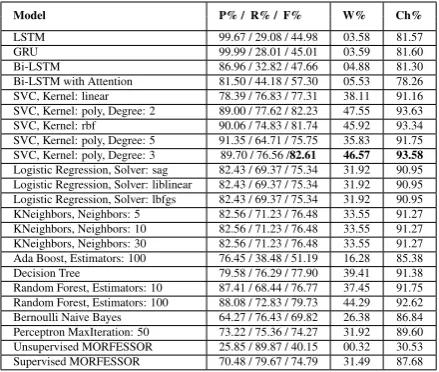
As described in Section 4, we designed vari-ous models for the morphological segmentation task. In the following subsections, different ex-periments done in this work are reviewed. In all tables, the column entitled byW% indicates the proportion of perfectly segmented words. The column entitled by Ch% indicated the accuracy of characters which are classified as boundary or non-boundary. Finally, P%, R%, andF% indi-cate precision, recall and F-measure score respec-tively for the morpheme boundary detection, natu-rally excluding the trivial final position characters from our evaluation.
5.2.1 Comparison of Different Models
this also explains the inferior performance of our seq2seq model compared to the Bi-LSTM model implemented for this work.
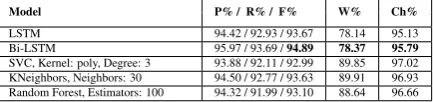
Finally, Table5shows results of selected mod-els when the segmentation is done on all words occurring in a corpus instead of a segmented lexi-con. In this experiments we expected those words with more frequency has higher effect on results comparing with less frequent words.
5.2.2 Effect of Training Data Size
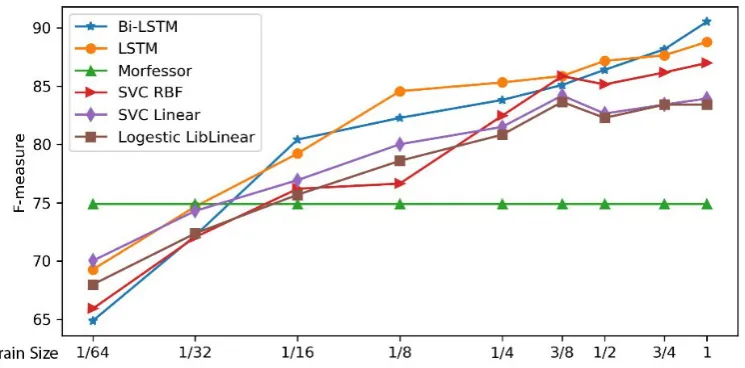
In order to evaluate the effect of the training data size on our DL models, different amount of train-ing data are selected from and feed to our models. Figure4and Figure5demonstrate an experiment in which the baseline line is the results of unsu-pervised version of MORFESSOR for similar test dataset. Only four best performing feature-based models in addition to two DL-based models are selected to be shown here. As this figure shows, after having more than 10K training instances, in-creasing the training data further does not have a substantial effect any more.
5.2.3 Semi-Space Feature for Persian Words
An important feature of the Persian and Arabic languages is the existence of semi-space. For ex-ample word “
اهباتک
” (books) is a combination of word “باتک
” and “اه
”, in which the former is Per-sian translation of word “book” and the latter is morpheme for a plural form. We can say these semi-space signs segment words into smaller mor-phemes. However, in formal writing and in all Per-sian normal corpora, this space is neglected fre-quently and it could make a lot of problems in Persian and Arabic morphological segmentation task. For example both forms for the previous example, “اهباتک
” and “اهباتک
” , are considered correct in Persian text and have the same mean-ing. To deal with this problem and in order to improve the quality of our segmentation dataset, we implemented a preprocessor to distinguish thisModel P% / R% / F% W% Ch%
LSTM 94.42 / 92.93 / 93.67 78.14 95.13 Bi-LSTM 95.97 / 93.69 /94.89 78.37 95.79
SVC, Kernel: poly, Degree: 3 93.88 / 92.11 / 92.99 89.85 97.02 KNeighbors, Neighbors: 30 94.50 / 92.77 / 93.63 89.91 96.93 Random Forest, Estimators: 100 94.32 / 91.99 / 93.10 88.64 96.66
Table 5: Experiment results when a model is used to predict boundaries of Persian words of a small corpus instead of lexicon words. Only five best performing models are shown.
kind of space in Persian words and consequently our hand-annotated dataset contains these semi-spaces correctly. While we wanted to test the ef-fect of having this prior knowledge in the lexicon, we evaluated our models in two different forms. In the first case, we used our hand annotated dataset as is. In the second case, we removed all semi-spaces from the lexicon. Table6shows a compar-ison for deploying our models on these two dif-ferent datasets and as could be seen in this table, having the accurate dataset which is created by our preprocessing strategy could improve results dras-tically.
6 Conclusion
The main task of this work is to evaluate different supervised models to find the best segmentation of a word when only a segmented lexicon without any extra information is available in the training phase. In recent years, recurrent neural networks (RNN) attracted a growing interest in morpholog-ical analysis, that is why we decided to design and evaluate various neural network based mod-els (LSTM, Bi-LSTM, GRU, and attention based models) as well as some machine learning classi-fication models including SVM, Random Forest, Logistic Regression and others for our morpho-logical segmentation task. While a critical point in any DL model is the training data size, we de-cided to create a rich hand annotated Persian lex-icon which is the only segmented corpus for Per-sian words. Using this lexicon we evaluated our presented models as well as the effect of train-ing data size on results. Moreover, we evaluated and tested our models on some limited datasets for Czech and Finnish languages. Experimental re-sults show our Bi-LSTM model performs slightly better in boundary prediction, however the results of classification-based approaches overcome the DL models in percentage of completely correctly segmented words.
Acknowledgments
Figure 4: The effect of Persian training data size on boundary detection F-measure.
Figure 5: The effect of Persian training data size on whole-word segmentation accuracy.
with semi without semi
Model
P% / R% / F% W% Ch% P% / R% / F% W% Ch% LSTM 90.09 / 87.57 / 88.80 64.10 93.20 91.15 / 74.76 / 82.15 51.42 89.53 Bi-LSTM 92.50 / 88.65 /90.53 66.51 94.37 89.19 / 77.18 / 82.75 52.58 89.64 SVC, Kernel: linear 85.86 / 82.20 / 83.94 73.08 94.45 81.67 / 77.75 / 79.66 68.17 92.62 SVC, Kernel: poly, Degree: 2 89.57 / 85.86 / 87.67 78.72 95.72 86.52 / 82.96 / 84.71 75.66 94.43 SVC, Kernel: rbf 89.71 / 84.42 / 86.99 77.61 95.52 86.34 / 80.96 / 83.56 74.39 94.08 SVC, Kernel: poly, Degree: 5 89.77 / 83.91 / 86.74 77.17 95.45 86.11 / 80.11 / 83.00 73.00 93.90 SVC, Kernel: poly, Degree: 3 89.58 / 85.89 / 87.70 78.70 95.73 86.30 / 83.02 / 84.63 75.30 94.39 Logistic Regression, Solver: sag 87.55 / 79.66 / 83.42 72.60 94.39 83.83 / 75.75 / 79.58 68.61 92.77 Logistic Regression, Solver: liblinear 87.55 / 79.60 / 83.42 72.63 94.39 83.84 / 75.75 / 79.59 68.63 92.78 Logistic Regression, Solver: lbfgs 87.49 / 79.78 / 83.46 72.64 94.39 83.74 / 75.59 / 79.46 68.47 92.73 KNeighbors, Neighbors: 5 82.47 / 86.22 / 84.30 73.12 94.56 82.19 / 76.34 / 79.15 67.36 92.52 KNeighbors, Neighbors: 10 86.22 / 82.47 / 84.30 73.12 94.56 82.19 / 76.34 / 79.15 67.36 95.52 KNeighbors, Neighbors: 30 90.23 / 86.69 / 88.42 78.64 95.73 82.19 / 76.34 / 79.15 67.36 92.52 Ada Boost, Estimators: 100 83.34 / 64.10 / 72.46 58.21 90.83 75.17 / 51.87 / 61.39 52.95 87.87 Decision Tree 88.25 / 87.05 / 87.65 76.83 95.38 88.24 / 86.05 /87.13 75.92 95.21
Random Forest, Estimators: 10 89.75 / 84.87 / 87.15 76.08 95.30 85.04 / 78.17 / 81.46 70.83 93.38 Random Forest, Estimators: 100 89.93 / 85.92 / 87.88 77.37 95.54 85.21 / 79.66 / 82.34 71.95 93.65 Bernoulli Naive Bayes 78.38 / 88.31 / 83.05 66.71 93.21 75.63 / 84.91 / 80.00 62.01 92.01 Perceptron MaxIteration: 50 83.98 / 74.45 / 78.93 65.07 92.52 75.41 / 77.28 / 76.34 62.51 90.05 Unsupervised MORFESSOR 69.58 / 81.10 / 74.90 29.01 83.28 71.16 / 81.88 / 76.14 30.33 83.48 Supervised MORFESSOR 82.13 / 92.94 / 87.20 59.56 91.60 81.60 / 92.24 / 86.60 58.84 90.80
Table 6: The effect of considering semi-space on training data when all training data are used.
Czech Republic (project LM2015071). References
LIN-F. Pedregosa, G. Varoquaux, A. Gramfort, V. Michel, B. Thirion, O. Grisel, M. Blondel, P. Pretten-hofer, R. Weiss, V. Dubourg, J. Vanderplas, A. Pas-sos, D. Cournapeau, M. Brucher, M. Perrot, and E. Duchesnay. 2011. Scikit-learn: Machine learning in Python. Journal of Machine Learning Research 12:2825–2830.
Hoifung Poon, Colin Cherry, and Kristina Toutanova. 2009. Unsupervised morphological segmentation with log-linear models. In Proceedings of Hu-man Language Technologies: The 2009 Annual Conference of the North American Chapter of the Association for Computational Linguistics. Association for Computational Linguistics, Strouds-burg, PA, USA, NAACL ’09, pages 209–217.
http://dl.acm.org/citation.cfm?id=1620754.1620785.
Hanieh Poostchi, Ehsan Zare Borzeshi, and Massimo Piccardi. 2018. BiLSTM-CRF for Persian Named-Entity Recognition ArmanPersoNERCorpus: the First Entity-Annotated Persian Dataset. In Proceed-ings of the Eleventh International Conference on Language Resources and Evaluation, LREC 2018, Miyazaki, Japan, May 7-12, 2018..
Mohammad Sadegh Rasooli, Ahmed El Kholy, and Nizar Habash. 2013. Orthographic and Morpho-logical Processing for Persian-to-English Statisti-cal Machine Translation. In Proceedings of the Sixth International Joint Conference on Natural Language Processing. Asian Federation of Natural Language Processing, Nagoya, Japan, pages 1047– 1051.https://www.aclweb.org/anthology/I13-1144.
Teemu Ruokolainen, Oskar Kohonen, Sami Virpioja, and Mikko Kurimo. 2013. Supervised Morphologi-cal Segmentation in a Low-Resource Learning Set-ting using Conditional Random Fields. In Proceed-ings of the Seventeenth Conference on Computa-tional Natural Language Learning. Association for Computational Linguistics, Sofia, Bulgaria, pages 29–37. https://www.aclweb.org/anthology/W13-3504.
Teemu Ruokolainen, Oskar Kohonen, Sami Virpi-oja, and Mikko Kurimo. 2014. Painless semi-supervised morphological segmentation using con-ditional random fields. In Proceedings of the 14th Conference of the European Chapter of the Association for Computational Linguistics, volume 2: Short Papers. Association for Computational Linguistics, Gothenburg, Sweden, pages 84–89.
https://doi.org/10.3115/v1/E14-4017.
Kairit Sirts and Sharon Goldwater. 2013. Minimally-supervised morphological segmentation using adap-tor grammars. TACL1:255–266.
Ilya Sutskever, Oriol Vinyals, and Quoc V. Le. 2014. Sequence to sequence learning with neural networks. CoRR abs/1409.3215.
http://arxiv.org/abs/1409.3215.
Hossein Taghi-Zadeh, Mohammad Hadi Sadreddini, Mohammad Hasan Diyanati, and Amir Hos-sein Rasekh. 2015. A new hybrid stem-ming method for Persian language. Digi-tal Scholarship in the Humanities 32(1):209–221.
https://doi.org/10.1093/llc/fqv053.
Sami Virpioja, Ville T. Turunen, Sebastian Spiegler, Oskar Kohonen, and Mikko Kurimo. 2011. Empir-ical comparison of evaluation methods for unsuper-vised learning of morphology. TRAITEMENT AU-TOMATIQUE DES LANGUES52(2):45–90.
Linlin Wang, Zhu Cao, Yu Xia, and Gerard de Melo. 2016. Morphological Segmentation with Window LSTM Neural Networks. In Dale Schuurmans and Michael P. Wellman, editors, AAAI. AAAI Press, pages 2842–2848.