844
Large-Scale Hierarchical Alignment for Data-driven Text Rewriting
Nikola I. NikolovandRichard H.R. Hahnloser
Institute of Neuroinformatics, University of Z¨urich and ETH Z¨urich, Switzerland {niniko, rich}@ini.ethz.ch
Abstract
We propose a simple unsupervised method for extracting pseudo-parallel monolin-gual sentence pairs from comparable cor-pora representative of two different text styles, such as news articles and scien-tific papers. Our approach does not re-quire a seed parallel corpus, but instead relies solely on hierarchical search over pre-trained embeddings of documents and sentences. We demonstrate the effective-ness of our method through automatic and extrinsic evaluation on text simplification from the normal to the Simple Wikipedia. We show that pseudo-parallel sentences extracted with our method not only sup-plement existing parallel data, but can even lead to competitive performance on their own.1
1 Introduction
Parallel corpora are indispensable resources for advancing monolingual and multilingual text rewriting tasks. Due to the scarce availability of parallel corpora, and the cost of manual creation, a number of methods have been proposed that can perform large-scale sentence alignment: auto-matic extraction ofpseudo-parallelsentence pairs from raw, comparable2 corpora. While pseudo-parallel data is beneficial for machine translation (Munteanu and Marcu,2005), there has been little work on large-scale sentence alignment for mono-lingual text-to-text rewriting tasks, such as simpli-fication (Nisioi et al.,2017) or style transfer (Liu et al.,2016). Furthermore, the majority of existing methods (e.g. Marie and Fujita(2017);Gr´egoire
1
Code available at https://github.com/ ninikolov/lha.
2Corpora that contain documents on similar topics.
Source document
Source document
Target document
Document alignment
Sentence alignment
Target 1 Target 2
Target 3
Target 4 Target 5
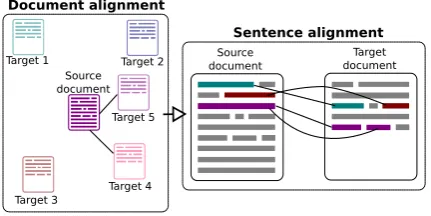
Figure 1: Illustration of large-scale hierarchical align-ment (LHA). For each docualign-ment in asourcedataset, doc-ument alignmentretrieves matching documents from a tar-getdataset. In turn,sentence alignmentretrieves matching sentence pairs from within each document pair.
and Langlais(2018)) assume access to some par-allel training data. This impedes their application to cases where there isno parallel data available whatsoever, which is the case for the majority of text rewriting tasks, such as style transfer.
In this paper, we propose a simple unsuper-vised method, Large-scale Hierarchical Align-ment (LHA) (Figure 1; Section 3), for extract-ing pseudo-parallel sentence pairs from two raw monolingual corpora which contain documents in two different author styles, such as scientific papers and press releases. LHA hierarchically searches for document and sentence nearest neigh-bors within the two corpora, extracting sentence pairs that have high semantic similarity, yet pre-serve the stylistic characteristics representative of their original datasets. LHA is robust to noise, fast and memory efficient, enabling its application to datasets on the order of hundreds of millions of sentences. Its generality makes it relevant to a wide range of monolingual text rewriting tasks.
pseudo-parallel datasets obtained by LHA are not only useful for augmenting existing parallel data, boosting the performance on automatic measures, but can even be competitive on their own.
2 Background
2.1 Data-Driven Text Rewriting
The goal of text rewriting is to transform an input text to satisfy specific constraints, such as simplic-ity (Nisioi et al., 2017) or a more general author style, such as political (e.g. democratic to republi-can) or gender (e.g. male to female) (Prabhumoye et al.,2018;Shen et al.,2017). Rewriting systems can be valuable when preparing a text for multi-ple audiences, such as simplification for language learners (Siddharthan,2002) or people with read-ing disabilities (Inui et al.,2003). They can also be used to improve the accessibility of technical doc-uments, e.g. to simplify terms in clinical records for laymen (Abrahamsson et al.,2014).
Text rewriting can be cast as a data-driven task in which transformations are learned from large collections of parallel sentences. Limited avail-ability of high-quality parallel data is a major bottleneck for this approach. Recent work on Wikipedia and the Simple Wikipedia (Coster and Kauchak,2011;Kajiwara and Komachi,2016) and on the Newsela dataset of simplified news arti-cles for children (Xu et al., 2015) explore super-vised, data-driven approaches to text simplifica-tion. Such approaches typically rely on statisti-cal (Xu et al.,2016) or neural (ˇStajner and Nisioi,
2018) machine translation.
Recent work on unsupervised approaches to text rewriting without parallel corpora is based on vari-ational (Fu et al., 2017) or cross-aligned (Shen et al., 2017) autoencoders that learn latent repre-sentations of content separate from style. In ( Prab-humoye et al., 2018), authors model style trans-fer as a back-translation task by translating input sentences into an intermediate language. They use the translations to train separate English decoders for each target style by combining the decoder loss with the loss of a style classifier, separately trained to distinguish between the target styles.
2.2 Large-Scale Sentence Alignment
The goal ofsentence alignmentis to extract from raw corpora sentence pairs suitable as training ex-amples for text-to-text rewriting tasks such as ma-chine translation or text simplification. When the
documents in the corpora are parallel (labelled document pairs, such as identical articles in two languages), the task is to identify suitable sen-tence pairs from each document. This problem has been extensively studied both in the multi-lingual (Brown et al., 1991; Moore, 2002) and monolingual (Hwang et al., 2015; Kajiwara and Komachi, 2016; ˇStajner et al., 2018) case. The limited availability of parallel corpora led to the development of large-scale sentence alignment
methods, which is also the focus of this work. The aim of these methods is to extract pseudo-parallel sentence pairs from raw, non-aligned corpora. For many tasks, millions of examples occur naturally within existing textual resources, amply available on the internet.
The majority of previous work on large-scale sentence alignment is in machine translation, where adding pseudo-parallel pairs to an existing parallel dataset has been shown to boost the trans-lation performance (Munteanu and Marcu, 2005;
Uszkoreit et al., 2010). The work that is most closely related to ours is (Marie and Fujita,2017), where authors use pre-trained word and sentence embeddings to extract rough translation pairs in two languages. Subsequently, they filter out low-quality translations using a classifier trained on parallel translation data. More recently, (Gr´egoire and Langlais,2018) extract pseudo-parallel trans-lation pairs using a Recurrent Neural Network (RNN) classifier. Importantly, these methods as-sume that some parallel training data is already available, which impedes their application in set-tings where there is no parallel data whatsoever, which is the case for many text rewriting tasks such as style transfer.
There is little work on large-scale sentence alignment focusing specifically on monolingual tasks. In (Barzilay and Elhadad, 2003), authors develop a hierarchical alignment approach of first clustering paragraphs on similar topics before per-forming alignment on the sentence level. They ar-gue that, for monolingual data, pre-clustering of larger textual units is more robust to noise com-pared to fine-grained sentence matching applied directly on the dataset level.
3 Large-Scale Hierarchical Alignment (LHA)
3. InferSent6 (Conneau et al.,2017) is a super-vised sentence embedding approach based on bidirectional LSTMs, trained on natural lan-guage inference data.
4. BERT7(Devlin et al.,2019) is a state-of-the-art supervised sentence embedding approach based on the Transformer architecture.
Word Similarity We additionally test four
word-based approaches for computing text simi-larity. Those can be used either on their own, or to refine the nearest neighbour search across doc-uments or sentences.
1. We compute the unigram string overlap o(x,y) = |{y|{}∩{y}|x}| between source tokensx
and target tokens y (excluding punctuation, numbers and stopwords).
2. We use the BM25ranking function ( Robert-son et al.,2009), an extension of TF-IDF.
3. We use the Word Mover’s Distance (WMD) (Kusner et al., 2015), which measures the distance the embedded words of one docu-ment need to travel to reach the embedded words of another document. WMD has re-cently achieved good results on text retrieval (Kusner et al.,2015) and sentence alignment (Kajiwara and Komachi,2016).
4. We use the Relaxed Word Mover’s Distance (RWMD) (Kusner et al.,2015), which is a fast approximation of the WMD.
4 Automatic Evaluation
We perform an automatic evaluation of LHA using an annotated sentence alignment dataset (Hwang et al.,2015). The dataset contains 46 article pairs from Wikipedia and the Simple Wikipedia. The 67k potential sentence pairs were manually la-belled as either good simplifications (277 pairs), good with a partial overlap (281 pairs), par-tial (117 pairs) or non-valid. We perform three comparisons using this dataset: evaluating docu-ment and sentence aligndocu-ment separately, as well as jointly.
For sentence alignment, the task is to retrieve the277good sentence pairs out of the67k possi-ble sentence pairs in total, while minimizing the
6
We use the GloVe-based model provided by the authors.
7We use the base 12-layer model provided by the authors.
number of false positives. To evaluate document alignment, we add 1000 randomly sampled arti-cles from Wikipedia and the Simple Wikipedia as noise, resulting in1046article pairs in total. The goal of document alignment is to identify the orig-inal46document pairs out of1046×1046possible document combinations.
This set-up additionally enables us to jointly
evaluate document and sentence alignment, which best resembles the target effort of retrieving good sentence pairs from noisy documents. The two aims of the joint alignment task are to identify the good sentence pairs from within either 1M doc-ument or125M sentence pairs, in the latter case without relying on any document-level informa-tion whatsoever.
4.1 Results
Our results are summarized in Tables 1 and 2. For all experiments, we set K = 1 and report the maximum F1 score (F1max) obtained from varying the document threshold θd and the sen-tence thresholdθs. We also report the percentage of true positive (TP) document or sentence pairs that were retrieved when the F1 score was at its maximum, as well as the average speed of each approach (doc/sandsent/s). The speed becomes of a particular concern when working with large datasets consisting of millions of documents and hundreds of millions of sentences.
On document alignment, (Table 1, left) the Sent2Vecapproach achieved the best score, outper-forming the other embedding methods including the word-based similarity measures. On sentence alignment (Table1, right), the WMD achieves the best performance, matching the result from ( Ka-jiwara and Komachi, 2016). When evaluating document and sentence alignment jointly (Table
2), we compare our hierarchical approach (LHA) to global alignment applied directly on the sen-tence level (Global). Global computes the simi-larities between all125M sentence pairs in the en-tire evaluation dataset. LHA significantly outper-forms Global, successfully retrieving three times more valid sentence pairs, while remaining fast to compute. This result demonstrates that document alignment is beneficial, successfully filtering some of the noise, while also reducing the overall num-ber of sentence similarities to be computed.
align-Table 1: Automatic evaluation of Document (left) and Sentence alignment (right). EDimis the embedding dimensionality. TPis the percentage of true positives obtained atF1max. Speed is calculated on a single CPU thread.
Document alignment Sentence alignment Approach EDim F1max TP θd doc/s F1max TP θs sent/s
Embedding
Average word embeddings (Avg) 300 0.66 43% 0.69 260 0.675 46% 0.82 1458
Sent2Vec (Pagliardini et al.,2018) 600 0.78 61% 0.62 343 0.692 48% 0.69 1710
InferSent†(Conneau et al.,2017) 4096 - - - - 0.69 49% 0.88 110
BERT†(Devlin et al.,2019) 768 - - - - 0.65 43% 0.89 25
W
or
d
sim
Overlap - 0.53 29% 0.66 120 0.63 40% 0.5 1600
BM25 (Robertson et al.,2009) - 0.46 16% 0.257 60 0.52 27% 0.43 20K
RWMD (Kusner et al.,2015) 300 0.713 51% 0.67 60 0.704 50% 0.379 1050
WMD (Kusner et al.,2015) 300 0.49 24% 0.3 1.5 0.726 54% 0.353 180
(Hwang et al.,2015) - - - 0.712 - -
-(Kajiwara and Komachi,2016) - - - 0.724 - -
-†: These models are specifically designed for sentence embedding, hence we do not test them on document alignment.
Table 2: Evaluation on large-scale sentence alignment: identifying thegoodsentence pairs without any document-level information. We pre-compute the embeddings and use the Annoy ANN library. For the WMD-based approaches, we re-compute the top 50 sentence nearest neighbours of Sent2Vec.
Approach F1max TP time
LHA (Sent2Vec) 0.54 31% 33s
LHA (Sent2Vec+WMD) 0.57 33% 1m45s
Global (Sent2Vec) 0.339 12% 15s
Global (WMD) 0.291 12% 30m45s
ment, while also being the fastest to compute. We therefore use it as the default approach for the fol-lowing experiments on text simplification.
5 Empirical Evaluation
To test the suitability of pseudo-parallel data ex-tracted with LHA, we perform empirical exper-iments on text simplification from the normal Wikipedia to the Simple Wikipedia. We chose simplification because some parallel data are al-ready available for this task, allowing us to ex-periment with mixing parallel and pseudo-parallel datasets. In the supplementary material8we exper-iment with an additional task for which there is no parallel data: style transfer from scientific journal articles to press releases.
We compare the performance of neural machine translation (NMT) systems trained under three dif-ferent scenarios: 1) using existing parallel data for training; 2) using a mixture of parallel and pseudo-parallel data extracted with LHA; and 3) using pseudo-parallel dataon its own.
5.1 Experimental Setup
NMT model For all experiments, we use a
single-layer LSTM encoder-decoder model (Cho
8Available in our arXiv paper at https://arxiv.
org/abs/1810.08237
et al., 2015) with an attention mechanism ( Bah-danau et al., 2015). We train our models on the subword level (Sennrich et al.,2015), capping the vocabulary size to 50k. We re-learn the subword rules separately for each dataset, and train until convergence using the Adam optimizer (Kingma and Ba,2015). We use beam search with a beam of 5 to generate all final outputs.
Evaluation metrics We report a diverse range of
automatic metrics and statistics. SARI (Xu et al.,
2016) is a recently proposed metric for text sim-plification which correlates well with simplicity in the output. SARI takes into account the total number of changes (additions, deletions) of the in-put when scoring model outin-puts.BLEU(Papineni et al., 2002) is a precision-based metric for ma-chine translation commonly used for evaluation of text simplification (Xu et al.,2016;ˇStajner and
Ni-sioi,2018) and of style transfer (Shen et al.,2017). Recent work has indicated that BLEU is not suit-able for assessment of simplicity (Sulem et al.,
2018), it correlates better with meaning preserva-tion and grammaticality, in particular when using multiple references. We also report the average Levenshtein distance (LD) from the model out-puts to the input (LDsrc) or the target reference (LDtgt). On simplification tasks, LD correlates well with meaning preservation and grammatical-ity (Sulem et al.,2018), complementing BLEU.
Extracting pseudo-parallel data We use LHA
align-Table 3:Datasets used to extract pseudo-parallel monolingual sentence pairs in our experiments. Dataset Type Documents Tokens Sentences Tok. per sent. Sent. per doc.
Wikipedia Articles 5.5M 2.2B 92M 25±16 17±32
Simple Wikipedia Articles 134K 62M 2.9M 27±68 22±34
Gigaword News 8.6M 2.5B 91M 28±12 11±7
Table 4:Example pseudo-parallel pairs extracted by our Large-scale hierarchical alignment (LHA) method.
Dataset Source Target
wiki- simp-65
However, Jimmy Wales, Wikipedia’s co-founder, de-nied that this was a crisis or that Wikipedia was run-ning out of admins, saying, ”The number of admins has been stable for about two years, there’s really nothing going on.”
But the co-founder Wikipedia, Jimmy Wales, did not believe that this was a crisis. He also did not believe Wikipedia was running out of admins.
wiki- news-74
Prior to World War II, Japan’s industrialized econ-omy was dominated by four major zaibatsu: Mit-subishi, Sumitomo, Yasuda and Mitsui.
Until Japan ’s defeat in World War II , the economy was dominated by four conglomerates , known as “ zaibatsu ” in Japanese . These were the Mitsui , Mit-subishi , Sumitomo and Yasuda groups .
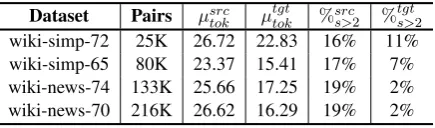
Table 5: Statistics of the pseudo-parallel datasets extracted with LHA.µsrctokandµ
tgt
tokare the mean src/tgt token counts,
while%srcs>2 and %tgts>2 report the percentage of items that
contain more than one sentence. Dataset Pairs µsrc
tok µ
tgt
tok %srcs>2 %
tgt s>2 wiki-simp-72 25K 26.72 22.83 16% 11% wiki-simp-65 80K 23.37 15.41 17% 7% wiki-news-74 133K 25.66 17.25 19% 2% wiki-news-70 216K 26.62 16.29 19% 2%
ment experiments, which enables extraction of up to 5 sentence nearest neighbours.
Parallel data As a parallel baseline dataset, we
use an existing dataset from (Hwang et al.,2015). The dataset consists of 282K sentence pairs ob-tained after aligning the parallel articles from Wikipedia and the Simple Wikipedia. This dataset allows us to compare our results to previous work on data-driven text simplification. We use two versions of the dataset in our experiments: full contains all 282K pairs, whilepartialcontains 71K pairs, or 25% of the full dataset.
Evaluation data We evaluate our simplification
models on the testing dataset from (Xu et al.,
2016), which consists of 358 sentence pairs from the normal Wikipedia and the Simple Wikipedia. In addition to the ground truth simplifications, each input sentence comes with 8 additional refer-ences, manually simplified by Amazon Meachan-ical Turkers. We computeBLEUandSARIon the 8 manual references.
Pseudo-parallel data We align two dataset
pairs, obtaining pseudo-parallel sentence pairs for text simplification (statistics of the datasets we use for alignment are in Table 3). First, we align the normal Wikipedia to the Simple
Wikipedia using document and sentence sim-ilarity thresholdsθd= 0.5andθs={0.72,0.65}, producing two datasets: wiki-simp-72 and
wiki-simp-65. Because LHA uses no
document-level information in this dataset, align-ment leads to new sentence pairs, some of which may be distinct from the pairs present in the exist-ing parallel dataset. We monitor for and exclude pairs that overlap with the testing dataset. Second, we alignWikipediato theGigawordnews ar-ticle corpus (Napoles et al.,2012), usingθd= 0.5 andθs = {0.74,0.7}, resulting in two additional pseudo-parallel datasets: wiki-news-74 and wiki-news-70. With these datasets, we inves-tigate whether pseudo-parallel data extracted from adifferent domain can be beneficial for text sim-plification. We use slightly higher sentence align-ment thresholds for the news articles because of the domain difference.
We find that the majority of the pairs extracted contain a single sentence, and 15-20% of the source examples and 5-10% of the target exam-ples contain multiple sentences (see Table 5 for additional statistics). Most multi-sentence exam-ples contain two sentences, while0.5-1%contain 3 to 5 sentences. Two example aligned outputs are in Table 4(additional examples are available in the supplementary material). They suggest that our method is capable of extracting high-quality pairs that are similar in meaning, even spanning across multiple sentences.
Randomly sampled pairs We also experiment
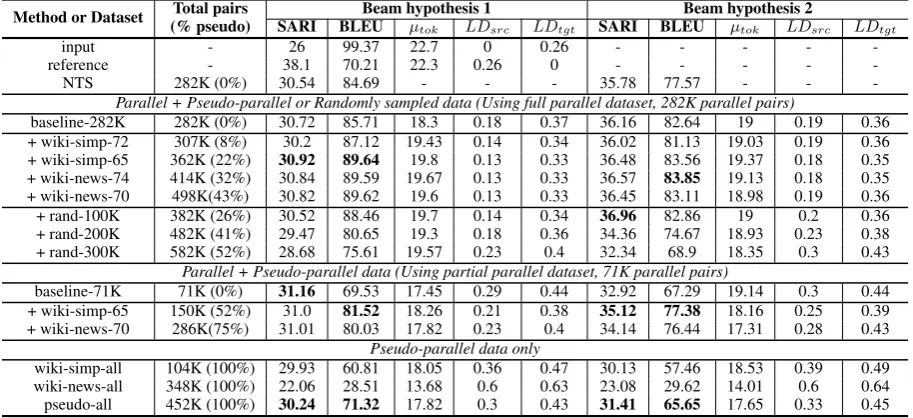
Table 6: Empirical results on text simplification from Wikipedia to the Simple Wikipedia. The highest SARI/BLEU results from each category are in bold.inputandreferenceare not generated using Beam Search.
Method or Dataset Total pairs (% pseudo)
Beam hypothesis 1 Beam hypothesis 2
SARI BLEU µtok LDsrc LDtgt SARI BLEU µtok LDsrc LDtgt
input - 26 99.37 22.7 0 0.26 - - - -
-reference - 38.1 70.21 22.3 0.26 0 - - - -
-NTS 282K (0%) 30.54 84.69 - - - 35.78 77.57 - -
-Parallel + Pseudo-parallel or Randomly sampled data (Using full parallel dataset, 282K parallel pairs)
baseline-282K 282K (0%) 30.72 85.71 18.3 0.18 0.37 36.16 82.64 19 0.19 0.36
+ wiki-simp-72 307K (8%) 30.2 87.12 19.43 0.14 0.34 36.02 81.13 19.03 0.19 0.36
+ wiki-simp-65 362K (22%) 30.92 89.64 19.8 0.13 0.33 36.48 83.56 19.37 0.18 0.35
+ wiki-news-74 414K (32%) 30.84 89.59 19.67 0.13 0.33 36.57 83.85 19.13 0.18 0.35
+ wiki-news-70 498K(43%) 30.82 89.62 19.6 0.13 0.33 36.45 83.11 18.98 0.19 0.36
+ rand-100K 382K (26%) 30.52 88.46 19.7 0.14 0.34 36.96 82.86 19 0.2 0.36
+ rand-200K 482K (41%) 29.47 80.65 19.3 0.18 0.36 34.36 74.67 18.93 0.23 0.38
+ rand-300K 582K (52%) 28.68 75.61 19.57 0.23 0.4 32.34 68.9 18.35 0.3 0.43
Parallel + Pseudo-parallel data (Using partial parallel dataset, 71K parallel pairs)
baseline-71K 71K (0%) 31.16 69.53 17.45 0.29 0.44 32.92 67.29 19.14 0.3 0.44
+ wiki-simp-65 150K (52%) 31.0 81.52 18.26 0.21 0.38 35.12 77.38 18.16 0.25 0.39
+ wiki-news-70 286K(75%) 31.01 80.03 17.82 0.23 0.4 34.14 76.44 17.31 0.28 0.43
Pseudo-parallel data only
wiki-simp-all 104K (100%) 29.93 60.81 18.05 0.36 0.47 30.13 57.46 18.53 0.39 0.49
wiki-news-all 348K (100%) 22.06 28.51 13.68 0.6 0.63 23.08 29.62 14.01 0.6 0.64
pseudo-all 452K (100%) 30.24 71.32 17.82 0.3 0.43 31.41 65.65 17.65 0.33 0.45
random pairs are uniformly sampled from the Wikipedia and the Simple Wikipedia, respectively. With the random pairs, we aim to investigate how model performance changes as we add an increas-ing number of sentence pairs that are non-parallel but are still representative of the two dataset styles.
5.2 Automatic Evaluation
The simplification results in Table6are organized in several sections according to the type of dataset used for training. We report the results of the top two beam search hypotheses produced by our models, considering that the second hypothesis of-ten generates simpler outputs (ˇStajner and Nisioi,
2018).
In Table 6, input is copying the normal Wikipedia input sentences, without making any changes. reference reports the score of the original Simple Wikipedia references with respect to the other 8 references available for this dataset. NTS is the previously best reported result on text simplification using neural sequence models (ˇStajner and Nisioi,2018). baseline-{282K, 71K}are our parallel LSTM baselines, trained on 282K and 71K parallel pairs, respectively.
The models trained on a mixture of paral-lel andpseudo-parallel data generate longer out-puts on average, and their output is more sim-ilar to the input, as well as to the original Simple Wikipedia reference, in terms of the LD. Adding pseudo-parallel data frequently yields BLEU improvements on both Beam hypotheses: over the NTS system, as well as over our
base-lines trained solely on parallel data. The BLEU gains are larger when using the smaller paral-lel dataset, consisting of 71K sentence pairs. In terms of SARI, the scores remain either sim-ilar or slightly better than the baselines, in-dicating that simplicity in the output is pre-served. The second Beam hypothesis yields higher SARI scores than the first one, in agreement with (ˇStajner and Nisioi, 2018). Interestingly, adding out-of-domain pseudo-parallel news data (wiki-news-* datasets) results in an increase in BLEU despite the potential change in style of the target sequence.
Larger pseudo-parallel datasets can lead to big-ger improvements, however noisy data can result in a decrease in performance, motivating careful data selection. In our parallel and random set-up, we find that an increasing number of random pairs added to the parallel data progressively de-grades model performance. However, those mod-els still manage to perform surprisingly well, even when over half of the pairs in the dataset are ran-dom. Thus, neural machine translation can suc-cessfully learn target transformations despite sub-stantial data corruption, demonstrating robustness to noisy or non-parallel data for certain tasks.
Acknowledgments
We acknowledge support from the Swiss National Science Foundation (grant 31003A 156976).
References
Emil Abrahamsson, Timothy Forni, Maria Skeppstedt, and Maria Kvist. 2014. Medical text simplification using synonym replacement: Adapting assessment of word difficulty to a compounding language. In
Proceedings of the 3rd Workshop on Predicting and Improving Text Readability for Target Reader Popu-lations (PITR), pages 57–65.
Dzmitry Bahdanau, Kyunghyun Cho, and Yoshua Ben-gio. 2015. Neural machine translation by jointly learning to align and translate. Proc. of ICLR 2015.
Regina Barzilay and Noemie Elhadad. 2003. Sentence alignment for monolingual comparable corpora. In
Proceedings of the 2003 conference on Empirical methods in natural language processing, pages 25– 32. Association for Computational Linguistics.
Peter F Brown, Jennifer C Lai, and Robert L Mercer. 1991. Aligning sentences in parallel corpora. In
Proceedings of the 29th annual meeting on Associa-tion for ComputaAssocia-tional Linguistics, pages 169–176. Association for Computational Linguistics.
Kyunghyun Cho, Aaron Courville, and Yoshua Ben-gio. 2015. Describing multimedia content using attention-based encoder-decoder networks. IEEE Transactions on Multimedia, 17(11):1875–1886.
Alexis Conneau, Douwe Kiela, Holger Schwenk, Loic Barrault, and Antoine Bordes. 2017. Supervised learning of universal sentence representations from natural language inference data. Proc. of EMNLP 2017.
William Coster and David Kauchak. 2011. Simple en-glish wikipedia: a new text simplification task. In
Proceedings of the 49th Annual Meeting of the Asso-ciation for Computational Linguistics: Human Lan-guage Technologies: short papers-Volume 2, pages 665–669. Association for Computational Linguis-tics.
Jacob Devlin, Ming-Wei Chang, Kenton Lee, and Kristina Toutanova. 2019. Bert: Pre-training of deep bidirectional transformers for language understand-ing. Proc. of NAACL 2019.
Zhenxin Fu, Xiaoye Tan, Nanyun Peng, Dongyan Zhao, and Rui Yan. 2017. Style transfer in text: Exploration and evaluation. arXiv preprint arXiv:1711.06861.
Francis Gr´egoire and Philippe Langlais. 2018. Ex-tracting parallel sentences with bidirectional recur-rent neural networks to improve machine translation.
arXiv preprint arXiv:1806.05559.
William Hwang, Hannaneh Hajishirzi, Mari Osten-dorf, and Wei Wu. 2015. Aligning sentences from standard wikipedia to simple wikipedia. In HLT-NAACL, pages 211–217.
Kentaro Inui, Atsushi Fujita, Tetsuro Takahashi, Ryu Iida, and Tomoya Iwakura. 2003. Text simplifica-tion for reading assistance: a project note. In Pro-ceedings of the second international workshop on Paraphrasing-Volume 16, pages 9–16. Association for Computational Linguistics.
Tomoyuki Kajiwara and Mamoru Komachi. 2016. Building a monolingual parallel corpus for text sim-plification using sentence similarity based on align-ment between word embeddings. In Proceedings of COLING 2016, the 26th International Confer-ence on Computational Linguistics: Technical Pa-pers, pages 1147–1158.
Diederick P Kingma and Jimmy Ba. 2015. Adam: A method for stochastic optimization. InInternational Conference on Learning Representations (ICLR).
Matt J Kusner, Yu Sun, Nicholas I Kolkin, Kilian Q Weinberger, et al. 2015. From word embeddings to document distances. InICML, volume 15, pages 957–966.
Gus Liu, Pol Rosello, and Ellen Sebastian. 2016. Style transfer with non-parallel corpora.
Benjamin Marie and Atsushi Fujita. 2017. Efficient extraction of pseudo-parallel sentences from raw monolingual data using word embeddings. In Pro-ceedings of the 55th Annual Meeting of the Associa-tion for ComputaAssocia-tional Linguistics (Volume 2: Short Papers), volume 2, pages 392–398.
Robert C Moore. 2002. Fast and accurate sentence alignment of bilingual corpora. InConference of the Association for Machine Translation in the Ameri-cas, pages 135–144. Springer.
Dragos Stefan Munteanu and Daniel Marcu. 2005. Im-proving machine translation performance by exploit-ing non-parallel corpora. Computational Linguis-tics, 31(4):477–504.
Courtney Napoles, Matthew Gormley, and Benjamin Van Durme. 2012. Annotated gigaword. In Pro-ceedings of the Joint Workshop on Automatic Knowl-edge Base Construction and Web-scale KnowlKnowl-edge Extraction, pages 95–100. Association for Compu-tational Linguistics.
Matteo Pagliardini, Prakhar Gupta, and Martin Jaggi. 2018. Unsupervised learning of sentence embed-dings using compositional n-gram features. In Pro-ceedings of the 2018 Conference of the North Amer-ican Chapter of the Association for Computational Linguistics: Human Language Technologies, Vol-ume 1 (Long Papers), pages 528–540. Association for Computational Linguistics.
Kishore Papineni, Salim Roukos, Todd Ward, and Wei-Jing Zhu. 2002. Bleu: a method for automatic eval-uation of machine translation. In Proceedings of the 40th annual meeting on association for compu-tational linguistics, pages 311–318. Association for Computational Linguistics.
Shrimai Prabhumoye, Yulia Tsvetkov, Ruslan Salakhutdinov, and Alan W Black. 2018. Style transfer through back-translation. arXiv preprint arXiv:1804.09000.
Stephen Robertson, Hugo Zaragoza, et al. 2009. The probabilistic relevance framework: Bm25 and be-yond.Foundations and TrendsR in Information Re-trieval, 3(4):333–389.
Rico Sennrich, Barry Haddow, and Alexandra Birch. 2015. Neural machine translation of rare words with subword units. arXiv preprint arXiv:1508.07909.
Tianxiao Shen, Tao Lei, Regina Barzilay, and Tommi Jaakkola. 2017. Style transfer from non-parallel text by cross-alignment. InAdvances in Neural Informa-tion Processing Systems, pages 6833–6844.
Advaith Siddharthan. 2002. An architecture for a text simplification system. In Language Engineering Conference, 2002. Proceedings, pages 64–71. IEEE.
Sanja ˇStajner and Sergiu Nisioi. 2018. A detailed evaluation of neural sequence-to-sequence models for in-domain and cross-domain text simplifica-tion. InProceedings of the Eleventh International Conference on Language Resources and Evaluation (LREC-2018). European Language Resource Asso-ciation.
Elior Sulem, Omri Abend, and Ari Rappoport. 2018. Bleu is not suitable for the evaluation of text simpli-fication. InEMNLP.
Jakob Uszkoreit, Jay M Ponte, Ashok C Popat, and Moshe Dubiner. 2010. Large scale parallel docu-ment mining for machine translation. In Proceed-ings of the 23rd International Conference on Com-putational Linguistics, pages 1101–1109. Associa-tion for ComputaAssocia-tional Linguistics.
Sanja ˇStajner, Marc Franco-Salvador, Paolo Rosso, and Simone Paolo Ponzetto. 2018. CATS: A Tool for Customized Alignment of Text Simplification Cor-pora. InProceedings of the Eleventh International Conference on Language Resources and Evaluation (LREC 2018), Miyazaki, Japan. European Language Resources Association (ELRA).
Wei Xu, Chris Callison-Burch, and Courtney Napoles. 2015. Problems in current text simplification re-search: New data can help. Transactions of the As-sociation for Computational Linguistics, 3:283–297.
Wei Xu, Courtney Napoles, Ellie Pavlick, Quanze Chen, and Chris Callison-Burch. 2016. Optimizing statistical machine translation for text simplification.