The Use of a FileMaker Pro Database in Evaluating
Sign Language Notation Systems
Julie A. Hochgesang
Gallaudet University, LinguisticsSLCC3206, 800 Florida Ave NE, Washington, DC 20002 USA E-mail: [email protected]
Abstract
In this paper, FileMaker Pro has been used to create a database in order to evaluate sign language notation systems used for representing hand configurations. The database cited in this paper focuses on child acquisition data, particularly the dataset of one child and one adult productions of the same American Sign Language (ASL) signs produced in a two-year span. The hand configurations in selected signs have been coded using Stokoe notation (Stokoe, Casterline & Croneberg, 1965), the Hamburg Notation System or HamNoSys (Prillwitz et al, 1989), the revised Prosodic Model Handshape Coding system or PM (Eccarius & Brentari, 2008) and Sign Language Phonetic Annotation or SLPA, a notation system that has grown from the Movement-Hold Model (Johnson & Liddell, 2010, 2011a, 2011b, 2012). Data was pulled from ELAN transcripts, organized and notated in a FileMaker Pro database created to investigate the representativeness of each system. Representativeness refers to the ability of the notation system to represent the hand configurations in the dataset. This paper briefly describes the design of the FileMaker Pro database intended to provide both quantitative and qualitative information in order to allow the sign language researcher to examine the representativeness of sign language notation systems.
Keywords: sign language, phonetics, phonology, child acquisition, transcription, notation, FileMaker Pro, database
1.
Introduction
In this paper, the database tool, FileMaker Pro (a tool well known by sign language linguists, e.g., Boyes Braem, 2001), is used to evaluate notation systems used for representing hand configurations in child acquisition data. Using one dataset of child and adult productions of the same American Sign Language (ASL) signs produced in a two-year span (37 signs, 966 tokens) from a bilingual-bimodal ASL acquisition corpus, the hand configurations in selected signs have been coded using Stokoe notation (Stokoe, Casterline & Croneberg, 1965), the Hamburg Notation System or HamNoSys (Prillwitz, Leven, Zienert, Hanke, & Henning, 1989), the revised Prosodic Model Handshape Coding system or PM (Eccarius & Brentari, 2008) and Sign Language Phonetic Annotation or SLPA, a notation system that has grown from the Movement-Hold Model (Johnson & Liddell, 2010, 2011a, 2011b, 2012). The ID glossing of signs was conducted in ELAN then relevant data was pulled, organized and notated in a FileMaker Pro database created to investigate the representativeness of each system. Representativeness refers to the ability of the notation system to represent the hand configurations in the dataset.
While this paper focuses only on one aspect of the transcription process, the phonetic or phonological form of the hand configuration, this systematic evaluation of notation systems represents an important first step in evaluating current transcription practices in general. Transcription practices have to do with design principles governing how original data is represented in research. The researcher selects a certain set of data, decides how to represent that data and adds the necessary codes to help facilitate analysis. This aspect of research usually
does not receive much attention. It is hoped that the same type of investigation will be carried out for other aspects of transcription. In this paper, the methodology is described to encourage the use of similar techniques by other researchers who can then suggest design improvements.
2.
Transcription Design
Transcription design helps create a balance in which the researcher is representing the raw data while remaining faithful to the language act (Edwards, 1993). For instance, with child acquisition data, a notation system is expected to represent enough detail about the child production in order to allow the linguist to observe, describe and ultimately try to explain the relevant linguistic data. Faithful (or representative) transcription should adhere to two general design principles: human-readability and machine-readability (Edwards, 1993). Other design principles (Dressler & Kreuz, 2000) include specificity (broad versus narrow), universality (not limited to a single language), consensus (agreement in the field), parsimony (limited number of symbols), conventionality (found across cross-platforms), and extensibility (the ability to add new aspects as needed). The inclusion of these principles serves to make the transcribed data consistent and standardizable and therefore more amenable to analysis and accessible to researchers.
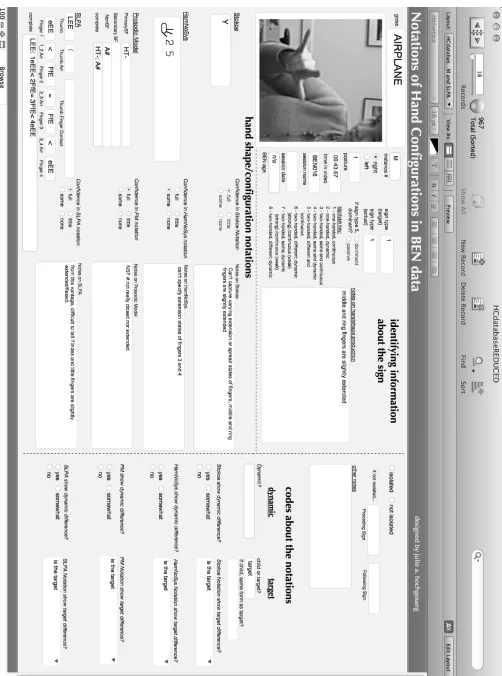
In the hand shape/ configuration notations section (lower left part of Figure 2), fields have been created for each possible section of a hand configuration notation schema in each notation system. There is one field each for Stokoe notation and HamNoSys. For PM notation, there are four fields, one for each “selected fingers” slot (PSF, SSF and NSF) and one for the complete notation. For the SLPA notation, there are 11 fields - one each for the following features: thumb opposability and joint extension, thumb-fingers arrangement, thumb-finger contact, finger 1 joint extension, finger 1 and 2 arrangement, finger 2 joint extension, finger 2 and 3 arrangement, finger 3 extension, finger 3 and 4 arrangement, and finger 4 extension; as well as one for the compete notation. As seen in Figure 2, each token is coded with a handshape label from Stokoe notation (e.g., Y), a hand configuration label from HamNoSys (e.g.,
), a handshape label from PM (e.g., HT-; A#), and a hand configuration label from SLPA (LEE⟨ 1eEE< 2FfE= 3FfE< 4eEE). This layout allows for notations from each system to be easily visible and accessible for the same token.Separate FileMaker Pro layouts were created for each notation system. This allowed the user to code all of the tokens for one notation system at once. This approach enables full attention to one notation system at a time therefore resulting in more consistency and less interference among the systems. A “cheat sheet” to the codes of each notation system is immediately accessible to the right of each layout for each notation system. This “cheat sheet” information minimized errors in entering codes for each system.
The field “Notes on (name of notation system)” was used to include any observations I had about using the
notation systems. “Confidence in (notation system)” field will be described in a later subsection.
5.
Representativeness of Notations
In order to analyze the representativeness of each notation system in notating hand configurations, each token in the dataset was coded using each notation system. A summary of the codes and their meanings is shown in Table 1.
Codes Level of representativeness
Full notation Representative
[or] notation Potential redundancy
[?] notation Not effectively representative
[Q] notation Not representative
Table 1. Codes for level of representativeness
Notations that were judged to represent the hand configurations accurately and discretely, appear as
complete notations, free of any [or], [?], or [Q] codes.
This indicates that the notation system is fully representative for that token. If more than one set of notations in the same notation system could represent the same hand configuration, all possible notations were entered with [or] separating each notation. This is an indicator that the notation system contains overlapping symbols (that is, more than one symbol or set of symbols represents the same information) as opposed to discrete symbols, a fact that challenges representativeness. If it was unsure that a notation represented the observed hand configuration, [?] symbolwas entered at the end of the notation. This can be either an indicator that the notation system is not effectively representative or that the transcriber could not apply it. If a symbol (or set of symbols) in the notation system could not be found to represent the observed hand configuration, a [Q] symbol was entered. This indicates that the system is not representative in that particular token.
5.1
Examples of notation codes
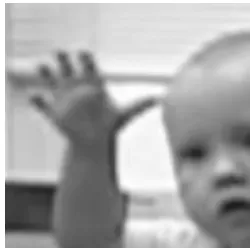
5.1.1 Full notationIf there was a symbol(or set of symbols)in the notation systems that fully described the hand configuration in a given token, the notation was deemed to be “representative” and received no additional code other than the notation using the labels from notation system. For instance, the hand configuration during the sign for “father” in ASL seen in Figure 3 was notated as [5] in
Stokoe notation since it matched the dictionary
description of the symbol, “spread hand; fingers and thumb spread like ‘5’ of manual numeration” (Stokoe et al., 1965, p. xi).
Figure 3. Child production of ASL sign FATHER
5.1.2 [or] notation
Figure 4. Child production of ASL sign BALL
Both base symbols signify that the fingers are not spread, the bending operator (the line above the base symbol) signifies that the fingers are bent (at the base joint), and the thumb symbol (the line sticking out of the bottom of the base symbols) signifies that the thumb is extended and opposed. The only apparent difference is that[
] is a thumb combination handshape which should be used when there is the potential for thumb-finger contact. Regardless of this difference, it still stands that it appears these two notations can represent the same hand configuration, thus receiving the [or] code.5.1.3 [?] code
If it could not be determined whether a symbol was
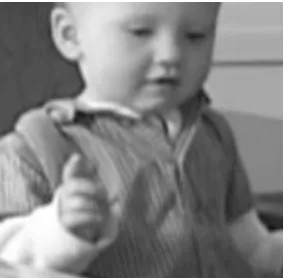
appropriate for the hand configuration in a given token, a [?] followed the notation. For example, with Stokoe notation, the hand configuration in the ASL sign glossed as “where” in Figure 5 did not entirely match any description in the dictionary.
Figure 5. Child production of ASL sign WHERE
The closest description is “index hand; like ‘g’ or sometimes like ‘d’; index finger points from fist” (Stokoe et al., 1965, p. xi). While the child’s index finger is extended creating an “index hand”, he does not exactly have a fist. His little, ring and middle fingers are somewhat flexed and the thumb is not flexed at all. This means his hand configuration does not exactly match the description. As a result, the hand in this token was coded as [G?] because there was no exact match between the handshape and a description. In cases like these, the closest approximate notation is used along with a [?] in the notation.
5.1.3 [Q] code
Finally, if it was unclear how to select notation symbols
in any system (or rather assign the appropriate codes to the appropriate slot for either PM or SLPA) for representing a hand configuration in a token, a [Q] code
was assigned to that token. For example, the first
postural segment in this child production of ASL “dog” shown in Figure 6 has been notated as [Q] for PM.
Figure 6. Child production of ASL sign DOG (first postural segment)
Some tokens received [Q] in only one slot and others in
two slots.
5.2 Notation Representativeness Codes
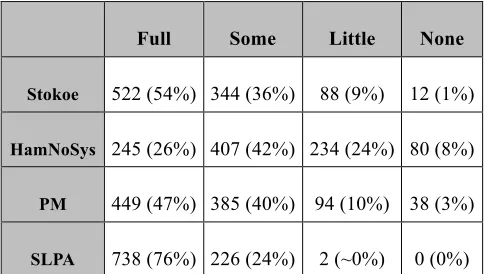
Essentially representativeness here means the ability (as measured by four codes developed for this database) to notate the state of the hand in chosen signs (37 ASL signs) from the study’s corpus (a total of 966 tokens). In Table 2, a summary of the results pulled from the database after coding and proofing the codes is provided.
Full code [or] [?] [Q]
Stokoe 586 199 163 18
HamNoSys 859 80 16 11
PM 719 20 216 11
SLPA 966 0 0 0
Table 2. Summary of representativeness codes