Combining dependency information and generalization in a pattern-based
approach to the classification of lexical-semantic relation instances
Silvia Necs¸ulescu
∗, Sara Mendes
∗†, N ´uria Bel
∗ ∗Universitat Pompeu FabraRoc Boronat, 138, Barcelona, Spain
{silvia.necsulescu, sara.mendes, nuria.bel}@upf.edu
†Centro de Lingu´ıstica da Universidade de Lisboa
Avenida Professor Gama Pinto, 2, Lisboa, Portugal [email protected]
Abstract
This work addresses the classification of word pairs as instances of lexical-semantic relations. The classification is approached by leveraging patterns of co-occurrence contexts from corpus data. The significance of using dependency information, of augmenting the set of dependency paths provided to the system, and of generalizing patterns using part-of-speech information for the classification of lexical-semantic relation instances is analyzed. Results show that dependency information is decisive to achieve better results both in precision and recall, while generalizing features based on dependency information by replacing lexical forms with their part-of-speech increases the coverage of classification systems. Our experiments also make apparent that approaches based on the context where word pairs co-occur are upper-bound-limited by the times these appear in the same sentence. Therefore strategies to use information across sentence boundaries are necessary.
Keywords:lexical-semantic relations, pattern-based classification systems, information extraction
1.
Introduction
The automatic classification of relation instances is an im-portant area for many NLP applications and tasks such as the automatic construction of relational language resources like WordNet (Miller, 1995) or for inference systems in the area of information retrieval and question answering (Pasca and Harabagiu, 2001).
The present article addresses the classification of word pairs as instances of lexical-semantic relations. For instance, the word pairs(table:leg)and(pan:handle)are both instances of the relation of meronymy: since tableshave legs and
panshavehandles;legandhandleare meronyms oftable
andpan, respectively.
Hearst (1992)’s seminal work in this area opened a line of research followed by many authors who have focused on the identification of specific relations like hypernymy
(Hearst, 1992; Ravichandran and Hovy, 2002; Snow et al., 2004),meronymy(Berland and Charniak, 1999; Girju et al., 2006),cause(Girju, 2003) andantonymy(Lin et al., 2003), resulting in dedicated approaches to each type of semantic relation. Considering the vast range of semantic relations connecting words, creating a different system for the iden-tification of each type of semantic relation available will tend to result in approaches lacking in generalization, be-sides being very inefficient as a global approach. Turney (2008b) proposes a unified treatment for all semantic rela-tions, approaching the classification of relation instances as an analogy task: a word pair has the relationrif it is sim-ilar to a known instance of relationr(see Section 2 for a more detailed presentation of the general lines of this ap-proach). A similar method, known as distant supervision, was applied by Mintz et al. (2009) for classifying relation instances regardingworld knowledge. These are relations
holding between named-entities, and typically used to pop-ulate knowledge databases such as Freebase (Bollacker et al., 2008) and Yago (Suchanek et al., 2007).
Although the identification of these two types of relations, lexical-semantic relations and world-knowledge relations, has been treated in a similar way in the literature, by re-lying on a set of example word pairs and their context of co-occurrence as the source of information provided to au-tomatic systems, each of these groups has different prop-erties, which are reflected in the distributional behavior of instances of these relations and thus in corpora data.
As aforementioned, world-knowledge relations typically hold between two named-entities, while lexical-semantic relations link words in any parto-of-speech. Moreover, a pair of named-entities can instantiate more than one seman-tic relation (Hoffmann et al., 2011; Surdeanu et al., 2012), which is never the case for lexical-semantic relations. For instance the entities Obama andUnited Statesinstantiate the relation BornIn, as well as the relationEmployedBy. Moreover, world-knowledge relations tend to be explicitly expressed in language data in sentences like Obama was born in the United States, for instance, in which the ex-plicit contextX was born in Yexpresses the relationBornIn
holding between the two entitiesObamaandUnited States. This is generally not the case for lexical-semantic relations, as these relations tend not to be explicitly expressed in lan-guage data, although they can be inferred from the set of contexts in which their instances occur.
For instance, Girju et al. (2003) extracted patterns of co-occurrence contexts for the relation of meronymy. 92.15% of these patterns were phrase-level patterns, such asX of Y
re-lation type which makes lexical-semantic rere-lation instances harder to classify.
In this paper we focus on lexical-semantic relations and we apply an approach similar to Turney (2008b)’s and Mintz et al. (2009)’s for the classification of instances of these se-mantic relations: starting from a set of examples of a target relationr, a supervised system automatically learns which patterns of co-occurrence contexts, as collected from cor-pus data, express the relationr; new word pairs are clas-sified based on the context where they co-occur in corpus. To accomplish this, the contexts where two words co-occur are transformed in a pattern by replacing each target word with a slot. These patterns are then used as cues to gather distributional information from corpus, and provide it to the classification system.
Naturally, the results of systems based on this approach depend on the amount of contexts where each word pair co-occurs and, due to the ubiquitous phenomenon of data sparseness, they are characterized by low recall scores. In the work presented in this paper, we focus on strategies for improving recall scores of pattern-based classification sys-tems using only information extracted from corpora. We use dependency paths, i.e. sequences of dependency relations, connecting two target words in a dependency graph output by a dependency parser as the context of co-occurrence of word pairs. Current systems based on this type of context use only the shortest dependency paths con-necting two target words (Snow et al., 2004; Mintz et al., 2009; Wu and Weld, 2010). One of the strategies proposed here is to leverage all the dependency paths up to three edges instead of only the shortest ones to create patterns of co-occurrence contexts. Additionally, to find similar-ities between slightly varying contexts of co-occurrence, and consequently increase the coverage of the automati-cally acquired patterns, we also test a generalization strat-egy based on part-of-speech information for creating more general patterns.
Therefore to overcome this upper-limit, strategies to use in-formation across sentence boundaries are necessary. The rest of the paper is structured as follows: Section 2. introduces previous work addressing the general research lines followed in this paper to address the general scientific problem described in Section 3.; Section 4. describes a sys-tem combining two strategies to improve recall scores of pattern-based systems for the classification of relation in-stances; Section 5. presents the experimental setup whose results are presented in Section 6. and discussed in Section 7.; final remarks are presented in Section 8.
2.
Previous work
Hearst (1992)’s work pioneered the automatic extraction of instances of semantic relations. This author manually cre-ated a set of lexical-syntactic patterns to find word pairs instantiating a relation of hypernymy. Berland and Char-niak (1999) developed a similar approach for identifying meronyms. These approaches are characterized by good precision but a very low recall due to the large variation of contexts expressing a semantic relation. In fact, although, for each relation there may be a small set of very pre-cise patterns, such as X is a part of Y for the relation of
meronymy, these do not necessarily occur with all the in-stances of the relation in a corpus. This way, to increase the recall of this type of approach additional patterns have to be developed, which increases development costs exponen-tially, as these patterns tend to be less frequent, thus having to be more numerous to effectively affect the coverage of the system.
To overcome these limitations and the high cost of man-ual development, approaches for automatically extracting patterns of co-occurrence have been developed. Snow et al. (2004) used WordNet to automatically acquire patterns based on dependency relations for hypernym extraction, Davidov and Rappoport (2006) used symmetry patterns and high frequency words for co-hyponym extraction, while Girju et al. (2006) used general patterns - patterns having high coverage of the corpus, but low precision -, manually annotated with semantic information extracted from Word-Net for meronym detection.
However, each of these authors focuses on a single specific relation, which results in the definition of different types of patterns for automatically identifying instances of each se-mantic relation. To avoid this, Turney (2008b) proposed a uniform approach for the classification of semantic relation instances. According to this author, the automatic identifi-cation of instances of any semantic relations is subsumed as an analogy task: given a target relationr, a word pair
(x, y)can be labeled as an instance of the semantic relation
rif(x, y)is analogous to a word pair(x, y)r, instance ofr.
This approach builds on thedistributional hypothesiswhich states that when two words have similar distributions they tend to share aspects of meaning. Thelatent relation hy-pothesis(Turney, 2005) reformulates the distributional hy-pothesis for pairs of words: pairs of words that co-occur in similar contexts tend to have the same lexical-semantic relation. Therefore, to recognize analogous word pairs, the similarity between their distributional behavior is cal-culated based on patterns extracted from the contexts in which both members of the pair co-occur. Starting from a set of examples, this author automatically acquired con-texts of co-occurrence from an input corpus and used them to generate lexicalized patterns of co-occurrence.
pat-screwdriver−−−→conj X
N←−−obj handleV −−→obj YN←−−−mod otherJ
screwdriver−−−→conj X
N←−−obj V−−→obj YN←−−−mod otherJ
screwdriver−−−→conj X
N←−−obj handleV −−→obj YN
screwdriver−−−→conj X
N←−−obj V−−→obj YN
XN←−−obj handleV −−→obj YN←−−−mod otherJ
XN←−−obj V−−→obj YN←−−−mod otherJ
XN←−−obj handleV −−→obj YN
XN←−−obj V−−→obj YN
Table 1: Examples of dependency patterns generated from the dependency pathscrewdriver−−−→conj hammer
N ←−−obj
handleV −−→obj toolN ←−−−mod otherJ
terns and patterns involving dependency information, are lexicalized patterns of co-occurrence. Due to data spar-sity both approaches are generally characterized by a low recall. In this work we test strategies for improving the re-call of systems leveraging patterns of co-occurrence created with dependency infomation, by using additional informa-tion extracted from corpora data. Our proposal consists in using all the dependency paths between two words up to three edges, instead of using only the shortest paths. We also introduce a generalization technique of the lexicalized patterns of co-occurrence based on part-of-speech informa-tion. We test these two strategies for classifying instances of five different lexical-semantic relations.
3.
Problem description
In the present work we address the classification of un-labeled word pairs as instances of lexical-semantic re-lations. This means that given a set of target seman-tic relations R = {r1, . . . , rn}, and a set of word pairs
W = {(x, y)1, . . . ,(x, y)n}, the classification of relation
instances consists in labeling each word pair (x, y)i with
the relationrj ∈Rthat holds between its members.
Con-sidering this, the output of the classification procedure is a set of tuples((x, y)i, rj), where(x, y)i∈W andrj∈R.
We approach the classification of relation instances as a su-pervised learner: given a set of target semantic relations
R ={r1, . . . , rn}, and a set of tuplesE = ((x, y)i, ri)of
relation instances for each relation, our system learns fea-tures that are associated with eachri ∈ R and outputs a
classifier. Then, given a new unlabeled pair (x, y)u, the
classifier decides if any of the relationsri ∈ Rholds
be-tweenxandy.
4.
Pattern-based Classification ModEl
As aforementioned, in our work, we aim to analyze the im-pact of combining dependency information with a pattern generalization method based on part-of-speech information for the classification of instances of lexical-semantic rela-tions.
Relying on the latent relation hypothesis (Turney, 2005), according to which pairs of words that co-occur in similar contexts tend to be instances of the same lexical-semantic relation, in our approach, word pairs are classified as in-stances of a semantic relation based on the context where its members co-occur. To do this, a set of features representing patterns of co-occurrence contexts is automatically created and used to create a vectorial representation for each word
pair. A supervised system is trained to learn how to clas-sify these word pairs based on the information in the feature vectors which represent their distributional behavior.
Further we refer to this systemPattern-basedClassification
ModEl (PaCE).
Feature Selection In our model, patterns of co-occurrrence are defined based on dependency relations be-tween words as collected from corpus data. To extract these dependency relations, the input corpus was initially parsed using the Stanford Parser in the ”collapsed dependency” format. Besides the dependency relations provided by the parser, we add a dependency relation vbV connecting the
subject with the object of a verbVin a given sentence. We assume that all the contexts in which the members of any word pair(x, y)co-occur are likely to provide informa-tion regarding the relainforma-tion that holds between them. There-fore, for each pair of words (x, y)that appears in the ini-tial set of examples E, all sentences containing xand y
are extracted. These sentences are then individually used to collect patterns of co-occurrence potentially indicating a semantic relation as follows: all the dependency paths be-tweenxandyup to three edges and containing only nouns, adjectives, verbs and adverbs are harvested from the de-pendency graph of each sentence; neighboring ”window” nodes that are not included in the path but are connected to one of the members of the word pair are added to the path; each dependency path is transformed into a pattern of co-occurrence by unlexicalizingxandy, i.e. xandyare replaced with a slot which can be filled in by any word with the same part-of-speech.
For finding similarities between patterns of co-occurrence slightly differently lexicalized, each pattern is generalized using part-of-speech information: 2(n−2)patterns are
gen-erated, nbeing the number of words on the initial depen-dency path, by iteratively replacing each word in the pattern with its part-of-speech. Window nodes are not submitted to this generalization procedure.
Finally, we filter out all the dependency patterns that do not co-occur with at leastkunique example word pairs in our corpus. For the present experiments we set k = 5, following Snow et al. (2004).
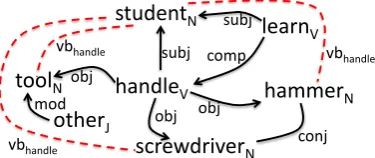
For instance, from the dependency graph of the sentence ”The students learned how to handle screwdrivers, ham-mers and other tools” shown in Figure 1, the path between
tool and hammer generates the patterns shown in Table 1. The dependency relations inserted between the subject and the object of a verb in a sentence are represented using dashed red lines.
Word Pair Representation For classifying a word pair
handle
Vstudent
Nlearn
V
screwdriver
Nhammer
Ntool
Nother
Jobj
obj obj
conj subj comp
mod
subj vbhandle
vbhandle
vbhandle
Figure 1: Dependency graph of the sentence ”The students learned how to handle screwdrivers, hammers and other tools.”. As mentioned, only words from the main part-of-speech are considered.
co-occurrence considered by the system1.
Classification In our experiments word pairs are classi-fied using an n-way multi-class SVM classifier with a radial basis function kernel (Platt, 1999). The system is trained by being provided with the feature vectors of word pairs from an initial small set of labeled relation instances. The trained SVM classifier is then used to determine whether an unla-beled word pair(x, y)uis an instance of a semantic relation
ri∈R.
As mentioned earlier, our approach relies on the assump-tion that any sentence in which a pair of words co-occurs is likely to provide information regarding the lexical se-mantic relation holding between them. Naturally, this does not necessarily hold for all the patterns of context acquired, as some of the features may not express any semantic re-lation of interest. For instance, the sentence I can feel my fingers and close my hand. contains the relation in-stance((hand, f inger), meronymy)but the context does not provide any information regarding the relation holding between hand and finger. We assume that the machine learning algorithm is able to discover which features are noisy, i.e. not informative for the task at hand, and to asso-ciate corresponding weights for minimizing errors in clas-sification results.
5.
Experiments
Our work addresses the classification of word pairs as in-stances of lexical-semantic relations. Systems developed to perform this task relying on the context of co-occurrence of words generally achieve good precision of classification but they typically score poorly on recall, as candidate word pairs must co-occur in the same type of context a sufficient number of times to provide enough distributional informa-tion to the system. The experiment presented in this paper has been designed to shed light on the impact of two strate-gies for potentially improving the recall of systems based on patterns of co-occurrence: the use of all the dependency paths between two words up to three edges instead of only the shortest ones; and the incorporation of a generalization
1
Preliminary experiments were run for finding the best per-forming way of representing the information in the vectors. We compared vectors in which occurrence information was repre-sented with binary information, mutual information and the log-arithm of the relative frequency. The best results were obtained using the logarithm of the frequency used in the experiments pre-sented in this paper.
strategy of the features used in classification based on part-of-speech information. These strategies are combined in the PaCE classification system (see Section 4.). For evalu-ating their impact in the classification of relation instances, we compare PaCE with three other systems.
PAIRCLASS The PairClass algorithm (Turney, 2008b) pro-vides a state-of-the-art pattern-based approach for classifying the relationship between word pairs, which has performed well for many relation types. Using a set of seed pairs(x, y)for each relation, PairClass ac-quires a set of lexical patterns using the template
[0 to 1 words] x [0 to 3 words] y [0 to 1 words]
From the initial set of lexical patterns extracted from a corpus, additional patterns are generated by option-ally generalizing each word to its part of speech. For
N seed pairs, the most frequent kN patterns are re-tained. We follow Turney (2008b) and setk = 20. The patterns retained are then used as features to train an SVM classifier over the set of possible relation types. Finally, we underline that in the original experi-ments, PairClass was trained using a corpus of5×1010
words, which is three orders of magnitude larger than the BNC corpus used in our experiments.
BASELINE As a baseline system for our experiments, we
use a similar system to the one developed by Snow et al. (2004). This approach uses the shortest paths connecting two target words in the dependency graph of a sentence as features for the classification of word pairs. Besides, for each target word in the path, a neighboring window node (see Section 2) can be added to the dependency path. For a correct compari-son, the baseline system uses the same classifier as the PaCE system.
BASELINEGEN For highlighting the importance of the
POS-generalization strategy incorporated in PaCE, we created a variant of the Baseline system that uses the same generalization strategy, but relies on the same features as the Baseline system.
PaCELEX For evaluating the specific contribution of con-sidering all the dependency paths between two words instead of using only the shortest ones, and the im-portance of the POS-generalization strategy used in PaCE, we provide results obtained with PaCELEX, a variant of the PaCE system that uses as features only lexicalized dependency paths up to three edges.
PATTERNS For completeness, we also constructed a
com-posite system using Hearst patterns (Hearst, 1992) for detecting hypernyms and co-hyponyms, and Bearland patterns (Berland and Charniak, 1999) for detecting meronyms. Classification is performed by measuring the frequency in corpus data of each relation pattern and then selecting the relation whose patterns occur more frequently2.
2
PATTERNS PAIRCLASS BASELINE BASELINEGEN PACELEX P
ACE UL
P. R. F. P. R. F. P. R. F. P. R. F. P. R. F. P. R. F. R.
ATTR 80.8 36.8 50.6 83.9 47.5 60.6 82.1 50.3 62.4 84.3 46.9 60.3 79.2 55.5 65.3 74
COORD 98.9 31.8 48.1 76.3 29.8 42.9 78 45.5 57.4 78.4 47.5 59.2 80.5 46.9 59.3 82 47.4 60.1 64.7
ACT 73.5 46.4 56.9 78.7 64.7 71 79.1 65 71.3 78.3 64.6 70.8 78.2 65.3 71.2 83
HYPO 58.1 10.8 18.2 25.4 21.9 23.5 88 13.2 22.9 85.9 13.7 23.6 88.4 14.2 24.5 73 17 27.5 60
MERO 70.2 18.9 29.7 67.4 33.5 44.7 75 43.7 55.3 73 46.2 56.6 74.8 44 55.4 69.3 48.3 56.9 73.9
ALL 83.8 23.3 36.5 66.8 35.6 46.4 78.9 47.6 59.4 78.4 49.3 60.5 79.4 48 59.8 77.1 51.1 61.4 72.8
Table 2: Precision (P), Recall (R) and F-measure (F) obtained by the 5 systems and 2 variations considered, across all relation types. In the last column we present the upper-limit for recall (UL) (see Section 7).
Dataset To evaluate our system for the classification of lexical-semantic relations we used the BLESS dataset (Ba-roni and Lenci, 2011). This dataset provides relation in-stances for 200 concepts, covering 17 topical domains, e.g., tools or fruit. The relations considered are the taxonomic relations holding between nouns - hypernymy (hammer, tool), co-hyponymy, i.e., coordinates (hammer, drill), and meronymy (hammer, handle) -, but also attributes of nouns (hammer, heavy), and actions done by or to a noun ( ham-mer, beat).
Corpora All systems were compared using distribu-tional information collected in the British Nadistribu-tional Corpus (BNC), a balanced 100-million word corpus, parsed with the Stanford dependency parser.
Evaluation We compare system performance based on the scores obtained for precision (P), recall (R) and F1-measure (F). Precision is defined as the percentage of cor-rect relation classifications of those made by a system; re-call is defined as the percentage of relation instances in the dataset correctly classified by a system. The F1 measure is the harmonic mean of precision and recall. All the systems were tested using stratified 10-fold cross validation per do-main. Results across all the domains are reported in Table 2.
6.
Results
We compared the results obtained for each semantic re-lation and the results obtained across all the rere-lations in-cluded in the BLESS dataset to assess the overall perfor-mance of each system. Overall, PaCE achieves statistically significant3 better results across all the measures
consid-ered. It overcomes the PairClass system by 6.3 points in precision, 13 points in recall and 11.8 points in F-measure4.
When compared with the Baseline, it scores 3.4 points
meronyms because no standard manually-designed patterns exist in the literature for the two remaining lexical-semantic relations considered in our experiments.
3Statistical significance was calculated using Student’s t-test
with a 95-percent confidence interval.
4
Furthermore, it should be noted that the approach used in the PairClass system, in contrast with all the other systems consid-ered, does not seem to work consistently for all types of semantic relations (see the poor performance of the system for the hyper-nymy relation in Table 2). Although further research would have to be conducted to support any analysis of these contrasts, the results obtained seem to suggest that the more asymmetric a se-mantic relation is, the more poorly this system performs.
higher in recall, losing 1.8 points in precision. The compar-ison between the Baseline and BaselineGEN shows that by using a generalization strategy based on part-of-speech the recall increases by 1.7 points whereas no statistically sig-nificant difference is observed in precision scores. Compar-ing the PaCE system with PaCELEX, 3.5 points are gained in recall but the precision decreases by 2.3 points. How-ever, according to the F-measure scores, which measures the balance between these two indicators of performance, PaCE is clearly the best performing system. The results for the Patterns system, calculated only for three relations (hypernymy, co-hyponymy and meronymy), show a high precision but a very low recall.
7.
Discussion
All the systems relying on dependency information achieve better results than the PairClass system, which does not use this type of information. This comparison shows the im-pact this type of information has both on precision and re-call across all the relations tested. The 8.1-point increase in precision achieved by the Baseline mirrors the greater reli-ability of patterns based on dependency information when compared against surface patterns. Additionally, the Base-line scores 12 points higher in recall, a difference that we attribute to the fact that these patterns go beyond the three word window used by Turney (2008b) and therefore pro-vide a larger amount of the data available in corpus to the classification system.
Comparing the PaCELEX system that uses all the
depen-dency paths up to three edges with the Baseline system that uses only the shortest paths no statistically signifi-cant differences are observed in the results. Therefore, we can conclude that even when only the shortest dependency paths are considered, the most important patterns of co-occurrence are already gathered.
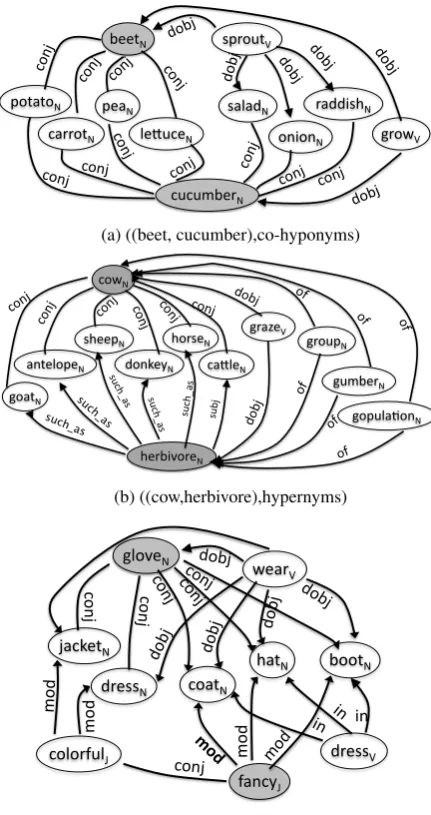
The positive impact of combining information on all depen-dency paths up to three edges with the POS-generalization strategy in the recall scores, as made apparent by the scores of the PaCE system, has nonetheless to be under-lined. In fact, comparing BaselineGEN with the Baseline
withcolorf ulJ, which is an adjectival modifier ofjacketN
anddressN, two words that occur in a coordination relation
withgloveN.
Therefore, for detecting new relation instances, valuable information can be extracted from parallel sentences sepa-rately containing occurrences of each individual member of a candidate pair and where the members of the pair share other co-occurring words. The vectorial representation of each individual target word captures this type of informa-tion but it is unclear how to use this informainforma-tion to assess whether a given lexical-semantic relation holds or not be-tween a candidate word pair. And yet, as made apparent by the examples above, dependency relations between in-dividual target words and shared third party co-occurring words may be a valuable indication of the relation holding between a word pair.
In future work we plan to investigate possible strategies to combine this type of shared dependency information be-tween the individual members of a candidate word pair.
8.
Conclusions
The present work addresses the impact of using all the de-pendency paths up to three edges, instead of only the short-est one, in combination with a generalization strategy using part-of-speech information in the classification of instances of lexical-semantic relations. The isolated use of all the de-pendency paths up to three edges has not resulted in any statistically significant improvements when compared with using only the shortest paths. POS-generalized patterns of co-occurrence, however, are able to correctly classify more candidate word pairs. But it is the combination of these two strategies that yield the highest increase in recall, 3.5 points, although this apparently results in a loss of preci-sion of the patterns of co-occurrence, as made apparent by the drop in precision by 2.3 points.
Finally, running an error analysis of the results obtained made apparent the need for new techniques to go be-yond sentence boundaries when harvesting information in pattern-based models for the classification of relation in-stances.
9.
Acknowledgements
The authors gratefully acknowledge the support of the CLARA project (EU-7FP-ITN-238405), of the SKATER project (Ministerio de Economa y Competitivi-dad, TIN2012-38584-C06-05) and of Fundac¸˜ao para a Ciˆencia e a Tecnologia (FCT) post-doctoral fellowship SFRH/BPD/79900/2011.
10.
References
Baroni, M. and Lenci, A. (2011). How we blessed dis-tributional semantic evaluation. In Proceedings of the Workshop on Geometrical Models of Natural Language Semantics, pages 1–10, Stroudsburg, PA, USA. Associa-tion for ComputaAssocia-tional Linguistics.
Berland, M. and Charniak, E. (1999). Finding parts in very large corpora. InProceedings of ACL, pages 57–64. As-sociation for Computational Linguistics.
Bollacker, K., Evans, C., Paritosh, P., Sturge, T., and Tay-lor, J. (2008). Freebase: a collaboratively created graph database for structuring human knowledge. In Proceed-ings of the 2008 ACM SIGMOD International Confer-ence on Management of Data, pages 1247–1250. ACM. Davidov, D. and Rappoport, A. (2006). Efficient
unsu-pervised discovery of word categories using symmetric patterns and high frequency words. In Proceedings of COLING-ACL, pages 297–304.
Girju, R., Badulescu, A., and Moldovan, D. (2003). Learn-ing semantic constraints for the automatic discovery of part-whole relations. In Proceedings of the 2003 Con-ference of the North American Chapter of the Associa-tion for ComputaAssocia-tional Linguistics on Human Language Technology - Volume 1, NAACL ’03, pages 1–8, Strouds-burg, PA, USA. Association for Computational Linguis-tics.
Girju, R., Badulescu, A., and Moldovan, D. I. (2006). Automatic discovery of part-whole relations. Computa-tional Linguistics, 32(1):83–135.
Girju, R. (2003). Automatic detection of causal relations for question answering. InProceedings of the ACL 2003 Workshop on Multilingual Summarization and Question Answering - Volume 12, MultiSumQA ’03, pages 76–83, Stroudsburg, PA, USA. Association for Computational Linguistics.
Hearst, M. A. (1992). Automatic acquisition of hyponyms from large text corpora. In Proceedings of COLING, pages 539–545.
Herdadelen, A. and Baroni, M. (2009). Bagpack: A gen-eral framework to represent semantic relations. In Pro-ceedings of the Workshop on Geometrical Models of Nat-ural Language Semantics, pages 33–40. Association for Computational Linguistics.
Hoffmann, R., Zhang, C., Ling, X., Zettlemoyer, L., and Weld, D. S. (2011). Knowledge-based weak supervision for information extraction of overlapping relations. In
Proceedings of the 49th Annual Meeting of the Associ-ation for ComputAssoci-ational Linguistics: Human Language Technologies-Volume 1, pages 541–550. Association for Computational Linguistics.
Lin, D., Zhao, S., Qin, L., and Zhou, M. (2003). Identify-ing synonyms among distributionally similar words. In
Proceedings of the 18th International Joint Conference on Artificial Intelligence, IJCAI’03, pages 1492–1493, San Francisco, CA, USA. Morgan Kaufmann Publishers Inc.
Miller, G. A. (1995). Wordnet: A lexical database for en-glish.Communications of the ACM, 38:39–41.
Mintz, M., Bills, S., Snow, R., and Jurafsky, D. (2009). Distant supervision for relation extraction without la-beled data. InProceedings of ACL-CONLL, pages 1003– 1011. Association for Computational Linguistics. Pasca, M. and Harabagiu, S. M. (2001). The informative
role of WordNet in open-domain question answering. In
Proceedings of NAACL-01 Workshop on WordNet and Other Lexical Resources, pages 138–143.
Burges, C. J. C., and Smola, A. J., editors,Advances in kernel methods, pages 185–208. MIT Press, Cambridge, MA, USA.
Ravichandran, D. and Hovy, E. H. (2002). Learning sur-face text patterns for a question answering system. In
Proceedings of ACL, pages 41–47.
Snow, R., Jurafsky, D., and Ng, A. Y. (2004). Learning syntactic patterns for automatic hypernym discovery. In
Proceedings of NIPS.
Suchanek, F. M., Kasneci, G., and Weikum, G. (2007). Yago: A core of semantic knowledge. InProceedings of the 16th International Conference on World Wide Web, WWW ’07, pages 697–706, New York, NY, USA. ACM. Surdeanu, M., Tibshirani, J., Nallapati, R., and Manning, C. D. (2012). Multi-instance multi-label learning for re-lation extraction. InProceedings of the 2012 Joint Con-ference on Empirical Methods in Natural Language Pro-cessing and Computational Natural Language Learning, pages 455–465. Association for Computational Linguis-tics.
Turney, P. (2005). Measuring semantic similarity by la-tent relational analysis. InProceedings of the Nineteenth International Joint Conference on Artificial Intelligence (IJCAI-05).
Turney, P. D. (2006a). Expressing implicit semantic rela-tions without supervision. InProceedings of COLING-ACL, pages 313–320. Association for Computational Linguistics.
Turney, P. D. (2006b). Similarity of semantic relations.
Computational Linguistics, 32(3):379–416.
Turney, P. D. (2008a). The latent relation mapping engine: Algorithm and experiments. J. Artif. Intell. Res.(JAIR), 33:615–655.
Turney, P. D. (2008b). A uniform approach to analogies, synonyms, antonyms, and associations. InProceedings of COLING, pages 905–912.
Turney, P. D. (2013). Distributional semantics beyond words: Supervised learning of analogy and paraphrase.
arXiv preprint arXiv:1310.5042.