Modeling, Managing, Exposing, and Linking Ontologies with a Wiki-based Tool
Alessio Bosca
1, Matteo Casu
1, Mauro Dragoni
2, Andi Rexha
31Celi s.r.l., Via S.Quintino 31, I-10131, Torino, Italy 2FBK–IRST, Trento, Italy
3Know-Center Graz, Graz, Austria
alessio.bosca—[email protected] [email protected] [email protected]
Abstract
In the last decade, the need of having effective and useful tools for the creation and the management of linguistic resources significantly increased. One of the main reasons is the necessity of building linguistic resources (LRs) that, besides the goal of expressing effectively the domain that users want to model, may be exploited in several ways. In this paper we present a wiki-based collaborative tool for modeling ontologies, and more in general any kind of linguistic resources, called MoKi. This tool has been customized in the context of an EU-funded project for addressing three important aspects of LRs modeling: (i) the exposure of the created LRs, (ii) for providing features for linking the created resources to external ones, and (iii) for producing multilingual LRs in a safe manner.
Keywords:Ontology Authoring, Collaborative Modeling, Multilinguality
1.
Introduction
The construction of effective LRs is one of the most impor-tant aspects for improving the quality of information sys-tems like ones that widely perform natural language pro-cessing and information retrieval activities. Recently, the wide usage of LRs raised the necessity of building such ar-tifacts in a way that grants their quality and the possibility of easily exploiting them. Here, we want to focus on four important challenges concerning the creation and mainte-nance of LRs.
Collaboration It is nowadays well-established that craft-ing LRs has become a teamwork activity, as it requires a range of knowledge and skills hardly findable all together in a single person. For this reason, collaborative aspects in LRs modeling, in particular concerning ontologies, have been investigated, and several works to support and en-hance collaboration in this context have been presented (see e.g. (Palma et al., 2011; Dimitrova et al., 2008)). The re-quirements and features that have emerged from these stud-ies highlighted the need to support collaboration in an ar-ticulated way: from supporting the collaboration between who understands the domain to be represented (the domain expert) and who has proper expertise in LRs modeling (the knowledge engineer), in order to support communication, discussion, and decision making between (geographically) distributed teams of contributors. Supporting collaboration requires enabling the awareness of the user on the evolu-tion of the modeling artifacts, favoring the coordinaevolu-tion of the modeling effort within the team, as well as fostering the communication of the modeling choices and decisions made among the modeling actors.
Multilinguality With the recent rapid diffusion over the international computer networks of world wide distributed document bases, the issue of multilinguality is becoming increasingly relevant. So far, research and development activities have been concentrated on monolingual environ-ments and, in the large majority of cases, the default lan-guage has been English. Although English admittedly tends to play a predominant role in international
communica-tions, the diversity of the world’s languages and cultures gives rise to an enormous wealth of knowledge and ideas. A clear example of this scenario is represented by users throughout the world that, independently of their native tongue, want to access to the massive volumes of informa-tion available over the networks and, in particular, over the World Wide Web. Together with the growth of these re-quests, the LRs community has started exploring the possi-bility to use multilinguality for increasing the expressive-ness of the artifacts, which are more and more used for enhancing the information associated to the available re-sources. A recent example, which witnesses the impor-tance of multilinguality in the field of ontology engineer-ing, is provided by the Monnet Project1, which targets the problem of multilingual information access at the semantic level (McCrae et al., 2011).
Exposure The growth of complex and distributed plat-forms, especially when Web Services are widely used, re-quired the necessity of making the built LRs available through the network in order to permit their usage. Such a feature includes the necessity of exposing all information in several standard formats that may also evolve through the time; therefore, an effective exposure service is necessary when there is an intensive usage of LRs in very dynamic contexts.
Linking The last aspect concerns the necessity of linking the modeled LRs with the existing ones. With the grown of interest in creating semantic artifacts for representing knowledge, the possibility of defining effective links be-tween different artifacts permits to spread knowledge not only for enriching the representation of the knowledge it-self, but also for breaking language barriers in accessing contents. One of the most general benefit of having map-ping facilities is the possibility of quickly enrich original (”local”) artifacts with information coming from external artifacts, without the need of redefining knowledge in the “local” one.
1
through the integration of the Solr search engine.
VocBench19 is a web-based, multilingual, editing and workflow tool that manages thesauri, authority lists and glossaries using SKOS-XL. Designed to meet the needs of semantic web and linked data environments, VocBench provides tools and functionalities that facilitate both col-laborative editing and multilingual terminology. It also in-cludes administration and group management features that permit flexible roles for maintenance, validation and publi-cation. The tool is designed to allow external developers to add functionality via plug-ins without disturbing the core; with Prot´eg´e, these are the only tools that foreseen an ex-panding mechanism of their functionalities through plug-ins, or others. Finally, it provides a native for SKOS for the management of multiple triple-stores.
In the next Section, we will present the collaborative tool presented in this paper, while the discussion and its com-parison with respect to the ones described above will be provided in Section 4..
3.
The
MoKi
Tool
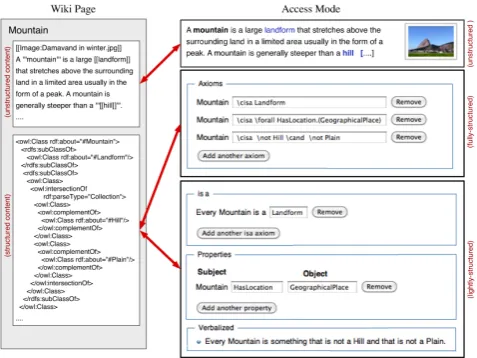
MoKi20 is a collaborative MediaWiki -based (Wikimedia Foundation, 2012) tool for modeling ontological and procedural knowledge in an integrated manner21. MoKiis grounded on three main pillars, which we briefly illustrate with the help of Figure 1:
• each basic entity of the ontology (i.e., concepts, object and datatype properties, and individuals) is associated to a wiki page. For instance, the concept Mountain in Figure 1 is associated to a wiki page which contains its description;
• each wiki page describes an entity by means of both unstructured (e.g., free text, images) and structured (e.g. OWL axioms) content;
• a multi-mode access to the page content is provided to support easy usage by users with different skills and competencies.
The multi-mode access is the key feature that permits the support of collaboration between different types of users. Figure 1 shows the three access modes, implemented in MoKi, for accessing the unstructured and structured con-tent of the wiki page:
• the unstructured access mode allows the user to edit/view the unstructured part of aMoKipage. Edit-ing/viewing occurs in the standardMediaWikiway;
• the fully-structured access mode allows the user to edit/view the structured part of a MoKi page using the full OWL 2 expressiveness22 and is meant to be
19
http://vocbench.uniroma2.it/
20
http://moki.fbk.eu
21
ThoughMoKiallows to model both ontological and proce-dural knowledge, here we will limit our description only to the features for building ontologies.
22We adopt the syntax oflatex2owl: https://dkm.fbk.
eu/index.php/Latex2owl
Figure 1: A page and the access modes inMoKi
used by knowledge engineers to author the formal statements describing the entity associated to the wiki page;
• the lightly-structured access mode enables users to edit/view the content of the structured part of theMoKi page in a simplified way. This access mode, consists of a form meant to be used by domain experts, and contains statements that correspond to all the axioms in the fully-structured access mode. In the upper part the user can view and edit simple statements which can be easily converted to/from OWL statements. An ex-ample is the uppermost statement “Every Mountain is a Landform” in the lightly-structured access mode of Figure 1. The bottom part of the form provides a ver-bal description (automatically obtained via the OWL 2 Verbalizer (Kaljurand and Fuchs, 2007)) of those OWL statements which cannot be intuitively trans-lated/edited as simple statements in the upper part of the page. The purpose of this verbal description is to give the domain expert a flavor of the complex state-ments that the knowledge engineer has formalized. If doubtful about some of the statements, the domain ex-pert can mark them and ask for a clarification using e.g., the Discussion mechanism.
A comprehensive description of core version of MoKi is presented in (Ghidini et al., 2012).
3.1. Supporting the Collaborative Modeling of Multilingual Ontologies withMoKi
In this subsection, we describe the main customizations im-plemented in the MoKi tool for providing support to the collaborative multilingual management and exposure of on-tologies and, more in general, LRs.
Figure 2: Example of started discussion.
features ofMoKi, expanded with the possibility of assign-ing specific tasks of ontology entity evolution to specific experts who need to monitor, check, and approve the sug-gested change. This customization promotes the manage-ment of the changes carried out on the ontology (both at domain and linguistic layer) by providing the facilities nec-essary to manage the ontology entity life-cycle.
These facilities may be split in two different sets of features. The first group may be considered as a monitor of the ac-tivities performed on each entity page. When changes are committed, approval requests are created (Figure 3). They contain the identification of the expert in charge of approv-ing the change, the date in which the change has been per-formed, and a natural language description of the change. Moreover, a mechanism for managing the approvals and for maintaining the history of all approval requests for each en-tity is provided. The second set of features contains the fa-cilities for managing the discussions associated with each entity page. A user interface for creating the discussions has been implemented together with a notification proce-dure that alerts users when new topics/replies, related to the discussions they are following, are posted (Figure 2). Therefore, MoKiprovides a set ofMediaWiki-based col-laborative editing functionalities, such as:
• Discussions: to discuss about challenging issues re-lated to the ontology modeling. It is possible to discuss on single ontology entities or on (a part of) the whole model. Comments in the discussion pages are orga-nized in threads, with details on the user and date/time associated to each comment;
• Watchlist: to monitor interesting ontology entities. Any change performed on monitored ontology enti-ties is notified (with messages and email alerts) to the user;
• Notifications: to inform users about ontology changes that are relevant for them. E-mail or message notifica-tions are automatically sent in case changes to pages in the users’ watchlist occur. Users can also send spe-cific notifications, soliciting a confirmation or revision on some aspects of the ontology from particular users;
• History and Revision: to track changes and comments added on a specific ontology entity.
Multilinguality Management Features. MoKi is equipped with a set of features for enabling both manual and automatic translation of labels and descriptions asso-ciated to each entity defined by users into ontologies and vocabularies that they are modeling. Manual translations may be provided with a custom interface, while automatic suggestions are available through a connector that invokes
Figure 3: Approval box.
Figure 4: Quick translation box for editing entities transla-tions
external translation services. Concerning automatic translation, the component sends the request to APIs exposed by third-party translation services (for instance, Microsoft Bing23) and, after the retrieval of the result, the representation of the entity is updated with the returned information. Further details, about the translation services currently supported byMoKican be found in (Dragoni et al., 2011).
Also the export functionality, which enables the dump of the linguistic artifact in several semantic web formats (OWL, SKOS, etc.), has been revisited in the light of mul-tilinguality, by adding the possibility to choose the export languages, among the available ones.
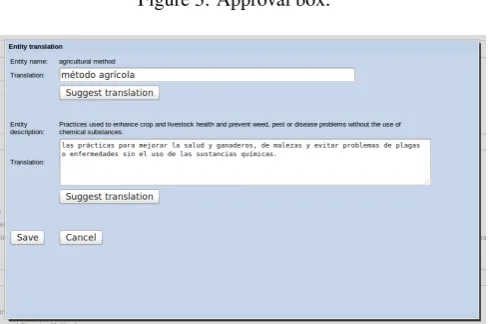
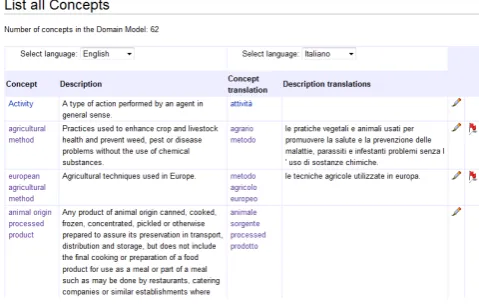
For facilitating the work of language experts, we have im-plemented the possibility of comparing side-by-side two lists of translations. This way, the language expert in charge of revising the translations, avoiding to navigate among the entity pages, is able to speed-up the revision process. Figure 5 shows such a view, by presenting the list of con-cepts in the English and Italian translations. At the right of each element of the table, it is placed a link allowing to invoke a quick translation box (as shown in Figure 4) that gives the opportunity to quickly modify information with-out opening the entity page. Finally, in the last column, it is placed a flag indicating that changes have been performed on that concept, and a revision/approval is requested.
Linked Open Data Service. In order to permit the expo-sure of the ontology artifact to third-party services, MoKi has been equipped with a service that exposes entity infor-mation by using Linked Open Data formats. Such a service offers the possibility to perform operations on the ontology remotely; examples of available remote operations are the
23
Figure 5: View for comparing entities translations
retrieval of the entire ontology, or part of it, or the possi-bility to edit the ontology e.g., by adding a new translated label. The service provides a RESTful interface for receiv-ing the requests, while the results are exposed by usreceiv-ing the SKOS language24.
This customization has been implemented for providing an exposure feature that permits the linking betweenMoKiand external third-party tools that want to exploit the modeled artifacts. The interface of the service allows to retrieve on-tology data by sending POST or GET requests to the ser-vice. The current version of the service is able to under-stand four different parameters:
• “method”: the name of the method that the client wants to invoke (see (Dragoni, 2014) for the list of the available methods);
• “concept”: the name of the concept for which the client wants to retrieve information;
• “langid”: the identification code of the language used for filtering the results;
• “updatetimestamp”: used when the client wants to re-trieve only the list of the concepts updated after a cer-tain timestamp.
Entity Linking Component. Linking the local ontology to external ones provides a big benefit for extending the local knowledge and also for navigating through external resources. In order to supply these benefits,MoKihas been extended with an Ontology Linking component, which of-fers to experts a set of suggestions for candidate matching concepts, ranked by their confidence. This component has been designed as an iterative process implemented in two steps:
• Syntactic search: similar concepts, based on their la-bel content and description, are searched. This phase uses a syntactic match, based on label similarity algo-rithms, enriched with semantic information (like syn-onyms). The results are computed starting from a set of pre-indexed resources generally expressed in linked open data formats.
24
http://www.w3.org/2004/02/skos/
• Feedback re-rank: suggestions are re-ranked accord-ing to feedbacks provided by the users. This phase uses previous accepted mappings to boost and improve the results of theSyntactic search
The first step is used in some of the state of the art ap-proaches like in (William W Cohen, 2003). Semantic rela-tionships may not be exploit from the word similarity, but multilinguality in this case, raises chances of syntactic sim-ilarity.
The other advantage of this component is the feedback from the user. Such feedbacks allows to have a partial alignment of the ontology and orient the search for similar concept to a certain subset of concepts. This is very important to avoid false positive results of theSyntactic searchstep. It also gives room for the implementation of further machine learning technique allowing the improvement of the Syn-tactic searchby learning weights of the terms occurring in the labels and description.
Practically, from the concept page it is possible to invoke an external service that receives as input a bean containing all information related to the concept that has to be mapped (in case of multilingual representation of the concept all labels and all descriptions are used), and that returns a list of candidate concepts that can be mapped. The user has only to select which concept, if any, is a good mapping to the local one.
Figure 6 shows how the list of candidate mappings appears when new request is sent.
Figure 6: Candidate mappings.
4.
Remarks
In this Section, we discuss the features of MoKiwith re-spect to the state of the art in order to highlight which were the improvement carried out in the presented version with respect to the real-world knowledge management environ-ment.
In particular, we focused on how MoKi addressed chal-lenges described in Section 1. and how they have been ad-dressed by the other tools. In particular, the facilities that we have considered are the following:
• support for collaboration between users; as collabo-ration, we also consider the facilities for non-formal experts people;
• general ontology management; the support for manag-ing multiple ontologies in the same environment;
• ontology mapping; the support for linking the modeled ontologies with other within the same environment or through external services;
• ontology suggestion; the support of automatic enrich-ment of ontologies starting from the analysis of text sources;
• ontology exposure; if ontologies are exposed through API interface or Web Services;
• ontology evolution; how the versioning of modeled ontologies is managed and how these information are exposed to third-party services that may be exploit them for further activities.
If we analyze the features of all other tools, we may notice that the only two aspects widely supported are the general ontology management and the ontology exposure. About the first one, even it should be foregone by all ontology management tool, some of them only provide simple mech-anisms for editing single ontologies or controlled vocab-ularies without providing the support for managing more complex scenario like the one in which multiple ontolo-gies that have to be mapped each other. Instead, concern-ing knowledge exposure, most of the tools provide effective module for publishing modeled data both in a natural lan-guage or in a structured way. This aspect is crucial nowa-days by considering the importance of connecting different services to the Linked Open Data cloud.
Concerning ontology evolution, some of the comprehen-sive ontology tools support the versioning of the ontologies and the tracking of their changes; however, it is not speci-fied if these information are exposed or not. In (Dragoni et al., 2011), we explained why it is important also to expose these information. Briefly, if third-party tools have such information available, they may exploit them for activities like tagging and retrieval of resources that are compatible, from a “temporal” point of view, with old versions of the ontologies.
Another aspect that has been taken into account by some tools is the possibility of managing the multilinguality of the ontologies as well as the definition of mappings be-tween concepts. However, while the axiomatization of such information is simple to implement from a technical point of view; it is different the fact of providing a mechanism that is able to support the possibility of plugging differ-ent external services providing such facilities (i.e. machine translation and ontology mapping). Indeed, the possibility of plugging different services allows to equip the model-ing tools with facilities that may be more effective with re-spect to the domain that users want to model. Let’s consider as example the agricultural domain: the use of domain-adapted services, i.e. for translating concept labels and descriptions, as well as, the suggestion of candidate map-pings with concepts defined in external ontologies, allows
to avoid issues concerning ambiguities and incorrect words in translations, as well as, to improve the effectiveness of the suggested mappings.
Finally, two kind of features that, in general, are not present in almost all tools, or that have been investigated just pre-liminarily, is the collaboration between users, and the pos-sibility of analyzing external textual sources for retriev-ing suggestions about possible enrichment of the ontology. Concerning collaboration, we have seen in Section 2., that this aspect has been faced by providing the supporting of working remotely for modeling the same ontology (or vo-cabulary). Unfortunately, this is not enough for providing a full support for collaborative modeling. Indeed, as “col-laboration”, we do not mean just the possibility of model-ing somethmodel-ing by users geographically distributed, but from users with different expertise. Such users need facilities that allow them to model knowledge without having expe-rience in writing axioms of in formalizing entity relation-ships. The same is for the ontology suggestion task, where only one tool (i.e. PoolParty) provides the possibility of analysis text for extracting terms that may be exploited as candidate suggestions for enriching the ontology. Indeed, even this feature has been thought for tagging resources, and not for suggesting terms, this is the only facilities ap-proaching the suggestion task.
By performing a “skimming ” of the tools presented in the previous section, with respect to the challenges focused in this paper, we identified that the only tools that may be compared with the MoKi are four: Neon, VocBench,
Prot´eg´e, and Knoodl. While the first two, Neon and
VocBench, are the ones more oriented for supporting the management of multilinguality in ontologies; while their support for collaboration is quite limited. On the contrary,
Prot´eg´eandKnoodlprovide some step ahead with respect the previous ones concerning collaboration, while their sup-port for multilinguality is restricted to the description of the labels. Finally, an interesting aspect is given by the possi-bility, inVocBenchand inProt´eg´e, of implementing plug-ins for extending the core functionalities. This open envi-ronment gives the room for the potential implementation of connectors with external services.
MoKihas been evaluated in two different context:
• the usability and the usefulness of the tool has been measured in a real-world use case within the Or-ganic.Lingua EU project. The results and the lessons learned may be found in (Dragoni et al., 2013).
• the quality of the multilingual ontologies modeled in a collaborative way by different experts supported by the tool facilities have been injected in a Cross-Language Information Retrieval system in order to evaluate the impact of such ontologies on systems ef-fectiveness. The results have been presented and dis-cussed in (Dragoni, 2014).
users with different expertise and the implementation of components supporting the plug of different external ser-vices for several ontology management tasks like domain-based translations, ontology mappings, and suggestion ser-vices for ontology enrichment.
On the contrary, from a critical point of view, the main lack of MoKiis related to its usability that sometimes is quite complicated due to the difficulty of merging all manage-ment workflows implemanage-mented with the tool. This is the point will be mainly taken into account for the general im-provement of the tool.
5.
Conclusions
In this paper we presented a tool for modeling multilingual ontologies, but usable also for building any kind of LRs, in a collaborative way. We briefly discussed the challenges concerning the modeling tasks in the collaborative environ-ment, as well as the problematics related to the multilin-guality, the exposure, and the linking of the created arti-facts. We shown a state of the art of knowledge modeling, and we presented a collaborative modeling wiki-based tool customized in order to provide a set of features able to ad-dress the presented challenges.
6.
References
Bellahsene, Zohra, Bonifati, Angela, and Rahm, Er-hard, editors. (2011). Schema Matching and Mapping. Springer.
Dimitrova, Vania, Denaux, Ronald, Hart, Glen, Dolbear, Catherine, Holt, Ian, and Cohn, Anthony G. (2008). In-volving domain experts in authoring owl ontologies. In
Proceedings of the 7th Int. Semantic Web Conference (ISWC 2008), volume 5318/2010 ofLNCS, pages 1–16. Springer Berlin / Heidelberg.
Dragoni, Mauro, Ghidini, Chiara, Stoitsis, Giannis, Si-cilia, Miguel Angel, and Sanchez-Alonso, Salvador. (2011). Recommendations for revising existing ontolo-gies and schemas. Organic.Lingua EU Project, Deliver-able D3.1.1.
Dragoni, Mauro, Francescomarino, Chiara Di, Ghidini, Chiara, Clemente, Julia, and Alonso, Salvador S´anchez. (2013). Guiding the evolution of a multilingual ontol-ogy in a concrete setting. In Cimiano, Philipp, Corcho,
´
Oscar, Presutti, Valentina, Hollink, Laura, and Rudolph, Sebastian, editors,ESWC, volume 7882 ofLecture Notes in Computer Science, pages 608–622. Springer.
Dragoni, Mauro. (2014). Revised (final) organic.lingua moki. Organic.Lingua EU Project, Deliverable D3.2.1.3. Euzenat, J´erˆome and Shvaiko, Pavel. (2007). Ontology
matching. Springer.
Ghidini, Chiara, Rospocher, Marco, and Serafini, Luciano. (2012). Conceptual modeling in wikis: a reference ar-chitecture and a tool. IneKNOW2012, Valencia, Spain, pages 128–135.
Kaljurand, Kaarel and Fuchs, Norbert E. (2007). Verbal-izing owl in attempto controlled english. InProceedings of Third International Workshop on OWL: Experiences and Directions, Innsbruck, Austria (6th–7th June 2007), volume 258.
Wikimedia Foundation. (2012). Mediawiki. http://www.mediawiki.org.
McCrae, J., Spohr, D., and Cimiano, P. (2011). Linking lexical resources and ontologies on the semantic web with lemon. InESWC (1), volume 6643 ofLecture Notes in Computer Science, pages 245–259. Springer.
Palma, Ra´ul, Corcho, Oscar, G´omez-P´erez, Asunci´on, and Haase, Peter. (2011). A holistic approach to collabo-rative ontology development based on change manage-ment. Web Semantics: Science, Services and Agents on the World Wide Web, 9(3).