Language Resources and Annotation Tools for Cross-Sentence Relation
Extraction
Sebastian Krause, Hong Li, Feiyu Xu, Hans Uszkoreit, Robert Hummel, Luise Spielhagen
Language Technology LabGerman Research Center for Artificial Intelligence (DFKI) Alt-Moabit 91c, 10559 Berlin, Germany
{skrause, lihong, feiyu, uszkoreit, rohu01, masp04}@dfki.de
Abstract
In this paper, we present a novel combination of two types of language resources dedicated to the detection of relevant relations (RE) such as events or facts across sentence boundaries. One of the two resources is thesar-graph, which aggregates for each target relation ten thousands of linguistic patterns of semantically associated relations that signal instances of the target relation (Uszkoreit and Xu, 2013). These have been learned from the Web by intra-sentence pattern extraction (Krause et al., 2012) and after semantic filtering and enriching have been automatically combined into a single graph. The other resource iscockrACE, a specially annotated corpus for the training and evaluation of cross-sentence RE. By employing our powerful annotation tool Recon, annotators mark selected entities and relations (including events), coreference relations among these entities and events, and also terms that are semantically related to the relevant relations and events. This paper describes how the two resources are created and how they complement each other.
Keywords:corpus annotation, coreference resolution, information extraction
1.
Introduction
In detecting relation instances within sentences, good re-sults were achieved by distant-supervision RE with seed ex-amples from a knowledge base such as Freebase, finding in-stances on the web by a search engine and preprocessing of mentions by named-entity detection and dependency pars-ing. In (Moro et al., 2013), we could demonstrate how the method could be used for n-ary relations and how semantic filtering with lexical-semantics resources such as BabelNet (Navigli and Ponzetto, 2012) effectively boosted precision. Extending the method to cross-sentence relation mentions poses several challenges. Among them are (i) coreference resolution, (ii) finding instances of semantically related re-lations that refer to individual arguments and aspects of the target relation and (iii) piecing them together to the appro-priate tuples of the target relation. For tackling (i) we are extending an approach by (Xu et al., 2008) that uses domain knowledge and reduces the problem of coreference resolu-tion to the coreferences of immediate relevance for RE. For (ii) we initially work with the rules we acquired from intra-sentential RE since our approach also learns rules or pro-jections of the target relation as long as the main arguments are present. For (iii) we have combined the learned depen-dency patterns from our rules into a large directed graph termedsar-graph, which we will describe in the following section.
The second new type of language resource applies ACE compliant annotation to the marking of kinship relations. All direct and indirect mentions of three next-of-kin rela-tions (marriage, parenthood, sibling) and relevant coref-erences for the recognition of these mentions within and across sentence boundaries are annotated in English texts from PEOPLE magazine. The resulting corpus with ACE compliant annotation, which we callcockrACE(corpus of coreferences and kinship relations in ACE fashion), will be made freely available to the scientific community for use
in research on relation extraction, coreference resolution, textual inference and for any other purpose.
For our own research, cockrACE serves three purposes: Parts of the it will be utilized for establishing a research baseline by measuring recall and precision of RE across sentence boundaries with available means, i.e. with and without sar-graphs and existing coreference resolution in order to evaluate their contributions. A second purpose is the learning of additional patterns needed for cross-sentence RE and for the training of improved specialized coreference resolution. The third application is then not surprisingly the evaluation of the improved RE system by some withheld portion.
2.
Sar-graphs
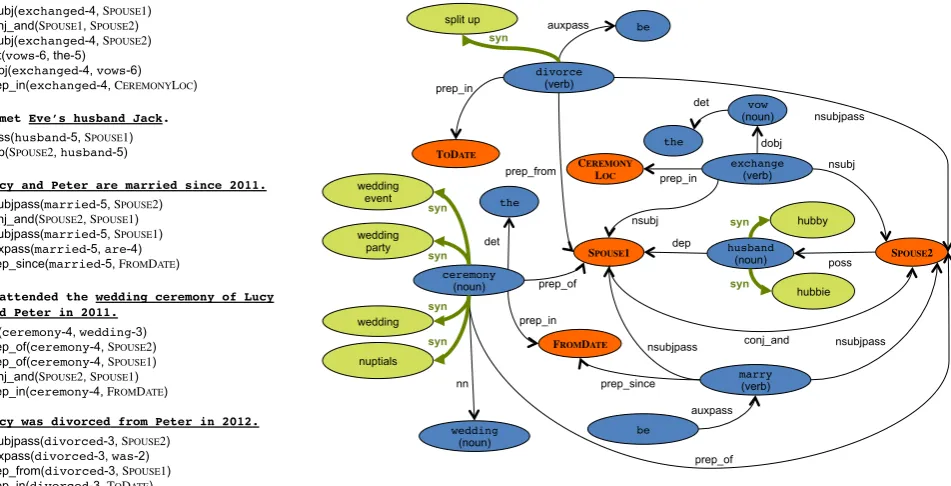
A sar-graph is a graph containing linguistic knowledge at syntactic and lexical semantic levels for a given lan-guage and target relation1. The nodes in a sar-graph are either semantic arguments of a target relation or content words (to be more exact, their word senses) needed to ex-press/recognize an instance of the relation. The nodes are connected by two kinds of edges: syntactic dependency-structure relations and lexical semantic relations. Thus they are labeled with dependency-structure tags provided by the parser or lexical-semantic relation tags. A formal definition can be found in (Uszkoreit and Xu, 2013).
A sar-graph can be built for every n-ary relation Rha1, ..., ani(such asmarriage: R〈SPOUSE1, SPOUSE2,
CEREMONYLOC, FROMDATE, TODATE〉) and every lan-guagel.
Figure 1 shows a simplified sar-graph for two English con-structions wheremarriagerelations are mentioned. From
1The construction of sar-graphs is part of our Google
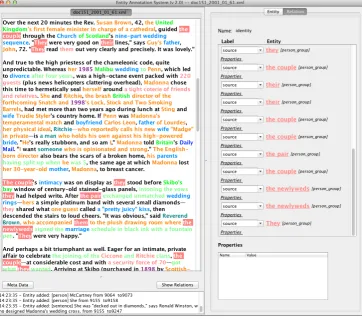
Figure 3: Annotation of cross-sentence relation mention in Recon, cf. Example 1.
Google through a Focused Research Award granted in July 2013.
8.
References
George Doddington, Alexis Mitchell, Mark Przybocki, Lance Ramshaw, Stephanie Strassel, and Ralph Weischedel. 2004. The automatic content extraction (ace) program tasks, data, and evaluation. In Pro-ceedings of the Fourth International Conference on Language Resources and Evaluation (LREC’04). Jenny Rose Finkel, Trond Grenager, and Christopher
Man-ning. 2005. Incorporating non-local information into in-formation extraction systems by Gibbs sampling. In Pro-ceedings of the 43nd Annual Meeting of the Association for Computational Linguistics (ACL 2005).
Laura Hasler, Constantin Orasan, and Karin Naumann. 2006. NPs for events: Experiments in coreference annotation. In Proceedings of the Fifth International Conference on Language Resources and Evaluation (LREC’06).
Erwin R. Komen. 2009. Coreference annotation guidelines. Technical report, Radboud University.
http://erwinkomen.ruhosting.nl/doc/2009_Core
fCodingManual_V2-0.pdf.
Sebastian Krause, Hong Li, Hans Uszkoreit, and Feiyu Xu. 2012. Large-scale learning of relation-extraction rules with distant supervision from the web. In Proceed-ings of the 11th International Semantic Web Conference. Springer, 11.
Hong Li, Xiwen Cheng, Kristina Adson, Tal Kirshboim, and Feiyu Xu. 2012. Annotating opinions in german po-litical news. In Nicoletta Calzolari (Conference Chair), Khalid Choukri, Thierry Declerck, Mehmet U˘gur Do˘gan, Bente Maegaard, Joseph Mariani, Jan Odijk, and Ste-lios Piperidis, editors,Proceedings of the Eight Interna-tional Conference on Language Resources and Evalua-tion (LREC’12), Istanbul, Turkey, May. European Lan-guage Resources Association (ELRA).
Hong Li, Sebastian Krause, Feiyu Xu, Hans Uszkoreit, Robert Hummel, and Veselina Mironova. 2014. Anno-tating relation mentions in tabloid press. InProceedings of the Nineth International Conference on Language Re-sources and Evaluation (LREC’14).
Linguistic Data Consortium. 2005. Annotation guide-lines for entity detection and tracking (EDT). An-notation guidelines accompanying the LDC corpus LDC2005T09.http://catalog.ldc.upenn.edu/docs /LDC2005T09/guidelines/EnglishEDTV4-2-6.PDF. Ruslan Mitkov, Richard Evans, Constantin Orasan,
Catalina Barbu, Lisa Jones, and Violeta Sotirova. 2000. Coreference and anaphora: developing annotating tools, annotated resources and annotation strategies. In Pro-ceedings of the Discourse Anaphora and Reference Res-olution Conference (DAARC2000).
Andrea Moro, Hong Li, Sebastian Krause, Feiyu Xu, Roberto Navigli, and Hans Uszkoreit. 2013. Semantic rule filtering for web-scale relation extraction. In Pro-ceedings of the 12th International Semantic Web Confer-ence (ISWC 2013), Sidney, Australia.
Roberto Navigli and Simone Paolo Ponzetto. 2012. Babel-Net: The automatic construction, evaluation and applica-tion of a wide-coverage multilingual semantic network.
Artificial Intelligence, 193:217–250.
Hans Uszkoreit and Feiyu Xu. 2013. From strings to things – Sar-graphs: A new type of resource for connecting knowledge and language. In Proceedings of the work-shop NLP-DBpedia 2013 (position paper), Sidney, Aus-tralia.