Of-constructions in the Predicate of demonstrate and show in
Academic Discourse
Liyin Chen
Siaw-Fong Chung
National Chengchi University
No.64, Sec.2, ZhiNan Rd.,
Wenshan District, Taipei City 11605,
Taiwan
National Chengchi University
No.64, Sec.2, ZhiNan Rd.,
Wenshan District, Taipei City 11605,
Taiwan
Abstract
This study investigates of-constructions in the predicates of two verbs, demonstrate and
show, in academic discourse. A construction perspective is taken to examine how the two predicate constructions (‘demonstrate N1 of
N2’ and ‘show N1 of N2’) would differ when the information-weighting of N1 and N2 are considered. The noun phrases were compared following Sinclair’s (1991) conception of semantic headedness. He notes the peculiarity of of through the expression of double-headed constructions (i.e., considering both N1 and N2 as the semantic heads). This study adopts this framework and applies it to analyze the
of-constructions of the two synonymous verbs. The results show that headedness of the of-constructions can be used to identify the subtle differences between the two synonyms. Demonstrate displays greater information weight predominated by double-headed constructions and tends to be associated with abstract conception. Show
follows closely after demonstrate, but further analysis reveals that show tends to provide more ‘relational’ evidence described in terms of partitive uses through nouns like variety, degree, incidence, level, rate and range.
1
Introduction
In Sinclair’s (1991) book chapter “The meeting of lexis and grammar”, he provides his insightful analysis on the word of to demonstrate the fusion of lexis and grammar. The word of, being one of the commonest English words, is conventionally conceived as a preposition with a postmodifying function. However, Sinclair underlines the encompassing roles of of. In particular,
nominalization structures (e.g., the effectiveness of the telescope; the importance of symoblisation) have drawn much research attention (e.g., Halliday & Martin, 1993; Kreyer, 2003; Quirk et al., 1985). For example, Quirk et al. (1985) investigate the substitutability of genitive constructions (e.g., China’s economy) with of-nominalization (e.g., the economy of China) and the results suggest that several restrictions comply. In a similar vein, Kreyer (2003) investigates corpus data which also allow for a possible alternation between genitive and of-construction (e.g., the chairman of the committee and the committee’s chairman) and shows that processability and degree of human involvement are two crucial factors influencing speakers’ selection of the constructions. Specifically, of-construction is more likely to be selected when the second noun phrase is pre-modified (e.g., the son of the Royal Bucks secretary) and when the semantic relationship between the two noun phrases is more objective, attributive and partitive. In other words, in comparison with genitive constructions, of-constructions are hardly used when it comes to describing possessive, and kinship relations. The word of, along with other prepositions, also plays a role in nominalization structure. Prepositional phrases are conventionally regarded as postmodifiers (e.g., the overall ehthalpy charge for the conversion of graphite to cardon dioxide) to provide additional semantic content in scientific texts (Halliday & Martin, 1993). Halliday and Martin examine scientific texts and show a high degree of nominalization in such texts. They also found that objectification (e.g., diamond is energetically unstable can be objectified into the energetic instability of diamond), or object-like
status as a result of nominalization, allows the nominal group to be less negotiable. They also point out that an important function of nominalization is to structure scientific knowledge in a static, synoptic representation of reality. According to these two functions, nominalization plays a crucial role in constructing scientific discourse to represent objectivity.
While previous studies have established the functions of of-constructions like demonstrating objectivity or expressing attributive and partitive relations between the two noun phrases (i.e., N1 and N2), few studies actually investigate if these functions would vary under different linguistic environment. To fill this research gap, we follow the co-occurrence approach (Gries & Otani, 2010) to examining the distributive characteristics of two verbs, namely, demonstrate and show, in academic discourse. According to Gries and Otani (2010), the co-occurrence approach takes the position that “the distributional characteristics of the use of an item reveals many of its semantic and functional properties and purposes (p. 122)”. This approach follows researchers such as Firth (1957) and Bolinger (1968) to emphasize on the dependence of linguistic context for any lexical items. Gries and Otani (2010) also indicate the application of the underlying principles of this approach to a number of synonymy studies. In this study, we focus on demonstrate and show, two reporting verbs in academic discourse. A large number of studies on reporting verbs has been carried out, but they mainly focus on citational functions (e.g., Hyland, 1999), evaluation (e.g., Thompson & Ye, 1991), and disciplinary variation (e.g., Hyland, 2000; Charles, 2006). Both demonstrate and show can be considered to be in the same sub-class of reporting verbs that report research activities which have been accepted by the reporting writer (Thomas & Hawes, 1994). To the best of our knowledge, the co-occurrence approach has been rarely applied to the research of reporting verbs in academic writing.
In sum, we would like to identify if the semantic relationships of N1 and N2 in of-constructions (i.e., N1 of N2) would vary when associated with different neighboring words and if such semantic relationships can help us distinguish near-synonyms like demonstrate and show. In other words, we want to compare the types of-constructions predicated in demonstrate N1 of N2 and show N1 of N2. We ask the following two research questions:
(1) How do the N1 of N2 predicates of demonstrate and show differ in terms of their distribution of N1-N2 semantic relationships? (2) What major functions can be found from the
of-predicates that are associated with each verb?
The rest of the paper is organized as follows. Section two presents a brief review of semantic analyses of of-phrases. Section three presents the current study and criteria used and Section four introduces our methodology. Sections five and six present our results. Finally, we discuss and conclude our study in sections seven and eight.
2
Semantic Analyses of
of
-phrases
Different approaches have been taken to the semantic analysis of of-phrases. The following subsections briefly describe each.
2.1
A conventional accountThe conventional approach treats of-N2 as a postmodifier. Quirk et al. (1985), for example, take such a position by comparing of-construction with its equivalent genitive construction as illustrated in (1a) and (1b) (examples taken from Quirk et al., 1985: 1276).
(1a) the city’s population
(1b) the population of the city
Phrase (1a) can be paraphrased as (1b) to convey
the same message. However, the of-/genitive alternation cannot be applied to all instances which delimits its explanatory power, as exemplified by (2) and (3) (taken from Quirk et al., 1985: 1277-8).
(2a) the family’s car
(2b) ?the car of the family
(3a) a woman of courage
(3b) *courage’s woman
2.2
Sinclair’s (1991) double-headed approachA rather novel approach to the semantic analysis of of-construction is Sinclair’s (1991) work. He posits that the preposition of behaves in a very different manner from most prepositions and demonstrates the peculiarity of of-construction by emphasizing the likelihood of semantic double-headedness exhibited in some of-constructions. Sinclair identifies three semantic heads in the N1 of N2 construction: (1) N1 as the head, (2) N2 as the head, and (3) both N1 and N2 as the head or double heads. While the first head class follows the conventional perspective regarding of as a post-modifying preposition, much of Sinclair’s discussion focuses on the latter two. N2 as the head covers three major sub-categories, namely ‘measure/quantifier’, ‘focus’ nouns and ‘support’ nouns. ‘Measure/quantifier’ as N1 (bolded and underlined) can be either conventional measure (e.g., both of them; a couple of weeks) or less conventional measure with unclear boundaries (e.g., a series of S-shaped curves; the bulk of their lives; groups of five). ‘Focus’ nouns are what Sinclair refers to as “an extension of quantifier or partitive” (p. 87). There are three sub-categories, namely, focus on a part (e.g., the middle of a sheet; the edge of the teeth; the end of the day), focus on a more specialized part (e.g., the evening of 5th August; the first week of the war; the point of denotation) and focus on a component, aspect or attribute (e.g., the whole hull of your boat; an arrangement of familiar figures). The last category of N2 as the head are nouns that provide support to N2. There are also three sub-categories: (1) reduced in meaning (e.g., the notion of machine intelligence; various kinds of economic sanctions); (2) an intention to be vague (e.g., a sort of parody; the kind of thing that Balzac would have called); (3) additional grammatical support (e.g., a single act of
cheating; the power of speech). This N2 head category is what Sinclair refers to as metaphorical expressions (e.g., the juices of their imagination; the grasp of the undertow).
However, further complication arises when N1 is modified. The semantic head assignment would no longer be an N2 but shift to a double head (e.g., the technical resources of reconnaissance; a comprehensive selection of containers). In addition to the modified N1 cases described above, there are three major categories for double-headed of-constructions. The first includes titles of people, places (e.g., the Duchess of Beford; the new president of Zaire). The second involves nominalizations or “where there is something approximating to a propositional relationship between the two nouns” (Sincliar, 1991, p. 91). One of the propositional relationships between the two nouns refers to ‘verb-subject’ or ‘verb-object’ (e.g., the payment of Social Security can be rephrased as x pays Social Security; the enthusiastic collaboration of auctioneers can be rephrased as auctioneers collaborate enthusiastically). The second propositional relationship is where N1 is a derivation of an adjective (e.g., the shrewdness of the inventor). The last category is loose association or references to common location, sponsorship, and representation (e.g., the tea shops of Japan; the Mission to the UN of the PRC; the closed fist salute of ZANU-PF). While Sinclair’s framework provides a comprehensive analysis, Owen (2007) elaborates on Sinclair’s classification of headedness with the notion of gradience.
2.3
Owen’s (2007) gradience approachOwen (2007) posits a gradience approach to of-construction. Table 2 presents his analysis which views semantic headedness of of-construction in a continuum. The author constructs an omissibility test (denoted as OT) based on the
Head? Expression Comment OT
N2 A lot of money Quantifier Fail
N1?? + N2 A load of money Measure Fail
N1? + N2 A bag of money Less conventional measure Fail N1?+ N2 A history of money Focus on component, aspect or attribute Fail N1 + N2 A hatred of money Propositional: x wastes money (fixed
expression?)
Fail
N1? + N2? A bait of money a. Money laid as a bait b. Bait consisting of money
a. Fail b. Pass N1 + N2? A reward of money Of-phrase seems to add secondary info.,
qualifying head
Pass
criterion which determines the degree of damage to the meaning of the whole expression if of and N2 are omitted. Owen revisits Sinclair’s (1991) work and notices that Sinclair’s work encapsulates the notion of information-weighting. Although Owen does not elaborate on the issue, the idea will be discussed in this paper when it comes to comparing the linguistic contexts of two items.
Although Owen’s analysis is effective, there are two potential problems when corpus data are to be applied. First, complexity arises when N1 and/or N2 are pre-modified.
(4) the family history of obsessions
Although the gradience analysis does not consider pre-modified cases such as (4), according to Sinclair discussed earlier, this example can be considered as a double-headed construction, since N1 (history) is pre-modified by family. In addition to pre-modification, post-modification (e.g., the existence and persistence of inequalities in health) has not been dealt with in the scheme. Kreyer (2003), in his consideration of 698 instances of transformable genitives and of-constructions, found that approximately a fifth of the data are post-modified and the most commonly found construction is prepositional phrase (e.g., the spread of acid precipitation in both Europe and eastern North America).
In addition to elucidating some unestablished grounds, further exploration of of-construction in the research of Natural Language Processing (NLP) is considered. Although the field of NLP has a rather different aim from linguistics, one of the ultimate goals of NLP is to provide automatic processing of language in large portion. In other words, the perspective taken in NLP studies needs to be comprehensive to facilitate various possibilities of linguistic forms. In the next section, we consider an NLP study on of-constructions.
2.4
Mohanty et al.’s (2004) head selection approachThe field of NLP has also paid much attention to the analysis of of-constructions, as the of-construction poses a prepositional phrase (PP) attachment problem. For example, Mohanty et al. (2004) have designed an algorithm with 92% accuracy for semantic head selection of either N1 or N2. The authors also point out that any of-phrase has a syntactic head and a semantic head, and these two heads may not be identical. They
indicate that there are three types of of-constructions, namely, ‘associative’ (e.g., a donation of $50,000), ‘partitive’ (e.g., a bundle of rags) and ‘kind’ (e.g., a bird of that kind) constructions. The associative construction is equivalent to what Sinclair (1991) refers to as double-headedness, treating the second noun phrase as an argument rather than as an adjunct. The ‘partitive’ construction denotes categories including ‘whole’ and ‘fractional numbers’, ‘aggregate numbers’, ‘dozen words’ (e.g., dozen, ream, quire, gross), ‘quantitative determiners’ (e.g., either, neither, each, some, all, both, half, many), ‘container words’ (e.g., can, bag, bottle, spoon, tin), ‘collection words’, ‘measure units’ and ‘indefinite amount’ (e.g., drop, pinch, dose). In other words, the ‘partitive’ construction encompasses Sinclair’s ‘quantity/measure’ and ‘focus’ noun groups. The last class, ‘kind-construction’, consists of words like kind, type, sort, variety, and species. As noted by Mohanty et al. (2004), this category is special due to its flexibility that allows alternation of the order of both NPs (e.g., a bird of that kind and that kind of bird).
In general, Mohanty et al.’s (2004) linguistic model provides us with a means of categorizing of-constructions that shares common grounds with Sinclair’s (1991) framework. While previous work recognizes the equal importance of N2 with N1 in of-constructions, the extent of N2 and double semantic heads exist in real data has not yet been empirically attested.
3
Current Study
The current study is a preliminary work to investigate the distribution patterns of the three types of semantic heads. We apply the semantic head analysis to the object position of two synonymous verbs, namely, demonstrate and show, in academic discourse. We speculate that the distribution of the semantic heads would help differentiate the two verbs, serving as an additional means of analyzing words in the same synonymous set. The following demonstrates our criteria to determine a semantic head as exemplified with data from British National Corpus (BNC).
3.1
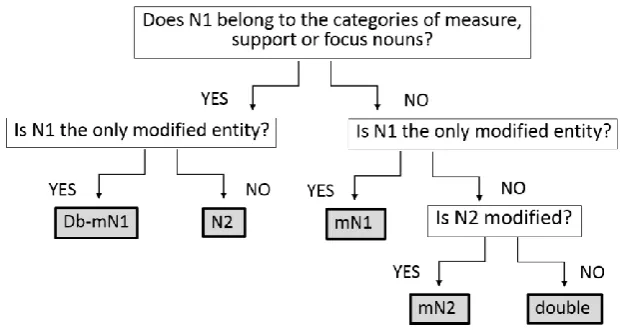
Criteria of Headedness in ‘V N1 of N2’ ConstructionFigure 3. The criteria are mainly based on Sinclair’s (1991) framework with minor modification. While there are mainly three categories of semantic heads, namely, N1-, N2-, and double- head categories, each category could be coming from different sources. The first step is to ask if N1 belongs to the categories of ‘measure’, ‘support’ or ‘focus’ nouns as discussed in more details in Section 2. If the answer is affirmative, we assign the utterance as a double head on the condition that N1 is modified (denoted as db-mN1). Example (5) illustrates a typical db-mN1.
(5) Thin sections show a great variety of internal structures important in accurate identification. (AMM565)
If N1 is not modified, we then assign the utterance an N2 head as shown in (6).
(6) Given the opportunity not to be continually wrapped in a nappy a 1-year-old child will show a lot of interest in urination and indicate what has happened. (CGT1568)
Moreover, this group of N2 heads can be further identified according to their N1 type (e.g., ‘focus’, ‘measure’ or ‘support’). Example (5) is an instance of the ‘measure’ group where a lot (N1) denotes quantity.
In contrast, if N1 does not belong to the categories of ‘measure’, ‘support’ or ‘focus’ noun groups, we assign the utterance to the N1-head category on the condition that only N1 is modified (denoted as m-N1).
(7) Such an approach is not at all for the sake of establishing some banal historical continuity, or of demonstrating a universal homogeneity of narrative... (ARD159)
Example (7) shows a typical nominalization of the of-structure with N1 modified, rendering N1 heavier as far as information-weighting is concerned.
In a similar fashion, if N1 is not modified but N2 is modified, an N2 head is designated as exemplified by (8) (denoted as m-N2).
(8) In R. v. Sang ( H.L. , 1979 ) it was said that evidence should not be excluded simply to show disapproval of improper police conduct. (EVK1311)
In this example, N2 (police conduct) is pre-modified by the word improper. If both N1 and N2 are not modified and N1 does not belong to one of the ‘measure’, ‘support’ or ‘focus’ groups, a double-head is found as shown in (9) (denoted as double).
(9 In both cases, extrinsic evidence could be introduced to show a want of jurisdiction. (GU61013)
Following the categorization criteria, corpus data were analyzed and details are presented in the next sections.
4
Methodology
The data for this study were collected from the free online British National Corpus (BNCweb) with selection restricted to the written academic prose which is comprised of 15,778,028 words in 497 files. A search string was applied to query for the target ‘V NP1 of NP2’ constructions, as illustrated in (10) for the verb demonstrate.
(10) {demonstrate}_V* (no)? (any)? (_{ART})? (_{A})* (_{N})* of.
The corpus results were downloaded and
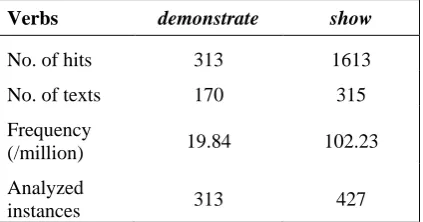
transferred to an Excel file as summarized in Table 3.
Each instance was categorized according to the semantic head of the ‘N1 of N2’ predicate following the criteria set in Table 3. Instances in an ‘irrelevant’ (abbreviated as irr.) category include a number of fixed expressions (e.g., point of view) and irrelevant structures (e.g., ‘demonstrated approval of them’ EF3660) which were excluded from further analysis (see Appendix I for raw scores). Each category was counted and converted into percentage. In addition, an association plot was drawn with an R script for making a comparison between the two verbs.
5
Overall Distribution of Semantic
heads in ‘N1
of
N2’ Predicate
Constructions
The frequency distribution of semantics heads for both demonstrate and show is presented in Table 4. Among the three types of semantic heads, the frequencies of N1-heads for both demonstrate and show (16.0% and 16.6%, respectively) are much lower than the other two categories (56.5% and 50.1% for double-heads; 25.2% and 30.9% for N2-heads). The predominant double-headed instances can be attributed to the nature of academic prose which tends to structure scientific knowledge with objectivity as previous work on nominalization have shown (cf. Halliday & Martin, 1993). It is more difficult to provide an explanation for a low occurrence rate of N1-heads since such construction is the conventional view on of (e.g., Quirk et al., 1985). It is quite interesting to find that both verbs share a common distribution pattern of the heads. As pointed out by Hyland (2002), both demonstrate and show function to imply writer’s acceptance of previous claims, leaving readers with a stronger sense of writer evaluation. The proportion of N1-heads is equal
in each verb, with a rate of approximately 16 percent. However, as for both the proportions of N2- and double-heads, the frequencies vary between the two classes. While double-heads occupy approximately 50 percent in demonstrate and show, N2-heads only reach 30 percent of the total. More detailed analysis for the two verbs will be presented in the next section.
6
A Comparison of semantic heads
between
Demonstrate
and
Show of
-predicates
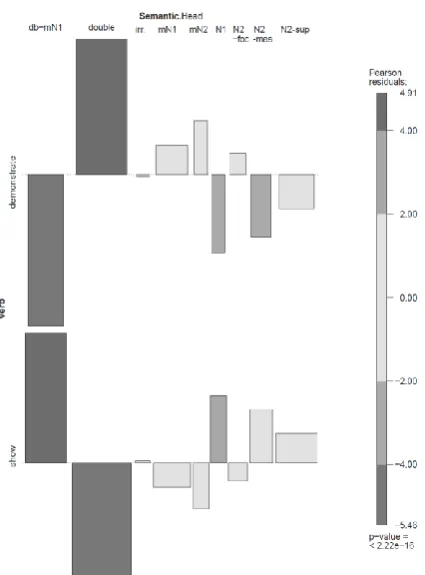
Although the overall distribution patterns of semantic heads show that demonstrate and show share some similarities, they are some striking differences. Figure 3 presents an association plot of semantic heads for both verbs. As indicated by the vertical scale on the right hand side, the darker the shade, the more significantly different a category will be found compared to its expected frequency. The graph shows that statistical significance can be found in some variables according to Pearson residuals where the p-value is less than 0.001. The following discussion is divided into three sub-sections, each designating to one category of semantic heads.
6.1
Double headsThe types of double-headed instances for demonstrate and show actually vary quite extensively. There are two major types of
Verbs demonstrate show
No. of hits 313 1613
No. of texts 170 315
Frequency
(/million) 19.84 102.23
Analyzed
instances 313 427
Table 3: Summary of BNCweb search results
Semantic Heads Demonstrate Show
N1 0.0% 4.4%
mN1 16.0% 12.2%
N1 Subtotal 16.0% 16.6%
double 52.1% 23.4%
db-mN1 4.5% 26.7%
Double Subtotal 56.5% 50.1%
mN2 4.2% 1.2%
N2-mea (N1=’measure’) 2.2% 7.3%
N2-sup (N1=’support’) 14.4% 19.4%
N2-foc (N1=’focus’) 4.5% 3.0%
N2 subtotal 25.2% 30.9%
irrelevant (irr.) 2.2% 2.3%
Total 100.0% 100.0%
double-headed nouns: (1) those derived from nominalization which tend to be heavy in information weighting (denoted as double), and (2) those with a modified N1 that result in a category shift from an N2 head to a double head (denoted as db-mN1). Examples (11) and (12) represent the double heads.
(11) The idea was to demonstrate the solidarity of the NATO alliance with a view to ensuring that negotiations with the Eastern bloc would be from a position of strength. (ASB1450)
(12) Adolescents may show a combination of middle school age and more adult type behaviour with depressive reactions and anxiety states ( Graham et al.,… (CN6785)
While N1 constitutes a large number of factual nouns like solidarity, effect, impact, and disapproval, N2 is often occupied by research entities such as vitamin A supplementation, aphasia, a protein, and local political control. N1 in the N1 of N2 construction could thus be
used as a site of evaluation to present writer’s stance.
The second group of double heads are those with a modified N1 (db-mN1) which can be exemplified by (13) and (14).
(13) But they demonstrate a fairly clear hierarchy of claims to receive financial benefit from a relative which runs: spouse and/or children; parents; brothers and sisters and their children; grandparents; uncles and aunts. (CRF108)
(14) Secondly, however, these clusters also show a certain degree of relatedness or overlap. (CFX439)
The frequency of db-mN1 for demonstrate is as low as 4.5 percent, while that for show is 26.7 percent. In other words show tends to be used with all kinds of ‘measure’, ‘focus’ and ‘support’ nouns more often than demonstrate.
Overall, both types of double head of-nominals show that demonstrate tends to be used with information–heavy, nominalization constructions, while show tends to be used with nouns that are lighter in information content. In addition, demonstrate tends to be used more commonly with an evaluative function than show.
6.2
N1 headsIt came as a surprise that N1 heads constitute the smallest proportion among the three head categories. There are two types of N1 heads. The rarer type is a ‘genuine’ N1 head as illustrated in (15) and (16).
(15) Although the teacher may well have introduced this later, and indeed CDL trials did show evidence of this, we decided to include some carefully graded illustrations in the documentation that…(EUW870)
(16) John and Mary (the two experimenters) show a child of three years of age a red box and a blue box and a pound coin. (A0T639)
These two examples show that of-N2 serves a post-modifying function even though such instances are very rare in show and are not found in demonstrate at all. There are mainly two kinds of N1 heads from the corpus. The first is illustrated in (15) where N2 is a pronoun, and the second is when N2 is a quantity as shown in (16). Another type of N1 heads is comprised of information-heavy constituents for both N1 and N2, and it is N1-headed because N1 is elaborated Figure 3. An association plot of semantic
heads for both demonstrate and show. ( db-mN1 denotes a double head with modified N1;
further with modifications. Examples (17) and (18) demonstrate this point.
(17) …domestic dogs are descendants of wolves, to which they show many similarities of appearance and behaviour. (FED1377)
(18) Getting more information on comparative performance also enabled them to ask the right questions, although it also demonstrated the continuing inadequacies of data. (HXT1193)
Difference between demonstrate and show again can be found here in terms of distribution of N1 heads. While there are more information-heavy, modified N1 instances for demonstrate, show again is much less information-driven.
6.3
N2 headsThere are four types of N2 heads in this study, namely, modified N2 heads and those with information-light N1s including ‘focus’, ‘measure’, and ‘support’ nouns, which are exemplified by (19) to (22), respectively.
(19) The molecular cloning data presented in this paper not only confirm the existence of clusters of related ZNF genes on chromosome 10, but also demonstrate duplication of an entire cluster… (K5P648)
(20) Irving has demonstrated the tendency of investigators to employ interrogation techniques likely to accentuate rather than ameliorate these and other distorting factors. (FBK335)
(21) The inner core is now characterized by a preponderance of public tenants (nearly half of households), whereas the rings show a majority of owner-occupiers in line with national patterns. (F9G766)
(22) It follows that the snails show a pattern of prey selection. (FU074)
Among the four groups, only the N2 heads with N1 ‘measure’ nouns reach statistical significance for demonstrate. Show appears to co-occur more often with both ‘measure’ and ‘support’ N1 nouns than demonstrate, but not with ‘focus’ nouns.
6.4
Section SummaryIn summary, semantic head categories can be viewed as providing different degrees of information weighting as addressed by Owen (2007). While double-headed of-constructions provide the highest information-weighting, both
modified N2 heads and N1 heads also provide heavy information load. The constructions with the least information weighting are N1 heads and N1 in the ‘measure’ group. Moreover, the results also show significant differences between demonstrate and show. Whereas demonstrate is more likely to be used with information-heavy words, show displays the opposite trend.
7
Discussion
In this study, we have examined three types of semantic heads in two synonymous verbs. From the distribution of the three heads, we found a quite similar pattern for both verbs, with the double heads taking up half of the total instances, N2 heads about one-quarter and N1 heads about one-fifth. However, by taking a closer examination of the sub-classes of each category, differences between the two verbs can be identified. The most significant differences were the double heads and N2 heads demonstrated in the association plot. Following Sinclair’s (1991) framework, the results show that it is more common for show to have ‘measure’, ‘focus’ and ‘support’ nouns in the N1 position. What these noun classes have in common is that all of them provide specificity relevant to N2. While ‘measure’ nouns, such as amount and some, provide information on quantity, and ‘focus’ nouns, such as tendency and value, specify a particular part, component, aspect or attribute of N2, ‘support’ nouns, such as importance and extent, are more abstract. The occurrence rate of ‘focus’ nouns is relatively low in the data which could be due to the functions of the construction for the two verbs. It is possible that the object position of the of-nominals limits its content to express a proposition or reach a conclusion (cf. Johns, 2001). In other words, we would expect an evaluation embedded in the of-nominals by means of modified N1 or factual nouns found in the ‘support’ group.
8
Conclusions
Contrary to the conventional view on of-nominals, we found a rather low percentage of N1 semantic heads (only 19 out of 723 relevant instances or approximately 3 percent) in the object position of demonstrate and show in academic discourse. The results of this study, therefore, support Sinclair’s insight on the semantic role of N2 in of-construction. In addition, we found that the framework of semantic headedness can be used to capture the subtle variation between synonyms. In this study, significant differences were found between ‘demonstrate N1 of N2’ and ‘show N1 of N2’ constructions. While both demonstrate and show incorporate more than 50% of double-headed of-nominals, the of-nominals of show tend to occur with modified N1 heads. In other words, demonstrate are more likely to be used with information-heavy nominals and abstract notions. Rather than providing pieces of evidence in the object position, demonstrate is more often used to present propositions or observations. On the other hand, show is more commonly used to present specific evidence because its co-occurring nouns in the N1 position often denote specificity and/or attributes of a phenomenon, an event or a process of N2. Because present work only provides preliminary results limited to two verbs, further work is necessary to attest this position with additional evidence such as including of-nominals in the subject or other positions, examining a wider range of verbs, or considering genral variation.
Acknowledgement
This work was supported in part by the National Science Council under the Grants NSC101-2410-H-004-176-MY2.
References
Dwight L. Bolinger. 1968. Entailment and the meaning of structures. Glossa, 2, 119–127.
Maggie Charles. 2006. Phraseological patterns in reporting clauses used in citation: A corpus-based study of theses in two disciplines. English for Specific Purposes, 25(3), 310-331.
John R. Firth. 1957. Papers in linguistics. Oxford: Oxford University Press.
Stephan Th. Gries and Naoki Otani. 2010. Behavioral profiles: A corpus-based perspective on synonymy and antonymy. ICAME Journal, 34, 121-150.
Stephan Th. Gries and Anatol Stefanowitsch. 2004. Extending collostructional analysis: A corpus-based perspective on ‘alternations’. International Journal of Corpus Linguistics, 9(1), 97-129.
Michael A. K. Halliday and James R. Martin. 1993. Writing Science. Pittsburgh: University of Pittsburgh Press.
Ken Hyland. 1999. Academic attribution: citation and the construction of disciplinary knowledge. Applied Linguistics, 23(3), 341-367.
Ken Hyland. 2000. Disciplinary discourses: Social interactions in academic writing. Edingburgh: Pearson Education.
Ken Hyland. 2002. Activity and evaluation: reporting practices in academic writing. In John Flowerdew (Ed.), Academic discourse, pp. 115-130. London: Longman.
Tim Johns. 2001. From evidence to conclusion: the case of ‘indicate that’. In Martin Hewings (Ed.) Academic Writing in Context. Implications and Applications. University of Birmingham Press. 55-62.
Rolf Kreyer. 2003. Genitive and of-construction in modern written English. Processability and human involvement. International Journal of Corpus Linguistics, 8(2): 169-207.
Rajat K. Mohanty, Srinivas Samala, Ashish F. Almeida and Pushpak Bhattacharyya. 2004. The Complexity of OF in English. Proceedings of International Conference on Natural Language Processing (ICON-2004), Hyderabad, India.
Charles Owen. 2007. Notes on the ofness of of: Sinclair and grammar. International Journal of Corpus Linguistics, 12(2): 201-221.
Randolf Quirk, Sidney Greenbaum, Geoffrey Leech and Jan Svartvik. 1985. A Comprehensive Grammar of the English Language. London: Longman.
John M. Sinclair. 1991. Corpus, Concordance, Collocation. Oxford: Oxford University Press.
Sarah Thomas and Thomas P. Hawes. 1994. Reporting verbs in medical journal articles. English for Specific Purposes, 13(2), 129-148.
Appendix I: Raw scores of coded data
Heads Demonstrate Show
N1 0 19
mN1 50 52
N1 Subtotal 50 71
double 163 100
db-mN1 14 114
Double Subtotal 177 214
mN2 13 5
N2-mea
(N1=’measure’) 7 31
N2-sup
(N1=’support’) 45 83
N2-foc (N1=’focus’) 14 13
N2 subtotal 79 132
irrelevant (irr.) 7 10