Methods and Tool for Constructing Phonetically-Balanced Materials for
Speech Perception Testing: A Development of Thai Sentence-Length
Materials
Adirek Munthuli
Charturong Tantibundhit
Department of Electrical and Computer
Engineering, Faculty of Engineering,
Thammasat University, Thailand
[email protected]
Department of Electrical and Computer
Engineering, Faculty of Engineering and
Center of Excellence in Intelligent
Informatics, Speech and Language
Technology, and Service Innovation (CILS)
Thammasat University, Thailand
[email protected]
Chutamanee Onsuwan
Krit Kosawat
Department of Linguistics, Faculty of Liberal
Arts and Center of Excellence in Intelligent
Informatics, Speech and Language
Technology, and Service Innovation (CILS)
Thammasat University, Thailand
National Electronics and Computer
Technology Center (NECTEC), National
Science and Technology Development
Agency (NSTDA), Thailand
[email protected]
[email protected]
Abstract
Phonemic content is one of many important criteria in a development of any kind of speech testing materials. In this paper, we explain a procedure and tool we created in the process of constructing phonetically-balanced (PB) sentence-length materials for Thai, as an assessment for speech reception thresholds. Our procedure includes establishing criteria, preselecting sentences, creating pool of replacement words, determining phonemic distribution, and constructing sentences. Importantly, a tool is created to determine whether set of words or sentences are phonetically balanced. Once the phoneme distribution and the set of words with transcription are specified, the tool efficiently computes phoneme occurrences among words or sentences (within a set) and can be used to manipulate words to achieve goal in
phonetically balanced (PB). To show how this is accomplished, two sentence sets are constructed and evaluated by native speakers. The procedure and tool have characteristics that make them potentially useful in other applications and can be applied to other languages.
Keywords: Thai, sentence-length material construction, phonetically balanced speech materials
1
Introduction
It is well-established that an assessment technique for evaluating an individual’s hearing sensitivity based on pure-tone audiometry alone does not truly reflect the individual's speech understanding (Bilger et al., 1984; Egan, 1948). Importantly, measuring of speech intelligibility could be obtained by counting number of correct responses from speech testing materials, e.g., phonetically-balanced (PB) monosyllabic words, polysyllabic words, and sentences (Egan, 1948).
293
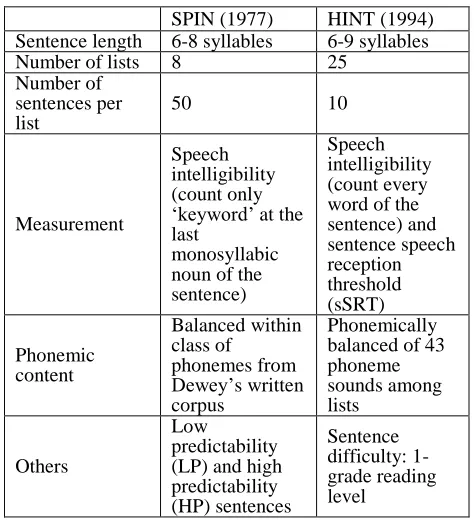
background, we opt for familiar words. This is carried out by selecting words and sentences, which match desired phonemic content, from children’s textbooks and stories, (Thai Children Stories, 1990; Ministry of Education, 1986; Sripaiwan, 1994; Sangworasin, 2003). In terms of sentence length, we follow SPIN (Kalikow et al., 1977), HINT (Nilsson et al. 1994), and RAMA.SSI (Wissawapaisal, 2002) and limit each sentence to six to eight syllables with no words greater than two syllables long. The PB sentences will compose of 10 lists, each with 10 sentences.
In addition, to address a question of whether different levels of predictability affect sentence intelligibility (Kalikow et al., 1977), in all five lists will be created to fit the ‘low’ predictability status and another five the ‘high’ predictability. However, degrees of predictability are beyond the scope of our developed tool, and are determined by semantics and overall sentence contexts. (see Sections 4 and 5).
3
Procedure and Concept Design for Tool
For SPIN (Kalikow et al., 1977) and HINT (Nilsson et al., 1994), pre-selection of sentences were carried out prior to phonemic distribution analysis and matching. HINT sentences were selected from Bamford-Kowal-Bench (BKB) corpus. SPIN sentences were constructed by generating sets of ‘low’ predictability and ‘high’ predictability sentences and manipulated key words (monosyllable nouns) in sentence final position by determining their semantics link to preceding words in the sentence. The key words were drawn from Thorndlike-Lorge corpus. Consequently, for HINT, there is 68% (of 252 sentences) where phonemes are off 1 from the target phonemes (Nilsson et al., 1994).
We found their approach quite difficult to achieve for Thai sentences as there are 4 phoneme types (initials, vowel, finals, and lexical tones) to account for. Therefore, we have taken a slightly different approach by starting with pre-selection of sentences in the same fashion, but the sentences will be further modified by replacing and reconstructing some words in sentences until it yields desired phonemic contents as described in Section 3.1.
Kalikow et al. (1977) asserted that recognition of keywords in sentence is based on
familiarity of word. Therefore, for our lists, we have to make certain that the selected words (candidates) are familiar words in the language. We do so, by selecting words from children’s textbooks and stories. In addition, to estimate frequency of word occurrences, we utilize the largest available Thai written corpus InterBEST (Kosawat et al., 2009).
Most importantly, our PB word candidates are considered to be as phonetic balanced as possible, i.e., less than 10% difference from targeted phoneme distribution.
3.1
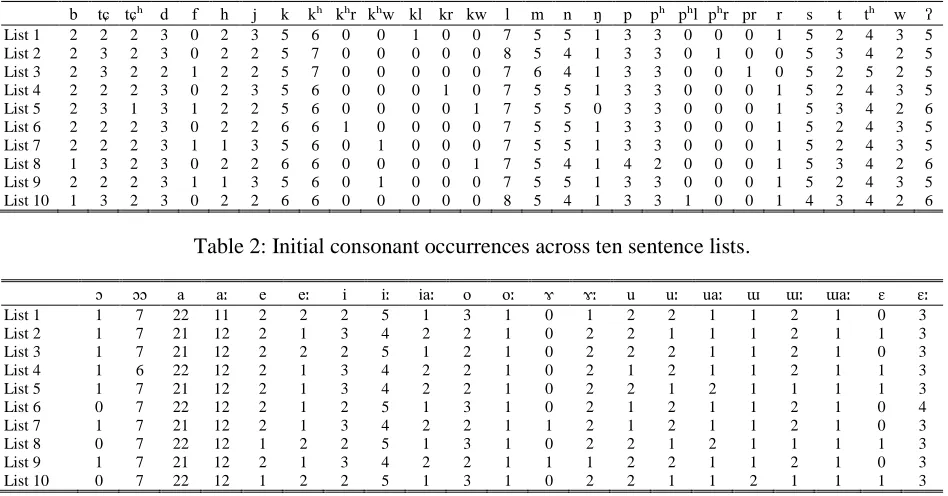
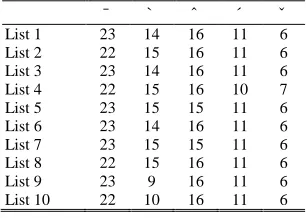
Preselecting Sentences and Pool of Replacement WordsThe first step to create PB sentences is based on preselection of sentences. All sentences from a collection of 89 children’s stories (Thai Children Stories, 1990) are analyzed and only simple sentences, (i.e., verb-(adverb), subject-verb-complement/object), are kept. These result in 313 sentences in total. Then, each sentence is transcribed and its phonemic distribution of initials, finals, vowels, and tones are tallied. Attempts are made to group a set of 10 sentences in to a list (10 lists in all) such that the phoneme distributions are as close to the ones shown in Tables 2-5 as possible.
However, from a limited number of simple sentences (313 sentences) that were preselected, the best outcome we could obtain was 10 lists of useable PB sentences with very low off-target from the desired phoneme distributions.
Therefore, we propose an additional step, which is to modify our preselected sentences by replacing and reconstructing some words using a pool of replacement words so that it finally yields ten mutually exclusive groups of 10 sentences that match the desired phoneme distributions.
Our pool of replacement words came from the collection of 89 children’s stories (Thai Children Stories, 1990) and word corpora based on three children’s textbooks (Ministry of Education, 1986; Sripaiwan, 1994; Sangworasin 2003).
3.2
Phonemic Contentout of target at most 2 times and 6 times in total.
10.Use words in the replacement pool to construct 10 sentences, where each sentence is a simple sentence composed of seven syllables.
Repeat Steps 1 to 10 to construct PB sentences for Lists 2 to 5.
4
Tool
Graphical user interface is developed to facilitate insertion or removal of words by consideringeach list of PB sentences one by one.
Figures 1-2 show asterisks on the chart. Each of which signifies a target number of occurrences of any phoneme. Bar refers to current number of occurrences of any phoneme, where positive/negative number signifies that number of occurrences is higher/lower than a target number of occurrences of that phoneme.
Figure 1 shows an example of the PB sentence constructing process with the tool starting with Step 1 described earlier in Section 3.3. Here, we
show construction of sentences in list I (low predictability sentences). After Steps 2 to 3 are performed, select the best combination of 10 sentences stated in Step 4. Then, each sentence (one by one) is put in the tool as shown in Fig. 1.
After Steps 5 to 7 are performed, insert words from pool of replacement words. Figures 1-2 show words ranked in ascending order based on frequency of occurrences (from InterBEST corpus).
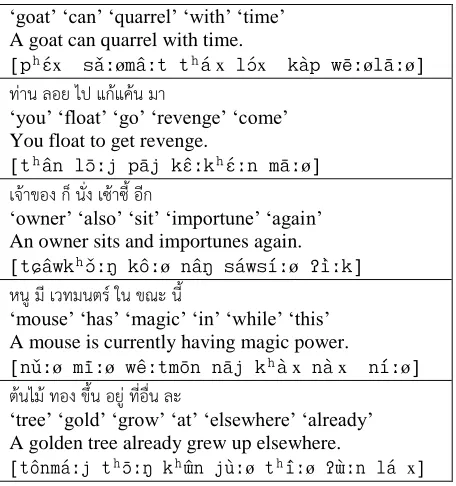
Figure 2 shows phoneme distributions after performing Step 9. Then, Step 10 is performed and 10 PB sentences with low predictability are shown in Table 6. As another example, we use the tool to construct 10 PB sentences with high predictability as shown in Table 7.
It should be noted that degrees of predictability are beyond the scope of this tool, and are determined by semantics and overall sentence contexts. At this stage, the tool users are expected to make several attempts in word selecting and replacing to achieve desired level of predictability, which could be later evaluated (see Section 5).
List 1 2 2 2 3 0 2 3 5 6 0 0 1 0 0 7 5 5 1 3 3 0 0 0 1 5 2 4 3 5 List 2 2 3 2 3 0 2 2 5 7 0 0 0 0 0 8 5 4 1 3 3 0 1 0 0 5 3 4 2 5 List 3 2 3 2 2 1 2 2 5 7 0 0 0 0 0 7 6 4 1 3 3 0 0 1 0 5 2 5 2 5 List 4 2 2 2 3 0 2 3 5 6 0 0 0 1 0 7 5 5 1 3 3 0 0 0 1 5 2 4 3 5 List 5 2 3 1 3 1 2 2 5 6 0 0 0 0 1 7 5 5 0 3 3 0 0 0 1 5 3 4 2 6 List 6 2 2 2 3 0 2 2 6 6 1 0 0 0 0 7 5 5 1 3 3 0 0 0 1 5 2 4 3 5 List 7 2 2 2 3 1 1 3 5 6 0 1 0 0 0 7 5 5 1 3 3 0 0 0 1 5 2 4 3 5 List 8 1 3 2 3 0 2 2 6 6 0 0 0 0 1 7 5 4 1 4 2 0 0 0 1 5 3 4 2 6 List 9 2 2 2 3 1 1 3 5 6 0 1 0 0 0 7 5 5 1 3 3 0 0 0 1 5 2 4 3 5 List 10 1 3 2 3 0 2 2 6 6 0 0 0 0 0 8 5 4 1 3 3 1 0 0 1 4 3 4 2 6
Table 2: Initial consonant occurrences across ten sentence lists.
List 1 1 7 22 11 2 2 2 5 1 3 1 0 1 2 2 1 1 2 1 0 3 List 2 1 7 21 12 2 1 3 4 2 2 1 0 2 2 1 1 1 2 1 1 3 List 3 1 7 21 12 2 2 2 5 1 2 1 0 2 2 2 1 1 2 1 0 3 List 4 1 6 22 12 2 1 3 4 2 2 1 0 2 1 2 1 1 2 1 1 3 List 5 1 7 21 12 2 1 3 4 2 2 1 0 2 2 1 2 1 1 1 1 3 List 6 0 7 22 12 2 1 2 5 1 3 1 0 2 1 2 1 1 2 1 0 4 List 7 1 7 21 12 2 1 3 4 2 2 1 1 2 1 2 1 1 2 1 0 3 List 8 0 7 22 12 1 2 2 5 1 3 1 0 2 2 1 2 1 1 1 1 3 List 9 1 7 21 12 2 1 3 4 2 2 1 1 1 2 2 1 1 2 1 0 3 List 10 0 7 22 12 1 2 2 5 1 3 1 0 2 2 1 1 2 1 1 1 3
‘x’
List 1 9 3 3 10 6 3 4 4 9 19 List 1 23 14 16 11 6 List 2 9 3 3 9 6 4 3 4 10 19 List 2 22 15 16 11 6 List 3 9 3 3 9 6 4 3 4 10 19 List 3 23 14 16 11 6 List 4 8 3 4 10 6 3 4 4 9 19 List 4 22 15 16 10 7 List 5 9 3 3 9 7 3 4 3 10 19 List 5 23 15 15 11 6 List 6 8 3 4 9 6 4 3 4 9 20 List 6 23 14 16 11 6 List 7 9 3 3 9 7 3 4 3 10 19 List 7 23 15 15 11 6 List 8 8 3 4 9 6 4 3 4 9 20 List 8 22 15 16 11 6 List 9 9 3 3 9 6 4 4 3 10 19 List 9 23 9 16 11 6 List 10 8 3 3 10 6 3 4 4 9 20 List 10 22 10 16 11 6
Table 4: Final consonant occurrences across ten sentence lists. Table 5: Lexical tone occurrences across ten sentence lists.
Figure 1: Simulation of tool in process of subtraction in a set of preselected sentences that has minimum absolute of summation errors. It should be noted that c is , ch is , kh is , khl is , khr is , khw is
,ng is , ph is , phl is , phr is , th is , thl is za is ‘x’, zaa is @ is , @@ is , aa is , ee is , ii is , iia is , oo is , q is , qq is , uu is , uua is , v is , vv is x is xx is 0 is mid tone, 1 is low tone, 2 is falling tone, 3 is high tone and 4 is rising tone.
‘she’ ‘feel slight’ ‘then’ ‘quarrel’ ‘again’ If she feels slighted, quarrel will begin again. x x
บัณฑิต แต่ละ คน มี ชื่อเสียง
‘graduate’ ‘each’ ‘person’ ‘has’ ‘famous’ Each Graduate is famous.
x
บุตรหลาน ดูแล ไม่ ง่าย
‘children’ ‘take care’ ‘not’ ‘easy’ [Taking care of children is not easy.
ฉัน ก าลัง ตาม เก็บ กุหลาบ
‘I’ ‘being’ ‘follow’ ‘pick’ ‘rose’ I am picking roses.
Table 7: Example of a set of ‘high’ predictability sentence (constructed sentences) (‘x’ signifies an ending of any short-vowel syllables with no final consonant whereas ‘’ a syllable with long vowel with no final consonant).
Mean Standard
deviation
Type 1: ‘Low’
predictability (Preselected)
1.72 0.48
Type 2: ‘Low’
predictability (Constructed)
1.86 0.80
Type 3: ‘High’
predictability (Preselected)
4.48 0.30
Type 4: ‘High’
predictability (Constructed)
3.20 0.80
Table 8:Mean and average rating score of four types of sentences.
We perform ANOVA to test differences between high predictability and low predictability sentence types and use multiple comparisons to check whether each pair is statistically significant as shown in Figure 3. As expected, results show that significant differences are found in pairs of Types 1 and 3; and Types 2 and 4. An important point to be taken here is that levels of predictability could be estimated and later evaluated by native speakers (but this is beyond the scope of the developed tool).
Figure 3: Multiple comparisons between 4 types of sentences. It should be noted that LP-Sel, LP-Cons, HP-Sel, and HP-Cons are referred to Type 1, Type
2, Type 3, and Type 4, respectively.
6
Discussion and Future Direction
We believe that we have successfully proposed and outlined procedure as well as constructed an efficient tool for constructing PB sentence sets. Importantly, a main advantage of our proposed procedure and tool is that it is easy to administer and create sets of words that are close to the desired distribution. As previously mentioned, a fully automated tool of this type would be ideal, but would require other crucial components such as a language model and other information associated with each word (e.g., part of speech). The procedure and tool outlined here have characteristics that make them potentially useful in other applications and can be applied to other languages, but will certainly require a language specific set of data (i.e., phoneme distribution and language-specific grapheme-to-phoneme software).
Acknowledgments
This work was supported by Thailand Graduate Institute of Science and Technology (TGIST), NSTDA (TGIST 01-57-020) to the first author. Special thanks to Thanaporn Anansiripinyo for her help with Thai-to-English gloss and translation.
References
R. C. Bilger, J. M. Nuetzel, W. M. Rabinowitz, and C. Rzeczkowski. 1984. Standardization of a Test of Speech Perception in Noise. Journal of Speech,