A Reference Dependency Bank for Analyzing Complex Predicates
Tafseer Ahmed, Miriam Butt, Annette Hautli, Sebastian Sulger
Universit¨at Konstanz [email protected]
Abstract
When dealing with languages of South Asia from anNLPperspective, a problem that repeatedly crops up is the treatment of complex predicates. This paper presents a first approach to the analysis of complex predicates (CPs) in the context of dependency bank development. The effort originates in theoretical work onCPs done within Lexical-Functional Grammar (LFG), but is intended to provide a guideline for analyzing different types ofCPs in an independent framework. Despite the fact that we focus onCPs in Hindi and Urdu, the design of the dependencies is kept general enough to account forCPconstructions across languages.
Keywords: Complex Predicates, Dependency Bank, Lexical-Functional Grammar, ParGram, South Asian languages, Urdu/Hindi
1.
Introduction and motivation
In building NLP applications for the less well-resourced languages of the world, such as the languages of South Asia, a problem that crops up repeatedly is how to deal with complex predications.1Many languages of the world use a combination of more than one predicate to express concepts that in languages like English are expressed with a single verb, e.g., ‘memory do’ = ‘remember’, ‘fear come’ = ‘fear’, ‘clean do’ = ‘clean’. In addition, verb+verb combinations are used to express permissive, causative or aspectual rela-tions. The issue of complex predication also comes up with respect to languages like English and German, e.g., English constructions like take a bath, do a Chomsky, give a stir or German eine Rede halten ‘a speech hold=give a speech’. However, in languages like German and English, these con-structions do not constitute the majority of predicational in-stances and so are generally discussed in terms of further complex phenomena that need to be dealt with appropri-ately eventually, once basic lexical resources are in place. In contrast, the verbal system of South Asian languages and many other languages of the world is constructed quite differently. For example, there are only about 700 basic verbs in Urdu and the vast majority of verbal predication is achieved via complex predicational structures. As such, the need to understand how to represent complex predicates arises almost immediately in the course of building anNLP
application.
In this paper, we seek to ameliorate the problem by provid-ing a reference dependency bank for complex predicates, based on our in-depth analysis of the South Asian language Urdu (Butt, 1995; Butt and King, 2007; Ahmed and Butt, 2011). Urdu/Hindi2allows for the following types of com-plex predicates: aspectual and permissive V-V CPs,
mor-phological causatives and different types of N-V, ADJ-V
andP-V CPs. South Asian languages form an areally
de-1
We would like to gratefully acknowledge the DFG (Deutsche Forschungsgemeinschaft), for the funding that enabled this work via our project on Urdu grammar development.
2
Hindi and Urdu are mostly parallel with respect to syntax and semantics, some differences exist with respect to vocabulary and derivational morphology.
fined Sprachbund (Masica, 1993) and most other South Asian languages exhibit these or different subtypes of com-plex predicates. As such, we seek to provide a reference dependency bank for complex predicates that can be used as a guide by teams working onNLPapplications primarily for other South Asian languages, but also for other relevant languages across the world. In order to make the reference dependency bank as useful as possible, we also provide ref-erence analyses for related constructions, namely: modals and auxiliaries, which look like complex predicates on the surface but are not. Complex predicates are often analyzed on a par with these constructions, but their syntactic distri-bution in fact differs markedly from that of complex pred-icates (see, e.g., Butt (2010) for an overview of the struc-ture of complex predication crosslinguistically). NLP ef-forts which do not take the difference into account tend to yield unsatisfactory analyses and POS tag sets that are too vague to be truly useful.
All complex predicate (CP) analyses described in this paper are implemented in the Urdu ParGram grammar (Butt et al., 1999; Butt and King, 2007; B¨ogel et al., 2009); although the grammar is couched within Lexical-Functional Gram-mar (LFG) (Dalrymple, 2001), we keep the design of the de-pendency bank as general as possible, following the exam-ple set by King et al. (2003) withPARC700; thereby provid-ing a crosslprovid-inguistic and theoretically independent analysis ofCPs. We also see our effort as a seed resource to which reference representations of furtherCPtypes crosslinguisti-cally can be added, thus eventually resulting in a complete typology ofCPs that can be used as a resource for a variety ofNLPapplications. The dependency bank may be down-loaded freely from the web.3
We provide a sketch of four types ofCPs: the aspectualV
-V, the permissiveV-V,N-V CPs, morphological causatives andADJ-V CPs. These types are presented in section 2. We then provide examples of verbal complexes that are often mistaken for complex predicates, but in fact are not (section 3.). In section 4. we describe the format and the design of the dependency bank. Section 5 concludes the paper.
3http://ling.uni-konstanz.de/pages/home/
2.
Types of Complex Predicates
This section goes through different types of possible com-plex predicates and describes each of them briefly, includ-ing some combinatory possibilities. In addition to the two types ofV-Vcomplex predicates discussed below, the stan-dard literature acknowledges two different types ofN-V CPs (agreeing vs. non-agreeing) as well as an ADJ-V CP (Mo-hanan, 1994). We have additionally identified a P-V CP. Since theP-V CPso far appears to be quite rare, we do not discuss it here.2.1. An aspectual V-V complex predicate
AspectualCPs are formed by combining two verbs as
co-heads: a main verb in its bare form and an inflected light verb. The light verb contributes aspectual meaning to the predicate, providing information about the kind of ac-tion/event that is described; it does not, however, add an ar-gument or arar-guments to the overall subcategorization frame of the predication. Therefore, the number of arguments of the resultingCPis the same as that of the main verb. How-ever, the finite light verb does determine the case marking of the subject and semantic selectional constraints govern-ing the combinatory possibilities of main and light verb must be observed. See Butt (1995) and Butt et al. (2003) for detailed discussion and further references. (1a) is an ex-ample of a simple intransitive verb; (1b) is an exex-ample of a verb-verb aspectualCP.4
(1) a. nAdiyah hans-I
Nadya.F.Sg.Nom laugh-Perf.F.Sg ‘Nadya laughed.’
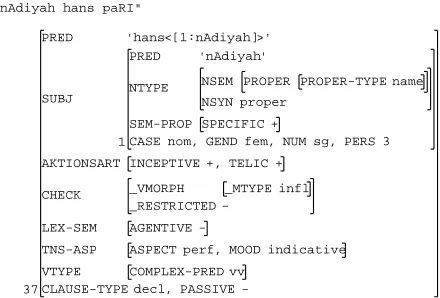
b. nAdiyah hans paR-I Nadya.F.Sg.Nom laugh fall-Perf.F.Sg ‘Nadya burst out laughing.’
Figure 1 provides an LFG f(unctional)-structure analysis of (1b). The f-structure is essentially a dependency struc-ture which expresses not only basic predicate-argument relations, but also encodes detailed information about tense/aspect, Aktionsart, mood, case, clause type, verb type, etc.5
Looking at the top-levelPREDin Figure 1, we can see that the main verb’s argument structure has not been altered. The aspectual light verb paR ‘fall’ contributes only aspec-tual information about the event; this information is en-coded in the f-structure under theAKTIONSARTfeature. This type of complex predicate is extremely common in Urdu/Hindi as well as in many of the other South Asian languages. The light verb not only provides information about Aktionsart, but also contains contextually dependent information about whether the action was to somebody’s benefit, responsibility for the action, forcefulness of the ac-tion, etc. In Urdu/Hindi, a set of about 24 verbs can act as
4
The transliteration scheme employed for representing the Arabic script of Urdu is described in Malik et al. (2010).
5
All the f-structures shown in this paper have been generated by the Urdu ParGram grammar. Note that theCHECK features in the f-structures are used to collect features that are only used for well-formedness checking — these provide no independent functional information.
"nAdiyah hans paRI"
'hans<[1:nAdiyah]>' PRED
'nAdiyah' PRED
name PROPER-TYPE PROPER
NSEM proper NSYN NTYPE
+ SPECIFIC SEM-PROP
CASE nom, GEND fem, NUM sg, PERS 3 1
SUBJ
INCEPTIVE +, TELIC + AKTIONSART
infl _MTYPE _VMORPH
-_RESTRICTED CHECK
-AGENTIVE LEX-SEM
ASPECT perf, MOOD indicative TNS-ASP
vv COMPLEX-PRED VTYPE
CLAUSETYPE decl, PASSIVE -37
Figure 1: LFGdependency (f-structure) analysis for (1b)
light verbs. Common ones are ‘take, give, fall, rise, sit, hit’. Since the type of information contributed by these light verbs in South Asian languages is very contextually dependent and defeasible, it is not represented in our syn-tactic analysis.
2.2. A permissive V-V complex predicate
The Urdu permissive is a combination of an infinitive verbal predicate with a finite verb. The two verbs contribute to the overall argument structure of the clause. For example, in (2) there is a single CP dEkH dE ‘let see’, composed of dEkH ‘see’ and dE ‘give’. Two arguments come from the verb dEkH ‘see’, the seer and the seen item, and two arguments are provided by the verb dE ‘give’: the person giving permission and the action that is permitted. The total of four arguments combine into just three arguments in the
CP: the person giving permission is the subject in (2), the seer and the person granted permission fall together as the indirect object (OBJ-THorOBJ-GOinLFG) and the thing seen is the overall object of the clause. The action that is permitted is analyzed as an argument of dE ‘give’, but is also part of the complex predication, as shown in the top-levelPREDvalue in Figure 2.
(2) nAdiyah nE yAsIn kO Nadya.F.Sg Erg Yassin.M.Sg Dat
kitAb dEkH-nE d-I
book.F.Sg.Nom see-Inf.M.Sg.Obl give-Perf.F.Sg ‘Nadya let Yassin look at the book.’
Note in particular that such constructions differ syntacti-cally from biclausal embedding constructions such as the one in (3), where the agreement facts show that ciTTHI ‘note’ is an embedded object, unlike kitAb ‘book’ in (2).
(3) nAdiyah nE yAsIn kO Nadya.F.Sg Erg Yassin.M.Sg Dat
[ciTTHI likH-nE kO] kah-A
note.F.Sg.Nom write-Inf.M.Sg.Obl Acc say-Perf.M.Sg ‘Nadya told Yassin to write the note.’
We follow Mohanan (1994), who analyzes this type of noun as being the grammatical object of the clause (which ac-counts for the agreement pattern) but also, simultaneously, as part of the N-V CP. That is, it plays two roles in the clause. Additionally, Ahmed (2011) shows that some of the nouns within the agreeingN-V CPs class allow modi-fiers, thus identifying a further subclass ofN-V CPs. The light verbs commonly used withN-V CPs are ‘do, be, become, stay and keep’. It should be noted that there are many instances ofN-Vsequences which look likeCPs but are actually simple transitive sentences as in (5). Example (8) looks like aCPon the surface because of the verb ‘do’, which also allows for a light verb use as in (4), (6) and (7).
(8) nAdiyah nE kAm ki-yA
Nadya.F.Sg Erg work.M.Nom do-Perf.M.Sg ‘Nadya did some/the work.’
However, a crucial difference is that in the examples we have identified asCPs, we can point to an extra argument in the clause that is being contributed by the noun. This is not the case in (8) and we therefore do not analyze this as aCP.
2.4. Adj-V sequences
Similarly, withADJ-Vsequences we have examples where the adjective contributes an argument of its own and ones where this situation does not obtain. We consider the for-mer asCPs, but not the latter. In (9), we have an example of anADJ-V CP. Here, the verb ‘do’ combines with the ad-jective alag ‘separate’, which introduces its own argument (kHiRkI ‘window’). Evidence from scrambling, etc. speaks in favor of an analysis in which this extra argument should be treated as a clause-level argument rather than being em-bedded as an argument of the adjective. The f-structure analysis is provided in Figure 4.
(9) yAsIn nE SISE kO
Yasin.M.Sg Erg glass.M.Sg.Obl Acc
kHiRkI sE alag ki-yA
window.F.Sg Inst separate.Nom do-Perf.M.Sg ‘Yassin removed the glass from the window.’
On the other hand, in examples as in (10) and (11), the ad-jective does not contribute any extra arguments of its own. We therefore do not consider these to beCPs.
(10) mEz s3Af he
table.F.Sg.Nom clean.Nom be.Pres.3.Sg ‘The table is clean.’
(11) yAsIn nE mEz s3Af
Yasin.M.Sg Erg table.F.Sg.Nom clean.Nom k-I
do-Perf.F.Sg
‘Yasin cleaned the table.’/‘Yasin made the table clean.’ However, all of these examples are special in a different sense – they are resultatives. The result of doing some-thing to the table or to the glass in the examples above is that they become clean or separate. Resultatives are known as instances of secondary predication. In our representa-tions, we have accounted for this by introducing the gram-matical relation of a PREDLINK (cf. Butt et al. (1999)).
The PREDLINK is what is predicated of a certain entity,
e.g., the objects in the examples above. That is, the ta-ble is predicated to be clean, the glass separate from the window. However, this relationship is not shown overtly in the f-structure, as the interpretation of resultatives as well as depictives crosslinguistically tends to be context depen-dent. The relationship must be inferred through the pres-ence of thePREDLINK, which must be related to one of the other grammatical relations in the clause, in our examples theOBJ.
2.5. Causatives
Languages may have morphological or periphrastic causatives. Some periphrastic causatives may qualify as complex predicates (i.e., be functionally monoclausal), while others may not. The status of periphrastic causatives thus needs to be investigated carefully on a language-by-language basis. Morphological causatives, on the other hand, tend to be monoclausal. In both morphological and periphrastic causatives the arguments of the clause are con-tributed by different elements.
Urdu is a language with morphologically formed causatives, where transitive verbs have an intransitive root form (12a) that is related to the transitive via vowel lengthening or the suffixation of an -A morpheme (12b). The indirect causative is formed by the morphme -vA, as shown in (12c).
(12) a. makAn ban-A
house.M.Sg.Nom be made-Perf.M.Sg ‘The house was built.’
b. nAdiyah nE makAn
Nadya.F.Sg Erg house.M.Sg.Nom ban-A-yA
be made-Caus-Perf.M.Sg ‘Nadya built a house.’
c. nAdiyah nE (mAzdUrON sE) Nadya.F.Sg Erg (laborer.M.Pl.Obl Inst)
makAn ban-vA-yA
house.M.Sg.Nom be made-Caus-Perf.M.Sg ‘Nadya had a house built (by the laborers).’ In (12b), the agent/subject argument nAdiyah is licensed by the causative morpheme, in (12c) the optional instru-mental is additionally licensed by the -vA causative mor-pheme. The patterns of causation are highly dependent on verb class and are fairly complex. For a brief survey of the relevant patterns and details on the implementation of causatives within the Urdu ParGram grammar see Butt and King (2006).
2.6. Combinations of all of the above
We have now surveyed the major types of complex predi-cation. All the types discussed above tend to be common in the languages of South Asia. Equally common is the pos-sibility of combining the several different types of complex predications. We provide an example in (13).7
7Discussing all the various types of possible combinations and
combination-"yAsIn nE SISE kO kHiRkI sE alag kiyA"
'kar<[1:yAsIn], [21:SISa], 'alag<[52:kHiRkI]>'>' PRED
'yAsIn' PRED
obl _NMORPH CHECK
name PROPER-TYPE PROPER
NSEM
proper NSYN NTYPE
+ SPECIFIC SEM-PROP
CASE erg, GEND masc, NUM sg, PERS 3 1
SUBJ
'SISa' PRED
obl _NMORPH CHECK
count COMMON NSEM
common NSYN NTYPE
+ SPECIFIC SEM-PROP
CASE acc, GEND masc, NUM sg, PERS 3 21
OBJ
'kHiRkI' PRED
obl _NMORPH CHECK
count COMMON NSEM
common NSYN NTYPE
CASE inst, GEND fem, NUM sg, PERS 3 52
OBL
infl _MTYPE _VMORPH
_GEND masc, _NUM sg, _RESTRICTED -, _VFORM perf CHECK
+ AGENTIVE LEX-SEM
ASPECT perf, MOOD indicative TNS-ASP
av COMPLEX-PRED VTYPE
decl CLAUSE-TYPE 81
Figure 4:LFGdependency (f-structure) analysis for (9)
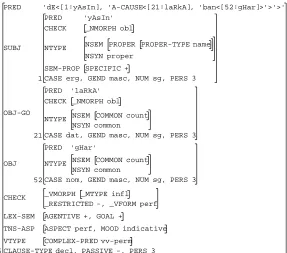
(13) yAsIn nE laRkE kO gHar
Yassin.M.Sg Erg boy.M.Sg.Obl Acc house.M.Sg.Nom
ban-A-nE di-yA
make-Caus-Inf.M.Obl give-Perf.M.Sg ‘Yassin let the boy build a house.’
As can be seen in Figure 5, this example consists of a causative in combination with a permissive. That is, the permissive ‘give’ introduces the subject argument ‘Yassin’ and takes a verbal predication as an argument. This ver-bal predication is in turn complex as it contains a causative morpheme, which licenses the indirect object ‘boy’. Fi-nally, the intransitive verb ban ‘be made’ is responsible for the object ‘house’.
3.
Other Verbal Complexes
Complex predicates are often confused with other verbal constructions such as modals and auxiliaries, although their syntactic distribution differs markedly. TheCPs described above form verbal complexes which have special proper-ties in terms of how the arguments of the overall clause are licensed — each part of the complex predicate contributes to the overall argument structure. The aspectual V-V CPs
discussed in section 2.1. would seem to be an exception. However, as shown in Butt (1995), the light verbs here do have an effect on the overall argument structure in that they ultimately determine the case marking of the subject and place constraints on what kind of verbs they can combine with. This is very much unlike the behavior exhibited by
atory possibilities are impressive — all the types of the complex predicates discussed here can in principle be combined with one another, though there are restrictions on the order of combination.
auxiliaries (section 3.2.) and modals (section 3.1.), which can combine with mostly any verb.
In this paper and in our dependency bank, we provide some examples of modals and auxiliaries in order to alert re-searchers to the fact that not all verbal complexes are auto-matically complex predicates and as to how the structure of complex predicates contrasts with other verbal complexes.
3.1. Modals
Modality in Urdu/Hindi is mostly expressed construction-ally and the language features only two dedicated modals, cahiyE ‘need’ (14) and sak ‘can’ (15). Modal expressions in Urdu have been analyzed as instances of either control or raising (Bhatt et al., 2011) and show no common behav-ior with complex predicates. We follow the general LFG
analysis in that the modal verb is the main predicate and subcategorizes for anXCOMP(a non-finite complement) in the f-structure. That is, each verb (e.g. ‘speak’ and the modal in the examples below) is the head of its own clausal domain. The finite modal verb embeds the other, non-finite verb so that the structure is biclausal.
(14) yAsIn [kitAb paRH]
Yassin.M.Sg.Nom book.F.Sg.Nom read sak-A
able-Perf.M.Sg
"yAsIn nE laRkE kO gHar banAnE diyA"
'dE<[1:yAsIn], 'A-CAUSE<[21:laRkA], 'ban<[52:gHar]>'>'>' PRED
'yAsIn' PRED
obl _NMORPH CHECK
name PROPER-TYPE PROPER
NSEM proper NSYN NTYPE
+ SPECIFIC SEM-PROP
CASE erg, GEND masc, NUM sg, PERS 3 1
SUBJ
'laRkA' PRED
obl _NMORPH CHECK
count COMMON NSEM
common NSYN NTYPE
CASE dat, GEND masc, NUM sg, PERS 3 21
OBJ-GO
'gHar' PRED
count COMMON NSEM
common NSYN NTYPE
CASE nom, GEND masc, NUM sg, PERS 3 52
OBJ
infl _MTYPE _VMORPH
_RESTRICTED -, _VFORM perf CHECK
AGENTIVE +, GOAL + LEX-SEM
ASPECT perf, MOOD indicative TNS-ASP
vv-perm COMPLEX-PRED
VTYPE
CLAUSE-TYPE decl, PASSIVE -, PERS 3 106
Figure 5:LFGdependency (f-structure) analysis for (13)
(15) yAsIn kO [kitAb paRH-nI]
Yassin.M.Sg Dat book.F.Sg.Nom read-Inf.F.Sg cahiyE
need.Sg
‘Yassin should read a/the book.’
On the surface, these verbal complexes may look very sim-ilar to complex predicates, however, their syntactic and se-mantic behavior differs markedly. For one, there is al-ways a clearly modal meaning, in contrast to the com-plex predicates. For another, there are no comcom-plex selec-tional restrictions between modal and the non-finite verb and there is no merging of predicational domains — each keeps their own and the subject of the embedded clause is controlled according to standard patterns found crosslin-guistically (Bresnan, 1982). In our dependency structures, the modal interpretation is captured (both at the f-structures and the triples) by a special feature encoding the type of modality, thereby further distinguishing them from com-plex predicate constructions.
3.2. Auxiliaries
Both auxiliaries and light verbs in Urdu can be used as main verbs. If one goes just by surface form, a proper identifica-tion of the syntactic status and behavior of the verbs be-comes confusing. Auxiliaries differ from light verbs and main verbs in that they do not contribute any of their own arguments/participants to the clause. Auxiliaries are re-sponsible only for contributing tense and aspect informa-tion to a clause. In Urdu, the auxiliary complex can become quite long and difficult to interpret, yet each piece is really only contributing information about the duration, iteration, etc. of an action. In the case of (16), for example, the main
verb is bOl ‘talk’. The verb cal ‘walk’ signals that the ac-tion is a long one, jA ‘go’ in its auxiliary form contributes an iterative dimension to the action, whereas rah ’stay’ is the progressive marker.
(16) nAdiyah bOl-tI cal-I
Nadya.F.Sg talk-Impf.F.Sg walk-Perf.F.Sg
jA rah-I he
go stay-Perf.F.Sg be.Pres.3.Sg
‘Nadya is talking (repeatedly, over a long time).’
In order to do justice to non-complex predicate verbal com-plexes such as in (17), our dependency bank encodes fine-grained aspectual information based on the features repre-sented at the f-structures.
4.
A reference dependency bank for
complex predicates
The sentences contained in the reference dependency bank illustrate examples of all common CP types in Urdu as well as prototypical examples of auxiliary constructions and modals so thatNLPresearchers will be able to use the prototype analyses in order to model data in further South Asian languages without needing to rediscover that syntac-tic distributions and properties differ across these construc-tions (a situation that often arises at the moment).
are of importance. These are banked using theLFG
parse-banker (Ros´en et al., 2009), where ambiguous analyses can be easily disambiguated via the manual selection of dis-criminants.
Our dependency bank is based on the triples format of
PARC700 (King et al., 2003) which provides a theory-independent way of encoding the interrelationships within a sentence and also enables other parsers to evaluate their analysis against the reference bank. The XLE internal mechanism allows for the f-structure facts to be stored in the triples format. In addition,XFRrewrite rules can rewrite or flatten f-structure features so that the set of triples is ad-justed (Crouch et al., 2012).
These adjustments are done in particular for the represen-tation of the verbal complex in the triples. The general methodology is that every part of a complex predicate (ei-ther aV-V, aN-Vor anADJ-V CP) that contributes some ar-gument structure is concatenated by an underscore to make clear that the whole complex is the main predicate of the clause (e.g. the triplepred(root,dEkH dE)in (17)). In cases where a verb only contributes aspectual informa-tion and no arguments as in (1b), the informainforma-tion captured in the f-structure underAktionsartis retained in the de-pendency triples.
Apart from the verbal information, we restrict the set of triples to predicate-argument relations and neglect the more detailed information in the f-structure. The predicate-argument structure is split into two parts in order to keep the dependency bank as transparent as possible: for one, we list the grammatical relations of the whole predicational do-main, but we also indicate which part of theCPcontributes what argument in the sentence. The parts of theCPare la-beled consecutively, based on their linear position in the concatenated main clause predicate.
Based on the f-structure in Figure 2 for the permissive
V+V CP, the resulting triples to be included in the ref-erence dependency bank are shown in (17). The f-structure information has been reduced to only include the predicate-argument structure and the necessaryCPtype in-formation. The complex predicate of the main clause is
dEkh dE, with its grammatical relationssubj,objand
obj-go. The nature of theV-Vis captured by the triple
complex-pred-type(dEkH dE,vv-perm).
In order to represent the argument structure of each part of the complex predicate, the concatenated predicate is split up into its parts, with information about which arguments are being contributed by which part. Due to the number based on the linear precedence in the concatenated predi-cate, dEkH ‘see’ is labeled as the first part of the complex predicate (cp-part1) and the permissive light verb dE ‘give’ is labeled as the second part of theCP(cp-part2). Each part of the complex predicate is assigned a list of
arg1 and arg2 facts that should not be confused with PropBank style argument numbering (Palmer et al., 2005), instead they are simply a naming convention for identify-ing the arguments of a predicate. For example, the finite verb, dE ‘give’ has two arguments, nAdiyah (arg1) and the verbdEkh‘to see’ (arg2). dEkh in turn has also two arguments, yAsIn (arg1) and kitAb ‘book’ (arg2). As a convention, the highest predicate in the f-structure (here,
dE‘give’) is put first in the triples set, followed by the verb that it subcategorizes for (here,dEkH‘see’).
(17) pred(root,dEkH dE) subj(dEkH dE,nAdiyah) obj(dEkH dE,kitAb) obj-go(dEkH dE,yAsIn)
complex-pred-type(dEkH dE,vv-perm) cp-part1(dEkH dE,dEkH)
cp-part2(dEkH dE,dE) arg1(dE,nAdiyah) arg2(dE,dEkH) arg1(dEkH,yAsIn) arg2(dEkH,kitAb) asp(dEkH dE,perf).
Similarly, for the N+V CP in Figure 3, we arrive at the triples dependency representation shown in (18). Again, the triples contain the concatenated predicate and its infor-mation about the grammatical relations as well as the argu-ments of the individual predicates.
(18) pred(root,yAd kar) subj(yAd kar,nAdiyah) obj(yAd kar,kahAnI)
complex-pred-type(yAd kar,nv) cp-part1(yAd kar,yAd)
cp-part2(yAd kar,kar) arg1(kar,nAdiyah) arg2(kar,yAd) arg1(yAd,kahAnI) asp(yAd kar,perf).
The ADJ+V CPs receive a parallel dependency anal-ysis to the other CPs. The resultative part of the
ADJ+V is contained within the complex PRED (e.g.,
alag kar=‘separate do’). The object to which the
resul-tative property is applied is encoded as the overall object. This yields the set of triples in (19) for our example (9). (19) pred(root,alag kar)
subj(alag kar,yAsIn) obj(alag kar,SISa) obl(alag kar,kHiRkI) cp-part1(alag kar,alag) cp-part2(alag kar,kar) arg1(kar,yAsIn)
arg2(kar,SISa) arg1(,alag,kHiRkI)
complex-pred-type(alag kar,av) asp(alag kar,perf).
Our dependency bank also contains examples of complex predicates with more than two levels of embedding, such as the example in Figure 5 where theCPconsists of three parts. The verb ban ‘build’ is causativized with an -A causative and then combined with the permissive light verb dE ‘give’, each of the parts contributing their own arguments.8
8
(20) pred(root,ban A dE) subj(ban A dE,yAsIn) obj(ban A dE,gHar) obj-go(ban A dE,laRkA) cp-part1(ban A dE,ban) cp-part2(ban A dE, A) cp-part3(ban A dE,dE) arg1(dE,yAsIn) arg2(dE, A) arg1( A,laRkA) arg2( A,ban) arg1(ban,gHar) asp(ban A dE,perf).
Further CP constructions and their representation in the triples format, in particular the agreeing N-V CPs, are presented and discussed in the on-line resource
http://ling.uni-konstanz.de/pages/home/ pargram urdu/main/Resources.html.
5.
Conclusion
This paper presented a seed bank for a complete reference dependency bank forCPs crosslinguistically. The reference dependency bank to date contains examples of all com-mon Urdu/HindiCP types we are aware of and it further-more includes instances of other constructions which are notCPs, but which are often mistakenly analyzed on a par withCPs. The differences between these constructions is also clearly shown in the set of dependency triples which are theory-independent in nature and can serve as a gold standard in further applications for the resolution of com-plex predicates. Furthermore, theCP dependency bank is meant as a reference resource thatNLPresearchers can con-sult when working on a new language and can use for tasks such as figuring out an appropriatePOStagset for the lan-guage, constructing analyses for treebanking, chunking or extracting lexical resources.
6.
References
Tafseer Ahmed and Miriam Butt. 2011. Discovering Se-mantic Classes for Urdu N-V Complex Predicates. In Proceedings of the International Conference on Compu-tational Semantics (IWCS 2011).
Tafseer Ahmed. 2011. Some issues related to plex Predicates in Urdu/Hindii. In Workshop on Com-plex Predicates in South Asian Languages, ICON 2011, Chennai.
Rajesh Bhatt, Tina B¨ogel, Miriam Butt, Annette Hautli, and Sebastian Sulger. 2011. Urdu/Hindi modals. In Miriam Butt and Tracy Holloway King, editors, Proceedings of LFG11, pages 47–67. Stanford: CSLI Publications. Tina B¨ogel, Miriam Butt, Annette Hautli, and Sebastian
Sulger. 2009. Urdu and the Modular Architecture of Par-Gram. In Proceedings of the Conference on Language and Technology 2009 (CLT09).
Joan Bresnan. 1982. Control and complementation. In Joan Bresnan, editor, The Mental Representation of Grammatical Relations, pages 282–390. MIT Press, Cambridge, MA.
Miriam Butt and Tracy Holloway King. 2006. Restric-tion for Morphological Valency AlternaRestric-tions: The Urdu Causative. In Intelligent Linguistic Architecturs: Varia-tions on Themes by Ronald M. Kaplan. Stanford: CSLI Publications.
Miriam Butt and Tracy Holloway King. 2007. Urdu in a Parallel Grammar Development Environment. Language Resources and Evaluation, 41(2):191–207.
Miriam Butt, Tracy Holloway King, Mar´ıa-Eugenia Ni˜no, and Fr´ed´erique Segond. 1999. A Grammar Writer’s Cookbook. CSLI Publications.
Miriam Butt, Tracy Holloway King, and John T. Maxwell III. 2003. Productive Encoding of Urdu Complex Pred-icates in the ParGram Project. In Proceedings of the EACL03: Workshop on Computational Linguistics for South Asian Languages: Expanding Synergies with Eu-rope.
Miriam Butt. 1995. The Structure of Complex Predicates in Urdu. CSLI Publications.
Miriam Butt. 2010. The Light Verb Jungle: Still Hacking Away. In Mengistu Amberber, Brett Baker, and Mark Harvey, editors, Complex Predicates in Cross-Linguistic Perspective. Cambridge University Press.
Dick Crouch, Mary Dalrymple, Ronald M. Kaplan, Tracy Holloway King, John T. Maxwell III, and Paula Newman, 2012. XLE Documentation. Palo Alto Re-search Center.
Mary Dalrymple. 2001. Lexical Functional Grammar, vol-ume 34 of Syntax and Semantics. Academic Press. Tracy Holloway King, Richard Crouch, Stefan Riezler,
Mary Dalrymple, and Ron Kaplan. 2003. The PARC700 Dependency Bank. In Proceedings of the EACL03: 4th International Workshop on Linguistically Interpreted Corpora (LINC-03).
Muhammad Kamran Malik, Tafseer Ahmed, Sebastian Sul-ger, Tina B¨ogel, Atif Gulzar, Ghulam Raza, Sarmad Hussain, and Miriam Butt. 2010. Transliterating Urdu for a Broad-Coverage Urdu/Hindi LFG Grammar. In Proceedings of the Seventh Conference on International Language Resources and Evaluation (LREC 2010). Colin P. Masica. 1993. The Indo-Aryan Languages.
Cam-bridge University Press.
Tara Mohanan. 1994. Argument Structure in Hindi. CSLI Publications.
Martha Palmer, Dan Gildea, and Paul Kingsbury. 2005. The proposition bank: A corpus annotated with semantic roles. Computational Linguistics, 31(1).