CSEIT11724104 | Received : 15 August 2017 | Accepted : 29 August 2017 | July-August-2017 [(2)4: 808-816]
International Journal of Scientific Research in Computer Science, Engineering and Information Technology © 2017 IJSRCSEIT | Volume 2 | Issue 4 | ISSN : 2456-3307
808
A Study on Efficiency of Data Mining Approaches to Online
-Learning Methods
Chinaguravaiah Makkena
*1, K Anuradha
2*12Assistant Professor, Department of Computer Science and Engineering, Sri Indu College of Engineering and Technology, JNTU Hyderabad, Hyderabad, India
2
Assistant Professor, Department of Computer Science and Engineering, KMIT, Affiliated Jntu Hyderabad, Hyderabad, Andhra Pradesh, India
ABSTRACT
Now days, on-line learning systems increase student’s ability to be told on their own. the use of information Mining in education system has become a significant analysis area, and it's accustomed collect info expeditiously from electronic learning systems. The academic systems face numerous issues like static delivery of the fabric identification of student desires and checking the standard of student interaction level. This paper surveys academic data processing approaches like pattern mining, clustering, classification, and AI. The goal of this paper is to get economical information from web-based learning systems. This work provides specific web-based courses, well-known adjective environment, and intelligent learning systems. The comparison of electronic learning systems and elaborated analysis modify students to enhance the training expertise. This paper presents the previously performed analysis connected studies, techniques that may be used to improve the scholar information and tutorial progress in an E-Learning system.
Keywords: Online-Learning, Adaptive, Data Mining, Learning System
I.
INTRODUCTION
An Online -Learning Strategies will be outlined as a web-based system that provides an outsized quantity of knowledge to users or learners, with none time restrictions still as geographic limitations. These systems square measure typically terribly economical in analyzing the performance, behavior of students, the disadvantage of lecture delivering vogue and course content of the instructors. It looks like a blessing; simply a click away is quickly obtainable lots of helpful info concerning any topic. academic data processing (EDM) involves extraction of knowledge from E- Learning systems, analysis and detection of learning patterns and, behavior still as relationships.
With the passage of your time, the net has introduced numerous changes within the education system. The E-learning systems provide to be told with multiple blessings like obtaining the data at anytime, anywhere, supported any topic, data will be extracted from everywhere the globe. These facilities won't be realistic
and not result in an efficient learning if the setting isn't properly designed and algorithms aren't with efficiency enforced, it's necessary to supply a software system design that facilitates access to the training resources and, teachers, whereas taking care of specific user wants, their goals still as preferences; it ought to be adaptative to the learner and to the context.
[6]. Student’s classification supported the performance and on extra-curricular activities, detection of irregular learning attitudes and outlier, learning system together with improper interaction with students/optimization, bunch with same E-learning system usage and, system enhancement/adaptation to student’s demand and capability [1, 3, 7]. it's still difficult to supply associate degree adaptative intelligent primarily based learning setting. As this is often the disadvantage that no paper presents the comparative studies with E-learning system still as adaptative intelligence primarily based academic system. A survey paper is conferred, that provides a comparative study of various strategies for up the E-learning systems.
This paper could be a account of previous literature 2010-2016 by use of various data processing techniques, and colligation, Genetic algorithms, mathematical logic, AI strategies, Clustering, mental image strategies, Classification strategies or Classifiers with Artificial Neural networks [2, 6, 8-10]. To decrease student’s dropout quantitative relation, increase the motivation for college students and improve the progress of offered courses with the experiences of academic systems square measure the foremost difficult tasks in [11].
Process of EDM and Research Goals:
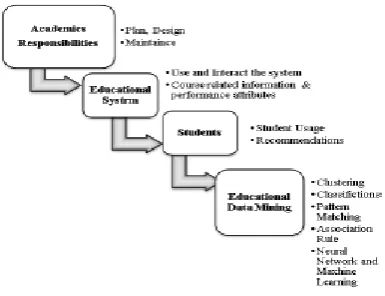
The educational Data mining consists of following basic step: in which academic responsibilities, educational systems, students and implementation of data mining techniques are included and this whole process is repeated repeatedly for further improvements as the suggestions are taken from every stakeholder.
Figure 1. Education system using Data Mining Figure one shows that Educational systems perform a deep study, analysis of academic responsibilities and
various architectures after deep observation, past experiences and studies. They make a rough sketch, implement this work into proper Design, which is our Education System, Online, or offline, the interaction between student, courses and Instructor occur, recommendations and modifications arise. In order to make a better system, we gather the historical information, current data and applied data mining techniques on it for improvement in courses, and education systems. In this way, the whole Process is modeled. There are many research goals, as mentioned in [12]. Student is Prediction for Future learning: Prediction of student’s performance in advance, learning process as well as behavior of learner. This can be achieved by making models of learners, after getting the details of the students.
The details of student include information about the subjects, thinking skills, motivation, previous results, academic information, attitude of learner, and extra-curricular activities related information etc. its main applications is student performance prediction in advance for the betterment of educations systems and student’s grades, Domain models are discovering provide improvements: By struggling to discover the models and improve them using data mining techniques, Effects of Education support related study: By studying the different effects of learning provided by online, gives advancement in scientific knowledge: For learners and learning process, student’s model is used to build by using latest technology and software.
The paper has been organized into major 5 sections. In which, Section 1 is the introduction Section 2 and 3 presents the relevant literature studies, describes the multiple techniques of data Mining related to E-learning System and, also provides the implemented projects of existing E-learning systems with Data mining. This paper is also describing the major steps of Evaluation of the E-learners Behaviour using various techniques, section 4 is description of an Intelligent Adaptive ELS, and section 4 is about tool, Last section presents the Discussion, Conclusions, and Future work.
II.
RELATED WORK
This section is based on the previous work done on the E-learning system; various papers have been published in Literature. This paper is discussing major papers from 2010 to 2016 systematically with techniques and effectiveness of data mining in Education system as well as limitations in each paper.
Comparison of ELS:
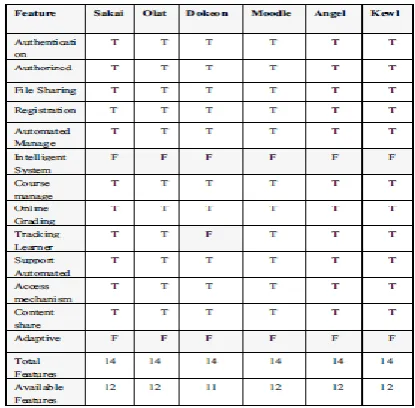
The detailed comparison of (Model) was presented with different Electronic learning course management systems, compared the education systems with a product based on various learning tools, technical tools, support tools, so it is based on two types of comparison, first provides Model learning system, as well as architecture other, is giving technical points, results concluded that the best learning system is Model , the issue in this paper is that it does not provide the secure and flawless education system , security related issues are not present [13].
Model architecture consists of many sections; Communication between Learner and Instructor module, where various types and format of files, mails, discussion and attachments are handled. Productivity section used to search articles, calendars, progress reports and relevant data is to be discussed. A separate section for the learner’s work involvement and exam related information. Admin section used to manage all contents, secure authentication access, and issues to be handled on all learning development methods and related problems. Electronic course section managed by admin and the instructor consists of a grading section and course related data. One section handles the internal and external curriculum activities and the design process.
Table 1: Comparison of E-Learning Management System With Features
Above Table 1 [13] shows the comparisons between different learning systems, we conclude that Dokeon, Blackboard and college are less efficient than Noodle and there is a lack of neural network and artificial intelligence technique implementations for the adaptive learning environment.
Work on a learning system with adaptive features[14] used the Artificial neural network and techniques of data mining, took different parameters likes student’s confidence level based on multiple aspects, content for studying English language, gender, performance and used four-level mechanism. Total seventy student based datasets are used for experiments, taken from junior school students the course is studied for twelve weeks, then a test is examined, empirical experiments also conducted. The results are not efficient for all courses; this approach is suitable for the single course, which relates to English issues. It needs various improvements to provide the efficient learning systems. Theoretical studies [15] presented an explanation of Data warehousing and data mining techniques in E-learning system and discussed the E-E-learning standard components. In which communication content, meta-data, wrapping of contents, a profile of the user and, registration is considered. Integrated and offline web usage techniques are to be used. This paper is not implementing any algorithm properly, data mining technique as well as data sets for experiments. This paper needs implementations.
learning systems. The three most important and well known LM systems; Sakai, Model, and, Tutor are included [16] worked on deeply, the study of the systems with creation of course process, access procedures, optimization of material, compared them with W3c standards, Tag and Wag guidelines. Results showed that A Tutor is best in many cases. Comparisons provide the weak points as well as discussed mostly occur problems in education systems, this will helpful in making new E-learning systems.
III.
BACKGROUNDS OF DATA MINING IN
EDUCATION SYSTEM
Preprocessing is the most important step of removing irrelevant data, any entry that can cause the problem will be removed or modified according to the specified standards, and filling of missing values in datasets is done in this process. To improve the online learning system in course-selection mechanism, major phase [9] has been improved by use of Apriori association rule, Tertius and filtered Rule-based associations and, predictive Apriori association. Preprocessing is applied to process the course data so final eight most preferred courses are selected from eighty-two courses, Weak used for statistical analysis, applied to datasets. Results showed that Apriori Association is the best for course selection mechanism in education systems; this work is not using algorithms like decision tree, clustering, and other data mining algorithms for prediction of courses. It is not an optimal approach. A limited number of data set is used in this approach.
To determine the patterns, which are frequently, used correlation/Association Rule of mining used. We calculate the Machine learning and agent-based, software for association rule and mining For Rules Prediction process Statistical Tracking of based Analysis Behavior and Statistical For Behavior based Analysis and student Assessment tasks
Following Table 2 shows of the E-learning web based Projects College. The combination of techniques provides better results and related techniques in which statistical based analysis, rule-than a single association rule. Weka is used and statistical based prediction, machine learning, agent-based software, and methods
are applied. By using empirical
studies and, association rule mining, as well as inductive inferences, are Hypothesis based experiment, we can make it more efficient.
Used in below-listed universities. Before
Preprocess the data; making Dimensions as well as cube of OLAP, Preparation of data mining models, Decision tree used to find the occurrence of defined model with selected parameters, by using the neural network, optimized the selected parameters to predict the attributes for adding the artificial neural networking in learning system. This approach is efficient but not reliable and feasible. This study is not focusing on the authentications process and secure mechanism for learners.
A. Predictive Apriori Association Rule
In this approach, predictive accuracy is used which is the combination of Support and confidence. For this purpose Tertius Association rule, provides the parameters (Threshold, Empirical studies describe, by the use of statistics and correlation methods presented by [18] provides various effects and comparative study as the survey of data mining techniques in Electronic learning system(ELS). Three hundred and four students are used in datasets of the 1st year class; the whole concept is based on first Aid course awareness, which is totally based on the marks. No other parameter considered for analysis, which is not a proper method, ignoring other important parameters. This paper is not using any intelligence techniques for the improvement of E-learning systems
.
B. Fuzzy Logic and Artificial Neural Network
Fuzzy logic methods play an important role in the E-learning systems as in [19] provided an intelligent system used fuzzy logic methods for student’s evaluation. In order to determine the interaction level between the students and completely intelligent system fuzzy logic model is used. The addition of artificial neural network, fuzzy logic was used by the composition of maximum and minimum. Fuzzy logic with data mining algorithms are used in prediction of student’s performance in advance, the failure and success rate of education is determined in advance[20-22] used to predict the student behavior as well as the performance of student and learning environment success rate.
C. Clustering
To find the similar groups or objects from the data sets clustering algorithms are used. Clustering is helpful in
gathering the same level contents, student’s mental level understanding, as well as behavior that is why it is better to use in educational systems. The clustering hundred and thirty-one students from College named as Mercury, belonged to final and second year of bachelor in studies. Reference [6] applied techniques on a dataset of one thousand, six hundred and thirty-one students; the data is taken from College named as Mercury and belongs to final and second year students of bachelor studies. Mainly to find the effect and impact of E-learning system, just one approach of the clustering algorithm is applied in order to improve the learning system and ANOVA-test is conducted with the null hypothesis. Graphs are presented to show the results of traditional learning and E-learning systems. Statistical methods are applied to the data. This approach provides good results.
Another work done by [23] focused on applying data mining, artificial intelligence techniques as well as new learning adaptive methods. A new model is presented in this paper for learning Information. Bio-data of students is necessary to know the level of interest and learning style of education. The questionnaire is conducted, to answer the required information for course and learning mechanism. Feature selection is applied to the dataset, preprocessed the data, and then clustering algorithms are applied according to various learner categories. This approach is time taking, theoretical and, expensive to implement. Experiments should be conducted to verify the techniques.
IV.
AN INTELLIGENT ADAPTIVE ELS AND
MODEL
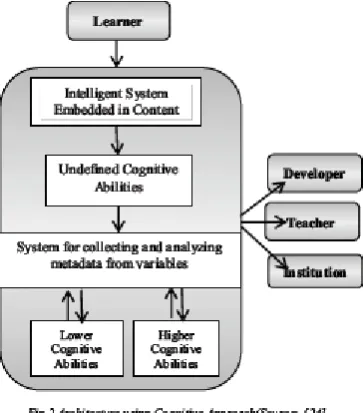
real learning platform, to test this system, a dataset is taken from different five Primary schools, which is about one hundred and seventeen students, to get the metadata, different variables for qualitative as well as quantitative is gathered, this system provides better results than a typical learning environment. To evaluate E-learning system, student usability statistics is used. There are many tools available, measures the total visits and per page visitors. Distribution with respect time mostly offered and selected courses.
Various tests are conducted for regression, correlation etc. analysis tools are used like SAS and SPSS. Visualization techniques are used where data is in relational form of databases. Due to less interaction between students and instructor, the quality level of E-learning is going downwards [8] presented a survey paper to elaborate E-learning procedure and a way to improve the education. This paper is describing the pros of E-learning and, presenting the challenges during the development of an efficient learning environment. Discussion of all studies in chronological order, their disadvantages, advantages, techniques, and implementation of an algorithm are done. The comparative study does not give the details of datasets of selected papers.
Most recent work done by [25] provided interesting solutions for distance learning systems in which learner access and identification, good learning content, pleasant environment for learning, keep the record of learner’s activity, improve the security related issues are included. It also discussed the issues while developing a learning system. Jensen- Shannon model is used in this approach, ranks the document according to the query. An asymmetric key algorithm for
encryption is used for security. This approach is so efficient and latest for improving the E-learning system. In order to improve the learning system, the artificial intelligence with data mining can helpful to get the better and, adaptive learning contents as well as the style. The architecture consists of four main stages. Student data is collected at admission time as well as maintained with the passage of time, result and demographics information is added according to the courses cleared, also record the behavior and mental level details. This record is used as data sets in next stages.
In next stage, preprocessing is applied on data, irrelevant information is cleared and missing values filled according to the data mining techniques various classifiers and clustering algorithms are applied for pattern matching.
In next stage, learning mechanism is based on student’s ability and data.
The Last stage is based on various styles of learning and student’s behavior type. Where the cluster has formed that form of study is preferred. The instructor will develop the course content according to eight types of student’s learning style and behaviors. The courses can be presented in the form of audio, video, and, the graphical presentation formats.
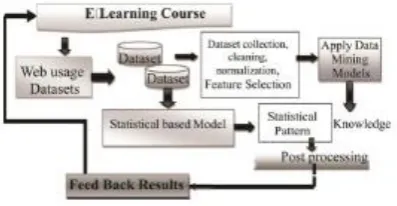
An important work presented [3]; the main purpose of his work is to build a model to evaluate the E-learner’s behavior. First step is to analyze the log files by use of statistical based techniques. These techniques are not good for the decision purpose support system and its feedback is not enough. The second step consisted of different models of fuzzy logic clustering and its application. The third step is a combination of both above two models and evaluation mechanism of the Conceptual, Innovative, Like Theories Liked Visual information in pictorial form representation Prefer spoken and written Liked to work too much/ try many times earn by Deep thinking, working constantly Like Linear, ordering, learn by steps Holistic, Learn in large heaps adaptive and simple E-learning Systems as shown in Fig 4.
Fig 4 Evaluating of Learner Behavior
V. TOOLS FOR EDUCATIONAL DATA MINING There are many free tools available i.e. data analyzer, TANAGRA, See5 and C5.0, ORANGE, SPINA, Carrot, Alpha minor and mostly used WEKA for clustering, visualizations, classification, regression, Text and pattern mining, predictions, association rule and decision tree[26].
V.
CONCLUSION
In this paper, Data Mining techniques and current state of art for betterment of E-learning system is presented. The survey will be helpful for researchers, business analysts and most importantly for teachers and students. After a detailed study, it is concluded that the most promising approach is Intelligent Adaptive system. It can be helpful in improving the Learning environment. In real environments, machine learning and artificial intelligence techniques with data mining concepts such as classification and clustering algorithms are required. The instructor/course content provider has to make the content of different styles, mentality levels and formats. This method is very expensive to implement and time taking. The main purpose of this term paper is to provide the studies related to the online learning system, by comparative study of previous work in a form of the survey. Data mining provides researcher efficient tools and methods to enhance the decision-making ability and determines the new approaches to implementing personalized learning environment.
VI.
REFERENCES
[1]. F. Castro, A. Vellido, À. Nebot et al., "Applying data mining techniques to e-learning problems," Evolution of teaching and learning paradigms in intelligent environment, pp. 183-221: Springer, 2007.
[2]. J.L. Hung, and K. Zhang, "Revealing online learning behaviors and activity patterns and making predictions with data mining techniques in online teaching," MERLOT Journal of Online Learning and Teaching, 2008.
[3]. G. Sakarkar, S. Deshpande, and V. Thakare, "Intelligent online e-learning systems: a comparative study," International Journal of Computer Applications, vol. 56, no. 4, 2012. [4]. M. A. Hogo, "Evaluation of e-learners behaviour
using different fuzzy clustering models: a
comparative study," arXiv preprint
arXiv:1003.1499, 2010.
[5]. K. E. Maull, M. G. Saldivar, and T. Sumner, "Observing the online behavior of teachers: From Internet usage to personalization for pedagogical practice."
[6]. F. Mödritscher, M. Andergassen, and G. Neumann, "Dependencies between e-learning usage patterns and learning results." p. 24. [7]. D. Suresh, and S. Prakasam, "The Impact of
Algorithm (ESURBCA),"International Journal of Computer Applications, vol. 83, no. 7, 2013. [8]. A. Garrido, and L. Morales, "E-Learning and
Intelligent Planning: Improving Content Personalization," Tecnologias del Aprendizaje, IEEE Revista Iberoamericana de, vol. 9, no. 1, pp. 1-7, 2014.
[9]. B. Y. Babu, G. Sriramakrishnan, and G. Visvanathan, "Survey of E-Learning: Content Personalization."
[10]. S. BAher, and L. LMR J, "A comparative study of association rule algorithms for course recommender system in e-learning," International Journal of Computer Applications, vol. 39, no. 1, pp. 48-52, 2012.
[11]. M. Blagojević, and Ž. Micić, "A web-based intelligent report e-learning system using data mining techniques," Computers & Electrical Engineering, vol. 39, no. 2, pp. 465-474, 2013. [12]. S. A. E. A. Elaal, "E-Learning Using Data
Mining," Chinese-Egyptian Research Journal Helwan University, 2013.
[13]. R. S. Y. Baker, K (2009), Baker, R.S.; Yacef, K (2009). "The state of educational data mining in 2009: A review and future visions". JEDM-Journal of Educational Data Mining 1 (1): 2017. [14]. S. Kumar, A. K. Gankotiya, and K. Dutta, "A
comparative study of moodle with other e-learning systems." pp. 414-418.
[15]. Y. -h. Wang, and H.-C. Liao, "Data mining for adaptive learning in a TESL-based e-learning system," Expert Systems with Applications, vol. 38, no. 6, pp. 6480-6485, 2011.
[16]. M. F. AlAjmi, S. Khan, and A. Sharma, "Studying Data Mining and Data Warehousing with Different E-Learning System," IJACSA) International Journal of Advanced Computer Science and Applications, vol. 4, no. 1, 2013. [17]. A. Iglesias, L. Moreno, P. Martínez et al.,
"Evaluating the accessibility of three open‐source learning content management systems: A comparative study," Computer Applications in Engineering Education, vol. 22, no. 2, pp. 320-328, 2014.
[18]. S. B. Aher, and L. Lobo, "Applicability of data mining algorithms for recommendation system in e-learning." pp. 1034-1040.
[19]. M. Prema, and S. Prakasam, "Effectiveness of
Data Mining-based E-learning system
(DMBELS)," International Journal of Computer Applications, vol. 66, no. 19, 2013.
[20]. G.J. Hwang, T. C. Huang, and J. C. Tseng, "A
group-decision approach for evaluating
educational web sites," Computers & Education, vol. 42, no. 1, pp. 65-86, 2004.
[22]. D. Kabakchieva, "Predicting student performance by using data mining methods for classification," Cybernetics and information technologies, vol. 13, no. 1, pp. 61-72, 2013.
[23]. P. Meedech, N. Iam-On, and T. Boongoen, "Prediction of Student Dropout Using Personal Profile and Data Mining Approach," Intelligent and Evolutionary Systems, pp. 143-155: Springer, 2016.
[24]. S. Sivakumar, S. Venkataraman, and C. Gombiro, "A User - Intelligent Adaptive Learning Model for Learning Management System Using Data Mining and Artificial Intelligence," International Journal for Innovative Research in Science and Technology, vol. 1, no. 10, pp. 78-81, 2015.
[25]. K. Dolenc, and B. Aberšek, "TECH8 intelligent and adaptive e-learning system: Integration into Technology and Science classrooms in lower secondary schools," Computers & Education, vol. 82, pp. 354-365, 2015.
[26]. P. Appalla, V. M. Kuthadi, and T. Marwala, "An efficient educational data mining approach to support e-learning," Information Systems Design and Intelligent Applications, pp. 63-75: Springer, 2016.
[27]. R. Jindal, and M. D. Borah, "A Survey on Educational Data Mining and Research Trends," International Journal of Database Management Systems, vol. 5, no. 3, pp. 53, 2013.
[28]. E. Wakelam, A. Jefferies, N. Davey et al., "The Potential for Using Artificial Intelligence Techniques to Improve e-Learning Systems." p. 762.
[30]. L. Morales, A. Garrido, and I. Serina, "Planning and execution in a personalised e-learning setting." pp. 233-242.
[31]. S. Prakasam, "An agent-based intelligent system
to enhance e-learning through mining