Using Core Ontology for Domain Lexicon Structuring
Rita Marinelli* Adriana Roventini* Giovanni Spadoni**
*Istituto di Linguistica Computazionale, C.N.R. Area della Ricerca Via Moruzzi 1, 56124 Pisa Italy e-mail: [email protected] – [email protected]
**President & C.E.O. S. Spadoni s.r.l. Shipping Agency, Livorno, Italy
Abstract
The users’ demand has determined the need to manage the growing new technical maritime terminology which includes very different domains such as the juridical or commercial ones. A terminological database was built by exploiting the computational tools of ItalWordNet (IWN) and its lexical-semantic model (EuroWordNet).
This paper concerns the development of database structure and data coding, relevance of the concepts of ‘term’ and ‘domain’, information potential of the terms, complexity of this domain and detailed ontology structuring recently undertaken and still in progress.
Our domain structure is described defining a core set of terms representing the two main sub-domains specified in ‘technical-nautical’ and ‘maritime transport’ terminology. These terms are sufficiently general to be the root nodes of the core ontology we are developing. They are mostly domain-dependent, but the link with the Top Ontology of IWN remains, endorsing either general and ‘foundation’information, or detailed description directly connected with the specific domain. Through the semantic relations linking the synsets, every term ‘inherits’ the top ontology definitions and becomes itself an integral part of the structure. While codifying a term in the maritime database, the reference is at the same time allowed to the Base Concepts of the terminological ontology embedding the term in the semantic network, showing that upper and core ontologies make it possible for the framework to integrate different views on the same domain in a meaningful way.
1. Introduction
Our research was originated by a request on the part of specialized users for a terminological maritime dictionary written in Italian but referred to the English language. The users’ demand has determined the need to manage the growing new technical terminology which also includes very different domains such as the juridical or the economic one.
By exploiting the computational instruments of ItalWordNet (Roventini et als., 2003) and its lexical-semantic model EuroWordNet (Vossen, 1999), a terminological database was built containing about 2,500 synsets (Marinelli et als., 2003). This allowed us to overcome the concept of ‘dictionary’, and obtain data not only described (by definition), but also codified (by semantic relations), managed automatically in an easy manner and linked to the corresponding closest concepts in English through the Inter-Lingual Index (ILI).
2. Types of Relations
We started to design the top level terminological data base, identifying the most relevant and representative domain concepts, taking into account terms:
1) belonging either to the generic or to the specialized lexicon.
2) having a large number of hyponyms. 3) significant (only) in that knowledge field.
The next step was a top-down development process defining and coding more specific concepts to populate and enlarge the database.
The lexical semantic relations provided by the EWN/IWN model were employed. The Internal relations allow information encoding in the form of lexical-semantic relations between pairs of synsets1. Synonymy and hyponymy are the most important relations encoded; this linguistic model is very rich and contains many other lexical-semantic relations such as part of, cause, purpose, sub-event, belong-to-class, etc.
The Equivalence relations link the Italian synsets with the closest concepts (synonyms, near synonyms, etc.) in the Inter-Lingual Index (ILI), a separate language-independent module containing all WN1.5 synsets but not the relations among them. The possibility to use IWN and the terminological DB for multilingual applications is ensured by this link.
The Plug-in relations allow to connect the specialized wordnet to the generic one linking a terminological sub-hierarchy (represented by its root node) to a node of the generic wordnet.
1
the subsequent specialization of the concepts (top-down development process), defining the most specific concepts, and then grouping them under more general concepts (bottom-up development). This ‘combination’ approach may be considered the easiest way of developing an ontology, since the concepts ‘in the middle’ tend to be the most descriptive concepts in the domain (Rosch, 1978).
Therefore we started with a few top-level concepts such as ‘goods’ (merci), and several specific concepts used for goods classifying, for example, ‘materiali da costruzione’ (construction materials) and ‘prodotti chimici’ (chemical products). Afterwards we related them to a middle-level concept, such as ‘merci varie’ (general cargo).
We then divided and distributed the many types (hyponyms) of construction materials or chemical products, by structuring a number of middle-level concepts and their hyponyms atvarious levels.
In the Fig. 1 the concept ‘materiali da costruzione’ (construction materials) is highlighted and there is evidenced the link either with the hyperonym ‘merci varie’ (general cargo) or with the hyponyms, e.g.: ‘cemento’ (cement), ‘granito’ (granite), etc.
Fig. 1 ‘Materiali da costruzione’ (construction materials)
In the set of core concepts proposed to represent our domain ontology, a non rigid categorization methodology was used. Regarding the concept ‘merci’ (goods), for instance, a classification is shown, in the figure above, which takes into account the criteria used by the Leghorn Port Authority. However, it is possible to insert different types of classification, e.g. the reference codes used by ISTAT, Istituto Nazionale di Statistica (National Statistics Institute), so that both classification systems can be provided for helping and supporting, e.g.:
autoveicoli nuovi e usati (new and second-hand motor vehicles) hashyperonym materiali da trasporto (transport materials) (according to ISTAT);
autoveicoli nuovi e usati (new and second-hand motor vehicles) has hyperonym veicoli (vehicles) (according to Port Authority).
In defining a class hierarchy, we have to consider that the ontology should not contain all the possible information about the domain, but should try to guarantee consistency. Another example of the issue of establishing the criteria for classification is, the concept ‘nave’ (ship): it has a large number of hyponyms but, as we said above, they can be classified from different points of view: on the basis of the type of propulsion (oars, sails, propeller), of the use for which they were built (transport of goods or passengers, competitions, war operations, etc.), of the place where they move (river, lake, sea).
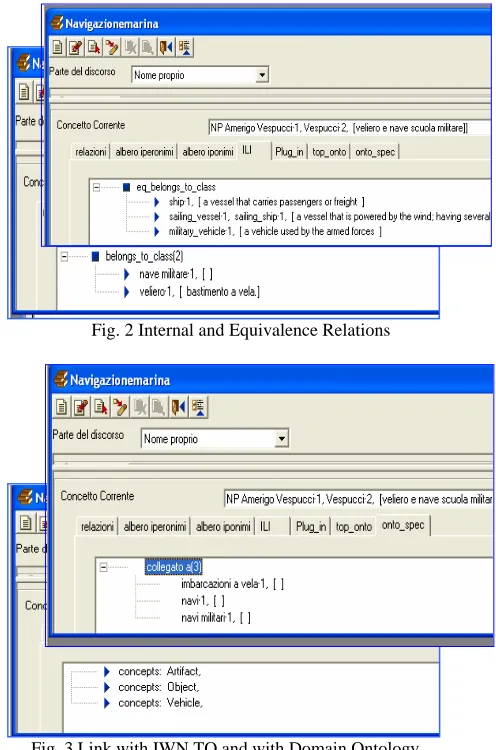
In this maritime domain, for example, we could classify the concept ‘ship’ into military, passengers, or cargo ships, considering the different kinds of uses. Alternatively, from a different point of view, we could divide the concept of ship into sailing or propeller ships. As allowed by most knowledge-representation systems, multiple inheritance in the concepts hierarchy is represented: a concept can be a ‘sub concept’ of more than one concept. For example, if in the domain specific ontology we defined the two separate classes of sailing vessels and military ships, the Vespucci would inherit both concepts as it is both a sailing vessel and a military ship, as shown in Fig. 2 and in Fig. 3:
Fig. 2 Internal and Equivalence Relations
Fig. 3 Link with IWN TO and with Domain Ontology
in the generic database, but also a type of dangerous goods, depending on the ‘focal orientation’ in which the is-a relationship is viewed.
Among the several viable alternatives, it is a matter of deciding which one could work better for the planned task, or would be more intuitive, more extensible, and more maintainable: an ontology is a model of reality of the world and the concepts in the ontology must reflect this reality (Friedman Noy and McGuinness, 2001).
6. Modeling the Domain Structure
Our analysis and modelling processes are guided by domain-independent criteria and relations, i.e. by the upper ontology provided by the IWN model. The model of this structure, like the database, is WN-like: the most important relations are the (vertical/hierarchical) is-a relations and among the ‘horizontal’ relations, a subset is exploited (is means, for purpose, causes) and also integrated with new semantic relations more suitably tailored tothe specific needs (event location, event time), e.g.:Fiera Internazionale della Nautica (International Nautics Fair) event location Genova
Fiera Internazionale della Nautica (International Nautics Fair) event time 20-28 Novembre 2005.
As a matter of fact, in the maritime domain, there are a large numberof terms to be coded as ‘events’, therefore new semantic relations are necessary to represent the space-temporal dimension in a more exhaustive manner. A study is in progress to examine this subject in more detail.
The subset of the above-mentioned relations seems to be the most appropriate to characterize the main conceptual schemas that people of the technical-nautical or maritime transport ‘world’ actually use, namely activity plans, programs involving particular devices for cargo stowage, shipping goods, navigation management, etc. (Marinelli and Spadoni, 2006).
While the core concepts are mostly domain dependant, the link with the Top Ontology of IWN continues to exploit the plug-in relations: in this way it is possible to guarantee either general and ‘foundation’ information, or detailed information directly connected with the specific domain. The tool we are using to build the specific ontology also allows an ‘integrated’ consultation of the terminological database, highlighting that every term ‘inherits’ the IWN Top Ontology definitions and becomes an integral part of the structure; at the same time, while codifying a term in the maritime database, reference to the concepts of the domain ontology is allowed, embedding the term in the terminological network.
We can consider a concept in the generic database and the relative concepts linked by the semantic relations as an anchor point. We wish to give prominence and development to these concepts within the appropriate framework of the terminological database. In this way the
generic database IWN is really not only a theoretical but also a pragmatic model, giving the drift about the (initial) paths to follow each time a concept is to be improved, enlarged and refined in the terminological database. In this development process it is likely to find concepts in the terminology that are not present in IWN but worth including in the database; or it may be necessary to codify concepts or missing relations, proceeding by approximation and considering the results step by step, exploiting the most effective and operative aspects of the two databases, in a dynamic process aimed at knowledge management and interoperability.
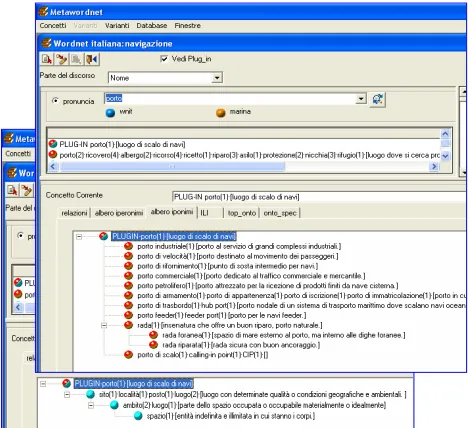
The example of ‘porto’ (harbour) is shown hereafter as it appears in the integrated consultation of the tool:
Fig. 4 Downward and upward relations
Fig. 5 The links to Domain Ontology and IWN TO
represented knowledge for users who need to share information in this domain, for professionals and not professionals who wish to reuse domain knowledge, to
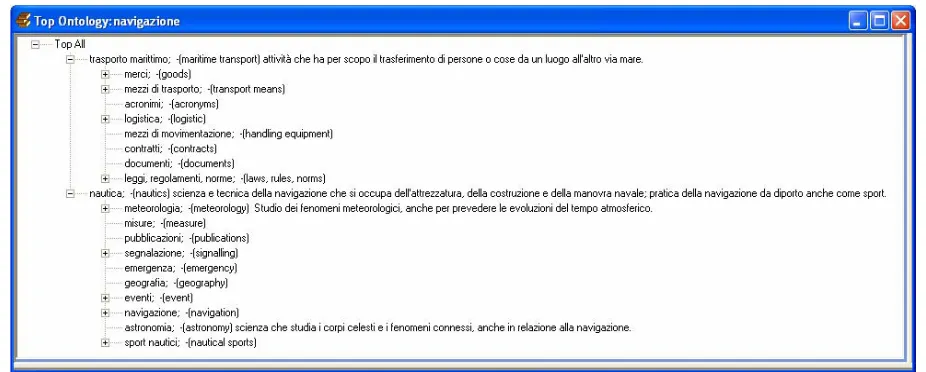
clarify and separate domain and operational knowledge. What follows is the ‘core’ set of concepts representing the main two sub-domains specified in maritime terminology:
Fig. 6 The core concepts representing the two sub-domains specified in maritime terminology
Most of the concepts that are shown in Fig. 6 are in the plural form: our objective is to indicate, in this way, the whole category, the whole set extensionally represented by its elements. The plural is also a heritage from the (Italian and English) glossaries lexicon and, most of all, from the ‘Italian Navigation Code’, where the titles of the main paragraphs and subjects dealt with generally contain words in the plural, e.g.: ‘navi e galleggianti’ (ships and floats) (op. cit.: 30), ‘categorie della gente di mare’ (sea people categories) (op. cit.: 60), ‘zone portuali’ (harbour zones) (op. cit.: 65), etc.
7. Final Remarks
Multiple inheritance, categories without rigid boundaries, a categorization performed from different points of view together with the possibility of being enlarged and provided with new details, make the system a flexible
dynamic structure, where no account is suggested of absolute levels of categorization.
Our approach to ontology building is not to create a rigid system with reduced freedom of interpretation, but to admit and navigate alternative interpretations, conceiving different contexts of use which have to be promptly highlighted for effective usefulness granting information integration, interoperability without overlapping, clarified information tested and officially validated.
The aim of our project is to underline the dynamic cognitive processes leading to ontology organization that are strictly connected with dynamic applicative and pragmatic processes, integrated in an iterative (even recursive) enriching, refining, tuning cycle: we view ontology design as a creative process, trying to guarantee not completeness, but consistency (Gruber, 1993) and we can assess its quality by enlarging, testing and refining, and, actually using it (Friedman Noy and McGuinness, 2001).
References
Cabré Castelvì M. T., La terminologia: representacion y comunicacion, Institut Universitari de Linguistica Aplicada, Barcelona, 2000.
Cabré Castelvì M.T., Theories of terminology, Terminology 9:2 (2003), 163-199.
Chierchia G., Semantica, Bologna, Il Mulino, 1997. Codice della Navigazione e relativi regolamenti, Milano,
Giuffrè, 1971.
Croft W., Cruse D. A. , Cognitive Linguistics. Cambridge University press, 2004.
Friedman Noy N., McGuinness D.L., “Ontology Development 101: A Guide to Creating Your First Ontology”. Stanford Knowledge Systems Laboratory Technical Report, 2001.
Gangemi, A., Development of an Integrated Formal Ontology and an Ontology Service for Semantic Interoperability in the Fishery Domain, Draft project plan v.7, CNR – Institute of Cognitive Sciences and Technologies, Ontology and Conceptual Modeling Group, 2005.
Gruber, T.R. , A Translation Approach to Portable Ontology Specification. Knowledge Acquisition 5: 199-220, 1993.
Marinelli R., Roventini A., Spadoni G. , Linking a subset of maritime terminology to the Italian WordNet. Proceedings of the Third International Conference on Maritime Terminology, Lisbon, 2003.
2004: Fourth International Conference on Language Resources and Evaluation, held in Memory of Antonio Zampolli. Lisbon, Portugal, 26th, 27th & 28 May 2004, Proceedings, Volume II, Paris, The European Language Resources Association (ELRA), 465-468, 2004.
Marinelli R., Roventini A., Some Considerations about the Italian Maritime Lexicon Structuring. In Proceedings of the IX Simposio Internacional de Comunicación Social, Santiago de Cuba, 24-28 de Enero de 2005. 635-639, 2005.
Marinelli R., Spadoni G., Some Considerations in Structuring a Terminological Knowledge Base. In Proceedings of the Third International WordNet Conference, GWC 2006, (forthcoming).
Poli R., Ontological Metodology, in Human Computer Studies, (2002), 56, 639-664.
Rosch, E. , Principles of Categorization. Cognition and Categorization. R. E. and B. B. Lloyd, editors. Hillside, NJ, Lawrence Erlbaum Publishers: 27-48, 1978.
Roventini, A., Alonge, A., Bertagna, F., Calzolari, N., Cancila, J., Girardi, C., Magnini, B., Marinelli, R., Speranza, M., Zampolli, A.: ItalWordNet: Building a Large Semantic Database for the Automatic Treatment of Italian, in: «Linguistica Computazionale», vol. XVI-XVII (2003), pp.745-791, Giardini, Pisa.
Roventini A., Marinelli R., Extending the Italian WordNet with the Specialized language of the Maritime Domain. Proceedings of the Second International WordNet Conference, GWC 2004, 193-198.
Vossen, P. (ed.): EuroWordNet General Document, 1999.http://www.hum.uva.nl/~EWN