IQ
MT: A Framework for Automatic Machine Translation Evaluation
Jes ´us Gim´enez and Enrique Amig ´o
TALP Research Center, LSI Department Universitat Polit`ecnica de Catalunya Jordi Girona Salgado 1–3. 08034, Barcelona
Departamento de Lenguajes y Sistemas Inform´aticos Universidad Nacional de Educaci´on a Distancia
Juan del Rosal, 16. 28040, Madrid [email protected], [email protected]
Abstract
We present the IQMTFramework for Machine Translation Evaluation Inside QARLA. IQMToffers a common workbench in which
eval-uation metrics can be utilized and combined. It provides i) a measure to evaluate the quality of any set of similarity metrics (KING), ii) a measure to evaluate the quality of a translation using a set of similarity metrics (QUEEN), and iii) a measure to evaluate the reliability of a test set (JACK). The first release of the IQMTpackage is freely available for public use. Current version includes a set of 26 metrics
from 7 different well-known metric families, and allows the user to supply its own metrics. For future releases, we are working on the design of new metrics that are able to capture linguistic aspects of translation beyond lexical ones.
1.
Introduction
In the last years, it has been repeatedly argued that cur-rent Machine Translation (MT) evaluation metrics do not capture well possible improvements attained by means of incorporating linguistic knowledge to MT systems (Och et al., 2003). One of the possible reasons is that most of the current metrics do not take into account any information at linguistic levels further than lexical. This is the case of metrics such as BLEU (Papineni et al., 2001), NIST (Dod-dington, 2002), WER (Nießen et al., 2000), PER (Leusch et al., 2003), GTM (Melamed et al., 2003), ROUGE (Lin and Och, 2004a), and METEOR (Banerjee and Lavie, 2005). More sophisticated metrics are required. However, little work has been done in that direction. For instance, met-rics such as ROUGE and METEOR may consider stem-ming. We may also find the WNM metric (Babych and Hartley, 2004), a variant of BLEU which weights n-grams according to their statistical salience estimated out from a monolingual corpus. Additionally, METEOR may perform a lookup for synonymy in WordNet (Fellbaum, 1998). But all these are still attempts at the lexical level. To our knowl-edge, the only attempt so far to exploit information at an upper level has been done by Liu and Gildea (2005) who introduced a series of syntax-based features based on syn-tactic tree matching.
Doubtless the design of a metric that is able to capture all the linguistic aspects that distinguish ‘correct’ translations from ‘incorrect’ ones is an ambitious and difficult goal. In-stead of building such a sophisticated metric we suggest to follow a ‘divide and conquer’ strategy, and design a set of specialized metrics, devoted to the evaluation of partial as-pects of MT quality. The new challenge is how to combine their outputs into a single measure.
In a recent work, Kulesza and Shieber (2004) tried to com-bine some aspects of different metrics by applying machine learning techniques to build classifiers that distinguished between human-generated (‘good’) and machine-generated (‘bad’) translations. They used features inspired in metrics
like BLEU, NIST, WER and PER.
Our approach is based on QARLA (Amig´o et al., 2005), a probabilistic framework originally designed for the evalua-tion of text summarizaevalua-tion systems. QARLA automatically identifies the features that distinguish human translations from automatic ones. It permits metric combinations, with-out any a-priori weighting of their relative importance. Be-sides, no training or adjustment of parameters is required, there is no need for human assessments, and it does not de-pend on the scale properties of the metrics being evaluated. The methodology which is closest to QARLA is ORANGE (Lin and Och, 2004b). However, ORANGE does not permit metric combinations.
Our initial experiments applying QARLA to MT evaluation are discussed in (Gim´enez et al., 2005). As a result of our experience, in this work we present the IQMT1 Framework
for MT Evaluation, a public workbench in which similarity metrics may be robustly combined.
The rest of the paper is organized as follows. Section 2 describes the fundamentals of QARLA. The IQMT
architec-ture is deployed in Section 3. Section 4 presents a case of study on the evaluation of the Europarl Corpus Spanish-to-English translation task. Finally, ongoing work is outlined in Section 5.
2.
Fundamentals
IQMTis based on the QARLA Framework (Amig´o et al.,
2005). QARLA uses similarity to models (human refer-ences) as a building block. The main assumption is that all human references are equally optimal and, while they are likely to be different, the best similarity metric is the one
1
The IQMT Framework is publically available, released
un-der the GNU Lesser General Public License (LGPL) of the Free Software Foundation. It may be freely downloaded at http://www.lsi.upc.edu/˜nlp/IQMT. Discussion on this software as well as information about oncoming updates takes place on the IQMTgoogle group, to which you can subscribe at
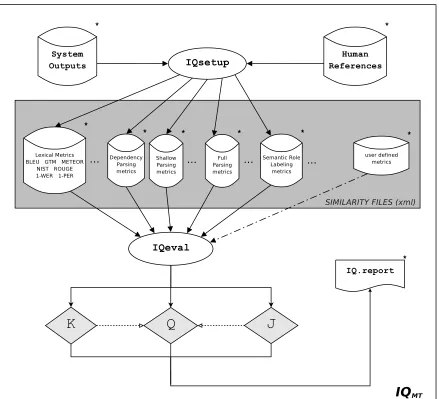
Figure 1: IQMTsystem architecture.
Based on this information, IQsetup generates for each met-ric a collection of ‘IQ XML’ similarity files:
metricM . system-systemM .xml
metricM . system-reference+M .xml
metricM . reference-reference+M .xml
These files are based on the ‘IQ XML’ representation schema. See an example:
<IQ metric="BLEU-4" ref="R0"
score="0.3945" target="S0"> <S n="1">0.3033</S>
<S n="2">0.5833</S> ...
<S n="1007">0.6852</S> <S n="1008">0.8333</S> </IQ>
The file above provides system and sentence level similar-ity scores obtained by comparing system ‘S0’ against ref-erence ‘R0’ based on the ‘BLEU-4’ similarity metric.
The set of similarity metrics is a dynamic component in our framework. We have started by addapting existing MT evaluation metrics. These metrics are transformed into sim-ilarity metrics by considering just a single reference when computing its value. Current version integrates 26 vari-ants from 7 families of metrics (BLEU, NIST, WER and
PER, GTM, ROUGE, and METEOR)2. New metrics will
be added in the future.
But the main advantage of the ‘IQ XML’ representation schema is that it allows users to supply their own metrics in a transparent and unified manner. For every new met-ric, the user is responsible for generating an IQ XML simi-larity file for each pair system-reference+M , reference-reference+M , and system-systemM .
3.2. IQeval
IQeval allows us to calculate the KING, QUEEN, and JACK measures. Several options must be specified:
the set of references
(all references are used by default).
2
source los ciudadanos esperan de nosotros algo m´as que la simple gesti ´on de las
crisis ; esperan se ˜nales y una pol´ıtica sostenible en estos ´ambitos .
systems
WB the citizens expect of us something more than the simple management of
the crisis and a sustainable policy in these areas . expectantly signals SYSTRAN the citizens wait for of us something more than the simple management of
the crises; they wait for signals and a sustainable policy in these scopes.
PB the citizens expect us any more than simply managing crises ; they hope
signals and a sustainable policy in these areas .
PB++ the citizens expect us something more than simply crisis management ;
they expect signs and a sustainable policy in these areas .
references
R0 the public expect more than just crisis management ; they expect signs ,
and a sustainable policy in these fields .
R1 citizens expect something more of us than just simple crisis management ;
they expect signs and sustainable policies in these areas .
R2 the citizens expect from us something more than a simple crisis management ;
they expect signs and a sustainable policy in these matters .
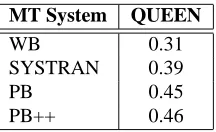
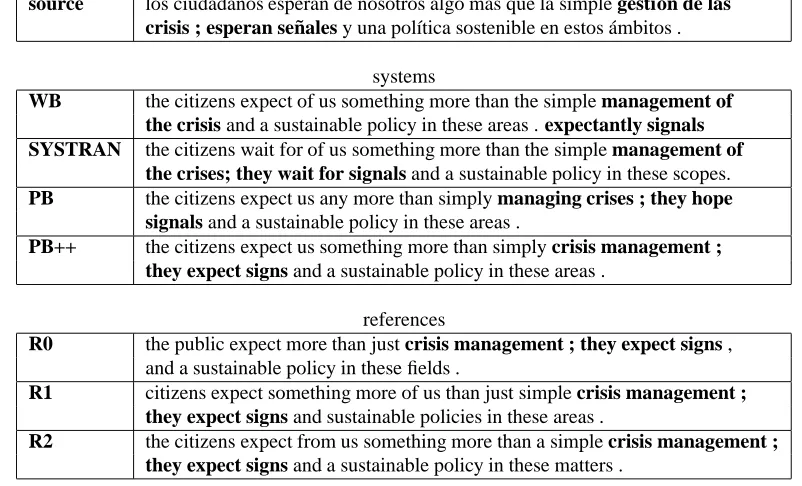
Table 3: A case of error analysis, according to the QUEEN measure, in which the ‘PB++’ system outperforms the rest.
Jes´us Gim´enez, Enrique Amig´o, and Chiori Hori. 2005. Machine translation evaluation inside qarla. In
Proceed-ings of the International Workshop on Spoken Language Technology (IWSLT’05).
Alex Kulesza and Stuart M. Shieber. 2004. A learn-ing approach to improvlearn-ing sentence-level mt evalua-tion. In Proceedings of the 10th International
Confer-ence on Theoretical and Methodological Issues in Ma-chine Translation.
G. Leusch, N. Ueffing, and H. Ney. 2003. A novel string-to-string distance measure with applications to machine translation evaluation. In Proceedings of MT Summit IX. Chin-Yew Lin and Franz Josef Och. 2004a. Automatic evaluation of machine translation quality using longest common subsequence and skip-bigram statics. In
Pro-ceedings of ACL.
Chin-Yew Lin and Franz Josef Och. 2004b. Orange: a method for evaluating automatic evaluation metrics for machine translation. In Proceedings of COLING. Dekang Lin. 1998. Dependency-based evaluation of
mini-par. In Proceedings of the Workshop on the Evaluation
of Parsing Systems.
Ding Liu and Daniel Gildea. 2005. Syntactic features for evaluation of machine translation. In Proceedings
of ACL Workshop on Intrinsic and Extrinsic Evaluation Measures for Machine Translation and/or Summariza-tion.
I. Dan Melamed, Ryan Green, and Joseph P. Turian. 2003. Precision and recall of machine translation. In
Proceed-ings of HLT/NAACL.
S. Nießen, F.J. Och, G. Leusch, and H. Ney. 2000. Evalu-ation tool for machine translEvalu-ation: Fast evaluEvalu-ation for mt research. In Proceedings of the 2nd International
Con-ference on Language Resources and Evaluation.
Franz Josef Och, Daniel Gildea, Sanjeev Khudanpur, Anoop Sarkar, Kenji Yamada, Alex Fraser, Shankar
Ku-mar, Libin Shen, David Smith, Katherine Eng, Viren Jain, Zhen Jin, and Dragomir Radev. 2003. Final report of johns hopkins 2003 summer workshop on syntax for statistical machine translation. Technical report, Johns Hopkins University.