Training a Statistical Machine Translation System without GIZA++
Arne Mauser, Evgeny Matusov, Hermann Ney
Lehrstuhl f¨ur Informatik VI - Computer Science Department RWTH Aachen University
Aachen, Germany
{mauser, matusov, ney}@i6.informatik.rwth-aachen.de
Abstract
The IBM Models (Brown et al., 1993) enjoy great popularity in the machine translation community because they offer high quality word alignments and a free implementation is available with the GIZA++Toolkit (Och and Ney, 2003). Several methods have been developed
to overcome the asymmetry of the alignment generated by the IBM Models. A remaining disadvantage, however, is the high model complexity. This paper describes a word alignment training procedure for statistical machine translation that uses a simple and clear statistical model, different from the IBM models. The main idea of the algorithm is to generate a symmetric and monotonic alignment between the target sentence and a permutation graph representing different reorderings of the words in the source sentence. The quality of the generated alignment is shown to be comparable to the standard GIZA++training in an SMT setup.
1
Introduction
Currently, the majority of statistical machine translation systems is trained using word alignments of parallel cor-pora generated by the complex IBM Models (Models 3, 4 or 5, see (Brown et al., 1993)) with the GIZA++Toolkit (Och and Ney, 2003). This paper describes a word align-ment training procedure for statistical machine translation that uses a simple and clear statistical model, different from the IBM models.
The novel training method described here produces word alignments for statistical machine translation while simul-taneously reordering each source sentence to match the word order in the corresponding target sentence. This re-ordering has shown to improve translation quality (Kanthak et al., 2005), (Crego et al., 2005) when using reordering in search.
The main idea of the algorithm is to generate a monotonic alignment between the target sentence and a permutation
lattice representing different reorderings of the words in
the source sentence. In contrast to GIZA++ alignments, this alignment is symmetric, i.e. it allows for many-to-one and many-to-one-to-many connections simultaneously. Further-more, full coverage is ensured for source and target sen-tence. The alignment is determined with a dynamic pro-gramming algorithm similar to the Levenshtein algorithm. In addition, the best permutation of the source sentence is selected from the given permutation lattice in the global de-cision process. This distinguishes the approach presented here from the methods presented in literature, where static word alignment information is used for reordering.
In the following section, we will give a review of the most common statistical alignment models. Section 3 gives a short description of the translation framework using weighted Finite State Transducers (WFST). A new lexicon-based method for reordering in training is introduced in Section 4 and the alignment procedure is described in detail in Section 5. We will present some experimental results in Section 6.2.
2
Statistical Alignment Models
The task of statistical machine translation is to translate an input word sequence f1J = f1, . . . , fJ in the source language into a target language word sequence eI1 = e1, . . . , eI. Given the source language sequence, we select the target language sequence that maximizes the product of the language model probabilityP r(eI
1)and the translation model probability P r(fJ
1|eI1). The translation model de-scribes the correspondence between the words in the source and the target sequence whereas the language model de-scribes well-formedness of a target word sequence. Intro-ducing a hidden variable, the translation model can be writ-ten as:
P r(f1J|eI1) =
X
aJ
1
P r(f1J, aJ1|eI1)
where aJ1 are called alignments and represent mappings from the source word position j to the target word posi-tion i = aj. Alignments are introduced into translation model as a hidden variable, similar to the concept of Hid-den Markov Models (HMM) in speech recognition. The translation probabilityP r(fJ
1, aJ1|eI1)can be factorized as follows:
P r(fJ
1, aJ1|eI1) =
J
Y
j=1
P r(fj, aj|f1j−1, aj−1 1, eI1)
= J
Y
j=1
P r(aj|f1j−1, aj−1 1, eI1)·
·P r(fj|f1j−1, a
j
1, eI1)
whereP r(aj|f1j−1, a
j−1
1 , eI1)is alignment probability and P r(fj|f1j−1, a
j
1, eI1)is the lexicon probability.
In all popular translation models IBM-1 to IBM-5 as well as in the HMM translation model, the lexicon probabil-ity P r(fj|f1j−1, aj1, eI1) is approximated with the single-word lexicon probability p(fj|eaj) which takes into
ac-count solely the aligned words fj and eaj. The
Tuesday would suit me fine .
1 Dienstag 2 wuerde 3 mir 4 gut 5 passen 6 .
Dienstag|Tuesday wuerde|would mir|$ gut|$ passen|suit_me_fine .|.
Tuesday would suit me fine .
1 Dienstag 2 wuerde 5 passen 3 mir 4 gut 6 .
Dienstag|Tuesday wuerde|would passen|suit mir|me gut|fine .|.
Figure 1: Example for reordering in training. From a given alignment (top) we reorder the source words to generate a monotonic alignment (bottom). Below the alignment matrices the bilanguage representation is shown. It can be seen that by reordering the source sentence, the assignment in the intermediate language improves.
P r(aj|f1j−1, aj−1 1, eI1). A detailed description can be found in (Och and Ney, 2003).
Other methods for word alignment often use heuristic mod-els based on cooccurrence counts, such as (Melamed, 2000) or recently (Moore, 2005).
3
Statistical Translation with Finite State
Transducers
3.1 Approach
In statistical machine translation, we want to find the target sentenceeI1with the highest probability for a given source language sentencef1J. Here, we formulate the decision rule for maximizing the joint probability of source and target sentenceP r(f1J, eI1). As in equation (1), the alignment is introduced as a hidden variableA.
ˆ
eIˆ
1 = argmax
I,eI
1
P r(fJ
1, eI1) (1)
∼
= argmax
I,eI
1
max
A P r(A)·P r(f J
1, eI1|A) (2)
For representing the joint events of source words and target words occurring together, we use given alignment informa-tion to create biwords, i.e. from a pair of aligned source and target word we create a new word separated by a delimiting symbol. Each token in the bilanguage represents the event of the source wordsf˜and the target words˜ebeing aligned in the training data. For these events, we want to model the joint probability P r(f, e). The transformation of the whole training corpus in such a way results in a bilanguage representation of the training corpus.
On this new corpus, we apply standard language modeling techniques to train smoothedm-gram models.
Anm-gram language model can also be represented by a FSA. The histories can be interpreted as the states of the FSA (Allauzen et al., 2003).
In the RWTH system as described in (Kanthak and Ney, 2004), the source language side of the tuplesf˜is always a single source word. The corresponding target tuplee˜is a sequence of0or more target words. For the unique map-ping, we require an alignment that is a function of the target words.
In experimental trials it turned out that a 4-gram model yields the best performance for most translation tasks. For better generalization we applied absolute discounting with leaving-one-out parameter estimation.
3.2 Reordering in Training
While most approaches only use the initial alignments to extract bilingual tuples without reordering, the RWTH sys-tem first uses alignments which are functions of the source words to reorder the source corpus to reflect the target sen-tence order. The tuples are then extracted using the re-ordered corpus.
Given an initial (non-monotonic) alignment, we reorder the source words to form a monotonic alignment. The effect of reordering on the bilanguage representation of the align-ment is shown in Figure 1. Reordering helps to extract smaller tuples, leading to a better generalization on unseen data.
In most approaches, alignment and reordering are treated as separate problems. First the best alignment is generated and then the source corpus is reordered given this alignment. The obtained reordering is static and cannot be changed. It is not clear, if the alignment is still optimal with the given reordering. In contrast, with the novel algorithm presented in this work, alignment and reordering are determined in a global decision process.
3.3 Reordering in Translation
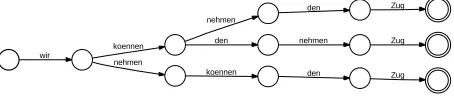
In search, alignment information is not available. Reorder-ing, however, is necessary since the training examples were extracted on a reordered source corpus and word order in tuple sequences does not match the original word order. Therefore, we consider permutations of the source sentence in translation. Since arbitrary reorderings are infeasible for larger sentences, we use constrained reordering, for exam-ple with the IBM constraints (Berger et al., 1996) or local constraints as described in (Kanthak et al., 2005). They use linear automata to represent sentences and efficiently com-pute permutation automata on demand.
mir
would
that
suit
passen mir
auch
mir
passen
auch
auch
passen
too
me
würde
mir
auch
passen
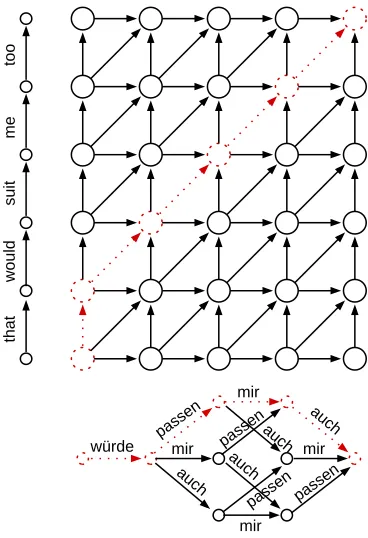
Figure 5: Illustration of the alignment process using a per-mutation graph and a monotonic alignment lattice.
sentence coverage and restricts the alignments permit-ted in the alignment lattice. The target sentence is left unpermuted.
• From the composition of permutation graph and align-ment lattice, the best path is extracted. This can be seen as simultaneously finding the best path through the alignment lattice and the permutation graph.
Finding the best monotonic alignment between source and target sentence corresponds to finding the best sequence of monotonic transitions. A monotonic path consists of three different types of transitions: A diagonal transition takes place when a source and a target word are assumed to be directly associated with each other. It corresponds to a match/substitution in the Levenshtein algorithm. A hori-zontal or a vertical movement can be interpreted as an in-sertion of a source word or a target word, respectively. The probabilities each movement are given by a statistical bilin-gual lexicon.
Each of the three types of phrasal tuples can be seen as a different movement in the alignment lattice. The regular one-to-one tuple(f, e)corresponds to a diagonal transition in the alignment lattice. The tuples(f, ε)and(ε, e) corre-spond to a horizontal and vertical movement, respectively. The states in the alignment lattice indicate which source and target words have already been covered.
For permutation, it is possible to use either the constrained reorderings or the n-best reorderings presented in Sec-tion 3.3. The general process is illustrated in Figure 5. The alignment lattice is constructed in such a way, that arcs are labeled with the source and target words associated at the current position. For the target words, this is
unambigu-ous. Since we want to allow for source sequence reorder-ings any possible source word has to be considered at the horizontal and diagonal transitions in the lattice.
The individual states in the lattice represent the current po-sition in the target sentence (bottom to top) and the number of source words read (left to right).
In the resulting automaton, every path corresponds to an alignment of source sequence and target sequence, where source words are in the order of their aligned target words. In order to determine the best alignment between source and target sequence, we determine the best path though the composition of alignment lattice and permutation automa-ton using a general search algorithm.
The lexical probabilities can be modeled taking different context lengths into account. In analogy to the Levenshtein alignment, we first decided to use a zero-order model, where only the current transition is taken into account. This is then extended to a first-order model by the context of the previously aligned words. The models are described in more detail in the following sections.
5.1 Zero-Order Model
For the diagonal transition, the probability is given by the
joint lexicon probabilitypd(f, e)of the source wordf and the target wordeinvolved. The horizontal transitions have no direct association with a target word and are weighted by the probabilityph(f|ε). Similarly, the probabilities for the vertical transitions arepv(e|ε).
For initializing the lexicon probabilities of the zero-order model, we decided to use the probabilities obtained from the IBM Model 1. Being simple and easy to obtain, IBM Model 1 also has the advantage of making no assumptions on the word ordering in the languages. This allows us to decide independently of the lexicon, which reordering con-straints are suitable for the given task.
Having the named advantages, IBM Model 1 offers a good starting point for the training of other alignment models. For our experiments, we rely on the symmetrized version of the translation lexicon as described in (Zens et al., 2004). Lexica for the source-to-target and target-to-source transla-tion directransla-tion are combined log-linearly. This has shown to improve alignment quality. Furthermore, with the mod-els proposed in this section, symmetric alignments will be generated. Therefore, using a symmetric lexicon model for initialization seems to be advisable.
The concept for the implementation of the training uses a recursive problem formulation. The auxiliary quantity Q(i, j)defines the maximum probability for aligning the firstitarget words andjsource words. The recursive for-mulation ofQ(i, j)is
Q(i, j) = max©Q(i−1, j−1)·p(fj, ei), Q(i, j−1) ·p(fj, ε), Q(i−1, j) ·p(ε, ei)
ª
(3)
a predecessor setP red(c), that contains all coverage vec-tors that are predecessors ofcin the permutation graph. If c0 ∈P red(c),jis the index of the source word in whichc andcdiffer. The maximization has to be extended to the set of predecessors. Additionally, each arc in the alignment lat-tice can be associated with the transition probabilityp(d), p(h)orp(v). This can be used to favor diagonal transitions in the alignment. The complete auxiliary quantityQ(i, c)
then is
Q(i, c) = max© max
c0∈P red(c)Q(i−1, c
0)·p
d(fj, ei)·p(d),
max
c0∈P red(c)Q(i, c
0) ·p
h(fj, ε) ·p(h),
Q(i−1, c) ·pv(ε, ei) ·p(v)
ª
Initialization of Q(i, j) is done as in the Levenshtein al-gorithm. The generated alignment is symmetric, since we keep track of the correspondence of source and target word and allow for one-to-many and many-to-one alignments.
5.2 First-Order Lexicon Model
As a refinement, the lexical probabilities for the non-diagonal transitions can include first-order context depen-dency on the previous source wordf0and the previous tar-get worde0, i. e. p
h(f|f0, e0)andpv(e|f0, e0), respectively. The previously joint event of a source or target word with-out a direct association with a word in the other language is now written as a conditional probability of the word, given the previously aligned words.
For initialization, the probabilities are obtained from an alignment generated by the zero-order model.
5.3 Alignment Procedure
The probability distributions are initialized with a simple lexicon model – IBM Model 1. Then, the alignment and re-ordering is improved in an iterative training procedure. The lexicon probabilities in the next iteration are reestimated using relative frequencies based on the alignments for the whole training corpus in the previous iteration.
The reordering of source words is achieved by considering the permutation lattice. The lattice is processed from left to right. Having processedjsource positions, all lattice word alternatives for the positionj+ 1in the (reordered) source sentence are hypothesized with every diagonal or horizontal transition.
5.4 Implementation
The permutation lattice is computed on-demand under the reordering constraints described in Section 3.3, or we use then-best reorderings as described in Section 4.
The algorithm was implemented using weighted finite state transducers (WFSTs). This allows for a convenient incor-poration of the permutations described above. In contrast to GIZA++, a distributed implementation of this algorithm is straightforward.
6
Experiments
6.1 Experimental Setting
The word alignment and reordering methods presented here were evaluated on three different machine translation tasks
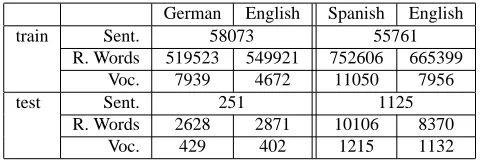
Table 3: Corpus Statistics for the German-English Verb-mobil Corpus and the Spanish-English Xerox Corpus. The average number of reference translations for the Verbmobil corpus is 3.9 for the test set while the Xerox corpus only had single references
German English Spanish English
train Sent. 58073 55761
R. Words 519523 549921 752606 665399 Voc. 7939 4672 11050 7956
test Sent. 251 1125
R. Words 2628 2871 10106 8370 Voc. 429 402 1215 1132
with respect to translation quality (as measured by well-established objective error criteria). The proposed train-ing procedure fits especially well with a joint-probability WFST translation system (Kanthak et al., 2005). This sys-tem searches for the best translation by composing a lattice that represents constrained reorderings of the source sen-tence with a WFST representation of a bilingual m-gram model.
Experiments were carried out on the German-English Verb-mobil task and the Spanish-English Xerox task with the training, development, and test data as shown in Table 3. The Verbmobil task contains dialogues about appointment scheduling and hotel reservation. The Xerox task is the translation of instruction manuals for technical devices. Despite many approaches, there is still no generally ac-cepted criterion for the evaluation of machine translation output. Different available measures capture different as-pects of the translation quality, therefore we will provide several evaluation measures: The word error rate (WER), the position-independent word error rate (PER), the BLEU
criterion and the NISTprecision measure.
For each of these evaluation measures, multiple references were used for the Verbmobil, but not for the Xerox task.
6.2 Experimental Results
The overall performance of the proposed alignment proce-dure compares well with the GIZA++IBM Model 4 training while using a significantly simpler model.
Table 1 shows the translation quality for the German-English Verbmobil task when using this WFST system. The error measures were computed with respect to multiple ref-erences. The table shows, that n-best reordering has a slightly worse performance than the IBM constraints. How-ever, for large corpora, alignment with these constraints is not feasible due to the computational complexity. Using the n-best reorderings results in a major speedup of the align-ment procedure. For the Verbmobil corpus, the first-order model performs worse than the zero-order model. This can be attributed to data sparseness problems. In fact, most of the bigrams of bilingual tuples are only seen once in train-ing, making probability estimates very unreliable. This problem does not occur to this degree for the zero-order model.
re-Table 1: Translation performance on the German-English Verbmobil task using the proposed training algorithm. Reordering in translation is performed under the IBM constraints, window size 4.
training model reordering in training WER[%] PER[%] BLEU[%] NIST
GIZA++IBM model 4 static 36.2 27.4 49.1 8.00
zero-order IBM constraints (window size 4) 35.9 22.8 49.0 7.77
zero-order N-best reordering (N = 1000) 36.5 22.8 47.5 7.75
first-order IBM constraints (window size 4) 36.1 22.1 48.9 7.82
first-order N-best reordering (N = 1000) 36.9 23.1 47.8 7.74
Table 2: Translation performance on the Spanish-English Xerox task using the proposed training algorithm. Reordering in translation is performed under local constraints, using the same window size as in training.
training model reordering in training WER[%] PER[%] BLEU[%] NIST
GIZA IBM model 4 static 35.7 19.7 54.0 8.69
zero-order local constraints (window size 3) 29.6 21.9 57.3 8.71
first-order local constraints (window size 3) 29.3 21.6 57.5 8.76
ordering was not performed here, since the language pair only requires local reorderings, which are sufficiently fast to evaluate. In contrast to the Verbmobil corpus, the first-order model gives a slight improvement over the zero-first-order model. In the domain of the Xerox corpus, technical man-uals, expressions are more standardized and less free as in spontaneous speech. Therefore, more reliable bigram counts on the level of bilingual tuples can be obtained.
7
Conclusions
In summary, the main contributions of this work compared to previous approaches are:
• a unified training algorithm for word alignment and source sentence reordering which is much simpler than the algorithms implemented in GIZA++,
• the use of context information in lexical probabilities,
• and a novel approach for reordering in training using theN-best reordering hypotheses.
The translation systems trained with the proposed method perform at least as well or better than the same systems trained with the GIZA++word alignment toolkit.
Future directions for research might be the use of smooth-ing methods in the alignment procedure to attenuate data sparseness effects. This would also allow for using higher m-gram models in training.
8
Acknowledgement
This work was in part funded by the European Union under the in-tegrated project TC-STAR – Technology and Corpora for Speech to Speech Translation (IST-2002-FP6-506738).
9
References
C. Allauzen, M. Mohri, and B. Roark. 2003. Generalized algo-rithms for constructing statistical language models. In
Pro-ceedings of the 41st Annual Meeting of the Association for Computational Linguistics, pages 40–47.
A. L. Berger, P. F. Brown, S. A. Della Pietra, V. J. Della Pietra, A. Kehler, and R. L. Mercer. 1996. Language translation appa-ratus and method using context-based translation models. U.S. patent #5,510,981.
Peter F. Brown, Vincent J. Della Pietra, Stephen A. Della Pietra, and R. L. Mercer. 1993. The mathematics of statistical ma-chine translation: parameter estimation. Computational
Lin-guistics, 19(2):263–312, June.
J. M. Crego, J. B. Mari no, and A. de Gispert. 2005. Reordered search, and tuple unfolding for Ngram-based SMT. In
Pro-ceedings of the MT Summit X, pages 283–289, Phuket,
Thai-land, September.
S. Kanthak and H. Ney. 2004. FSA: an efficient and flexible c++ toolkit for finite state automata using on-demand computation. In Proceedings of the 42nd Annual Meeting of the
Associa-tion for ComputaAssocia-tional Linguistics (ACL 2004), pages 510–
517, Barcelona, Spain, July.
S. Kanthak, D. Vilar, E. Matusov, R. Zens, and H. Ney. 2005. Novel reordering approaches in phrase-based statistical ma-chine translation. In Proceedings of the ACL Workshop on
Building and Using Parallel Texts, pages 167–174, Ann Arbor,
Michigan, June.
K. Knight and Y. Al-Onaizan. 1998. Translation with finite-state devices. In AMTA ’98: Proceedings of the Third Conference
of the Association for Machine Translation in the Americas on Machine Translation and the Information Soup, pages 421–
437, London, UK.
E. Matusov, S. Kanthak, and H. Ney. 2005. Efficient statistical machine translation with constrained reordering. In
Proceed-ings of the 10th annual Conference of European Association of Machine Translation (EAMT 2005), pages 181–188, Budapest,
Hungary, May.
I. D. Melamed. 2000. Models of translational equivalence among words. Computational Linguistics, 26(2):221–249, June. R. C. Moore. 2005. Association-based bilingual word
align-ment. In Proceedings, Workshop on Building and Using
Paral-lel Texts: Data-Driven Machine Translation and Beyond, pages
1–8, Ann Arbor, Michigan, June.
F. J. Och and H. Ney. 2003. A systematic comparison of var-ious statistical alignment models. Computational Linguistics, 29(1), March.
R. Zens, E. Matusov, and H. Ney. 2004. Improved word align-ment using a symmetric lexicon model. In Proceedings of the