Extending VerbNet with Novel Verb Classes
Karin Kipper
4, Anna Korhonen
y, Neville Ryant
4, Martha Palmer
4
Computer and Information Science Department University of Pennsylvania
[email protected],[email protected] y
University of Cambridge Computer Laboratory
Department of Linguistics University of Colorado at Boulder
Abstract
Lexical classifications have proved useful in supporting various natural language processing (NLP) tasks. The largest verb classification for English is Levin’s (1993) work which defined groupings of verbs based on syntactic properties. VerbNet (Kipper et al., 2000; Kipper-Schuler, 2005) – the largest computational verb lexicon currently available for English – provides detailed syntactic-semantic descriptions of Levin classes. While the classes included are extensive enough for some NLP use, they are not comprehensive. Korhonen and Briscoe (2004) have proposed a significant extension of Levin’s classification which incorporates 57 novel classes for verbs not covered (comprehensively) by Levin. This paper describes the integration of these classes into VerbNet. The result is the most extensive Levin-style classification for English verbs which can be highly useful for practical applications.
1.
Introduction
Lexical classes, defined in terms of shared meaning com-ponents and similar (morpho- )syntactic behavior of words, have attracted considerable interest in NLP (Jackendoff, 1990; Levin, 1993). These classes are useful for their abil-ity to capture generalizations about a range of (cross- )lin-guistic properties. NLP systems can benefit from lexical classes in a number of ways. Such classes define the map-ping from surface realization of arguments to predicate-argument structure, and are therefore an important compo-nent of any system which needs the latter. As the classes can capture higher level abstractions (e.g. syntactic or se-mantic features) they can be used as a principled means to abstract away from individual words when required. They are also helpful in many operational contexts where lexi-cal information must be acquired from small application-specific corpora. Their predictive power can help compen-sate for lack of sufficient data fully exemplifying the be-havior of relevant words. Lexical classes have proved help-ful in supporting a number of (multilingual) tasks, such as computational lexicography, language generation, ma-chine translation, word sense disambiguation, semantic role labeling, and subcategorization acquisition (Dorr, 1997; Prescher et al., 2000; Korhonen, 2002). While this work has met with success, it has been small in scale. Large-scale exploitation of the classes has not been possible because no comprehensive classification is available.
The largest and the most widely deployed classification in English is Levin’s (1993) classification of verbs. VerbNet (VN) (Kipper et al., 2000; Kipper-Schuler, 2005)1 – the most extensive on-line verb lexicon currently available for English – provides detailed syntactic-semantic descriptions of Levin classes organized into a refined taxonomy. While
1
http://verbs.colorado.edu/ kipper/verbnet.html
VN has proven useful for a variety of natural language tasks (see Section 5.), it mainly deals with Levin-style verbs (i.e. verbs taking noun (NP) and prepositional phrase com-plements (PP)) and thus also suffers from limited cover-age. Experiments have been reported which indicate that it should be possible, in the future, to automatically supple-ment VN with novel classes and member verbs from cor-pus data (Brew and Schulte im Walde, 2002; Korhonen et al., 2003; Kingsbury, 2004). While an automatic approach would avoid the expensive overhead of manual classifica-tion and enable applicaclassifica-tion-specific tuning, the very devel-opment of the technology capable of large-scale classifica-tion requires access to a target gold standard classificaclassifica-tion more extensive than that available currently.
Korhonen and Briscoe (2004) have proposed a substantial extension to Levin’s original classification which incorpo-rates 57 novel classes for verb types not covered (compre-hensively) by Levin. They have demonstrated the utility of these classes by using them to support automatic subcatego-rization acquisition and shown that the resulting extended Levin classification has a fairly extensive coverage over the English verb lexicon. While these novel classes are poten-tially very useful for the research community, their practical use is limited by the fact that no detailed syntactic-semantic descriptions are provided with the classes, and no attempt has been made to organize the classes into a taxonomy or to integrate them into Levin’s taxonomy.
Our paper addresses these problems: it describes the inte-gration of the novel classes of Korhonen and Briscoe into VerbNet. The result is a single coherent resource which now provides the most comprehensive and versatile Levin-style verb classification for English. This extended resource is freely available for the research community.
We introduce VN in section 2. and the novel classes of
rhonen and Briscoe in section 3. Section 4. describes the integration of the new classes into VN. Section 5. provides discussion on the present and future work.
2.
Description of VerbNet
VerbNet is a hierarchical domain-independent, broad-coverage verb lexicon with mappings to several widely-used verb resources, including WordNet (Miller, 1990; Fellbaum, 1998), Xtag (XTAG Research Group, 2001), and FrameNet (Baker et al., 1998). It includes syntactic and semantic information for classes of English verbs derived from Levin’s classification which is considerably more de-tailed than that included in the original classification. Each verb class in VN is completely described by a set of members, thematic roles for the predicate-argument struc-ture of these members, selectional restrictions on the argu-ments, and frames consisting of a syntactic description and semantic predicates with a temporal function, in a manner similar to the event decomposition of Moens and Steedman (1988). The original Levin classes have been refined and new subclasses added to achieve syntactic and semantic co-herence among members. The resulting class taxonomy in-corporates different degrees of granularity. This is an im-portant quality given that the desired level of granularity varies from one NLP application to another.
2.1. Syntactic Frames
Each VN class contains a set of syntactic descriptions, or syntactic frames, depicting the possible surface realizations of the argument structure for constructions such as transi-tive, intransitransi-tive, prepositional phrases, resultatives, and a large set of diathesis alternations listed by Levin as part of each verb class. Each syntactic frame consists of thematic roles (such as Agent, Theme, Location), the verb, and other lexical items which may be required for a particular con-struction or alternation.
Semantic restrictions (such as animate, human, organiza-tion) are used to constrain the types of thematic roles al-lowed in the classes. Each syntactic frame may also be constrained in terms of which prepositions are allowed. Additionally, further restrictions may be imposed on the-matic roles to indicate the syntactic nature of the con-stituent likely to be associated with the thematic role. Levin classes are characterized primarily by NP and PP comple-ments. Some classes also refer to sentential complementa-tion, although this extends only to the distinction between finite and nonfinite clauses, as in the various subclasses of Verbs of Communication. In VN the frames for class Tell-37.2 shown in Examples (1) and (2) are illustrative of how the distinction between finite and nonfinite comple-ment clauses is implecomple-mented.
(1) Sentential Complement (finite)
“Susan told Helen that the room was too hot.” Agent V Recipient Topic[+sentential infinitival ]
(2) Sentential Complement (nonfinite) “Susan told Helen to avoid the crowd.” Agent V Recipient Topic[+infinitival -wh inf]
2.2. Semantic Predicates
Each VN frame also contains explicit semantic information, expressed as a conjunction of boolean semantic predicates such as ‘motion,’ ‘contact,’ or ‘cause.’ Each of these pred-icates is associated with an event variable E that allows predicates to specify when in the event the predicate is true (start(E)for preparatory stage,during(E)for the culmi-nation stage, andend(E)for the consequent stage). Re-lations between verbs (or classes) such as antonymy and entailment present in WordNet and relations between verbs (and verb classes) such as the ones found in FrameNet can be predicted by semantic predicates. Aspect in VN is cap-tured by the event variable argument present in the predi-cates.
2.3. Status of VerbNet
Before integrating the novel classes, VN 1.0 had descrip-tions for 4,100 verbs (over 3,000 lemmas) distributed in 191 first-level classes, and 74 new subclasses. These de-scriptions used 21 thematic roles, 36 selectional restric-tions, 314 syntactic frames and 64 semantic predicates. The lexicon also relies on a shallow hierarchy of preposi-tions with 57 entries. The coverage of VN 1.0 has been evaluated through a mapping to almost 50,000 instances from Proposition Bank’s corpus instances (Kingsbury and Palmer, 2002). VN syntactic frames account for over 78% of the exact matches found to the frames in PropBank. The information in the lexicon has proved useful for various NLP tasks such as word sense disambiguation and seman-tic role labeling (see Section 5.). In VN 1.0 Levin’s taxon-omy has gained considerably in depth, but not in breadth. Verbs taking adjectival (ADJP), adverbial (ADVP), parti-cle, predicative, control and sentential complements were still largely excluded, except where they showed interest-ing behavior with respect to NP and PP complementation. Many of these verb types are highly frequent in language and thus important for applications. As the new classes be-ing proposed cover these verb types, it made sense to invest effort on incorporating them into VN.
3.
Description of the new classes
The resource of Korhonen and Briscoe (2004) includes a substantial extension to Levin’s classification with 57 novel classes for verbs as well as 106 new diathesis alterna-tions. The classes were created using the following semi-automatic approach2:Step 1: A set of diathesis alternations were constructed for verbs not covered extensively by Levin. This was done by considering possible alternations between pairs of sub-categorization frames (SCFs) in the comprehensive clas-sification of Briscoe (2000) which incorporates 163 SCFs (a superset of those listed in the ANLT (Boguraev et al., 1987) and COMLEX Syntax dictionaries (Grishman et al., 1994)), focusing in particular on those SCFs not covered by Levin. The SCFs define mappings from surface argu-ments to predicate-argument structure for bounded depen-dency constructions, but abstract over specific particles and
2
See Korhonen and Briscoe (2004) for the details of this ap-proach and http://www.cl.cam.ac.uk/users/alk23/classes/ for the latest version of the classification.
prepositions. 106 new alternations were identified manu-ally, using criteria similar to Levin’s.
Step 2: 102 candidate lexical-semantic classes were se-lected for the verbs from linguistic resources of a suitable style and granularity: (Rudanko, 1996; Rudanko, 2000), (Sager, 1981), (Levin, 1993) and the LCS database (Dorr, 2001).
Step 3: Each candidate class was evaluated by examining sets of SCFs taken by its member verbs in syntax dictio-naries (e.g. COMLEX) and whether these SCFs could be related in terms of diathesis alternations (106 novel ones or Levin’s original ones). Where one or several alternations were found which captured the sense in question, a new verb class was created.
Identifying relevant alternations helped to identify addi-tional SCFs, which often led to the discovery of addiaddi-tional alternations. For those candidate classes which had an in-sufficient number of member verbs, new members were searched for in WordNet. These were frequently found among the synonyms, troponyms, hypernyms, coordinate terms and/or antonyms of the extant member verbs. The SCFs and alternations discovered during the identification process were used to create the syntactic-semantic descrip-tion of each novel class. For example, a new class was cre-ated for verbs such as order and require, which share the ap-proximate meaning of “direct somebody to do something”. This class was assigned the following description (where the SCFs are indicated by number codes from Briscoe’s (2000) classification):
3.ORDER VERBS
SCF57: John ordered him to be nice
SCF104: John ordered that he should be nice
SCF106: John ordered that he be nice
Alternating SCFs: 57$104, 104$106
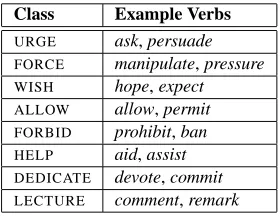
The work resulted in accepting, rejecting, combining and refining the 102 candidate classes and - as a by-product - identifying 5 new classes not included in any of the re-sources used. In the end, 57 new verb classes were formed, each associated with 2-45 member verbs. Table 1 shows a small sample of these classes along with example verbs. The evaluation of the novel classes showed that they can be used to support an NLP task and that the extended classifi-cation has good coverage of the English verb lexicon.
Class Example Verbs
URGE ask, persuade
FORCE manipulate, pressure
WISH hope, expect
ALLOW allow, permit
FORBID prohibit, ban
HELP aid, assist
DEDICATE devote, commit
LECTURE comment, remark
Table 1: Examples of K&B’s Verb Classes
4.
Incorporating the New Classes into
VerbNet
Although the new classes of Korhonen and Briscoe (K&B) are similar in style to the Levin classes included in VN, their integration to VN proved a major task. The first step was to assign the classes VN-style detailed syntactic-semantic descriptions. This was not straightforward be-cause the K&B classes lacked explicit semantic descrip-tions and had syntactic descripdescrip-tions not directly compatible with VN’s descriptions. Some of the descriptions available in VN had to be enriched for the new classes for this task. The second step was to incorporate the classes into VN. This was complicated by the fact that K&B is inconsistent in terms of granularity: some classes are broad while others are fine-grained. Also the comparison of the new classes to Levin’s original classes had to be done on a class-by-class basis: some classes are entirely new, some are subclasses of existing classes, while others require reorganization of original Levin classes. These steps, which were conducted largely manually in order to obtain any reliable result, are described in sections 4.1. and 4.2., respectively.
4.1. Syntactic-Semantic Descriptions of Classes
Assigning syntactic-semantic descriptions to the new classes involved work on both VN and K&B. The differ-ent sets of SCFs used required creating new roles, syntac-tic descriptions and restrictions on VN. The set of SCFs in K&B is broad in coverage and relies, in many cases, on finer-grained treatment of sentential complementation than present in VN. Therefore, VN’s syntactic descriptions had to be enriched with a more detailed treatment of sentential complementation. On the other hand, prepositional SCFs in K&B do not provide VN with explicit lists of allowed prepositions as required, so these had to be added to the classes. Also, no syntactic description of the surface re-alization of the frames was included in K&B and had to be created. Finally, information about semantic (thematic) roles and restrictions on the arguments was added to K&B.
4.1.1. Thematic Roles
In integrating the new classes, it was found that none of the 21 VN thematic roles seemed to appropriately convey the semantics of the arguments for some classes. As an ex-ample, the members of the proposed URGE class describe events in which one entity exerts psychological pressure on another to perform some action (John urged Maria to go home). While the urger (John) is assigned the role Agent as the volitional agent of the action and the urged entity (Maria) is assigned Patient as the affected participant, it is unclear what thematic role best suits the urged action (of going home). A new Proposition role was included which seemed to more appropriately describe the semantics of the urging event. Similar situations arose in the integration of 8 other classes. In the end, two new thematic roles were added to VN, Content and Proposition.
4.1.2. Syntactic Descriptions
Only 44 of VN’s syntactic frames had a counterpart in Briscoe’s classification. This discrepancy is the by-product of differences in the design of the two resources. Briscoe
abstracts over prepositions and particles whereas VN dif-ferentiates between otherwise identical frames based on the precise types of prepositions that a given class of verbs sub-categorizes for. Additionally, VN may distinguish two syn-tactic frames depending on thematic roles (e.g. there are two variants of the Material/Product Alternation Transitive frame differing on whether the object is the Material or Product).
Regarding sentential complements the opposite occurs, with VN conflating SCFs that Briscoe’s classification con-siders distinct. In integrating the proposed classes into VN it was necessary to greatly enrich the set of possible syntac-tic restrictions VN allows on clauses. The original hierar-chy contained only the valencessentential,infinitival, andwh inf. The new set of possible syntactic restrictions consists of 55 such features accounting for object control, subject control, and different types of complementation. Examples (3), (4), (5), and (6) show the VN realizations and the set of constraints for the proposed FORCE class which includes two frames with object control complements.
(3) Basic Transitive “I forced him.” Agent V Patient
(4) P-P-ING-OC (into-PP)
“I forced him Prep(into) coming.” Agent V Patient into Proposition[+oc ing]
(5) NP-PP (into-PP)
I forced John into the chairmanship.” Agent V Patient into Proposition[-sentential]
(6) NP-TO-INF-OC “I forced him to come.”
Agent V Patient Proposition[+oc to inf]
4.1.3. Semantic descriptions
Integrating the new classes also required enriching VN’s set of semantic predicates. Whenever possible, existing VN predicates were reused. However, as many of the incoming classes represent concepts entirely novel to VN, it was nec-essary to introduce 30 new predicates to adequately provide descriptions of the semantics of these incoming classes.
4.2. Integrating the Classes into VerbNet
After assigning the class descriptions, each of K&B’s classes was thoroughly investigated to determine the feasi-bility of it being added to VN. Of the classes proposed, two were rejected as being either insufficiently semantically ho-mogeneous or too small to be added to the lexicon, with the remaining 55 selected for incorporation. The classes fell into three different categories regarding Levin’s classifica-tion: 1) classes that could be subclasses of existing Levin classes; 2) classes that require a reorganization of Levin classes3; 3) entirely new classes.
4.2.1. Entirely Novel Classes
A total of 42 classes could be added to the lexicon as novel classes or subclasses without any restructuring. Some of
3
Levin focused mainly on NP and PP complements, but many verbs classify more naturally in terms of sentential complementa-tion
these overlapped to an extent with existing VN classes se-mantically but syntactic behavior of the members was suffi-ciently distinctive to allow them to be added as new classes without restructuring of VN. 35 novel classes were actually added as new classes while 7 others were added as new sub-classes (e.g. an additional novel subclass, Continue-55.3, was discovered in the process of subdividing Begin-55.1). The 35 new classes all share the quality of not overlapping to any appreciable extent with a pre-existing VN class from the standpoint of semantics. For instance, K&B’s classes of FORCE, TRY, FORBID, and SUCCEED express en-tirely new concepts as compared to VN 1.0.
4.2.2. Novel Sub-Classes
Some of the proposed classes, such as CONVERT, SHIFT, INQUIRE, and CONFESS were considered suf-ficiently similar in meaning to current classes and were added as new subclasses to existing VN classes. For exam-ple, both the proposed classes CONVERT and SHIFT are similar syntactically to the VN class Turn-26.6. However, whereas the members of Turn-26.6 exclusively involve to-tal physical transformations, the members of the proposed class CONVERT invariably exclude physical transforma-tion, instead having a meaning that involves non-physical changes such as changes in the viewpoint of the Theme (I converted the man to Judaism.). Similarly, the verbs of SHIFT might be characterized as the class of verbs only taking the intransitive frames from CONVERT. Conse-quently, as both SHIFT and CONVERT are semantically similar, yet still distinct, from the existing VN class Turn-26.6, they were added as subclasses to Turn-26.6, yielding the new classification Turn-26.6.1, Convert-26.6.2, and Shift-26.6.3.
4.2.3. Classes Where Restructuring Was Necessary 13 of the proposed classes overlapped significantly in some way with existing VN classes (either too close semantically or syntactically) and required restructuring of VN.
Classes such as WANT, PAY, and SEE obviously over-lapped with existing VN classes Want-32.1, Give-13.1, and See-30.1 in terms of meaning. Nor could the proposed classes be distinguished from the existing classes by re-course to syntactic behavior. Adding such classes required restructuring of VN to produce classes whose verb mem-bership was the union of the overlapping proposed and ex-isting classes and whose SCFs, similarly, were the union of those for each of the overlapping classes.
Broadly, the process of integrating the classes can be di-vided into two categories: 1) merging proposed classes with the related VN class; 2) adding the proposed class as a novel class but making modifications to existing VN classes.
Cases involving merger of a proposed class and an exist-ing class: In considerexist-ing these classes for addition to VN, it was observed that semantically their members patterned after a pre-existing class almost exactly. In the cases where the frames from the new classes were a superset of the frames recorded in VN, then the existing VN class was re-structured by adding the new members and by enriching its syntactic description with the novel frames.
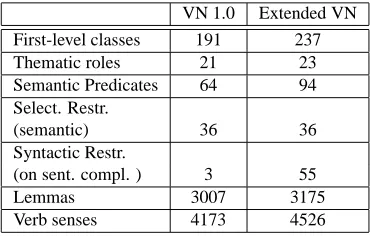
VN 1.0 Extended VN First-level classes 191 237 Thematic roles 21 23 Semantic Predicates 64 94 Select. Restr.
(semantic) 36 36
Syntactic Restr.
(on sent. compl. ) 3 55
Lemmas 3007 3175
Verb senses 4173 4526
Table 2: Summary of the Lexicon’s Extension
For example, both K&B’s proposed WANT class and the VN class Want-32.1 relate to the act of an experiencer de-siring something. VN class Want-32.1 differs from the pro-posed WANT class in its membership and in that it consid-ers only alternations in NP and PP complements whereas the proposed class WANT also considered alternations in sentential complements, particularly control cases. Added as new class but requiring restructuring of classes: K&B’s work is of particular importance when considered in the context of classes of Verbs With Predicative Com-plements, whose members are frequent in language. These verbs classify more naturally in terms of sentential rather than NP or PP complementation. The proposed class CONSIDER overlaps with four of VN’s classes (Appoint-29.1, Characterize-29.5, Declare-29.4, and Conjecture-29.6), none of which were originally semantically homo-geneous. The process of adding CONSIDER as another class of verbs with predicative complement gave us the op-portunity to revise these four problematic classes making them more semantically homogeneous by using the more detailed coverage of complementation presented in K&B.
5.
Conclusion and Future Work
A limitation in Levin’s widely-employed verb classification is that it deals mostly with NP and PP complements with the result that verbs taking ADJP, ADVP, predicative, control and sentential complements are not included or addressed in depth. With respect to NLP applications this is a seri-ous limitation because many of the missing verb types are highly frequent in language. Thus integrating K&B’s novel classes is a crucial extension of VerbNet.A summary of how this integration affected VN and the result of the extended lexicon is shown in Table 2. The fig-ures show that our work enriched and expanded VN consid-erably. The number of first-level classes grew significantly (from 191 to 237), along with the set of semantic predicates and the syntactic restrictions on sentential complements. An obvious question from the NLP point of view is the practical usefulness of the extended VN. Korhonen and Briscoe (2004) showed that new classes now incorporated in VN can be used to significantly aid an NLP task (subcat-egorization acquisition) and that the extended classification has good coverage over the English verb lexicon (as evalu-ated against WordNet). The evaluation of the extended VN was beyond the scope of our work; however, we can ex-pect to see improved results on many NLP applications in
the near future, given the promising results reported by Ko-rhonen and Briscoe and the wide use of VN in the research community. Currently, the use of verb classes in VN 1.0 is being attested in a variety of applications such as auto-matic verb acquisition (Swift, 2005), semantic role labeling (Swier and Stevenson, 2004), robust semantic parsing (Shi and Mihalcea, 2005), word sense disambiguation (Dang, 2004), building conceptual graphs (Hensman and Dunnion, 2004), and creating a unified lexical resource for knowledge extraction (Crouch and King, 2005), among others. In the future, we hope to extend VN’s coverage further. It is planned to search for additional novel classes and members using automatic methods, e.g. clustering. This is now re-alistic given the more comprehensive target and gold stan-dard classification provided by VN. In addition, we plan to include in VN statistical information concerning the rela-tive likelihood of different classes, SCFs and alternations for verbs in corpus data, using, e.g. the automatic meth-ods proposed by McCarthy (2001) and Korhonen (2002). Such information can be highly useful for statistical NLP systems utilizing lexical classes.
Acknowledgments
This work was supported by National Science Foun-dation Grants NSF-9800658, VerbNet, NSF-9910603, ISLE, NSF-0415923, WSD, the DTO-AQUAINT NBCHC040036 grant under the University of Illinois subcontract to University of Pennsylvania 2003-07911-01 and DARPA grant N66001-00-1-8915 at the University of Pennsylvania. Any opinions, findings, and conclusions or recommendations expressed in this material are those of the authors and do not necessarily reflect the views of the National Science Foundation, DARPA, or the DTO.
6.
References
Collin F. Baker, Charles J. Fillmore, and John B. Lowe. 1998. The Berkeley FrameNet project. In Proceedings of the 17th International Conference on Computational Linguistics (COLING/ACL-98), pages 86–90, Montreal. Branimir Boguraev, Ted Briscoe, John Carroll, David
Carter, and Claire Grover. 1987. The derivation of a grammatically-indexed lexicon from the Longman Dic-tionary of Contemporary English. In Proceedings of the
25 th
annual meeting of ACL, pages 193–200, Stanford, CA.
Chris Brew and Sabine Schulte im Walde. 2002. Spectral clustering for German verbs. In Conference on Empiri-cal Methods in Natural Language Processing, Philadel-phia, USA.
Ted Briscoe. 2000. Dictionary and System Subcate-gorisation Code Mappings. Unpublished manuscript, http://www.cl.cam.ac.uk/users/alk23/subcat/ sub-cat.html, University of Cambridge Computer Labora-tory.
Dick Crouch and Tracy Holloway King. 2005. Unify-ing lexical resources. In In ProceedUnify-ings of Interdisci-plinary Workshop on the Identification and Representa-tion of Verb Features and Verb Classes, Saarbruecken, Germany.
Hoa Trang Dang. 2004. Investigations into the Role of Lexical Semantics in Word Sense Disambiguation. Ph.D. thesis, CIS, University of Pennsylvania.
Bonnie J. Dorr. 1997. Large-scale dictionary construction for foreign language tutoring and interlingual machine translation. Machine Translation, 12(4):271–325. Bonnie J. Dorr. 2001. LCS Verb Database. In Online
Software Database of Lexical Conceptual Structures and Documentation, University of Maryland.
Christiane Fellbaum, editor. 1998. WordNet: An Eletronic Lexical Database. Language, Speech and Communica-tions. MIT Press, Cambridge, Massachusetts.
Ralph Grishman, Catherine Macleod, and Adam Meyers. 1994. COMLEX syntax: building a computational lexi-con. In Proceedings of the International Conference on Computational Linguistics, Kyoto, Japan.
Svetlana Hensman and John Dunnion. 2004. Automat-ically building conceptual graphs using VerbNet and WordNet. In In Proceedings of the 3rd International Symposium on Information and Communication Tech-nologies (ISICT), pages 115–120, Las Vegas, NV. Ray Jackendoff. 1990. Semantic Structures. MIT Press,
Cambridge, Massachusetts.
Paul Kingsbury and Martha Palmer. 2002. From Treebank to PropBank. In Proceedings of the 3rd International Conference on Language Resources and Evaluation, Las Palmas, Canary Islands, Spain.
Paul Kingsbury. 2004. Verb clusters from PropBank an-notation. Technical report, University of Pennsylvania, Philadelphia, PA.
Karin Kipper, Hoa Trang Dang, and Martha Palmer. 2000. Class-based construction of a verb lexicon. In AAAI/IAAI, pages 691–696.
Karin Kipper-Schuler. 2005. VerbNet: A broad-coverage, comprehensive verb lexicon. Ph.D. thesis, Computer and Information Science Dept., University of Pennsylvania, Philadelphia, PA, June.
Anna Korhonen and Ted Briscoe. 2004. Extended Lexical-Semantic Classification of English Verbs . In Proceedings of the HLT/NAACL Workshop on Compu-tational Lexical Semantics, Boston, MA.
Anna Korhonen, Yuval Krymolowski, and Zvika Marx. 2003. Clustering polysemic subcategorization frame dis-tributions semantically. In Proceedings of the 41st An-nual Meeting of ACL, pages 64–71, Sapporo, Japan. Anna Korhonen. 2002. Semantically motivated
subcatego-rization acquisition. In ACL Workshop on Unsupervised Lexical Acquisition, Philadelphia.
Beth Levin. 1993. English Verb Classes and Alternation, A Preliminary Investigation. The University of Chicago Press.
Diana McCarthy. 2001. Lexical Acquisition at the Syntax-Semantics Interface: Diathesis Alternations, Subcatego-rization Frames and Selectional Preferences. Ph.D. the-sis, University of Sussex.
George A. Miller. 1990. WordNet: An on-line lexi-cal database. International Journal of Lexicography, 3(4):235–312.
Marc Moens and Mark Steedman. 1988. Temporal Ontol-ogy and Temporal Reference. Computational Linguis-tics, 14:15–38.
Detlef Prescher, Stefan Riezler, and Mats Rooth. 2000. Using a probabilistic class-based lexicon for lexical ambiguity resolution. In 18th International Confer-ence on Computational Linguistics, pages 649–655, Saarbr¨ucken, Germany.
Juhani Rudanko. 1996. Prepositions and Complement Clauses. State University of New York Press, Albany. Juhani Rudanko. 2000. Corpora and Complementation.
University Press of America.
Naomi Sager. 1981. Natural Language Information Pro-cessing: A Computer Grammar of English and Its Appli-cations. Addison-Wesley Publising Company, MA. Lei Shi and Rada Mihalcea. 2005. Putting pieces together:
Combining FrameNet, VerbNet and WordNet for robust semantic parsing. In Proceedings of the Sixth Inter-national Conference on Intelligent Text Processing and Computational Linguistics, Mexico City, Mexico. Robert Swier and Suzanne Stevenson. 2004. Unsupervised
semantic role labelling. In Proceedings of the 2004 Con-ference on Empirical Methods in Natural Language Pro-cessing, pages 95–102, Barcelona, Spain, August. Mary Swift. 2005. Towards automatic verb acquisition
from VerbNet for spoken dialog processing. In In Pro-ceedings of Interdisciplinary Workshop on the Identifi-cation and Representation of Verb Features and Verb Classes, Saarbruecken, Germany.
XTAG Research Group. 2001. A lexicalized tree adjoin-ing grammar for English. Technical Report IRCS-01-03, IRCS, University of Pennsylvania.