ISA & ICA - Two Web Interfaces for Interactive Alignment of Bitexts
J¨org Tiedemann
Alfa Informatica, University of Groningen Oude Kijk in ’t Jatstraat 26 9712 EK Groningen, The Netherlands
Abstract
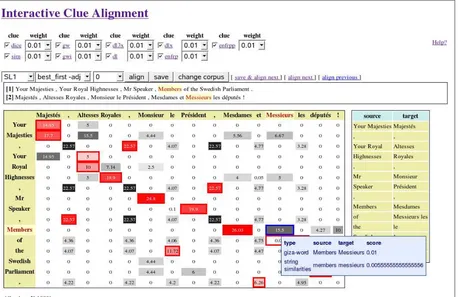
ISA and ICA are two web interfaces for interactive alignment of parallel texts. ISA provides an interface for automatic and manual sentence alignment. It includes cognate filters and uses structural markup to improve automatic alignment and provides intuitive tools for editing them. Alignment results can be saved to disk or sent via e-mail. ICA provides an interface to the clue aligner from the Uplug toolbox. It allows one to set various parameters and visualizes alignment results in a two-dimensional matrix. Word alignments can be edited and saved to disk.
1.
Introduction
In this paper we describe two web-based interfaces for in-teractive alignment of parallel texts, one for sentence align-ment (ISA) and one for word alignalign-ment (ICA). Both in-terfaces use automatic alignment as the backbone but al-low users to revise the proposed alignments. The sen-tence aligner can also be used to create manual alignments from scratch. Manual alignments have previously been used for evaluation purposes, i.e. to produce gold stan-dards for automatic alignment systems, see e.g. (V´eronis and Langlais, 2000; Melamed, 2001). Alignment inter-faces have also been shown to be effective for visualization (Smith and Jahr, 2000) and alignment improvement (Isa-hara and Haruno, 2000; Ahrenberg et al., 2003; Callison-Burch et al., 2004). Our interfaces include both, alignment visualization and post-editing tools for sentence and word alignment.
2.
General Architecture
ISA and ICA are part of the Uplug toolbox for parallel text processing (Upl, 2005). They are developed to interact with other parts of the toolbox. They are implemented in PHP1
and, hence, they are server-side web applications provid-ing interfaces for alignment of parallel texts stored on the server’s file system. They do not provide functions for file management (e.g. for uploading files to the server). Cor-pus files have to be installed and prepared off-line on the server to enable alignments via the interfaces. This can eas-ily be done using the provided configuration routines and the Uplug tools.
Both, ISA and ICA use Uplug alignment tools for au-tomatic alignment. Essentially they call external Uplug scripts and transform their output to information displayed in the web interfaces. ISA and ICA allow to modify align-ment parameters and to edit alignalign-ment results. In this way, they can be used to visualize alignments with different set-tings and to post-edit alignment results.
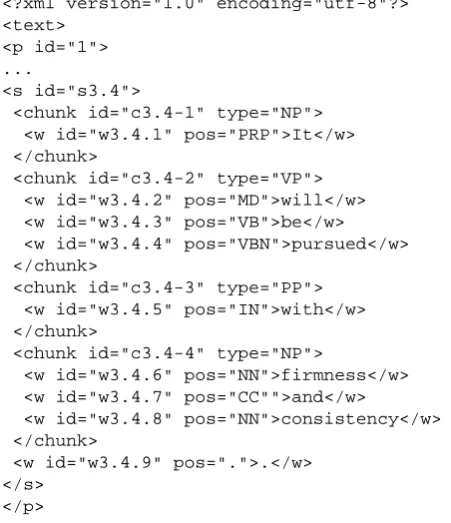
ISA and ICA require different kinds of pre-processing. Both presume tokenized corpus data in XML format. Fig-ure 1 shows a simple example of one tokenized sentence in
1
Javascript is also used for highlighting objects and tooltip windows.
an English sample corpus.
<?xml version="1.0" encoding="utf-8"?> <text>
...
<s id="s3.4">
<w id="w3.4.1">It</w> <w id="w3.4.2">will</w> <w id="w3.4.3">be</w> <w id="w3.4.4">pursued</w> <w id="w3.4.5">with</w> <w id="w3.4.6">firmness</w> <w id="w3.4.7">and</w>
<w id="w3.4.8">consistency</w> <w id="w3.4.9">.</w>
</s> ...
Figure 1: A simple example of tokenized input text.
Corpus files may include further markup that might be used in automatic alignment. For instance, structural markup such as paragraph boundaries can be used in the sentence aligner interface. Another example are part-of-speech tags that can be used as a feature in word alignment clues. How-ever, once tokenized and annotated, corpus files should be static, i.e. they should not be modified anymore because ISA and ICA will produce indeces with file positions to jump to arbitrary sentences in the corpus. The indexing is done automatically when opening the web interfaces for the first time with a new corpus.
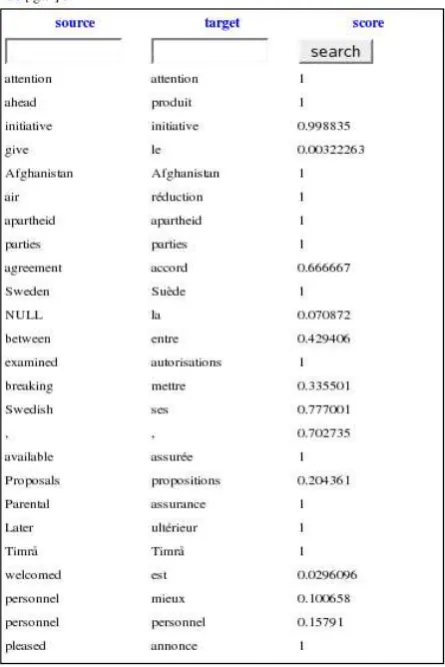
type can be opened and inspected. Figure 5 shows a screen-shot when browsing through GIZA++ clues (gw).
Figure 5: Browsing through a clue database
Each clue is a pair of source and target features (the surface strings in the example in figure 5) with an attached link score. It is possible to search for source and target patterns (using regular expressions). ICA applies for this external tools and defines again a time-out to reduce the server load. Searching and browsing through clue databases (especially big ones) is not stable mainly because of these time-outs.
5.
Conclusions and Future Work
ICA and ISA are two web interfaces for interactive sen-tence and word alignment. They use the Uplug toolbox for automatic alignment and provide flexible interfaces for revising links. The sentence alignment interface ISA in-cludes several features for improving automatic alignment such as cognate filters and possibilities of using structural markup. The word alignment interface ICA uses the clue alignment approach for automatic alignment. It provides a visualization of the alignment result and possibilities to edit links. ICA allows one to set various parameters such as clue weights and alignment strategies. Both, ISA and ICA allow one to store alignment results on disk. Sentence alignment results can also be sent via e-mail in three different formats. In the future we would like to add several features espe-cially to the word alignment interface. We would like to in-clude a feature to go back to previously saved alignments to
continue editing them. We would also like to learn automat-ically from manual corrections to improve the alignment dynamically. It could also be nice to be able to add align-ment clues directly from the interface. Also, alignalign-ment at other segmentation levels (e.g. chunks/phrases) would be an interesting option.
6.
Availability
Both interfaces are implemented in PHP with some addi-tional Javascript calls. They are freely available from the Uplug project at http://sourceforge.net/projects/uplug/
7.
References
Lars Ahrenberg, Magnus Merkel, and Michael Petterstedt. 2003. Interactive word alignment for language engineer-ing. In Conference Companion of the 11th Conference of the European Chapter of the Association for Com-putational Linguistics (EACL), pages 49–52, Budapest, Hungary.
Chris Callison-Burch, Colin Bannard, and Josh Schroeder. 2004. Improved statistical translation through edit-ing. In European Association for Machine Translation (EAMT) Workshop, University of Malta, Valletta, Malta. William A. Gale and Kenneth W. Church. 1993. A pro-gram for aligning sentences in bilingual Corpora. Com-putational Linguistics, 19(1):75–102.
H. Isahara and M. Haruno. 2000. Japanese-english aligned bilingual corpora. In Jean V´eronis, editor, Parallel Text Processing: Alignment and Use of Translation Corpora. Kluwer Academic Publishers, Dordrecht.
Dan I. Melamed. 2001. Empirirical Methods for Exploit-ing Parallel texts. The MIT Press, Cambridge, MA. Franz Josef Och, Christoph Tillmann, and Hermann Ney.
1999. Improved alignment models for statistical ma-chine translation. In Proceedings of the Joint SIGDAT Conference on Empirical Methods in Natural Language Processing and Very Large Corpora (EMNLP/VLC), pages 20–28, University of Maryland, MD, USA. Noah A. Smith and Michael E. Jahr. 2000. Cairo:
An alignment visualization tool. In Proceedings of The Second International Conference on Language Re-sources and Evaluation (LREC), pages 549–552, Athens, Greece.
J¨org Tiedemann. 2003. Recycling Translations – Extrac-tion of Lexical Data from Parallel Corpora and their Application in Natural Language Processing. Ph.D. the-sis, Department of Linguistics, Uppsala University, Up-psala/Sweden.
J¨org Tiedemann. 2004. Word to word alignment strategies. In Proceedings of the 20th International Conference on Computational Linguistics (COLING), pages 212–218, Geneva, Switzerland.
2005. Uplug: Tools for linguistic corpus processing, word alignment and term extraction from parallel corpora. available at http://sourceforge.net/projects/uplug. Jean V´eronis and Philippe Langlais. 2000. Evaluation of
Figure 6: The Interactive Sentence Aligner ISA