Chunking with Max-Margin Markov Networks
* Tang Buzhou, Wang Xuan , and Wang XiaolongDepartment of Computer Science and Technology, Harbin Institute of Technology Shenzhen Graduate School, Shenzhen, 518055,China
{[email protected], [email protected], [email protected]}
Abstract. In this paper, we apply Max-Margin Markov Networks (M3Ns) to English base phrases chunking, which is a large margin approach combining both the advantages of graphical models(such as Conditional Random Fields, CRFs) and kernel-based approaches (such as Support Vector Machines, SVMs) to solve the problems of multi-label multi-class supervised classification. To show the efficiency of M3Ns, we compare it with CRFs and other relative systems on the data set of CoNLL-2000 comprehensively. The experiment results show that M3Ns achieves state-of-the-art performance with strong generalization ability, which is better than CRFs.
Keywords: max-margin markov networks; graphical models; conditional random fields; support vector machines; generalization ability
1.
Introduction
Text chunking is an intermediate step towards full parsing, which consists of dividing a text in syntactically correlated parts of words. Tasks of chunking are extracting the non-overlapping segments from a stream of data and identifying them with non-recursive cores of various types of phrases. It can be solved as sequential labeling.
Many probabilistic graphical models such as Hidden Markov Models (HMMs) (Zhou et al.,2000; Sang and Buchholz, 2000), Maximum Entropy Models (MEs) (Koeling, 2000), Conditional Random Fields (CRFs) (Lafferty et al., 2001), Semi-Markov Random Fields (Collins, 2002a) have been applied to chunking for their abilities to deal with structured data by taking advantages of the potential of interactions in a factored way (Jordan al., 1998). However, the condition of the probabilistic infinite samples assumption cannot be satisfied in practice and over fitting problem cannot be avoided.
On the other hand, the tasks of chunking can be recognized as a classifying problem, statistic machine learning techniques are also often applied to chunking and various machine learning approaches have been proposed for chunking such as SVMs (Cortes and Vapnik, 1995; Vapnik, 1999) and Boosting (Freund and Schapire, 1996). Compared with probabilistic graphical models, statistic machine learning approaches have no flaw of infinite samples assumption and have strong generalization guarantees theoretically, but they assume that the classification of each object (word or phrase) is independent and ignore some precious correlation information in structured data.
*
This research has been partially supported by the National Natural Science Foundation of China (No.60435020 and No.90612005) and the Goal-oriented Lessons from the National 863 Program of China (No.2006AA01Z197).
E2 A E2 tag is used to mark the first token immediately preceding E of a chunk consisting of more than three tokens.
E3 A E3 tag is used to mark the first token immediately preceding E2 of a chunk consisting of more than four tokens.
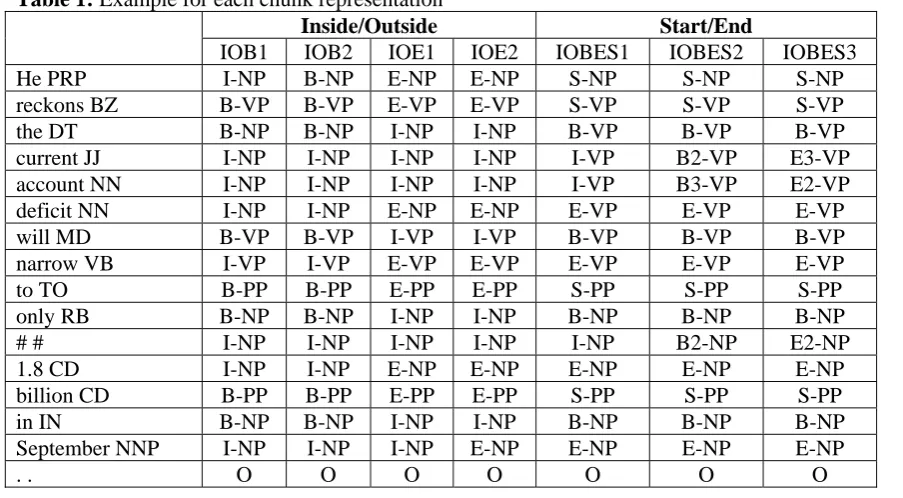
We called this representation as IOBES3. In the CONLL-2000 text chunking shared task, the grammatical class of each chunk should be identified as a grammatical class label, and we represent them by a pair of an {I, O, B, E, S} label and a grammatical label. Examples of these representations of each phrase are shown in Table 1.
Table 1: Example for each chunk representation
Inside/Outside Start/End
IOB1 IOB2 IOE1 IOE2 IOBES1 IOBES2 IOBES3
He PRP I-NP B-NP E-NP E-NP S-NP S-NP S-NP
reckons BZ B-VP B-VP E-VP E-VP S-VP S-VP S-VP
the DT B-NP B-NP I-NP I-NP B-VP B-VP B-VP
current JJ I-NP I-NP I-NP I-NP I-VP B2-VP E3-VP account NN I-NP I-NP I-NP I-NP I-VP B3-VP E2-VP
deficit NN I-NP I-NP E-NP E-NP E-VP E-VP E-VP
will MD B-VP B-VP I-VP I-VP B-VP B-VP B-VP
narrow VB I-VP I-VP E-VP E-VP E-VP E-VP E-VP
to TO B-PP B-PP E-PP E-PP S-PP S-PP S-PP
only RB B-NP B-NP I-NP I-NP B-NP B-NP B-NP
# # I-NP I-NP I-NP I-NP I-NP B2-NP E2-NP
1.8 CD I-NP I-NP E-NP E-NP E-NP E-NP E-NP
billion CD B-PP B-PP E-PP E-PP S-PP S-PP S-PP
in IN B-NP B-NP I-NP I-NP B-NP B-NP B-NP
September NNP I-NP I-NP I-NP E-NP E-NP E-NP E-NP
. . O O O O O O O
3.2.Feature template
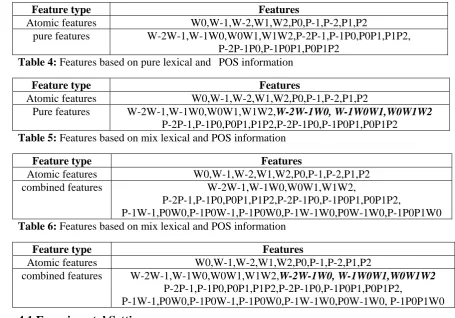
Graphical models (MEMM and CRFs) are highly dependent on feature templates. For the sake of comparing the effectiveness of different types of features, four different templates are selected for experiments. Context predictions of the current token are sources for feature selection. We firstly introduce atomic features in Table 2 (Ratnaparkhi 1996; Koeling 2000), and four templates are shown in Table 3, Table 4, Table 5 and Table 6. Table 3 and Table 4 shows the templates based on pure lexical and POS information, while Table 5 and Table 6 shows the templates based on mix lexical and POS information. We called them tmpt-1, tmpt-2, tmpt-3 and tmpt-4 in turn.
Table 2: Atomic features
Feature tag Feature remark Feature tag Feature remark
W0 Current word P0 POS tag of the current word
W-1 The previous word P-1 POS tag of W-1
W-2 The previous word of W-1 P-2 POS tag of W-2
W1 The next word P1 POS tag of W1
W2 The next word of W1 P2 POS tag of W2
4.
Experiments
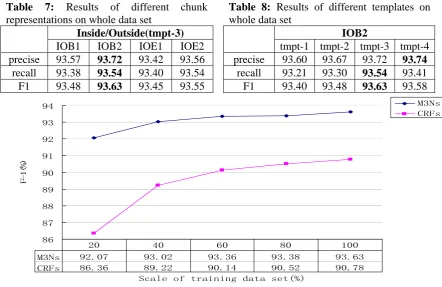
the performance of M3Ns and CRFs2 on the same training data sets of different sizes. Figure 1 shows the experiment result that the M3Ns achieve better performance and the curve of M3Ns goes more smoothly.
2
http://crfpp.sourceforge.net/
Table 7: Results of different chunk
representations on whole data set
Inside/Outside(tmpt-3)
IOB1 IOB2 IOE1 IOE2 precise 93.57 93.72 93.42 93.56 recall 93.38 93.54 93.40 93.54 F1 93.48 93.63 93.45 93.55
Table 8: Results of different templates on
whole data set
IOB2
tmpt-1 tmpt-2 tmpt-3 tmpt-4 precise 93.60 93.67 93.72 93.74
recall 93.21 93.30 93.54 93.41 F1 93.40 93.48 93.63 93.58
86 87 88 89 90 91 92 93 94
Scale of training data set(%)
F
-1(%
)
M3Ns CRFs
M3Ns 92.07 93.02 93.36 93.38 93.63
CRFs 86.36 89.22 90.14 90.52 90.78
20 40 60 80 100
Figure 1: results for CoNLL-2000 training data sets of different size using IOB2 representation
4.3.Comparison with Related Works
In this section, we compare our results with eleven systems in CONLL-2000 (Tjong Kim Sang et al., 2000). Table 9 shows the performance of our system and systems in CONLL-2000.
Table 9: Comparison with systems in CONLL-2000
systems precisio
n
recall F
systems
precisio
n
recall F
Our 93.74%
93.54%
93.63
Koe00 92.08%
91.86%
91.97%
KM00 93.13%
93.51%
93.48%
Osb00 91.65%
92.23%
91.94%
Hal00 93.13%
93.51%
93.32%
VB00 91.05%
92.03%
91.54%
TKS00 94.04% 91.00%
92.50%
PMP00 90.63%
89.65%
90.14%
ZST00 91.99%
92.25%
92.12%
John00 96.24%
88.25%
87.23%
Dej00 91.87%
92.31%
92.09%
VD00 88.82%
82.91%
85.76%
Clearly, M3Ns performed better than all systems in CONLL-2000. Especially, better than single-algorithm systems: Rule-based systems by Villain and Day, Johansson, and Dejeanbetter; Memory-based systems by Veenstra and Vanden Bosch; and Statistical systems by Pla, Molina and Prieto, Osborne, Koeling, Zhou, and Tey and Su.
it is not a fair comparison to our system since it is reasonable to believe that we can achieve appreciable improvement in the similar approaches.
5.
Summary
In this paper, we introduce a text chunking system based on Max-Margin Markov Networks. Since M3Ns make full use of correlations in data like CRFs, they can achieve good performance using the same features of CRFs. Furthermore, due to the theoretical generalization guarantee, M3Ns also have special error toleration ability. In our experiments, we have shown that M3Ns perform better than CRFs with high generalization ability. The success of M3Ns in text chunking suggests that the approach might be applicable to other NLP problems such as Part Of Speech (POS) and Named Entity Recognition (NER).
Reference
GuoDong Zhou, Jian Su and TongGuan Tey, Hybrid Text Chunking. In: Proceedings of CoNLL-2000 and LLL-2000, Lisbon, Portugal, 2000.
Erik F. Tjong Kim Sang and Sabine Buchholz, Introduction to the CoNLL-2000 Shared Task: Chunking. In: Proceedings of CoNLL-2000 and LLL-2000, Lisbon, Portugal, 2000. Rob Koeling, Chunking with maximum entropy models, Proceedings of the 2nd workshop on
Learning language in logic and the 4th conference on Computational natural language learning, September 13-14, 2000, Lisbon, Portugal.
John D. Lafferty, Andrew McCallum and Fernando C. N. Pereira. 2001. Conditional Random Field: Probabilistic models for segmenting and labeling sequence data [A]. In: ICML-18 [C], pp.282-289. June 28-July 01, 2001.
Nianwen Xue and Libin Shen. Chinese word segmentation as LMR tagging [A]. In: Proceedings of the Second SIGHAN Workshop on Chinese Language Processing [C], pp.176-179, Sapporo, Japan: July 11-12, 2003.
Lance A. Ramshaw and Mitchell P. Marcus. 1995. Text chunking using transformation -based learning. In Proceedings of the 3rd Workshop on Very Large Corpora,pages 88–94. Kiyotaka Uchimoto, Qing Ma, Masaki Murata, Hiromi Ozaku, and Hitoshi Isahara. 2000.
Named Entity Extraction Basedon AMaximum Entropy Model and Transformation Rules. In Processing of the ACL2000.
Collins, M. (2002a). Discriminative Training Methods for Hidden Markov Models: Theory and Experiments with Perceptron Algorithms. In Proceedings of EMNLP 2002.
Michael I. Jordan, editor. Learning in Graphical Models. MIT press, Cambridge, MA, 1998. Corinna Cortes and Vladimir Vapnik. Support-vector networks. Machine Learning, 20(3):273–
297, 1995.
V. Vapnik. The Nature of Statistical Learning Theory. Statistics for Engineering and Information Science. Springer, New York, NY, 1999.
Yoav Freund and Robert E.Schapire. 1996. Experiments with a new boosting algorithm. In International Conference on Machine Learning(ICML), pages 148–146.
Ratnaparkhi, A.,“A Maximum Entropy Model for Part-Of-Speech Tagging,” In Proceedings of EMNLP’1996, New Brunswick, New Jersey, USA, 1996, pp. 133-142.
Tong Zhang, Fred Damerau and David Johnson, Text Chunking based on a Generalization of Winnow. In Journal of Machine Learning Research, volume 2 (March), 2002, pp. 615-637.