CSEIT1831434 | Received : 16 Feb 2018 | Accepted : 28 Feb 2018 | January-February-2018 [(3) 1 : 1818-1823]
International Journal of Scientific Research in Computer Science, Engineering and Information Technology © 2018 IJSRCSEIT | Volume 3 | Issue 1 | ISSN : 2456-3307
1818
A Comparitive Analysis on Load Balancing Algorithms in Cloud
Computing
D. Suresh Kumar, E. George Dharma Prakash Raj
Scho.ol of Computer Science, Engineering and Applications, Bharathidasan University, Tiruchirappalli, Tamil Nadu, India
ABSTRACT
Cloud computing is one of device technology now a days for providing everything as a services to the cloud users. Cloud computing is a specific style of computing where everything from computing power to infrastructure, business apps are provided as a service. It mainly refers to applications and services that run on distributed network using virtualized resources and accessed by common internet standards. The basic principle of cloud computing is that user data is not stored locally but is stored in the data center of internet. The allocation of the group of resources may start a problem of availability of these resources and distributing the workload of all the VMs among themselves called as load balancing. As the numbers of users are increasing on the cloud, the load balancing has become the challenge for the cloud provider. Load balancing is a main issue in cloud environment. It helps in proper utilization of resources .It also improves the performance of the system. This paper is a brief discussion on the existing load balancing algorithms in cloud computing and further compares them based on various parameters like maximum completion time that is Makespan and resources utilization. This paper analyses the result based on existing load balancing algorithms like virtual machine random load balancing VMARLB, Priority based virtual machine load balancing algorithm PBVMLBA and EVMLBA algorithms.
Keywords: Cloud Computing, Load Balancing, Virtual Machine, Makespan, Analysis
I.
INTRODUCTION
Cloud computing is the best ever developed technology in the IT industry and a new delivery technique for the services on pay per use basis. [1] Cloud Computing has become one of the current technologies adopted by both industry and academic. It provides a flexible and efficient way to store and retrieve the data. The main problem is to schedule the incoming request in a way that it should take least response time, efficient resource utilization and at the same time resources should not be underutilized. Cloud Computing system are heavily rely on term virtualization that improves the power
efficiency of datacenters and enables virtual machines to single physical server. It delivers all services through the internet dynamically when user demands, such as operating system, network, storage, software, hardware and resources. These services are classified into these types: [2] Software as a Service (SaaS), Platform as a Service (PaaS), Infrastructure as a Service (IaaS), and Everything as a Service (Xaas). The Cloud computing domain is divided into three categories such as Public, Private and Hybrid cloud. [3]
specifies the load balancing in cloud computing. Section III describes literature study on relevant load balancing algorithms. Section IV tells the performance analysis of load balancing algorithms. Section V specifies the conclusion.
II.
LOAD BALANCING IN CLOUD COMPUTING
Load balancing is a new technique that provides high resource time and effective resource utilization [3] by assigning the total load among the various cloud nodes, side by side it solves the problem of overutilization and underutilization of virtual machines. Load balancing resolves the problem of overloading and focuses on maximum throughput, [4] optimizing resource utilization and minimize response time. It is the pre requirements for maximizing the cloud performance and utilizing the resources efficiently. The utilization of clouds has been improved by a resource allocation method, which has pre-emptible task execution.
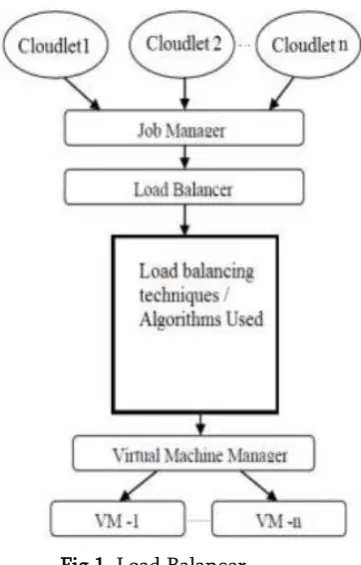
Fig 1. Load Balancer
The load balancing is an efficient and critical concept in cloud computing and it helps to utilize the resources optimally, thereby minimizing the
consumption of resources. Thus, load needs to be distributed over the nodes in cloud-based architecture, so that each resource does the equal amount of work at any point of time that is allocated by a load balancer. The load balancer determines the various request allocation to different servers. The load balancer uses various algorithm to determine the server which has to handle the request .[5]
Figure.1 shows a framework of under which load balancing algorithms work in a cloud computing environment. Cloudlet submits tasks to Job Manager and then Job Manager gives all jobs to Load Balancer. Load Balancer applies Load Balancing Algorithm for Submitted Tasks and schedules all tasks in such way that each Virtual Machine will get equal number of task for execution. [6]
In cloud computing, different load balancing algorithms have been proposed. The ultimate aim of all these proposals is to achieve high throughput and minimizing the response time.
III. RELATED WORK
Virtual Machine Algorithm Random Load Balancing
shortest time and which is available at that moment. If found, the algorithm will reply back to the Data Center Controller with the id of that machine (Vm id) and the Data Center Controller assign the job of that Vm otherwise waits for the signal which is to be forwarded to DCC. This algorithm produces the minimum Makespan. This algorithm compared with MIN MIN algorithm and produces improved results. [7]
Priority Based Virtual Machine Load Balancing Algorithm
The load balancer is play the important role in this PBVMLBA algorithm. Here a special node called as Load Balancer (LB) completes the allocation and decision. This node is responsible for storing knowledge base of entire cloud network. The Data Center Controller (DCC) receives all the requests from the users from all around the world, which is one of the major components of Cloud. Data Center Controller forwards the request to the Load Balancer to assign the request to the available virtual machines. It handles a table, which contains the job id of the user request (priority or no priority), completion time of the virtual machine and the state of the virtual machine. Initially, checks the jobs priority, if any priority, allocate the VM and update the status or allocate the VM based on the condition of the completion time of that task is less than to makespan of RPA_LBIMM. To handle further request, this algorithm will search the table and repeat the above procedure until all the tasks are completed. This algorithm deals with priority request. When priority request occurs. This algorithm executed it produces the best result for resource utilization and minimum makespan. [8]
Enhanced Virtual Machine Load Balancing Algorithm
This algorithm is one of the improved algorithm it is mainly used for to find the minimum makespan from
all available virtual machines. The proposed EVMLBA is a load-balancing algorithm in which all the allocation and decision of scheduling are completed by a special node called as Load Balancer (LB). This node is responsible for storing knowledge base of entire cloud network. The Data Center Controller (DCC) receives all the requests from the users from all around the world, which is one of the major components of Cloud. Data Center Controller forwards the request to the Load Balancer. It handles a table, which contains the job id of the user request, completion time of all the virtual machines and the state of the virtual machine. Based on the information available on the table.LB compute the minimum makespan VM, allocate the job to that VM, and update the status. The algorithm will reply to the Data Center Controller with the id of that machine (Vm id). Otherwise waits for the signal. This algorithm produces the minimum makespan and resource utilization. This algorithm compared with VMARLB and Min Min algorithm and the performance of the EVMLBA is better than the other algorithm. [9]
IV. PERFORMANCE ANALYSIS OF LOAD
BALANCING ALGORITHMS
Table1: Task Parameter
Table2: Resource Speed
Resource
Table3: Computed Completion time(CT)
Task Resource
Table4: Execution time of VMARLB algorithm
Task Resource
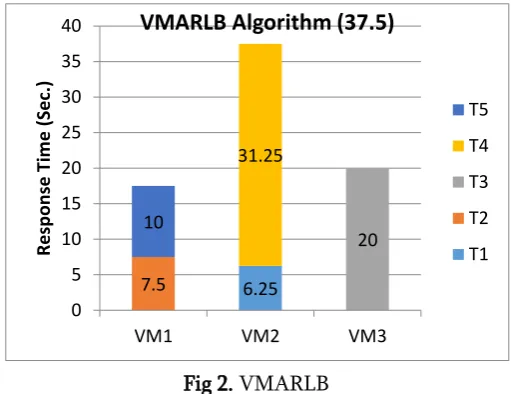
The results of above table 4 and the fig. 2 represents (VMARLB) the virtual machine based random load balancing algorithm produces the makespan 37.5s.
Table 5: Completion time of PBVMLBA algorithm
Tas
The results of above table 5 and the fig. 3 represents (PBVMLBA) the Priority Based virtual machine load balancing algorithm produces the makespan 31.25s.
6.25
PBVMLBA Algorithm (31.25)
T1
T2
T3
T5
Table6: Completion time of EVMLBA algorithm
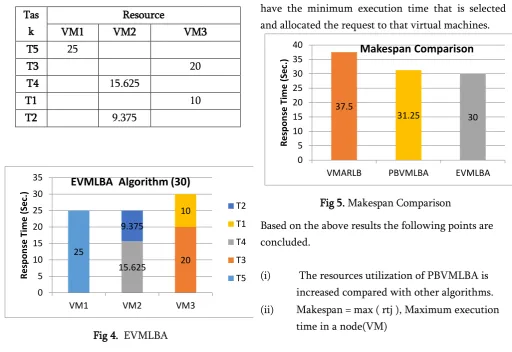
The results of above table 6 and the fig. 4 represents (EVMLBA) the Enhanced virtual machine load balancing algorithm produces the makespan 30s.
The EVMLBA algorithm shows a reduction in execution time of tasks. The above algorithms execute 5 tasks on three virtual machines. The VMARLB algorithm execute the same tasks with time utilization is 37.5 , the PBVMLBA algorithm executes 5 tasks with time utilization is 31.25 seconds the EVMLBA algorithm executes the same tasks 30 seconds. This shows that the EVMLBA algorithm used minimum time for execution of the task. This is due to the use of enhanced approach, which reduces the waiting time and increases the utilization time of the resources.
In the random approach, compare the results with three set of values. Priority approach the task, which has the priority that is assigned to the priority virtual
machine. In the Enhanced approach, Initially It calculated completion time for all tasks which one have the minimum execution time that is selected and allocated the request to that virtual machines.
Fig 5. Makespan Comparison
Based on the above results the following points are concluded.
(i) The resources utilization of PBVMLBA is increased compared with other algorithms. (ii) Makespan = max ( rtj ), Maximum execution
Average resource utilization (Ua)
∑ [1]
Nm
N = Number of nodes, m= makespan, Ci = Completion Time
Table8 Resource Utilization
Algorithmas Resource Utilization (% )
EVMLBA Algorithm (30)
.
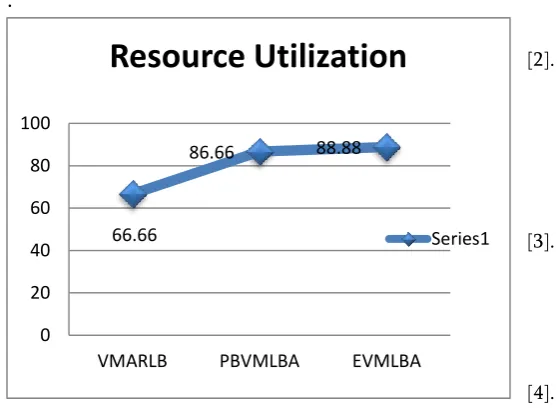
Fig 6. Resource Utilization
The above result says that the EVMLBA algorithm is better than other two algorithms VMRLBA and PBVMLBA. It produce the best result for resource utilization.
V.
CONCLUSION
Load balancing is a main task in cloud computing for efficient utilization of resources and minimizing and makespan. The study deals with various load-balancing algorithms like VMRLBA, PBVMLBA and EVMLBA. The ultimate purpose of those algorithms is to reduce the response time and maximize the resource utilization. The results of the existing algorithms are confined to give better result. The performances of three algorithms VMRLBA, PBVMLBA and EVMLBA discussed in this paper. Here Enhanced Virtual Machine Load balancing algorithm reduces the task completion time and increases the resource utilization, therefore EVMLBA algorithm is more efficient in terms of utilization of resource and Makespan for load balancing on cloud data centers.
VI. REFERENCES
[1]. Sarika Vasantrao Bodake, “Cloud Computing Load Balancing Algorithms Comparison Based Survey”, International Journal of Advanced Engineering,
Management and Science (IJAEMS, Vol-2, Issue-5, May- 2016.
[2]. Navtej Singh Ghumman, Rajesh Sachdeva “An Efficient Approach for Load Balancing in Cloud Computing using Composite Techniques”, International Journal of Research in Engineering and Applied Sciences ,VOLUME 6, ISSUE 2 ,February, 2016.
[3]. Reena Panwar, Bhawna Mallick, “A Comparative Study of Load Balancing Algorithms in Cloud Computing”, International Journal of Computer Applications (0975 - 8887) Volume 117 - No. 24, May 2015.
[4]. Sachin Soni1, Praveen Yadav, “A Load Balancing Approach to Minimize the Resource Wastage in Cloud Computing, “International Advanced Research Journal in Science, Engineering and Technology, Vol. 3, Issue 3, March 2016.
[5]. Mamta Khanchi*, Sanjay Tyagi, “An Efficient Algorithm for Load Balancing in Cloud Computing”, International Journal Of Engineering Science & Research Technology, Khanchi* et al., 5(6): June 2016.
[6]. Harshada Raut , Kumud Wasnik, “ a survey on load balancing algorithms in cloud computing,International Journal of Advanced Technology in Engineering and Science ,Volume No 03, Special Issue No. 01, ISSN (online): 2348 - 7550, March 2015.
[7]. D.Suresh Kumar, Dr. E. George Dharma Prakash Raj, VMARLB - Virtual Machine Based Algorithm for Random Load Balancing in Cloud Computing, 2017 International Conference on Advanced Computing and Communication Systems (ICACCS - 2017), IEEE, Coimbatore, INDIA,Jan. 06 - 07,2017. [8]. D. Suresh Kumar, Dr. E. George Prakash College,
“PBVMLBA-Priority Based Virtual Machine Load Balancing algorithm in Cloud Computing”, International Journal of Computer Science and Software Engineering , Volume 6 issue 11,2017. [9]. D. Suresh Kumar, Dr. E. George Prakash College,
“EVMLBA-Enhance Virtual Machine Load Balancing algorithm in Cloud Computing”, International Journal of Advanced Studies in Computer Science and Engineering , Volume 6 issue 11,2017.
66.66
86.66 88.88
0 20 40 60 80 100
VMARLB PBVMLBA EVMLBA