DOI : https://doi.org/10.32628/CSEIT195274
Supervised Machine Learning Algorithms for Credit Card Fraudulent
Transaction Detection
Karthik R, Navinkumar R, Rammkumar U, Mothilal K. C.
Computer Science and Engineering, Sri Krishna College of Engineering & Technology, Coimbatore, Tamil Nadu, India
ABSTRACT
Cashless transactions such as online transactions, credit card transactions, and mobile wallet are becoming more popular in financial transactions nowadays. With increased number of such cashless transaction, number of fraudulent transactions is also increasing. Fraud can be distinguished by analyzing spending behavior of customers (users) from previous transaction data. Credit card fraud has highly imbalanced publicly available datasets. In this paper, we apply many supervised machine learning algorithms to detect credit card fraudulent transactions using a real-world dataset. Furthermore, we employ these algorithms to implement a super classifier using ensemble learning methods. We identify the most important variables that may lead to higher accuracy in credit card fraudulent transaction detection. Additionally, we compare and discuss the performance of various supervised machine learning algorithms that exist in literature against the super classifier that we implemented in this paper.
Keywords : Credit Card Fraud, Online Fraud, Cashless Transactions, Neural Network
I. INTRODUCTION
Credit card fraud is a wide-ranging term for theft and fraud committed using a credit card or any similar payment mechanism as a fraudulent source of funds in a transaction. The purpose may be to obtain goods without paying, or to obtain unauthorized funds from an account. Credit card fraud is also an adjunct to identity theft. According to the Federal Trade Commission, while identity theft had been holding steady for the last few years, it saw a 21 percent increase in 2008. However, credit card fraud, that crime which most people associate with ID theft, decreased as a percentage of all ID theft complaints for the sixth year in a row. Despite the large amount of money lost to credit card fraud, it is actually quite rare an occurrence as a result of extensive countermeasures introduced since early 1990s. In 1999, out of 12 billion transactions made annually, approximately 10 million—or one out of every 1200
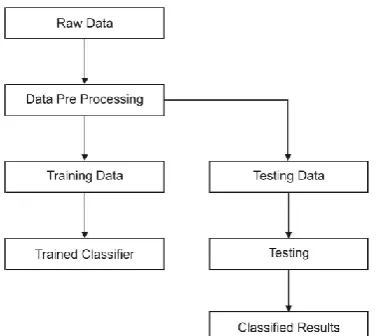
Figure 1. Behavior Based credit card Fraud Detection
The costs of card fraud in 2006 were 7 cents per 100 dollars worth of transactions (7 basis points). Due to the high volume of transactions this translates to street light power minimization. Proposed system design is provided in Section III. Chapter IV describes the result and discussions part. Finally, the card fraud, and, secondly, to evaluate unconventional techniques that have been used in fraud detection. The sub-aim is to present, compare and examine recently published discovering in credit card fraud detection. Credit card fraud detection has developed a number of techniques via bunch of investigate interest and, with special importance on, data mining and distributed data mining have been recommended. Also there is a problem is, first the observation data possibly will be missing for a number of intervals. Following that there are multiple observation streams that are not necessarily synchronous to each other and possibly will have different emission distributions" for the same state. So in proposed
research we are using multiple observation sequences which are associated with the semi hidden state sequence and these observations may not be synchronized to each other. We divide a large data set of labelled transactions (either fraudulent or legitimate) into smaller subsets by applying distributed data mining techniques to generate classifiers in parallel, and come together the resultant base models by meta learning from the classifiers’
performance to produce a meta classifier. in addition extensibility, combining multiple models computed over all available data produces meta classifiers that can counterbalance the loss of predictive presentation that usually occurs when mining from data subsets or sampling. Furthermore, when we use the learned classifiers (for example, during transaction authorization), the base classifiers can carry out in parallel, with the meta classifier then combining their results. So, our approach is highly efficient in generating these models and also relatively efficient in applying them.
III. LITERATURE REVIEW
Ghosh and Reilly [9] used three-layer feed forward Neural network to detect frauds in 1994. The Neural Network was trained on examples of fraud containing stolen cards, application fraud, counterfeit fraud, Non Received Issue (NRI) fraud, and mail order fraud.
Abhinav and Amlan [7] proposed a Hidden Markov Model to detect the frauds in credit cards. Proposed Model does not require fraud signatures and still it
can detect frauds by considering a cardholder’s
spending habit. This system is also scalable to handle large number of transactions.
done in three phase. First phase is initial user authentication and verification of card details.
After successfully completing this phase, fuzzy cmeans clustering algorithm is performed to find out normal usage behavior of user based on past transactions. If new transaction is found to be doubtful in this phase, mechanism based on neural network based is applied to determine whether it was actually fraudulent transaction or not.
Kang Fu, Dawei Cheng, Yi Tu, and Liqing Zhang at [3] proposed a convolutional neural network (CNN) based approach to find fraudulent transactions. Convolutional Neural Network is a part of deep learning and is a type of feed-forward Neural Network that consists of more than one hidden layer. In this paper, for finding more complex fraud patterns and to improve classification accuracy, a new feature trading entropy is proposed. To relieve the problem of the imbalanced dataset, cost based sampling method is used to generate more number of frauds. Generally, CNN is used for image recognition, Character recognition, image processing, video recognition and recommender system. In this paper for the first time, CNN is used to detect frauds.
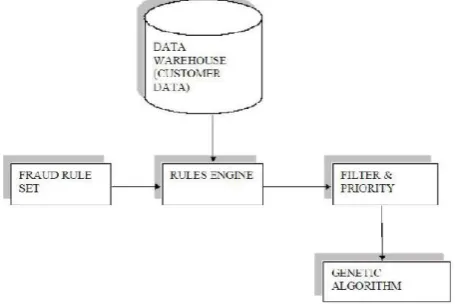
Figure 2. Architecture for fraud detection using genetic algorithm
In this chapter of literature review, we analyzed several papers that are formerly involved in credit card fraud detection. However multiple observation streams of these systems do not have necessity of
being synchronous to each other and lack in effective prediction of fraud detection. This detecting efficiency is improved by using three variants of Hidden Markov Model which are mentioned in upcoming chapter.
IV. SYSTEM DESIGN
1. Supervised learning and unsupervised learning
Using supervised method helps to find out the label on past transaction, they tend to not recognized fraud pattern that has occurred in the past [23], [24]. While unsupervised technique helps to find out the class of transactions [22].
2. Unbalanced data
It is quite challenging to learn from an unbalanced dataset and for balancing it, the sampling method used. A publicly available dataset that contains 284,807 transactions made in Sep. 2013 by European cardholders [25], [11]. The dataset includes 492 fraud transactions, which is highly imbalanced. Hence, under-sampling was applied [14].
3. Pre processing
Initially, the attributes used in the dataset are converted into numerical data. Feature selection is a very important stage in fraud detection. The features in the data efficiently portray the usage behavior of an individual. In this model, the features which interpret the behavior of the customer are selected for detection. Adding irreverent features make the classifier inefficient. Transaction amount is the most important behavior it varies from person to person. Frequency of card usage is calculated from the Date and Time Attributes. Average amount of transactions are calculated from each transactions.
representation instead of the full sizeinput. Feature extraction is special form dimensionality reduction.
Here, the features represent the relevant
characteristics of the input data are chosen. Instead of using full size input one may use this reduced representation set. If it is properly chosen then it will give successful task. Best results are achieved when an expert constructs a set of application-dependent features. Nevertheless, if no such expert knowledge is
available general dimensionality reduction
techniques may help.
4. Fraud Detection Classifier
Logistic Regression can handle the data with theoretical and statistical characteristics. Decision Tree is a supervised learning method that widely uses models for classification and regression tasks [26]. Random Forest method used for classification and regression using the collection of the decision tree, each one is slightly different from each other [8], [6]. With first introduction in 1995 Navies Bayes using Bayes theorem for independence hypothesis[27]. K-Nearest Neighborhood (KNN) is a necessary calculation which stores every single accessible occurrence [28]. The Gradient Boosted Tree Classifier (GBT) is a collection of classification and regression models. Boosting supports improve the tree accuracy.
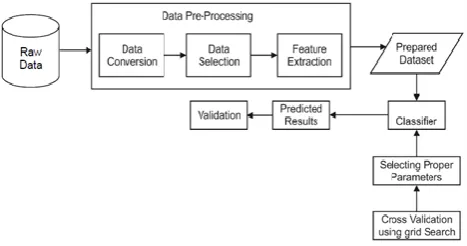
Figure 2. Proposed system architecture
XGB (XG boost Classifier) is the most refined classifier that works with all type of dataset. The support vector machines (SVM) are initially presented in 1995, and they have been observed to be
extremely fruitful in an assortment of exemplary classification tasks [6]. Figure 2 and 3 describe the proposed system algorithm implementation.
1. Obtain transaction data
2. Preprocess data to convert categorical attributes to numerical attributes
3. Normalize the numerical data using Min-Max Normalization
4. Create training and testing data files using the SVM format
5. Select an attribute a1
6. Apply K-Means Clustering with respect to the attribute a1
7. Select the second level attribute a2 8. For every cluster c obtained
a. Apply K-Means Clustering with respect to the attribute a2
9. End for
10. Supply the training file to SVM 11. Set the values for C and
12. Obtain results using the current C and pair 13. Perform step 6 and 7 till satisfactory results are
obtained from the training set 14. Test the accuracy using the test file 15. For every malicious transaction obtained,
a. Find clusters that contains the current transaction
b. Using collective animal behavior, check for a similar pattern in the clusters
c. If the pattern similarity exceeds the threshold t consider the transaction as normal
d. Else
e. Consider the transaction as malicious 16. End for
Figure 3. Pseudo code for proposed system algorithm
evaluations measures adequately reveal validation of the study very well. Proposed system naïve bayes merged with random forest to achieved highest classification accuracy.
V. RESULTS AND DISCUSSION
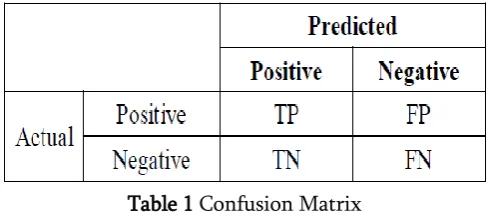
This process is evaluated with various sets of data containing different number of data items and the obtained values are recorded in a confusion matrix.
Table 1 Confusion Matrix
In this work,
• TP shows the number of genuine transactions correctly identified as non fraudulent.
• FP gives the number of genuine transactions incorrectly identified as fraudulent.
• TN is shows the number of fraudulent
transactions correctly identified as fraudulent.
• FN is mistakenly considering fraudulent transaction as genuine.
The two performance measures, sensitivity and specificity are used for evaluating the results. Sensitivity is the accuracy on the positive instances.
Sensitivity =TP/(TP+FN),
Sensitivity represents the ratio of positive class that was correctly identified. Specificity is the accuracy of the negative instances
Specificity = TN/(TN+FB)
Specificity represents the ratio of the negative cases that was incorrectly identified as positive.
Table 2 Dataset With 100 % Fraud Data
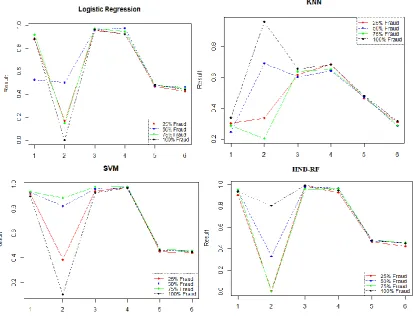
Figure 4. TPR and FPR performance of all the classifier
SUBJECT KNN SVM LOGISTIC
REGRESSION
HYBRID NB-RF
Accuracy 0.6704 0.9517 0.9429 0.9675 95% CI 0.6437, .6963 0.9383, .9628 0.9287, 0.9551 0.9562, .9766 NoInformation 0.5111 0.5349 0.5182 0.5182 P-Value <2e-16 < 2e-16 < 2.2e-16 < 2.2e-16
Kappa 0.3399 0.9031 0.8855 0.9348 Test P-Value 0.9609 0.01045 0.0006316 5.806e-07
Sensitivity 0.6595 0.9659 0.9161 0.9391 Specificity 0.6804 0.9393 0.9679 0.9939 Pos PredValue 0.6574 0.9326 0.9637 0.9930 Neg Pred 0.6825 0.9694 0.9254 0.9461 Prevalence 0.4818 0.4651 0.4818 0.4818 Detection Rate 0.3177 0.4493 0.4414 0.4525 Prevalence 0.4834 0.4818 0.4580 0.4556 Accuracy 0.6700 0.9526 0.9420 0.9665
‘Positive’Class Yes Yes Yes Yes
AUC 0.670 0.953 0.945 0.970
Precision 0.6672 0.9523 0.9643 0.9915
The hybrid approach. During the initial stages, when the number of entries are minimal, the plots point to 0,0 and 0,1 points. As the number of entries keeps increasing, the plotted points are clustered towards the northwest corner and are above the diagonal. This proves that this process provides a high level of accuracy, almost meeting the perfect standard of 0,1.Here, the values of the F-Measure show a rate of 0.869341figure 4 and table 2 clearly explain Proposed System Achieved Better accuracy rate of 0.96 is obtained. Hence it is proved that this process shows a higher accuracy rate and better performance.
VI. CONCLUSION
Under-sampling is done for balancing the unbalanced dataset. The learning model’s evaluation is based on
their accuracy, recall, precision, TPR, FPR, specificity and G-mean. The result of all the purposed models were superior in overall performance. Overall results show that stacking classifier which is used LR as meta classifier is most promising for predicting fraud transaction in the dataset, followed by the SVM, LR, KNN and HNB-RF classifier. Future work will be conducting the using the voting classifier and check the performance with other ML learning methods, increase the size of training and testing dataset.
VII.REFERENCES
[1]. Statista the statistic portal (2017, March 14) available
https://www.statista.com/topics/871/online-shopping/
[2]. Tanmay Kumar Behera, Suvasini Panigrahi,
“Credit Card Fraud Detection: A Hybrid
Approach Using Fuzzy Clustering & Neural
Network”, IEEE Computer Society, 2015
[3]. Kang Fu, Dawei Cheng, Yi Tu, and Liqing
Zhang, “Credit Card Fraud Detection Using
Convolutional Neural Networks”, Springer
International Publishing AG 2016.
[4]. Smt.S.Rajani, Prof.M. Padmavathamma, “A
Model for Rule Based Fraud Detection in
telecommunications”, International Journal of
Engineering Research & Technology (IJERT), Vol. 1 Issue 5, July –2012.
Support Vector Machines”, IMECS vol 1, 2011.
[6]. Abhinav Srivastava, Amlan Kundu, Shamik Sural, Senior Member, IEEE, and Arun K.
Majumdar, Senior Member, IEEE , “Credit Card
Fraud Detection Using Hidden Markov Model”
, IEEE transactions on dependable and secure computing, vol. 5, no. 1, january-march 2008. [7]. Michael Nielsen (2017, March 15), Deep
learning available
http://neuralnetworksanddeeplearning.com/cha p6.html [9] Ghosh, S., Reilly, D.L.: Credit card fraud detection with a neuralnetwork. In: Proceedings of the Twenty-Seventh Hawaii International Conference on System Sciences, 1994, vol. 3, pp. 621–630. IEEE (1994)
[8]. Emin Aleskerov, Bernd fieisleben and Bharat
Rao, “CARDWATCH: A Neural Ntwork based database Mining System for Credit Card Fraud
Detection”
[9]. Sam Maes, Karl Tuyls, Bram Vanschoenwinkel,
Bernard Manderick, “Credit card fraud detection using bayesian and neural networks”,
International Naiso Congress on Neuro Fuzzy Technology, 2002.
[10]. Minewiskan, Microsoft Neural Network Algorithm Technical Reference (2017, March
14) available at
sql/analysis- services/data-mining/microsoft-neural-networkalgorithm- technical-reference
[11]. Krishna Modi, Bhavesh Oza, “Outlier Analysis Approaches in Data Mining”, IJIRT vol 3 issue
7. [14] Raghavendra Patidar, Lokesh Sharma,
“Credit card fraud detection using Neural Network”, IJSCE Volume-1, Issue-NCAI2011, June 2011.
[12]. Alejandro Correa Bahnsen, Djamila Aouada, Aleksandar Stojanovic, Björn Ottersten,
“Feature engineering strategies for credit card fraud detection”, 0957-4174/ 2016 Elsevier.
Cite this article as :