University of Windsor University of Windsor
Scholarship at UWindsor
Scholarship at UWindsor
Electronic Theses and Dissertations Theses, Dissertations, and Major Papers
1-1-2007
Content-based image retrieval using Generic Fourier Descriptor
Content-based image retrieval using Generic Fourier Descriptor
and Gabor Filters.
and Gabor Filters.
Quan He
University of Windsor
Follow this and additional works at: https://scholar.uwindsor.ca/etd
Recommended Citation Recommended Citation
He, Quan, "Content-based image retrieval using Generic Fourier Descriptor and Gabor Filters." (2007). Electronic Theses and Dissertations. 7046.
https://scholar.uwindsor.ca/etd/7046
CONTENT-BASED IM AGE RETRIEVAL USING GENERIC FOURIER DESCRIPTOR AND GA BO R FILTERS
by
Quan He
A Thesis
Submitted to the Faculty o f Graduate Studies
through the Departm ent o f Electrical and Com puter Engineering in Partial Fulfillm ent o f the Requirem ents for
the Degree o f M aster o f Applied Science at the U niversity o f W indsor
W indsor, Ontario, Canada
1*1
Library and Archives CanadaPublished Heritage Branch
Bibliotheque et Archives Canada
Direction du
Patrimoine de I'edition
395 W ellington Street Ottawa ON K1A 0N4 Canada
395, rue W ellington Ottawa ON K1A 0N4 Canada
Your file Votre reference ISBN: 978-0-494-35177-2 Our file Notre reference ISBN: 978-0-494-35177-2
NOTICE:
The author has granted a non
exclusive license allowing Library
and Archives Canada to reproduce,
publish, archive, preserve, conserve,
communicate to the public by
telecommunication or on the Internet,
loan, distribute and sell theses
worldwide, for commercial or non
commercial purposes, in microform,
paper, electronic and/or any other
formats.
AVIS:
L'auteur a accorde une licence non exclusive
permettant a la Bibliotheque et Archives
Canada de reproduire, publier, archiver,
sauvegarder, conserver, transmettre au public
par telecommunication ou par I'lnternet, preter,
distribuer et vendre des theses partout dans
le monde, a des fins commerciales ou autres,
sur support microforme, papier, electronique
et/ou autres formats.
The author retains copyright
ownership and moral rights in
this thesis. Neither the thesis
nor substantial extracts from it
may be printed or otherwise
reproduced without the author's
permission.
L'auteur conserve la propriete du droit d'auteur
et des droits moraux qui protege cette these.
Ni la these ni des extraits substantiels de
celle-ci ne doivent etre imprimes ou autrement
reproduits sans son autorisation.
In compliance with the Canadian
Privacy Act some supporting
forms may have been removed
from this thesis.
While these forms may be included
in the document page count,
their removal does not represent
Conformement a la loi canadienne
sur la protection de la vie privee,
quelques formulaires secondaires
ont ete enleves de cette these.
ABSTRACT
Content-based image retrieval (CBIR) is an important research area with
applications to a large am ount o f image databases and m ultim edia information. In CBIR,
image is described by several low-level image features, such as color, texture, shape or
their combination. The focus o f this paper is on the problem o f shape and texture feature
extraction and representation for CBIR.
Shape is one o f the m ost important features because it is very important to
human perception. Two shape representation methods, region based shape descriptors
and contour based shape descriptors have been studied. A new shape descriptor, Generic
Fourier D escriptor (GFD) has been discussed and evaluated w ith existing shape
descriptors. Texture is a global feature that could be used to associate related shapes.
Gabor filters (GF) has been selected for texture feature extraction. W e apply Generic
Fourier Descriptor (GFD ) for shape feature extraction and Gabor Filters (GF) for texture
feature extraction on three different databases, and we successfully combined GFD and
GF together for shape and texture feature extraction. Experim ental results show that the
A C K N O W L E D G E M E N T S
This thesis could not be finished without the help and support o f many people who
are gratefully acknowledged here.
A t the very first, I ’m honored to express my deepest gratitude to my dedicated
supervisor, Dr. J. Wu; his patient and meticulous guidance and invaluable suggestions are
indispensable to the com pletion o f this thesis.
W hat’s more, I wish to extend my thanks to my comm ittee m em bers, for their
support o f this study. I owe special thanks to Dr. J. Chen and Dr. H. Wu, for their
priceless comments on this study.
Thanks are also due to my postgraduate friends, who never failed to give me great
encouragement and suggestions. Special thanks should go to Mr. Zhengqiao Ji, Ms. Lan
Xu, M iss Kathleen Dizon, and Mr. Tong W ang for their help and support when I had
problems w riting this thesis.
A t last but not least, I would like to thank my fam ily for their support all the way
from the very beginning o f my postgraduate study. I am thankful to all my family
TABLE OF CONTENTS
A B STR A CT... iii
A C K N O W LED G EM EN TS...iv
LIST OF T A B L E S ... vii
LIST OF F IG U R E S ... viii
C H A P T E R I. IN T R O D U C T IO N 1.1 Problem Statement and B ackground... 1
1.2 Research O bjectives... 3
1.3 Thesis O u tlin e ... 5
II. O V E R V IE W O F C O N T E N T -B A SE D IM A G E R E T R IE V A L 2.1 Introduction to content-based image retrieval... 7
2.2 Image Content D escriptors... 8
2.2.1 Color...8
2.2.2 Texture...10
2.2.3 S h a p e...11
2.3 Similarity and Performance M easurem ent... 12
2.3.1 Similarity Measurement... 13
2.3.1.1 Minkowski-Form Distance...14
2.3.1.2 $ Statistics... 14
2.3.2 Performance Measurement... 15
2.3.2.1 Recall and Precision Pair (RPP)...15
2.3.2.2 Percentage of Weighted Hits (PW H )...15
2.4 Image Retrieval System s... 16
2.5 Sum m ary... 17
m . F E A T U R E R E P R E S E N T A T IO N T E C H N IQ U E S 3.1 General Shape R epresentation... 18
3.1.1 Region-based Shape Descriptor... 19
3.1.2 Contour-based Shape Descriptor... 21
3.2.1 Polar Fourier transform...28
3.2.2 Implementation o f Generic Fourier D escriptor 29 3.3 General Texture Representation...31
3.3.1 Gabor Filters...31
3.4 Sum m ary...34
IV. APPLICATIONS IN GENERAL IMAGE RETRIEVAL 4.1 Introduction... 36
4.2 A Review o f Image S egm entation... 37
4.3 Image Retrieval Using Shape F eatu res... 41
4.4 Image Retrieval Using Texture Features... 50
4.5 Propose combined Shape and Texture Features...52
4.6 Sum m ary...53
V. EVALUATION AND EXPERIMENTAL RESULTS 5.1 Comparisons on Feature Extraction A lgorithm s...54
5.2 Similarity M easurem ents...65
5.3 Sum m ary...69
VI. CONCLUSIONS AND FUTURE WORK 6.1 C onclusions... 70
6.2 Future W orks... 72
REFERENCES...73
LIST OF TABLES
Ta b l e 2 . 1 Ex a m p l e s o fCBIR s y s t e m s... 1 7
Ta b l e 5 . 1 Re t r i e v a l Ra t e o n L E M S s i l h o u e t t e d a t a b a s e... 5 7
Ta b l e 5 . 2 Re t r i e v a l Ra t e o n Fi n g e r p r i n td a t a b a s e... 6 0
Ta b l e 5.3 Re t r i e v a l Ra t e o n ALOI d a t a b a s e...64
Ta b l e 5 . 4 Re t r i e v a l Ra t e o n LEM S s i l h o u e t t e d a t a b a s e o f d i f f e r e n ts i m i l a r i t y
M E A S U R E M E N T S ...6 6
Ta b l e 5 . 5 Ti m e t a k e n f o rt h e r e t r i e v a l o n L E M S s i l h o u e t t ed a t a b a s e 6 6
Ta b l e 5 . 6 Re t r i e v a l Ra t e o n A L O I Da t a s e t o f d i f f e r e n t s i m i l a r i t y
M E A S U R E M E N T S ...6 8
L I S T O F F I G U R E S
Fi g u r e 1 .1 : An e x a m p l e o ft e x t-b a s e d i m a g e s e a r c h m e t h o d... 2
Fi g u r eI .2 : Im a g e De s c r i p t i o n u s i n g Te x t a n d Co n t e n t i n f o r m a t i o n...3
Fi g u r e2 . 1: Co n t e n t-b a s e dr e t r i e v a l s y s t e m s t r u c t u r e... 8
Fi g u r e3 .1 Ex a m p l e s o f Re g i o na n d Co n t o u r-b a s e d s h a p e s i m i l a r i t y...1 8
Fi g u r e3 . 2 Ex a m p l e s o fs h a p e s t h a tc a n b e e f f i c i e n t l y d e s c r i b e d b y t h e
R E G IO N -B A SE D D ESCRIPTO R...1 9
Fi g u r e3 . 3 Ex a m p l e s o fs h a p e s t h a tc a n b e e f f i c i e n t l y d e s c r i b e d b y t h e c o n t o u r
-b a s e d D E SC R IPT O R ...2 1
Fi g u r e 3 . 4 Ex a m p l e o fc o o r d i n a t et r a n s f o r m a t i o n u s i n g T P S ...2 3
Fi g u r e3 .5 An e x a m p l e f o ro b t a i n i n g b o u n d a r y c o o r d i n a t e s... 2 4
Fi g u r e3 .6 Th r e e a p p l es h a p e s a n d t h e i rc e n t r o i d d i s t a n c e s i g n a t u r e s... 2 5
Fi g u r e3 . 7 Th e Fo u r i e rr e c o n s t r u c t e d a p p l e 1 , 2 , a n d 3 u s i n g:(a) t h e f i r s tt h r e e
F D ( B ) THE FIRST FIVE F D ... 2 6
Fi g u r e3 .8 Bl o c kd i a g r a m o fc o m p u t i n g F D ...2 7
F IG U R E 3 .9 (a) A s h a p e w i t h o u tc o n t o u r (b) , (c) t w o s h a p e sw i t h s a m e c o n t o u r
B U T WITH DIFFERENT INTERIOR C O N T E N T ... 2 8
Fi g u r e3 . 1 0 Po l a r r e p r e s e n t a t i o n o fa n i m a g e... 2 9
F IG U R E 3 .11 F W H M SA M PLIN G OF SPECTRAL RESPONSES OF G A B O R FILTERS IN FREQUENCY
P L A N E ... 3 3
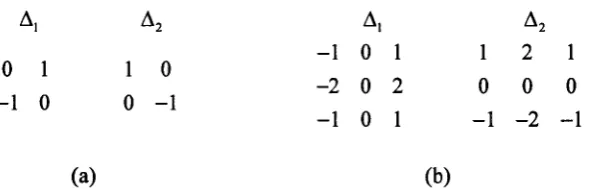
Fi g u r e4 . 1 (a) Ro b e r t Op e r a t o r (b) So b e l Op e r a t o r... 3 8
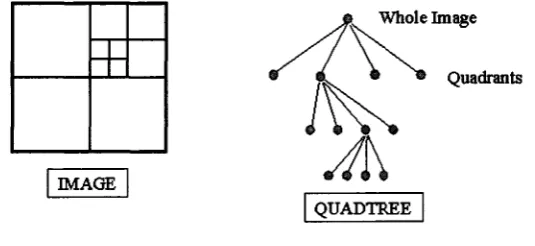
Fi g u r e4 . 3 Qu a d t r e e De c o m p o s i t i o n... 4 1
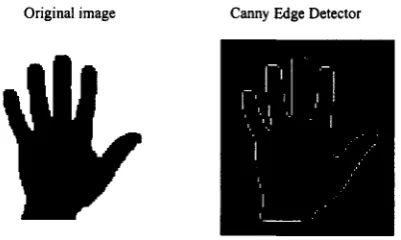
Fi g u r e4 . 4 (a) Or i g i n a l i m a g e (b) Im a g e s e g m e n t a t i o n u s i n g w a t e r s h e d
ALGO RITH M ...4 1
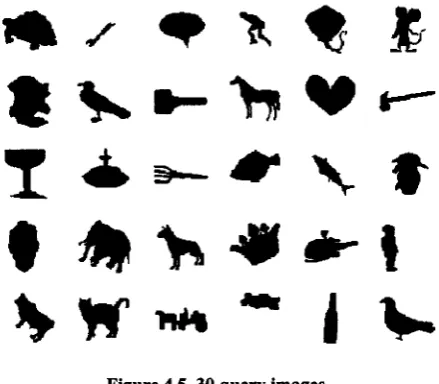
F IG U R E 4 .5 3 0 Q U ER Y IM A G E S...4 3
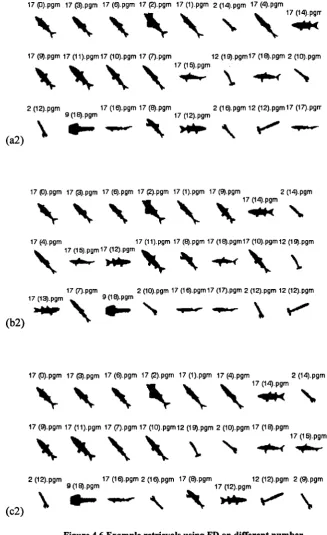
F i g u r e 4 . 6 E x a m p l e r e t r i e v a l s u s i n g FD o n d i f f e r e n t n u m b e r ( a 1 , a 2 ) 5 FDs
( B l , B 2 ) 10FDS ( C l , c2)15F D s... 45
F i g u r e 4 . 7 C o m p a r i s o n o f r e t r i e v a l e f f e c t i v e n e s s o f 5 FDs, 10 FDs a n d 15 F D s . 46
F i g u r e 4 . 8 E x a m p l e r e t r i e v a l s u s i n g GFD a n d FD ( A l , a 2 ) 36GFDS ( B l , b 2 ) 60GFDs
( C l , c2 ) 10FDS... 48
F i g u r e 4.9 C o m p a r i s o n o f r e t r i e v a l e f f e c t i v e n e s s o f I O F D s , 36GFDS
a n d 60G FDS... 49
F IG U R E 4 .1 0 EXAM PLE RETRIEVALS U SIN G G F ...5 1
Fi g u r e4 . 11 Re t r i e v a l Pe r f o r m a n c e u s i n g Ga b o r Fi l t e r s... 51
Fi g u r e5 . 1 Ex a m p l er e t r i e v a l s u s i n g Co m b i n e d f e a t u r e sw ith G F D a n d F D
( A ) 60GFDS ( B ) 36GFDS (C ) GF ( d ) 60GFDS+GF (E ) 36GFDS+GF... 56
F i g u r e 5 . 2 C o m p a r i s o n o f r e t r i e v a l e f f e c t i v e n e s s o f GF, 36GFDS,
60GFDS, 36GFDS+GF, 60GFDS+GF...56
Fi g u r e5 . 3 Ex a m p l er e t r i e v a l su s i n g Co m b i n e d f e a t u r e s w ith G F D a n d F D
( A ) 60GFDS ( B ) 36GFDS ( C ) GF ( D ) 60GFDS+GF (E)36GFDS+GF... 59
F i g u r e 5 . 4 C o m p a r i s o n o f r e t r i e v a l e f f e c t i v e n e s s o f GF, 36GFDS,
60GFDS, 3 6GFDs+GF,60GFDs+GF...60
Fi g u r e5 . 6 Ex a m p l er e t r i e v a l s u s i n g Co m b i n e d f e a t u r e s w i t h GFD a n d FD
( A ) 60GFDS ( B ) 36GFDS ( C ) GF ( D ) 60GFDS+GF (E ) 36G FD S+G F...63
Fi g u r e5 . 7 Co m p a r i s o n o fr e t r i e v a l e f f e c t i v e n e s so f GF, 36GFDS, 60GFDS,
36GFDS+GF, 60GFDS+GF...63
Fi g u r e5 . 8 Re t r i e v a l p e r f o r m a n c e o f d i f f e r e n ts i m i l a r i t y m e a s u r e m e n t s o n
LEM S Da t a s e t...66
Fi g u r e5 . 9 Re t r i e v a l p e r f o r m a n c e o fd i f f e r e n t s i m i l a r i t y m e a s u r e m e n t s o n
CHAPTER I
INTRODUCTION
1.1. Problem Statement and Background
Recent years have seen the use o f images in human com m unication increased
dramatically. Researchers use related images for investigation, reporters use images for
demonstration and improving text information, doctors use images to diagnose and
distinguish diseases, students use images for entertaining and studying and so on.
V arious image applications lead to the generation and prosperity o f digital
images. Both m ilitary and civilian equipm ent generate giga-bytes o f images everyday,
however, we cannot access or make use o f the image information unless it is organized to
allow efficient browsing, searching, and retrieval, so there has been urgent demand for
techniques to index and m anage digital images.
Before the 1980s, images were stored in text-based databases. Text-based
image indexing runs faster and offers more flexibility because the com puter does not
expend resources on processing the images. For the same reason, text-based applications
use mem ory m ore efficiently. Textual indexing o f images provides user with key word
searching, catalogue browsing and even with query interface such as Structural Query
Language (SQL). A very popular framework o f image retrieval was to first annotate the
images by text and then use text-based database m anagem ent systems (DBM S) to
perform image retrieval. Two comprehensive surveys on this topic are [1, 2], Here is a
traditional m ethod for searching an image using text-based method.
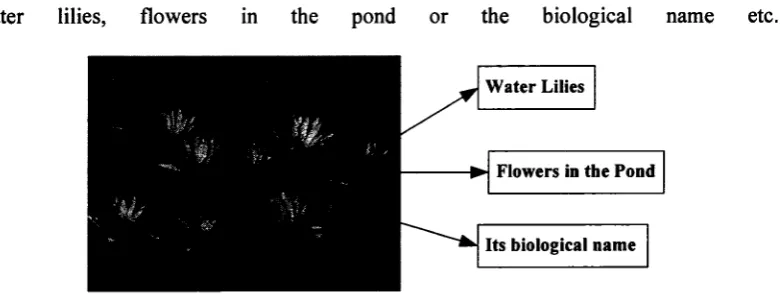
Figure 1.1 shows a common way for finding images by text-based method. In
water lilies, flowers in the pond or the biological name etc.
Flowers in the Pond
Figure 1.1: An example of text-based image search method
A lthough text-based method has its own merits, tw o m ajor difficulties also
exist, especially when the size o f image collections is large (tens or hundreds o f
thousands). One is that it is tim e consuming in m anual image annotation, when the
database is large, the other one, which is more essential, is that images have rich content
and are subjective to human perception. Visual features o f image are difficult to be
described using words, and for the same image content different people m ay perceive it
differently. Due to the deficiencies in text-based method, in the early 1990s, Content-
based Image Retrieval (CBIR) was proposed. It has the capability to retrieve image based
on their content, domain independence; and can be automated. Since then, many
techniques in this research direction have been developed and m any image retrieval
systems, both research and commercial, have been built.
Generally, in Content-based Image Retrieval, images w ould be indexed by
their own visual content, such as color, texture and shape. One o f the key issues o f CBIR
is the need to extract useful information from the raw data to represent the image content.
So the extraction o f effective content features is crucial to the success o f CBIR. From the
combinations are very useful for image description and retrieval. Feature extraction in
CBIR is the m ost important step for successful image retrieval [3] [4].
1.2 Research Objectives
From the above background information, w e can conclude that images in
databases can be represented and indexed either by textual or content information. And
image content is described by prim itive image features like color, texture, shape or the
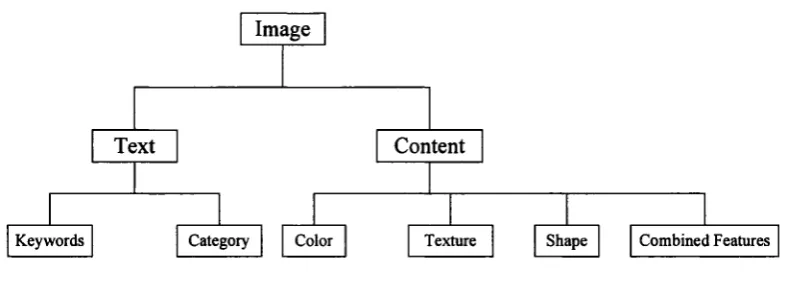
combination o f them (Figure 1.2). This research adopts CBIR approach, representing and
retrieving images by their content.
Color Texture Shape
Image
Category Keywords
Text Content
Combined Features
Figure 1.2: Image Description using Text and Content information
A successful design o f a new CBIR system needs a com prehensive and good
knowledge o f the CB IR techniques. A basic CBIR system is m ainly composed o f three
components: Im age Pre-processing, Feature Extraction and Q uery Engine. Shape is one
o f the m ost important low level image features due to the fact that shape is a very
important feature to hum an perception. Human beings tend to perceive scenes as being
composed o f individual objects, which can be best identified by their shapes. In our
research, we first focus on shape-based image retrieval techniques, from the most
classical techniques to the latest and effective techniques. The m ost important part in
extraction is to have a simple and reliable representation o f the shape image by
eliminating the redundant information and retaining m ost o f im portant clues for image
retrieval. Shape descriptors are generally used for shape feature extraction. Region-based
Shape D escriptor and Contour-based Shape Descriptor are two general categories in
shape image feature extraction. Fourier Descriptor (FD) and Generic Fourier Descriptor
(GFD) will be implem ented and compared in different image databases. The extracted
features are represented as shape descriptors. Shape descriptors are some set o f numbers
that are produced to describe a given shape. So it is easily discrim inated by similarity
measures. Query engine is used to calculate distance or similarity betw een images. The
smaller the distance is, the more similar between images. One o f the m ost popular
similarity m easures is Euclidean Distance. City block distance and % Statistics will be
also discussed and implemented for comparison. A t last, we w ill adopt recall and
precision pair (RPP) performance measure to evaluate different algorithm s for image
retrieval.
The main aim o f this research is to develop a better m ethodology for feature
extraction to obtain as m uch image information as possible, thus retrieving more relevant
images from database to the query user supplied. In an image retrieval system, the more
the related images retrieved, the more useful and effective the system is. As discussed
before, image content can be described by color, shape and texture. Texture is also an
important feature o f object. Texture is a global feature that could be used to associate
related shapes. When the shape o f an object changes largely, its texture usually remains
little change. Therefore, if shape o f object is complex, object’s texture information can be
improve system efficiency by combining texture and shape information together to
extract image features. Two-dimensional G abor filters (GF) is proved to be very effective
texture feature extraction methods in literature. M a and M anjunath evaluated the texture
image annotation by various w avelet transform representations [5]. They found that GF
had the best perform ance among the tested candidates. So we choose GF with specified
orientations and frequencies to obtain texture features for image retrieval.
Our research goal is to combine shape and texture information together for
feature extraction in our CBIR system. An in-depth comparison and analysis will be
carried out in different databases to test the effectiveness and robustness o f the proposed
method. Our image databases include silhouette database collected by The Laboratory for
Engineering M an/M achine Systems (LEM S) [6], Fingerprint database [7] and
Amsterdam Library o f Object Images (ALOI) [8]. We transfer all images in databases
into grey-scale images since we ignore color information.
1.3 Thesis Outline
Chapter 1 presents an introduction to the background o f digital image
collection and the problem o f traditional text-based method to index and m anage digital
images, and the reason and benefit o f proposed CBIR. It also provides an explanation o f
the objectives o f this research and where the m otivation came from.
Chapter 2 gives a brief review o f CB IR system, and provide a brief
description o f feature extraction and matching for color, texture and shape information.
Similarity m easurem ents and performance m easurements are described and discussed.
performance m easurem ents have been selected for use in later chapters. Some famous
image retrieval system has been introduced as well.
Chapter 3 focuses on the details o f the feature extraction algorithm s used in
this research. W e first give a description for the shape descriptor and its tw o categories:
region-based and contour-based shape descriptor. Then we will concentrate on a new
proposed shape descriptor, Generic Fourier Descriptor (GFD). G abor filters for texture
feature extraction w ill be described at last.
Chapter 4 first briefly introduce image segmentation m ethodology, which is
an important part for simulation in real world objects. And then w e give the application
for shape features as well as texture features. A combined shape and texture features are
proposed at last.
Chapter 5 describes the models o f the sets o f experiments. We will test and
compare the perform ance o f the image retrieval rate in three image databases through
different feature extraction algorithms and similarity measurements. The experimental
results will be discussed and the methodology for the com parison and testing will be
explained.
CHAPTER II
OVERVIEW OF CONTENT-BASED IM AGE RETRIEVAL
2.1. Introduction to content-based image retrieval
Content-based image retrieval (CBIR), a new technique to search images
from large-scale image databases by using image contents, has been developed and
prospered since the 1990s. As m entioned before, images were first annotated with text
and then searched using a text-based approach from traditional database m anagement
systems. Images can be organized by tropical or semantic hierarchies to facilitate key
word searching, catalogue browsing and etc. However, it is not feasible to automatically
generate descriptive texts for a large-scale image databases, m ost text-based image
retrieval system require m anual annotation o f images. As a result, text-based image
retrieval system has its limitations; it’s difficult to support a variety o f task-dependent
queries.
Content-based image retrieval, uses the visual contents o f an image such as
color, texture and shape to represent and index the image, and it can be automated and do.
on-line searching. Here is a typical structure o f CBIR. U ser supplies a query image to
CBIR system, the system extracts visual contents o f the query images and images in the
database, and then the extracted contents are described by m ulti-dim ensional feature
vectors. The feature vectors o f the images in the database form a feature database while
the query image is represented by its feature vectors. To retrieve images, the system
calculates the sim ilarities or distances between the feature vectors o f the query image and
the images in the database, and the retrieval is perform ed w ith the aid o f an indexing
Recent retrieval systems have incorporated user’ relevance feedback, in order to combine
human perception subjectivity into the retrieval process and provide users opportunities
to evaluate retrieval results, and automatically refine queries on the basis o f those
evaluations. In this chapter, we introduce these fundamental techniques for content-based
image retrieval.
I
II
Relevance Feedback
User^ Query Visual Content Feature
Image Description Vectors
Image Visual Content Feature
Database Description Vectors
Similarity Comparision
Indexing & Retrieval
Output < - Retrieval Results
Figure 2.1: Content-based retrieval system structure [4]
2.2 Image Content Descriptors
Generally speaking, image content may include both visual and semantic
content. General visual content include color, texture, shape, etc. Semantic content is
obtained either by textual annotation or by complex inference procedures based on visual
content. This chapter concentrates on general visual contents descriptions, we will
introduce some w idely used techniques for extracting color, texture and shape
information from images.
2.2.1 Color
The color feature is one o f the m ost extensive used visual features in image
size and orientation. Several m ethods for retrieving images on the basis o f colour
similarity have been described in the literature [9]. In image retrieval, the color histogram
is the m ost com m only used color feature representation. Each image added to the
collection is analysed to compute a colour histogram that shows the proportion o f pixels
o f each colour within the image. The colour histogram for each image is then stored in
the database. A t search time, the user can either specify the desired proportion o f each
colour (75% olive green and 25% red, for example), or submit an example image from
which a colour histogram is calculated. Either way, the m atching process then retrieves
those images whose colour histograms match those o f the query m ost closely. The
matching technique m ost commonly used, histogram intersection, was first developed by
Swain and Ballard [10]. Variants o f this technique are now used in a high proportion o f
current CBIR systems. M ethods o f improving on Swain and B allard’s original technique
include the use o f cumulative colour histograms [11], com bining histogram intersection
with some elem ent o f spatial matching [12], and the use o f region-based colour querying
[13]. The results from some o f these systems can look quite impressive.
Besides the color histogram, several other color feature representations have
been applied in image retrieval, including color m oments and color sets. To overcom e the
quantization effects, as in the color histogram, Strieker and Orengo proposed using the
color m oments approach [14]. The mathematical foundation o f this approach is that any
color distribution can be characterized by its moments. Furthermore, since most o f the
information is concentrated on the low-order moments, only the first m om ent (mean), and
feature representation. W eighted Euclidean distance w as used to calculate the color
similarity.
2.2.2 Texture
Texture is another important property o f images. Basically, texture
representation m ethods can be classified into two categories: structural and statistical.
Structural methods, including m orphological operator and adjacency graph,
describe texture by identifying structural prim itives and their placem ent rules. Statistical
methods, including Fourier pow er spectra, co-occurrence m atrices, shift-invariant
principal, com ponent analysis (SPCA), Tam ura feature, W old decom position, Markov
random field, fractal model, and multi-resolution filtering techniques such as G abor and
wavelet transform , characterize texture by the statistical distribution o f the image
intensity.
Co-occurrence m atrix representation o f texture features w as proposed by
Haralick et al in the early 1970s [15]. This approach explored the gray level spatial
dependence o f texture. It first constructed a co-occurrence m atrix based on the orientation
and distance between image pixels and then extracted m eaningful statistics from the
matrix as the texture representation. A fter that, Tamura et al explored the texture
representation from a different angle [16]. They developed computational approximations
to the visual texture properties found to be important in psychology studies. The six
visual texture properties were coarseness, contrast, directionality, linelikeness, regularity,
and roughness. One m ajor distinction between the Tam ura texture representation and the
representation are visually meaningful, whereas some o f the texture properties used in co
occurrence m atrix representation may not be. t
In the early 1990s, the wavelet transform was introduced and its theoretical
framework was established, many researchers began to utilize w avelet transform for
texture feature extraction. Smith and Chang used the statistics (mean and variance)
extracted from the wavelet subbands as the texture representation [17, 18]. In 1996, M a
and M anjunath evaluated the texture image annotation by various wavelet transform
representations [5]. They found that Gabor transform had the best perform ance among
the tested candidates.
2.2.3 Shape
Shape is one o f the m ost important low level image features due to that shape
is a very im portant feature to human perception. Shape refers to a specific region o f an
image while color and texture are both global attributes o f an image. A good shape
representation feature for an object should be size, rotational and translation invariant in
image retrieval application. Generally, shape description can be categorized into either
boundary-based or region-based methods. The former expresses shape properties o f the
object outline (contour), the latter expresses pixel distribution within the entire object
region. The m ost successful representatives for these tw o categories are Fourier
Descriptor and Zem ike Moments.
The m ain idea o f Fourier descriptor is to use the Fourier transform ed
boundary as the shape feature, m any works can be found in [19, 20], FD has many
advantages over m any other shape descriptors. It is simple to compute; and each
shape m atching a simple task; and it captures both global and local features. With
sufficient features for selection, FD overcomes the weak discrim ination ability o f those
simple global descriptors. FD also overcomes the noise sensitivity and difficult
normalization in the shape signature representations.
Recently, several researchers have proposed the use o f W D for shape
description [21]. A lthough WD has the advantage over FD in that it is o f multi-resolution
in both spatial space and spectral space, the increase o f spatial resolution will certainly
sacrifice frequency resolution. For example, only w avelet coefficients o f the few low
frequencies are used to represent shape. M ost importantly, the com plicated matching
scheme o f w avelet representation makes it impractical for online shape retrieval.
CSSD has also been widely used in shape representation [22]. CSS
descriptors are essentially the descriptors o f key local shape features. By putting shape
boundary into scale space, not only the locations o f convex (or concave) segments, but
also the degree o f convexity (or concavity) o f the segments on the shape boundary are
detected.
Zem ike moment, the most popular and efficient m om ent m ethod in region-
based shape descriptor, is to use region-based m oments w hich are invariant to
transform ations as the shape feature [23]. Recently, several researchers also use grid
method to describe shape [24]. The grid-based m ethod gains lots o f interest for its simple
format for representation and conformance to intuition.
2.3 Similarity and Performance M easurement
Content-based image retrieval calculates visual sim ilarities between a query
extracted is usually an N-dim ensional feature vector that can be regarded as a point in a
N-dimensional space. Once images are represented and indexed into the database using
the extracted feature vectors, the retrieval o f images is essentially the determination o f
similarity between the query image and the images in database, w hich is essentially the
determination o f distance between the feature vectors representing the images. Thus the
retrieval results are a list o f images ranked by their sim ilarities with the query image.
Many sim ilarity m easures have been developed for image retrieval based on empirical
estimates o f the distribution o f features in recent years, the desirable distance measure
should reflect hum an perception. So perceptually sim ilar images should have smaller
distance between them and perceptually different images should have larger distance
between them. Therefore, for a given shape feature, the higher the retrieval accuracy, the
better the distance m easure. W e will introduce several similarity m easures in this section.
A nother important area is performance m easurem ent to evaluate the retrieval
rate in CBIR. Generally, performance measurement m easures accuracy o f the retrieval.
There are different performance measurements. Some o f the im portant performance
measurements will be discussed in this section and a desirable one will be chosen for our
research.
2.3.1 Similarity Measurements
W e will introduce some commonly used similarity m easures. In this section,
we denote D ( I ,J ) as the distance between the query image I and the image J in the
2.3.1.1 Minkowski-Form Distance
The M inkowski-Form Distance is defined as:
N- 1
Dp{i,j)=cz\m-uj)\yp
(2.i)
/=0
W hen p = 1, it is known as city block distance or M anhattan distance.
a ( ^ ) = Z I / ( ' ) - . / ;g/ ) | (2.2>
W hen p = 2 , it is the Euclidean distance or Euclidean metric. Euclidean
distance is the m ost widely used measure for image retrieval. The Euclidean distance is
defined as follows:
N- 1
D2( / ,J ) = ( X | / . ( / ) - / ( A f ) 1/2 (2.3) 0
2.3.1.2
$
StatisticsThe $ Statistics is defined as
(2.4) 6 / a - / )
W here / ( / , J ) = # xhis quantity m easures how unlikely it is that
2.3.2 Performance Measurements
To evaluate different algorithms for image retrieval, an effective performance
m easurem ent is necessary. In this section, we will introduce several different
performance m easurem ents [27][28].
2.3.2.1 Recall and Precision Pair (RPPt
One o f m ost efficient evaluation methods for image retrieval is Recall and
Precision Pair (RPP), which is a standard evaluation method and popularly used by CBIR
community because RPP present abundant information o f retrieval result and can be
easily understood. Precision measures the retrieval accuracy while recall measures the
ability o f retrieving relevant items from the database. In the RPP graph,
Precision is the percentage o f similar images retrieved with respect to the
total num ber o f images retrieved.
p _ No. o f similar images retrieved ^ ^
Total No. o f images retrieved
Recall is the percentage o f similar images retrieved w ith respect to the total
number o f sim ilar images in database.
P _ No. o f similar images retrieved ^
Total No. o f similar images in database
2.3.2.2 Percentage o f Weighted Hits (PWFP
PW H is sim ilar to the recall m easurem ent in RPP. The subjective test is the
same as in RPP, that is, each subject select items relevant to the query from the dataset.
However, instead o f m easuring recall based on binary relevance value as in RPP, PW H
to the num ber o f subjects selecting item i as relevant or sim ilar to the query. Therefore,
PWH is defined as
1 ",
PW H = — (2.7)
1=1
W here n is the um ber o f items returned and N is the total num ber o f items in
the database. It is easy to observe that recall is a special case o f PW H w hen wi takes the
value o f 0 and 1.
2.4 Image Retrieval System
Content-based image retrieval has become a very prosperous research area
since the emergence o f large-scale images. M any comm ercial image retrieval systems
have been built. M ost systems allow searching the visual database contents in several
different ways described as follows [4]:
CD
Interactive Browsing (D Search by example© Search by sketch
© Search by a key word or complete text
© Search by specification o f visual features
Table 2.1 shows a list o f CBIR systems in alphabetic order, more details can
be find in the corresponding website.
System Website/ online demo
AltaVista Photofinder http://www.altavista.com/
Blobworld http://elib.cs.berkeley.edu/blobworld/start.html
CANDID http://public.lanl.gov/kelly/CANDID/index.shtml
MARS http://www-db.ics.uci.edu/pages/demos/index.shtml
OBIC http://wwwqbic.almaden.ibm.com/
Virage http://www.virage.com.
VisualSEEK http://www.ctr.columbia.edu/VisualSEEk/
WebSEEK http://www.ctr.columbia.edu/webseek/
WISE http://bergman.stanford.edu/~zwang/project/imsearch/WBIIS.html Table2.1 Examples of CBIR systems
2.5 Summary
In this chapter, we introduce some fundamental techniques for content-based
image retrieval. We first give a brief introduction to CBIR, and then discuss the important
parts in CBIR individually, including visual content description, similarity and
performance m easurem ent. We describe former and current techniques in each section,
and introduce several algorithms as well; some o f them will be discussed in next chapter
for research purpose. A t last, we give a brief introduction for some comm ercial and
CHAPTER III
FEATURE REPRESENTATION TECHNIQUES
3.1. General Shape Representation
Shape is one o f the most important low level image features due to that shape
is a very important feature to human perception. Human beings tend to perceive scenes as
being composed o f individual objects, which can be best identified by their shapes.
Besides, as far as query is concerned, shape is simple for user to describe, either by
giving example or by sketching.
Shape representation generally looks for effective and perceptually important
shape features based on either shape boundary information or boundary plus interior
content. V arious shape representation methods, or shape descriptors, exist in the literature,
these methods can be classified into two categories: region based versus contour based.
The difference between region based and contour based shape descriptors can
be clearly discrim inated in Figure 3.1.
•
9 1
9
•
•
s rig
8 ta
Figure 3.1 Examples of Region and Contour-based shape similarity [29]
Objects in the first row have similar spatial distribution o f pixels and are
different outline contours. Meanwhile, objects shown in each column are similar
according to a contour-based criterion. Posing a query with the object located in the first
row and second column will result in retrieved object from the first row (if region-based
similarity is concerned) or second column (if contour-based sim ilarity is concerned).
Now we will introduce region-based and contour-based shape descriptors for Shape-
based image retrieval.
3.1.1 Region-based Shave Descriptor
The region-based shape descriptor expresses pixel distribution within a 2-D
object region; it can describe complex objects consisting o f m ultiple disconnected regions
as w ell as sim ple objects with or without holes. The following Figure 3.2 is some object,
which can be efficiently described by Region-based Shape Descriptor.
Figure 3.2 Examples of shapes that can be efficiently described by the region-based descriptor [29] Region-based Shape Descriptor has some important features [29]:
(1) It gives a compact and efficient way o f describing properties o f multiple
disjoint regions simultaneously.
(2) Sometimes during the process o f segmentation, an object may be split into
disconnected sub-regions. Such an object can still be retrieved, provided that the
information w hich regions it w as split into is retained and used during the descriptor
(3) The descriptor is robust to segmentation noise, e.g., salt and pepper noise.
Com m on region based methods use m oment descriptors to describe shapes.
These include geometric moments, Legendre moments, Zem ike m om ents and pseudo-
Zem ike moments. It has been shown in [23] that Zem ike m om ents outperform s other
m oment m ethods in terms o f overall performance. O ther region-based methods include
grid method, shape matrix, convex hull and m edia axis. Here we briefly introduce
Zem ike m om ents as follows.
Zem ike-m om ent descriptor (ZMD) is obtained by using all the pixel
information within a shape region. It does not assume shape boundary information. ZM D
is one o f the best shape descriptors among the existing shape descriptors. It has been
tested on M PEG-7 shape databases and adopted in M PEG-7 as region-based shape
descriptor.
The com plex Zem ike moments are derived from Zem ike polynomials,
v nm(*. y) = K m (r cos 0 , r s i n 0 ) = Rnm ( r ) exp(ym6>) (3.1)
and R„m(r) = £ ( - 1 ) '--- (” ....
1 ■ hJ . m m n — mn r n' 2s (3.2)
- s ) \ ( —
£!(————— ■£)!(--— ~ — ■0
-W here r is the radius from (x, y) to the shape centroid, 6 is the angle between
r and x-axis, n and m are integers and subject to n-|m|=even, w here m < n . Zem ike
polynomials are a complete set o f com plex-valued function orthogonal over the unit disk,
i.e., x 2+y2=l. Then the complex Zem ike moments o f order n with repetition m are
A m
= —
X X / O ’
(*>
y )n x y
= Z Z f ( r C0S d >r Sin ^ X eXP(I"*6 ) ’r ~ 1 ‘3 ^
7T r g
W here f ( x , y ) is a binary shape function, V ' ( x , y ) is the com plex conjugate
o f V(x, y ) . The m agnitudes o f the acquired Zem ike m oments norm alized by the mass o f
the shape are used as shape descriptors.
3.1.2 Contour-based Shape Descriptor
The contour-based descriptor expresses shape properties o f the object outline
(contour). Objects for which characteristic shape features are contained in the contour are
described efficiently by this descriptor.
Figure 3.3 Examples o f shapes that can be efficiently described by the contour-based descriptor [29] Contour-based Shape Descriptor has the following im portant features:
(1) It can distinguish between shapes that have sim ilar region-shape
properties but different contour-shape properties.
(2) It supports search for shapes that are semantically sim ilar for humans,
even when significant intra-class variability exists
(3) It is robust to significant nonrigid deformations
(4) It is robust to distortions in the contour due to perspective transformations,
C ontour shape representations include global shape descriptors such as
eccentricity, circularity and bending energy, shape signatures such as chain code, centroid
distance, and cumulative angles, spectral descriptors such as FD and wavelet descriptors,
and curvature scale space descriptors (CSSD).
Global contour shape representation techniques usually compute a m ulti
dimensional num eric feature vector from the shape boundary information. Common
simple global descriptors are area, circularity (perimeter2/area), eccentricity (length o f
major axis/length o f m inor axis), m ajor axis orientation, and bending energy. These
simple global descriptors usually can only discriminate shapes w ith large differences;
therefore, they are usually used as filters to eliminate false hits or combined with other
shape descriptors to discrim inate shapes. They are not suitable to be standalone shape
descriptors.
Bending energy is based on thin-plate splines to calculate the energy needed
for coordinate transform ation between two images. The smaller the bending energy, the
more sim ilar betw een two images.
The thin-plate spline (TPS) is a spatial generalization o f the cubic spline for
estimating the deform ation that warps one set o f point patterns to another in 2D space.
The application o f TPS to match images with deform ations w as first proposed by
Goshtasby [30].
Figure 3.4 shows a Simple example o f coordinate transform ation using TPS.
The bending energy between red cross points and blue circle points is the energy needed
Figure 3.4 Example of coordinate transformation using TPS
A Shape signature represents a shape by a one-dim ensional function derived
from shape boundary points. Shape signatures are local representations o f shape features
and are extracted from spatial domain, as a result, they are sensitive to noise. Furthermore,
the m atching cost using shape signatures is high due to the com plex normalization o f
rotation invariance. Therefore, these representations need further processing using scale
space or using spectral transform such as Fourier transform , short-time Fourier transform,
and w avelet transform.
Spectral descriptors overcome the problem o f noise sensitivity and boundary
variations by analyzing shape in spectral domain. Spectral descriptors include Fourier
descriptor (FD), wavelet descriptor (W D) and curvature scale space descriptors (CSSD);
they are derived from spectral transforms on 1-D shape signatures.
M any comparative researches have been done in this area. Zhang and Lu
[31,32,33] have found that for general shapes, the centroid distance function is the most
desirable shape signature to derive FD. They have also found that 10 FD features are
sufficient to represent shape, this is a significant reduction in dim ensions o f FD compared
outperforms CSSD m ethod in term s o f retrieval performance and robustness. N ow we
will discuss FD as follows.
In general, FDs are obtained by applying Fourier transform on a shape
signature, the norm alized Fourier transform ed coefficients are called the Fourier
descriptors o f the shape. The shape signature is a one-dim ensional function that is derived
from shape boundary coordinates. Different shape signatures have been exploited to
obtain FD. Com plex coordinates; curvature function, cumulative angular function, and
centroid distance are the commonly used shape signatures. How ever, FD derived from
different signatures has significant different performance on shape retrieval. As has been
shown in [34], FD derived from centroid distance function outperform s FD derived from
other shape signatures in term s o f overall performance.
The first step o f computing FD is to obtain the boundary coordinates
(x(t),y(t)), t = 0 , 1 , . . . , N - 1 , where N is the num ber o f boundary points. In order to
obtain a shape boundary, we have to pre-process the image. In general, w e will binarize
the shape image; a simple thresolding is applied to convert the gray level shape image
into binary image. A nd then we trace the image contour in order to obtain the boundary
coordinates. Here is an example to obtain the boundary coordinates.
# ■
A fter obtaining the boundary coordinates, the centroid distance function can
be expressed by the distance o f the boundaiy points from the centroid (Xc; y c) o f the shape.
K O = (W O ~ x cf + [y( 0 - yc ]2 )1/2, / = 0 ,1,..., A - 1 (3.4)
W here *c = 7 7S MO ’ ^ = T 7 Z M O <3 -5)
For example, the following are three apple shapes and their centroid distance
function r(t), which are shown in Fig. 3.6. The left apple is the original shape, the other
two are the noise affected and defected versions o f the original shape. The irregular and
defected shapes are likely resulted from segmentation o f natural scene where noise,
irregularities, and occlusions around object boundary are common.
#
•
*
1
Fig. 3.6 Three apple shapes and their centroid distance signatures [31] The discrete Fourier transform o f r(t) is then given by
an = ^ | > ( 0 exP( n = 0 , \ , . . . , N — l (3.6)
W here an are the Fourier transform ed coefficients o f r[t) . The reconstructed
shapes o f apple 1, 2, and 3 using the first three coefficients are shown in Fig. 3.5a and the
reconstructed shapes o f apple 1, 2, and 3 using the first five coefficients are shown in
Fig. 3.7b. As can be seen, the three reconstructed shapes in Fig. 3.7a are veiy
similar even though their original shapes are affected by serious noise and defections.
usually the m ost significant and are used to derive shape descriptors, the two examples
indicate that, shape descriptors using Fourier transform ed coefficients are robust to
variations o f shape boundaries.
(a)
<b)
Fig.3.7 The Fourier reconstructed apple 1,2, and 3 using:(a) the first three FD (b) the first five FD[31] The acquired Fourier coefficients are translation invariant due to the
translation invariance o f the shape signature. In order to describe the shape, the acquired
Fourier coefficients have to be further normalized so that they are rotation, scaling and
start point independent shape descriptors. From Fourier transform theory, the general
form o f the Fourier coefficients o f a contour r(t) transform ed through translation,
rotation, scaling and change o f start point from the original contour r(t)m is given by:
an = exp(ywr) • exp(y^) • 5 • a(°] (3.7)
W here an and a(n0) are the Fourier coefficients o f the transform ed shape and
the original shape, respectively, r and ^ are the angles incurred by the change o f start
point and the rotation, respectively; s is the scale factor. N ow considering the following
expression:
b exp(ywr) • exp(y^) • s •
a0 e x p Q r) • exp(y^) • s ■ a(0o>
a(0)
=-757 exP[y (« - O r] = exp [j(n - l)r] (3.8)
W here b„n and b(„0)n are the normalized Fourier coefficients o f the transform ed shape and the original shape, respectively. The normalized coefficient o f the derived
shape bn and that o f the original shape b(n0) only have difference o f exp[y'(« - l ) r ] . I f we
ignore the phase information and only use m agnitude o f the coefficients, then \bn\ and
are the same. In other words, |6„| is invariant to translation, rotation, scaling and
change o f start point. The set o f magnitudes o f the normalized Fourier coefficients o f the
shape {|£>„|,0 < n < iVj are used as shape descriptors, denoted as {FDn,0 < n < N } . The
whole process o f computing FD from a shape is given in Fig. 3.8.
In p u t Im age P rep ro cessin g S ignature F o u rier N orm alization FDs D erivation T ran sfo rm
Fig.3.8 Block diagram of computing FD [31]
3.2 Generic Fourier Descriptor
W e have discussed two categories o f shape descriptor: region based versus
contour based, and their typical descriptors: Zem ike-m om ent descriptor (ZM D) and
Fourier Descriptor (FD). However, there are several drawbacks existed in the existing
descriptors. M ost o f the region-based shape descriptors are extracted from spatial domain,
as the result, they are sensitive to noise and shape variations. A nd in one-dim ensional FD,
it is difficult to derive 1-D FD for the shape in Fig. 3.9(a), because the contour o f the
shape is not available. Furthermore, 1-D FD cannot capture shape interior content that is
important for shape discrim ination, which is show in Fig. 3.9(b) and Fig. 3.9(c); FD is not
Fig. 3.9 (a) A shape without contour
(b), (c) two shapes with same contour but with different interior content
In order to overcome the disadvantages o f the existing shape descriptors,
Zhang and Lu proposed a generic Fourier D escriptor (GFD) in 2002 [33]. The proposed
shape descriptor is derived by applying two-dim ensional Fourier transform on a
polar-raster sampled shape image.
3.2.1 Polar Fourier transform
As has been discussed before, One-dimensional FT has been successfully
applied to contour shape to derive FD. The application o f one-dim ensional FT on shape
assumes the knowledge o f shape boundary information, which m ay not be available in
general situations. N ow we introduce 2D Fourier Transform first.
Here are form ulas for the continuous and discrete 2-D Fourier transform o f a
shape image f ( x , y) (0 < x < M , 0 < y < N )
F(u, v) =
J[
£ f ( x , y ) x exp[-j27r(ux + vy)\dxdy (3.9)M - l N- 1
y ) x e x p [ - j 2 7 r ( u x / M + v y / N) ] (3.10)
x=0 y=0
However, direct applying the 2-D FT to the Cartesian representation o f an
image is not practical. Because the resulting descriptors are not rotation invariant, which
is a crucial property for a shape descriptor. Zhang et al. give a solution to this problem by
correspondence between input parameters and their physical m eaning, Zhang et al.
proposed to treat the polar image in polar space as a normal two-dim ensional rectangular
image in Cartesian space, as shown in Fig. 3.10.
I f w e apply 2-D FT on the rectangular image, the polar FT has the similar
form to the normal 2-D discrete FT o f (3.10) in Cartesian space. Consequently, the
modified polar FT is obtained as:
P F (p , <p) = £ X f ( r > Bt) x exP P + ~ ^ r <P)] (3-11)
r i K 1
W here 0 < r < R and 6i - i ( 2 n l T ) (0 < i < T ) ; 0 < p < R and 0 < (p < T . R
and T are the radial and angular resolutions. / ( j c , y ) i s a binary function in shape
application. From (3.11), the physical meaning o f p and <p are simply the num ber o f
radial frequencies selected and the num ber o f angular frequencies selected. The
determination o f p and (p is physically achievable, because shape features are usually
captured by the few low frequencies.
o
Figure 3.10 Polar representation of an image
3.2.2 Implementation o f Generic Fourier Descriptor
The im plem entation o f GFD can be summarized into four steps, translation
normalization, polar Fourier transform, rotation normalization and scale normalization.
Given a shape image I = { f ( x , y ) ; 0 < x < M , 0 < y < N } , the shape image is
first converted from Cartesian space to polar space I p = { f ( r , 0); 0 < r < R, 0 < 9 < 2n) . R
is the m axim um radius o f the shape. The origin o f the polar space is set to be the centroid
o f the shape, so that the shape is translation invariant. The centroid (xc, j c) is given by
1 N- 1 1 M- 1
<3 1 2 >
m *= 0 l y y =0
and r = f l > - x j2 + [ y - y J 2)1/2,0 = a r c t a n ^ - ^ £- (3.13)
The acquired coefficients o f the polar Fourier transform are translation
invariant due to the use o f centroid as polar space origin. Rotation invariance is achieved
by ignoring the phase information in the coefficients and only retaining the m agnitudes o f
the coefficients. To achieve scale invariance, the first m agnitude value is normalized by
the area o f the circle (area) in which the polar image resides or the m ass o f the shape
(mass), and all the other magnitude values are normalized by the m agnitude o f the first
coefficient. The translation, rotation and scale normalized PFT coefficients are used as
the shape descriptors.
f |P F (0,0)| 1^ ( 0,1)1 | ^ ( 0,»)| |/ >/r(w ,0)|
[ mass ’ |P F (0,0)| ’" ‘ ’ |/>F(0,0)| ’' ‘ ‘ ’ |i>F(0,0)| ’ |/>F(0,0)| J
For efficient shape description, only a small num ber o f the acquired
descriptors are selected for shape representation. The selected descriptors form a feature
vector that is used for indexing the shape. For two shapes represented by their Fourier
descriptors, the sim ilarity between the two shapes is m easured by the similarity
3.3 General Texture Representation
Texture refers to the visual patterns that have properties o f hom ogeneity that
do not result from the presence o f only a single color or intensity [18]. It is an innate
property o f virtually all surfaces, including clouds, trees, bricks, hair, and fabric. It
contains im portant information about the structural arrangement o f surfaces and their
relationship to the surrounding environm ent [15].
Texture is also an important feature o f object. Texture is a global feature that
could be used to associate related shapes. When shape o f object changes largely, its
texture usually rem ains little changed. Therefore, if shape o f object is complex, object’s
texture information can be exploited to describe object together with object’s shape
feature. So texture features could be a good supplem ent for shape feature extraction in
image retrieval.
Previous attempts for extracting texture features include the following
approaches: random field m odeling [35], co-occurrence m atrices [15] and G abor filters
[5]. Tw o-dim ensional G abor filters (GF) is proved to be very effective texture feature
extraction m ethods in literature. M a and M anjunath evaluated the texture image
annotation by various wavelet transform representations [5], including orthogonal and bi-
orthogonal w avelet transform s, the tree-structured w avelet transform , and the Gabor
wavelet transform . The found that the G abor transform was the best among the tested
candidates w hich m atched human vision study results.
3.3.1 Gabor Filters
G abor filters are a group o f wavelets, with each w avelet capturing energy at a
convolved with a 2D Gabor function 30, to obtain a G abor feature ^ ^ as
follows:
(3 -15) *1
W here * indicates the complex conjugate.
A 2D G abor function g(x, y) has its form:
g(x, y ) = ~ e x p [ - ^ (— + — ) + 2 njWx] (3.16) 2n a xa y 2 a x a y
A nd g mn( x , y ) is a set o f self-similar functions generated from dilation and
rotation o f the G abor function g (* ,y ) [5].
g m„(x,y) = a~mg ( x , y ) (3.17)
x = a ~ m( x c o s 8 + y s i n d ) , y = a~m( -xs in & + y c o s 0 ) (3.18)
W here m and n specify the num ber o f scales and orientations respectively
(iw = 0 ,1 ,...A /'- 1 ,/j = 0 ,1 ,...JV -1 ), and a > 1, Q = n n ! N .
In order to decide the bank o f Gabor filters, the param eters in (3.16) to (3.18)
have to be determined. The Gabor wavelets generated using (3.16) through (3.18) are
complete but not orthogonal wavelets, it implies there is redundancy in the filters.
Therefore we may design a bank o f Gabor filters so that redundancy will be significantly
reduced while image texture will be well represented by the set o f individual filter
response. Due to the identical functional form o f G abor response function g(x, y) and its
spectral function,Its 2D Fourier transform G(u,v) can be written as
1 ( u - W ) 2 v2
G(u,v) = exp{—- [ - ---^ - + — ]} (3.19)
W here a u - ( 2 n a x) ‘and crv = ( 2n a^ . An optimal representation o f image
in spatial domain can be achieved by finding an optimal representation o f image
frequency spectrum. The idea o f achieving so is to use the full width at h a lf maximum
(FW HM ) o f the G abor spectral functions to form a complete coverage o f the frequency
plane within the m odulation frequency bandwidth. Specifically, the design follows three
principles [26]: (i) Uniform sampling o f orientation bandwidth; (ii) Exponential sampling
o f m odulation bandwidth; (iii) Continuous coverage o f the frequency space. This strategy
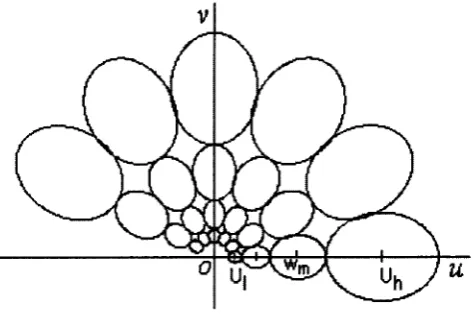
is illustrated in Figure 3.11.
Figure 3.11 FWHM sampling of spectral responses of Gabor filters in frequency plane
Let U, and Uh denote the lower and upper center frequencies o f interest. Let
K be the num ber o f orientations and S be the num ber o f scales in the m ultiresolution
decomposition. By the above strategy o f orthogonalization, the variables in the above
equations can be determ ined as following:
^ { a - \ ) U h " (a + l)V21n2
<r„ = tan(^ -)[ U h - 2 l n ( ^ ) ] [ 2 I n 2 - ( 2 ^ ] 2 (3.20)
I K U h U h
W e can obtain a set o f magnitudes by applying G abor filters on the image
I ( x , y ) with different orientation at different scale.
E(m, n) = £ £ |Gm„(x, y)\ (3.21)
* y
The m ean jumn and standard deviation a mn o f the m agnitude o f the
transform ed coefficients are as follows:
_ E(m,n) J
r*mn n ^ ’ mn ' y (3.22)
P x Q P x Q
The G abor feature vector is given by:
f = [Cr00’CT0P--■’°CM-1XV-1)] (3.23)
For tw o images represented by their G abor feature vectors, the similarity
between the two images is measured by the sim ilarity m easurem ent betw een the two
feature vectors.
3.4 Summary
In this chapter, State o f the art shape representation techniques have been
reviewed. Two shape representation methods, region based shape descriptors and contour
based shape descriptors have been introduced. Zem ike m oments and Fourier descriptor
the drawbacks o f existing shape representation techniques, has been introduced. Gabor
![Figure 3.1 Examples of Region and Contour-based shape similarity [29]](https://thumb-us.123doks.com/thumbv2/123dok_us/1472557.1180353/29.610.223.399.472.617/figure-examples-region-contour-based-shape-similarity.webp)