DIFFERENTIAL ACTION OF THE SUGARY G E N E I N MAIZE ON
TWO ALTERNATIVE CLASSES OF MALE GAMETOPHYTES R. A. BRINK AND C. R. BURNHAM
University of Wisconsin, Madison, Wisconsin Received January 11, 1927
TABLE OF CONTENTS
PAGE
INTRODUCTION. ... 348
Materials.. . . 349
Accuracy of classification.. . . 350
Ratios obtained on selfing waxy heterozygotes, homozygous for the sugary and the non- sugary genes, respectively. ... 352
Effect on the waxy ratio of the composition of the pistillate parent with respect to the sugary gene.. ... 357
Additional evidence from backcrosses that the sugary gene depresses the waxy ratio.
....
364The waxy ratio in the sugary and non-sugary classes following the use of the double hetero- zygote, S , S" W , W,, as the staminate parent.. ... 365
DISCUSSION.. ... 373
LITERATURE CITED.. ... 378
The sugary ratio when S, su W, W, plants are used as staminate parents. ... 372
SUMMARY ... 377
INTRODUCTION
I t was observed in 1924 that maize plants homozygous for the sugary gene and segregating for waxy, that is, of the formula su su W , W,, gave,
when self-pollinated, only 18.8 percent of waxy grains. Since non-sugary, waxy heterozygotes on being selfed give, on the average, about 24 percent waxy seeds, plans were made for testing out the relationship which appeared to exist between the sugary and waxy genes in modifying the waxy ratio. The breeding facts which have been gathered reveal a situa- tion of particular interest not only in its bearing on the r61e of the gameto- phyte of angiosperms in Mendelian inheritance but also on the broader problem of the relationship between cytoplasm and nucleus in heredity and determination. The results may serve, moreover, to give some further insight into the kinetics of the waxy and the sugary genes.
The sugary factor (S,) serves to differentiate the so-called sweet corns from other types of maize. The gene produces its most conspicuous effect in the endosperm which in sugary races is wrinkled in characteristic fashion and typically vitreous in appearance. The endosperm is smaller
of WISCONSIN, No. 68. Published with the approval of the Director of the Station.
GENETICS 12: 348 J1 1927
DIFFERENTIAL ACTION ON MALE GAMETOPHYTE 349
and lighter in weight than in non-sugary seeds due to differences in the nature and amount of the reserves. Sugary behaves regularly as a simple recessive to the non-sugary condition.
The waxy gene (W,) likewise occasions an alteration in the character of the endosperm. Seeds of this class have a dull, opaque appearance and the texture of a hard wax; they are only slightly lighter than non-waxy seeds and do not differ in shape. I n contrast to those of all other types of maize the endosperm of the waxy race gives a reddish-brown color with the iodine-potassium-iodide reagent. It has been shown that this peculiar color reaction is due to the presence of an unusual type of starch. This action of the waxy gene on the carbohydrate reserves is also exemplified in the pollen. In homozygous waxy races the starch in the pollen stains reddish-brown with iodine. In segregating individuals 50 percent of the pollen grains give this reaction; the remainder contain the ordinary blue- staining starch. The recessive waxy character is the result of a simple factor difference.
In inheritance the sugary and the waxy genes are independent of each other, their location on different chromosomes having been definitely established by EMERSON (1924).
MATERIALS
The original stock in which the influence of the sugary gene on the waxy ratio was first noted was represented in 1924 by a single sugary progeny, R11, consisting of 63 plants. The seed planted came from a
single ear resulting from a cross of the type su su W , W , X
S,
su W , W=.Of the plants which were self-pollinated, 25 proved to be segregating for waxy and yielded 31 ears. These ears bore 12,264 grains of which 18.84
percent were waxy. The proportion of waxy seeds expected on the Mendelian basis is, of course, 25 percent and the observed ratio is in defect of this by 6.16 k0.26 percent. The deviation, being over 23 times its probable error, is unquestionably significant.
Three non-sugary plants of the constitution S , su W , W, in progeny
R13,
a sib.of R11, were also self-pollinated in 1924. These three ears yielded 1245 grains, 24.82 50.68 percent of which were waxy. This is5.98 0.73 percent more waxy seeds than given by the homozygous sugary plants of like breeding. Since the difference between the sugary and non-sugary groups is over 8 times its probable error it is quite certainly not due to chance.5These findings indicated an important effect of the sugary gene on the waxy ratio and plans were made to pursue the problem further.
350 R. A. BRINK AND C. R. BURNHAM
I n the 1925 plantings provision was made for determining the effect of the sugary gene on the waxy ratio in a detailed way. Selfed ears were obtained on sib plants of the constitutions, S, S, W , W,, S, src W , W , and
S, S, W , W,. The following reciprocal combinations between sibs were also made: S , S, W , W , with S, S, W , W , and S, S, W , W , with S, S, W , W,. The plants used in these matings were all closely related, tracing back to two self-pollinated ears from R13 in 1924. These stocks are comprised in the progenies R21, R21a, R22 and R22a. Many of the tests made with these materials were duplicated with two other sets of plants of like composition with regard to the designated genes but of distinct breeding. The latter stocks are represented by the groups R23, R23a and R24, R24a, R24b, R24c, respectively. Their origin will be given below.
A number of crosses were made using pistillate plants of the types
S, S, W , W , and S, S, W , W = . These individuals were of diverse breeding except in the cases of progenies R27, R28, R28a, R28b and R36 which consisted of immediate descendants of self-pollinated plants in the sib progenies, R11 and R13.
The above material enables us to compare the waxy ratios in sugary and non-sugary stocks of like breeding with respect to other genetic factors. Furthermore, they provide for this comparison in three groups of distinct origin, making possible an estimate of the extent to which the relationship probably holds generally.
ACCURACY OF CLASSIFICATION
DIFFERENTIAL ACTION ON MALE GAMETOPHYTE 35 1
means of distinguishing the two classes. If the sugary seeds are very hard and translucent they must be split through the embryo before staining but it is usually possible by chipping near the base to classify the seed and retain it in a germinable condition. We find i t helpful to use a stronger solution of iodine in separating waxy and non-waxy sugary seeds than is otherwise called for. A preparation found very satisfactory contains 1.0 gram K1 and 0.6 grams I in 100 cc of water. Sugary seeds with pigment in the aleurone layer may readily be bleached by warming in a weak solution of sulfurous acid. If the grains are then washed with water and dried the iodine reaction may be readily obtained.
We have sought to measure the amount of error resulting in the.classi- fication of this sort of material. A group of 17 ears segregating for both sugary and waxy formed the basis of the study. The grains on each ear were separated into the four component classes by a first operator; each seed within the four groups was then checked independently by a second individual. When an apparently misclassified seed was found the matter was checked by examination under a microscope, if necessary, where the two types of starch grains, waxy and non-waxy, show a distinct differ- ence in reaction to iodine. The second classification was used as the standard against which the errors in the first were measured. With regard to the waxy grains in the non-sugary group, no errors were found in 9
of the 17 ears. I n the remaining 8 ears, 16 grains in all were misclassified. The total number of non-sugary seeds was 4097, which gives a percentage error equal to 0.39. However, 10 of the misclassified grains had been entered in the waxy class and 6 in the non-waxy group. These errors tend to cancel each other giving a net discrepancy negligible in size. I n the sugary class the error is larger. Of the 17 ears,
7
were correctly classified. Among the sugary grains in the remaining 10 ears, 33 were incorrectly identified. The error here amounts to 0.71 percent of the total, 4663seeds. I n 28 of the 33 cases the frequency of the waxy class was too high, which rather definitely indicates a tendency for the errors to go in this direction. I n the discussion below we shall be concerned with waxy ratios in the sugary class distinctly lower, in general, than those expected on the Mendelian basis. Assuming that the results obtained with this group of
17 ears are representative, the systematic error arising in classification tends to bring these ra.tios toward the “expected” value, then, rather than to exaggerate the difference. This being so, it would seem unnecessary to qualify our conclusions in regard to the significance of the departures from the theoretical ratios on account of possible errors in classification.
352 R. A. BRINK AND C. R. BURNHAM
RATIOS OBTAINED ON SELFING WAXY HETEROZYGOTES, HOMOZYGOUS FOR THE SUGARY AND THE NON-SUGARY GENES, RESPECTlVELY
Progenies R21 and R22 derived from selfed ears on sib plants comprised individuals of the constitutions S , S , W , W,, S , S , W , W,, S , su W , W,,
and S, S, W , W,. R21a and R22a, grown from the sugary seeds on the
same ears, consisted of the genotypes S, S, W , W , and S,S, W , W,. Since
the waxy character is expressed in the pollen-waxy grains staining yellowish to brownish-red with iodine in contrast with the bluish shade given by non-waxy pollen-it is possible to distinguish the two genotypes
W , W , and W , W , in the field a t flowering time. Taking advantage of
this fact, all the individuals in these four progenies were systematically examined and marked according to their composition with respect to the waxy gene before breeding work was begun. Plants homozygous or hetero- zygous for the non-sugary factor, however, can only be separated a t maturity on the basis of the character of the seeds produced. It was expected, on Mendelian grounds, that roughly twice as many waxy heterozygotes would be heterozygous for non-sugary as homozygous for it and this prediction was borne out; 13 ears of the former type were obtained and 7 of the latter. The results with progenies R21 and R22, on the one hand, and R21a and R22a, on the other, will be thrown together
to facilitate consideration.
TABLE 1
Distribution of waxy and non-waxy seeds obtained on selfing plants of the t y p e S, S, W , W ,
in progenies R21 and RZZ.
NUMBER OF SEED8
PEDIQREE NUMBER _____ ~ ~ PBRCENT W&XY Non-waxy
1
Waxy TotalR21-16
436
1-
~ 549
23.04k1.36 460
106 354
-25
23.61k1.41 43 2
102 330
-36
20.26k1.67 306
62 244 -48
25.13k1.49 382
96 286 -49
28.29k1.56 350
25 1 R22-56
24.711-1.19 603 454
-1 1
20.58k1.24
Totals 2355 727 3082 23.59k0.53
"
-DEVIATION8 IN TEE WAX[Y
C U B S IN PERCENT
-4.42 -0.29 +3.29 +O. 13
-4.74 -1.39 - 1.96 - 1.41
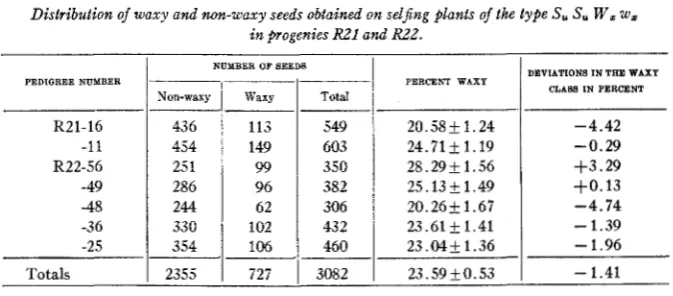
The numbers of waxy and non-waxy seeds obtained on selfing plants of the type S, S, W , W , are listed in table 1. These are to be compared
with the ratios in table 2 relating to sib plants of the constitution S, S,,
W , W.. The proportion of waxy seeds on the non-sugary ears is 23.59 +OS3
DIFFERENTIAL ACTION ON MALE GAMETOPHYTE 353
TABLE 2
Distribwtion o j waxy and non-waxy seeds obtained on seljing plants of the type S, su W , W ,
in progenies RZla and RZ2a.
NUMBER OF SEEDS
PEDIQREE NUMBER ___ ~ ~ PERCENT WAXY
DEVIATIONS IN TEE WAXY CLAW I N PmRaWF
1
Non-waxyI
Waxy1
Total1
RZla-15- 14
- 5
- 4 -23 R22a- 9 -11 - 14
- 14 -20 Totals
"
482 357 355 258 388 260 357 298
2 74 325 3354
"
~-
11399
-6.01 18.99k 1.20
595
-5.25 19.75k1.45
405 80
-
11.44 13.56k1.64317 43
- 11.88 13.12k1.58
343 45
-
13.37 11.63k1.45404 47
-2.38 22.62k1.59
336 76
-7.38 17.62k1.35
47 1 83
-1.33 23.67k1.59
338 80
-4.96 20.04k1.39
444 89
-3.29 21.71k1.37
456
755 4109 18.37k0.46 -6.63
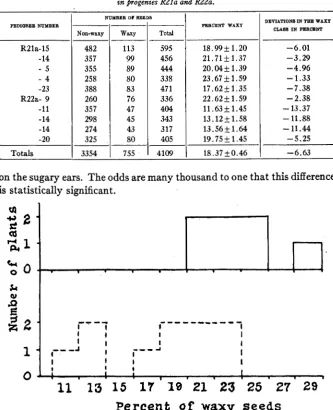
on the sugary ears. The odds are many thousand to one that this difference is statistically significant.
tn
e
l 4cd
pc
k
0
+3
k
S
2 2 -
l "
" l I I I I
"""_""
tI
I
I I I
1
-
O d !
l"" l I"- I
I I 1 I
I a
1 1 I
1 I
11
13
15
l7
19
21
23 25
27
2 9
Percent
o f
waxy
seeds
FIGURE 1.-Frequency distributions of plants, with respect to percent of waxy seeds produced on s e l h g in the non-sugary progenies R21, R22 (solid line) and the sugary progenies R21a and R22a (broken lime).
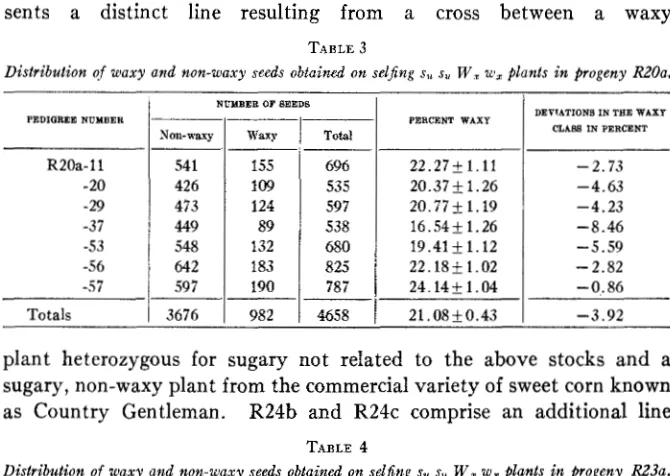
In tables 3, 4 and 5 the results obtained with three other sugary stocks are presented. Progeny R20a was grown from some sugary seeds on the original ear from which the families R21 and R22 were directly descended,
354 R. A. BRINK AND C. R. BURNHAM
the latter being once removed by self-pollination. Progeny R23a repre- sents a distinct line resulting from a cross between a waxy
TABLE 3
Distribution of waxy and non-waxy seeds obtained on selfing ss S,, W , z', plants in Progeny B o a .
NUMBER OF SEEDS
PEDIQREE NUMBER ____ _____ ___ PERCENT WAXY DEVIATION8 IN TEE WAXY CLASS IN PERCENT
Non-waxy
I
WaxyI
TotalR20a-l1
190 597
-57
183 642 -S6
132 548 -53
89 449
-37
124 473 -29 109 426 -20 155 541
3676 982 Totals ~ _ _ _ 696 535 S97 538 680 825 787 4658 22.27k1.11 20.37k1.26 20.77k1.19 16.54k1.26 19.41k1.12 22.18k1.02 24.14k1.04 21.08k0.43 -2.73 -4.63 -4.23 -8.46 -5.59 -2.82 -0.86 -3.92
plant heterozygous for sugary not related to the above stocks and a sugary, non-waxy plant from the commercial variety of sweet corn known as Country Gentleman. R24b and R24c comprise an additional line
TABLE 4
Distribution of waxy and non-waxy seeds obtained on sdjing S,, su W , W , plants in Progeny R23a. I NUMBER OF SEEDS l
PEDIQREE NUMBER ___
Non-waxy
R23a- 4 - 6 283 334 -20 330 -12 282 -40 256 -37 470 -36 350 -34 429 -29 306 -27 445 -22 334 -21 316 -18 373 -17 201 -13 476 -11 362 - 8 413 - 7 553
Totals 6513
Waxy 75 145 115 66 131 45 127 69 86 111 59 118 85 100 75 74 70 97 1648 Total
PERCENT WAXY
358 698 20.95k1.54 22.5151.41 43 1 17.5051.46 400 20.79k 1.55 356 22.66k1.60 331 17.54k1.22 570 19.54k1.40 435 21.5751.25 547 16.16k1.53 365 19.96k1.24 556 20.48k1.42 420 17.92k1.49 385 25.4051.31 500 18.29k1.86 246 21.58k1.18 607 15.42k1.41 428 21.78k1.27 528 20.7751.10
8161 20.1950.32
DEVIATIONS IN T E 3 WAXY C L A S I N PERCENT
-4.05 -4.23 -3.22 -9.58 -3.42 -6.71 +0.40 -7.08 -4.52 -5.04 -8.84 -3.43 -5.46 -7.46 -2.34 -4.21 -7.50 " -2.49 -4.81
differing markedly in habit of growth, time of maturity, shape and size
DIFFERENTIAL ACTION ON MALE GAMETOPHYTE 355
As compared with expectation on the Mendelian basis the selfed ears in progenies R20a and R23a show deficiencies in the waxy class of 3.92 & 0.43 percent and 4.81 kO.32 percent respectively. Families R24b and R24c
TABLE 5
Distribution of waxy and non-waxy seeds obtained on selfing S,, S,, W , W. plants i n progenies RZ4b
and RZ4c.
PEDIQREE NUMBER
R24b-2 -5 -6 R2k-9
Totals
I NUMBER OF SEED8
Non-waxy
330 295 242 145
1012 ~~
"
Waxy Total
53 383
27
156 11
276 34
322
125 1137
"
PERCENT W A X Y DEVSATIONS I N TEE W A X Y CLA88 I N PEBCENT
13.84k1.49
-
17.95 7 . 0 5 k 2 . 3 4-12.68 1 2 . 3 2 2 1 . 7 6
- 16.61 8 . 3 9 k 1 . 6 3
-11.16
10.99k0.87
-
14.01are especially noteworthy as exhibiting a much larger discrepancy in the waxy ratio; in this case but 10.99 kO.87 percent of the seeds fall in the recessive class.
1
Q
1
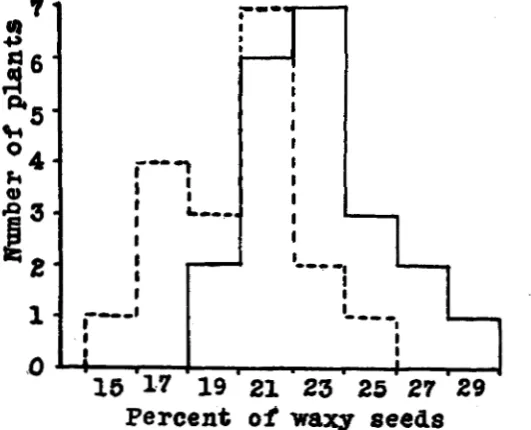
FIGURE 2.-Frequency distributions of plants, with respect to percent of waxy seeds produced on s e h g , in the non-sugary progeny R23 (solid line) and the sugary progeny R23a (broken line).
While these latter values cannot be measured against distributions from sib S, S, W , W, plants their significance may be judged by the
results obtained with corresponding stocks heterozygous for both sugary
356 R. A. BRINK AND C. R. BURNHAM
and waxy which we shall discuss in detail below. The data from the double heterozygous plants given in tables 14, 15 and 17 show-if we may anticipate a conclusion to be established later-that there is little if any difference in the waxy ratio after self-pollinating comparable plants of the constitutions S, S , W , W, and S , S, W , W = . The non-sugary progenies
under consideration are designated R20, R23, R24 and R24a. The percentages of waxy seeds found on self-pollinated ears in these groups are 22.88 f0.53, 22.92 50.29 and 22.51 50.43 respectively. The sugary progeny R20a yielded 1.80 i-0.68 percent fewer waxy grains than the corresponding R20 family which carried the non-sugary factor. The difference in this case is not demonstrably significant but it will be re- called that in the previous year progenies R11 and R13, of which R20a and R20 are duplicates, 'showed a difference in the same direction in the
2'1 . 29 31.
Percent
of
waxy seedsFIGURE 3.-Frequency distributions of plants, with respect to percent of waxy seeds produced
on selfing, in the non-sugary progenies R24 and R24a (solid line) and the sugary progenies R24b and R24c (broken line).
proportion of waxy grains amounting to 5.98 0.73 percent. Comparison of the ratios in R23 and R23a shows 2.73f0.43 percent fewer waxy grains'on the sugary ears. 'Such a difference would be expected to occur
as a matter of chance in only 1 case in several thousand trials. The odds are overwhelming in the case of the R24 families that the sugary homozy- gotes produce a smaller proportion of waxy seeds; the difference here amounts to 11.52 50.97 percent. The relations between the waxy ratios in sugary and non-sugary plants in the R21, R22 and R23 groups are shown graphically in figures 1, 2, and 3.
DIFFERENTIAL ACTION ON MALE GAMETOPHYTE 357
presumably, to variations in the residual inheritance. Apparently differ- ences also arise through changes in the environment as demonstrated by the results with the same material grown under the pedigree numbers R11, R13 one year and R20, R20a another. While the difference in the waxy ratios in corresponding sugary and non-sugary stocks in one of the above cases is not clearly significant when examined statistically, there are no exceptions to the rule that the proportion of waxy seeds on the sugary ears is lower; the additional evidence provided by other com- binations to be discussed below leaves little room for doubt, however, as to the existence of a real difference between the sugary and non- sugary classes in each of these groups. That the differentiating agent is the sugary gene itself and not some factor associated with it appears probable from the relative regularity in a given stock with which the low waxy ratios follow the sugary gene; this is especially evident in the R24 progenies where the difference is large. This argument finds additional support in the fact that the relationship holds in three pedigreed lines differing in origin.
EFFECT ON THE WAXY RATIO OF THE COMPOSITION OF THE PISTILLATE PARENT WITH RESPECT TO THE SUGARY GENE
In determining the mode of action of the sugary gene in modifying the waxy ratio it is important to know, in the first place, if the effect of the sugary factor is exerted through both the pistillate and staminate parents or in one of these only. On self-pollination, S, S, W , W, plants give a
significantly lower waxy ratio than comparable S, S, W , W, individuals.
Conceivably the large deficiency of waxy seeds in the former case might be the result of a less effective development of S, W, male gametophytes
as compared with S, W , gametophytes. Does the sugary gene contribute
to this deficiency through some effect in the style of the plant or wholly through its action in the pollen? To test this matter crosses were made with a view of studying the effect of the sugary gene in the pistillate and staminate parents separately.
The first of these combinations to be considered is of the type S, sU
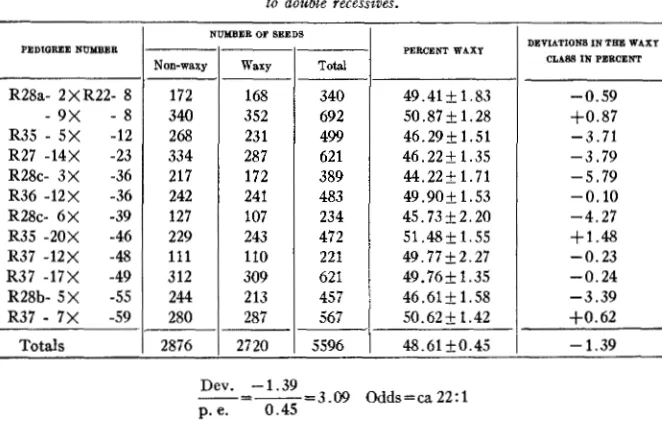
W, W, 0 XS, S , W , W, 3 , the pistillate parent only, carrying the sugary gene. Twelve ears were obtained on applying the pollen of S, S, W , W, plants in progeny R22 to double recessive individuals from 5 different stocks. Table 6 shows the distributions resulting. The average proportion of waxy seeds on these ears was 48.61 percent or 1.39 k0.45 percent in defect of Mendelian expectation. While this is possibly a significant departure from a 1 : 1 ratio it is very similar to the result formerly obtained
358 R. A. BRINK AND C. R. BURNHAM
(BRINK 1925) in a group of 75 ears from the cross S, S, W , W , 9 XS, S ,
W , W , 8. In this latter population 48.25 20.19 percent of the seeds were waxy. It appears, therefore, that the sugary gene acting in the pistillate parent alone does not increase the disparity in the waxy ratio.
Some further evidence on this point is afforded by the following matings. The pollen of a single S, S , W ,
wz
plant, R22-12, was applied to two waxy plants homozygous for sugary and non-sugary respectively. Of the 454 seeds borne on the ear of the sugary individual, 46.92 L- 1.58 percent were waxy; the ear on the non-sugary plant produced 499 grains of which 46.29k 1.51 percent were waxy. The difference, 0.63 k2.18 percent, is certainly not significant. The pistillate individuals used were unrelated.TABLE 6
Distribution of waxy and non-waxy seeds obtained on applying pollen of S, S, W , W , plants in R22
to double recessives.
PEDIQREE NUMBER
R28a- 2XR22- 8 - 9 x - 8 R35 - 5X -12 R27 -14X -23
R28c- 3X -36 R36 -12X -36
R 2 8 ~ - 6X -39 R35 -2OX -46
R37 -12X -48 R37 -17X -49 R28b- 5X -55 R37
-
7X -59Totals
Non-waxy
172 340 268 334 217 242 127 229 111 312 244 280
NUMBER OF 0EED0
-___ ~Waxy _ Total _ _
168
567 287 45 7 213
621 309
221 110
472 243
234 107
483 241
389 172 62 1 287
499 23 1
692 352
340
PERCENT DEVIATION8 I N TEE W A X Y
CLAW I N PEUCENT
49.41k1.83
+0.62 50.62C1.42 -3.39
46.61k1.58
-0.24 49.76C 1.35
-0.23 49.77C2.27
+1.48 51.48rt1.55
-4.27 45.73k2.20
-0.10 49.901k1.53
-5.79 44.22+1.71
-3.79 46.22k1.35
-3.71 46.29rt1.51
+0.87 50.8751.28
-0.59
"
Dev. -1.39
p. e. --=3..09 0.45 Odds=ca22:1
Four S , S , W , W , plants in R22 were self-pollinated and pollen from them
was also used on S, S, W , W , individuals of diverse breeding. The results
DIFFERENTIAL ACTION ON MALE GAMETOPHYTE 359
combination is 0.405 percent lower than when the pistillate parent is non-sugary. The standard deviation of the differences between the paired values, however, is 3.285 percent. This gives a value for z of 0.123. One finds on consulting STUDENT'S (1915-17) table that the odds corresponding
TABLE 7
The combinations, S, S , W , W , selfed, and S,S, W , w,O XS, S, W , W , $ , with four R& plants used as pollen parents.
8% w z W z EELFED au au wz W Z O xsu su W, W= 2
P d i
number n on-
3
Total1
Pedigree Non-
1
Total Percent I m m D ENCEAD- DIFFER-
waxy seeda Percent number waxy seeds W a y PEE- 2-1
9
seeds B Waxy d B CENT
""
R22-56
"0.25 24.88 62149.76k1.35 312309
R37-17XR22-49 38225.13k1.49
96 286 -49
-4.49 23.80 60747.61k1.37 289 318
R36-13XR22-56 35028.29k1.56
99 251
-48 62 244 30620.26zt1.67 R37-12XR22-48 221 110 111 49.77k2.27 24.88 +4.62 -36 330102 43223.61k1.40 R28~-3XR22-36 217 172 38944.22k1.71 22.11 -1.50
""
_"
Totals 1111 1470 359 24.42+0.88 Totals
"
958 880 183847.88k0.79 23.94 -0.405
M d 0.405
U d 3.285
z=-=" -0.123 Odds=ca1:1
are about 1 to 1. In other words a difference of this magnitude might be expected to occur in one-half the trials as a result of pure chance.
In the above crosses the S , S, w z w z and S, S, w z w z stocks used as
pistillate parents were not of similar breeding. The criticism might be offered, therefore, that extraneous genetic factors may have obscured a difference arising through the action of the sugary gene in the pistillate
TABLE 8
Distribution of waxy and non-waxy seeds on applying pollen of pwo S, S, W . W . planh in R22 to
su S, W . W . sibs in R2Za.
PSDIQBEE NUYBEE
R22a-10XR22-62 R22a-12XR22-59
Totals
NLIMBEE OF BEDM
" PEBCENT WAXY DEVIATIONB IN TEE WAXY
CLAW M PEBCENT
Non-waxy
I
WaxyI
Total334
-
1.78 23..22+1.0085 7 199
658
-3.45 21.55k1.44
413 89 324
24.77k1.39 444
110 -0.23
"
individual. The general regularity of the results presented, however, entitles us to considerable confidence in our conclusion.
There is one further bit of evidence, free from the objection noted, which makes it increasingly probable that sugary in 'the pistillate member of a
360 R. A. BRINK AND C. R. BURNHAM
pair only does not lower the waxy ratio. Pollen from two S, S, W , W ,
plants in R22 was applied to S, S,, W , w z sibs in R22a. The resulting distri-
butions are presented in table 8. The percentage of waxy seeds given in these crosses may be compared with that resulting on self-pollinating non-sugary waxy heterozygotes in progeny R22 as listed in table 1. While the same individuals were not used as pollen parents in the two combinations all the plants used were sibs. S , S , W , W , selfed yielded 24.42 kO.88 percent waxy seeds whereas the cross S, S, W , W , o XS, S ,
W , W , 3 gave 23.22
k
1.00 percent waxy grains. The difference 1.20+ 1.33 percent is clearly not significant.We shall next examine the results afforded by combinations of the types
S, S , W , W , o Xs, S, W , W , 3 and S, S, W , W , o Xs, S, W , W, 8 with a
TABLE 9
Distribution of waxy and non-waxy seeds on applying pollen of .S S. W , W , plants in families &'la
and RZZa to S, S, W , W , and S. S, W , W , stocks respectively.
I
I
S, s u wz w,o I I 8, wz wzQI
-
POLLEN PARENT
6
8
S
"
R21a
2E Totals
l5 R22a
13
"
"
-I---
3618
13229 5057 8172
6897 2343 4554
6332 2714
~"
~"
-1-
- ~ _ _ ~
5
Percent waxy W a x y Total waxy
g Non-
4
Z
42.86k0.42
2758 982 1776 7 38.23
1766 642 1124 4 33.97+0.41
992 340 652 3
""
""
""
DIFFER-
Percent waxy ENCE
34.271-1.07 -8.59
3 6 . 3 5 k 0 . 8 0 f 2 . 3 8
35.61
l-
-3.10z = " =
" M d "3.10
U d 5.484 -0.565 Odds=ca2:1
view of determining whether the composition of the pistillate parent with respect to the sugary gene exerts a material action when the waxy and non-waxy pollen comes from a sugary plant.
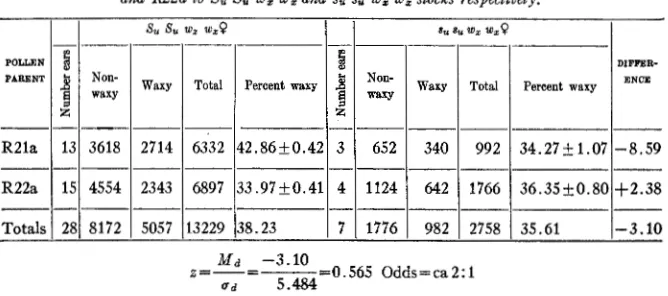
I n table 9, the results of applying the pollen of S, S, W , W , plants in
families R21a and R22a to S, S , W , W , and S,, S, W , W , stocks are shown in
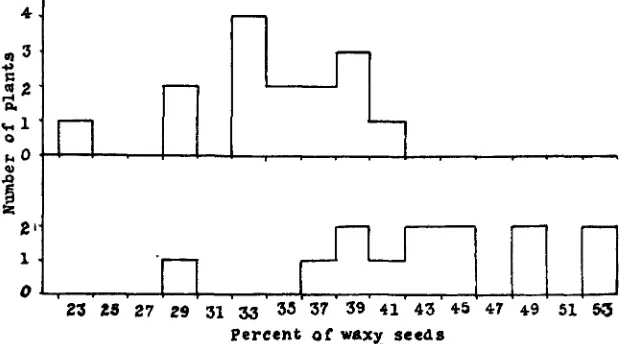
summary form. Distributions on individual ears are given in table 10 and 11 and plotted in figure 4.
It will be noted first in table 9 that there is a clearly significant departure from Mendelian proportions in each of the four groups. The deficiencies range from 7.14k0.42 percent to 16.03k0.41 percent, these extremes being shown when the pollen of R21a and R22a, respectively, is applied to S, S, w2 W , plants. The individuals in progenies R21a and R22a
DIFFERENTIAL ACTION ON MALE GAMETOPHYTE 361
was used were of diverse breeding. Why the R21a combinations with S,
S,,
w z W , plants regularly gave a higher .proportion of waxy seeds thandid the same type of cross where R22a was involved, we cannot say. Possibly the two stocks, in spite of their close relationship, differ in regard
TABLE 10
Distribution of waxy and non-waxy seeds on single ears following application of pollen from s,,suWIwI plants in RZla and RZZa to S&wIw. stock.
FTIDIQREE NUMBER
R25a-27XR2la- 6
. -31X - 4 -23X - 5
- 6 X - 9
- l x
- 9 -14X -23R25c-lOX -11
-
6X -14-
1 x -14- 1 x -23
S38 -28X -11
-135X -14
-160X -25
Sub-totals R25a-l1 XR22a- 9
- 8X - 9 -18X -14
R25c-20X -11
-12x -11 -
7x
-11- 4X -14 S38 -62X
-
3 -98X - 3- 2 x - 5
-14X - 9 -95x -10
- 2 x -11 -26X -24
-26X - 9 Sub-totals Totals
N 0 n - m ~
215 226 214 205 271 196 315 333 2 79 368 326 303 367 3618 263 214 243 352 241 377 407 302 402 345 264 222 293 328 301 m 4554 8172
DEB OF SEI
Waxy 235 217 161 153 188 223 251 132 177 226 303 241 207 2714 146 137 120 103 163 153 165 178 191 168 156 148 148 171 196 2343 5057 l Total 450 443 375 358 459 419 566 465 456 594 629 544 574 6332 409 351 363 455 404 530 572 480 593 513 420 370 441 499 497 6897 13229
PERCENT WAXY
52.22k1.59 48.98k1.60 42.93k1.74 42.74k1.78 40.96k1.57 53.22k1.65 44.35k1.42 28.39k1.56 38.81k1.58 38.05k1.38 48.17k1.34 44.30k1.45 36.06k1.41 42.86k0.42 35.70k1.67 39.03k1.80 33.06k 1.77 22.64k1.58 40.35k 1.68 28.87k1.46 28.85k1.41 37.08k1.54 32.21k1.38 32.75k1.49 37.14C1.65 40.00C1.75 33.56k1.61 34.27k1.51 39.44k1.51 33.97C0.41 38.23
DEVIATION IN TEE WAXY
CLAW IN PERCENT
+2.22 -1.02 -7.07 -7.26 -9.04 +3.22 -5.65 -21.61 -11.19
- 11.95
- 1.83 -5.70
-
13.94-7.14 -14.30
-
10.97-
16.94 -27.36-9.65 -21.13 -21.15
-
12.92 -17.79 -17.25- 12.86
- 10.00
-
16.44 -15.73-
10.56- 16.03 -11.77
to some accessory factors which, under certain conditions, markedly affect the waxy ratio. The anomolous value shown by the R21a group in the one combination makes.the entire body of data difficult to interpret. We cannot justifiably apply the ordinary probable error formula to the
362 R. A. BRINK AND C. R. BURNHAM
totals from the S , S, W , W , matings since the distributions on ears re-
sulting from R21a and R22a pollen clearly do not form a homogeneous
Percent of wax2 seeds
FIGURE 4.-Frequency distributions of plants, with respect to percent of waxy seeds produced in the backcross S, S, W , W , 0 XS, su W , W,#. The polygons above relate to the ears obtained
on using pollen from progeny R22a and those below to the ears resulting from the application
of pollen from the sib progeny R21a.
group. If we compare the results obtained on crossing each of the stami- nate groups with the two respective pistillate stocks we find, in the case of R21a, that the S, S, w z W, combination shows 8.59f 1.15 percent fewer
TABLE 11
Distribution of waxy and non-waxy seeds on single ears following application of ~ollenfroms,.s,W.w.
PEDlQREE NUMBER
R37 -10XR2la- 8 -16X - 9 R28 - 2X - 8
Sub-totals R28 - 4XR22a-14
R28b- 8X -24
-lox
-25-17x - 5 Sub-totals Totals _.
plants in R21a and R2Za to s,s,w,w, stocks.
NUMBER OF DEED8
~ _ _ _ DEVIATION I N T E E ~ W A X Y PERCENT
Non-waxy Waxy Total CLAM IN PERCENT
"" -____
162
- 18.50 31.50+1.50
508 160
348
- 13.39 36.61k2.25
224 82
142
- 12.31 37.69k2.09
260 98
"
652
-13.65 36.35+0.80
1766 642
1124
- 7.18 42.82k1.74
376 161
215
-20.48 29.52k1.85
332 98 234
-13.19 36.81k1.40
576 212 364
- 14.52 35.48k1.54
482 171
311
34.27k1.07 992
340
"- - 15.73
"
-1776
1
9821
2758-I
3.5.61I
-14.39~~
DIFFERENTIAL ACTION ON MALE GAMETOPHYTE 363
difference in the opposite direction of 2.39
k
0.90, which, however, might be due to chance.Evaluation of these data by STUDENT'S method shows that it would be unsafe to conclude that a significant difference in the waxy ratio incident upon a difference in composition of the pistillate plants is indi- cated here. The last column in table 9 shows that the average difference in percentage of waxy seeds in the two types of crosses is -3.10. But the standard deviation of the differences is 5.48 giving z the low value of 0.565. This value of z corresponds to a probability of only 1.86: 1 that the ratio is actually lower in the case of the su su W , W, combination.
Considering the facts as a whole, a definite conclusion that a significant difference is or is not shown seems unwarranted. It should be emphasized, however, that the proportions of waxy seeds in both types of crosses are, on the average, markedly lower than those observed when pollen of
S , S , W , W , plants is employed.
TABLE 12
Distribution of waxy and non-waxy seeds on applying pollen of the same susuWzwz plants from
R21a and R22a to both SuSuwzwz and ~ ~ ~ ~ w ~ w ~ s t o c k s .
S,
Pedigree number
"
R25a- 6XR21a- 9
- 1XR2la- 9 S38 - 2XR22a- 5 R25a-18XR22a-14 R25c- 4XR22a-14 S38 - 26XR22a-24
Totals
" - "_
"_
Non- Percent
W S Y B waxy
205 153 358 R37 -16XR21a- 9
271 188 459 40.96
}
345 168 513 32.75 R28b-17XR22a- 5
243 120 363 R28 - 4XR22a-14
407 165 572 28.85
1
328 171 499 34.27 R28b- 8XR22a-24
L799965276434.91k0.64
9
Total Pedigree number-"
42.74 41.73
33.06 30.48
-"
-1-
"
1
DIFFEB-
Non- 2 Percent ENCE w a y
5
waxy142 82 22436.61 -5.12
.-
l
a
, I I I
z="--=-- M d +3.12
U d 5.478
-0.569 Odds ca4:l
215 161 37642.82 +10.07 311 171 48235.48 4-5.00
364212 57636.81 +2.54
032 626 1658 37.76 4-3.12 5 0 . 8 3
The data assembled in table 12 furnish somewhat more critical evidence on the question at issue. In this group of crosses pollen from single su su W , W , plants was applied to both pistillate types. This enables us to
eliminate any major variation occasioned by the staminate parents. Again, however, the homogeneity of the data is doubtful and the use of the ordinary probable error formula in the case of the totals is of question- able value. A more reliable measure of the significance of the deviations shown is afforded, perhaps, by the pairing method and consideration of the average difference in relation to the standard deviation of the differ-
364 R. A. BRINK AND C. R. BURNHAM
ences. As shown in the last column of table 12 the average difference in percent of waxy seeds following crosses with the two types of pistillate individuals, is 3.12, the ears borne on the double recessive plants giving the higher ratio of waxy grains. It will be noted that the sign of the net difference is opposite to that in the case considered above. The standard deviation of the differences is 5.478 percent giving a value of z of 0.569. The corresponding odds are about 4: 1 ; or in about 1 trial in 5 we should expect such a difference to occur by chance. These data afford no evidence, therefore, of a difference in the waxy ratio when S, S, W , W , plants are
crossed with sugary and non-sugary pistillate stocks.
Summarizing the results of the experiments on the effect of the sugary gene in the pistillate member of a pair on the waxy ratio we find:
1. When pollen from a non-sugary plant heterozygous for waxy (S, S , W , W , ) is applied to the double recessive (S, S, W , W , ) a small deficiency in the waxy class amounting to about 1.5 percent occurs. This discrepancy in the waxy ratio is no greater than that found in W , W , o X
W ,
W , 3 crosses not involving the sugary factor.2. The combination S, S, W , W , o XS, S, W , W , 3 gives a large de- ficiency in the waxy class of roughly
15
percent.3. The cross S , S , W , W , o XS, S, W , W , 8 likewise results in a large minus deviation in the waxy class of about 15 percent.
The sugary gene in homozygous condition in the pistillate member of a pair only does not, therefore, depress the waxy ratio. When the polle, parent is homozygous for the sugary factor (S, S, W , W , ) a large deficiency
of waxy seeds results in combinations with waxy plants whether these be sugary or non-sugary. These findings point to the conclusion that the sugary gene exerts its disturbing influence on the waxy ratio through some action on the pollen and that the composition of the pistillate member of a mating with regard to this factor is of little, possibly no significance
ADDITIONAL EVIDENCE FROM BACKCROSSES THAT THE SUGARY GENE DEPRESSES THE WAXY RATIO
Twelve ears were obtained on applying pollen from R23a (S, sy W , W = )
to S , S , W , W , plants. The distributions of waxy and non-waxy seeds on
DIFFERENTIAL ACTION ON MALE GAMETOPHYTE 365
In contrast with these results from sugary plants in R23a we find, as shown a t the end of table 18, an average of 47.1610.97 percent waxy seeds on two ears following the application of pollen from S, S,
W ,
W ,TABLE 13
Distribution o j waxy and non-waxy seeds on ap#lying pollen o j s,,s,W,w, plants in R23a to SJUw.w.
PEDIGREE NUMBEB
R25a-18XR23a- 7
-
4 x -11 -13X -16-26X -17 -12X -36
-15x -37 R25b- 4X -13 R25c- 3X -21
-17X -21 -18X -29 -23X -34
R25d- 1X
-
4 Totalsindividuals.
N 0 n - m
"
229 266 211 180 256 194 287 254 255 323 349 399 3203
NUMBER OE BEEDE
waxy
160 171
85
150 121 67 135 163 141 221 267 117 1798
Total
389 43 7
296 330 377 261 422 417 396
544
616 516 5001
PERCENT W A X Y
41.13f1.71 39.13fl.61 28.72k1.96 45.45k1.86 32.10k1.74 25.67k2.09 31.99k1.64 39.09k1.65 35.61k1.69 40.62k1.45 43.34k1.36 22.67k1.48 35.9550.48
DEVIATION IN TEW WAXY CLAM IN PERCENT
-8.87
-
10.87 -21.28-4.55
-
17.90 -24.33 -18.01 -10.91-
14.39-9.38 -6.66 -27.33
-
14.05plants in R23 to double recessives. Similarly two ears obtained on apply- ing R23 pollen to R23a plants, a combination of the type S, su W , W , o
XS, S, W , W , 8, contained 26.16 1 1.19 percent waxy grains (table 16). The progenies R23 and R23a are of different breeding than any of the other stocks used as pollen parents in these experiments and it is important to have this confirmatory evidence that the sugary gene operates to depress the waxy ratio in this group as in the other cases discussed.
THE WAXY RATIO I N THE SUGARY AND NON-SUGARY CLASSES FOLLOWING THE USE OF THE DOUBLE HETEROZYGOTE, S, S, W , W,,
AS THE STAMINATE PARENT
I t has been shown above that waxy heterozygotes, homozygous for the non-sugary gene, when used as male parents with the double recessive type give approximately 48 percent of waxy seeds; waxy heterozygotes homozygous for sugary, on the other hand, in combination with the same pistillate form produce only about 35 percent of waxy grains. If the sugary gene exercises its initial differential effect in the male gametophyte after this has become independent of the parent sporophyte, that is, in the mature pollen grain or in the pollen tube, we should expect, following the
366 R. A. BRINK AND C. R. BURNHAM
cross S, S, W , W , o XS, su W , W, 3 , about 48 percent waxy seeds in the non-sugary class and 35 percent in the sugary group. The double hetero- zygote used as the staminate parent produces, of course, four classes of pollen grains, namely, S , W,, S , W,, S, W, and S, W,. The first two types
correspond to those formed by S , S , W , w z plants and the other two classes are identical, so far as nuclear composition is concerned, with the
TABLE 14
Distribution of waxy seeds i n the sugary and non-sugary classes on selfing double heterozygotes i n
PROQENY NUMBER
R20- 1 - 2 -12
- 13 -22 -23 Sub:totals R21- 2
- 3 - 5 - 9 -24 -32 -37 -61 Sub-totals
R22- 1 -26
-45
-47 Sub-totals
progenies RZO, El, and R2Z.
NON-BUQARY
l
Non- waxy
2
h
231 68 299
292 78 370
333 120 453 252
77 430 353 98 351 253 76 328
1714 517 2231 463 163 626 338 126 464 214 71 285 211 79 290 297 100 397
252 88 340 349 126 475 248 79 327 2372 832 3204
109 39 148 341 93 434 243 64 307 210 64 274 903 260 1163
Total " -" -" -" -" -"- l- Percent waxy Non-
waxy
I- 22.74k1.69 84 21.08k1.52 102 26.49k 1.37 128 23.18k1.61 90 27.92k1.56 86 17.91k1.411 128 23.17k0.62 618 26.04k1.17 157 27.16k1.36 102 24.91k1.73 73 27.24k1.71 78 25.19k1.47 90 25.88k1.58 82 26.53k1.34 123 24.16k1.61 68 25.97k0.52 773 26.35k2.40 5 0
21.43k1.40 113 20.85k1.67 92 23.36k1.76 72 22.36k0.86 327
Waxy 21 42 26 19 33 34 175 53 26 17 18 36 25 39 30 244 10 35 28 26 99 -
-
-
-
- SUGARYTotal Percent waxy
105 144 20.00k2.85 20.99k2.29 162 27.73k2.68 119 17.43k2.80 109 16.9912.35 l54 29.17k2.43
793 22.07k1.04 210 25.24k2.01 128 20.31k2.58 90 18.8923.08 96 18.75k2.98 126 28.57k2.60 107
24.07k2.29 162
23.36 k 2.82
-l
98 30.61k2.95 1017 23.99k0.9260 26.53k2.95 98 23.33k2.67 120 23.65k2.40 148 16.67k3.77
426 23.24k1.41 DIPIER- ENCE -2.74 $8.09 -9.50 -5.75 -0.19 $3.08
-
-0.80 -6.85 -6.02 -8.49 "3.38 -2.52 -2.46 "6.45-
-
-9.68 +2.22 +2.48 $3.17 - - 1.45pollen formed by S, S, W , w z individuals; if genetic constitution of the
gametophyte alone is the determining factor the double heterozygote should give markedly different waxy ratios in the sugary and non-sugary classes. I t is a remarkable fact that such a difference does not eventuate. Ears from the cross S, S, Wow, p xS, S, W , W , 3 or from self-pollinated
S,
S, W, W , individuals show about the same proportion of waxy seedsDIFFERENTIAL ACTION ON MALE GAMETOPHYTE 367
A considerable body of evidence has been accumulated bearing on this relation for the point is an important one. STUDENT’S method of analysis lends itself admirably to the evaluation of these data, where correlation exists between the ratio of waxy seeds in the sugary and non-sugary classes from single ears, and has been employed throughout. The pairs formed consist, naturally, of the percentages of waxy seeds in the two respective
TABLE 15
Distribution of waxy seeds in the sugary and non-sugary classes on selfing double heterozygotes in
Progeny R23.
PBOQENY N U M B E R
R23- 5
- 7 -11 - 3 -18 -20 -25 -29 -32 -34 -36 -33 -41.5 -43 -49 -5 7 -12
- 14 -5 1 -52 -59
Totals
I
NON-SUQARTI
EUQART INOD-
I
Waxy
1
Total waxy245
424 103 321
401 92 309 264 60 204 316 71
~ 350 93 443
i 305 101 406 362
382 83 299 472 90 382 411 118 293 341 81 260 460 98
238 86 324
1
311 103 414 194 60 254 235 66 301 254 70 324 215 60222 49 173
230 49 181
168 52 116
275
5552 1698 7250
305 418 113
”
-Percent waxy waxy Non-
22.47k1.64 143 22.73k1.80 76 22.94k1.46 50 22.07k1.96 54 21.3051.93 55 30.95k2.25 69 21.82k1.76 68 21.60k1.62 97 21.93k1.68 93 23.62k1.83 124 24.88k1.43 90 26.54k1.62 108 27.0351.43 102 21.73k1.49 145 19.07k1.34 125 28.71k1.44 86 23.75k1.58 125 21.3051.36
1 0 0
24.88k1.45 114 20.99k1.39 104 24.29f1.42 109
5
I
Total”
40 24
183
68 18 70 16 72 17 80 11 86 18 119 22 103 10 161 37
105 15 149 41 122 20 188 43 160 35 115 29 159 34 128 28 152 38 135 31 141 32 100
23.42+0.341 2037 15591 2596
Percent waxy DIFFERENCE
21.86k2.16 -0.61 24.00k2.92 +1.27 22.67k2.46 -1.33 22.96k2.51 -0.27 25.0052.37 +0.08 21.38k2.32 +4.01
25.22k2.72 +1.47 22.87k2.13 +3.80 27.52k2.39 +0.49 14.29k2.85 -12.25 22.98k2.30 -1.90 9.71k2.88 -13.91 18.49k2.68 -3.44 20.93k3.15 -0.67 13.75k3.26
-7.34 23.61k3.44
-8.07 21.87k2.58 -3.01
21.87k2.31 -6.84 16.39k2.64 -5.34
22.8653.49 +4.40 26.47k3.54
+1.56
”_
21.53k0.57 -2.281 z=“-=--” M d -2.281
U d 4.938
-0.462 Odds=34:1
classes on ears segregating for sugary. Since we are comparing two dis- tributions on the same ear we should expect fluctuations due to accessory circumstances to be reduced to a minimum affording our results a con- siderable degree of accuracy.
The first group of data to be considered comprises the distributions from self-pollinated plants of the constitution S , S, W , W, in progenies
R20, R21 and R22. These families are closely related, R21 and R22
368 R. A. BRINK AND C. R. BURNHAM
having been derived from sibs of R20 by self-pollination. The results are given in detail in table 14. In the non-sugary class 24.39 percent of the seeds are waxy as compared with 23.17 percent in the sugary group.
TABLE 16
Distribution of waxy seeds in the sugary and non-sugary classes following crosses of the type susuW,w,? XS,s,W,w,dl with RZ3a and RZ3 @ants.
PBOQENT NUMBER
1
z
i
1
Waxy
1
Total1
Percent waxy1
i
:::
1
Waxy1
TotalI- I- I I- I-I-
Totals
1
222I
72I
294 124.49i1.701 224I
86I
310I
NON%UQARYl
BUQARYPercent waxy
24.24k2.54 30.34k2.19
27.74k1.66
Examining the percentages of waxy grains in the sugary and non-sugary classes in the group of 18 ears by STUDENT'S method we find an average difference of 1.45 percent, the sugary class showing the lower ratio
TABLE 17
Distribution of waxy seeds in the sugary and non-sugary classes obtained on selling double heterozygotes in progenies RZ4 and RZ4a.
PROQENY NUMBER
R24 - 1 - 1 R24a- 1 - 5 -10 -14
-
15 -20 -24 -2 7-3 1 -34 -3 7
Totals - Non- waxy - 211 277 203 116 261 217 290 188 148 242 196 213 198 2760 __ __
NON-BUQART
I
W a w
- 61 96 45 59 85 50 57 54 36 63 48 60 61 775 - - - Total - 272 373 248 175 346 267 347 242 184 305 244 273 259 3535 __ - " " " -
Percent waxy Non- way,
22.43 k 1.77 70 25.74k1.51 18.15k1.85 65 59 23.55k1.81 68 21.78k1.77 58 19.67k1.87 44 20.66k1.67 41 19.57k2.15 55 22.31k1.88 80 16.43k1.57 63 18.73k1.79 77 24.57k1.57 38 33.7152.21 53
21.92k0.49 771
__
Waxy - 22 19 18 13 22 21 21 18 13 14 14 31 25 251 -B W Q S Y
Total - 92 84 71 51 99 84 101 73 54 58 72 99 84 .022 -
M d +2.420
z="="-
O d 4.705
-0.514 Odds=ca18:1
Percent waxy DIFFERENCE
23.91k3.04
25.49k4.09
+7.20 25.35k3.47 -3.12
22.62k3.19 +1.48
f 6 . 2 1 29.76k3.19
4-9.53 31.31k2.93
-0.23 19.44k3.44
f 3 . 4 8 24.1423.83
+4.50 24.0753.97
+2.35 24.66k3.42
f 4 . 3 6 20.79k2.91 4-6.27 25.00k3.19 -2.35 22.22k2.90 "8.22 24.56k0.91
DIFFERENTIAL ACTION ON MALE GAMETOPHYTE 369
In the unrelated progeny R23,21 S , S,,
W ,
W , plants were self-pollinated.The distributions obtained on the single ears are listed in table 15. The respective net percentages of waxy seeds in the non-sugary and sugary classes in this case are 23.42 and 21.53. The mean difference again reveals
a lower proportion of waxy seeds in the sugary class amounting to 2.281
6
5
0
&l
0,
$"
A
3
-
I
1 -
I
2 -
I"""' I
Q,
I
-
I---
1I 1 1 '
I
L"
-!L"""",
1
I l
I I
L," l I l I
17
1 9
21
23
25'
2
'
7
' 2 9
'31
Percent
o f
waxy
seeds
FIGURE 5.-Frequency distributions of percentages of waxy seeds in the non-sugary (solid line) and the sugary (broken line) classes on selfing S, su W , W, plants in progenies R24 and R24a.
percent. The standard deviation of the differences is 4.938 percent and the value of z, 0.462. I n this case the odds are about 34: 1 that the pro- portion of waxy seeds in the sugary class is significantly lower than that in the non-sugary group.
370 R. A. BRINK AND C. R. BURNHAM
A little further evidence on the behavior of progeny R23 is afforded by the results of two crosses with sib plants in family R23a. The distri- butions resulting from these combinations of the type su S, W , W , o xS,
S, W , W , 3 are given in table 16. I t will be seen that in the case of both ears the waxy ratio is higher in the sugary class, a result contrary to that afforded by self-pollinating R23 plants.
TABLE 18
Distribution of waxy seeds in the sugary and non-sugary classes obtained on backcrossing Sus,WzwI plants i n progenies R21, RZZ, and R23 to the double recessive used as the pistillate parent.
R27-11XR21-38
R36- 3X
-
9 ' 129129 R28- 7X -52
169
R38-11X -22
1
209 R38- 3X -24 1 136 Sub-totals 772 R27- 6XR22- 5l-
210 -1x
-11) 177 -15X -261 126 -13X -27173 -17X -44
183
R28- 5X -14 218 R28c-9X -30
112 R36-21X -47
60
R27- 7X -54 86 R37- 7X - 4
79
77 -18X -29
74 -17X -18
93 -19X - 7
- 3X -45 85 Sub-totals 1753
Sub-totals l 302
NON-SIIQARY ~
Waxy 162 97 137 153 100 649 170 176 141 137 168 195 56 111 101 97 66 82 60 67 1627 - - 138 154 292 - - Total 33 1 226 266 362 236 1421 380 353 267 320 341 413 116 223 180 183 159 156 137 152 3380
-
- 271 323 594 - -1
Non-"
Percent waxy
i waxy
48.9421.85 195 42.92k2.2 110 51.50k2.07,
4
118 42.27k1.77 196 42.37k2.20 133 45.67+0.89! 75249.86k1.791 192 52.81k2.06 132 42.81k1.89, 186 49.27k1.83 47.22k1.66 182
153
49.78k2.261 104 56.11k2.511 108 53.01k2.491 76 41.5112.67~ 85 52.56k2.70: 105 43.80k2.881 81 44.08k2.741 84
-
44.74k1.731 21748.27k3.131 78
48.13+0.581 1783 50.9212.051 134 47.66k1.881 207 49.16k1.38 341 -1
SUQARY
l
" Waxy 163 82 109 172 125 65 1 196 198 140 148 147 169 58 103 224 85 58 82 86 72 1766 119 163 - __. -
- 282
z=--"="- Md +0.287
U d 4.48
-0.064 Odds < 2 : 1
358 4 5 . 5 3 d -3.41 192 -3.48 48.02k2.24 227 -0.21 42.71k2.43 368 +6.08 48.45k2.10 258 +4.47 46.74k1.76 46.40+0.90 413 47.46k1.66 +2.72 390 50.77k1.71
48.15k1.80/ +0.93 351
44.3111.85 + l . S O 334
+0.91
136 42.65k2.891 -5.62 207 49.76k2.34 -0.02 332 67.47+1.85+11.36 161 52,7952,661 -0.22 143 -8.71 43.85k2.47 187 -0.95 40.56k2.82 272
49.00k1.95,
l
-0.27 300 -1.34 51.47k2.04 167 +2.07 46.15k2.70 156+7.70 51.50+2.61
~~
K 9 49.76k0.571
-l
253 47.04k2.12, -3.88 l- 3701 44.05+1.75/ -3.61 6231 45.26+1.35/A further group of selfed ears of this type was obtained in progenies R24 and R24a. The distributions are given in table 17 and shown graphi- cally in figure 5. I t will be recalled that the su su W , W , sibs of these
DIFFERENTIAL ACTION ON MALE GAMETOPHYTE 371
W , plants of the same breeding show 21.92 percent and 24.56 percent
waxy seeds in the non-sugary and sugary classes respectively. Calculating the average of the differences for the 13 selfed ears from the double heterozygotes we find that the proportion of waxy seeds in the sugary
5 5
E
4
3
- I n
2
0
Percent
o f
waxy seeds
l
nl
55 57
FIGURE 6.-Frequency distributions of percentages of waxy seeds in the non-sugary (solid line) and the sugary (broken line) classes following the combination su S,, ?U, W, $? XS, su W,
W , $ ; plants in progenies R21. R22 and R23 were used as pollen parents,
class is in excess by 2.420 percent. Since the standard deviation is 4.705 percent, z equals 0.514. This gives odds of about 19: 1 that the two groups differ significantly.
Analysis of the data afforded by the first of these three main groups of
372 R. A. BRINK AND C . R. BURNHAM
the sugary class; in the third group the difference is in the opposite direc- tion. Probably in neither of these cases, however, is the difference sig- nificant. In the second group comprising progeny R23 there does appear to be a significantly lower waxy ratio in the sugary class. Two plants in R23, numbers 41.5 and 49, show relatively large differences in proportion of waxy seeds in the sugary and non-sugary phenotypes amounting, respectively, to -12.25 percent and -13.91 percent. In view of the other findings it may be fairly questioned, in the case of these two indi- viduals, whether some other factor has not entered in to disturb the waxy ratio. If the two items are omitted the mean difference is reduced to
-
1.144 percent and the standard deviation of the differences becomes 3.648 percent. This gives z the value 0.314 corresponding to odds of but9: 1 that the difference is a significant one.
A total of 21 ears was obtained in backcrosses of the type S, su W , W , Q
XS, S, W , W , 3. The pollen parents involved in 19 cases came from progenies R21 and R22 and in the remaining 2 cases from R23. The double recessive pistillate individuals used fall into 3 groups. Progenies R27, R28, R28a, R28b and R36 have a common origin identical with that of R21 and R22; R28c and R37 belong to distinct lines. If there is an inherent difference in the effectiveness of the four classes of male gameto- phytes arising from S , su W , W , plants we should expect it to be manifested
in these backcrosses. The distributions from single ears are presented in table 18 and shown in the form of frequency polygons in figure 6. Examination of the group as a whole shows a remarkably close agreement in the ratio of waxy seeds in the sugary and non-sugary classes; the non- sugary group has a net percentage of 47.60 waxy grains and the sugary group, 48.41 percent. When examined by STUDENT’S method the sugary class is found to have on the average, 0.287 percent fewer waxy grains, a difference which is clearly not significant in view of the standard devia- tion of the differences which amounts to 4.48 percent. The value of z
is only 0.064 and is below the range of STUDENT’S table of odds. The chances are less than 2: 1, therefore that the difference is a significant one.
THE SUGARY RATIO WHEN S , .Su W , W, PLANTS ARE USED
AS STAMINATE PARENTS
If there were a tendency for S,, W , male gametophytes to be handicapped
to a greater extent than the other types of gametophytes arising from S, S, W , W , plants we should expect a deficiency in the sugary class as
well as in the waxy in S, S, W , W , o XS, S, W , W , 8 and S, S, W , W , o XS,