Analysis of Risk Factors Development of
Height Residential Building Development
Projects in DKI Jakarta to Improve Project
Quality Performance
Manlian Ronald. A. Simanjuntak1), Ade Novannius2)
Professor of Construction Management, Universitas Pelita Harapan, Jakarta, Indonesia1 Student of Magister of Civil Engineering, Universitas Pelita Harapan, Jakarta, Indonesia 2
ABSTRACT:Construction is a project that has a relatively high risk potential, compared to non-construction work such as manufacturing. The magnitude of the potential encountered, causing the contractor must find a way to deal with risks in order to achieve the expected quality objectives of the construction. Residential high rise buildings have special risks to be anticipated from the beginning, especially in the process of building high-rise residential buildings in DKI Jakarta, not yet have a good approach in order to prevent and cope with the risks that can occur during the construction. The overall research problem is to identify the risks of building process of high residential building, to analyse the risk of construction in the construction process of high occupancy building, risk transfer analysis in order to achieve the expected quality of work result. This study will analyse the respondents of the assigned recipients in this case the selected contractors. This research will specifically discuss some of the problems above research, that is analysing the risk of building process of high rise residential building. The literature review discussed in this research covers the process of construction implementation, risk management, the character of the high-rise building project, the high residential building, the portrait of the high rise residential building in DKI Jakarta, the project performance in order to achieve the expected quality. In addition, this study will also discuss various relevant research results in the last 10 years. This research uses a complete research methodology by identifying problems, analysing research problems, discussing research results, and producing improvement recommendations that impact the research object. The questionnaire was used as a means of collecting primary data from random sampling of the respondents. The research method used is qualitative method. Through this research is expected to produce recommendations on the prevention and transfer of risks of building construction projects of high rise residential buildings in DKI Jakarta. With this, the improvements made will result in the recipients of reliable tasks in the process of construction in the field.
KEYWORDS:risk management, risk identification, quality performance, development process, high rise building, occupancy..
I. INTRODUCTION
that has a relatively high risk potential, compared to projects in the non-construction sector, which in a Construction Project itself consists of Owner (Owner of Project / Land) and Contractor (As a service provider construction work). Risks borne by the contractor in a construction project are not small, for example, there is a deviation of the quality of the work, whether it is the result of a deliberate act or not. The risks to the construction project itself are a condition in which the impact of the occurrence of a risk may lead to non-achievement of a project objective, such as completion time, cost, and agreed quality, therefore Contractors in the construction industry, in particular Contractors, as implementers or providers today's construction services, should be increasingly aware of the importance of paying attention to the risks involved in the projects being handled, since errors in estimating and managing risk will have a negative impact on the quality of a construction project, either directly or indirectly on the construction project.
II. RESEARCHGAP
The number of cases of construction failures and construction accidents in recent years has prompted the perpetrators of the construction world to really pay attention to all aspects of the initial phase before the construction process begins until the completion of the construction period. The number of recent construction quality failures has prompted authors and all parties to pay close attention to and carefully plan the construction process. lack of "controlling", improper implementation of construction methods, and quality of operational management Improper construction projects cause many failures in a construction process. The construction project is one type of project that has a relatively high risk potential, compared to projects in the non-construction sector, which in a Construction Project itself consists of Owner (Owner of Project / Land) and Contractor (As a service provider construction work). Risks borne by the contractor in a construction project are not small, for example, there is a deviation of the quality of the work, whether it is the result of a deliberate act or not.
The impact of such matters will usually lead to disputes in courts, delays in work completion, increased claims, and schedule changes. This condition puts the contractor as a party who has a difficult position and high risk. Therefore, the handling of risks that will be faced on a project is important to do as early as possible. Knowledge of the parties involved in the project on risk analysis, handling and transfer is also considered very important. One of the steps that can be taken to reduce the risks in the construction work process is by analyse the factors that may affect the quality of a construction project. For that reason, it is necessary to study the settlement of contractor failure in carrying out development in the field of construction.
III.RESEARCHPROBLEMS
This research will focus on solving the problem:
1. What are the risk factors and variables in the construction of high rise residential building project in DKI Jakarta? 2. What are the important factors and variables of the construction project model of high rise residential building
construction?
IV.LIMITATIONOFRESEARCHPROBLEMS
This research will focus on solving the problem:
1. Identify the risk of building process of high residential building. 2. The study area of this study is limited to the city of DKI Jakarta.
3. Of the risks involved in the construction project, the risks to be analyzed and reviewed are the risks during the construction project implementation.
V. RESEARCHOBJECTIVES
The objectives in this study are as follows:
2. Knowing the factors and variables important model of construction project construction of high-rise residential buildings.
VI.REFERENCESSTUDY
Risk Management
The definition of risk management according to PMBOK 2004, project risk management is the art and science of identifying, analyzing, and handling, against risks through project processes with the primary objective of meeting project objectives. Risk management positively impacts on project recovery, determines the scope of the project, and develops a realistic schedule and estimates the costs to be incurred. It also helps project stakeholders understand the nature of the project, helps team members reflect on existing weaknesses and strengths, and helps to integrate other knowledge areas in project management. Risk by dictionary definition means the possibility of losing or losing. This definition underlines the negative side that is often associated with risk.
Definition Of Risk
Risk is a variation in things that may occur naturally in a situation (Fisk, 1997). Risk is a threat to life, property or financial finances due to danger (Gufbold&Trigumansyah). In general, risk is associated with the probability of occurrence of events beyond expectations (Soeharto, 1995).
Vaughan (1978) discusses several definitions of risk as follows: 1. Risk is the chance of loss (Risikoadalahkanskerugian).
2. Risk is the possibility of loss (Risikoadalahkemungkinankerugian) 3. Risk is uncertainty (Risikoadalahketidakpastian).
Risk Management Based On ISO 31000:2009
ISO 31000 is a standard implementation of risk management issued by the International Organization for Standardization on 13 November 2009. This standard is intended to be applicable and customizable for all types of organizations by providing generic and generic structure and guidance to all operations associated with risk management. Furthermore ISO 31000: 2009 requires that effective risk management implementation be adhered to in 11 principles. Here's an explanation of these principles:
1. Risk management creates and protects the value stated in the organization's objectives.
2. Risk management is an integral part of the whole process within the organization and a part of management responsibility
3. Risk management is part of the decision-making process through its role in providing options to decision makers. 4. Risk management should explicitly take into account the uncertainty and must consciously seek to reduce the
uncertainty in each of its activities in ensuring the organization's objective achievement
5. Risk management should be built through a systematic, structured, and timely approach in order to contribute efficiently and consistently produce comparable and reliable outputs
6. Risk management requires the availability of adequate information such as historical data, corporate experience, stakeholder feedback, observations, and expert judgments so that decision makers can be sure that the decision has calculated all available information at the time the decision was made
7. Risk management requires customization in accordance with both internal and external contexts- and the inherent risk profile of the organization
8. Risk management should take into account the human and cultural factors that form the capability of an organization to achieve its objectives
9. Risk management should be transparent and inclusive involving all stakeholders in determining risk criteria 10. Risk management should be dynamic, repeatable, and responsive to changes in both internal and external events. 11. Risk management should be able to facilitate the sustainable development of an organization measured by its
Risk Identification
Those involved in risk identification activities are; project heads, project team members, risk management teams, customers, outside project team experts, end users, other project heads, stakeholders, and risk management experts. Risk identification is a recurring process because new risks are likely to be recognized when the project is in progress during the project cycle. The frequency of repetition and who the personnel involved in each cycle will vary greatly from case to case. Project teams should always be involved in every process so that they can develop and maintain responsibility for risks and action plans against risks that arise.
Source Of Risk
A construction project the risks can be derived from two things, first deriving from decisions taken and the scope of the project (internal), such as those relating to technical, financial, scheduling and organizational issues, both sourced from outside the scope of the project (external) is nature and environment including legal, social, economic and cultural aspects in which the project is implemented. The risks of existing construction projects can be described as follows:
1. The design of the project (defective or faulty design, incomplete design and design built ability).
2. Contract documents, general and specific requirements, specifications, list of employment volumes, addendum contained in contract documents may be a source of risk for construction projects.
3. Natural conditions.
4. Implementation of construction work activities on a project, construction requires large resources, technological level of mastery, and specific products, the special characteristics of this construction project contains a potential risk that is not small..
5. Unstable economic conditions can complicate / inhibit the continuity of the implementation of the work. 6. The political situation greatly affects the business climate in a country.
Risk Allocation
The imposition or allocation of project risks to the parties involved in the project and on the principle of which party bears the burden of risk should be the party most able to control the risk. According to Fisk (2006), the basics to be considered in the allocation of risk are all risks are expenses to the owner, unless the contract has been approved or has been recognized by the contractor or the insurer to obtain appropriate compensation.
Basically there are several ways / methods in risk management that can be used to handle the risks of construction projects are:
1. Risk avoidance
2. Risk reduction/mitigation 3. Risk retention
4. Risk transfer
Construction Implementation Process
The construction project is a series of activities that are only one time implemented and generally short-term and clear time of the beginning and end of its activities. according to ervianto (2002), the construction project has three characteristics that can be viewed in three dimensions, namely:
1. Unique: no exact sequence of activities (no identical projects, similar projects existed), projects are temporary and always involve different groups of workers.
2. Needed resources: every project requires resources islabor, money, equipment, methods and materials.
Fig 1: Cost, Quality and Time. (Source :gooogle)
The construction project is a series of interrelated activities to achieve a specific purpose (building / construction) within certain time, cost and quality. Construction projects always require resources (man), materials (materials building), machine (equipment) and methods.
Stages Of Construction Implementation
In the life cycle project, the construction process is carried out after the procurement phase. This stage is the implementation stage of the planning that has been done.
Fig 2: Life Cycle Of Project
Factors and Risk Variables for Construction of Residential Buildings
There are many things that affect the performance of the project, where there are three main objectives of performance that is, performance time, cost, and quality. The factors - factors are as follows:
Design and Technology Evaluation Factors
Management Factor
Environmental Factor
Contract Document Factor
Labor Factor
Factor Tool And Material
Implementation Factor
Character Of Construction Project
For a construction project it is specifically seen as a whole to have some uniqueness when compared to some other types of projects such as manufacturing industry projects. Therefore in this paper will be discussed features of a construction project, among others, as follows:
Unique
Limited By Time, Quality and Cost
Items Working Systematically
Generally Workers / Laborers Release
Generally Working in the Open Space
The work is not repetitive
Handmade Work Results
Cost Calculation Performed Before Execution
Measurable Volume of Work
Huge Potential Of Occupational Risk
Using Heavy Construction Equipment
Character Building Project Of High Residential Building In DKI Jakarta
Here are some characteristics of high rise building building structures that can be useful in planning and implementation of construction projects
1. High Buildings. 2. Typical. 3. High risk. 4. High complexity 5. High safety demands,
6. The value of the contract is large
Quality Definition
In recent years, Garvin, Harvey and Green (1993) suggested five discrete and interdependent quality definitions. The five things are:
1. Special / extraordinary there are three variations 2. Perfection and consistency
3. Compliance for purpose 4. Value of money
5. Transformative
Quality Performance Management
The Project Quality Management Process includes:
a. Quality Planning - identifies quality standards relevant to the project and determines how to full fill them.
b. Conduct Quality Assurance - implement a planned, systematic planned activity to ensure that the project does all the processes necessary to meet the requirements.
c. Conduct Quality Control - the results of project-specific monitoring to determine whether they conform to relevant quality standards and to identify ways to eliminate unsatisfactory performance causes.
Character Of High Residential Building Project In DKI Jakarta
Here are some characteristics of high rise building structure that can be useful in planning and implementation. 1. Height of Building.
2. Typical. 3. High risk. 4. High complexity. 5. High safety demands. 6. The contract value is great.
VII. RESEARCHMETHODOLOGY
Research Process
Fig 3: Research Process
Data Collection
Data to be collected and used in this research is secondary data. Secondary data is data obtained from relevant research journals.
Research Respondent
The results of this study will further contribute to contractor respondents who use insurance services as a tool for risk transfer.
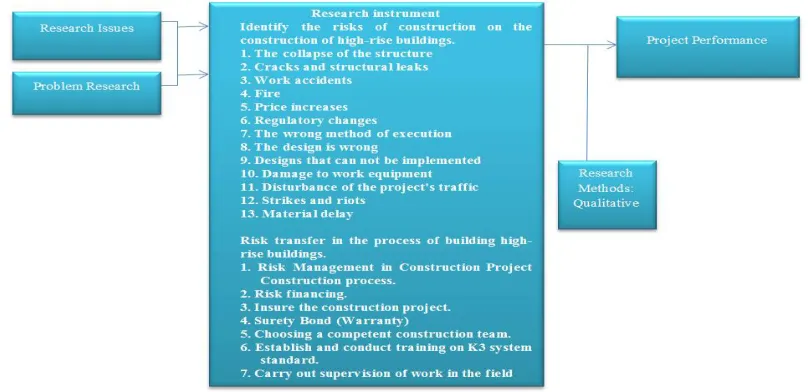
Research Instrument
This study further examines several research factors which will then be discussed to produce research findings in this study:
a. Identify the risks of construction on the construction of high-rise buildings. b. Risk transfer in the process of building high-rise buildings.
Operational Research Model
The Operational Model This study, developed as an important frame of mind, can be seen in Figure 4 below:
VIII. DISCUSSIONOFRESEARCHRESULTS
This study uses primary data obtained from the results of filling questionnaires by as many as 60 respondents who are all people or construction actors involved in the construction of high rise buildings (High Rise Building) located in the area of DKI Jakarta.Of the 60 questionnaires distributed to service users (owner) in the Jakarta area as many as 55 questionnaires are returned. Of the 55 incoming data only 50 respondents who were then sorted and recapitulated as in appendix table 3.3 recapitulation of respondents' answers research. The following is a recapitulation of data based on educational background:
- Diploma : 17 respondents - S1 : 29 respondents - S2 : 4 respondents
At this stage data questionnaire results that have been answered by the respondents will be collected and then the data respondents will be sorted. After that the answers from the questionnaires that have been filled respondents will be processed using the help of SPSS (Statistical Package for the Social Sciences) program. The type of testing performed is as follows:
Test Realiability
The reliability test is an advanced stage in the factor analysis after the validity test of the constituent variable of the factors formed. In the analysis of early stage factors have been obtained two component factors formed by each variable forming. Both components of these factors then tested its reliability by looking at the value of crombach alpha obtained from the results of reliability test.
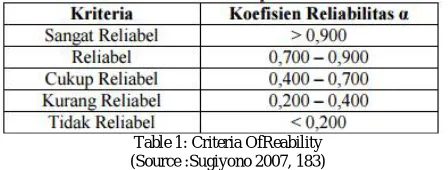
Table 1: Criteria OfReability (Source :Sugiyono 2007, 183)
Based on table 1 above, the adequacy of factor components is not reliable if it has coefficient crombach's alpha below 0.2, the coefficient of crombach's alpha between 0.2 to 0.4 declared less reliable and on the coefficient of crombach's alpha between 0.4 to 0, 7 has been declared quite reliable.
Using SPSS program support, the following table 2 is the result of the reliability test of the two component factors formed:
Reliability Statistics
Table 2: Reliability Of Factor Components
Based on table 2 above, the value of cronbach's alpha reliability factor test component factor is 0.904, which means the factor factor is declared reliable.
Correlation Test
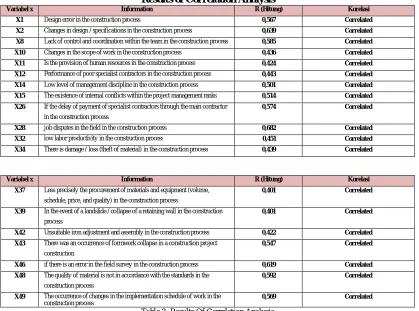
correlation analysis. The independent variable with correlation value of r ≥ 0,4 is considered to have a close
relationship with the risk of construction of building construction project high occupancy in improving project quality performance and will be analysed further by using intercorrelation analysis. Table3 The following are the variables that pass in correlation analysis:
Results of Correlation Analysis
Variabel x Information R (Hitung) Korelasi
X1 Design error in the construction process 0,567 Correlated
X2 Changes in design / specifications in the construction process 0,639 Correlated
X8 Lack of control and coordination within the team in the construction process 0,585 Correlated
X10 Changes in the scope of work in the construction process 0,436 Correlated
X11 Is the provision of human resources in the construction process 0,424 Correlated X12 Performance of poor specialist contractors in the construction process 0,443 Correlated
X14 Low level of management discipline in the construction process 0,501 Correlated
X15 The existence of internal conflicts within the project management ranks 0,514 Correlated X26 If the delay of payment of specialist contractors through the main contractor
in the construction process
0,574 Correlated
X28 job disputes in the field in the construction process 0,682 Correlated
X32 low labor productivity in the construction process 0,451 Correlated
X34 There is damage / loss (theft of material) in the construction process 0,439 Correlated
Variabel x Information R (Hitung) Korelasi
X37 Less precisely the procurement of materials and equipment (volume, schedule, price, and quality) in the construction process
0,401 Correlated
X39 In the event of a landslide / collapse of a retaining wall in the construction process
0,401 Correlated
X42 Unsuitable iron adjustment and assembly in the construction process 0,422 Correlated X43 There was an occurrence of formwork collapse in a construction project
construction
0,547 Correlated
X46 if there is an error in the field survey in the construction process 0,619 Correlated X48 The quality of material is not in accordance with the standards in the
construction process
0,592 Correlated
X49 The occurrence of changes in the implementation schedule of work in the construction process
0,569 Correlated
Table 3: Results Of Correlation Analysis
Based on table 3 above, it can be seen that from 49 variables analysed using SPSS Program, there are only 19 variables that have correlation (correlation value of r ≥ 0,4) to construction project risk variables in improving quality performance, these variables are further analysed by intercorrelation analysis.
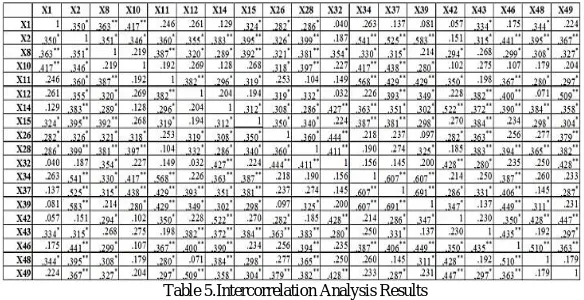
Intercorrelation test
Intercorrelation test conducted to determine the magnitude of the relationship between independent variables of the other free variables selected from the correlation test results. In the intercorrelation analysis, the free varabel causing a high correlation with the other independent variables (correlation value r ≥ 0.4) will be removed from the model until
Table 5.Intercorrelation Analysis Results
Factor Analysis Test
Factor analysis test is performed to form several groups of selected independent variables from the correlation and intercorrelation test results that are considered valid to explain the risk factors contained in the construction project construction phase in improving the quality performance of DKI Jakarta Province.
KMO and Bartlet
Bartlett of Sphericity and Keizer Meyer Olkin test Mearuse of Sampling Adequacy (KMO) is a test instrument used to measure intercorrelation between variables and whether factor analysis can be done. Criteria data that can be analyzed factors are data showing KMO> 0.5 and Bartlet's test of Sphericity at significant <0.05 (Ghozalli, 2006).
IX.CONCLUSION
Based on the results of analysis and discussion of research, the authors take the conclusion that is the answer of the questions on research problems are:
1. There are 49 variable risks identified by the author in a multi-storey building project in DKI Jakarta.
2. There are 19 causes of the risks identified (see Table 4.2). From the data analysis on these risks it can be obtained the result that the rank of the largest risk variables and mitigation actions for each risk variable are:X1(0,5670),
X2(0,567), X8(0,585), X10(0,436), X11(0,424), X12(0,443), X14(0,501), X15(0,514), X26(0,574), X28(0,682),
X32(0,451), X34(0,439), X37(0,401), X39(0,401), X42(0,422), X43, X46(0,619), X48(0,592), X49(0,569).
REFERENCES
1. ChandraHerryP.,EillenC.Tunardih,danImeldaSoetiono(2005).StudiTentangPengajuanKlaimKonstruksiDariKontraktorKePemilikBangunan,Ju rnalDimensi,Vol.7,No.2, 1990– 1 9 96.
2. Zulnaidi&SudamaT.W,Pengembangan ModelAsuransi CAR untukproyekkonstruksidiBandung, Skripsi, JurusanTeknikSipilITB, 1998. 3. CandraYuliana. MANAJEMEN RISIKO KONTRAK UNTUK PROYEK KONSTRUKSI. REKAYASA SIPIL /
Tujuandarijurnaliniadalahmengetahuijenis – jenisrisikopadapembangunanproyekkonstruksi, VOLUME 11, No.1 ISSN 1978 – 5658, 2017 4. Nurlela,HeriSuprapto. IDENTIFIKASI DAN ANALISIS MANAJEMEN RISIKO PADA PROYEK PEMBANGUNAN INFRASTRUKTUR
BANGUNAN GEDUNG BERTINGKAT.JurnalDesainKonstruksi Volume 13 No. 2, Desember 2014.
5. Octavio P.M Marques. I M. Alit K. Salaindan I W. Yansen MANAJEMEN RISIKO PADA PELAKSANAAN PROYEK KONSTRUKSI GEDUNG PEMERINTAH DI KOTA DILI – TIMOR LESTE. JurnalSpektran Vol. 2. No. 2, Juli 2014.
6. I KetutSucitadanAgung Budi Broto. INDENTIFIKASI Dan PENANGANAN RISIKO K3 PADA PROYEK KONSTRUKSI GEDUNG.JurusanTeknikSipilPoliteknikNegeri Jakarta Kampus UI Depok 16425.POLI TEKNOLOGI VOL.10 NO.1, JANUARI 2011. 7. Gabby E. M. Soputan,Bonny F. Sompie, Robert J. M. Mandagi.MANAJEMEN RISIKO KESEHATAN DAN KESELAMATAN KERJA (K3)
Study KasusPada Pembangunan Gedung SMA EbenHaezar.JurnalIlmiah Media Engineering Vol.4 No.4 (229-238) ISSN: 2087-9334, Desember 2014
9. DafidIrawan, Riman, APRESIASI KONTRAKTOR DALAM PENGGUNAAN ASURANSI PADA PEMBANGUNAN KONSTRUKSI DI MALANG, jurnalWidyaTeknika Vol.20 No.1, ISSN 1411 – 0660 : 31 – 38, Maret 2012
10. Apwiddhal, PENGALIHAN RESIKO PROYEK KONSTRUKSI PADA PERUSAHAAN ASURANSI DI INDONESIA, jurnalRekayasaSipil Volume IV, Nomor 2, ISSN : 1858-3695, Oktober 2008,
11. Diman Ade Mulada. THE ROLE OF BANK GUARANTY IN CONSTRUCTION CONTRACTS BETWEEN THE GOVERNMENT AND CONTRACTORS.Jurnal IUS VOL 1 NO 2 Agustus 2013.
12. BertinusSimanihurukdanHikmaDewita, PENYELESAIAN KEGAGALAN KONTRAKTOR DALAM MELAKSANAKAN KONTRAK DI BIDANG KONSTRUKSI,JurnalKonferensiNasionalTeknikSipil 4 (KoNTekS 4) Sanur-Bali, 2-3 Juni 2010.