ISSN(Online): 2320-9801 ISSN (Print): 2320-9798
I
nternational
J
ournal of
I
nnovative
R
esearch in
C
omputer
and
C
ommunication
E
ngineering
(An ISO 3297: 2007 Certified Organization)
Vol. 4, Issue 2, February 2016
Obstacle Detection Using Local Shape Context
Descriptor on Railway Track
Dr.D.Murugan1, V.Vivek2, K.Rajalakshmi3, Manish T.I4, T.Ganeshkumar4
Associate Professor, Dept. of CSE, Manonmaniam Sundaranar University, Tamilnadu, India1,3 Research Scholar, Dept. of CSE, Manonmaniam Sundaranar University, Tamilnadu, India2,4
ABSTRACT:This paper describe about a novel feature based on Local Shape Context descriptor for the obstacle detection on Railway tracks, this shape context descriptor is widely used algorithm in the object recognition, but it does not match for the object complex situations. Why because it does not consider the edges orientations. To address this issue, this present work add the edge based orientation information to the shape context descriptor. For that, this work first compute the image gradient in the nine directions and it can be extract the shape context descriptor in each direction. Finally it can be put the feature vector to linear SVM for training. Then it test this descriptor’s performance on the real-time video captured by the thermal night vision camera. The experimental results show that this work achieved a high detection rate and had fewer dimension than the other descriptors.
KEYWORDS:Thermal Night Vision, Local Shape Context Descriptor, SVM.
I. INTRODUCTION
Railway accidents happen every year frequently and about 30% of them are related to pedestrian collision. This is especially true in the unmanned level crossing and also the crossover roads. Sometimes it may cause by the loco pilots lack of concentrations most prime obstacle detection studies were based on the daytime environment [2,3]. The main concept of obstacle has better performance and it robustness. As compare with the daytime, night-time obstacle detection is more difficult as a result of contrast, image blur and image noise.
Most of the thermal day-and-night vision camera users the NIR (Near-Infrared) or FIR (Far-Infrared) camera [4,5,6], while others are based on the thermal image. Normally the process of night-time obstacle detection includes two stages: ROI (Region of Interest) segmentation and candidate verification. The core idea of segmentation is to reduce the seamed area for the next stage. While on candidate verification, the approaches of detection can dived into two types: Appearance Feature Extraction and temple matching. Nanda and Dasis [7] has introduced a effective idea of probability based obstacle detection methods just like HOG (Histogram of oriented gradients) features [8,9], is also used as in this present work very often Cao[10] proposed a modified LBP (Local Binary Pattern) feature extraction method for the pedestrian detection is both day and night environment.
These methods are complex and having large number of feature vector dimensions, As a result of these this work proposes a new descriptor for night-time obstacle detection inspired by the shape context and HOG descriptor.
II. PROPOSED ALGORITHM
ISSN(Online): 2320-9801 ISSN (Print): 2320-9798
I
nternational
J
ournal of
I
nnovative
R
esearch in
C
omputer
and
C
ommunication
E
ngineering
(An ISO 3297: 2007 Certified Organization)
Vol. 4, Issue 2, February 2016
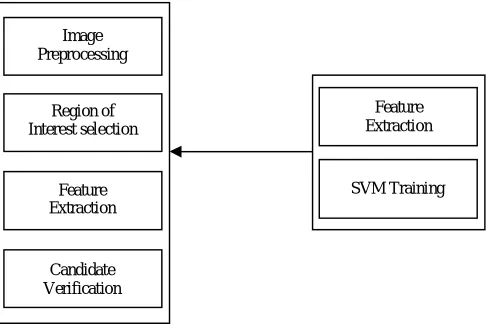
Figure 1. Architecture view of proposed work
III.FEATURE EXTRACTION OVERVIEW
A. Context Descriptor Extraction:
The entire object appearance and shape can be well characterized by the shape context [12,13] descriptor but it does not here the orientation functionality of edges, because the basic shape context descriptor does not include the gradient information.
HOG feature [8], the proposed work proposes a new descriptor based on the basic shape context that the system find a way to add gradient orientation information. The feature is extracted in four steps that are described below
1.Gradients Computations:
The gradient computation is sensitive to the detector performance. And this work had tested with different kinds of mask and found that the simplest mask [-1,0,1] turned to the best mask for gradient computation the gradient is computed as
E = dx + dy (1) .
θ= arctan (2) Where, E - Edge
θ −EdgeDirection
Compute dx and dy by scanning all pixels in image by the use of the mask [-1,0,1]
= [−1,0,1] (3)
=
−1
0 1
(4)
Where, - Horizontal Mask
- Vertical Mask
SVM Training Image
Preprocessing
Region of Interest selection
Feature Extraction
Candidate Verification
ISSN(Online): 2320-9801 ISSN (Print): 2320-9798
I
nternational
J
ournal of
I
nnovative
R
esearch in
C
omputer
and
C
ommunication
E
ngineering
(An ISO 3297: 2007 Certified Organization)
Vol. 4, Issue 2, February 2016
2. Vote for Nine Orientation:
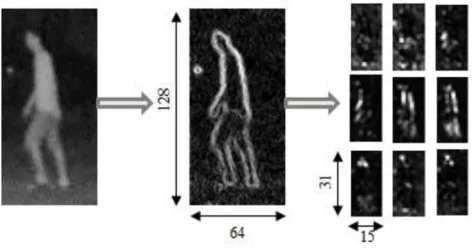
This is the essential part of the whole descriptor extraction first it sliding compute an orientation histogram of 8x8 pixel block with a four pixel stride (hence 4pixel fold coverage of each block) in 64x128 pixel image. There are nine orientation bins starts from 0O to 180Oin each histogram. In the every block, each pixel calculated a weighted vote for an edge orientation histogram channel, and the vote were summed together into its orientation bin. Here the system have nine 15x31 image as showing in Fig.2. the used orientation range from 0O to 180Oinstead of oriented of orientation from 0O to 360Orange, because signed gradients decrease the performance. To increasing the number of orientation bins improve the performance up to 9bins at each pixel votes two bins contrast in both orientation and position.The proposed system tested the different size of scanning block with different stride of blocks shown in Fig. 2.
Figure 2. Edge energy on Multi-orientation
3. Extract Shape Context:
From the Fig. 3, can clearly give the 8x8 block in nine 15x31 orientation bins by the proposed work extracted by shape context descriptor. The distribution of local normalized gradient orientations captured in a log-polar histogram. The log-polar bined was to the tolerant to small changes in the rotation of the body parts. The present system used twobins for location and four bins for gradient orientation, which generates a 2x4=8 dimensions descriptor for each block.
The experiment results shows that the 4 pixel improve the performance significantly, by the result of that 21x8=168 dimension vector found for each orientation bin. So an finally 168x9=1512 dimensions descriptor for each 64x128 image.
(a) (b) (c)
Figure 3. (a) One orientation bin; (b) 8x8 block; (c) Eight bins of gradient orientation and location.
4. Normalization:
ISSN(Online): 2320-9801 ISSN (Print): 2320-9798
I
nternational
J
ournal of
I
nnovative
R
esearch in
C
omputer
and
C
ommunication
E
ngineering
(An ISO 3297: 2007 Certified Organization)
Vol. 4, Issue 2, February 2016
p→p/(∣p∣ + )(5)
p→p/ ∣p∣ +
(6)
Where, p- Normalized descriptor vector |p| - K-norm for k=1, 2 and
−
B. Candidate Verification:
Finally after extracting the LSC descriptor, the system did the dot produce in-between the feature vector and the weight vector trained by the SVM [14], the result can be determined as
= 1
0 −
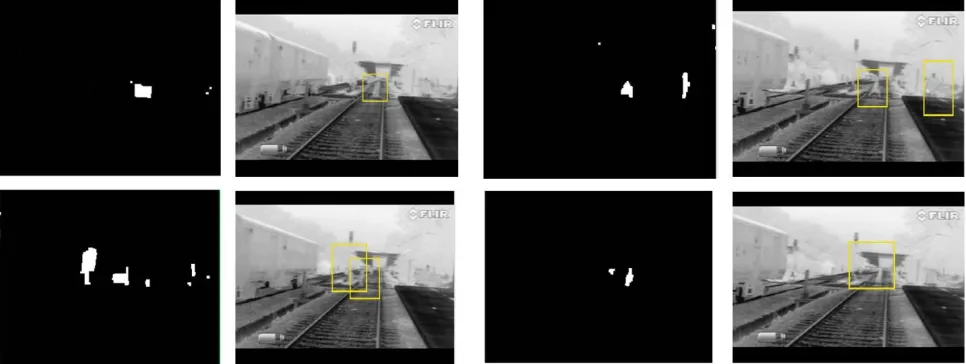
Where I – dot product result T – Threshold value Fig. 4 shows the final detection result in the proposed system.
Figure 4. Blob Detection image after merging
IV.EXPERIMENT RESULTS A. Dataset:
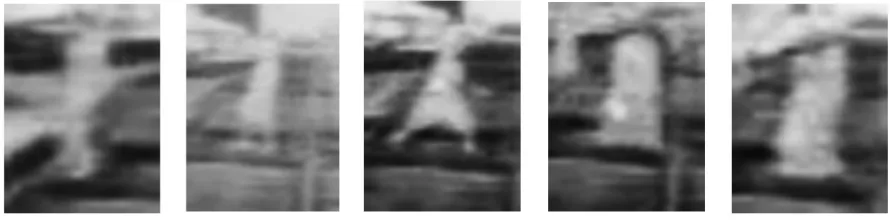
The datasets are captured from the thermal camera using real-time magnification software and that can be converted into images by the object cascading forms. And normally it has 898 images with 64x128 positive samples shown in Fig.5.
ISSN(Online): 2320-9801 ISSN (Print): 2320-9798
I
nternational
J
ournal of
I
nnovative
R
esearch in
C
omputer
and
C
ommunication
E
ngineering
(An ISO 3297: 2007 Certified Organization)
Vol. 4, Issue 2, February 2016
B. Experimental Results:
For the testing part, the proposed work has been tested by the SVM with LIBLINEAR SVM [15]. When the system compute gradients, the different masks were tested by the descriptor and finally found the mask values as [-1,0,1]. It resumes more details then the other masks. This proposed work did lots of experiments by changing the parameters including size of the block, step and normalization methods, Fig. 6 describe about the resultant images after the windows merging operation.
Figure6. The Resultant images after the algorithm performed
The resultant value using the different block size is shown in Fig. 7 an orientation histogram in 64x128 pixel image. By using a 10x10 pixel block with a 5 pixel image can give a quality outcome about 18% and it creates less-dimension vector.
False Positive per window (FPPW)
Figure 7. Different Gradient normalization methods at orientation bins using stages.
M
is
s
ra
ISSN(Online): 2320-9801 ISSN (Print): 2320-9798
I
nternational
J
ournal of
I
nnovative
R
esearch in
C
omputer
and
C
ommunication
E
ngineering
(An ISO 3297: 2007 Certified Organization)
Vol. 4, Issue 2, February 2016
V. CONCLUSION
As based on the experimental result shown above the proposed LSC (Local Shape Context) has a good performance on the obstacle (pedestrian, animal & vehicle) detection. And this work had varieties of image dimensions and outcome of it is a complex one to handle it. So that this work had a very strong gradient normalization, local contrast normalization and better block threshold method for the Region of Interest (ROI) selection and mean shift windows. The resultant outcome has given a clear view of good performance. The difficult is to handle the obstacle detection on night time has been achieved successfully, and it emphases the real-time problem on the future work.
REFERENCES
1. David Geronimo, Antonio M. Lo’pez, Angel D.sappa, “”Survey of Pedestrian Detection for ADAS”, IEEE transactions on Pattern Analysis and Machine Intelligence, 2010, Vol.32, No.7, PP.1239-1258
2. Enzweiler M., Gavrila, D.M., “Monocular Pedestrian Detection Survey and Experiments,” IEEE Transactions on Pattern Analysis and Machine Intelligence, 2009, Vol.31, No>12, pp.2179-2195.
3. Bo Li, Qingming Yao, Kunfeng Wang, “A review on vision-based pedestrian detection in intelligent transportation systems,” 2012 9th IEEE InternationalConference
on Networking, sensing and control (ICNSC 2012), pp.393-398.
4. Guoliang Li, Young Zhao, Daimeng Wei, Ruzhong Cheng, “Night Pedestrian Detection Using Local Oriented Shape Context Descriptor”, ICCSEE 2013, 5. Q.Tian, H.Sun et al, “Nighttime Pedestrian detection with a normal camera using SVM Classifier,” Advances in neural networks (ISNN 2005), Vol.3497/2005,
Dol.10.1007.
6. Y. Fang, K. Yamada, et al., “Comparison between Infrared-image based and Visible-image-based Approaches for Pedestrian Detection,” Intelligent Vehicles Symposium, 2003, pp.505-510
7. Harsh Nanda and Larry Davis, “Probabilistic Template Based Pedestrian Detection in Infrared Videos,” Intelligent Vehicle Symposium, 2002, IEEE, Vol.1 pp.15-20.
8. N. Dalal and B. Triggs, “Histograms of oriented gradients for human detection,” Proceedings of IEEE Computer Society Conference on Computer Vision and Pattern Recognition (CVPR 2005) , San Diego, USA, pp.886-893, June 2005.
9. S. Chang, F. Yang, W. Wu, et al., “Nighttime Pedestrian Detection Using Thermal Imaging Based on HOG Feature,” Proceeding of 2011 International Conference on System Science and Engineering, Macau, China, June 2011.
10. Yunyun Cao, SugiriPranata, et al., “Local Binary Pattern features for pedestrian detection at night/dark environment,” 2011 18th IEEE International Conference on Image Processing, pp. 2053-2056.
11. J. Ge, Y. Luo, G. Tei, “Real-Time Pedestrian Detection and Tracking at nighttime for Driver-Assistance Systems,” IEEE Transactions on Intelligent Transportation Systems, Vol.10, No.2, June 2009.
12. S.Belongie, J. Malik and J. Puzicha, “Shape Context: A new descriptor for shape matching and object recognition,” NIPS 2000. 13. S. Maji, A. Berg and J. Malik, “Classification using intersection kernel support vector machines is efficient,” CVPR 2008.
14. F. Keinosuke, L. D. Hostetler, “The Estimation of the Gradient of a Density Function, with Applications in Pattern Recognition,” IEEE Transactions on Information Theory, 1975.
15. R. E. Fan, K. W. Chang, et al., “LIBLINEAR: A library for large linear classification,” Journal of Machine Learning Research, 2008, pp.1871-1874
BIOGRAPHY
Dr.D.Muruganis an active analyst and Researcher in the field of Face Recognition and Intelligent systems, He received his Ph.D. in Computer Science & Engineering, Manonmaniam Sundaranar University, Tirunelveli. And currently he is working as Associate Professor under the Department of Computer Science & Engineering, M.S University, Tirunelveli, Tamilnadu, India.
V.VIVEK is a Research Scholar in the Research Centre-MSU under Computer Science and Engineering Department, Manonmaniam Sundaranar University. He received Master of Engineering (ME) degree in 2014 from MSU, and also he received his Bachelor of Technology (B.Tech) degree in 2011 from National College of Engineering,Tirunelveli, India. His research interests are Object Detection & Recognition in Image Processing and Computer Networks (wireless Networks).
Dr.Manish T.I, He received his both Master of Engineering on 2010, and Doctoral degree in the year of 2015, form the Department of Computer Science & Engineering, M.S University, and currently he is working as Associate Professor in NETS School of Engineering, Trisur, India.