A Substitute Method for Ad Hoc Networks to
Process of Selecting Among the Nodes in
Network
N.Premavathi 1
, K.Rajesh Kumar Reddy2
PG Scholar, Dept. of CSE, Kuppam Engineering College, Kuppam, Andhra Pradesh, India1 Assistant Professor, Dept. of CSE, Kuppam Engineering College, Kuppam, Andhra Pradesh, India2
ABSTRACT: This work deals with the problem of energy-efficient reliable wireless communication in the presence of unreliable or loss wireless link layers in multi-hop wireless networks. RMER and RMECR are proposed for networks in which either hop-by-hop or end-to-end retransmissions ensure reliability. Simulation studies show that RMECR is able to find energy-efficient and reliable routes similar to RMER, while also extending the operational lifetime of the network. This makes RMECR an elegant solution to increase energy-efficiency, reliability, and lifetime of wireless ad hoc networks. We conducted extensive simulations to study the power consumption, the end-to-end delay, and the network throughput of our protocols compared with existing protocols. In contrast to conventional power-aware algorithms, MRPC identifies the capacity of anode not just by its residual battery energy, but also by the expected energy spent in reliably forwarding a packet over a specific link. In this paper, we argue that such a formulation based solely on the energy spent in single transmission is misleading —the proper metric should include the total energy (including that expended for any retransmissions necessary) spent in reliably delivering the packet to its final destination.
KEYWORDS: Ad Hoc Networks, Energy Aware Routing, Battery Aware Routing, Energy Efficiency, Reliability, End-To-End delay, Hop-By Hop Retransmission.
I. INTRODUCTION
Ad hoc wireless networks have received significant attention in recent years due to their quick and economically less deployment and potential applications such as emergency disaster relief, military and etc. Ad hoc network is type of wireless network that uses multi-hop radio relaying and are capable of operating without any backbone infrastructure. If the communication nodes are close enough, then the communication session is achieved either through a single-hop transmission or relaying by inter-mediate nodes otherwise. In many scenarios, wireless communication protocols design requires two requirements that are Energy efficiency and resilience to packet losses. Management of energy resources has considerable impact on the ad hoc network since the nodes are powered by batteries with limited power. During transmission various factors such as fading, interference, multi-path effects and collisions, lead to heavy loss rates on wireless links, so handling losses in wireless environments entails central importance. Many applications needs end to- end reliability requirement, it is necessary to know how such reliability can be guaranteed in wireless environments in an energy efficient way. In this paper we focus the problem of energy efficient routing in wireless network that appropriately handles packet losses in the wireless environment. Since wireless links are prone to transmission errors, End-to-end reliability on multi hop path is achieved by using retransmission schemes.
A. Retransmission Schemes
Hop-by-hop retransmissions- lost packet in each hop is retransmitted by the sender when necessary, to ensure link level reliability. Acknowledgements are generated when receiver receives packet correctly
Now a day various routing algorithms have been proposed aiming at increasing reliability, energy-efficiency and the lifetime of wireless ad hoc networks (e.g., [1], [2], [3], [4], [5], [6],[7], [8]). We can broadly group these algorithms into three categories.
The first category includes algorithms that consider the reliability of links to find more reliable routes [e.g., proposed algorithm in [1]. These algorithms found the reliable routes that consist of links requiring less number of packet retransmissions during lost packet recovery. Since they require less number of retransmissions such routes may consume less energy, but they do not necessarily minimize the energy consumption for E2E packet traversal. Furthermore, giving a higher priority for reliability of routes may result in overusing some nodes. The higher reliable links will frequently be used to forward packets than other links. Nodes along with these reliable links will fail quickly, because they have to forward many packets on behalf of other nodes.
The second category includes algorithms that focus on finding energy-efficient routes (e.g., the proposed algorithms in [2], [3], [6], [7]). Even though some of these algorithms (e.g., the proposed algorithms in [6], [7]) address energy-efficiencyand reliability together, they do not avoid overuse of nodes since they do consider the remaining battery energy of nodes. And the major drawback of these algorithms is they consider only the transmission power of nodes and do not consider the actual energy consumption of nodes (that is the energy consumed by processing elements of transmitters and receivers) during energy-efficient route discovery. This will negatively affects reliability, energy-efficiency, and the operational lifetime of the network altogether.
The third category includes algorithms that aim to prolong the lifetime of network by finding routes along with the nodes having higher level of battery energy (e.g., the proposed algorithms in [4], [5]). However, these algorithms do not address reliability and energy-efficiency. Since the routes discovered by these algorithms may neither be reliable nor be energy-efficient, this can increase the overall energy consumption in wireless network.
The rest of the paper is structured as follows: Section 2 describes the preliminaries. Section 3 reviews the proposed algorithms. Section 4 presents the comparison among the proposed algorithms. Finally Section 5 presents the conclusion.
II. PRELIMINARIE
B. Communication model
We consider the topology of multi-hop wireless networks as a graph G = (V, E) where V is the set of nodes and E is the edge set. E (u, v) is a between u and v which means that u can send messages to v and d (u, v) is the distance between nodes u and v. Let us assume R be the maximum range of communication. In given graph G = (V, E), let n be the number of nodes in ad-hoc network and it is defined as n = |V |. In network each node is assigned a unique integer identifier between 1 and n. let N (u) be the neighbor set of vertex u, which is defined as
N (u) = {v | (u, v) ∈E}
receive its broadcast, and it is denoted by r(u) with 0≤r(u)≤R
C. Energy Model
When transmitting a message between sender and receiver, the energy consumption of network interface is calculated by using the range of the sender u and it is defined as:
E (u) = r (u) ^α
where r(u) is transmission range and α ≥ 2.
In particularly, thereby some more energy is needed for MAC control messages and overheads due to signal processing. Herewith a constant c is added to the previous equation. The common energy consumption formula is defined as:
E (u) = (r (u) ^α) +c where c is a constant.
we assume that each node can adjust its own power level, i.e. each node support adjustable transmission range. A transmission range allocation on the vertices in V is a function: r → V in an real interval [0, R] where R is the maximum transmission range
of nodes. The transmission range at each node u ∈V has finite subset of R. while maintaining the connectivity of the graph, each node in wireless network has to reduce its transmission range. The amount of total power consumption is given by the following formula:
E = ∑ (u∈V) (E (u))
where E is total power consumption and E(u) is the power consumption of node u.
D. Energy-Efficient Reliable Routing
Energy efficient reliable routing finds the routes which minimize the energy cost for packet traversal. The energy cost of a route is related to its reliability since larger amount of energy will be consumed per packet due to retransmissions of the packet if routes are less reliable
III. SYSTEM DESIGN
Wireless links in ad hoc networks are usually prone to transmission errors. This necessitates the use of retransmission schemes to ensure the reliability, HBH or E2E retransmissions can be used.
1.Routing in Wireless Ad Hoc Networks
Routing protocol supports the delivery of packets. It is the security has attracted more attention than before but the security concern for routing protocols has not been fully awared.
2. Hop-by-Hop and End-to-End Retransmission Systems
In the HBH system, a lost packet in each hop is retransmitted by the sender to ensure link level reliability. An acknowledgment (ACK) is transmitted by the receiver to the sender when it receives the packet correctly. If the sender does not receive the ACK, the sender retransmits the packet. In the E2E system, the ACKs are generated only at the destination and retransmissions happen only between the end nodes. The destination node sends an E2E ACK to the source node when it receives the packet correctly.
3. Routing in Wireless Ad Hoc Networks
Main objective is to find reliable routes which minimize the energy cost for E2E packet traversal. For this, reliability and energy cost of routes must be considered. The main aim is that energy cost of a route is related to its reliability.
IV. PROPOSED PROTOCOL
In the proposed a novel energy-aware routing algorithm, called reliable minimum energy cost routing (RMECR). RMECR finds energy efficient and reliable routes that increase the operational lifetime of the network. RMECR is proposed for networks with hop-by-hop (HBH) retransmissions providing link layer reliability, and networks with E2E retransmissions providing E2E reliability. It
Available Algorithm
1. Initially BS collects information regarding of all the nodes in the network. (a) BS transmit message to all nodes in the network
2. Assigning energy to all nodes. 3. Choose the source and destination. 4. To find the neighbours.
(a) First find HBH transmission (b) If this route is reliable then E2E route is reliable
5. Choose the shortest routing using Dijkstra's algorithm
(b) C(P(s,v))=C(P(s,v))+W(u,v)
6. Calculating the minimum energy routing path for using MinMax algorithm 7. Sending packets through the reliable path.due to retransmissions of the packet.
In Fig.1, first the nodes are created and energy is assigned to those nodes. During this process, HELLO packet are send to the neighboring nodes and this process continues until all the nodes in the network receives the HELLO packet. In the second step, find the source and destinations nodes. As the next step, find all the shortest path between the source and destination and select the path that consumes minimum energy for transferring the data. This path is considered as the reliable path.
V. SIMULATION RESULT
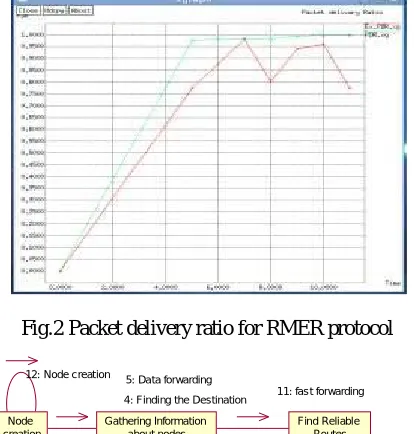
We carry out simulation in ns2 for evaluating the proposed routing protocol. Packet delivery ratio, Throughput, Average energy consumption is compared. The simulation program has been written in C++. The main simulation parameters are shown in Table 2.To evaluate the performance of RMECR and RMER algorithms, we consider a network in which nodes are uniformly distributed in a square area. Nodes are assumed to be static [3].
VALUES OF VARIOUS PARAMETERS USED IN SIMULATIONS
Simulation is carried out several times and averages of the results obtained are used for plotting the graphs showing the trends.
Fig.2 Packet delivery ratio for RMER protocol
Fig. 2 Average E2E reliability of selected routes
Node creation
Gathering Information about nodes
Find Reliable Routes
Minimum Energy
Cost Routing Increase the Operational lifetime of the network 1: Welcome
2: increase the network life time 3: Nodeinfo
4: Finding the Destination 5: Data forwarding
6: forwarding data through reliable routes 7: Topology 8: consuming less energy
9: data reaches the destination 10: consuming minimum energy in reliable routes
11: fast forwarding 12: Node creation
Screen shots:
Fig:Links creation
Fig: Login for access
Fig: File received from one node to another
VII. CONCLUSION
We presented an in-depth study of energy-aware routing in ad hoc networks, and we proposed a new routing algorithm for wireless ad hoc networks, via, Reliable Minimum Energy Cost Routing (RMECR). RMECR can increase the operational lifetime of the network using energy-efficient and reliable routes. In the design of RMECR, we used a detailed energy consumption model for packet transfer in wireless ad hoc networks. RMECR was designed for two types of networks: those in which hop-by-hop retransmissions ensure reliability and those in which end-to end retransmissions ensure reliability. The general approach that we used in the design of RMECR was used to also devise a state-of-the-art energy-efficient routing algorithm for wireless ad hoc networks, i.e., Reliable Minimum Energy Routing (RMER).Extensive simulations showed that RMER not only saves more energy compared to existing energy efficient routing algorithms, but also increases the reliability of wireless ad hoc networks. Furthermore, it is observed that RMER finds routes that their energy-efficiency and reliability high paths.
REFERENCES
1.Sebastin Christhu Raj A, Helensupriya M, Shanmuga Priya S ,”Reliable Energy Efficient Routing Algorithms In Wireless Ad Hoc Networks”,Volume 3, Issue 4, April 2014.
2.J. Vazifehdan, R. Prasad, and I. Niemegeers, “Minimum Battery Cost Reliable Routing in Ad Hoc Wireless Networks,” Proc. Eighth IEEE Consumer Comm. and Networking Conf., Jan. 2011.
3. X.-Y. Li, Y. Wang, H. Chen, X. Chu, Y. Wu, and Y. Qi, “Reliable and Energy-Efficient Routing for Static Wireless Ad Hoc Net- works with Unreliable Links,” IEEE Trans. Parallel and Distributed Systems, vol. 20, no. 10, pp. 1408-1421, Oct. 2009.
4.D.J. Vergados, N.A. Pantazis, and D.D. Vergados, “Energy- Efficient Route Selection Strategies for Wireless Sensor Net- works,” Mobile Networks and Applications, vol. 13, nos. 3-4, pp. 285-296, Aug. 2008.
5.J. Zhu, C. Qiao, and X. Wang, “On Accurate Energy Consumption Models for Wireless Ad Hoc Networks,”IEEE Trans. Wireless Comm.,vol. 5, no. 11, pp. 3077-3086, Nov. 2006.
6. Suresh Singh, C.S.Raghavendra,”PAMAS-Power Aware Multi Access Protocol with Signalling for Ad Hoc Networks”,pp-43-55,2006. 7. J.-H. Chang and L. Tassiulas, “Maximum Lifetime Routing in Wireless Sensor Networks,” IEEE/ACM Trans. Networking, vol. 12, no. 4, pp. 609-619, Aug. 2004.
8. D. Kim, J.J.G. Luna Aleve's, K. Obraczka, J. Carlos Cano, and P. Manzoni, “Routing Mechanisms for Mobile Ad Hoc Networks Based on the
Energy Drain Rate,” IEEE Trans. Mobile Computing, vol. 2, no. 2, pp. 161-173, Apr.-June 2003. 9.Reliable Communication in Multi-Hop Wireless
Networks,” Proc. ACM MobiHoc, pp. 146-156, June 2002.
10. V. Javad, R. Venkatesh, N. Ignas, “Energy-Efficient Reliable Routing Considering Residual Energy in Wireless Ad Hoc Networks”,IEEE comm. Trans, on Mobile Computing, vol. 13, no. 2, February 2014.
17. www.ijettjournal.org/2015/volume-23/number-7/IJETT-V23P268.pdf
11. D.S.J. De Couto, D. Aguayo, J. Bicket, and R. Morris, High- Throughput Path Metric for Multi-Hop Wireless Routing,” Proc. ACM MobiCom, pp. 134-146, 2003.
12. S. Singh and C. Raghavendra, “PAMAS—Power Multi-Access Protocol with Signalling for Ad Hoc Networks,” ACM Computer Comm. Rev., vol. 28, pp. 5-2 1999.
13. J. Gomez, A.T. Campbell, M. Naghshineh, an Bisdikian,“PARO: Supporting Dynamic Power Controlled Routing in Wireless Ad Hoc Networks,” Wireless Networks, vol. 9, no. 5,pp. 443-460, 2003.
14. C. Toh, “Maximum Battery Life Routing to Ubiquitous Mobile Computing in Wireless Ad Hoc Networks,” IEEE Comm. Magazine, vol. 39, no. 6, pp. - 147, June 2001.
15. A. Misra and S. Banerjee, “MRPC: Maximizing Lifetime for Reliable Routing in Wireless Environments,” Proc. IEEE Wireless Comm. and Networking . (WCNC ’02), pp. 800-806, 2002.