A Distributed Publisher-Driven Secure Data
Sharing Scheme For Information-Centric IOT
Deeksha K R1, Madhurya R2,Dr. K.S Jagadeesh Gowda3, Prof. Vanitha T N4
Student, Department of Computer Science & Engineering, SKIT College, Bangalore, India1,2
Professor and Head, Department of Computer Science &Engineering, Bangalore, India3
Assistant Professor, Department of Computer Science &Engineering, Bangalore, India4
ABSTRACT: In ICIoT (facts-Centric internet of things), for near data reproduction accesses IoT statistics are saved in
a network. The assignment is being occurred for the with ease adaptable authorization in the network for distributed statistics caching environment. To become aware of the above venture, CP-ABE(Ciphertext-coverage attribute-based totally Encryption) scheme has been taken as a assuring technique. In CP-ABE scheme, publisher get admission to the attributes from a centralised server for encryption of the facts, which ends up to boom in communique rate. To reduce this trouble we use CP-ABE scheme and we introduce a singular disbursed writer-pushed comfy information sharing for ICIoT (ICIoT) permitting only legal customers to retrieve IoT information from allotted cache. In DPD-ICIoT, we introduce AM(attribute happen) which is not anything however a records bite of the sort of “show up” wherein writer can retrieve the attributes from close by replica holders in preference to the centralised attribute server. An AASM(automated attribute Self-update Mechanism) is been proposed for the enablation of fast updates of attributes.
KEYWORDS: IoT, ICN, Encryption
I. INTRODUCTON
A developing wide variety of bodily items are being connected centralized servers/clouds, ICIoT has emerged as a promising option to offer viable IoT services to users. The net of things (IoT) introduces a imaginative and prescient of a destiny internet wherein customers, computing structures, and every day items possessing sensing and actuating talents cooperate with extraordinary comfort and reasonably-priced benefits. we gift CCN(content material-centric networking) which treats content material as a primitive – decoupling area from identity, to the net at an unprecedented rate figuring out the concept of the net of things (IoT). it's miles anticipated that fifty billion devices will be connected thru IoT by 2020, and large quantities of statistics can be generated from those gadgets. maximumIoT services are designed based totally on net generation, which quit-to-quit communications. based on such era, IoT information sharing applications were developed on the basis of security and get right of entry to, and retrieving content by way of name. technology including Radio-Frequency identity (RFID). The IoT is enabled through the contemporary developments in RFID, smart sensors, verbal exchange technologies and net protocols. The basic premise is to have clever sensors collaborate at once without human involvement to deliver a brand new elegance of programs. The current revolution in net, cell and system-to-device (M2M) technologies may be seen as the first segment of theIoT[1]. Very confined gadgets which include RFID may presently rent unique communiqueand security processes , however can also evolve to assist net[11].
the speedy boom of facts volume and the shift of verbal exchange interest from the host to the records. records-centric networking (ICN) affords a new idea of communication, one wherein a consumer genuinely requests statistics and leaves it to the network to decide in which it resides. This outcomes in a shift from a node-centric version to a version in which information can be stored at arbitrary, possibly many, places within the community. In ICN, content material identifiers, rather than server IP addresses, turn out to be the handles of requests and replies. In the sort of way, ICN clearly supports various functionalities which include content material distribution, multicast, and mobility, all of which leverage computing power[12]. Resilience, in telecommunications, refers back to the potential of the architecture to triumph over surprising interruption of the transport procedure due to sudden events such as link or node failure. There are a number of ICN architectures which have been reviewed and as compared significantly. in this work, the PURSUIT structure[4] is used because it gives appealing characteristics for growing data resilience answers.
II. LITERATURE SURVEY
IoT:A survey on allowing technologies, Protocols and packages. [1]This paper provide a top level view of the internet of things(IoT) with emphasis on permitting technologies, protocols software issues. The IoT is enabled through the brand new trends in RFID ,clever sensors and verbal exchange technology, and internet protocols. The contemporary revolution in internet, cellular and gadget-to-system(M2M)technology may be seen because the first section of IoT. In comparison to different survey papers in the subject, our objective is to offer a more thorough precis of the maximum applicable ;protocols and alertness problems to permit researches and utility developers to arise to hurry quickly on how the special protocols healthy collectively to supply preferred functionalities while not having to go through RFC’s and the usual specifications. IoT:Converging technology for smart Environments and included Ecosystems. ecu commission, Belgium [2]“IoT will enhance the financial system at the same time as improving our residents ’lives”. Analysts expect that new internet of things(IoT) services and products will develop exponentially in next years. I firmly consider that the commission will retain to guide studies in IoT in Horizon 2020.Open and integrated IoT environments will raise the competitiveness of eu SME’s and make human beings’s each day lifestyles easier. net of information and services:A Conceptual architecture for Integrating offerings and Contents at the destiny Interne. global, dozens of projects to redecorate the internet are in development underneath the banner of the so-called future net studies.
A few proposals argue that the maximum critical aspect is to layout to deal with offerings-primarily based packages. [3]in this paper we defined the idea that the most vital factor is to layout to integrate each elements in a cohesive manner. To do so, architectural blueprints need to be able to remedy indirections typically, to permit mobility and semantic wealthy look for devices and contents. factsResillience:source recuperation in an facts-Centric community. [4]In this text we introduce a unique resilience answer that is going past the scope of course restoration to address source failure scenarios a good way to obtain the extra wellknown form of statistics resilience. We show that via utilizing the information of information, offered by using apost/subscribe records-centric networking version, identification of many wide variety of publishers for unmarried records item can be completed. The development closer to turning into acknowledged [5]active distribution networks(ADNs)may be understood sincerely through a real-Time country Estimation (RTSE) application at massive scale is the dearth of a scalable and flexible conversation infrastructure for the well timed delivery of the excessive extent of synchronized and non-stop measurements. To perceive this task we introduce a communication platform referred to as C-DAX primarily based on the statistics-centric networking (ICN) idea.
In this algorithm,RXI is introduced to serve as a fine-grained and unified estimation criteria of possible future request probability for cached chunks.RXI is customized for steaming content delivery by adopting both file-level and chunk-level request probability and considering the dynamically varied request status at each route as well.Compared to prior work,the proposed algorithm evits the chunk with the minimum expectation of future request to maintain a high cache utilization. Understanding the Social impact of ICN between myth and reality:[7]The Information Centric Networking(ICN) paradigm is attracting more and more interest from the research community due to its peculiarities that make it one of the best candidate for constructing the future internet.
major security attacks.Security analysis indicated that the proposed scheme is robust against reply attacks,masqueradeattacks,delay attacks and message manipulation attacks.Ciphertext-Policy Attribute-Based Encrytion:AnExpressive, efficient,and provably secure:We present a new technology for realizing [9]Ciphertext-Policy Attribute-Based Encrytion(CP-ABE) under concrete and noninteractive cryptographic assumptions in the standardmodel.Our solution allow many encryptor to specify access control in terms of any access formula over the attributes in the system.In our most efficient system,ciphertext size encryption,and decryption time scales linearly with the complexity of the access formula.The only previous work to achieve these parameters was limited to a proof in the generic group model. A Survey on Internet of Things:Security and Privacy issues:[10]This paper introduces Internet of Things(IoTs),which offers capabilities to identify and connect worldwide physical objects into a unified system.
III. SYSTEM DESIGN
To provide IoT services based on Internet technology,central servers/clouds are typically deployed for storing the data collected from IoTdevices.This results in large latencies and much traffic overhead becauseof the considerable number ofduplicate data retrievalsfrom distant servers/clouds. On the other hand, routers areexpected to be equipped with caches. It can be predictedthatIoT data move from centralized servers/clouds to theedge of a network, such as caches surrounding users.
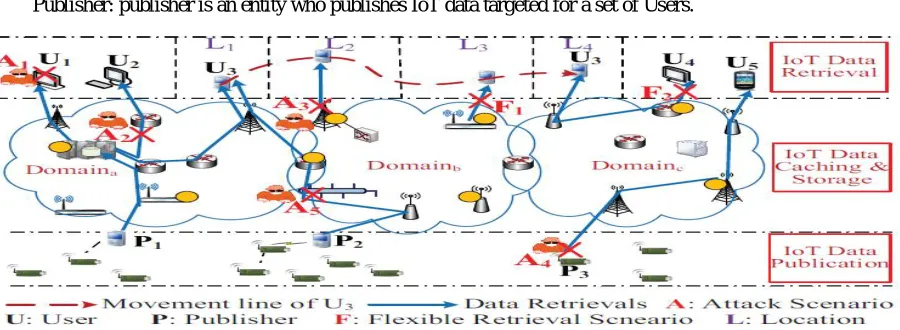
In the above scenario, besides the physical entities for communication the entities that logically play roles in IoTdatadisseminations are as follows.
User: user is an entity who retrieves data from server(s) or caches in the network. Publisher: publisher is an entity who publishes IoT data targeted for a set of Users.
Fig. 1 TypicalIoT use scenario
NOA (Network Operator and Authority): It is an entity who operates a network consisting of routers,
gateways, and access points, which are potentially equipped with caches. It provides security policies and functions for the devices in the network, such as functions for identity management and authentication services for entities.
DSA (Data Sharing Authority): The DSA is an entity that assists Publishers to provide access privileges to Users for securely providing their IoT data.
In the fig 1. There are three areas, serving as administrative domains, Domaina, Domainb, Domainc. An administrative
domain is a group of networkdevices, such as routers, base stations (BS), gateways, access points, and links among them, which have a common security policy and configurations. It performs the job of identifying the boundary of security settings, and different Domains may have different security.
denote IoT data users in Domaina; U4 and U5 represent IoT data users in Domainc;U3 represents a mobile User who
moves from LocationL1, Domaina to Location L4, Domainc passing to DomainbthroughLocation L2 and L3.
Consider a system in ICIoT, IoT data are cached in adistributed manner in the network after they are publishedby publishers. Then, users retrieve them from close copyholders. After data are published, publishers losecontrol over the data, and therefore, it would be challengingto make the data only accessible based on a publisherdefinedaccess policy, while also inhibiting attacks, suchas unauthorized access, illegal modification, and impersonationattack.
IV. IMPLEMENTATION
A Distributed Publisher-Driven Secure DataSharing Scheme for Information-Centric IoT implements the following modules. They are Publisher,User, DSA, DPDIC-IoT, Key Generation.
Publishers register their IoT data’s attributes with the DSA and DSA issues the corresponding AMs to the network. AMs are cached in the network using the ICN approach.Publisher only holds the PK for DSA.Users acquire permission to access a flexible set of IoT data from the DSA based on the attributes they hold. When publishing IoT data, Publishers retrieve the related AMs from the close copyholders in the network and enforce the security policy to the data based on these attributes. To provide efficient IoT data sharing, we do not intend to encrypt the data directly using CP-ABE, because of computing cost. Publisher can specify a group of IoT data by encrypting a message using the key chain mechanism.
For Users Us, DSA generates private keys (PriKs) corresponding to their attributes. The Users and DSA authenticate each other based on the authentication service provided by NOA. Then, they establish a shared key among them through key negotiation protocol, such as Die-Hellman key exchange. The shared key is used to securely distribute the PriKs to Users. After the provisions of PriKs, the User holds one or a set of PriKs that reflects its attributes.
DSA selects the bilinear group and master key, MK, and public key, PK. DSA provides PK to Publishers and Users. Meanwhile, it generates AMs and DMs according to the needs of Publishers, and then disseminates them in the network using the ICN approach.
The key exchange and operations in DPD-ICIoT as follows. DSA holds the master key, MK, and public key, PK, after setup. Then the DSA announces the PK in the network and Publishers Ps and Users Us can obtain it. The DSA generates the values for the attributes, and introduces AM to describe the attributes.
The Key Generation can be done as follows. DSA generates the private keys for Users using function KeyGen(MK,S) based on the Users’ attribute set, S, and the updated attribute values according to AASM . It uses different random numbers when generating private keys for different Users. Thus, the Users hold different private keys even if they hold a completely identical set of attributes. After generation of these private keys, the DSA sends these private keys to Users. The Users then install these private keys with the corresponding attributes.
AES
set of rules:
AES essentially repeats four most important capabilities to encrypt records. It takes 128 bit block of information and key[laymans term password] and gives the ciphertext as output. The capabilities are Sub Bytes, Shift Rows, mix Columns, add Key. The range of rounds performed through the set of rules strictly depends on the scale of key. the following desk offers evaluation of quantity of rounds accomplished with the enter of various key lengths.
Key Size(in bits) Rounds 128...10 192...12 256...14
The bigger the wide variety of keys the extra secure might be the statistics.
Steps for encryption and decryption Evaluation of Steps
1. KeyExpansion
Within the key expansion procedure the given 128 bits cipher key is stored in [4]x[4] bytes matrix (16*8=128 bits) after which the 4 column words of the important thing matrix is expanded right into a agenda of 44 words (forty four*four=176) resulting in eleven round keys (176/eleven=16 bytes or 128 bits). variety of spherical keys = Nr + 1. in which Nr is the range of rounds (that's 10 in case of 128 bits key length) So right here the round keys = eleven.
2. Sub Bytes
Every element of the matrix is changed through the an element of s-field matrix. Sub Bytes For an detail {d1} corresponding value is {3e}. The S-field is a unique lookup desk that's built through Galoisfields.
The generating feature used in this algorithm is GF(2^8) i.e. 256 values are possible. The elements of theS-field are written in hexadecimal gadget.
3. Shift Rows
On this step rows of the block are cylindricallyShiftedin left path. the primary row is untouched , the second by using one shift, 0.33 by means of two and fourth with the aid of 3. Shift Rows ensuing matrix after shift operation.
4. Mix Columns
That is the most essential part of the set of rules. It reasons the turn of bits to spread all around the block. in this step the block is increased with a fixedmatrix.The multiplication is discipline multiplication in galoisarea.For each row there are16 multiplication, 12 XORs and a 4 byte output.
Evaluation of Steps: Blend Columns and add round key
On this step each byte is XOR-edwith corresponding detail of key's matrix. as soon as this step is performed the keys aren't any longeravailable for this step. the usage of the equal key will weaken the algorithm. to conquer this trouble keys are extended.inside the ultimate spherical the mix column step is skipped. It isn't documented anywhere why this is achieved butrecently a paper changed into published against this method highlighting the weakening of cipher text.
V. EXPERIMENTAL RESULTS
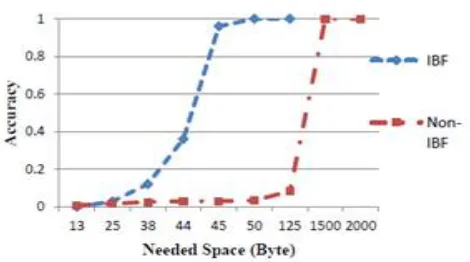
In Fig. 2 illustrate the tradeoff among the dimensions of the IBF and the achieved accuracy. The baseline of comparison is a relational table with a thousand facts. If we want to keep these IPs in a conventional relational desk, we need 4*N bytes of memory, whilst inside the proposed method, we need a great deal less memory. Fig. 3suggests the comparison of the accuracy of frequency information and the value of memory usage for the IBF versus a relational information shape.
VI. CONCLUSIONS
The contributions in this paper are summarized as follows. We furnished device descriptions and diagnosed thesecurity necessities for an ordinary IoT records sharing scenarioin distributed caching environment. We proposed a novelDPD-ICIoT scheme to allow at ease and flexible accesscontrol for IoT facts, which absorbs the merits from bothCP-ABE and CCN. The DPD-ICIoT scheme employs a key chain mechanism to provide efficient cryptographic operations.future internet architectures need to deal with diverse network demanding situations, including resilientcontent transport. records resilience goals to get better the transport of statistics regardless of its deliver. the PURSUIT-ICN structure to introduce a resilience management extension function. CCN is designed to update IP, but can be incrementally deployed as an overlay – making its purposeful benefits available to applications with out requiring regularly going on adoption.baby’s whereabouts. The paper moreover proposes security gadget which includes drunk and energy prevention device and tempo manipulate mechanism.
REFERENCES
[1] A. A1-Faquaha, M. Guizani, M. Mohammad, M.aledhari,And M. Ayyash, “Internet of Things: A survey on enabling Technologies, Protocols
and Applications,” IEEE Communications Surveys and Tutorials, issue 99, June 2015.
[2] O. Vermesan, and P. Friess (Editors), “Internet of Things:Converging Technologies for Smart Enviroments and Integrated Ecosystems,” River Publishers, 2013.
[3] D. Evans, “The Internet of Things How the Next Evolution of the Internet Is Changing Everything,” Cisco Internet Business Solutions Group white paper, Apr. 2011.
[4] M. Al-Naday, M. Reed, D. Trossen, and K. Yang, “Information Resilience: Source Recovery in an Information Centric Network,” IEEE Network, vol. 28, issue 3, pp. 36-42, 2014.
[5] W. Chai, and et. al., “An Information-Centric CommunicationInfrastructurefor Real-Time State Estimation of Active DistributionNetworks,” IEEE Trans.on Smart Grid, vol. 6, no. 4, pp.2134-2146,July 2015.
[6] HaipengLi,HidenoriNakazato,Syed Hassan Ahmed, “Request Expectation Index based Cache Replacement Algorithm for Streaming Content Delivery over ICN,”issue 14, November 2017.
[7] G. Piro, I. Cianci, A. Grieco, G. Boggia, and P. Camarda,“Information Centric Services in Smart Cities,” Journal of Systems andSoftware, vol. 88, pp. 169-188, 2014.
[8] Sk. Md. M. Rahman, N. Nasser, and T. Taleb, “Pairing based Secure Timing Synchronization for HeterogeneousSensor Networks,” IEEEGlobecom’08, New Orleans,Louisiana, USA, Dec. 2008.
[9] J. Bethencourt, A. Sahai, and B. Waters, “Ciphertext-Policy Attribute Based Encryption,” the 28th IEEE Symposium on Security and Privacy, pp. 321-334, Oakland, 2007.
[10] J. Kumar, and D. Patel, “A Survey on Internet of Things:Security and Privacy Issues,” International Journal Of Computer Applications, vol. 90, no. 11, 2014.
[11] J.Granjal, E. Monterio, and J. Silva, “Security for theinternet of Things: A Survey of Existing Protocols and Open Research Issues,” IEEE Communications Surveys& Tutorials, vol. 17. Issue 3, pp 1294-1312, Jan. 2015.
[12] H. Yin, Y. Jiang, C. Lin, Y. Luo, and Y. Liu, “Big data:Transformingthe design philosophy of future Internet,”IEEE Network, vol. 28, no.4, pp. 14-19, Jul.. 2014.
[13] V. Jacobson, D. Smetters, J. Thornton, M. Plass, N.Briggs, and R. Braynard, “Networking Named Content,” the 5th International Conference on