HEREDITY OF TWO VARIABLE CHARACTERS
I N
HABROBRACON
P. W. WHITING
University of Maine, Orono, Maine
Received November 14,1925
TABLE OF CONTENTS
PAGE
INTRODUCTION. Review of work on defective venation in Lancaster (L) material. . . 305
The Iowa City (I) material. . . 307
“Sooty” mesosternum. . . 308
EXPERIMENTAL DATA Origin and differences from L material. . . . 307
Defective venation. . . 309
Results of crossing I and L material. . . . 309
Low defective crosses. . . 309
L orange-eyed normal crossed with I.. . . . 309
1, orange-eyed low defective crossed with I. . . . 309
Black sooty of mixed origin (LI) crossed with L orange-eyed normal. . . 309
Summary and discussion; failure of linkage of orange, sooty and defective. . . 310
Origin of stocks 12, 13, 1 4 . . . . . 311
Linkage of high defective and sooty. . . 312
GENERAL SUMMARY AND CONCLUSIONS.. . . . 315
LITERATURE CITED.. . . . 316
INTRODUCTION. Review of work on defective venation in Lancaster Effects of crossing, selection and inbreeding on defective and sooty. The I by 5 series.
(L) material.
I n the parasitic wasp, Habrobracon juglandis (Ashmead), the fourth branch of the radius vein, r 4 , has been found to show defects since part or all of it may be lacking in either or both wings. Temperature and other environmental conditions affect the character to a considerable extent but it has been found that when insects are reared a t a uniform temperature of 30°C it is possible to estimate hereditary factors with a fair degree of accuracy. Results of studies made on about 95,000 wasps descended from a single female taken in Lancaster, Pennsylvania, (the L material), were discussed a t length in a previous publication
(WHITING,
P.W.
1924). Inheritance is of the sex-linkoid type with exceptions due to patrocliny.(WHITING, P. W. 1921a, WHITING, ANNA R. 1925).
Various ratios of defectives occurred in the different cultures of the L material
(WHITING,
P. W. 1924, p. 12 ff.) and a t least one “mutation” took place affecting this character. Very high percentages did not at first306 P. W. WHITING
appear but subsequently there were observed fraternities showing upwards of 90 percent defective. From these were isolated “high defective” stocks. (WHITING, P. W. 1924, p. 28 ff.). High defective acted as a unit, d , in heredity, the character showing in about 90-95 percent of males and 85-90 percent of females of the stocks and in about 45 percent of the males produced by heterozygous females. Variations in dominance of
D
overd occurred in the heterozygous females, Dd, so that 5 percent or more of them were defective. “Low defective” and “type” stocks were isolated but “medium defective” was lost. There was evidence that medium re- appeared by “mutation” but this “mutant” strain was not retained. (WHITING, P. W. 1924, p. 3 3 ) . Orange eye color acting as a unit occurred as a definite mutation (WHITING, P. W. 1921a) in the L material. Minor factors for defect causing occasional defectives in low defective stocks and acting as plus modifiers of d both for ratio and grade were postulated.
Stock 1, black, and stocks 5 and 8, orange, had normal venation, only 15 defectives occurring in 18,590 individuals, 0.0807 percent defectives. Stocks 2, 6 and
7,
orange, were called low defective stocks, showing about 0.325 percent defectives.Stocks 3 and 10, orange, and stocks 4 and 9, black, were high defective. Cultures carrying d through twenty-eight generations involved fourteen crossings up to type stock alternated with parthenogenetic segregations (WHITING, P. W. 1924, p. 29 ff.). These failed to reduce percentage of defect significantly or permanently. Stocks 3 and 4 showed 94.9 percent defective in males and 90.2 percent defective in females and stocks 9 and
10, isolated a t t h e end of this experiment, showed 94.4 percent defective in males and 89.9 percent defective in females. It may therefore be stated that high defective stocks differ from type stocks by only one significant factor for defective.
The method of origin of defective venation is of interest and is to be considered in the present paper. I t s sudden appearance does not necessari- ly involve mutation in the true sense. Recombination, concentrating subliminal factors, may cause appearance of the character in a higher percentage than previously. It is supposed that there are numerous loci containing factors of different potencies acting in either a plus or a minus direction as regards the production of the character.
For convenience in reference the locus for orange eye may be regarded as in the first linkage group, Chromosome I, while the “main factor” for defective venation, since i t segregates quite independently of orange
VARIABLE CHARACTERS I N HABROBRACON 307
acting as a unit may then be called dlIg5 since it produces about 95 percent defective males in pure stock under standard conditions. Its “normal”. alternative, as in stocks 1, 5 and 8 may be called DII. dII95 may have been formed by crossing over of dII groups of lesser potency or by mutation of a single dII unit.
Chromosome I also contains a lethal factor ZI, causing premature ini- tiation of metamorphosis of larvae into pupae, failure to spin cocoons and subsequent death of naked pupae. There were 59 crossovers to 243 straights or 19.5 percent crossovers. Lethal individuals could be classified as to eye color. (WHITING, P. W. 1921b).
Chromosome I also contains factors for defective venation acting as plus modifiers of dII95. One of these of relatively low potency increased both percentage and mean grade of defectives in sons of DIIdII95 females.
It
may be called d1,. It evidently occurs in stock 1 (WHITING, P.W.
1924, p. 47).I n addition there occurred by “mutation” in Chromosome I a plus modifier of greater potency which may be called dIb. This had the apparently anomalous effect of increasing the percentage of defectives from DIIdII95 females while decreasing their mean grade. The explanation of this apparent contradiction is simply that DIIdIb males are in part IOW grade defective while DIIdI, males are practically all normal.
EXPERIMENTAL DATA
The Iowa City
( I )
materialOrigin and differences from
L
materialI n September 1922 a wild female was taken in Iowa City, Iowa. She produced 145 males and 186 females of normal wing venation. From these were bred the I material which showed several marked differences from the
L
material.Fecundity was higher in that there were more offspring on the average per individual female. Either fertilizability of eggs or fertilizing capacity of sperm or both were higher as evidenced by higher female ratio from females mated within the strain and from the fact that reciprocal crosses with L showed higher female ratio than
L
alone.(WHITING,
ANNA R.1925).
I individuals are more excitable, Ay more readily and are more easily lost by inexperienced students.
Crosses demonstrate differences in production of patrocliny. (WHITING, ANNA
R.
1925).308 P. \V. WHITING
Rare occurrence of thelytoky or the production of females from un- fertilized eggs, never observed with certainty in the pure
L
material, has been demonstrated in I material and in crossbred material (LI).Unpublished data show differences in number of antennal joints. Different types of occasional freaks occur. There were recorded a very few, 15 males and 2 females, with thoraces showing a ventral split or un- usually broadened. Five males had wings markedly reduced in size or venation and eleven had a prothoracic wing or wing sack on one side in addition to the normal primaries and secondaries. The last named type of aberration has never before occurred in studies of Habrobracon, nor have I any knowledge of its appearance in other insects. I n eight of the eleven the structure was unexpanded, appearing a t first as a sack filled with hemolymph. This later dried and shrivelled. I n three it occurred on the right side, in five on the left. In the remaining three of the eleven the prothoracic wing was fully expanded, appearing on the right side in two, on the left side in one. When the wing was expanded the venation was similar to that of the normal primary. The point of origin of this sack or wing was just above but very close
to
the prothoracic leg."Sooty" wesosternum. The mesosterna, especially in the males, averaged much darker than the corresponding area in the L material. The character was called "sooty" and roughly graded as (1) yellow, with very little or no black pigment; (2) gray, with intermediate amount of black pigment; and ( 3 ) black, with mesosternum fully or almost fully black. L females are practically all yellow when bred a t 30°C or above. I females are lighter than I males but darker than L males as is shown by the following record of material bred under standard conditions.
I males
I females
L males stocks 4,
5.10
actual percent
actual percent
actual percent
YELLOW
744 8 .X5
918 56. 08
47 1 89.37
GRAY
486 5.78
402 2 4 . 5 6
36
6.83 3.;:
1
VARIABLE CHARACTERS I N HABROBRACON 309
Defective venation. As regards defective venation, I material appeared slightly more defective than low defective L.
Approximately 12,678 males were graded, showing 7 1 or 0.560 percent defective, while 2315 females showed 17 or 0.738 percent defective. L low defective stocks averaged 0.325 percent defective. Breeding tests described below showed I to be very different from L as regards genetic aspects of defective.
Pure I material is being retained, designated as stock 11.
Results of crossing I and L material
Low defective crosses
L orange-eyed normal crossed with I . Color of sternum is not recorded in data presented in this section. Offspring of the original
I
female were crossed reciprocally with L stock 5 (normal wings, orange eyes).Stock 5 male with
I
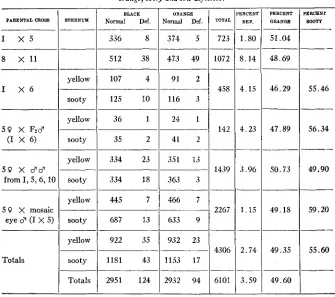
female gave all type, 63 males and 183 females, while the reciprocal cross produced 71 orange males and 85 type females. Fz males are recorded in table 1 ;I
X 5, with reference to venation and eye color. The percentage of defectives, 1.80, is over three times as high as in pure I and many times as high as L stock 5.I n order to test more fully the production of defectives in the second generation from crosses of
I
and normal L, wasps from stock 8 and stock11 were turned over in the spring of 1925 to ACHSA BEAN, a graduate stu- dant at the UNI~ERSITY OF MAINE. Stock 8 is an orange-eyed L stock of
normal venation showing in the males but 3 defectives among 4336 stud- ied (WHITING, P. W. 1924, p. 38). No change has been noted in this stock.
Stock 11 as stated above is of .pure I origin.
F2 males counted by
MISS
BEAN are recorded in table 1 ; 8 X 11. The ratio of defectives, 8.14 percent, is greatly in excess of that for the earlier experiment, 1.80 percent. Both exceed that of the pure I males, 0.560 percent, and of normal L males, 0.0807 percent. These differences may be attributed to chance selection of material used in the crosses.L orange-eyed low defective crossed with
I.
An orange male from stock 6(low defective
L, 0.325
percent defective) was crossed with a black I fe- male. Classification was made on the basis of eye color, venation and mesosternum, the latter being called simply yellow or sooty.F1
showed only normal venation and black eyes, 26 sooty males and 77 yellow females F, males are recorded i n table 1 ; 1 x 6 .3 10 P. W . WHITING
female resulting in 25 orange males and 39 black females. All but one of each sex had yellow sterna.
Fz
males are recorded in table 1 ;5
Q xF28(I
X6).Three defective sooty males from combinations of I material with stocks
5 , 6 and 10 were crossed with stock
5
females. There resulted males; sooty2, orange 104, orange sooty 10, females; type 98, sooty 9. (It may be noted that the two patroclinous males are sooty as well as black-eyed showing paternal character while the majority of the regular males as well as the females have yellow sterna.) FZ males are recorded in table 1 ; 5 Q X d* C?
from
1,
5 , 6, 10.I n t h e 1 x 5 series there occurred a male with eyes that were mosaics of black and orange (Freak 154). He bred like a black when crossed to stock
5 females and the
Fz
generation from his daughters showed that he trans- mitted sooty. F2 males are recorded in table 1 ; 5 Q X mosaic eye $(I
~ 5 ) .Summary and discussion; failure of linkage of orange, sooty, and defective.
The various crosses discussed above involved pure L, stock 5, 6 or 8 , on the one side. On the other were black-eyed sooty wasps, either of pure
I
origin or derived from I crossed with various orange 1, stocks. Hence the character black-eye and the “main factor” for sooty-sternum came into the cross from one side, orange-eye and yellow-sternum from the other. Among the 4306 Fz males classified with reference to orange and sooty, there are 49.4 percent recombinations, and hence no evidence of linkage.As regards defective venation i t is impossible to tell the origin of the factors involved. No “main factor” seems to be present since both parents occasionally show defective and the factors may recombine. On the average the I material is somewhat more defective than the L; hence coupl- ing with black or with sooty is to be expected if any linkage exists.
Among the total blacks are 4.032 percent defective and among the total orange 3.105 percent defective. The difference which is slightly less than three times its probable error may possibly indicate the presence of a minor factor for defect, dr, comparable with such as have been previously shown
(WHITING,
P. W. 1924, p. 45ff).
Among the total sooty are 2.506 percent defective and among the total yellow are 3.033 percent defective. This indicates that there is no apparent linkage between the low defective factors and sooty.
VARIABLE CHARACTERS I N HABROBRACON 311
BLACK
Normal Def.
336 8
TABLE 1
F 2 males from black-eyed sooty crossed with orange-eyed yellow, showing segregating relationships of mange, sooty and low defective.
ORANGE
Normal Def.
374 5 723
PARENTAL CROSS
PERCENT DEF. 1.80 8.14 4.15 4.23 3.96 1.15 I x 5
PERCENT PERCENr ORANQn SOOTY
~~-~
51.0448.69 ----
-
~
-
-46.29 55.46
--
47.89 56.34
_ _ _ ~ - -
50.73 49.90
_ _ ~ _ _ _ _
49.18 59.20
~
~
_
-8 X 11 512 38
107 4
125 10
36 1
35 2
334 23
334 18
445 7
687 13
922 35
1181 43
2951 124 - I X 6
473 49 1072
9 1 2
116 3
24 1
41 2
351 13
363 3
466 7
633 9
932 23
1153 17
2932 94 6101 458 ~- 142 - 1439 2267
-____
4306 _____ __5 9
x
0707 from I, 5, 6, 102.74
3.59
5 0 X mosaic eye 3 (I X 5)
49.35 55.60
49.60 Totals STERNUM yellow sooty yellow sooty yellow sooty yellow sooty yellow sooty Totals
Effects of crossing, selection and inbreeding on defective and sooty. The I by 5 series. Origin of stocks 12, 13, 14.
Some of the defective males of the Fz generation from the original
I
by 5 cross were mated back to I females and from the progeny lines were continued, the I by 5 series. Selection was made roughly for defective and sooty, both orange and black eye color being retained. Three stocks were isolated all with very dark sterna.Stock 12 rarely shows defective. Percentages of defectives in the males of the various generations in its ancestry tracing backwards were 2.0, 11.7, 4.6, 1.2, 3.5, 0, 2.4, 0. No definite counts to determine ratio of de- fectives in pure bred stock 12 have been made, but ANNA R.
WHITING
in studies of patrocliny recorded venation character in orange males from stock 12 females crossed to black males. They totaled 1968 including 38 or 1.930 percent defective. Stock 12 is therefore a low defective stock.312 P. W. WHITING
Relations of stock 12 in production of patrocliny have been discussed by ANNA
R.
WHITING
(1925).Stock 13 with orange eyes and stock 14 with black eyes were isolated from highly defective lines. Stock 13 had percentages of defective males in various generations as follows: 68.6, 80.0, 51.5, 50.0, 19.5, 33.4, 58.6,36.9, 15.4, 11.7, 4.6. It joined the common line with stock 1 2 in the P4 genera- tion of the latter in which there were 1.2 percent defective males. Stock 14 had 50.0, 41.6, 31.3, and joined the common line with stock 13 in the P6 generation of the latter in which there were 19.5 percent defective males. U.
A.
HATJBER (1925) has selected stock 14 for still higher grade of defect and made combinations with dIIg5, the “main factor” for defective which occurred by mutation in the L material. Thus stocks have been obtained showing practically 100 percent defective.Stocks 12, 1 3 and 14 have been continued as “pure” stocks.
Both “sooty” and “defective” showed considerable variation in the I by 5 series. “Sooty” ranged from jet black to clear yellow which is typical of stock 5 as of all L material bred a t 30°C or over. The average depth of pigmentation in some lines as in stocks 12, 13 and 14, exceeded considera- bly pure I material. For the entire series the males showed sterna yellow 162, gray 194, and black 5739, out of a total of 6095. The females showed sterna yellow 1115, gray 1417, black 1123 out of a total of 3655. Percent- ages of various grades of sooty for I and for the entire
I
by 5 series are brought together for comparison as follows:I males. .
.
. . .yellow 8.85 gray 5.78 black 85.36 Total 84051x5 “ . . _ . . _ 2.66 li 3 18 ‘l 94 16 ‘‘ 6095
I females.. . . ‘. 56.08 ‘‘ 24.56 ‘L 19.36 ‘ I 1637
1 1x5 (‘ . . . . *. 30 51 ‘‘ 38.76 ‘I 30.73 3655 The I by 5 serics is therefore darker with respect to mesosternum color, not only in certain of its branches but on the average, and in both males and females.
Linkage of high defective and sooty
Black-eyed males with sooty sternum and r4 defective due to low de- fective factors were crossed to stock 10 females. There resulted 13 black patroclinous males, 170 orange males and 145 black females. F, males were graded as yellow or sooty with respect to sternum color, and also classified with respect to orange and defective. Results are recorded in table 2, group A.
A sooty male with normal venation and black eyes occurring in F2
VARIABLE CHARACTERS IN HABROBRACON 313
There were also produced 131 black-eyed females of which
3
were defective.All
were graded with respect to sterna showing 110 yellow,17
gray and 4 black. F2 males are recorded in table 2, group B.An orange-eyed sooty male from
I
material bred up to stocks5
and 6 was crossed to stock 4 female. There were produced males; type 1, de- fective 66, and females; type 126, defective 2, no sooty appearing in FI. Fz males from two virgin F1 females are recorded in table 2, group C.An orange defective (grade 8) male derived from combinations of
I
with stocks 6 and 10 was crossed with stock 11 female. There were pro- duced black males, 1 yellow and 49 sooty, black females, 87 yellow and
8 sooty. F2 males are recorded in table 2, group
D.
TABLE 2
F, males from crosses involving orange, sooty and high defective, sizowitrg segregaliltg relationships.
PARENTAL CROSS
l
EYECOLOR
l 0 0 (oSrrd~r .)X
Total Orange
3'Osrrs,D11d,
Black
_ _ _ _ _ _ I l 0 0 (oS1rdrm)X
Total Orange
3'OsrraxDrI
Black
4 9 ( O S r l d I r d X
Total Orange
~ ' O S ~ I D I I
Black
"- ___
119 (OSIIS,DI~~,)X
Total Orange
3 ' o S u d n s
Black -__-__ Total Black Orange Total PYPE
-
11 9 20 " 57 115 58 - 17 18 35 - 7 11 4 - 89 92 181-
IOOTY __ 117 72 189 I_ 370 394 764 __ 51 48 99 " 57 57 114 - 550 616 1166-
SOOTY DEFEC- TIVE >EFEC- TIVEI _ _ _ 62 44 61 97 123 53 ~- 286 56 582 30 296 26
_
_
~
45 1 55 3 100 2 ~ _ _ 48 25 99 14 51 11 _ _ _ _ 441 181 904 89 463 92 'OTAL I_ 429 1517 237 249 2432 __ &ual percenl __ actual ween1 actual percenl Ictual percenl actual percen ""231 220 286 53.84 51.05 66.67
-
"
778 638 820 51.29 42.06 54.05
~ - _ _ _
122 103 102 51.48 43.46 43.04
~ _ _ _ -
50.60 49.80 55.82
1261
124
l
139____-
1257 1085 1347 51.69 44.61 55.39
-
CROSS- OVERS (?) __ 117 27.27 __ 171 11.27 __ 38 16.03 __ 36 14.46 " 361 14.88-
The four summaries of F2 males from defective by sooty are totaled with respect to these two characters a t the bottom of table 2. It may be seen that there is clear evidence of linkage for the recombinations, cross- overs (?), are but 14.88 percent of the total, This may be regarded as a
314 P. U’. WHITING
“repulsion” series but since both characters are variable there is no evi- dence that any of the 362 apparent crossovers are genetic. Moreover any of the 2070 apparent straights may be genetic crossovers. Crossing Over could be tested by breeding the apparent crossovers to a parent stock. This test would be complicated by recombination of supernumerary factors both for sooty and for defective.
The “main factor” or group of factors for sooty, showing linkage with &F,, may be called SII. Supernumerary factors for sooty of unknown
linkage groups may be called sx, and similarly supernumerary factors for defective may be called
dx.
Referring to the totals in table 2 we find that out of 2432
Fz
males, orange is very close to the expected 50 percent. There is a marked defi- ciency of defectives, doubtless due to the character overlapping withnormal, despite the presence of supernumerary factors,
dx,
in Some of the groups. There is a marked excess of Sooty, probably due to supernumerary factors, s X .Formulae for the parental crosses of the various groups are shown in the second column. Females are from stock 10, orange yellow de- fective, stock 4 ( O S I I ~ I I ~ ~ ) black yellow defective, and stock l l (Os11
Sx
DXI dx) black sooty sooty-supernumerary normal defective-supernum- erary. Males are of diverse composition but always different from females with reference to U , SII and dIIl15. As regards supernumerary factors, s xand dx, their formulae are hypothetical in part although based on origin, character, and progeny.
Orange offspring do not depart significantly from expectation in any of the groups.
Defective is in excess of expectation in groups
A
and D, sx coming from the male in A, from the female in D. ( I t must be noted that expectation is well below 50 percent due to overlapping, and that a ratio of 50 percent or over indicates supernumerary factors, dx, if temperature is standard,Sooty is in excess in groups A, B, and D, coming from the males in A and B, from the female in D. I n groups C and D the males have been freed of supernumerary factors possessed by I material, stock 11, by crossing with L material.
Variation in ratios of crossovers (?) might be correlated with presence of supernumerary factors but this cannot be done satisfactorily in the present instance, because of differences in standard of grading. It would also have
VARIABLE CHARACTERS I N HABROBRACON 315
GENERAL SUMMARY AND CONCLUSIONS
Hereditary factors governing defective venation (breaks in the fourth branch of the radius, r4) and sooty mesosternum are discussed. Both characters show continuous variation and are much affected by environ- mental factors, temperature in particular.
I n certain stocks of Lancaster material (L) there occurs a factor, ~ I I S ,
producing about 95 percent defectives among the males. Other L stocks are known as type, (less than one-tenth percent defective), and low de- fective (less than one percent defective). Total Iowa City material
(I)
recorded, 12, 678 males and 2315 females, showed less than one percent defective.
Fz generations from crosses of
I
material with type or low defectiveL
or with individuals of mixed origin (LI) show no evidence of linkage be- tween sooty and defective.
Certain of these
Fz
generations indicate recombinations of factors in- creasing ratio of defectives. This theory is strengthened by the great increase of defectives in certain branches of a series derived from I crossedwith normal L material,
I
by 5 series. Stocks 13 and 14, derived from the I by 5 series show very high ratios of defectives, over 50 percent, without the presence ofdIIg5.
Sooty mesosternum occurs in I material of which 8405 males and 1637 females were bred and graded in this respect. Males of either
L
or I ma- terial tend to be darker than their corresponding females but I females are darker than L males.Recombination of factors for sooty is shown by the mesosterna of the
I
by 5 series and by stocks 12, 13 and 14 derived from it. Stocks 12, 13 and 14 have very black mesosterna in both males and females. Of theI
by 5 series 6095 males and 3655 females were graded, averaging darker than the I males and females respectively.
Fz. males from high defective, &Ig5, crossed with sooty were type 181, defective 904, sooty 1166 and defective sooty 181. Since characters are variable this is not to be considered a correct gametic ratio. It does, however, demonstrate linkage of the main factor for defective, dIIg5, with the main factor for sooty which may therefore be called
Sir.
This linkage taken in connection with failure of linkage between low defective and sooty possessing SII indicates that the low defective under consideration was not in Chromosome 11.316 P. W. WHITING
LITERATURE CITED
HAUBER, U. A., 1925 An analysis by selection and crossing, of genetic factors involved in defective venation, a variable character of the parasitic wasp, Habrobracon juglandis (Ashmead). Genetics 10: 91-116.
WHITING, ANNA R., 1925 The inheritance of sterility and of other defects induced by abnormal fertilization in the parasitic wasp, Habrobracon juglandis (Ashmead). Genetics 10: 33-58
WHITING, P. W . , 1921a Studies on the parasitic wasp, Hadrobracon brevicornis (Wesmael). Biol. Bull. 41 : 42-54.
1921b Studies on the parasitic wasp, Hadrobracon brevicornis (Wesmael). Biol. Bull. 41:
1924 A study in hereditary and environmental factors determining a variable character. 143-155.