Customer Satisfaction- Aware Profit
Optimization Model to Find the Numeric
Optimal Cloud Configuration for Cloud
Service Providers
Ponnuru Aruna1, J.Raghunath2
M.Tech Student, Dept. of CSE, Gates Institute of Technology, Affiliated to JNTUA , Andhra Pradesh, India 1
Associate Professor, Dept. of CSE, Gates Institute of Technology, Affiliated to JNTUA, Andhra Pradesh, India2
ABSTRACT: In this paper, we take customer satisfaction into consideration to address the problem how to configure their cloud service platforms to obtain the maximum profit becomes increasingly the focus that they pay attention to. Customer satisfaction affects the profit of cloud service providers in two ways. On one hand, the cloud configuration affects the quality of service which is an important factor affecting customer satisfaction. On the other hand, the customer satisfaction affects the request arrival rate of a cloud service provider. This paper adopts the thought in Business Administration, and firstly defines the customer satisfaction level of cloud computing. Based on the definition of customer satisfaction, a profit maximization model is build in which the effect of customer satisfaction on quality of service (QoS) and price of service (PoS) is considered.
KEYWORDS: cloud computing; customer satisfaction; multiserver system; profit maximization.
I.INTRODUCTION
Cloud computing is quickly becoming an effective and efficient way of computing resources and computing services consolidation. By centralized management of resources and services, cloud computing delivers hosted services over the Internet, such that accesses to shared hardware, software, databases, information, and all resources are provided to consumers on-demand. Cloud computing is able to provide the most cost-effective and energy-efficient way of computing resources management and computing services provision. Cloud computing turns information technology into ordinary commodities and utilities by using the pay-per-use pricing model.
take customer satisfaction into consideration in solving profit maximization problem, or the existing works considering customer satisfaction do not give a proper formalized definition for it. To address the problem, this paper adopts the thought in Business Administration and defines the customer satisfaction level of cloud computing.
II. LITERATURE SURVEY
1) "Optimal multi server configuration for profit maximization in cloud computing,” Authors: J. Cao, K. Hwang, K. Li, and A. Y. Zomaya
As cloud computing becomes more and more popular, understanding the economics of cloud computing becomes critically important. To maximize the profit, a service provider should understand both service charges and business costs, and how they are determined by the characteristics of the applications and the configuration of a multiserver system. The problem of optimal multiserver configuration for profit maximization in a cloud computing environment is studied. Our pricing model takes such factors into considerations as the amount of a service, the workload of an application environment, the configuration of a multiserver system, the service-level agreement, the satisfaction of a consumer, the quality of a service, the penalty of a low-quality service, the cost of renting, the cost of energy consumption, and a service provider's margin and profit. Our approach is to treat a multiserver system as an M/M/m queuing model, such that our optimization problem can be formulated and solved analytically. Two server speed and power consumption models are considered, namely, the idle-speed model and the constant-speed model. The probability density function of the waiting time of a newly arrived service request is derived. The expected service charge to a service request is calculated. The expected net business gain in one unit of time is obtained. Numerical calculations of the optimal server size and the optimal server speed are demonstrated.
2) “Models of consumer satisfaction formation: An extension,” Authors: D. K. Tse and P. C. Wilton.
The authors extend consumer satisfaction literature by theoretically and empirically (1) examining the effect of perceived performance using a model first proposed by Churchill and Surprenant, (2) investigating how alternative conceptualizations of comparison standards and disconfirmation capture the satisfaction formation process, and (3) exploring possible multiple comparison processes in satisfaction formation. Results of a laboratory experiment suggest that perceived performance exerts direct significant influence on satisfaction in addition to those influences from expected performance and subjective disconfirmation. Expectation and subjective disconfirmation seem to be the best conceptualizations in capturing satisfaction formation. The results suggest multiple comparison processes in satisfaction formation.
3) “Maximizing cloud providers’ revenues via energy aware allocation policies,”
Cloud providers, like Amazon, offer their data centers' computational and storage capacities for lease to paying customers. High electricity consumption, associated with running a data center, not only reflects on its carbon footprint, but also increases the costs of running the data center itself. This paper addresses the problem of maximizing the revenues of Cloud providers by trimming down their electricity costs. As a solution allocation policies which are based on the dynamic powering servers on and off are introduced and evaluated. The policies aim at satisfying the conflicting goals of maximizing the users' experience while minimizing the amount of consumed electricity. The results of numerical experiments and simulations are described, showing that the proposed scheme performs well under different traffic conditions.
4) “Optimal power allocation and load distribution for multiple heterogeneous multicore server processors across clouds and data centers,”
Authors: J. Cao, K. Li, and I. Stojmenovic,
constrained load distribution methods for cloud computing in current and future large-scale data centers. In particular, we address the problem of optimal power allocation and load distribution for multiple heterogeneous multicore server processors across clouds and data centers. Our strategy is to formulate optimal power allocation and load distribution for multiple servers in a cloud of clouds as optimization problems, i.e., power constrained performance optimization and performance constrained power optimization. Our research problems in large-scale data centers are well-defined multivariable optimization problems, which explore the power-performance tradeoff by fixing one factor and minimizing the other, from the perspective of optimal load distribution. It is clear that such power and performance optimization is important for a cloud computing provider to efficiently utilize all the available resources. We model a multicore server processor as a queuing system with multiple servers. Our optimization problems are solved for two different models of core speed, where one model assumes that a core runs at zero speed when it is idle, and the other model assumes that a core runs at a constant speed. Our results in this paper provide new theoretical insights into power management and performance optimization in data centers.
III. EXISTING SYSTEM
Chen et al. adopted utility theory leveraged from economics and developed an utility model for measuring customer satisfaction in cloud. In the utility model, consumer satisfaction is relevant to two factors: service price and response time. They assumed that consumer satisfaction is decreased with higher service price and longer response time.
In other work, the user satisfaction is calculated as the ratio of the actual QoS level and the expected QoS level.
Wu et al. proposed an admission control and scheduling algorithms for SaaS providers to maximize profit by minimizing cost and improve customer satisfaction level. However, they did not give a specific formula to measure customer satisfaction level.
Chao et al. proposed a customer satisfaction aware algorithm based on the Ant-Colony Optimization(AMP) for geo-distributed datacenters.
DISADVANTAGES OF EXISTING SYSTEM:
The request arrival rate of a service provider is affected by many factors in actual, and customer satisfaction is the most important factor
Few existing works take customer satisfaction into consideration in solving profit maximization problem, or the existing works considering customer satisfaction do not give a proper formalized definition for it.
The existing formulas measuring customer satisfaction of cloud computing cannot properly reflect the definition of customer satisfaction, and they did not take into account user’s psychological differences
IV.PROPOSED WORK
This paper adopts the thought in Business Administration, and firstly defines the customer satisfaction level of cloud computing.
Based on the definition of customer satisfaction, we build a profit maximization model in which the effect of customer satisfaction on quality of service (QoS) and price of service (PoS) is considered.
ARCHITECTURE
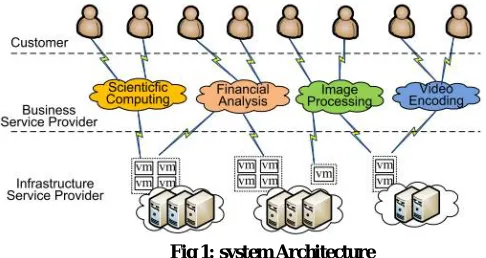
Fig 1: system Architecture
IMPLEMENTATION
A) Data Owner
In this module, the data owner uploads their data in the cloud server. For the security purpose the data owner encrypts the data file and then store in the cloud. The Data owner can have capable of manipulating the encrypted data file and the data owner can set the access privilege to the encrypted data file.
B) Cloud Servers
The Data Owner sends a request to Cloud Scheduler to provide services by assigning the task for any one cloud like Cs1, CS2, and CS3. The cloud service provider manages multiple clouds to provide data storage service via Cloud Scheduler. To access the shared data files, data consumers download encrypted data files of their interest from the specified cloud and then decrypt them and The Cloud server can attack the files in the cloud Server and performs the following operations such as Create 4 VMs by assigning memory, Receive file and assign the file to corresponding VM which is having more memory, View all VMs Memory, View all data owners and files., View all attackers, View all transactions (Upload, Download)
C) Cloud Scheduler
The Cloud Scheduler Will Schedule the cloud based on the number of jobs and SLA Time Period and performs the following operations such as Schedule the cloud based on the number of jobs, Schedule the cloud based on the SLA Period, View all transactions (Upload and downloads),View all Cloud Schedules (both no. of jobs, SLA Period)
D) Queuing model in Cloud Scheduler
E) Data Consumer(End User)
In this module, the user has to get Registered to Trust Manager to access the Cloud services and need to Authenticate the user by Logging in by providing the User Name and auto Generated Password by cloud server then the Data Consumer can access the data file with the encrypted key, so if User access the file by wrong Key then the user will consider as malicious users and blocked the User.
V. CONCLUSION
In this paper, we consider customer satisfaction in solving optimal configuration problem with profit maximization. Because the existing works do not give a proper definition and calculation formula for customer satisfaction, hence, we first give a definition of customer satisfaction leveraged from economics and develop a formula for measuring customer satisfaction in cloud. Based on the affection of customer satisfaction on workload, we analyze the interaction between the market demand and the customer satisfaction, and give the calculation of the actual task arrival rate under different configurations. In addition, we study an optimal configuration problem of profit maximization. The optimal solutions are solved by a discrete hill climbing algorithm. Lastly, a series of calculations are conducted to analyze the changing trend of profit. Moreover, a group of calculations are conducted to compare the profit and optimal configuration of two situations with and without considering the affection of customer satisfaction on customer demand.
REFERENCES
[1] P.MELL AND T.GRANCE,“THE NIST DEFINITION OF CLOUD COMPUTING,” COMMUNICATIONS OF THE ACM, VOL.53, NO.6, PP.50–50,2011. [2] J.CAO, K.HWANG, K.LI, AND A.Y.ZOMAYA,“OPTIMAL MULTISERVER CONFIGURATION FOR PROFIT MAXIMIZATION IN CLOUD COMPUTING,” IEEE TRANS.PARALLEL DISTRIB.SYST., VOL.24, NO.6, PP.1087–1096,2013.
[3]“AMAZON EC2,” HTTP://AWS.AMAZON.COM,2015. [4]“MICROSOFT AZURE,”
HTTP://WWW.MICROSOFT.COM/WINDOWSAZURE,2015. [5]“SALEFORCE.COM,”
HTTP://WWW.SALESFORCE.COM/AU,2014.
[6] J.MEI, K.LI, A.OUYANG, AND K.LI,“A PROFIT MAXIMIZATION SCHEME WITH GUARANTEED QUALITY OF SERVICE IN CLOUD COMPUTING,” IEEE TRANS.COMPUTERS, VOL.64, NO.11, PP.3064–3078, NOV 2015.
[7] R.N.CARDOZO,“AN EXPERIMENTAL STUDY OF CUSTOMER EFFORT, EXPECTATION, AND SATISFACTION,” JOURNAL OF MARKETING RESEARCH, PP. 244–249,1965.
[8] J.A.HOWARD AND J.N.SHETH, THE THEORY OF BUYER BEHAVIOR.WILEY NEW YORK,1969, VOL.14.
[9] G.A.CHURCHILL JR AND C.SURPRENANT,“AN INVESTIGATION INTO THE DETERMINANTS OF CUSTOMER SATISFACTION,” JOURNAL OF MARKETING RESEARCH, PP.491–504,1982.
[10] D.K.TSE AND P.C.WILTON,“MODELS OF CONSUMER SATISFACTION FORMATION: AN EXTENSION,” JOURNAL OF MARKETING RESEARCH, PP. 204–212,1988.
BIOGRAPHY
MISS PONNURU ARUNA RECEIVED B.TECH DEGREE IN COMPUTER SCIENCE &ENGINEERING FROM INDIRA PRIYADARSHINI COLLEGE OF ENGINEERING AND
TECHNOLOGY FOR WOMEN KURNOOL AND PURSUING MASTER'S DEGREE FROM GATES
INSTITUTE OF TECHNOLOGY ,GOOTY AFFILIATED TO JNTUANANTAPUR,A.P.