ISSN(Online): 2319-8753 ISSN (Print) : 2347-6710
I
nternational
J
ournal of
I
nnovative
R
esearch in
S
cience,
E
ngineering and
T
echnology
(A High Impact Factor, Monthly, Peer Reviewed Journal) Visit: www.ijirset.com
Vol. 7, Issue 12, December 2018
Evaluate the Performance of Diagrid Building
for Bracing Angle and Shape
Manasi Suresh Kambale, Prof.Shriganesh S Kadam
M. E Student, Department of Civil Engineering, S. K. N. Sinhgad College of Engineering Korti, Pandharpur.
Solapur University, Solapur, India
Department of Civil Engineering, S. K. N. Sinhgad College of Engineering Korti, Pandharpur, Solapur University,
Solapur, India
ABSTRACT: The rapid growth of urban population and limitation of available land, the taller structures are preferable
ISSN(Online): 2319-8753 ISSN (Print) : 2347-6710
I
nternational
J
ournal of
I
nnovative
R
esearch in
S
cience,
E
ngineering and
T
echnology
(A High Impact Factor, Monthly, Peer Reviewed Journal) Visit: www.ijirset.com
Vol. 7, Issue 12, December 2018
I. INTRODUCTION
1.1 Background
Tall commercial buildings are primarily a response to the intense pressure on the available land. Advances in materials, construction technology, analytical methods and structural systems for analysis and design accelerated the development of tall structures. The lateral loading due to wind and earthquake is the major factor that causes the design of high-rise buildings. These lateral loads are resisted by exterior structural system or interior structural system. The lateral load resisting systems that are widely used are mainly rigid frame, shear wall, wall-frame, braced tube system, outrigger system, diagrid system and tubular system. Recent trend shows that the diagrid structural system is becoming popular in the design of tall buildings due to its inherent structural and architectural advantages. Diagrid is an exterior structural system in which all perimeter vertical columns are eliminated and consists of only inclined columns on the façade of the building. Shear and over-turning moment developed are resisted by axial action of these diagonals compared to bending of vertical columns in framed tube structure. Vertical columns in the core are designed for carrying gravity loads only and the diagrid is useful for both gravity and lateral loading. Diagonalized applications of structural steel members for providing efficient solutions both in terms of strength and stiffness are not new, however nowadays a renewed interest in it and a wide spread application of diagrid is registered with reference to large span and high rise buildings, particularly when they are characterized by complex geometries and curved shapes.
The diagrid systems are the evolution of braced tube structures. The major difference between a braced tube building and a diagrid building is that, there are no vertical columns present in the perimeter of diagrid building. The diagonal members in diagrid structures act both as inclined columns and as bracing elements and due to their triangulated configuration, mainly internal axial forces arise in the members. Diagrid structures do not need high shear rigidity cores because shear can be carried by the diagrids located on the perimeter. The concept of diagrid is not new at all; people have always been intuitively familiar with the inherent stability of triangular structures. Placement of diagonals is the oldest and most natural solution in steel structures, and has widespread applications, receiving great popularity among engineers and architects; however the past architects considered diagonals highly obstructive and usually embedded them within the building interior cores.
1.2 Motivation
ISSN(Online): 2319-8753 ISSN (Print) : 2347-6710
I
nternational
J
ournal of
I
nnovative
R
esearch in
S
cience,
E
ngineering and
T
echnology
(A High Impact Factor, Monthly, Peer Reviewed Journal) Visit: www.ijirset.com
Vol. 7, Issue 12, December 2018
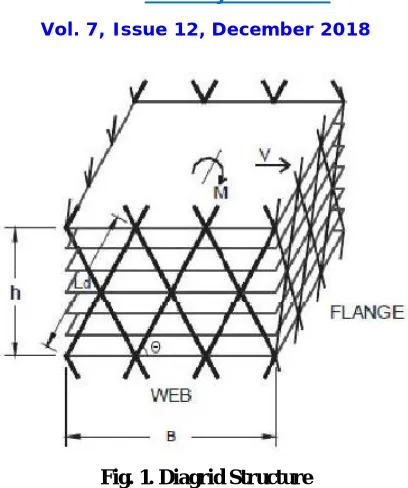
Fig. 1. Diagrid Structure
The diagonal members in diagrid structural systems can carry gravity loads as well as lateral forces due to their triangulated configuration. Diagrid structures are more effective in minimizing shear deformation because they carry lateral shear by axial action of diagonal members. Diagrid structures generally do not need high shear rigidity cores because lateral shear can be carried by the diagonal members located on the periphery.
Merits of Diagrid Structural System
1. The diagrid structures have mostly column free exterior and interior, hence free and clear, unique floor plans are possible.
2. The glass facades and dearth of interior columns allow generous amounts of day lighting into the structure. 3. The use of diagrids results in roughly 1/5th reduction in steel as compared to braced frame structures. 4. The construction techniques involved are simple, yet they need to be perfect.
5. The diagrids makes maximum exploitation of the structural material. 6. The diagrid structures are aesthetically dominant and expressive.
1.3 . Objective
1) To access the performance of high rise octagonal building with daigrid. 2) To access the performance of high rise hexagonal building with daigrid.
3) To compare result between octagonal and hexagonal building and finalizing suitable building based on performance.
ISSN(Online): 2319-8753 ISSN (Print) : 2347-6710
I
nternational
J
ournal of
I
nnovative
R
esearch in
S
cience,
E
ngineering and
T
echnology
(A High Impact Factor, Monthly, Peer Reviewed Journal) Visit: www.ijirset.com
Vol. 7, Issue 12, December 2018
story displacement, time period for various mode shapes, inter-story drift and lateral load distribution on diagrid and internal columns are plotted. Optimum brace angle for diagrid structures circular in plan is determined for various parameters.
Ravish Khan et.al. [2]In the diagrid structures, the vertical columns from the periphery are eliminated and this constructs the main difference between diagrids and exterior braced frames. Having triangulated configuration, the diagrids are able to carry the gravity and lateral loads. They also effectively minimize shear deformation as the diagonals carry the loads axially. The diagrid structural system is adopted these days for tall buildings because of its stiffness and flexibility in the architectural planning. This paper presents the study of 20-storeydiagrid structure in comparison with exterior braced frame structure. Analysis results and design of both the models are presented in terms of storey shear, displacement, drift and summary of lateral and gravity forces.
Paresh V. Patelbet.al[3]Structural design of high rise buildings is governed by lateral loads due to wind or earthquake. Lateral load resistance of structure is provided by interior structural system or exterior structural system. Usually shear wall core, braced frame and their combination with frames are interior system, where lateral load is resisted by centrally located elements. While framed tube, braced tube structural system resist lateral loads by elements provided on periphery of structure. It is very important that the selected structural system is such that the structural elements are utilized effectively while satisfying design requirements.Compared to closely spaced vertical columns in framed tube, diagrid structure consists of inclined columns on the exterior surface of building. Due to inclined columns lateral loads are resisted by axial action of the diagonal compared to bending of vertical columns in framed tube structure. Diagrid structures generally do not require core because lateral shear can be carried by the diagonals on the periphery of building. Analysis and design of 36 storey diagrid steel building is presented. A regular floor plan of 36 m × 36 m size is considered. ETABS software is used for modeling and analysis of structural members. All structural members are designed as per IS 800:2007 considering all combinations. Dynamic along wind and across wind are considered for analysis and design of the structure. Load distribution in diagrid system is also studied for 36 storey building. Similarly, analysis and design of 50, 60, 70 and 80 storey diagrid structures is carried out.
B K Raghu Prasad et. al. [4]In the present paper it is aimed to study different lateral load resisting systems like
octagrid and hexagrid bracing systems for tall building. Not much information is available in the literature on such systems. It is intended to study such lateral load resisting systems. The two types of bracing systems including octagrid and hexagrid bracings are modeled and analyzed. Behavior under lateral loads of hexagrid and octagrid system is compared with that and the commonly employed shear wall systems. The key parameter for comparison is the top story displacement under wind and seismic loading, the maximum storey drift ratio and also quantity of concrete consumed. It is found that the hexagrid and octagrid systems are best with respect to the above parameter. Although there is a marginal increase in the quantity of concrete consumed.
PatilMohanaKeshavet. al. [5]Now-a-days, there is rapid increase in development of tall buildings all over the world Advances in construction technology, materials, structural systems and analytical methods for analysis and design facilitated the growth of high rise buildings. It is very important that the selected structural system is such that the structural elements are utilized effectively while satisfying design requirements. Recently diagrid structural system is adopted in tall buildings due to its structural efficiency and flexibility in architectural planning. Compared to closely spaced vertical columns in framed tube, diagrid structure consists of inclined columns on the exterior surface of building Due to inclined columns lateral loads are resisted by axial action of the diagonal compared to bending of vertical columns in framed tube structure.
PoojaUdaykumar et.al. [6] Diagrids structures have evolved as an effective and innovative form used in the
ISSN(Online): 2319-8753 ISSN (Print) : 2347-6710
I
nternational
J
ournal of
I
nnovative
R
esearch in
S
cience,
E
ngineering and
T
echnology
(A High Impact Factor, Monthly, Peer Reviewed Journal) Visit: www.ijirset.com
Vol. 7, Issue 12, December 2018
performed examining on the behavior of structures and its performance under dynamic loads.In this study, a G+50 storey structure with tubular diagrid configuration is used with modeling done in ETABS and a non-linear type of investigation is performed on the different models having varied angles along the height of the structure. Also the building is situated in zone III and medium soil is used. From the analysis, various diagrid angles used in the structure are assessed for different parameters of earthquake and results are studied.
SachinHirannaiahet al.[7]In this paper, studied the performance characteristics of diagrid structures using nonlinear static pushover analysis. The models studied are circular in plan with aspect ratio H/B, (where H is total height and B is the base width of structure) varying from 2.67 to 4.26. The three different angles of external brace considered are 59°, 71° and 78°. The width of the base is kept constant at 12m and height of the structure is varied accordingly. The nonlinear behavior of the elements is modeled using plastic hinges based on moment- curvature relationship as described in FEMA 356 guidelines. Seismic response of structure in terms of base shear and roof displacement corresponding to performance point were evaluated using nonlinear static analysis and the results are compared. For 71° brace angle model base shear at performance shows an increase in all the aspect ratio considered in the study.
Harshada A. Naik [8] This paper reviewed the different authors on behavior of diagrid structures under wind loading and seismic loading to understand the performance of diagrid structures. According to this study it given the indication on parameters in terms of time-period, top-storey displacement, inter-storey drift and storey shear.
Ravi Sorathiyaet. al. [9] In this paper studied that stiffness-based design methodology for determining preliminary member sizes of r.c.c diagrid structures for tall buildings. A G+24, G+36,G+48,G+60 storey RCC building with plan size 18 m × 18 m located in surat wind and seismic is considered for analysis. STAAD Pro software is used for modelling and analysis of structural members. All structural members are designed as per IS 456:2000 and load combinations of seismic forces are considered as per IS 1893(Part 1): 2002. Comparison of analysis results in terms of beam displacement, Storey Drift, Bending Moment. This cause economical design of diagrid structure compared to conventional structure.
Rohit Kumar Singh et.al. [10]This paper had aimed is to concrete diagrid structure is analysed and compared with conventional concrete building. Structural design of high rise buildings is governed by lateral loads due to wind or earthquake. Lateral load resistance of the structure is provided by interior structural system or exterior structural system. Due to inclined columns lateral loads are resisted by axial action of the diagonal in diagrid structure compared to bending of vertical columns in conventional building.For this study A customary R.C.C building of five storey having floor design of size 36 m × 36 m located in seismic zone V is considered. STAAD Pro-software is used for modeling and analysis of structural members. All structural members are designed as per IS 456:2000 and load combinations of seismic forces are considered as per IS 1893(Part 1): 2002. Comparison of analysis results in terms of storey drift, node to node displacement, bending moment, shear forces, area of reinforcement, and also the economical aspect is presented. In diagrid structure, the major portion of lateral load is taken by external diagonal members which in turn release the lateral load in inner columns.
ISSN(Online): 2319-8753 ISSN (Print) : 2347-6710
I
nternational
J
ournal of
I
nnovative
R
esearch in
S
cience,
E
ngineering and
T
echnology
(A High Impact Factor, Monthly, Peer Reviewed Journal) Visit: www.ijirset.com
Vol. 7, Issue 12, December 2018
outside auxiliary framework. While confined tube, propped tube auxiliary framework oppose parallel loads by components gave on outskirts of structure. It is vital that the chose basic framework is with the end goal that the basic components are used viably while fulfilling structural requirement. According to its study diagrid basic framework is received in tall structures because of its basic proficiency, architectural requirement and adaptability in building arranging. Aim of the this study is response of four different diagrid structures of (G+30) storey are carried out to obtain optimized position of diagrid. And response of this diagrid building is compared with conventional building by providing same parameters to both the buildings. For this canalization is carried out by using ETAB software. And its result is obtained in terms of storey displacement brings about terms of day and age, top story removal and between story float is introduced in this paper.
HrdyaMenon[14] The study is consists of a perimeter grid made up of a series of triangulated truss system. Diagrid is formed by intersecting the diagonal and horizontal components. Due to inclined columns lateral loads are resisted by axial action of the diagonal in diagrid structure compared to bending of vertical columns in conventional buildings. Generally for tall building diagrid structure steel is used. Analysis and design of 30 RC building with steel is presented. A regular floor plan of 36 x36 m size is considered. ETABS software is used for modeling and analysis of structural members. All structural members are designed as per IS 456:2000 and IS 800:2007 considering all load combinations. Later the optimum angle for a 30 storey RC building with steel diagrid is found out.
Prashant T. G.et. al.[15] In this paper presented a 12 storey steel diagrid structure which is 36m in height. Symmetric and asymmetric structural configurations of diagrid structures were modeled and analyzed using SAP 2000 by considering Dead load, Live load and Seismic Loads (IS 1893-Part-1, 2002). Then FEMA 356 hinges (auto hinges) are assigned to the same structure and Nonlinear Static (Pushover) analysis is carried out by using seismic load as the pushover load case to find out the performance points that is Immediate Occupancy, Life Safety, and Collapse Prevention of diagrid elements using static pushover curve. At the same time spectral displacement demand & spectral displacement capacity as well as spectral acceleration demand and spectral acceleration capacity is compared to know the adequacy of the design by using ATC capacity spectrum method
ISSN(Online): 2319-8753 ISSN (Print) : 2347-6710
I
nternational
J
ournal of
I
nnovative
R
esearch in
S
cience,
E
ngineering and
T
echnology
(A High Impact Factor, Monthly, Peer Reviewed Journal) Visit: www.ijirset.com
Vol. 7, Issue 12, December 2018
IV. CONCLUSION
From the consideration of all the above points we conclude that the rapid growth of urban population and limitation of available land, the taller structures are preferable nowadays. So when the height of structure increases then the consideration of lateral load is very much important. For that the lateral load resisting system becomes more important than the structural system that resists the gravitational loads In this era, there is rapid increasing in construction of high rise building all over the world. Development of building types, forms, spans, construction technology, analysis and design software ease the growth of the high rise building. So when the height of structure is increases then the consideration of lateral force is become vital. For that the lateral force opposing formwork turns out to be more essential than the conventional framework that opposes gravitational force. The lateral force resisting framework that are broadly exerted as shear wall, wall frame, rigid frame, outrigger system, and braced tube system. In the present decade diagrid system has been widely used for high rise building because of its structurally efficiency and the aesthetical pleasant view given by the specially geometric arrangement of the framework. Hence the diagrid system satisfied the both architectural and structural requirement for high rise building. Diagrid has great appearance and it is effortlessly perceived. The auxiliary effectiveness of diagrid system additionally helps in avoiding the internal and corner columns, therefore permitting the huge adaptability with the floor plan. The setup and effectiveness of a diagrid system need the less number of structural elements on the exterior of the building. This is possible because the diagonal members in diagrid structural systems can carry gravity loads as well as lateral forces owing to their triangulated configuration, whereas the diagonals in conventional braced frame structures carry only lateral loads. Compared with conventional framed tubular structures without diagonals, diagrid structures are much more effective in minimizing shear deformation because they carry shear by axial action of the diagonal members, while conventional framed tubular structures carry shear by the bending of the vertical columns. Diagrid structures do not need high shear rigidity cores because shear can be carried by the diagrids located on the perimeter.
REFERENCES
[1] K. Kamath, ( 2016) "An analytical study on performance of a diagrid structure using nonlinear static pushover analysis," perspectives in science, 2016. [2] Ravish Khan, S.B. Shinde (Dec 2015) “Analysis of diagrid structure in comparison with exterior braced frame structure “International Journal of Research in Engineering and TechnologyVolume: 04 Issue: 12.pp.156-160
[3] Paresh V. Patel, KhushbuJania(2013) “Analysis and design of diagrid structural system for high rise steel buildings”Chemical, Civil and Mechanical Engineering Tracks of 3rd Nirma University International Conference on Engineering (NUiCONE- 2012).pp.92-101
[4] B K Raghu Prasad, Kavya A J, Amarnath K. (Nov 2014) “Comparative performance of octagrid and hexagrid lateral load resisting systems for tall building structure ”Int. Journal of Engineering Research and Applications Vol. 4, Issue 11(Version – 5), pp.74- 80
[5] P. Mohana, (2017) "Analysis of diagrid structure by using e-tabs software," International journal of advance technology in engineering and science, vol. 5, no. 4, 2017.
[6] PoojaUdaykumar, Supreeth, Pradeep C.R. (June 2017) “Study on behavior of tubular diagrid structures during seismic excitation “International Research Journal of Engineering and Technology (IRJET) Volume: 04 Issue: 06.pp.1033- 1039
[7] SachinHirannaiah. (May 2017) “An analytical study on performance of a diagrid structure using nonlinear static pushover analysis.”
[8] Harshada A. Naik, S. R. Suryawanshi.(March 2017) “Review on comparative study of diagrid structure with conventional building. “International Journal of Science Technology & Engineering | Volume 3 | Issue 09.pp.631-632
[9] Ravi Sorathiya, PradeepPandey.(April 2017) “Study on diagrid structure of multistory building.” International Journal of Advance Engineering and Research Development Volume 4, Issue 4,pp.512 - 524
[10] Rohit Kumar Singh, Dr. VivekGarg, Dr. Abhay Sharma (Sept 2014) “Analysis and design of concrete diagrid building and its comparison with conventional frame building. International Journal Of Science, Engineering And Technology