ISSN(Online): 2320-9801
ISSN (Print): 2320-9798
I
nternational
J
ournal of
I
nnovative
R
esearch in
C
omputer
and
C
ommunication
E
ngineering
(An ISO 3297: 2007 Certified Organization)
Vol. 3, Issue 4, April 2015
Real Time Face Detection System for Safe
Television Viewing
SurajMulla, Vishal Dubal, KedarVaze, Prof. B.P.Kulkarni
B.E. Student, Dept. of E&TC Engg., P.V.P.I.T, Budhgaon, Sangli, Maharashtra, India.
B.E. Student, Dept. of E&TC Engg., P.V.P.I.T, Budhgaon, Sangli, Maharashtra, India.
B.E. Student, Dept. of E&TC Engg., P.V.P.I.T, Budhgaon, Sangli, Maharashtra, India.
Assistant Professor, Dept. of E&TC.Engg., P.V.P.I.T, Budhgaon, Sangli, Maharashtra, India.
ABSTRACT:This system will come into picture when a human being approaches the television and stays at a particular distance for a specific time, as this is dangerous for our eye-sight, television will switch-off automatically. This system is based on the concept of face detection and further by using image processing. The television system control will be carried out by using microcontroller P89V51RD2.
KEYWORDS: Proximity, television screen, camera, face-detection, microcontroller.
I. INTRODUCTION
Television is one of the most popular entertaining systems now-a-days, but it also comes along with some drawbacks, continuous or frequent television viewing affects the natural sight of human beings. Watching television from a much closer distance affects eye-sight drastically; children do this frequently and they may have to wear spectacles with heavy numbers at an early age. This system will come into picture when a human being approaches the television and stays at a particular distance for a specific time, as this is dangerous for our eye-sight television will switch-off automatically. This system is based on the concept of face detection and further by using image processing. The television system control will be carried out by using microcontroller, and audio-video engineering.
To overcomethe harmfulness caused by television to human eyes, we have developed a system which is based on human face detection. As a human being goes nearer to the television set, his/her face will be captured by the camera. If he/she is close to the television then the captured image will be correlated with the given template. If the correlation is successful, a signal will be sent to the microcontroller for further processing. If the person stays there for a specified interval of time, then a buzzer will start ringing and warn the person to move back. If the person still stays at the same position, then after some time the television will off automatically. However, television screen will not switch-off if a pet goes or comes around it, as this system works purely on human face detection only. Also the system will not switch-off if a human being simply passes through the periphery of the television screen[2].
II. EXISTING WORK
ISSN(Online): 2320-9801
ISSN (Print): 2320-9798
I
nternational
J
ournal of
I
nnovative
R
esearch in
C
omputer
and
C
ommunication
E
ngineering
(An ISO 3297: 2007 Certified Organization)
Vol. 3, Issue 4, April 2015
to choose one of the available scripts or to prepare a new one, and to set up different audio/video modes in a room, similarly to switching profiles on mobile phones. The system is not limited to presence detection and audio/video control. Performing simple modifications of behaviour scripts, the controller can interpret data from different kinds of sensors in an unobtrusive way of controlling various home appliances[5][6][7][8].
III. METHODOLOGY
This article comprises of the following steps[1][4]:
STEP-1Capture a live image through the web-camera by using a function as ‘videoinput’. Store the image in a variable
[4]
.
STEP-2 Then extract number of samples from the captured image, store them to another variable.
STEP-3 Display the captured image.
STEP-4 Enlarge the figure-window to full screen if needed.
STEP-5 Save this image to the disk i.e. computer memory by specifying a particular file name (in this case as ‘my1image.jpg’).
STEP-6 Then write the image to filename, inferring the format to use from the filename's extension.
STEP-7 Input the image back to MATLAB by recalling it.
STEP-8 Convert the recalled image into gray-scale i.e. RGB to Gray-scale conversion.
STEP-9 Then view the captured image in ‘Image Tool 2’ by using a command ‘imview(K)’ so that image properties
(as pixel position, etc.) can be observed closely.
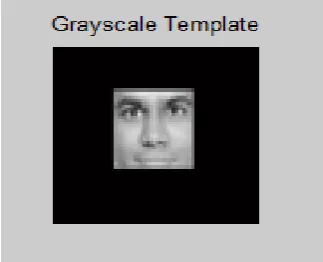
STEP-10 Choose a suitable ‘template’, convert this template into gray-scale for proper normalized cross correlation as
shown in the Fig. 1 & 2 below.
Fig. 1: Original template Fig. 2: Gray -scale template
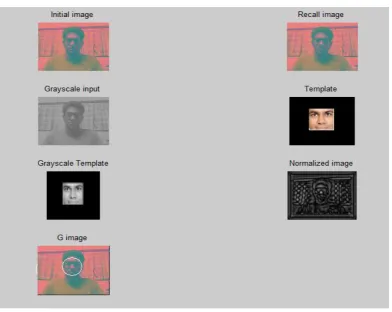
STEP-11 Then carry out face detection by using Template matching method, by correlating chosen ‘template’ over the given image to detect a human face in it as shown in Fig. 3 & 4 below.
ISSN(Online): 2320-9801
ISSN (Print): 2320-9798
I
nternational
J
ournal of
I
nnovative
R
esearch in
C
omputer
and
C
ommunication
E
ngineering
(An ISO 3297: 2007 Certified Organization)
Vol. 3, Issue 4, April 2015
Fig. 5 below shows the final plot of normalized image and the white circle in it indicates the face detected.
Fig. 5: Final output plot of the project
STEP-12Each image capturing process is delayed by ‘n’ seconds by using a command ‘pause(n)’ which pauses
execution for ‘n’ seconds before continuing, where ‘n’ can be any non-negative real number (in the program given n=5).
STEP-13Whenever face is detected, alarm goes on (as shown in the RESULT ahead), next television is switched off, if face is not detected television stays on without alarm going on. Alarm ON leaves a warning to the viewer to move away from the television to a certain distance.
IV. PROPOSED METHOD
Template Matching Method used for Face Detection:
A basic method of template matching uses a convolution mask (template), tailored to a specific feature of the search image, which we want to detect. This technique can be easily performed on grey images or edge images. The convolution output will be highest at places where the image structure matches the mask structure, where large image values get multiplied by large mask values.
ISSN(Online): 2320-9801
ISSN (Print): 2320-9798
I
nternational
J
ournal of
I
nnovative
R
esearch in
C
omputer
and
C
ommunication
E
ngineering
(An ISO 3297: 2007 Certified Organization)
Vol. 3, Issue 4, April 2015
positions of the template with respect to the search image are considered, the position with the highest score is the best position. This method is sometimes referred to as 'Linear Spatial Filtering' and the template is called a filter mask.
Design Flow:
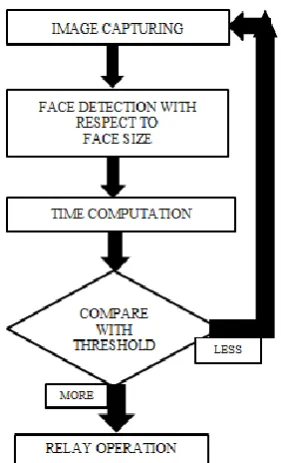
The design flow of this project paper is as shown below.
Fig. 6: Design flow of the project Construction:
An embedded camera will be mounted over the television set, and a microcontroller will be used to control the switch on/off of television set and that of the alarm, via their respective relay switches. A serial port RS232 will be used so that the camera captured data can be sent to the microcontroller serially.
When a human face appears much near to the television set, his/her facial image will be captured automatically. If that person stays at the same position for a much longer time above the threshold, then the microcontroller will raise the alarm initially to warn that person to move away, if he/she still stays near the television set, then microcontroller will switch off the television via a relay-switch.
V. EXPERIMENTAL RESULTS
ISSN(Online): 2320-9801
ISSN (Print): 2320-9798
I
nternational
J
ournal of
I
nnovative
R
esearch in
C
omputer
and
C
ommunication
E
ngineering
(An ISO 3297: 2007 Certified Organization)
Vol. 3, Issue 4, April 2015
Fig. 7: Experimental setup used for the project.
ISSN(Online): 2320-9801
ISSN (Print): 2320-9798
I
nternational
J
ournal of
I
nnovative
R
esearch in
C
omputer
and
C
ommunication
E
ngineering
(An ISO 3297: 2007 Certified Organization)
Vol. 3, Issue 4, April 2015
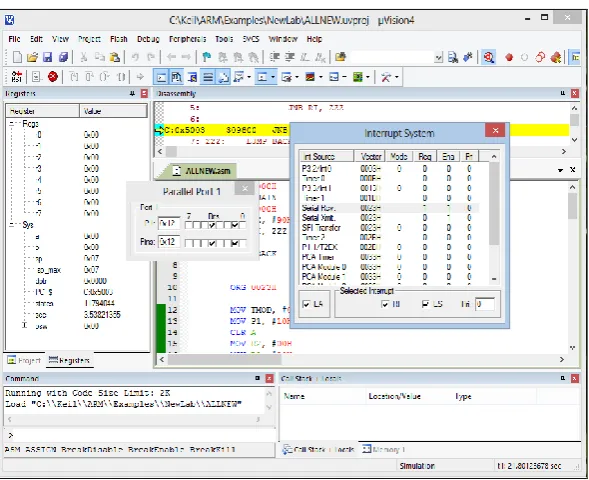
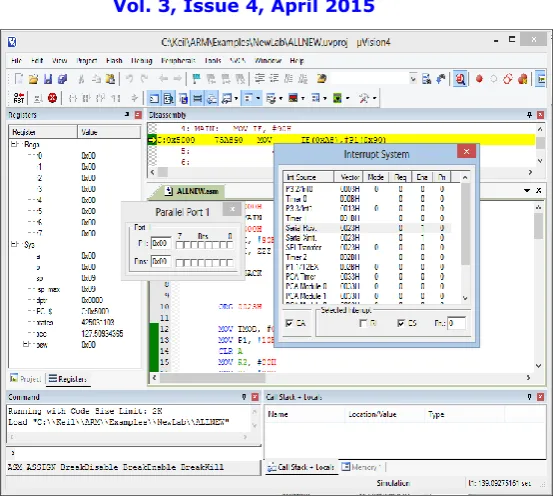
Fig. 9: Output of Keil simulator shown above indicates that though the warning is given to the viewer, instead of moving away he/she is still standing near the television, then first alarm goes off, and finally the television
is switched off after approximately 2 minutes i.e. 120 seconds (Pin 4=TV, Pin 1=Alarm).
VI. CONCLUSION AND FUTURE SCOPE
Conclusion:
This paper proves that the system is more generalized as well as multi-purpose and which can be implemented with several other applications as specified in the future scope. Also that it is effective human-face detection based controlling project.
Future scope:
Internal Message Displaying: Instead of shutting off T.V., messages can be displayed through T.V. like ‘KEEP SAFE DISTANCE’, etc. so it will not disturb the T.V. viewer and will just act like a warning. Renown T.V. production companies or DTH service providers who can implement this technology to portray their T.V.’s image as eye caring T.V. which will indulge senses of a T.V. viewer.
Security purpose in Museums and Historical heritages: The places like museum where there is a collection of many precious as well as ancient things that are supposed to be preserved for a long time. These objects have some historical importance. The system is face detection based so it prevents the human entrance within a restricted area. Many times it’s a general observation that some visitors try to damage or touch the things which are kept in museum. The system will immediately alarm the security guards who are on duty to take necessary remedial action against such people.
For Industry Safety: Heavy or large scale industries involve many chemical tankers, gas chambers which are threatening for human life. Many severe accidents may take place, as a remedy safe distance must be maintained. This system will be applicable in high voltage power areas and also in a server room security of a big multinational software company.
REFERENCES
ISSN(Online): 2320-9801
ISSN (Print): 2320-9798
I
nternational
J
ournal of
I
nnovative
R
esearch in
C
omputer
and
C
ommunication
E
ngineering
(An ISO 3297: 2007 Certified Organization)
Vol. 3, Issue 4, April 2015
4. Digital Image Processing using MATLAB by Rafael C. Gonzalez and Richard E. Woods.
5. M. Weiser, "The Computer for the 21st Century," ACM SIGMOBILE Mobile Computing and Communications Rev., vol. 3, no. 3, 1999, pp. 3-11.
6. UPnP Forum, UPnP Device Architecture Version 1.1, 2008. 7. Digital Livig Network Alliance, www.dlna.org.
8. M. Z. Bjelica, I. Papp, N. Teslic, JM. Coulon "Set-top box-based home controller", Proc. of 14th Inter. Symposium on Consumer Electronics 2010, Braunschweig, Germany.
BIOGRAPHY