ISSN(Online): 2320-9801 ISSN (Print): 2320-9798
I
nternational
J
ournal of
I
nnovative
R
esearch in
C
omputer
and
C
ommunication
E
ngineering
(An ISO 3297: 2007 Certified Organization)
Vol. 3, Issue 4, April 2015
Design and Implementation of Tracking
System
Snehal A. Thakre1, Prof. A.P. Bodkhe2, Prof. S.A. Nirmal3
PG Student, Dept. of Electronics & Telecomm., P.R.M.I.T & R, Badnera, Amravati, Maharashtra, India1 Professor, Dept. of Electronics & Telecomm., P.R.M.I.T & R, Badnera, Amravati, Maharashtra, India2
Assistant Professor, Dept. of Electronics & Telecomm., P.R.M.I.T & R, Badnera, Amravati, Maharashtra, India3
ABSTRACT: Locating an object of interest in continuous video frames can be termed as Object Tracking. Computer
Vision is branch recently focussing on interaction between human and computer system. Continuously tracking desired object in consecutive frames is a difficult task. Tracking helps in sorting out situations such criminal incidents, traffic congestion, reckless driving and speed violation. The object in motion is detected using algorithm based on frame differencing and background subtraction. Morphological operations along with filtering are implemented to eliminate noise. The object co-ordinates are displayed along with direction of motion. It is a real time human tracking System. The same algorithm is used for color (yellow) based tracking. For vehicle tracking Simulink model is implemented in which stored video is processed using frame differencing and optical flow. Thus using this algorithm continuous monitoring and surveillance system is introduced.
KEYWORDS: Object Detection, Frame Differencing, Background Subtraction, Morphological Operation, Object
Tracking, Optical Flow.
I. INTRODUCTION
A continuous monitoring and surveillance system is needed to keep eye on suspicious activities on airports, public parking’s, banks, and railways as security being important. So there is need of highly interactive surveillance system which can respond in high time. An object to be tracked may represented in various shapes and sizes based on appearance. Object Tracking has vast applications such as automatic suspicious event detection, Traffic monitoring, Object identification and many more. Object Tracking can be termed as locating a moving object in video frames. While tracking an object the problems faced are occlusion, addition of noise, non uniform structures, changing pattern of illumination, sudden object motion. So there is a need of smart system which can cope up with the problems faced while tracking an object. There exist visual features such as color, edges, optical flow and texture based on which object can be tracked. The various object detection techniques present upto date are point detectors, background subtraction and segmentation. Object Tracking methods include point tracking, kernel tracking and silhouette tracking.
An enhanced object system comprises of following important steps 1. Determining object of interest and detecting it.
2. Tracking the detected object thorough consecutive frames.
3. Determining the direction of motion so as to estimate the path of motion of object.
ISSN(Online): 2320-9801 ISSN (Print): 2320-9798
I
nternational
J
ournal of
I
nnovative
R
esearch in
C
omputer
and
C
ommunication
E
ngineering
(An ISO 3297: 2007 Certified Organization)
Vol. 3, Issue 4, April 2015
displays the co-ordinates of tracked object. The Multiple vehicles are tracked in offline mode using Horn Schunck optical flow method (Simulink Model) which takes into account motion vectors to track the vehicles.
II. RELATED WORK
Tracking has been an active research topic for decades and review of all the tracking methods is impossible. So some papers related to the proposed system are mentioned as below:
[1] proposed a unified method for single object tracking in which target category is actively recognized. High level offline model is combined with low level online model to achieve better tracking performance.[2] presented a robust and efficient automated single object tracking system based on frame differencing and dynamic template matching. The system has been automated using a pan-tilt setup which is synchronized with the algorithm.[3] presented Object Tracking as a SURVEY introducing extensive survey of object tracking methods and also gives a brief review of related topics.[4] proposed real time visual surveillance system implemented in outdoor environment for detecting and tracking people and monitoring their activities. It operates on single gray scale video imagery or on video imagery from an infrared camera. The system employs a combination of shape analysis and tracking to locate people and their parts and to create models of people's appearance so that they can be tracked through interactions such as occlusions. [5] dealt with the tracking of single object in a sequence of frames either from a live camera or from videos saved previously using Median approximation technique, Kalman filter estimation and Template Matching algorithm.[6] present various algorithms for motion detection, object classification, objects tracking and action recognition based on haar features. The rectangle areas are multiplied by their weights and then added to calculate the value of Haar feature. [7] proposed object tracking system using concepts of frame differencing and template matching. This study presents an effective way to detect the moving body of interest, discarding the smaller unwanted objects causing false alarms during implementation. [8] proposed an approach for tracking multiple objects in single frame in which the centroid of objects are taken as central component. The feature histogram based target representations are regularized by isotropic kernel. The target localization problem is formulated by attraction of local maxima.[9] proposed a new method to track objects by combining two well-known trackers, sum-of-squared differences (SSD) and colour-based mean-shift (MS) tracker. These when combined compensate for disadvantage of each other. MS tracker overcomes the rapid model change in SSD tracker. Also MS tracker is incapable of handling large displacements which in turn is handled by SSD tracker. Thus the MS tracker is used to track Local parameters instead of global. In order to update MS tracking module likelihood ratio weighting is used.
III.PROPOSED SYSTEM
A. System Implication
ISSN(Online): 2320-9801 ISSN (Print): 2320-9798
I
nternational
J
ournal of
I
nnovative
R
esearch in
C
omputer
and
C
ommunication
E
ngineering
(An ISO 3297: 2007 Certified Organization)
Vol. 3, Issue 4, April 2015
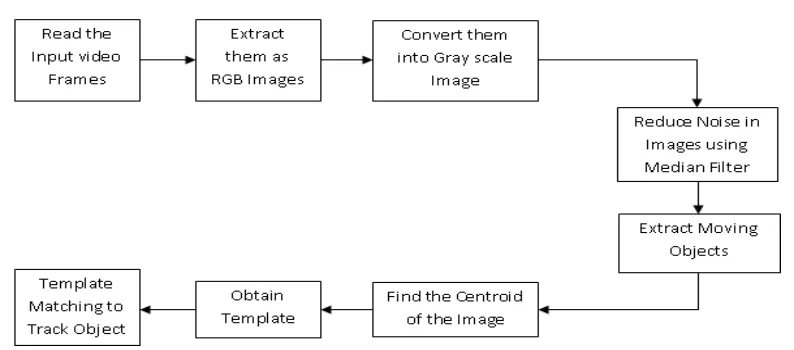
The work approach is as shown above. Video as an input is taken from online mode. Video is converted to number of frames. The extracted RGB images are converted into gray scale images. Noise in the images is removed using Median Filter. In order to detect moving object frame difference algorithm and morphological operations such as erosion and dilation for avoiding detection of non-stationary objects are applied. Determine the centroid for the position of moving object in the given scene. An image template is extracted and matched to track the object. Using this algorithm Human Face is tracked and also Yellow Color Object is tracked.
B. Description of Algorithm
1. Tracking Human Face and Yellow Color using Matlab
ISSN(Online): 2320-9801 ISSN (Print): 2320-9798
I
nternational
J
ournal of
I
nnovative
R
esearch in
C
omputer
and
C
ommunication
E
ngineering
(An ISO 3297: 2007 Certified Organization)
Vol. 3, Issue 4, April 2015
The initial step is to capture video input using Webcam or Camera. The captured video is converted into frames whose properties such FramesPerTrigger and ReturnedColorSpace are set accordingly. FramesPerTrigger is used to implement continuous acquisition by setting its value to infinity and ReturnedColorSpace is used to implement color space conversion. Also to help the application to keep up with the incoming video stream while processing the data Frame Interval is added. The first Frame is grabbed and is considered as a reference frame. Frame Differencing is applied for motion detection. Median Filter is used for noise removal. Median Filter provides an output in the form of intensity image. Further Thresholding is done to change pixel values above or below a certain intensity value. Morphological operations such erosion and dilation are used. Erosion is removal of structures of certain shape and size and Dilation are filling of holes of certain shape and size. Region prop function ‘Basic’ is used which computes measurements of 'Area', 'Centroid', and 'Bounding Box'. If the area of reference frame is greater than the other frames than the properties centroid and bounding box are updated accordingly. The directions of motion such as up, down, left and right are displayed according to condition of the vertical co-ordinates obtained. The steps for tracking based on color (yellow) are similar to the steps of human tracking with slightest change. Here imcomplement is used on grayscale or truecolor image in which dark areas become lighter and light areas become darker.
2. Vehicle Tracking using Simulink Model
a. Take Input from Multimedia file.
b. Acquire frame and convert it from RGB to intensity. c. Use optical flow to estimate motion changes.
d. Perform Thresholding and region filtering (apply morphological operation). e. For tracking and counting of vehicles draw rectangular box and line.
IV.RESULTS
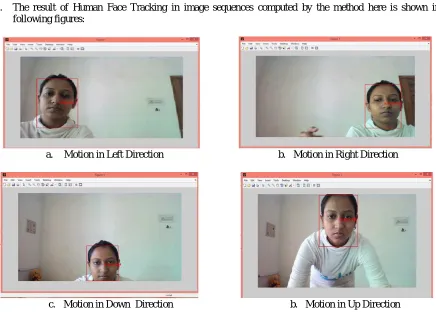
1. The result of Human Face Tracking in image sequences computed by the method here is shown in the following figures:
a. Motion in Left Direction b. Motion in Right Direction
c. Motion in Down Direction b. Motion in Up Direction
ISSN(Online): 2320-9801 ISSN (Print): 2320-9798
I
nternational
J
ournal of
I
nnovative
R
esearch in
C
omputer
and
C
ommunication
E
ngineering
(An ISO 3297: 2007 Certified Organization)
Vol. 3, Issue 4, April 2015
The results of face tracking are shown in the above figures. Fig.a shows the motion of Human in left direction displaying the ordinates X:283,Y:407. Fig.b shows the motion of Human in right direction displaying the co-ordinates X:1020,Y:425. Fig.c shows the motion of Human in down direction displaying the co-co-ordinates X:663,Y:584. Fig.d shows the motion of Human inn up direction displaying the co-ordinates X:653,Y:198.
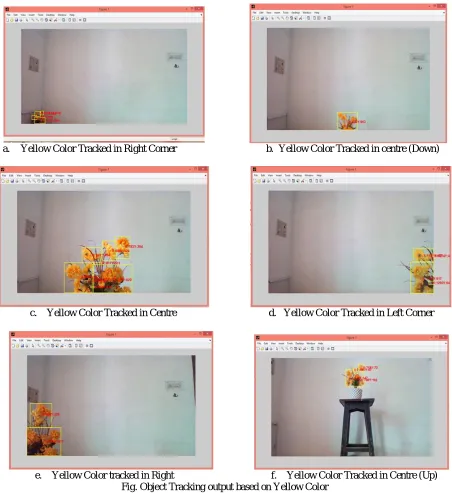
2. The result of Color Based Tracking in image sequences computed by the method here is shown in the following figures:
a. Yellow Color Tracked in Right Corner b. Yellow Color Tracked in centre (Down)
c. Yellow Color Tracked in Centre d. Yellow Color Tracked in Left Corner
e. Yellow Color tracked in Right f. Yellow Color Tracked in Centre (Up) Fig. Object Tracking output based on Yellow Color
ISSN(Online): 2320-9801 ISSN (Print): 2320-9798
I
nternational
J
ournal of
I
nnovative
R
esearch in
C
omputer
and
C
ommunication
E
ngineering
(An ISO 3297: 2007 Certified Organization)
Vol. 3, Issue 4, April 2015
ordinates of the tracked object. Fig.a shows the co-ordinates X:151,Y:694. Fig.b shows the co-ordinates X:632,Y:663. Fig.c shows the co-ordinates X:617,Y:511. Fig.d shows the co-ordinates X:1184,Y:617. Fig.e shows the co-ordinates X:113,Y:617. Fig.f shows the co-ordinates X:700,Y:162.
3. The result of Vehicle Tracking computed by the method here is shown in the following figure:
Fig. Tracked Vehicles
The above figure displays multiple tracked vehicles shown by green bounding box. The count of vehicles is updated as the vehicles cross the white line. The above figure displays the count 2 as two vehicles are tracked.
V. CONCLUSION AND FUTURE SCOPE
The work introduces an efficient method for motion detection of a moving object utilizing frame differencing, median filtering and morphological operations. The experiment method has good performance and efficiency and provides accurate results. Future may focus on tracking of multiple objects and identifying them. The algorithm can hereby be implemented to track other objects such as dogs, cats and other quadrupeds.
ACKNOWLEDGEMENT
I would like to present my honest gratitude to Prof. A. P. Bodkhe and Prof. S. A. Nirmal for their immense support and guidance throughout the work.
REFERENCES
1. Jialue Fan, Xiaohui Shen and Ying Wu, " What are we Tracking: A Unified Approach of Tracking and Recognition", IEEE Transactions on Image Processing, Vol.22, No.2, pp. 549-560, 2013.
2. Karan Gupta, Anjali V. Kulkarni, “Implementation of an Automated Single Camera Object Tracking System using Frame differencing and Dynamic Template Matching”, International Joint Conferences on Advances in Computer, Information, System Sciences and Engg. Sponsored by IEEE, Bridgeport, pp. 245-250, 2007.
3. A. Yilmaz, O. Javed and M. Shah, "Object Tracking: A Survey", ACM Comput. Surv. Vol.38, No.4, pp.1-13, 2006.
4. Ismail Haritaoglu, David Harwood and Larry S. Davis, “W 4: Who? When? Where? What? A Real Time System for Detecting and Tracking People”, IEEE Transaction on Patt. Analy. Mach. Intell, Vol. 22, No. 8, pp. 809-830, 1998.
5. G. Mallikarjuna Rao and Dr.Ch.Satyanarayana, “Object Tracking System Using Approximate Median Filter, Kalman Filter and Dynamic Template Matching”, I.J. Intelligent Systems and Applications,Vol.6, No.5, pp. 83-89, 2014.
6. Prerna Rajput and Vikas Tripathi, “New Trends in Object Motion Analysis”, International Journal of Advanced Research in Computer Science and Software Engineering, Vol.4, No.4, 2014.
7. N. Prabhakar, V. Vaithiyanathan and Akshaya Prakash Sharma, “Object Tracking Using Frame Differencing and Template Matching”, Research Journal of Applied Sciences, Engineering and Technology, Vol.4, No.24, pp. 5497-5501, 2012.
8. Rahul Mishra, Mahesh K. Chouhan, Dr. Dhiiraj Nitnawwre, “Multiple Object Tracking by Kernel Based Centroid Method for Improve Localization”, I.J of Advanced Research in Computer Science and Software Engineering, Vol.2, No.7, pp. 137-140, 2012.
9. R. Venkatesh Babu , Patrick Perez and Patrick Bouthemy ,“ Robust tracking with motion estimation and local Kernel-based color modeling”, Elsevier, Vol. 25, No. 8,pp. 1205-1216, 2007.
10. Richard Y.D. Xu, John G. Allen, Jesse S. Jin, "Robust real- time tracking of non-rigid objects", Proceedings of the Pan-sydney area workshop on Visual Information processing, Vol. 36, pp.95-98, 2004.
11. S. Avidan, "Ensemble Tracking", IEEE Trans. Pattern Anal. Mach. Intell, Vol.29, No.2, pp.261-271, 2007.
12. B. Babenko, M-H. Yang and S. Belongie, "Visual tracking with online multiple instance learning ", in Proc. Conf. Comput. Vis. Pattern Recogni., pp. 983-990, 2009.
13. H. Grabner, M. Grabner and H. Bischof, "Real-time tracking via online boosting", in Proc. British Mach. Vis. Conf., pp.1-10,2006