| INVESTIGATION
The Evolutionary Fates of a Large Segmental
Duplication in Mouse
Andrew P. Morgan,* J. Matthew Holt,†Rachel C. McMullan,* Timothy A. Bell,* Amelia M.-F. Clayshulte,* John P. Didion,* Liran Yadgary,* David Thybert,‡,1Duncan T. Odom,§,** Paul Flicek,‡,**
Leonard McMillan,†and Fernando Pardo-Manuel de Villena*,2
*Department of Genetics and Lineberger Comprehensive Cancer Center, and†Department of Computer Science, University of North Carolina, Chapel Hill, North Carolina 27599,§Cancer Research United Kingdom Cambridge Institute, University of Cambridge, CB2 0RE, United Kingdom,‡European Bioinformatics Institute, European Molecular Biology Laboratory, and **Wellcome Trust Sanger Institute, Wellcome Genome Campus, Cambridge, CB10 1SA, United Kingdom ORCID ID: 0000-0003-1942-4543 (A.P.M.)
ABSTRACTGene duplication and loss are major sources of genetic polymorphism in populations, and are important forces shaping the evolution of genome content and organization. We have reconstructed the origin and history of a 127-kbp segmental duplication,
R2d, in the house mouse (Mus musculus).R2dcontains a single protein-coding gene,Cwc22.De novoassembly of both the ancestral (R2d1) and the derived (R2d2) copies reveals that they have been subject to nonallelic gene conversion events spanning tens of kilobases.R2d2is also a hotspot for structural variation: its diploid copy number ranges from zero in the mouse reference genome to.80 in wild mice sampled from around the globe. Hemizygosity for high copy-number alleles of R2d2is associated inciswith meiotic drive; suppression of meiotic crossovers; and copy-number instability, with a mutation rate in excess of 1 per 100 transmissions in some laboratory populations. Our results provide a striking example of allelic diversity generated by duplication and demonstrate the value ofde novoassembly in a phylogenetic context for understanding the mutational processes affecting duplicate genes.
KEYWORDScopy-number variation; meiotic drive; segmental duplications
D
UPLICATION is an important force shaping the evolution of plant and animal genomes: it provides a substrate for evolution. Redundancy transiently frees the duplicates from selective constrant (Lynch and Conery 2000). Segmental duplications (SDs), defined as contiguous sequences which map to more than one physical position (Bailey and Eichler 2006), are a common feature of eukaryotic genomes and particularly those of vertebrates.Like any sequence variant, a duplication first arises in a single individual in a population. The distinction between such copy-number variants (CNVs) and SDs isfluid and somewhat
arbitrary: tracts of SDs are highly polymorphic in populations in species fromDrosophila(Dopman and Hartl 2007) to mouse (Sheet al.2008) to human (Bailey and Eichler 2006). Studies of parent-offspring transmissions have shown that SDs are prone to recurrent de novomutations including some impli-cated in human disease (reviewed in Stankiewicz and Lupski 2002). Bursts of SD have preceded dramatic species radiations in primates and, more broadly, blocks of conserved synteny in mammals frequently terminate at SDs (Bailey and Eichler 2006). This suggests that SDs could mediate the chromosomal rearrangements through which karyotypes diverge and repro-ductive barriers arise.
Notwithstanding their evolutionary importance, SDs are difficult to analyze. Repeated sequences with high pairwise similarity are likely to be collapsed into a single sequence during genome assembly. Efficient and sensitive alignment of high-throughput sequencing reads to duplicated sequence remains challenging (Treangen and Salzberg 2011). Genotyping of sites within SDs is difficult because variants between copies (para-logous variants) are easily confounded with variants within Copyright © 2016 by the Genetics Society of America
doi: 10.1534/genetics.116.191007
Manuscript received April 29, 2016; accepted for publication June 27, 2016; published Early Online June 30, 2016.
Supplemental material is available online atwww.genetics.org/lookup/suppl/doi:10. 1534/genetics.116.191007/-/DC1.
1Present address: Earlham Institute, Norwich Research Park, Norwich NR4 7UH,
United Kingdom.
2Corresponding author: 5049 Genetic Medicine Bldg., Department of Genetics,
copies between individuals at a given copy (allelic variants). Latent paralogous variation may bias interpretations of se-quence diversity and haplotype structure (Hurles 2002).
Paralogy also complicates phylogenetic inference. Ances-tral duplication followed by differential losses along separate lineages may yield a local phylogeny that is discordant with the genome-wide phylogeny (Goodmanet al.1979). Within each duplicate copy, local phylogenies for adjacent intervals may also be discordant due to nonallelic gene conversion between copies (Dover 1982; Nagylaki and Petes 1982).
In this manuscript we present a detailed analysis ofR2d, a segmental duplication in the house mouse (Mus musculus).R2d
is a 127-kbp unit which contains the protein-coding geneCwc22
andflanking intergenic sequence. Although the C57BL/6J refer-ence strain and other classical laboratory strains have a single haploid copy of theR2dsequence (in theR2d1locus), the wild-derived CAST/EiJ, ZALENDE/EiJ, and WSB/EiJ strains have an additional 1, 16, and 33 haploid copies, respectively, in theR2d2
locus.R2d2is the responder locus in a recently-described meiotic drive system on mouse chromosome2(chr2) but is absent from the mouse reference genome (Waterston et al. 2002; Didion
et al. 2015, 2016). We draw on a collection of species from the genusMussampled from around the globe to reconstruct the sequence of events giving rise to the locus’present structure (Figure 1). Using novel computational tools built around indexes of raw high-throughput sequencing reads, we perform localde novo assembly of phased haplotypes and explore patterns of sequence diversity within and between copies ofR2d.
Both phylogenetic analyses and estimation of mutation rate in laboratory mouse populations reveal thatR2d2 and its surrounding region on chr2 are unstable in copy number. Cycles of duplication, deletion, and nonallelic gene conver-sion have led to complex phylogenetic patterns discordant with species-level relationships within Mus, which cannot be explained by known patterns of introgression between
Musspecies (Bonhommeet al.2007; Yanget al.2011).
Materials and Methods
Mice
WildM. musculusmice used in this study were trapped at a large number of sites across Europe, the United States, the Middle East, northern India, and Taiwan. Trapping was car-ried out in accordance with local regulations and with the approval of all relevant regulatory bodies for each locality and institution. Trapping locations are listed in Supplemental Material,Table S1. Most samples have been previously pub-lished (Didionet al.2016).
Tissue samples from the progenitors of the wild-derived inbred strains ZALENDE/EiJ (M. m. domesticus), TIRANO/EiJ (M. m. domesticus), and SPRET/EiJ (M. spretus) were provided by Muriel Davisson, as described in Didionet al.(2016).
Tissue samples from the high running (HR) selection and intercross lines were obtained as described in Didionet al.
(2016).
Female Diversity Outbred (DO) mice used for estimating mutation rates atR2d2were obtained from the Jackson Lab-oratory and housed with a single FVB/NJ male. Progeny were killed at birth by cervical dislocation in order to obtain tissue for genotyping.
All live laboratory mice were handled in accordance with the Institutional Animal Care and Use Committees protocols of the University of North Carolina at Chapel Hill.
DNA preparation
High molecular weight DNA: High molecular weight DNA was obtained for samples genotyped with the Mouse Diversity Array (MDA) or subject to whole-genome sequencing. Geno-mic DNA was extracted from tail, liver, or spleen using a standard phenol-chloroform procedure (Sambrook and Russell 2006). High molecular weight DNA for most inbred strains was obtained from the Jackson Laboratory, and the remainder as a generous gift from Francois Bonhomme and the University of Montpellier Wild Mouse Genetic Repository.
Low molecular weight DNA:Low molecular weight DNA was obtained for samples to be genotyped on the Mega Mouse Universal Genotyping Array (MegaMUGA) (see Microarray genotyping below). Genomic DNA was isolated from tail, liver, muscle, or spleen using QIAGEN (Valencia, CA) Gentra Puregene or DNeasy Blood and Tissue Kits according to the manufacturer’s instructions.
Whole-genome sequencing and variant discovery
Inbred strains: Sequencing data for inbred strains of mice except ZALENDE/EiJ and LEWES/EiJ were obtained from the Sanger Mouse Genomes Project web site (ftp://ftp-mouse. sanger.ac.uk/current_bams) as aligned BAMfiles. Details of the sequencing pipeline are given in Keane et al. (2011). Coverage ranged from25 to 503per sample.
The strains LEWES/EiJ and ZALENDE/EiJ were sequenced at the University of North Carolina High-Throughput Sequenc-ing Facility. Libraries were prepared from high molecular weight DNA using the Illumina (Carlsbad, CA) TruSeq kit and insert size250 bp, and 23100-bp paired-end reads were generated on an Illumina HiSequation 2000 instrument. LEWES/ EiJ was sequenced to 123 coverage and ZALENDE/EiJ to
203. Alignment was performed as in Keaneet al.(2011).
Wild mice:Whole-genome sequencing data from 26 wildM. m. domesticusindividuals described in Pezeret al.(2015) was downloaded from the European Nucleotide Archive (ENA) under accession number PRJEB9450. Coverage ranged from
12 to 203per sample. An additional two wildM. m. domes-ticus individuals, IT175 and ES446, were sequenced at the University of North Carolina to approximate coverage of 83 each. Raw reads from an additional 10 wildM. m. castaneus
PRJEB2188. Reads for each sample were realigned to the mm10 reference using BWA-MEM v0.7.12 with default pa-rameters (Li 2013). Optical duplicates were removed with samblaster (Faust and Hall 2014).
Variant discovery:Polymorphic sites on chr2 in the vicinity of
R2d2 (Figure 4B) were called using Freebayes v0.9.21-19-gc003c1e (Garrison and Marth 2012) with parameters
“--standard-filters”using the Sanger Mouse Genomes Project VCFfiles as a list of known sites (parameter“--@”). Raw calls werefiltered to have quality score.30, root mean square mapping quality.20 (for both reference and alternate allele calls) and at most two alternate alleles.
Copy-number estimation
R2d copy number was estimated using quantitative PCR (qPCR) as described in Didionet al.(2016). Briefly, we used commercial TaqMan assays against intron-exon boundaries inCwc22(Life Technologies assay numbers Mm00644079_cn and Mm00053048_cn) to determine copy number relative to reference genesTert(catalogue number 4458368, for target Mm00644079_cn) or Tfrc(catalogue number 4458366, for target Mm00053048_cn). Cycle thresholds forCwc22relative to the reference gene were normalized across assay batches using linear mixed models with batch and target-reference pair treated as random effects. Control samples with known
haploid R2d copy numbers of 1 (C57BL/6J), 2 (CAST/EiJ), 17 (WSB/EiJxC57BL/6J)F1, and 34 (WSB/EiJ) were included
in each batch.
Samples were classified as having one, two, or more than two haploid copies ofR2dusing linear discriminant analysis. The classifier was trained on the normalized cycle thresholds of the control samples from each plate, whose precise integer copy number is known, and applied to the remaining samples.
Microarray genotyping
Genome-wide genotyping was performed using MegaMUGA (Neogen/GeneSeek, Lincoln, NE) (Morganet al.2015). Geno-types were called using the GenCall algorithm implemented in the Illumina BeadStudio software. For quality control we com-puted, for each markerion the array:Si=XiþYi; whereXi andYiare the normalized hybridization intensities for the two alleles. The expected distribution ofSiwas computed from a large set of reference samples. We excluded arrays for which the distribution ofSiwas substantially shifted from this refer-ence; in practice, failed arrays can be trivially identified in this manner (Morgan et al.2015). Access to MegaMUGA geno-types was provided by partnership between the McMillan and Pardo-Manuel de Villena labs and the University of North Carolina Systems Genetics Core Facility.
Additional genotypes for inbred strains and wild mice from the MDA were obtained from Yanget al.(2011).
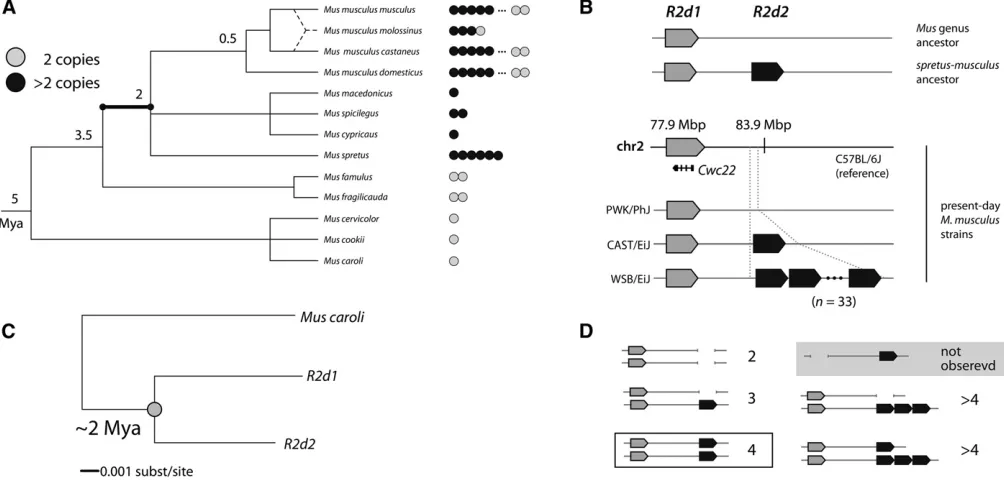
Figure 1 Origin and age of theR2d2duplication. (A)R2dcopy number across the phylogeny of the genusMus. Each dot represents one individual; shaded dots indicate a diploid copy number of two and solid dots a copy number of more than two. The duplication event giving rise toR2d1andR2d2
most likely occurred on the highlighted branch. Approximate divergence times (Suzukiet al.2004) are given in MYA at internal nodes. (B) Schematic structure of the R2d1-R2d2 locus. The mouse reference genome (strain C57BL/6J, M. m. domesticus) contains a single copy ofR2d atR2d1. Wild-derived inbred strains vary in haploid copy number from 1 (PWK/PhJ,M. m. musculus) to 2 (CAST/EiJ,M. m. castaneus) to 33 (WSB/EiJ,M. m. domesticus).R2d1is located at77.9 Mb andR2d2at 83.8 Mb. (C) Concatenated tree constructed fromR2d1(reference genome) andde novo
All microarray genotypes are provided in PLINK format in
File S2.
De novo assembly of R2d2
Raw whole-genome sequencing reads for WSB/EiJ from the Sanger Mouse Genomes Project were converted to a multi-string Burrows–Wheeler transform (msBWT) and associated FM-index (Holt and McMillan 2014) using the msbwt v0.1.4 Python package (https://pypi.python.org/pypi/msbwt). The msBWT and FM-index implicitly represent a suffix array to provide efficient queries over arbitrarily large string sets. Given a seed k-mer present in that string set, this property can be exploited to rapidly construct a de Bruijn graph which can in turn be used for localde novoassembly of a target sequence (Figure S1A). The edges in that graph can be assigned a weight (corresponding to the number of reads containing the
kþ1-mer implied by the edge) which can be used to evaluate candidate paths when the graph branches (Figure S1B).
R2d2was seeded with the 30-bp sequence (TCTAGAGCAT GAGCCTCATTTATCATGCCT) at the proximal boundary ofR2d1
in the GRCm38/mm10 reference genome. A single linear contig was assembled by“walking”through the local de Bruijn graph. Because WSB/EiJ has33 copies ofR2d2and a single copy of
R2d1, any branch point in the graph which represents a paralo-gous variant should having outgoing edges with weights differ-ing by a factor of33. Furthermore, when two (or more) branch points occur within less than the length of a read, it should be possible to“phase”the underlying variants by following single reads through both branch points (Figure S8B). We used these heuristics to assemble the sequence ofR2d2(corresponding to the higher-weight path through the graph) specifically.
After assembling a chunk of 500 bp, the contig was checked for colinearity with the reference sequence (R2d1) using the BLAST-like alignment tool (BLAT) and ClustalW2 (using the European Molecular Biology Laboratory, European Bioinformatics Institute web server:http://www.ebi.ac.uk/ Tools/msa/clustalw2/).
Repetitive elements such as retroviruses are refractory to assembly with our method. Upon traversing into a repetitive element, the total edge weight (total number of reads) and number of branch points (representing possible linear assem-bled sequences) in the graph become large. It was sometimes possible to assemble a fragment of a repetitive element at its junction with a unique sequence, but it was not possible to assemble unambiguously across the repeat. Such regions were marked with blocks of Ns, and assembly reseeded using a nearbyk-mer from the reference sequence. Thefinal contig is provided in FASTA format inFile S1.
Thefinal contig was checked against its source msBWT by confirming that each 30-mer in the contig which did not contain an N was supported by at least 60 reads. A total of 16 additional haplotypes in eight regions of R2d totaling 16.9 kbp (Table S5) were assembled in a similar fashion, using the WSB R2d2contig and the R2d1 reference se-quence as guides. Multiple sese-quence alignments from these regions are provided inFile S1.
Sequence analysis of R2d2 contig
Pairwise alignment of R2d paralogs: The reference R2d1
sequence and our R2d2 contig were aligned using LASTZ v1.03.54 (http://www.bx.psu.edu/rsharris/lastz/) with parameters “--step=10 --seed=match12 --notransition --exact=20 --notrim --identity=95.”
Transposable element content: The R2d2 contig was screened for transposable-element (TE) insertions using the RepeatMasker web server (http://www.repeatmasker.org/ cgi-bin/WEBRepeatMasker) with species set to “mouse” and default settings otherwise. As noted previously, we could not assemble full-length repeats, but the fragments we could assemble at junctions with unique sequence allowed identification of some candidate TEs to the family level.R2d1-specific TEs were defined as TEs annotated in the RepeatMasker track at the University of California, Santa Cruz (UCSC) Genome Browser with no evidence (no homologous sequence, and no Ns) at the corresponding position in the R2d2 contig. Candidate R2d2-specific TEs were defined as gaps$100 bp in size in the alignment to
R2d1 for which the corresponding R2d2 sequence was
flagged by RepeatMasker.
Gene conversion tracts:To unambiguously define gene con-version events without confounding from paralogous se-quences, we examined 15 wild M. m. domesticus samples and 37 laboratory strains with evidence of two diploid copies ofR2d. We confirmed that these copies ofR2dwere located at
R2d1 by finding read pairs spanning the junction between
R2d1and the neighboring sequence. Gene conversion tracts were delineated as clusters of derived alleles shared with
R2d2. Using a pairwise of alignment of R2d2 and R2d1
we identified single-nucleotide variants between the two sequences, and queried those sites in aligned reads for M. caroli. If theM. caroliandR2d1shared an allele, we recorded the site as a derived allele informative for the presence of
R2d2. We used the resulting list of 1411 informative sites to query aligned reads for the samples of interest and recorded, for each site and each sample, whether the derived allele (R2d2), ancestral allele (R2d1), or both alleles were present. Conversion tracts were then identified by manual inspection. Boundaries of conversion tracts were defined at approximately the midpoint between thefirstR2d1- (orR2d2-) specific var-iant and the lastR2d2- (orR2d1-) specific variant.
parameters treat each sample as having ploidy up to 20, im-pose an uninformative prior on genotype frequencies, and limit the algorithm to the discovery of atomic variants (single nucleotide variations or short indels, not multi-nucleotide polymorphisms or other complex events) with at most two alleles at each segregating site. Sites in low-complexity se-quence (defined as Shannon entropy,1.6 in the 30-bp win-dow centered on the site) or within 10 bp of another variant site were further masked to minimize spurious calls due to ambiguous alignment of indels. To avoid confounding with the retrocopies ofCwc22outsideR2d, coding exons ofCwc22
were masked. Finally, sites corresponding to an unaligned or gap position in the pairwise alignment between R2d1 and
R2d2were masked.
To compute diversity inR2d1we counted segregating sites in 12 wildM. m. domesticussamples with two diploid copies ofR2d(total of 24 sequences), confirmed to be inR2d1by the presence of read pairs spanning the junction betweenR2d1
and a neighboring sequence. To compute diversity inR2d2, we counted segregating sites in 14 wild M. m. domesticus
samples with more than two diploid copies of R2d(range 3–83 per sample; total of 406 sequences), but excluded sites corresponding to variants amongR2d1 sequences. Remain-ing sites were phased toR2d2by checking for the presence of a 31-mer containing the site and the nearest R2d1-vs-R2d2
difference in the raw reads for each sample using the corre-sponding msBWT. Sequence diversity was then computed using Watterson’s estimator (Watterson 1975), dividing by the number of alignable bases (128,973) to yield a per-site estimate. Standard errors were estimated by 100 rounds of resampling over the columns in theR2d1-vs-R2d2alignment.
Analyses of Cwc22 expression
RNA sequencing read alignment: Expression ofCwc22was examined in adult whole brain using data from Crowleyet al.
(2015), Sequence Read Archive (SRA) accession number SRP056236. Paired-end reads (23100 bp) were obtained from eight replicates for each of three inbred strains: CAST/EiJ, PWK/PhJ, and WSB/EiJ. Raw reads were aligned to the mm10 reference using STAR v2.4.2a (Dobinet al.2012) with default parameters for paired-end reads. Alignments were merged into a singlefile per strain for further analysis. Expression in adult testis was examined in 23 wild-derived inbred strains from Phifer-Rixeyet al.(2014), SRA accession number PRJNA252743. Single-end reads (76 bp) were aligned to the mm10 genome with STAR using default parameters for single-end, reads.
Transcript assembly: Read alignments were manually inspected to assess support forCwc22isoforms in Ensembl v83 annotation. To identify novel isoforms in R2d2, we applied the Trinity v0.2.6 pipeline (Grabherr et al.2011) to the subset of reads from WSB/EiJ, which could be aligned toR2d1 plus their mates (a set which represents a mixture of Cwc22R2d1 and Cwc22R2d2 reads). De novo transcripts were aligned both to the mm10 reference and to theR2d2contig using BLAT, and were assigned toR2d1
orR2d2based on sequence similarity. Because expression from R2d2 is high in WSB/EiJ, R2d2-derived transcripts dominated the assembled set. Both manual inspection and the Trinity assembly indicated the presence of retained introns and an extra 39exon, as described in theResults. To obtain a full set ofCwc22transcripts including those of both
R2d1 and R2d2 origin, we supplemented the Cwc22 tran-scripts in Ensembl v83 with their paralogs fromR2d2as de-termined by a strict BLAT search against theR2d2contig. We manually created additional transcripts reflecting intron-retention and 39extension events described above, and obtained their sequence from the R2d2 contig. Transcript coordinates (with respect toR2d1) and sequences are pro-vided inFile S3.
Abundance estimation:Relative abundance ofCwc22 paral-ogs was estimated using kallisto v0.42.3 (Brayet al.2016) with parameters“—bias”(to estimate and correct library-specific, sequence-composition biases). The transcript index used for pseudoalignment and quantification included only theCwc22targets.
Phylogenetic analyses
Tree for R2d:Multiple sequence alignments for eight of the regions inFigure S5were generated using the MUSCLE soft-ware (Edgar 2004) with default parameters. The resulting alignments were manually trimmed and consecutive gaps removed. Phylogenetic trees were inferred with RAxML v8.1.9 (Stamatakis 2014) using the general time revers-ible (GTR)+gamma model with four rate categories and
M. caroli as an outgroup. Uncertainty of tree topologies was evaluated using 100 bootstrap replicates.
Divergence time: The time of the split between R2d1 and
R2d2was estimated using the Bayesian method implemented in BEAST v1.8.1r6542 (Drummondet al.2012). We assumed a divergence time forM. caroliof 5 MYA with a strict molec-ular clock, and analyzed the concatenated alignment for our
de novo assembled regions under the GTR+gamma model with four rate categories and allowance for a proportion of invariant sites. The chain was run for 10,000,000 iterations with trees sampled every 1000 iterations.
Local phylogeny around R2d2:Genotypes for 173 SNPs in the region surrounding R2d2 (chr2: 83–84 Mb) were obtained for 90 individuals representing both laboratory and wild mice genotyped with the MDA (Table S1) (Yang
Cwc22 coding sequences:To create the tree ofCwc22coding sequences, wefirst obtained the sequences of all its paralogs in mouse. The coding sequence ofCwc22R2d1(RefSeq tran-script NM_030560.5) was obtained from the UCSC Genome Browser and aligned to ourR2d2contig with BLAT to extract the exons ofCwc22R2d2. The coding sequence of retro-Cwc22 [genomic sequence corresponding to GenBank complemen-tary DNA (cDNA) AK145290] was obtained from the UCSC Genome Browser. Coding and protein sequences of CWC22 homologs from non-M. musculusspecies were obtained from Ensembl (Cunningham et al. 2014). The sequences were aligned with MUSCLE and manually trimmed, and a phylo-genetic tree estimated as described above. Sequence align-ments and tree are provided inFile S4.
We observed that the branches in the rodent clade of the
Cwc22tree appeared to be longer than branches for other taxa. We used Phylogenetic Analysis Using Maximum Likelihood (PAML) (Yanget al.2007) to test the hypothesis thatCwc22
is under relaxed purifying selection in rodents using the branch-site model (null model“model = 2, NSsites = 2,fix_omega = 1”; alternative model“model = 2, NSsites = 2, omega = 1,
fix_omega = 1”) as described in the PAML manual. This is a test of difference in evolutionary rate on a “foreground”branch (v1)—in our case, the rodent clade—relative to the tree-wide
“background”rate (v0). The distribution of the test statistic is an even mixture of ax2distribution with 1 d.f. and a point mass at
zero. To obtain theP-value, we calculated the quantile of thex2
distribution with 1 d.f. and divided by two.
Analyses of recombination rate at R2d2
To test the effect ofR2d2copy number on local recombination rate, we examined recombination events accumulated during thefirst 16 generations of breeding of the DO population, in which the high-copyR2d2allele from WSB/EiJ is segregat-ing. Founder haplotype reconstructions were obtained for 4640 DO individuals (reported in Didion et al. 2016) and recombination events were identified as junctions between founder haplotypes. We compared the frequency of junctions involving a WSB/EiJ haplotype to junctions not involving a WSB/EiJ haplotype over the 75–90 Mb region of chr2. Within each generation we also tested for differences in the lengths of haplotype blocks overlappingR2d2using one-sided Wilcoxon rank-sum tests (alternative hypothesis: WSB/EiJ haplotypes longer than others). Resulting P-values were subject to Bonferroni correction: for nominal significance levela= 0.01, the corrected threshold isP¼0:01
12 ¼8:3310
24:
We also estimated the difference between observed and expected recombination fraction in 11 experimental crosses, in which one of the parental lines was segregating for a high-copy allele atR2d2. We obtained expected recombination fractions from the standard mouse genetic map (Coxet al.2009), which was constructed from crosses between strains lackingR2d2HC alleles. Genotype data were obtained from The Jackson Labora-tory’s Mouse Phenome Database QTL Archive (http://phenome. jax.org/db/q?rtn=qtl/home). Recombination fractions were
calculated using R/qtl (http://rqtl.org/). Confidence intervals for difference between observed and expected recombination fractions were calculated by 100 iterations of nonparametric bootstrapping over individuals in each dataset.
Data availability
Allde novoassemblies used in this study are included inFile S1. The data structures on which the assemblies are based, and the interactive computational tools used for assembly, are publicly available athttp://www.csbio.unc.edu/CEGSseq/ index.py?run=MsbwtTools. Genotype data used for mapping the location of R2d2 and defining associated haplotypes are provided inFile S2. Transcript sequences used for analyses of gene expression are provided inFile S3. Nucleotide and amino acid sequences used for phylogenetic analyses of Cwc22 are provided inFile S4.
Results
R2d was duplicated in the common ancestor of M. musculus and M. spretus
In order to determine when theR2dCNV arose, we used qPCR and/or depth of coverage in whole-genome sequencing to assayR2dcopy number in a collection of samples spanning the phylogeny of the genusMus. Samples were classified as having a diploid copy number of two (two chromosomes each with a single copy of R2d) or more than two (at least one chromosome with anR2dduplication).
We find evidence for more than two diploid copies in representatives of all mouse taxa tested from the Palearctic clade (Figure 1 andTable S1) (Suzukiet al.2004): 236 of 525M. musculus, 1 of 1M. macedonicus, 1 of 1M. spicilegus, 1 of 1M. cypriacus, and 8 of 8M. spretussamples. However, wefind no evidence of duplication in species from the south-east Asian clade, which is an outgroup to Palearctic mice: 0 of 2M. famulus, 0 of 2M. fragilicauda, 0 of 1M. cervicolor, 0 of 1M. cookii, and 0 of 1M. carolisamples. Outside the sub-genus Mus, we found evidence for more than two diploid copies in none of the nine samples tested from subgenus
Pyromys. We concluded that theR2dduplication most likely occurred between the divergence of southeast Asian from Palearctic mice (3.5 MYA) and the divergence ofM. mus-culusfromM. spretus(2 MYA) (Suzukiet al.2004; Chevret
et al.2005), along the highlighted branch of the phylogeny in Figure 1A. If theR2dduplication wasfixed in the ancestor of
M. musculus, then extant lineages of house mice which have only two diploid copies of R2d—including the reference strain C57BL/6J (of predominantly M. musculus domesticus
origin; Yanget al.2007)—represent subsequent losses of an
R2dcopy. Alternatively, theR2dduplication may have been polymorphic in the ancestor ofM. musculusand then contin-ued to segregate inM. musculusandM. spretus.
Duplication of the ancestralR2dsequence resulted in two paralogs residing in loci which we denote R2d1 and R2d2
distal (Didion et al. 2015), as we describe in more detail below. The more proximal copy, R2d1, lies in a region of conserved synteny with rat, rabbit, chimpanzee, and human (Figure S1) (Muffatoet al.2010); we conclude that it is the ancestral copy.
The sequence of theR2d2paralog was assembledde novo
from whole-genome sequence reads (Keaneet al.2011) from the strain WSB/EiJ (of pure M. m. domesticusorigin; Yang
et al. 2011), which has diploid R2d copy number of 68 (Didion et al.2015). We exploited the difference in depth of coverage forR2d1(one haploid copy) andR2d2(33 hap-loid copies) to assign variants to R2d1 or R2d2. Pairwise alignment of theR2d2contig againstR2d1is shown inFigure S2. The paralogs differ by at least eight TE insertions: seven long interspersed nuclear elements (LINEs) specific toR2d1
and one endogenous retroviral element (ERV) specific to
R2d2(Table S2). (Due to the inherent limitations of assem-bling repetitive elements from short reads, it is likely that we have underestimated the number of young TEs inR2d2.) The
R2d1-specific LINEs are all,2% diverged from the consensus
for their respective families in the RepeatMasker database (http://www.repeatmasker.org/cgi-bin/WEBRepeatMasker), consistent with insertion within the last 2 MY. The oldest
R2d2-specific ERV we could detect is 0.7% diverged from its family consensus. TE insertions occurring since the ancestral
R2dduplication are almost certainly independent, so these data are consistent with duplication ,2 MYA. The R2d
unit, minus paralog-specific TE insertions, is 127 kbp in size.
R2d units in the R2d2 locus are capped on both ends by (CTCC)n microsatellite sequences, and no read pairs span-ning the breakpoint between R2d2 and flanking sequence were identified.
In order to obtain a more precise estimate of the molec-ular age of the duplication event we assembledde novoan additional 16.9 kbp of intergenic and intronic sequences in eight regions across theR2dunit from diverse samples and constructed phylogenetic trees. The trees cover 17R2d1or
R2d2haplotypes: 13 from inbred strains, and 4 from wild mice. The sequence of M. caroli(diploid copy number of two) is used as an outgroup. A concatenated tree is shown Figure 2 Copy-number variation ofR2din mouse populations worldwide. (A) Copy-number variation as measured by qPCR. The normalizedDCt value is proportional to log2(copy number). Samples are classified as having two diploid copies, more than two copies, or more than four copies ofR2dusing linear discriminant analysis. (B) Fine-mapping the location of R2d2in 83 samples genotyped on the MDA. Gray points give nominalP-values for association betweenR2dcopy number and genotype, red points show a smoothedfit through the underlying points. The candidate interval forR2d2
in Figure 1C. Using 5.061.0 MYA as the estimated diver-gence date forM. caroliandM. musculus(Suzukiet al.2004; Chevret et al. 2005), Bayesian phylogenetic analysis with BEAST v1.8 (Drummond et al. 2012) yields 1.6 MYA (95% highest probability density 0.7–5.1 MYA) as the es-timated age of the duplication event that gave rise toR2d1
andR2d2. Although the assumption of a uniform molecular clock may not be strictly fulfilled forR2d1 andR2d2, the totality of evidence—from presence/absence data across the mouse phylogeny, paralog-specific TE insertions, and sequence divergence between paralogs—strongly supports the conclusion that R2d was first duplicated within the last 2 MY in the common ancestor ofM. musculusandM. spretus. Allde novoassembled sequences are provided in
File S1.
For clarity, Figure 1D illustrates diploid copy-number states that will be referenced in the remainder of the manuscript. Hereafter we refer to diploid copy numbers except when dis-cussing inbred strains (which are effectively haploid).
Copy number at R2d2 is highly polymorphic in M. musculus
We previously demonstrated that haploid copy number ofR2d
ranges from one in the reference strain C57BL/6J and clas-sical inbred strains A/J, 129S1/SvImJ, NOD/ShiLtJ, and NZO/HILtJ; to two in the wild-derived strain CAST/EiJ; to 34 in the wild-derived strain WSB/EiJ. Using linkage map-ping in two multi-parental genetic reference populations, the Collaborative Cross (Collaborative Cross Consortium 2012) and DO (Svensonet al.2012), we showed that for the two strains with haploid copy number of more than one, one of the copies maps toR2d1 while all extra copies map to the
R2d2locus at chr2: 83 Mb (Didionet al.2015).Cwc22was recently reported to have diploid copy number as high as 83 in wildM. m. domesticus(Pezer et al.2015). In whole-genome sequence data from.60 mice from both laboratory stocks and natural populations (Table S1), we have observed zero instances in which the R2d copy in R2d1 is lost. We conclude that diploid copy number of more than two indi-cates at least one copy ofR2dis present inR2d2(Figure 1D). In order to understand the evolutionary dynamics of copy-number variation atR2d2, we investigated the relationship between copy number and the local phylogeny in the R2d2
candidate region. In particular, we sought evidence for or against a single common origin for each of the copy-number states atR2d2which are derived with respect to theM. spretus– M. musculuscommon ancestor (Figure 1D). If a derived copy-number state has a single recent origin, it should be associated with a single haplotype atR2d2. If a derived copy-number state arises by recurrent mutation, the same copy number should be associated with multiple haplotype backgrounds and possibly in multiple populations.
The extent ofR2dcopy-number variation inM. musculus, as estimated on a continuous scale by qPCR, is shown in Figure 2A. (Note that the qPCR readout is proportional to copy number on the log scale. Extrapolation to integer copy
number is imprecise for copy numbers of more than approx-imately six.) We confirmed thatR2d2maps to chr2: 83 Mb by performing association mapping between SNP genotypes from the MegaMUGA array (Morgan et al. 2015) and the qPCR readout (Figure 2B).
We performed a similar analysis to test the hypothesis that R2d2 alleles with high copy number (diploid copy number more than four, hereafterR2d2HC; Figure 1D) have a single origin. First we observed that R2d2HC alleles are confined with few exceptions to M. m. domesticus(Table S3). The best-associated SNP on the MegaMUGA array (JAX00494952) only weakly tags copy number (r2 =
0.137), but ascertainment bias on the MUGA platform (Morgan et al. 2015) makes local linkage disequilibrium patterns difficult to interpret. To examine further, we con-structed a neighbor-joining phylogenetic tree for the region containing R2d2 (chr2: 83–84 Mb) using genotypes from the 600K SNP MDA (Yang et al.2011). We restricted our attention to inbred strains or wild mice with homozygous, nonrecombinant haplotypes in the target region. Twelve samples withR2d2HCalleles, both wild mice and laboratory stocks, cluster in a single clade (Figure 2C). (A single
M. spretusstrain, SPRET/EiJ, also carries anR2d2HCallele, but seeDiscussion).
Next we expanded the analysis to include an additional 11 samples withR2d2HCalleles and evidence of heterozygos-ity aroundR2d2. The total set of 24 samples includes 7 wild-derived laboratory strains (DDO, RBA/DnJ, RBB/DnJ, RBF/DnJ, WSB/EiJ, ZALENDE/EiJ, and SPRET/EiJ), 4 classical inbred strains (ALS/LtJ, ALR/LtJ, CHMU/LeJ and NU/J), 1 line derived from the ICR:HsD outbred stock (HR8; Swallowet al.1998), and 12 wild-caught mice. All 24 samples withR2d2HCalleles share an identical haplotype across a single 21-kbp interval, chr2: 83,896,447–83,917,565 (GRCm38/mm10 coordinates) (Fig-ure 2D). These analyses support a single origin for R2d2HC alleles withinM. m. domesticus.
To test the hypothesis that losses of R2d2 (diploid copy number less than four, at least one chromosome with zero copies inR2d2; Figure 1D) have a single origin, we examined their distribution across the three well-differentiated subspe-cies ofM. musculus. Losses ofR2d2occur in all subspecies ofM. musculusin populations that span its geographic range (Table S3). Based on this distribution and a previous observation that no common haplotype is shared in samples with low copy number in M. m. domesticus(Didionet al. 2016), we reject the hypothesis of single origin and conclude thatR2d2has been lost multiple times on independent lineages in each subspecies. Alternatively, we could posit that theR2dduplication never
fixed in the ancestor ofM. musculusand that both duplicated and unduplicated alleles have been maintained for 2 MY as balanced polymorphisms in the major lineages in the Pale-arctic clade ofMus. Wefind this a less-likely scenario given current estimates of effective population size (Ne) in house mice (50,000–250,000; Suzuki et al. 2004; Salcedo et al.
The genomic region containing R2d2 is structurally unstable but has low sequence diversity
The extent of copy-number polymorphism involving R2d2
suggests that it is prone to recurrent mutation. Consistent with these observations, we find that the rate of de novo
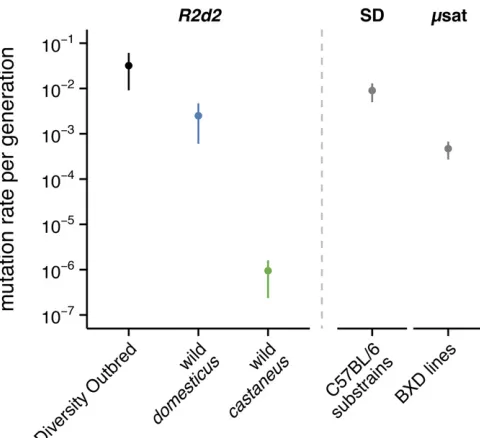
copy-number changes atR2d2is extremely high in laboratory populations (Figure 3). In 183 mice sampled from the DO population we identified and confirmed through segregation analysis eight new alleles, each with distinct copy number and each occurring in an unrelated haplotype (Table S4). Without complete pedigrees and genetic material from breeders, a direct estimate of the mutation rate in the DO is not straightfor-ward to obtain. However, since the population size is known, we can make an analogy to microsatellite loci (Moran 1975) and estimate the mutation rate via the variance in allele sizes: 3.2 mutations per 100 transmissions (3.2%) (95%bootstrap C.I. 1.1–6.0%).
Structural instability in this region of chr2 extends outside theR2d2locus itself. There is another duplication,200 kbp distal toR2d2(Figure 4B, gray shaded region)—containing a retrotransposed copy ofCwc22—that is present in seven tan-dem copies in the reference genome. That region, plus a further 80 kbp immediately distal to it, is copy-number poly-morphic in wildM. m. domesticusand wildM. m. castaneus
(Figure 4B). Instability of the region over longer timescales is demonstrated by the disruption, just distal to the aforemen-tioned SD, of a syntenic block conserved across all other mammals (Figure S1).
Despite the high mutation rate for structural variants involving R2d2 and nearby sequences, sequence diversity at the nucleotide level is modestly reduced relative to di-versity inR2d1and relative to the genome-wide average in
M. m. domesticus. In a 200-kbp region containing theR2d2
insertion site at its proximal end,pb(an estimator of average heterozygosity) in M. m. domesticusreduced by at least a factor of two from the local average of 0.3% (which is comparable to previous reports in this subspecies, see Salcedo et al. 2007) (Figure 4B). Divergence between
M. musculus and M. caroli is similar to its genome-wide average of2.5% over the same region.
Estimation of diversity within a duplicated sequence such asR2dis complicated by the difficulty of distinguish-ing allelic from paralogous variation. To circumvent this problem we split our sample of 26 wild M. m. domesticus
into two groups: those having R2d1 sequences only, and those having bothR2d1andR2d2sequences. Within each group we counted the number of segregating sites among all R2d2 copies, using nearby fixed differences between
R2d1andR2d2to phase sites toR2d2(seeMaterials and Meth-ods for details), and used Watterson’s estimator of theta to calculate nucleotide diversity per site. AmongR2d1sequences inM. m. domesticus,u= 0.0960.03%vs.u= 0.0460.02% amongR2d2sequences inM. m. domesticus(Figure 4C) and
u= 0.1360.04% amongR2d2sequences inM. m. castaneus.
R2d contains the essential gene Cwc22
The R2d unit encompasses one protein-coding gene, Cwc22, which encodes an essential (mRNA) splicing factor (Yehet al.
2010). The gene is conserved across eukaryotes and is present in a single copy in most non-rodent species represented in the TreeFam database (http://www.treefam.org/family/TF300510; Li 2006). Five groups ofCwc22paralogs are present in mouse genomes: the copies inR2d1(Cwc22R2d1) andR2d2(Cwc22R2d2), the retrotransposed copies in one locus at chr2: 83.9 Mb, and at two loci on the X chromosome (chrX) (Figure 5A).
The three retrotransposed copies are located in regions with no sequence similarity to each other, indicating that each represents an independent retrotransposition event. The copy on chr2 was subsequently expanded by further duplication and now exists (in the reference genome) in seven copies with .99.9% mutual similarity. The two retrotransposed copies on chrX are substantially diverged from the parent gene (,90% sequence similarity), lack intact open reading frames (ORFs), have minimal evidence of expression among GenBank cDNAs, and are annotated as likely pseudogenes (Pei et al. 2012). We therefore restricted our analyses to the remaining three groups ofCwc22sequences, all on chr2. The canonical transcript ofCwc22R2d1(ENSMUST00000065889) is encoded by 21 exons on the negative strand. The coding sequence begins in the third exon and ends in the terminal exon (Figure 5B). Six of the seven protein-codingCwc22R2d1 transcripts in Ensembl v83 use this terminal exon, while one transcript (ENSMUST0000011824) uses an alternative Figure 3 Rate ofde novocopy-number changes atR2d2. Estimates of per-generation mutation rate for CNVs at R2d2 (61 bootstrap SE) in
the DO population, among wild M. m. domesticus, and among wild
M. m. castaneus. For comparison, mutation rates are shown for the CNV with the highest rate of recurrence in a C57BL/6J pedigree (Egan
terminal exon. Alignment of the retrogene sequence (ENSMUST00000178960) to the reference genome demon-strates that the retrogene captures the last 19 exons of the canonical transcript—that is, the 19 exons corresponding to the coding sequence of the parent gene.
Cwc22 is intact in and expressed from all R2d paralogs, and fast-evolving in rodents
To identify the coding sequence of Cwc22R2d2, we first aligned the annotated transcript sequences of Cwc22R2d1 from Ensembl to our R2d2contig. All 21 exons present in
R2d1are present inR2d2. We created a multiple sequence alignment and phylogenetic tree ofCwc22cDNAs and pre-dicted amino acid sequences from Cwc22R2d1, Cwc22R2d2, retro-Cwc22, and Cwc22 orthologs in 19 other placental mammals, plus opossum, platypus, and finally chicken as an outgroup (Figure S3). An ORF is maintained in all three
Cwc22loci in mouse, including the retrogene. Information content of each column along the alignment (Figure S4) reveals that sequence is most conserved in two predicted conserved domains, MIF4G and MA3, required forCwc22’s function in mRNA processing (Yehet al.2010).
Next we examined public RNA-sequencing (RNA-seq) data from adult brain and testis in inbred strains with one or more copies ofR2d2 for evidence of transcription of eachCwc22
family member. We identified several novel transcript iso-forms specific to R2d2 arising from two intron-retention events and one novel 39exon (Figure 6A). The 18th intron is frequently retained in Cwc22R2d2transcripts, most likely due to an A.G mutation at the 59splice donor site of exon 17 inCwc22R2d2. The 12th intron is also frequently retained. While we could not identify any splice-region variants near this intron, it contains an ERV insertion that may interfere with splicing (Figure 6A). Both intron-retention events would Figure 4 Sequence and structural diversity aroundR2d2. (A) Geographic origin of wild mice used in this study, color-coded by subspecies (blue,M. m. domesticus; red,M. m. musculus; green,M. m. castaneus). Diploid copy number of theR2dunit is shown for wild samples for which integer copy-number estimates are available: 26M. m. domesticusand 10M. m. castaneuswith whole-genome sequencing data, and representatives fromM. m. molossinusandM. m. musculusfor comparison. Schematic shows theR2d1/R2d2configurations corresponding to diploid copy numbers of two and four. CN, copy number. (B) Profiles of read depth (top two panels), average sequence divergence to outgroup speciesM. caroli(dxy, third panel), number of segregating sites per base (S/L, fourth panel) and within-population average heterozygosity (p,fifth and sixth panels). The region shown is 500 kbp in size; the insertion site ofR2d2is indicated by the red dashed line. Gray boxes along baseline show positions of repetitive elements (from UCSC RepeatMasker track); black boxes show nonrecombining haplotype blocks. Blue bars indicate the position of seven tandem duplications in the mm10 reference sequence with.99% mutual identity, each containing a copy of retro-Cwc22. Gray shaded region indicates duplicate sequence absent from
create an early stop codon. Finally, we find evidence for a novel 39exon that extends to the boundary of theR2dunit and is used exclusively byCwc22R2d2(Figure 6A).
We estimated the expression of the various isoforms of Cwc22R2d1,Cwc22R2d2, and retro-Cwc22in adult brain and testis. For brain we obtained reads from eight
each read across all isoforms with compatible sequence.
Cwc22is clearly expressed from all three paralogs in both brain and testis (Figure 6B). However, both the total ex-pression and the pattern of isoform usage differ by tissue and copy number.
Maintenance of an ORF in allCwc22paralogs for.2 MY is evidence of negative selection against disrupting muta-tions in the coding sequence, but long branches within the rodent clade inFigure S3suggest thatCwc22may also be under relaxed purifying selection or positive selection in rodents. The rate of evolution of Cwc22 sequences in mouse is faster than in the rest of the tree (x2 = 4.33,
d.f. = 1,P= 0.037).
Phylogenetic discordance in R2d1 is due to nonallelic gene conversion
The topology of trees across R2dis generally consistent: a long branch separating the single M. carolisequence from the M. musculus sequences, and two clades corresponding to R2d1- and R2d2-like sequences. However, we observed that the affinities of some R2d paralogs change along the sequence (Figure 7A), a signature of nonallelic (i.e., inter-locus) gene conversion. In this context, we use“gene conver-sion”to describe a nonreciprocal“copy-and-paste”transfer of sequence from one donor locus into a different, homologous receptor locus, without reference to a specific molecular mechanism (Chenet al.2007).
To investigate further, we inspected patterns of sequence variation in whole-genome sequencing data from 15 wild-caught mice, 2 wild-derived inbred strains, and 22 classical inbred strains of mice with a diploidR2dcopy number of two. Wefirst defined 1411 pairwise single-nucleotide differences (1 per 89 bp; Ti:Tv = 1.85) between R2d2 and R2d1, for whichR2d2has the derived allele with respect toM. caroli. We then tested for the presence of the derived allele, ances-tral allele, or both at each site in each sample. Finally, we identified conversion tracts by manual inspection as clusters of derived variants shared withR2d2(Figure S5).
This analysis revealed nonallelic gene conversion tracts on at least 9 chromosomes out of the small sample of 54 chro-mosomes examined (Figure 7B). The conversion tracts range in size from 1.2 to 119 kbp. The boundaries of several tracts are shared within populations, suggesting that they are identical by descent. We excluded the possibility of com-plementary losses fromR2d1andR2d2(which would leave similar patterns of sequence variation) byfinding read pairs spanning the boundary betweenR2d1andflanking sequence, and betweenR2d1- andR2d2-like tracts on the same chro-mosome (examples shown in Figure 7C).
The conversion tracts we detected are orders of magnitude longer than the 15–750 bp reported in recent studies of allelic gene conversion at recombination hotspots in mouse meiosis (Coleet al. 2010, 2014). We require the presence ofR2d2 -diagnostic alleles at two or more consecutive variants to de-clare a conversion event, and these variants occur at a rate of
1 per 100 bp, so the smallest conversion tracts we could
theoretically detect are on the order of 200 bp in size. Even if we require only a single variant to define a conversion tract, all samples without a long conversion tract share ,55 and most,10 (of 1411) derived alleles withR2d2, of which all are also shared by multiple other samples from different pop-ulations (Figure S5). This pattern indicates that those sites in fact represent either artifacts (from mis-assignment of ances-tral and derived alleles) or homoplasy rather than short gene conversions.
Four conversion tracts partially overlap theCwc22gene to create a sequence that is a mosaic of R2d1- andR2d2-like exons (Figure 7B). Recovery of Cwc22mRNA in an inbred strain (PWK/PhJ) indicates that its exons are intact, adjacent, and properly oriented incis. The presence of bothR2d1- and
R2d2-like sequence in extantM. musculuslineages with two diploid copies ofR2dfurther reinforces our conclusion that the duplication is indeed ancestral to the divergence of
M. musculus.
In addition to exchanges between R2d1andR2d2, we identified an instance of exchange between R2d2 and the nearby retrotransposed copy of Cwc22in a single M. m. domesticus individual from Iran (IR:AHZ_STND:015;
Figure S6). This individual carries a rearrangement that has inserted a 30-kbp fragment corresponding to the 39 half of Cwc22R2d2into the retro-Cwc22 locus, apparently mediated by homology between the exons of Cwc22R2d2 and retro-Cwc22.
High copy number at R2d2 suppresses meiotic recombination
The difficulty offine-mappingR2d2in crosses (Didionet al.
2015) and patterns associated with selective sweeps for
R2d2HC(Didion et al. 2016) suggested that recombination is suppressed aroundR2d2. Based on a previous observation that the rate of meiotic recombination is reduced near clus-ters of SDs (Liu et al.2014), we tested whether the region aroundR2d2has lower recombination when anR2d2HCallele is present. Understanding patterns of recombination atR2d2
is important for interpreting levels of sequence and haplotype diversity in the surrounding region.
First we analyzed local recombination rate in the DO population. The DO is an outbred stock derived from eight inbred founder strains (including one, WSB/EiJ, with an
R2d2HC allele) and maintained by random mating with 175 breeding pairs; at each generation, one male and one female offspring are chosen from each mating and randomly paired with a nonsibling to produce the next generation (Svensonet al.2012). Figure 8A shows the cumulative distri-bution of 2917 recombination events on central chr2,
strati-fied according to R2d2 copy number of the participating haplotypes. The recombination map has a pronounced pla-teau in the region betweenR2d1and1 Mb distal toR2d2
(dashed lines) forR2d2HChaplotypes, but notR2d2LC hap-lotypes. As a result,R2d2HC haplotype blocks overlapping
correction) in 8 of the 10 generations sampled (Figure 8B). The difference arose early in the breeding of the DO and persists through the most recent generation for which the randomized breeding scheme was maintained (E. J. Chesler,
D. M. Gatti, A. P. Morgan, M. Strobel, L. Trepanier, D. Oberbeck, S. McWeeney, R. Hitzemann, M. Ferris, R. McMullan, A. Clayshulte, T. A. Bell, F. P. M. de Villena, and G. A. Churchill, unpublished data).
Figure 6 Expression of Cwc22 iso-forms. (A) Read coverage and splicing patterns inCwc22in adult whole brain from three wild-derived inbred strains. Swoops below x-axis indicate splicing events supported byfive or more split-read alignments. Known transcripts of
Cwc22R2d1(gray, from Ensembl), inferred transcripts fromCwc22R2d2(black), and the sequence of retro-Cwc22 mapped back to the parent gene (blue) are shown in the bottom panel. Red stars indicate retained introns, red arrow indicates insertion site of an ERV in R2d2. (B) Estimated relative expression of Cwc22
Second, we reexamined genotype data from 11 published crosses in which at least one parent was segregating for an
R2d2HCallele. Whereas in the DO we used haplotype block length as a proxy for recombination rate, in these F2
and backcross designs we can directly estimate the recom-bination fraction acrossR2d2and compare it to its expected value in the absence of an R2d2HC allele (Figure S7). In 9 of 11 crosses examined, the observed recombination Figure 7 Signatures of nonallelic gene conversion between R2d1 and R2d2. (A) Phylogenetic trees for three repre-sentative intervals across R2d. Se-quences are labeled according to their subspecies of origin using the same color scheme as in Figure 4; open circles areR2d1-like sequences and solid circles areR2d2-like. Trees are drawn so that
M. caroli, the outgroup species used to root the trees, is always positioned at the top. The changing affinities of PWK/PhJ (red) and CAST/EiJ (green) along R2d are evidence of nonallelic gene conversion. (B) R2dsequences from 20 wild-caught mice and 5 labora-tory inbred strains. Each track represents a single chromosome; shaded regions are classified as R2d1-like based on manual inspection of sequence variants, and solid regions asR2d2-like. Top panel shows sequences from samples with a single copy ofR2d, residing inR2d1. Bottom panel shows representative
R2d2sequences for comparison.* indi-cates samples for which read alignments are shown in panel C. (C) Top panel: paired-end read alignments (visualized with Integrative Genomics Viewer) across the proximal boundary (dashed line) ofR2d1in a sample with a conver-sion tract extending to the boundary. Positions of derived variants shared with
R2d2are indicated by black dots. Bot-tom panel: read alignments across the boundary of a nonallelic gene conver-sion tract.R2d1sequence from a single chromosome with a mosaic ofR2d1-like (gray) and R2d2-like (black) segments. A magnified view of read pairs in the 3.8 kbp surrounding the proximal bound-ary of the tract shows read pairs spanning the junction. Black dots indicate the po-sition of derived alleles diagnostic for
fraction is lower than the expected (P,0.032, one-sided binomial test).
Discussion
In this manuscript we have reconstructed in detail the evolu-tion of a multi-megabase SD in mouse, R2d2. Ourfindings illustrate the challenges involved in accurately interpreting patterns of polymorphism and divergence within duplicated sequence.
SDs are among the most dynamic loci in mammalian genomes. They are foci for copy-number variation in popula-tions, but the sequences of individual duplicates beyond those present in the reference genome are often poorly resolved. Obtaining the sequence of this“missing genome,”as we have done forR2d2, is an important prerequisite to understanding the evolution of duplicated loci. Since each paralog follows a partially-independent evolutionary trajectory, individuals in a population may vary both quantitatively (in the number of copies) and qualitatively (in which copies are retained). Cy-cles of duplication and loss may furthermore lead to thefi x-ation of different paralogs along different lineages. This
“genomic revolving door”(Demuthet al.2006) leaves a sig-nature of polymorphism far in excess of the genome-wide background, due to coalescence between alleles originating from distinct paralogs.
Accurate deconvolution of recent duplications remains a difficult task that requires painstaking manual effort. Clone-based and/or single-molecule, long-read sequencing remain the gold standard techniques. But short reads at sufficient depth nonetheless contain a great deal of information. We exploited the specific properties of R2d2 in the WSB/EiJ mouse strain—many highly-similar copies ofR2d2relative to R2d1, with informative paralogous variants every
100 bp—to obtain a nearly complete assembly ofR2d2from short reads (Figure S8). With the sequence of both theR2d1
andR2d2paralogs in hand, we were able to recognize several remarkable features of R2d2 that are discussed in detail below.
Long-tract gene conversion
Previous studies of nonallelic gene conversion in mouse and human have focused either on relatively small (,5 kbp) in-tervals within species, or have applied phylogenetic methods to multiple paralogs from a single reference genome (Dumont and Eichler 2013). This study is thefirst, to our knowledge, with the power to resolve large (.5 kbp) non-allelic gene conversion events on an autosome in a popula-tion sample. We identify conversion tracts up to 119 kbp in length, orders of magnitude longer than tracts arising from allelic conversion events during meiosis. Gene conversion at this scale can rapidly and dramatically alter paralogous se-quences, including (as shown in Figure 7) the sequences of essential protein-coding genes. This process has been impli-cated as a source of disease alleles in humans (Chenet al.
2007).
Importantly, we were able to identify nonallelic exchanges inR2d1as such only because we were aware of the existence ofR2d2in other lineages. In this case the transfer of paralo-gous R2d2 sequence into R2d1 creates the appearance of deep coalescence amongR2d1sequences. Ignoring the effect of gene conversion would cause us to overestimate the de-gree of polymorphism atR2d1by an order of magnitude, and would bias any related estimates of population-genetic pa-rameters (for instance, of effective population size).
Our data are not sufficient to estimate the rate of nonal-lelic gene conversion between R2d2and homologous loci. At minimum we have observed two distinct events: one from
R2d2 intoR2d1, and a second fromR2d2 into retro-Cwc22. From a single conversion event replacing most ofR2d1with
R2d2-like sequence, the remaining shorter conversion tracts could be generated by recombination withR2d1sequences. Because wefind converted haplotypes in bothM. m. musculus
andM. m. domesticus, the single conversion event would have had to occur prior to the divergence of the threeM. musculus
subspecies and subsequently remain polymorphic in the di-verged populations. We note that all conversion tracts we observed are polarized:R2d2is always the donor.
The other possibility is that nonallelic gene conversion betweenR2dsequences is recurrent. Recurrent gene conver-sion homogenizes duplicate sequences, coupling their evolu-tionary trajectories (“concerted evolution”, Dover 1982). The absolute sequence divergence (2%) between R2d1 and
R2d2 (Figure 1B) argues against the hypothesis that gene conversion has occurred at a uniformly high rate throughout their history. However, we cannot rule out a role for gene conversion in maintaining sequence identity between multi-ple copies ofR2dlocated inR2d2. This would help explain the reduced diversity withinR2d2 vs. R2d1(Figure 4C). There is some direct evidence that the rate of gene conversion is pos-itively correlated with copy number and negatively corre-lated with physical distance between duplicates (Melamed and Kupiec 1992), so we might expect it to be highest for
R2d2HCalleles.
In this respectR2d2 may be similar to the male-specific region of the Y chromosome (chrY) in mouse (Soh et al.
2014) and human (Rozenet al.2003). The large palindromic repeats on chrY are homogenized by frequent nonallelic gene conversion (Hallastet al.2013) such that they have retained .99% sequence identity to each other even after millions of years of evolution. Frequent nonallelic gene con-version has also been documented in arrays of U2 small nuclear RNA genes in human (Liao et al. 1997), and in ribosomal RNA gene clusters (Eickbush and Eickbush 2007) and centromeric sequences (Schindelhauer 2002; Shiet al.
2010) in several species.
Pervasive copy-number variation
Clusters of SDs have long been known to be hotspots of copy-number variation in populations (Bailey and Eichler 2006; Sheet al.2008) and de novomutations in pedigrees (Egan
revealed the existence of thousands of multi-allelic CNVs segregating in human populations (Handsakeret al.2015).
We have surveyedR2d2copy number in a large and di-verse sample of laboratory and wild mice, and have shown that it varies from 0 to.80 in certainM. m. domesticus pop-ulations (Figure 4A). In a cohort of outbred mice expected to be hemizygous for anR2d2HCallele from WSB/EiJ (33 diploid copies), we estimate that large deletions, .2 Mb in size, occur at a rate of 3.2% (95% bootstrap C.I. 1.1–6.0%) per generation. This estimate of the mutation rate for CNVs atR2d2should be regarded as a lower bound. The power of our copy-number assay to discriminate between copy numbers .25 is low, so the assay is much more sensitive to losses than to gains. Even our lower-bound mutation rate exceeds that of the most common recurrent deletions in hu-man (1 per 7000 live births) (Turneret al.2007) and is an order of magnitude higher than the most active CNV hotspots described to date in the mouse (Eganet al.2007).
However, the structural mutation rate appears to depend strongly on the diplotype configuration atR2d2. As Figure 1D shows, individuals heterozygous for an R2d2HC haplotype and anR2d2-null haplotype are in fact hemizygous for sev-eral megabases of DNA inR2d2. This has important conse-quences. High mutation rates are observed only in the context of populations in which hemizygosity forR2d2HCis common (Figure 3): highest in the DO, and to a lesser extent in wildM. m. domesticuspopulations harboring bothR2d2HC andR2d2-null alleles. Homozygosity forR2d2HCis not asso-ciated with mutability: in eight recombinant inbred lines from the Collaborative Cross which are homozygous for an
R2d2HC haplotype, we observed zero new mutations in at least 400 meioses, through both the male and female germ-line (8 germ-lines32 meioses/generation325 or more genera-tions of inbreeding). Sex also appears to have a role in
determining the mutation rate at R2d2: in a pedigree in which all females were hemizygous for R2d2HC, zero new mutations were observed in 1256 meioses (data not shown). Taken together, these observations hint at a common structural or epigenetic mechanism affecting the resolution of double-strand breaks in large tracts of unpaired (i.e., hemi-zygous) DNA during male meiosis. At least one other study in mouse has hinted that hemizygous SDs on the sex chromo-somes are unstable in intersubspecific hybrids (Scavetta and Tautz 2010). Both the obligate-hemizygous sex chromo-somes and large unpaired segments on autochromo-somes are epige-netically marked for transcriptional silencing during male meiotic prophase (van der Laanet al.2004; Baarendset al.
2005), and are physically sequestered into a structure called the sex body (Bhattacharyyaet al.2013). Repair of double-strand breaks within the sex body is delayed relative to the autosomes (Mahadevaiahet al.2001) and involves a differ-ent suite of proteins (Turner et al. 2004). We hypothesize that these male-specific pathway(s) may be error-prone in the presence of nonallelic homologous sequences.
However, we cannot exclude the possibility that large-scale rearrangement (such as an inversion) associated with copy-number expansion atR2d2contributes to its instability. Phys-ical mapping of theR2d2locus in WSB/EiJ is in progress (T. Keane, personal communication) and will shed light on this question.
Origin and distribution of an allele subject to meiotic drive
Females heterozygous for a high- and low-copy allele atR2d2
preferentially transmit the high-copy allele to progeny via meiotic drive (Didionet al.2015). Meiotic drive can rapidly alter allele frequencies in laboratory and natural populations (Lindholmet al.2016), and we recently showed thatR2d2HC Figure 8 Suppression of crossing-over aroundR2d2. (A) Cumulative number of unique recombination events in the middle region of chr2 in genomes of 4640 DO mice. Recombination events involving the high copy-number WSB/EiJ haplotype are shown in purple and all other events in gray. Dashed vertical lines indicate the position ofR2d1(left) andR2d2(right). (B) Distribution of haplotype block sizes atR2d2in selected generations of the DO, for
alleles sweep through laboratory and natural populations de-spite reducing the fitness of heterozygous females (Didion
et al.2016). These“selfish sweeps”account for the marked reduction in within-population diversity in the vicinity of
R2d2(Figure 4B).
The present study sheds additional light on the age, origins, and fate ofR2d2HCalleles. Wefind thatR2d2HCalleles have a single origin inM. m. domesticus. They are present in several different “chromosomal races”—populations fixed for spe-cific Robertsonian translocations between which geneflow is limited (Hauffe and Searle 1993)—indicating that they were likely present at intermediate frequency prior to the origin of the chromosomal races within the past 6000–10,000 years (Nachman et al. 1994) and were dispersed through Europe as mice colonized the continent from the south and east (Boursotet al.1993). The presence ofR2d2HCin a non-M. m.
domesticussample (SPRET/EiJ,M. spretusfrom Cadiz, Spain) is best explained by recent introgression following secondary contact withM. m. domesticus(Bonhommeet al.2007; Yang
et al.2011).
Additional members of the Cwc22 family
The duplication that gave rise toR2d2also created a new copy ofCwc22. Based on our assembly of theR2d2sequence, the ORF ofCwc22R2d2is intact and encodes a nearly full-length predicted protein that retains the two key functional domains characteristic of the Cwc22 family. Inspection of RNA-seq data from samples with high copy number at R2d2reveals several novel transcript isoforms whose expression appears to be copy number- and tissue-dependent. In testis, the most abundant isoform retains an intron containing an ERV inser-tion (red arrow in Figure 6), consistent with the well-known transcriptional promiscuity in this tissue. The most abundant isoforms in adult brain is unusual in that its stop codon is in an internal exon which is followed by a 7-kbp 39UTR in the terminal exon. Transcripts with a stop codon in an inter-nal exon are generally subject to nonsense-mediated decay (NMD) triggered by the presence of exon-junction complexes downstream of the stop codon. Curiously,Cwc22is itself a member of the exon-junction complex (Steckelberg et al.
2012).
That an essential gene involved in such a central bio-chemical pathway should both escape NMD and be overex-pressed .10-fold is surprising. Preliminary data from the DO population shows that theR2d2HC allele is associated with elevated levels of bothCwc22transcripts and protein in adult liver (Churchill et al. 2016). Further studies will be required to determine the distribution of transcription and translation ofCwc22across isoforms, tissues, and develop-mental stages.
Conclusions and future directions
Our detailed analysis of the evolutionary trajectory ofR2d2
provides insight into the fate of duplicated sequences over short (within-species) timescales. The exceptionally high mu-tation rate and low recombination associated specifically
with hemizygousR2d2HCalleles motivate hypotheses regard-ing the biochemical mechanisms which contribute to observed patterns of polymorphism at this and similar loci. Finally, the birth of a new member of the deeply conservedCwc22gene family inR2d2provides an opportunity to test predictions re-garding the evolution of young duplicate gene pairs.
Acknowledgments
We thank all the scientists and personnel who collected and processed the wild mouse samples used in this study. In particular we thank Francois Bonhomme for providing samples from wild-derived inbred strains housed at the University of Montpellier Wild Mouse Genetic Repository, and Ted Garland for providing tissue samples from the“high running”selection lines and related crosses. This work was supported by National Institutes of Health grants P50 GM-076468 (F.P.-M.d.V.), U19 AI-100625 (F.P.-M.d.V. and A.P.M.), F30 MH-103925 (A.P.M.), T32 GM-067553 (J.P.D. and A.P.M.) and R21MH09621 (F.P.-M.d.V.); and the Vaadia-Binational Agricultural Re-search and Development Fund Postdoctoral Fellowship Award FI-12 478-13 to L.Y. Additional support was provided by Cancer Research United Kingdom, the European Re-search Council, European Molecular Biology Organization Young Investigator Programme (D.T.O.); the European Mo-lecular Biology Laboratory (D.T.O. and P.F.); the Wellcome Trust (WT095908 to P.F. and WT098051 to P.F. and D.T.O.); and finally by the European Union’s Seventh Framework Programme (FP7/2007-2013) under grant agreement HEALTH-F4-2010-241504 (EURATRANS).
Literature Cited
Baarends, W. M., E. Wassenaar, R. van der Laan, J. Hoogerbrugge, E. Sleddens-Linkelset al., 2005 Silencing of unpaired chroma-tin and histone H2A ubiquichroma-tination in mammalian meiosis. Mol. Cell. Biol. 25: 1041–1053.
Bailey, J. A., and E. E. Eichler, 2006 Primate segmental duplica-tions: Crucibles of evolution, diversity and disease. Nat. Rev. Genet. 7: 552–564.
Bhattacharyya, T., S. Gregorova, O. Mihola, M. Anger, J. Sebestova
et al., 2013 Mechanistic basis of infertility of mouse intersub-specific hybrids. Proc. Natl. Acad. Sci. USA 110: E468–E477. Bonhomme, F., E. Rivals, A. Orth, G. R. Grant, A. J. Jeffreyset al.,
2007 Species-wide distribution of highly polymorphic minisatellite markers suggests past and present genetic exchanges among house mouse subspecies. Genome Biol. 8: R80.
Boursot, P., J. C. Auffray, J. Britton-Davidian, and F. Bonhomme, 1993 The evolution of house mice. Annu. Rev. Ecol. Syst. 24: 119–152.
Boyden, L. M., J. M. Lewis, S. D. Barbee, A. Bas, M. Girardiet al., 2008 Skint1, the prototype of a newly identified immunoglob-ulin superfamily gene cluster, positively selects epidermal T cells. Nat. Genet. 40: 656–662.
Bray, N. L., H. Pimentel, P. Melsted, and L. Patcher, 2016 Near-optimal RNA-seq quantification. Nat Biotechnol. 34: 525–527. Chen, J.-M., D. N. Cooper, N. Chuzhanova, C. Férec, and G. P.