ISSN(Online): 2319-8753
ISSN (Print): 2347-6710
I
nternational
J
ournal of
I
nnovative
R
esearch in
S
cience,
E
ngineering and
T
echnology
(An ISO 3297: 2007 Certified Organization)
Vol. 5, Special Issue 1, March 2016
A Comparative Study on the Electrochemical
Behaviour of Ascorbic Acid, Paracetamol and
L-Cysteine at the Carbon-Spinel Hetero
Junction
S. Shravan Kumar, *K.Premalatha
P.G & Research, Department of Chemistry, D.G. Vaishnav College, Chennai, , India
ABSTRACT: The electrochemical behaviour of Ascorbic acid (AA), Paracetamol (PA) and L-Cysteine(CY) was studied by cyclic voltammetry using modified platinum electrode. Initially, the carbon material was prepared from natural honey source and Cobalt chromite spinel (CoCr2O4) was synthesised by co-precipitation method. The
pre-treated platinum electrode was coated with carbon-spinel mixture using PEG 6000 and N-methyl pyrrolidine as binders and dried at 50 ºC. The modified platinum electrode thus prepared exhibited excellent electron mediating behavior and showed good sensitivity and selectivity towards the simultaneous determination of AA, PA and CY. The redox behaviour of these drug components is determined by their voltammetric responses into well-defined peaks.
KEY WORDS: Modified platinum electrode, cyclic voltammetry, redox behavior.
I. INTRODUCTION
The study of electrochemical behavior of Ascorbic acid (AA), Paracetamol (PA) and L-Cysteine is of great interest as these organic compounds are biomedically and neurologically important. They are present in many biological tissues and involved in a number of metabolic processes. L-Cysteine, a semi-essential sulfur-containing amino acid is important for protein synthesis, detoxification and other metabolic functions. It is a prospective radiation protector and cancer indicator [1-3]. Paracetamol (PA) otherwise called as Acetaminophen, a widely used antipyretic and analgesic drug, is highly effective for the release of pain associated with neuralgia and headache and even patients suffering from gastric symptoms [4]. Similarly, Ascorbic acid (AA) is used in the prevention and treatment of common cold, mental illness, infertility and cancer [5]. These drug components are completely metabolized by our body but over dosage of these sometimes causes inflammation of pancreas [6-7] and accumulation of toxins in kidney, liver etc. Hence it becomes inevitable to detect these chemicals by a simple, accurate and fast technique.
ISSN(Online): 2319-8753
ISSN (Print): 2347-6710
I
nternational
J
ournal of
I
nnovative
R
esearch in
S
cience,
E
ngineering and
T
echnology
(An ISO 3297: 2007 Certified Organization)
Vol. 5, Special Issue 1, March 2016
II. EXPERIMENTAL
2.1. Chemicals and Reagents
All chemicals namely Co(NO3)2·6H2O (Qualigens), Cr(NO3)3·9H2O(CDH), sodium hydroxide (Merck), Pluronic P123
(Sigma–Aldrich), tetraethyl orthosilicate (Merck), Ascorbic Acid (Merck), and L-Cystine (Merck) were used as such. Paracetamol and Natural honey were purchased from local supermarket. The buffer solution was made up of 0.1M NaH2PO4 (Merck) and Na2HPO4. All other reagents were of analytical grade and used without further purification. All
solutions were prepared using double distilled water.
2.2 Apparatus
Electrochemical Measurements were performed on a CH silicone voltammetric Analyzer model 604E work station with conventional 3 electrode system. Modified Pt electrode was used as the working electrode while the platinum wire and saturated Calomel electrode were used as counter and reference electrodes respectively. Digital pH/mV model 780 Metrohm was used for the preparation of phosphate buffer solution. The X-ray diffraction pattern of the synthesized cobalt chromite spinel was recorded on Rigaku Miniflex II X-ray diffractometer in the range 5 to 80 degree at a scan rate 3 deg/min using Ni-filtered CuKα radiation. The BET surface area for carbon was determined by N2 physisorption
at −196 ◦C using a Micromeritics ASAP 2020 automatic analyzer. Scanning electron micrographs were recorded on a FEI Model Quanta 200 HR-SEM. Transition electron microscope (TEM) images were obtained with JEOL 3010 UHR TEM equipped with a Gatan Imaging Filter.
2.3 Synthesis of Ordered Mesoporous Carbon
Initially, the silica template SBA-15 was synthesized from tetraethyl orthosilicate (TEOS) using Pluronic 123 as the surfactant [41]. The mesoporous carbon material was synthesized using SBA-15 as the template [42-44]. In a typical synthesis, 2g of SBA-15 was added to a mixture of 1.2 g of honey, 0.2 g of sulphuric acid and 5 g of water. The mixture was stirred well at room temperature to obtain a homogeneous solution. Then the solution was placed in oven for 6 hours at 100o C and subsequently the temperature of the oven was raised to 160oC for another 6 hours. Again the same amount of honey, H2SO4 and water were added to the pre-treated sample in order to get a fully polymerized and
carbonized honey. The template-carbon material thus obtained was calcined at 900o C under nitrogen flow and kept for 6 hours. The calcined sample was dissolved in 5% wt of Hydrofluoric acid to remove silica framework. The mesoporous carbon thus obtained was filtered, washed several times with ethanol and dried.
2.4 Synthesis of spinel type Cobalt Chromite [CoCr2O4]
Initially, 2.91 g (0.01 M) of Co(NO3)2.6H2O (M. Wt = 291.03) was dissolved in 30 mL distilled water with
continuous stirring on a magnetic stirrer [45-47]. 8.004 g of Cr(NO3)3.9H2O (0.02 M), (M. Wt = 400.15) was added to
it slowly and the stirring was continued till the reaction mixture became homogeneous. Then, 2N sodium hydroxide solution was added drop wise till the pH of the mixture reached 9-10. A pale green precipitate was formed. It was kept for ageing in an oil bath at about 60 ºC for two hours. Then the precipitate was filtered at the vacuum pump, washed with water several times to remove the excess alkali. It was dried in hot air oven at 80 ºC and again dried in vacuum oven at 80 ºCovernight. It was then powdered and calcined at 700 ºC under air flow in tubular furnace for 5 hours. The dark green coloured crystals formed were separated, powdered and kept in air-tight containers.
2.5 Preparation of spinel-carbon modified platinum electrode
The platinum (Pt) electrode was pre-treated by placing in 1N HCl for 24 hours and sonicated in HCl for 1 hour followed by double distilled water for 45 minutes and allowed to dry at room temperature and polished. 0.1 g of synthesized carbon material was mixed with 0.1 g of Cobalt Chromite spinel in a mortar and ground well. To this mixture, added a small amount of PEG 6000 and few drops of N-Methyl Pyrolidine as binder and made into a paste using pestle. A thin layer of this paste was coated uniformly on the platinum electrode and allowed it to dry at 50oC. The spinel-carbon coated platinum electrode thus obtained was used as working electrode for the Electro analytical study. Similar procedure was adopted for the preparation of carbon modified and spinel modified electrodes
ISSN(Online): 2319-8753
ISSN (Print): 2347-6710
I
nternational
J
ournal of
I
nnovative
R
esearch in
S
cience,
E
ngineering and
T
echnology
(An ISO 3297: 2007 Certified Organization)
Vol. 5, Special Issue 1, March 2016
III. RESULTS AND DISCUSSION
3.1 Characterisation of Cobalt Chromite [CoCr2O4]
The XRD patterns of CoCr2O4, calcined at 700 ◦C are represented in Fig 1. The typical reflection planes of the sample
shown namely (2 2 0), (3 1 1), (2 2 2), (4 4 0), (5 1 1), (4 4 0) and (5 3 1) corresponds to the cubic lattice planes (JCPDS Number 80-1668), revealing the formation of standard structure of CoCr2O4 having a cubic spinel structure.
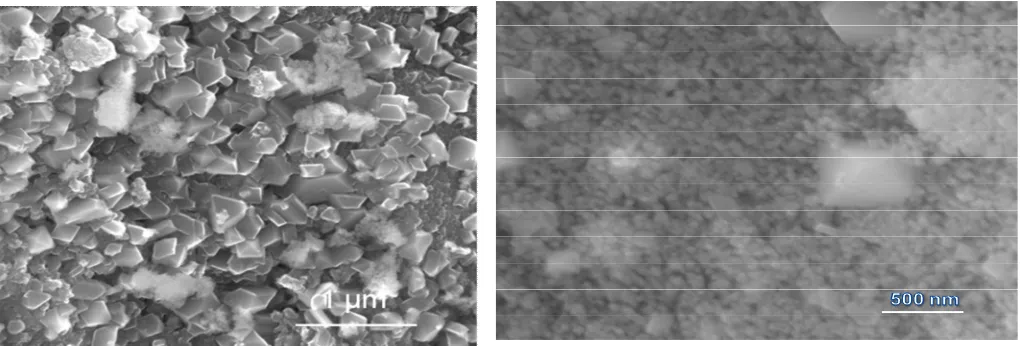
The particle size was determined from the full width at half maximum (FWHM) of the XRD patterns using Scherrer formula and was found to be 15nm. Fig 2 illustrates the SEM images of Cobalt Chromite. It has a grain morphology consisting of perfect octahedrons throughout the entire catalyst, characteristic of spinels.
Fig. 1 XRD pattern of CoCr2O4 spinel (a) As synthesized (b) Calcined at 700 ◦C
ISSN(Online): 2319-8753
ISSN (Print): 2347-6710
I
nternational
J
ournal of
I
nnovative
R
esearch in
S
cience,
E
ngineering and
T
echnology
(An ISO 3297: 2007 Certified Organization)
Vol. 5, Special Issue 1, March 2016
3.2 Characterisation of Mesoporous Carbon
Fig.3 Low-angle XRD of Mesoporous carbon and SBA-15 (inset)
2 μm
ISSN(Online): 2319-8753
ISSN (Print): 2347-6710
I
nternational
J
ournal of
I
nnovative
R
esearch in
S
cience,
E
ngineering and
T
echnology
(An ISO 3297: 2007 Certified Organization)
Vol. 5, Special Issue 1, March 2016
Fig.5 TEM images of Mesoporous carbon
3.3 Electroanalytical measurement
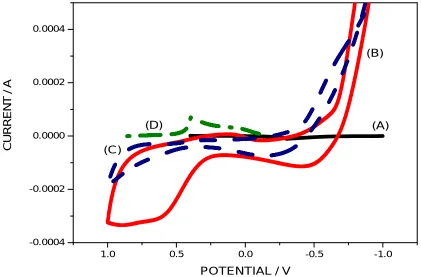
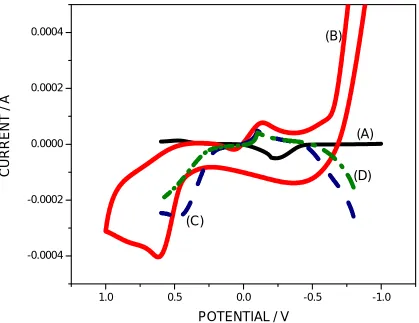
The electrochemical behavior of carbon-spinel modified platinum electrode was investigated by cyclic voltammetry. All experiments were conducted at room temperature. The concentration of analytes used in this investigation namely AA, PA and CY was 5 mM. The experiments were conducted using phosphate buffer at a pH 6.6.
The cyclic voltammograms of AA, CY and PA are represented in Fig. 6, Fig. 7 and Fig. 8 respectively. The Epa andEpc
ISSN(Online): 2319-8753
ISSN (Print): 2347-6710
I
nternational
J
ournal of
I
nnovative
R
esearch in
S
cience,
E
ngineering and
T
echnology
(An ISO 3297: 2007 Certified Organization)
Vol. 5, Special Issue 1, March 2016
0.8 0.6 0.4 0.2 0.0 -0.2 -0.4
-0.0004 -0.0003 -0.0002 -0.0001 0.0000 0.0001 0.0002
(D)
(C)
(B) (A)
C
U
R
R
E
N
T
/
A
POTENTIAL / V
Fig. 6 Cyclic Voltammogram of Ascorbic Acid using (A) bare Pt electrode, (B) carbon-spinel modified Pt electrode, (C) Carbon coated Pt electrode, (D)Spinel coated Pt electrode
1.0 0.5 0.0 -0.5 -1.0
-0.0004 -0.0002 0.0000 0.0002 0.0004
(D)
(C)
(B)
(A)
C
U
R
R
E
N
T
/
A
POTENTIAL / V
ISSN(Online): 2319-8753
ISSN (Print): 2347-6710
I
nternational
J
ournal of
I
nnovative
R
esearch in
S
cience,
E
ngineering and
T
echnology
(An ISO 3297: 2007 Certified Organization)
Vol. 5, Special Issue 1, March 2016
1.0 0.5 0.0 -0.5 -1.0
-0.0004 -0.0002 0.0000 0.0002 0.0004
(D)
(C)
(B)
(A)
C
U
R
R
E
N
T
/
A
POTENTIAL / V
Fig. 8 Cyclic Voltammogram of Paracetamol using (A) bare Pt electrode, (B) carbon-spinel modified Pt electrode, (C) Carbon coated Pt electrode, (D)Spinel coated Pt electrode
Table 1: The anodic and cathodic potential of AA, PA and CY at modified Pt electrodes
Modified Pt Electrode ASCORBIC ACID PARACETAMOL L-CYSTEINE Epa (V) Epc (V) Epa (V) Epc (V) Epa (V) Epc (V)
Spinel-Carbon Junction 0.4665 0.7140 -0.1299 0.6102 0.8090 0.2526 Carbon 0.0121 0.4136 0.4264 0.6157 0.9429 0.4214
ISSN(Online): 2319-8753
ISSN (Print): 2347-6710
I
nternational
J
ournal of
I
nnovative
R
esearch in
S
cience,
E
ngineering and
T
echnology
(An ISO 3297: 2007 Certified Organization)
Vol. 5, Special Issue 1, March 2016
3.4 Simultaneous determination of Paracetamol, Ascorbic Acid and L-Cysteine
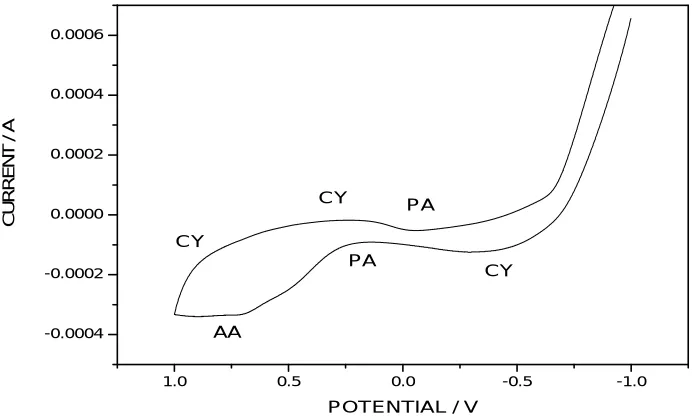
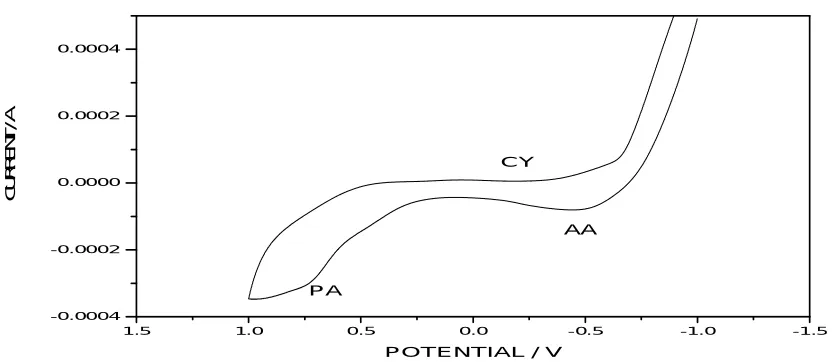
The simultaneous determination of PA with AA and CY were carried out by cyclic voltammetry in the potential range from 1.5V to -1.5V in 0.1M phosphate buffer solution. Fig. 9, Fig. 10 and Fig. 11 represent the cyclic voltammograms using carbon-spinel mixture coated PE, carbon modified PE and spinel coated PE respectively. Well defined redox peaks were observed with carbon-spinel coated Pt electrode for PA, AA and CY when compared with other two modified electrodes. The difference in the oxidation potential for PA, AA and CY, facilitated the sensitive and selective detection of the three compounds simultaneously.
Fig. 9 Cyclic voltammogram for the simultaneous determination of PA, AA and CY at carbon-spinel mixture coated Pt electrode
1.0 0.5 0.0 -0.5 -1.0
-0.0004 -0.0002 0.0000 0.0002 0.0004 0.0006 CY CY PA AA PA CY C U R R E N T / A
POTENTIAL / V
Fig. 10 Cyclic voltammogram for the simultaneous determination of PA, AA and CY at carbon modified Pt electrode
1.0 0.5 0.0 -0.5 -1.0
-0.0004 -0.0002 0.0000 0.0002 0.0004 AA CY PA PA CY AA C U R R E N T / A
ISSN(Online): 2319-8753
ISSN (Print): 2347-6710
I
nternational
J
ournal of
I
nnovative
R
esearch in
S
cience,
E
ngineering and
T
echnology
(An ISO 3297: 2007 Certified Organization)
Vol. 5, Special Issue 1, March 2016
1.5 1.0 0.5 0.0 -0.5 -1.0 -1.5
-0.0004 -0.0002 0.0000 0.0002 0.0004
PA
CY
AA
C
U
R
R
E
N
T
/
A
POTENTIAL / V
Fig. 11 Cyclic voltammogram for the simultaneous determination of PA, AA and CY at spinel coated Pt electrode
IV. CONCLUSION
The Mesoporous Carbon material was prepared from honey source and Cobalt Chromite spinel was prepared by co-precipitation method. They were characterized by various analytical techniques. The working platinum electrode was fabricated with carbon, spinel and 1:1 carbon-spinel mixture. The electrochemical behavior of PA, AA and CY were studied by cyclic voltammetry using these three modified electrodes. The well-resolved peaks are the clear indication of the catalytic behavior of the carbon-spinel modified electrode towards the oxidation of AA, PA and CY on comparison with carbon coated and spinel coated electrodes. Further, the simultaneous determination of PA, AA and CY was more facilitated at carbon-spinel hetero-junction. Hence it can be concluded that the carbon provides large surface area on which the cobalt-chromite acts as active sites for the oxidation of AA, PA and CY. Thus the heterojunction provides excellent sensitivity and high selectivity.
REFERENCES
1. Chen, H. L.; Li, M. S. structure and function of Biomacromolecules ; Shanghai science press: shanghai, (1999). 2. Kulys, J.; Drungliene, A., Anal., Chim. Acta 243, (1991) 287-292.
3. Townshend, A. Encyclopedia of Analytical Science; Academic Press: London, (1995).
4. J. G. Manjunatha, B. E. Kumara Swamy, M. Deraman and G. P. Mamatha., Der Pharma Chemica, 4, 6, (2012) 2489-2497 5. R.D. O Neill, Analyst ,(1994) 119,767.
6. M.E. Bosch, A.J.R. Sanchez, F.S. Rojas and C.B. Ojeda, J. Pharm. Biomed. Anal., 42 (2006) 291 7. R.J.S. Prabakar and S.S. Narayanan, Talanta, 72 (2007) 1818.
8. K.A.R. Sirajuddin, A. Shah, M.I. Bhanger, A. Niaz and S. Mahesar, Spectrochim. Acta. Part A, 68 (2007) 747. 9. S.M. Sultan, Talanta, 34 (1987) 605.
10. K.K. Verma, A. Jain and K.K. Stewart, Anal. Chim. Acta, 261 (1992) 261. 11. J.M. Calatayud and C.G. Benito, Anal. Chim. Acta, 231 (1990) 259. 12. J.A.M. Pulgarin and L.F.G Bermejo, Anal. Chim. Acta, 333 (1996) 59. 13. W. Peng, T. Li, H. Li and E. Wang, Anal. Chim. Acta, 298 (1994) 415. 14. M.L. Ramos, J.F. Tyson and D.J. Curran, Anal. Chim. Acta, 364 (1998) 107. 15. K.G. Kumar and R. Letha, J. Pharm. Biomed. Anal., 15 (1997) 1725.
ISSN(Online): 2319-8753
ISSN (Print): 2347-6710
I
nternational
J
ournal of
I
nnovative
R
esearch in
S
cience,
E
ngineering and
T
echnology
(An ISO 3297: 2007 Certified Organization)
Vol. 5, Special Issue 1, March 2016
21. G.N. Kamau, W.S. Willis, J.F. Rusling, Anal. Chem. 57 (1985) 545. 22. J. Chen, C.S. Cha, J. Electroanal. Chem. 463 (1999) 93.
23. M.B. Gelbert, D.J .Curran, Anal. Chem., (1986) 58, 1028. 24. X.L. Wen, Y.H. Jia, Z.L .Liu, Talanta, (1999) 50, 1027.
25. Y.X. Sun, B.X. Ye, WM .Zhang, X.Y. Zhou, Anal. Chim. Acta., (1998) 363, 75-80. 26. T. Selvaraju, R. Ramaraj, Electrochem. Commun., (2003) 5, 667
27. P. R .Roy, T.Okajima, T. Ohsaka, Bioelectrochemistry, (2003) 59,11
28. R. Aguilar, M.M .Dávila, M.P. Elizalde, J .Mattusch, R .Wennrich, Electrochim. Acta, (2004) 49, 851. 29. H. R. Zare, N. Nasirizadeh, M.M .Ardakani, J. Electroanal.Chem., (2005) 577, 25.
30. Z.H .Wang, J. Liu, Q.L. Liang, Y.M. Wang, GA .Luo, Analyst, (2002) 127, 653. 31. S.M. Chen, J.W. Liu, R. Thangamuthu, Electroanalysis, (2006) 18, 2361. 32. S.M .Chen, J.Y .Chen, VS.Vasantha, Electrochim. Acta, (2006) 52, 455. 33. T. J .Yin, W.Z .Wei, J.X. Zeng, Anal. Bioanal. Chem.,(2006) 386, 2087 34. V. S .Vasantha, S.M.Chen, J. Electroanal. Chem., (2006) 592, 77. 35. S.M. Chen, W.Y. Chzo, J. Electroanal. Chem. (2006) 587, 226.
36. X.R. Deng, L.S.Wang, S.F .Zhang, X.X. Liu, J.Y. Mo, Chin. J. Anal. Chem. (2006) 34, 637.
37. S. S. Kumar, J. Mathiyarasu, K.L.N. Phani, V. Yegnaraman, J.Solid State Electrochem., (2006) 10, 905. 38. G. J .Yang, J. J .Xu, K. Wang, H.Y .Chen, Electroanalysis, (2006) 18, 282.
39. M. Nardini, P. Pisu, V. Gentili, F. Natella, M. Di, F. Piccolella, C. Scaccini, Free Radical Bio Med., (1998) 25, 1098. 40. Jing Lu, Xiangjie Bo, Huan Wang, Liping Guo, Electrochimica Acta 108 (2013) 10– 16
41. Nengqin Jia, Zhiyong Wang, Guofeng Yang, Hebai Shen, Longzhang ZhuElectrochemistry Communications 9 (2007) 233–238 42. S. Jun, S.H. Joo, R. Ryoo, M. Kruk, M. Jaroniec, Z. Liu, T. Ohsuna, O. Terasaki, J. Am. Chem. Soc. 122 (2000) 10712. 43. D. Zhao, J. Feng, Q. Huo, N. Melosh, G.H. Fredirckson, B.F. Chemlka, G.D. Science 279 (1998) 548.
44. K. Premalatha, P.S. Raghavan, B. Viswanathan App. Catalysis A: Gen .l419– 420 (2012) 203– 209 45. W. Turek, A. Sniechota, J. Haber, Catal. Lett. 127 (2009) 7–12.
46. X. Yang, X. Wang, Z. Zhang, J. Cryst. Growth 277 (2005) 467–470.