Scholarship at UWindsor
Scholarship at UWindsor
Electronic Theses and Dissertations Theses, Dissertations, and Major Papers
2008
Training counselors: An efficacy study of a new teaching method
Training counselors: An efficacy study of a new teaching method
Andreea Cristina Andreescu University of Windsor
Follow this and additional works at: https://scholar.uwindsor.ca/etd
Recommended Citation Recommended Citation
Andreescu, Andreea Cristina, "Training counselors: An efficacy study of a new teaching method" (2008). Electronic Theses and Dissertations. 8011.
https://scholar.uwindsor.ca/etd/8011
This online database contains the full-text of PhD dissertations and Masters’ theses of University of Windsor students from 1954 forward. These documents are made available for personal study and research purposes only, in accordance with the Canadian Copyright Act and the Creative Commons license—CC BY-NC-ND (Attribution, Non-Commercial, No Derivative Works). Under this license, works must always be attributed to the copyright holder (original author), cannot be used for any commercial purposes, and may not be altered. Any other use would require the permission of the copyright holder. Students may inquire about withdrawing their dissertation and/or thesis from this database. For additional inquiries, please contact the repository administrator via email
By Andreea Cristina Andreescu
A Thesis
Submitted to the Faculty of Graduate Studies through the Department of Psychology in Partial Fulfillment of the Requirements for the
Degree of Master of Arts at the University of Windsor
Windsor, Ontario, Canada 2008
Published Heritage Branch
395 Wellington Street Ottawa ON K1A0N4 Canada
Direction du
Patrimoine de I'edition
395, rue Wellington Ottawa ON K1A0N4 Canada
Your file Votre reference ISBN: 978-0-494-47091-6 Our file Notre reference ISBN: 978-0-494-47091-6
NOTICE:
The author has granted a non-exclusive license allowing Library and Archives Canada to reproduce, publish, archive, preserve, conserve, communicate to the public by
telecommunication or on the Internet, loan, distribute and sell theses
worldwide, for commercial or non-commercial purposes, in microform, paper, electronic and/or any other formats.
AVIS:
L'auteur a accorde une licence non exclusive permettant a la Bibliotheque et Archives Canada de reproduire, publier, archiver,
sauvegarder, conserver, transmettre au public par telecommunication ou par Plntemet, prefer, distribuer et vendre des theses partout dans le monde, a des fins commerciales ou autres, sur support microforme, papier, electronique et/ou autres formats.
The author retains copyright ownership and moral rights in this thesis. Neither the thesis nor substantial extracts from it may be printed or otherwise reproduced without the author's permission.
L'auteur conserve la propriete du droit d'auteur et des droits moraux qui protege cette these. Ni la these ni des extraits substantiels de celle-ci ne doivent etre imprimes ou autrement reproduits sans son autorisation.
In compliance with the Canadian Privacy Act some supporting forms may have been removed from this thesis.
Conformement a la loi canadienne sur la protection de la vie privee, quelques formulaires secondaires ont ete enleves de cette these.
While these forms may be included in the document page count,
their removal does not represent any loss of content from the thesis.
Canada
Bien que ces formulaires
I hereby certify that I am the sole author of this thesis and that no part of this thesis has been published or submitted for publication.
I certify that, to the best of my knowledge, my thesis does not infringe upon anyone's copyright nor violate any proprietary rights and that any ideas, techniques, quotations, or any other material from the work of other people included in my thesis, published or otherwise, are fully acknowledged in accordance with the standard
referencing practices. Furthermore, to the extent that I have included copyrighted material that surpasses the bounds of fair dealing within the meaning of the Canada Copyright Act, I certify that I have obtained a written permission from the copyright owner(s) to include such material(s) in my thesis and have included copies of such copyright clearances to my appendix.
I declare that this is a true copy of my thesis, including any final revisions, as approved by my thesis committee and the Graduate Studies office, and that this thesis has not been submitted for a higher degree to any other University or Institution.
Research indicates an increasing number of training programs, teaching trainees to establish an adequate working alliance with clients. Such programs appear effective, but suffer from methodological shortcomings. As a response, a training program for
undergraduate psychology students has been designed at the University of Windsor. The current study is assessing the effectiveness of the program. The program was formulated in an experiential- integrated fashion. Twenty-four advanced psychology students
underwent twelve weeks of training. Students practiced with volunteers in 45-minute counseling sessions in four occasions throughout the program. The program outcome was reflected in the improvement of helping skills compared to baseline, rated by trainees and "clients". Results show significant improvements of trainees' ability to establish a
supportive working relationship with the clients, as well as a trend of improvement in dealing with their own anxieties. Findings indicate the course was successful and propose improvements for future implementations.
Firstly, I would like to thank Dr. Antonio Pascual-Leone for being more than my supervisor, for all his advice and for supporting me through my journey from the first year of graduate studies, including all my overly ambitious ideas for super-theses.
Secondly, there are no words to express my gratitude towards my parents, and my grandmother who ventured into a new country to offer me a better future. Thank you for always encouraging me to follow my dreams and to not take "no" for an answer and for being my best friends, above all.
Last but definitely not least, I want to thank Jim, my fiancee, for always believing in me and loving me through all the busy school times and the distance.
DECLARATION OF ORIGINALITY iii
ABSTRACT iv DEDICATION v LIST OF TABLES x LIST OF FIGURES xi CHAPTER
I. INTRODUCTION 1 Training Counsellors 2
Issues Related to Training Therapists 3 Single vs integrative training frameworks 3
Methods of supervision 4 Personal/didactic psychotherapy 5
The Necessary and Sufficient Conditions of Therapy 6 Early Programs Developed to Train Helping Skills 8 More Recent Approaches to Helping Skills Training 12
Training in an integrative approach 12 Training in experiential therapy 13 Training in cognitive behavioural therapy 14
Cross-training approaches to teaching therapists 15
Research on Counsellor Training Programs 17 A review of outcome research 17
training programs 19 Recommendations for conducting research
on training outcomes 21 Current Context: A Platform for Conducting Research 26
Course Design of 46-430 26
Lectures 26 Practice and supervision 27
Assignments 28 Formal sessions with volunteers 29
Ethical considerations 31
Current Study 32
Research Possibilities vs Current Design 32
Hypotheses 37
II. METHODS 39 Participants 39
Client Participants 39 Counsellor Participants 40
Measures 40 Client Measures 40
Counsellor/trainee Measures 42
Control Variables 44
Procedures 45 Research Protocol 45
Procedures to Ensure Ethical Process 45
RESULTS 47 Preliminary Analyses 47
Main Analyses 50 Testing Hypothesis 1 50
Testing Hypothesis 2 52 Testing Hypothesis 3 54
Secondary Analyses 54 DISCUSSION 56
Discussion of the Individual Measure Findings 56 Improvements in Counselling Skills: Perspectives of Both Trainees
and Their Clients 57 Is There a Drop in Performance at the End of Training? 61
Methodological Considerations: How Did the Improvement Suggestions
Work? 62 Future Directions and Improvements 67
REFERENCES 71 APPENDIX A: Course Outline Psychology 0246430 79
APPENDIX B: Letter of approval from the Research Ethics Board 93
APPENDIX D: Consent Form for Participant Pool Students 97 APPENDIX E: Counselor Activity Self-Efficacy Scales 101 APPENDIX F: Self-Awareness and Management Strategies
Scales for Therapists 106 APPENDIX G: Working Alliance Inventory- Short Revised Version 109
APPENDIX H: Revised Session Reaction Scale 110 APPENDIX I: Demographic Questionnaire for Participant
Pool Volunteers and Course Students 113
VITAAUCTORIS 114
Table
1 Variables available from course vs. variables proposed for in study
2 Timeline of data collected in course
3 Trainee development over the four testing times, as shown by client and trainee measures
4 Descriptive statistics of baseline scores at beginning of the program 5 Effects of gender and prior exposure on course performance
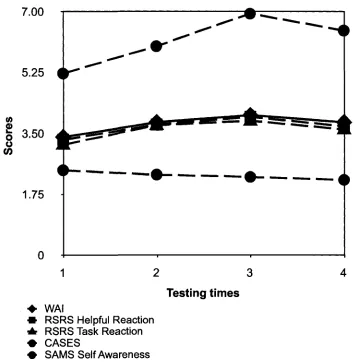
Figure Page 1 Trainees performance at the testing times, according to client
and trainees mean standardized scores 50
Training Counselors: An Efficacy Study of a New Teaching Method
Introduction
An important feature of the profession of Clinical Psychology is the training and supervision of psychotherapists to provide effective service to the clients in need. As psychotherapy has become more established in the mental healthcare, numerous therapist training programs have been developed and implemented. Research on these programs is focused on two levels: (1) developing the best training sequence (i.e., How can we train students to be the best psychotherapists?) and (2) developing better methods of evaluating training programs (i.e., How do we know if a program works and how well it work?). After a few decades during which research has focused on developing programs, there appears to be a reorientation of interest in the field towards the effectiveness of training.
The current study follows this more recent research trend by evaluating the effectiveness of a training program. This study is not intended to design or develop techniques for training psychotherapists. Rather, the study assesses the effectiveness of a newly developed program, which was taught to advanced psychology undergraduates at the University of Windsor.
Training Counsellors
Following the development of various paradigms and theoretical frameworks for psychotherapy (psychodynamic, cognitive-behavioural, humanistic, etc) and research established their effectiveness, the field moved onward with questions of refinement, such as: "which framework is more effective?", "how can we match a disorder with the most appropriate treatment?" and other similar questions (Hill & Lent, 2006). In contrast, relatively less interest was invested in how to teach psychotherapy and how to train professionals. At the same time, increasing demand for psychotherapy points towards the need for more therapists, who can provide effective services for a very large range of difficulties (van Deurzen- Smith, 1996). It follows then that there is an increasing need for more training programs.
As a result, there is an important need to research which skills students should have to conduct effective and efficient psychotherapy. In a meta-analytical study, Ahn and Wampold (2001) investigated a wide range of therapies developed between 1970 and
measurable increment of basic therapy skills in a classroom format?" and "How much can undergraduate students improve their skills within a single term?"
Issues Related to Training Therapists
Single vs. Integrative Training Frameworks.
Most current training programs are based on certain theoretical frameworks (cognitive-behavioural, psychodynamic, systemic, etc). The more comprehensive programs are from 1 to 2 semesters to several years (Hill & Lent, 2006). Initially, programs were developed following manuals from particular theoretical bases, with a strong emphasis on teaching specific techniques (Ronnestad & Ladany, 2006). As the field evolved, there was an increased influence of not only cognitive and social sciences, but also of philosophical streams (with Oriental influences such as meditation and mindfulness-oriented therapy). This evolution is characterized by increasingly large variations in terms of theoretical orientations, degree of eclecticism, training ideologies, and standards of professional competence (Ronnestad & Ladany, 2006). There are also practical reasons for the departure from traditionally manualized training programs. For example, simply learning a manual seemed not to be enough to develop adequate and effective treatment skills. In 2000, Bein, Anderson, Strupp, Henry, Schact et al. conducted a study which compared the impact of training on therapy outcome. They found that there were no significant differences between therapists who had received a manualized
intensive, highly structured, integrative therapist training. Their studies showed that students trained in this integrative manner were able to facilitate better therapy outcomes for their clients than students trained traditionally. The most comprehensive training programs also integrate manualized teaching with supervision (in practica and
internships), self-therapy (or personal therapy) and highly structured courses (Ronnestad & Ladany, 2006).
Methods of supervision.
Supervision has evolved from the traditional one-on-one meetings between the trainee and the trainer after therapy sessions conducted by the trainee. Other methods include supervision from audio or video recordings. Still other approaches include live supervision, when the trainee enters a session with a two-way audio device (bug-in-ear, or phone-ins) which allows the trainer to convey guidance and feedback to the trainee in vivo. Although there is some mixed evidence for the usefulness of live supervision from the perspective of therapy outcome (Champe, & Kleist, 2003), there is also evidence that this method is becoming more ubiquitous in clinical settings. Several studies examined the effects of supervision (post-session consultations vs. live supervision) and found that supervisory training usually involves a considerable amount of problem solving which is correlated with increased counselor skills, improved counselor-client partnership and increased goal attainment (Harkness, 1995). These results could be potentially caused by a modeling of the trainer's empathy and interpersonal style by the trainee. In the
providing the trainee with specific examples of applying therapy techniques and constructing the therapeutic alliance.
Personal/didactic psychotherapy.
Since the beginning of psychodynamic training programs, personal therapy has been used as a training requirement. Currently, four out of five psychotherapists (from various theoretical orientations) report being or having been in personal therapy (Orlinsky, Ronnestad, Willutzki, Wiseman, Boterman et al., 2005). In this approach, future therapists undergo therapy sessions, with the intention of resolving their own issues, stress and frustration that might emerge during training. Furthermore, once the therapists have addressed their own issues, it is believed they will be more apt to act professionally in sessions with clients (Sherman, 2000). In addition, being in the role of the client allows the trainee to gain a new perspective of being in a vulnerable and open position vis-a-vis the therapist, and thereby helps trainees to develop empathy for their clients (Greenberg & Goldman, 1988). Through this process trainees gain first-hand knowledge by witnessing the application of theoretical concepts and having the opportunity to follow behaviour modeled by more experienced therapists (Sherman, 2000).
the decreasing preponderance of staunchly psychodynamic schools, personal/didactic, and self-therapy are no longer widely required among graduate training programs in North America. One of the reasons for this are ethical concerns that have been raised by requiring trainees' to undergo treatment and potential conflicts of interest that can follow from the nature of didactic psychotherapy (Sherman, 2000).
The Necessary and Sufficient Conditions of Therapy
the client's private life. These conditions allow the client to connect with the therapist and allow him or herself to be eased into the therapeutic process.
Coming at a time when behavioural therapies emphasized techniques over relationship factors, Rogers' approach was revolutionary in that it defined the client-therapist relationship as a key in therapeutic change. Moreover, this relationship was defined as independent of theoretical positions since therapist's most salient contribution is the personal relationship, not the technical interventions (Horvath, 2000). Rogers (1957) asserted that the alliance established in therapy is not particularly "special", but rather is very similar to everyday, "real" relationships, albeit constantly focused on benefiting the client. The three necessary and sufficient conditions for therapy outlined by Rogers laid the foundation for how to instruct trainees on establishing a therapeutic alliance with their clients.
1997 has found that the alliance effects accounted for 5% of the outcome, still a
significant influence given the tremendous amount of variability from diverse clients and their presenting problems (Martin, Garske & Davis, 2000). Given the influence that the working alliance bears on the therapeutic change and ultimately outcome, an old question still remains to be fully addressed: Leaving the specific techniques aside, to what degree can one train the skills necessary for achieving a productive alliance? In other words, is one born an "empathic listener" or is one trained? Rogers initially believed one could train such abilities, but later reformulated them as personal therapist attitudes, rather than aptitudes (Rogers, 1957).
Early Programs Developed to Train Helping Skills
Despite Rogers' position later in his career, a number of his disciples believed that therapy skills oriented towards helping the client acclimatize and progress through therapy were the result of a given therapists' practice and knowledge of theory (Hill & Lent, 2006). Several followers of Rogers started formulating programs for psychotherapy trainees with the purpose of teaching students how to help, to be attentive, be empathic and achieve a collaborative partnership with the clients. Most programs today are based on three foundational frameworks, developed independently by Carkhuff (1969), Ivey (1971) and Kagan (1984). The following will provide a short description of these programs.
Formulated as a 100-hour program, it provides the trainees with a manual, integrating experiential approaches to therapy. In this program, therapists progress through three stages with clients. The first stage is "self-exploration" by the client: The therapist
facilitates the exploration process through empathy and reflection of feelings. The second stage is "understanding" the nature of the issue presented in therapy: The therapist uses advanced empathy, adequate self-disclosure, interpretation and confrontation. Once the client has obtained a detailed understanding of the conflict, the therapist facilitates "action" through problem-solving, decision-making and behavioural techniques. Because the therapist is trained to guide and facilitate the healing process, the program emphasizes empathy and open questions, allowing the client freedom to explore and direct the
therapy.
Schroeder, Hill, Gormally and Anthony (1973) examined the progression of trainees through the HRT course and noted that stylistically correct empathic responses are achieved within the first six hours of training. They also added that the remainder of the time is dedicated to helping the trainees modulate their answers from "stiff and formal" to a more sensitive and adequate answers (Kagan, 1972), where helping is a form of relating to the client. The progress and performance of trainees is assessed in different forms: written responses to analogue situations presented in the form of written
statements (Anthony & Wain, 1971), audiotaped statements (Bierman, Carkhuff & Santilli, 1972) or interviews with volunteer clients (Pierce & Drasgow, 1969).
integrated into a pyramid. The basis is formed by fundamental skills (e.g., attending to the client, allowing the client to talk while giving minimal encouragement). Following this, the degree of difficulty increases to more complex skills (e.g., reflection of feelings, paraphrasing, summarizing, direct mutual conversation) leading up to highly complex skills (e.g., interpretation and integration of skills into a fluid style) (Hill & Lent, 2006). Microcounseling is built to incorporate several components: a) a focus on teaching specific skills and gradually integrating them b) modeling, used to modify existing behaviours and form new behaviours, c) practice with the purpose of rehearsing and assimilating the new behaviours, d) feedback, meant to reinforce learning, e)
microcounseling sessions meant to resemble real therapy sessions and used both as a learning experience and as progress assessment (Ivey, 1971). As a basic procedure, the trainee interviews a client and videotapes the encounter. The client is invited to complete evaluation measures at the end of the session. These measures are part of the teaching experience and will be used in supervision meetings with the trainee. The trainee is also provided a manual teaching the skills to be learned in the session and watches a video of an expert counselor using the skills. The trainee and supervisor watch the tape taken with the client and discuss examples where the trainee applied or failed to make use of the target skills. After reviewing the skills together and planning for the next session, the trainee interviews the same client and receives feedback on the final session (Ivey, 1971).
founder of IPR, proposed that people are driven by two forces, a need for human contact and a fear of human contact. He explained that early experiences imprint feelings of fear and helplessness that persist throughout a person's life, being often hidden from others and remaining unlabeled. At the same time, one is aware of the need to socialize and attempts to reconcile these opposite forces by behaving in socially acceptable manners. Specifically, the therapist, when faced with a client's issue will resort to at least one of two avoidance procedures. Therapists might "feign clinical naivete" through an unwillingness to understand and become involved with the client's issue. Otherwise therapists might "ignore the client's messages" by deciding the course of therapy
unilaterally, instead of collaboratively. Kagan (1980) considered that therapists in training already have skills appropriate for therapy, but that these skills are blocked by anxiety. The program is therefore designed to "remove the blockage". The training consists of a session conducted by the trainee with a client, which is audio recorded. While listening to the recording after the session, the trainer asks the trainee to reflect on the thoughts and feelings experienced during the session. The atmosphere of the supervision is non-threatening and instructive, as the trainer asks open questions, allowing the trainee to elaborate on the experience at the time of the session. The trainee is encouraged to find his/her own resolution to the thoughts and feelings discussed (Bernard & Goodyear,
More Recent Approaches to Training Helping Skills
Since the development of the three programs described above, there has been a tendency to integrate these programs into new training curricula. The following is a short review of more recent approaches to training helping skills.
Training in an integrative approach.
In recent years, a new comprehensive program has been developed by Hill and O'Brien (1999). The Helping Skills approach integrates early training programs to maximize the training effect. The program focuses on three components. The first phase is exploration of the client's issue, during which the therapist facilitates the process by attending to the client's narrative, asking open questions, restating and reflecting feelings. In the second phase, trainees seek to help the client achieve an insight about the problem by challenging the client's pattern of thoughts, offering interpretations and adequate self-disclosure. In the third part, the therapist and client prepare an action plan, with the therapist offering direct guidance and information on action possibilities.
overview and broad integration of the skills taught throughout. Apart from this integrative approach of Hill and O'Brien (1999), several theoretical paradigms also led to training programs with unique features designed to teach specific treatment approaches.
Training in experiential therapy.
Gestalt therapy, one of the early approaches to experiential therapy that moved beyond the client centered tradition, is taught in stages designed to train exclusively in the Gestalt paradigm. In this approach there is a strong emphasis on personal therapeutic work, focused on increasing individual awareness both of oneself as a person and as an attending, caring professional (Greenberg & Goldman, 1988). A Gestalt training program developed by Greenberg (1980) sought to systematize the teaching of certain techniques (such as two-chair interventions). The program is an integration of behavioural skill training, theory, experiential learning and personal therapy. By combining "dialectic-experiential" (i.e. experiences both as client and therapist) and skill training programs, the trainees not only could apply the technique more effectively but also increased their level of guidance and attention to nonverbal cues (Greenberg & Sarkissian, 1984). Indeed, for training as an experiential therapist in general, it is believed that practicing in both the role of therapist and client leads trainees to gain an increased awareness of a client's perspective in the therapy situation (Greenberg & Goldman, 1988).
Other approaches to experiential therapy training combine theoretical skills (taught through manuals) with alliance-building skills such as attending to and
through experience, which necessitates practice and personal growth. To this end, some such programs use techniques meant to deepen the trainee's experience as clients by encouraging them to attend personal therapy or to complete process measures given to trainees as part of the therapeutic process (Toukmanian, 1984). In addition to the personal growth component, experiential training programs also make use of manuals, which are focused on teaching students the "when-then" relationship (Rice & Greenberg, 1984). In this approach, "when the client presents a marker... then the therapist intervenes in a particular fashion" (Greenberg & Goldman, 1988, p. 698). Manuals for experiential therapy are therefore aimed at teaching in-session diagnostic skills as well as specific interventions. Training manuals for Emotion Focused Therapy, for example,
systematically describe client "markers" or targets for intervention in almost as much detail as the interventions themselves (see Elliott, Watson, Goldman & Greenberg, 2004).
Training in cognitive behavioural therapy.
Approaches to training in Cognitive Behavioural Therapy (CBT) usually involve three phases: selection of trainees that are committed to the theoretical orientation, intensive study of the theory using highly structured manuals and practicing the
More recently, web-based programs have become available as a possible alternate type of CBT training programs. Shlomoskas et al. (2005) investigated such programs and described them as follows: (1) a section covering the basics of CBT, (2) a section based on questions usually raised by other therapists during training, (3) two increasingly difficult testing sections and (4) one virtual role-playing section. They compared results of three groups of students: trainees who only read a CBT manual, trainees who
participated in a Web-based program and trainees who were enrolled in a seminar with supervision. Results show that the most effective method appeared to be the seminar and supervision condition, followed by the Web program. The manual-only condition was the least effective. These results remained stable over time, supporting the general conclusion from other approaches, that a multi-method program is the most effective way of training psychotherapists (Sexton, Littauer, Sexton & Tommeras, 2005; Carkhuff, 1969; Ivey,
1971; and Kagan, 1984).
Cross-training approaches to teaching therapists.
Integrative approaches to therapy and to training can be formulated in several ways. Hill and O'Brien's (1999) Helping Skills approach teaches therapist skills within a coherent integrative approach that emphasizes common factors. However, other
approaches to integration are more eclectic and teach a survey of treatment approaches. Thus, the trainees gain knowledge of varied approaches and can make an educated choice for the approach that best suits them (Consoli & Jester, 2005). Given that specific
teaching the basics in the four main approaches: psychodynamic, cognitive-behavioural, experiential, and multicultural (Consoli & Jester, 2005). In essence, this is a form of cross-training for psychotherapists. Consoli & Jester (2005) describe a training program presented in the form of a single semester graduate course, divided as follows: two weeks on the structure of integrative psychotherapy, three weeks on psychodynamic thinking, three weeks on cognitive-behavioural thinking, two weeks on existential thinking, two weeks on multicultural, and two weeks on integrating these approaches. Students undergo two exams (midterm and final) and write a paper consolidating and integrating the
material studied. There is an exclusive reliance on manuals and theoretical training but the course occurs at the same time as an internship placement, thus giving the students an opportunity to practice their skills and apply their knowledge in working with clients.
Although comprehensive, learning integrative approaches in this way can be overwhelming given the amount of information they entails. Moreover, one of the complications of cross-training in several treatment orientations is that there are
Research on Counsellor Training Programs
A review of outcome research.
Most of the outcome research on counselor training programs explores the effectiveness of HRT, MC, and IPR, which still form the basis of many training
skills so their improvement margin might be smaller (Goodyear & Guzzardo, 2000). Similarly, Kasdorf and Gustafson (1978) confirmed the efficacy of the MC approach, although they noted some variability among individuals.
When comparing all programs, Baker, Daniels, and Greeley (1990) conducted a meta-analysis of the three programs and showed the smallest training effects were obtained with IPR training (.20), and the largest with HRT (1.07), MC falling in the midrange with an effect of .63. However, researchers cautioned the validity of these findings, given that the sample sizes from which they were extracted were small (41 studies in total). Nonetheless, these findings are similar to the ones Mayer (2004)
reported. Overall, it appears that HRT is the most efficient program, followed by MC and IPR. A possible reason lies in the level of structure offered by the courses, as IPR relies on free discussions during supervision sessions. This method appears to be less efficient than HRT's manualized course. Another line of reasoning points at the role of the
supervisor in these programs. In HRT, the trainer acts as a teacher who shares experiences and teaches the techniques. At the opposite pole, the IPR trainer works in a supervision-type setting, guiding the trainee through the learning process, but offering minimum structure and maximum freedom of exploration.
to detach themselves and gather insights about their own cognitive and emotional processes.
After noticing variability in trainee response to the MC program, Kasdorf and Gustafson (1978) advanced the observation that integrating MC and IPR could lead to a superior training program. Their study supports Kagan's (1980) suggestion to use the method in conjunction with other programs. As discussed, Hill and O'Brien's (2004) program uses an integrative method to teaching psychotherapy skills. When reviewing that program, Hill and Kelems (2002) found encouraging evidence that trainees were more able to establish a therapeutic relationship, and were rated higher by their clients than at baseline in a pre-post design. More studies are still needed to explore Hill and O'Brien's (2004) Helping Skills approach before it can be established as a very effective training method.
Identifying effective components of therapist training programs.
The programs discussed tend to target the same general skills and therefore are similar to a large extend in terms of the techniques and processes used to train these skills. Even though there is little consensus on which program is most effective, there are several studies that investigated the specific training methods within each program and discuss their relative successes. Thus far, it appears that the positive outcome of training is related to training methods such as supervision, feedback, modeling, video-taping and discussion, instruction and self-observation (Kasdorf & Gustafson, 1978).
do not consistently support this view. Even so, there is evidence that therapists who had undergone therapy were rated as more effective by their clients (Kernberg, 1973; Sherman, 2000). In a review of this literature, Sherman (2000) cites several studies in which therapists with personal experience with psychotherapy responded in a more therapeutic manner to clients' issues, and exhibited more empathy, warmth and genuineness (see Guild, 1969 and Strupp, 1958, as cited by Sherman, 2000). Other studies point out that personal therapy of the therapists has at best no effect on the improvement of clients, if not a detrimental one (see Strupp, 1958, as cited by Sherman, 2000). Even so, personal therapy continues to be used, particularly in training programs with a psychoanalytical orientation. As a result, such a component should be considered of probable use in training.
The "personal experience" component of experiential training programs, which consists of brief experiences as "client" and being the target of interventions, is distinct from ongoing personal therapy. As such, it offers a different form of hands-on experience. To date there seems to be no research on the contribution of personal experience as a training component. Even so, having brief experiences as client and then therapist, while using ones personal material (as opposed to role playing) provides a unique opportunity to get immediate and direct feedback from peers-as-clients. This is likely to have its own benefits apart from personal growth following psychotherapy (Greenberg & Goldman,
1988).
restatement, and reflection of feelings. Training methods most often cited by these studies were modeling, instruction, practice, and feedback. They found an aggregated effect of.
89, which is considered a large effect compared to no-training controls. The most frequent assessment methods used ratings of counseling session with a trained/coached client and ratings of response to analogue situations. The performance ratings based on these types of assessments was not deemed to differ significantly, suggesting that analogue situations are adequate outcome measures. Modeling was found to be more effective than instruction and feedback (d = .67, confidence interval 0.33 to 1.00). In terms of combining training methods, Hill and Lent (2006) found that multi-method approaches (combining modeling and instruction) were more effective than single-method programs (d= 1.58, confidence intervals .49 to 1.03), suggesting that combining methods improves the development of helping skills. Despite these promising findings, much of the existing research would benefit from more rigorous design and outcome measurement.
Recommendations for conducting research on training outcomes.
The literature presented up to this point is promising in the sense that trainees in helping skills programs are shown to improve compared to no-training controls.
1. Content of training. Most studies did not use manuals for training, which
implies that adherence to certain structure of the program was unknown. The reliability of such studies is questionable, as there are no descriptions of the course structure. Hill and Lent (2006) noted that most courses were offered within the context of educational programs so the teaching style varied with each educational program. Gormally and Hill (1974) suggested that as a consequence, the trainer-variable becomes an important confound in such research studies. Specifically, trainees often perform only as well as the trainer. In such cases, the outcome is not a reflection of the program merits, but of the characteristics of the trainer as teacher and counselor. They advised defining the instructor variables that could potentially influence the results, such as experience as trainer, interpersonal style and level of skills. Also, strict adherence to program outlines or manuals is advised to increase reliability and repeatability of the studies (Carkhuff,
1974).
2. Teaching to the test. Many of the training programs conducted so far "teach to
3. Practice as training. Hill and Lent (2006) emphasized the need of clearly
defined and separated methods of training, as they noted in most studies, modeling and instruction overlap. Also, the effect of practice has rarely been included as an outcome process marker. It is recommended that practice be included as a variable but also as a teaching method.
Interventions which allow trainees to practice their helping skills ranged between 5 minutes and 1 hour. Hill and Lent (2006) disagreed with the common practice of explicitly stating that training should be done swiftly and pointed to the fact that most therapy training programs (for CBT, EFT, psychoanalysis etc) allow the trainees vast time for practice and training. A more adequate study would require lengthy practice sessions, resembling genuine counseling sessions.
4. Targets of training. Most studies focus on basic skills such as empathy to the
detriment of other more complex skills (e.g., interpretation) (Hill & Lent, 2006). A few of these studies focused on the learning of only one skill (such as empathic responses). So, the results show not the effectiveness of an entire skills training program, but rather only of one component. Ideally, a more accurate study would involve general ratings of helping skills, which would gauge the integrated, fluid style sought in the training programs.
5. Structure of training. Training programs differ greatly in length, from as little
recommended that a standard timeframe be sought, in particular one that is close to the length of the actual training program (1 to 2 semesters).
6. Trainees and training groups. Hill and Lent (2006) draw attention to the fact
that in most studies, participants sign up voluntarily, thus increasing the bias of the population selection criteria. Participants would, in this case, be highly motivated to learn helping skills and could artificially inflate the effects of the program. Although it is difficult to assign participants randomly, the authors suggest keeping this bias in consideration when calculating the effectiveness of a training program.
On the other hand, this critique by Hill and Lent (2006) might overlook the inherent ecological validity entailed in having trainee-participants who volunteered. It is usually the case that psychotherapy students are indeed very motivated to participate in such programs and it would be very unusual for trainees to otherwise be trained as therapists. Therefore, contrary to this particular critique regarding self-selected samples, it may be more adequate to maintain the usual manner of participant recruiting.
A separate factor that should be taken into consideration is the number of participants in each study, which varied from 7 to 12 trainees per training group (Hill & Lent 2006). Generally, smaller groups allow for a more active participation and
7. Measurement of outcome. Program outcomes have been measured in several ways. Assessment involved interview behaviours (e.g., pauses, length of responses; Matarazzo & Wiens, 1967) or receiving ratings to oral or written responses to analogue situations (e.g., writing an empathic response to an audiotaped client; Smit & van der Molen, 1995, 1996). Gormally & Hill (1974) as well as Carkhuff (1969), critiqued such methods, deeming them artificial and inadequate. They further suggest that genuine interactions with clients would be more realistic and would allow gauging the improvement of the clients as the clients themselves perceive it. Such an assessment method would eliminate the need for outside judges and implicitly, a source of unknown error.
Thus, an additional recommendation in the literature is the use of realistic
counseling sessions, using several such sessions with different clients at each assessment point. While supporting this recommendation, Hill and Lent (2006) mention some of the problems with this. They highlight that the same trainee might receive a very
psychologically-minded client at the beginning of the training course and a very reluctant client at the end of the course. Such discrepancies in client-based evaluations would not reflect accurately the effects of the training. Consequentially, the authors have
recommended that more than one client be used per trainee, per assessment point.
8. Measurement of trainee change process. Finally, assessing the process, rather
than simply the outcome of training would provide a more detailed and useful
would provide a measurement of the trainees existing helping skills level, as some
trainees already possess a high level of such skills and it can be expected that the program will not offer as large an improvement as for trainees with a lesser baseline level. It would also provide an initial point of comparison against which the effectiveness of the program can be measured. Subsequent testing times would allow one to track progress on a learning curve and might inform the relative importance of training periods.
Current context: A Platform for Conducting Research
The current study was designed to evaluate an advanced psychology course on counselling offered at the University of Windsor. The course was designed to address the existing shortcomings of programs developed up to date and thus requires a formal evaluation of the degree to which it achieves its purpose of providing an efficient training sequence. The current researcher acted as a graduate assistant for the course, organizing and mediating the training practice session. Before outlining the research method, a description of the skills training course will be provided.
Course Design of 46-430
Lectures.
A training skills program was designed by Dr. Pascual-Leone to incorporate instruction, modeling, feedback, and practice of helping skills into a 13-week course (39 hours of in-class activity plus approximately 40 hours of readings and assignments). For a detailed course syllabus, see Appendix A. The course was aimed at teaching the
working alliance and repair alliance ruptures; (2) develop skills necessary for initiating and guiding clients into deeper experiential (i.e. affective-meaning) processing; (3) identify and discriminate between productive and unproductive client processes based on psychotherapy process measures. And finally, although training was not designed to include self-therapy per se, a series of assignments were designed to have students consider their own personal processing style, degree of affective avoidance, issues, etc., which is believed to (4) facilitate personal insight as relevant to therapist training.
The course met once per week on Thursdays from 4:00 until 6:50 pm for 13 weeks in the Fall semester of 2007. Students were gathered in a medium-sized classroom for the lecture component of the class. During the practice sessions, they were divided in two rooms, which allowed for greater privacy. The first class was used to introduce the course in terms of aims, structure, and requirements.
For the following weeks, with the exception of 4 special classes ("formal
sessions" to be discussed later), the structure of classes was divided between instruction (lecture based on weekly assigned readings), modeling (videos of master therapists from different treatment orientations) and a practice session (with peers). In order to ensure adequate teaching, approximately 60% of class time was devoted to class discussion, instruction, and modeling through video while the other 40% was devoted to practicing skills.
Practice and supervision.
(offering intervention suggestions only at the request of the therapist). Trainees playing client were invited to present personal material that was appropriate for training purposes. For the purpose of the peer practice sessions, trainees were divided in two rooms,
allowing for more privacy. In each room there was a maximum of 4 groups. Each practice session usually allowed for 2 rounds of 15-20 minutes such that each group of
participants had an opportunity to rotate roles (client, counselor, and observer) at least once. The professor offered live supervision for each counseling group by dropping into ongoing practice sessions as unobtrusively as possible and then intervening or making suggestions as necessary. After the end of the practice time, a 15-minute class discussion allowed trainees from the different sub-groups and the trainer to comment on the
experience of the counseling sessions and to address areas of difficulty.
Assignments.
Trainees completed weekly journal entries which consisted of a one-page
commentary on what trainees discovered about themselves or the therapy process during the previous assignment and/or in-class practice sessions and a page containing questions and commentaries on the current week's readings.
Core Conflictual Relationship Theme (CCRT). Trainees used their own personal material (i.e. stories about real life events) to complete and code the assignments. They also attached a reflection on their experience of using the measures. The 6 assignments asked trainees to examine their own personal experiences and these exercises can be understood as self-explorations that are facilitative of therapists' training.
Formal sessions with volunteers.
Four classes, spread across the term, were dedicated to practicing therapy skills with "clients" with whom trainees had no previous contact. These "formal sessions" allowed trainees to have full one-on-one sessions with volunteer "clients" from outside the course. They are contrasted with the "practice sessions" in which trainees practice with each other for shorter periods in groups of three. Thus, formal sessions provided trainees an opportunity to practice their skills on "clients" who were unfamiliar with the training program and who were unknown to trainees but did not have serious clinical issues. The "clients" were asked to present issues of medium-to-minor concern that were of personal and current relevance to them. The trainees were instructed to provide support and make use of the skills they had learned up to that point in the course.
As such, formal sessions with volunteers served as unique practice sessions in their own right, but they also served as opportunities for standardized feedback to trainees on their progress. To maximize the feedback to trainees, volunteer "clients" were asked to complete a set of self-report measures regarding the quality and usefulness of their
feedback from standardized measures in each of the formal sessions was used as a teaching tool: they indexed key aspect of therapy, including areas for therapist
discomfort/distraction, the quality of the therapeutic relationship, and feedback from the client on what was most and least helpful.
In order to encourage genuine involvement during formal sessions on the part of the "clients", dyads were distributed across three different classrooms, allowing for a certain level of privacy. Each room hosted a maximum of 8 dyads, each in a different part of the lecture room. In contrast to the weekly practice sessions (with peers-as-"clients"), no supervision was offered during these sessions so as to allow for a more realistic experience. Nonetheless, the professor and graduate assistant were available for
emergency assistance in a separate room, and visited the rooms at the beginning and end of each formal practice sessions.
The first of these formal sessions took place in the second week of the course. This was the only formal session where trainees worked with peers from the same training class and where the session length was shorter. This session was defined as an introductory practice session to orient trainees to the format of formal sessions to come. Classes 5, 9 and 12 (out of 13) offered the trainees counseling opportunities with
standardized session outcome measures were then summarized to provide trainees feedback on their ongoing development, as discussed.
Evaluation in the course consisted of attendance/journal completion (12%), assignments (75%), and skills improvement over the course (13%). Both trainees and "clients" were well informed that feedback from the formal sessions was not used to calculate course grades.
Ethical considerations.
In evaluating the effectiveness of a counselor training program, two sets of ethical considerations compel close examination. The first one pertains to ethical barriers within the course, such as student privacy and issues arising from the use of live volunteers. The second one relates to conducting research focused on the training program. This section will detail the first category of ethical considerations (i.e., related to the design of the course). The second category will be addressed in the methods section.
(a licensed clinical psychologist) was in attendance for all formal sessions, for any clinical emergencies that could potentially occur, as participants discussed their personal issues. Moreover, Student Counseling Services was notified of the possibility that
participants may be seeking additional assistance on or following the formal session days.
The process of using single counselling sessions and also of using volunteers to act as "clients" has been widely used in skills training courses at both undergraduate and graduate levels, without adverse effects by Dr. Greenberg at York University (from 2001 to 2005) and by Dr. Kou at University of Windsor (Course 46-674, Winter, 2006). Approval for the course process and to use all course material for the purposes of a research project evaluating the training course was obtained in September 2007 (see Appendix B).
Current Study
Research Possibilities vs. Current Design
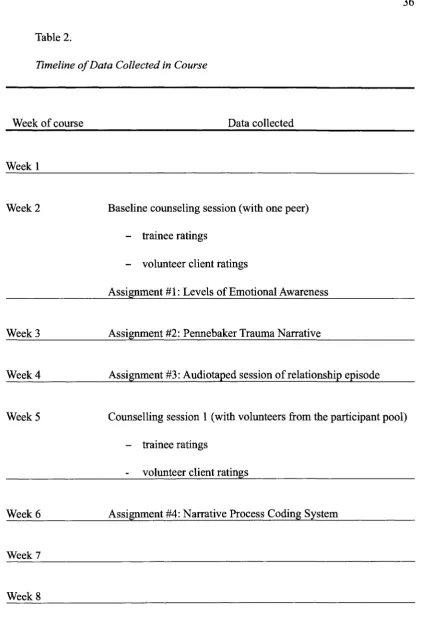
were chosen for the effectiveness assessment. Table 2 reflects the times at which different parts of the course took place.
This study was conceived as a repeated measure design, assessing the improvement of student counseling performance across the training program (one
semester) by examining their skills performance in counseling sessions at 4 points in time during the course. The outcome variable examined is reflected in the trainees' skills performance at the end of the course. This performance is measured in two ways: subjectively, by the trainees and objectively, by the "clients".
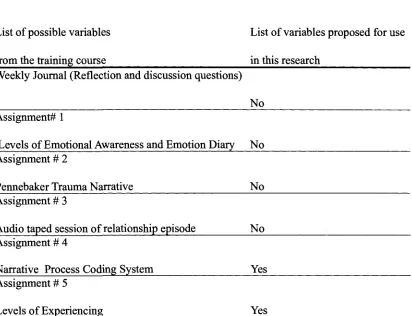
Table 1.
Variables Available from Course vs. Variables Proposed for Use in Study.
List of possible variables List of variables proposed for use from the training course in this research
Weekly Journal (Reflection and discussion questions)
Assignment# 1
Levels of Emotional Awareness and Emotion Diary Assignment # 2
Pennebaker Trauma Narrative Assignment # 3
Audio taped session of relationship episode Assignment # 4
Narrative Process Coding System Assignment # 5
Levels of Experiencing
No
No
No
No
Yes
Assignment # 6
Core Conflictual Relationship Data from formal session baseline Data from baseline formal #1 Data from baseline formal #2 Data from baseline formal #3
Yes Yes Yes Yes Yes Trainee: The Counselor Activity Self-Efficacy Scales Yes
(CASES): 3 subscales - Helping Skills - Session Management
Counseling Challenges Efficacy
Trainee: The Self- Awareness and Management Yes Strategies Scales for Therapists (SAMS): 2 subscales
- Self Awareness - Session Management
Client: Helping Skills Measure (HSM): 3 subscales No - Exploration
- Insight - Action
Client: The Working Alliance Inventory- Short RevisedYes Version (WAI): 3 subscales
Client: The Revised Session Reaction Scale (RSRS): 3 Yes subscales:
- Task
- Relationship Reaction - Hindering
Client and Trainee: Demographic questionnaire: Yes - for "clients"
- for trainees
Table 2.
Timeline of Data Collected in Course
Week of course Data collected
Weekl
Week 2 Baseline counseling session (with one peer) - trainee ratings
- volunteer client ratings
Assignment #1: Levels of Emotional Awareness
Week 3 Assignment #2: Pennebaker Trauma Narrative
Week 4 Assignment #3: Audiotaped session of relationship episode
Week 5 Counselling session 1 (with volunteers from the participant pool) - trainee ratings
volunteer client ratings
Week 6 Assignment #4: Narrative Process Coding System
Week 7
Week 9 Counselling session 2 (with volunteers from the participant pool) - trainee ratings
- volunteer "client" ratings Assignment #5: Levels of Experiencing
Week 10 Assignment #6: Core Conflictual Relationship
Week 11
Week 12 Counselling session 3 (with volunteers from the participant pool) - trainee ratings
- volunteer "client" ratings
Week 13 Improvement in counselling skills: Self evaluations
Note. Journals (not listed) were also completed weekly. A complete listing of assigned
readings, lecture topics, and videos used in class are listed in the course syllabus. Hypotheses.
It is hypothesized that an integrated combination of instruction, modeling, and practice will allow trainees to provide more support to clients during single counseling sessions. In other words, trainees will feel increasingly more effective and adequate over the course of the program in building a therapeutic alliance with the clients and offering empathetic guidance to the clients in working with them. Also, trainees are expected to report less hindering self-awareness (e.g., intrusive thoughts about their lack of
Given the fact that developing a collaborative therapeutic alliance is one of the training goals it is also hypothesized that "clients" will rate their counsellors as being increasingly effective in helping them explore their issue and providing support and guidance. Moreover, "clients'" rating of their relationship with their therapist will also improve in terms of agreement on goals, and tasks for accomplishing the goals, as well as overall interpersonal bond.
A second hypothesis is to investigate whether learning about psychotherapeutic processes measures will predict skill level at the end of the course. There is scant research to date on the use of psychotherapy processes measures (e.g., the Experiencing Scale or Narrative Process Coding System) to improve therapists' understanding of good therapy process (Toukmanian, 1984). It is hypothesized that a greater knowledge of such concepts and measures will be associated with an increased ability of the therapist to facilitate productive sessions. As an addition, the number of practice exercises is thought to help increase the development rate of helping skills (Hill & Lent, 2006, Carkhuff, 1974). The attendance and engagement in the program is expected to be correlated with the rate of skills development.
In summary, the following hypotheses will be tested:
2. The trainee improvement will also be demonstrated across training in terms of increased confidence in trainees' ability to conduct a helpful session, and deal with session challenges.
3. Trainees grades on 3 of the assignments (NPSC, EXP, CCRT) as well as trainees' attendance to practice sessions will be significant variables in the prediction of the counselor performance, as measured at the last formal session of counseling volunteer "clients".
Methods Participants
There are two groups of participants in this study: counselor participants (i.e. trainees) and client participants (volunteer "clients" who are only present for the formal sessions). Client Participants
"Client-participants" were undergraduate students, who registered to participate in the formal sessions of the course through the university participant pool. A total of 72 participants were recruited, with a gender distribution of 16 males and 56 females and an age distribution between 18 and 44 (M- 22.2). Their average number of years of
Counselor Participants
The "counselor-participants" are fourth year undergraduate psychology students, who registered for the helping skills training course and have volunteered to participate in the study. This sample consists of 24 "counselor participants" and is comprised of five males and nineteen female participants. Their ages range from 21 to 41, (M= 23).
Participants have had an average University education of 4.0 years, out of 24 participants 83% were majoring in psychology alone, with 16.6% pursuing double majors including psychology. Out of 24 the ethnic distribution was as follows: 79.16% Caucasian, 8.33% Middle Eastern, 8.33% Asian, 4.16% Southeast Asian. Out of the 24 trainees 70.33% had some previous exposure to therapy, 45.33% as clients, 20.83% had some form of formal training and 4.16% indicated exposure both as client and as trainee.
Measures
Client Measures
The Working Alliance Inventory- Short Revised Version (WAI-SR, Hatcher &
Gillaspy, 2006) consists of 12 Likert- scale items, ranging from 1 (strongly disagree) to 5 (strongly agree). The measure is designed to gauge the depth of the therapeutic
component). The WAI-SR was designed to differentiate between these three components in a more time-efficient form. Correlations of the new scale with the old WAI and WAI-S suggested that the new questionnaire was an adequate replacement (Hatcher & Gillaspy, 2006). Reliability coefficients also reached satisfactory levels (between .88 and .92). In terms of construct validity coefficients, the WAI-SR correlates strongly with the
Confident Collaboration Scale (Hatcher & Barends, 1996) lending further credibility to the revised scale.
The Revised Session Reaction Scale (RSRS; Elliott & Wexler, 1994) is a 24-item
questionnaire formulated to assess the client's experience after completing a session. Items are on a Likert scale ranging from 1 (not at all) to 5 (very much) and comprise four sub-scales. The Helpful Reaction sub-scale consists of 14 items and gauges the overall feeling of support and useful exploration of the issue perceived by the client. For
example, where clients might give their rating from 1 to 5 on "Understanding", where a 5 is, "As a result of this session, I now feel understood by my therapist, either generally as a person or in specific ways; or I am impressed by how accurately my therapist
understood what I was thinking, feeling or trying to say". The Hindering sub-scale is comprised of eight items, expressing negative feelings towards the therapy and/or therapist rating from 1 to 5. For example, "Stuck/lack of progress: As a result of this session, I now feel stuck, blocked, floundering, or unable to progress in therapy; or I feel impatient, frustrated, angry, bored, disillusioned, or critical of therapy or my therapist". One final item provides an overall view of the session effects, where the client endorses answers ranging from 1 (extremely hindering) to 9 (extremely helpful). The RSRS is the updated and improved version of the Session Impact Scale by Elliott and Wexler (1994). There is no research to date on this revised version, but the original scale was found to have a very good reliability, ranging from .67 for the Hindering Impacts factor to .91 for Relationship Impacts. Similarly, convergent validity was satisfactory, when compared with Session Evaluation Questionnaire (Stiles, 1980) and the Simplified Personal Questionnaire (Elliott & Wexler, 1994).
Counsellor/Trainee Measures
The Counselor Activity Self-Efficacy Scale (CASES; Lent, Hill & Hoffman, 2003)
Helping Skills section, the counselor reports the perceived comfort and ability in situations requiring attending to the client's issue, restating the client's ideas, providing open questions, reflections and interpretations, as well as guidance, intentional silence, homework design. The Session Management section gauges efficacy in keeping the client on track, guiding the client towards a deeper analysis of the issue, all the while remaining focused on the set goal for the session. Finally, the Counseling Challenges Efficacy subscale focuses on the counselor's ability to provide adequate and prompt support in situations when the client is depressed, suicidal, anxious, reliving a significant trauma, inappropriate towards the counselor and so forth.
The measure has been shown to have good convergent and discriminant validity when compared with other counselor self-reports such as Counselor Self-Estimate Inventory and Social Desirability scales (Hill, Lent and Hoffman, 2003). Also test-reliability after a delay period of two weeks was adequate, ranging from .42 to .91 (Lent, Hill & Hoffman, 2003).
The Self-Awareness and Management Strategies Scales for Therapists (SAMS;
intrusive thoughts about the course of the therapy and thoughts about personal issues outside of the therapy matters (Williams et al., 2003). The second part of the measure is concerned with the usual compensatory behaviours that help manage and diminish the effect of self-awareness, such as actively returning focus on the session, self-reflection, seeking consultation and personal therapy. Self-awareness and Management subscales were shown to be internally consistent (.76 and .73, respectively).
The measure was shown to have good convergent and discriminant validity when compared with the Self- Monitoring Scale (Snyder, 1974) as well as a satisfactory reliability coefficient (Williams et al., 2003). In addition, results show that the three main management strategies employed by therapists are refocusing on the client, using basic therapy techniques (i.e., reflection and paraphrasing) and attempt to suppress awareness. These findings have been supported by other research results (Williams, Judge, Hill & Hoffman, 1997).
Control Variables
Demographic questionnaire. This brief questionnaire was designed to collect
possible confounding factors, such as gender, age, ethnicity, academic orientation, career plans and possible previous exposure to therapy as well as grade point average. The questionnaire has been completed by both trainees and "clients".
Research Design
studies in the literature have used true experimental designs with random assignment, there are four reasons for the omission of a no-training control as being adequate in this study. (1) The improvements of trainees in counseling skills over the course of the semester can reasonably be attributed to their participation in the training program. In support of this argument, the spontaneous development of counseling skills in a 3 month period is not likely to reasonably be related to maturational or other academic factors during that brief period. (2) Using four points of measurement across time (as opposed to simple pre-post comparisons) allows one to incrementally relate training to increasing skill level, which lends support to a causal interpretation. In addition, (3) creating a no-training control group in an educational setting where students expect to gain certain knowledge has obvious practical and ethical obstacles. Finally, (4) despite studies in the literature using various controls (i.e. no-training, attention control group, alternative training group; see Baker et al, 1990) as well as no control group (see Hill & Kellems, 2002) there are no recommendations in Hill and Lent's (2006) review for the use of a no-training control group.
Procedures
Research Protocol
The course was run as described. The "formal session" of counseling, conducted during week 2 was used to represent baseline skills (session 1). The subsequent "formal sessions" from weeks 5, 9 and 12 represented the assessment of skills at time 2, time 3, and time 4 respectively. Each of these were considered single session therapies used to address mild to moderate personal difficulties in a non-clinical sample, and therefore were structured to identify the client's issue and investigate the underlying processes as thoroughly as possible within the limits of the session time.
Procedures to Ensure Ethical Process
Students were made aware that their participation in data collection for a study was not required, would remain unknown to the professor, and that it would not influence the evaluation of their performance in the course. Also to reduce the perception of
Results
Before presenting the findings of the current study, a note on significance level is useful. For the purposes of the hypotheses, a large number of ANOVAs were completed, thereby running the risk of type I error. An option for counteracting this risk was to decrease the confidence level from .05 to .01. However, the current study is also an exploratory study, meant to detect effects and to suggest improvements for future training programs therefore using more stringent criteria would have proven counter to the main goal of this inquiry.
Preliminary Analyses
Prior to analyses, a verification of the assumptions for repeated-measures ANOVAs was conducted as was a search for outliers on all variables included in the analyses (WAI bond, goal and task, RSRS helpful reactions, task reactions, relationship reactions and hindering reactions, CASES challenge management, helping skills and session management and SAMS self awareness and session management). To that end, two cases were found with z score absolute values of 3.72 and 3.07, respectively. The two cases represent two female trainees whose characteristics suggest no significant
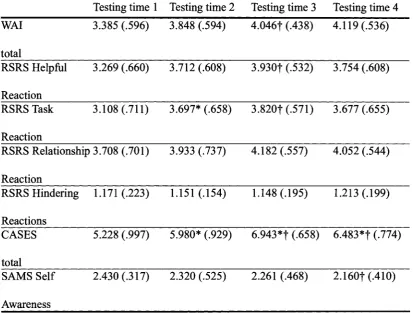
A Pearson correlation test was run and the results indicated no significant correlations between the variables being used. Therefore no variables were eliminated from the analyses. For a descriptive account of the variables, see table 3.
Table 3.
Trainee development over the four testing times, as shown by client and trainee
measures.
Variables Measure score means and standard deviations
Testing time 1 Testing time 2 Testing time 3 Testing time 4 WAI total RSRS Helpful Reaction RSRS Task Reaction 3.385 (.596) 3.269 (.660) 3.108 (.711)
RSRS Relationship 3.708 (.701)
Reaction RSRS Hindering Reactions CASES total SAMS Self Awareness 1.171 (.223) 5.228 (.997) 2.430 (.317) 3.848 (.594) 3.712 (.608) 3.697* (.658) 3.933 (.737) 1.151 (.154) 5.980* (.929) 2.320 (.525) 4.046f (.438) 3.930| (.532) 3.820f (.571) 4.182 (.557) 1.148 (.195) 6.943*f (.658) 2.261 (.468) 4.119 (.536) 3.754 (.608) 3.677 (.655) 4.052 (.544) 1.213 (.199) 6.483*f (.774) 2.160f(.410)
* indicates significant pairwise comparison with the previous testing time with a significance level p<0.05
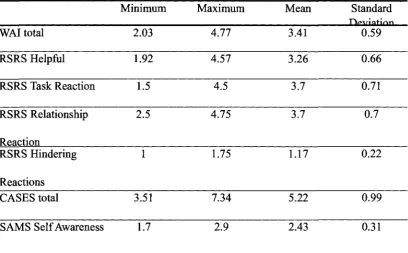
A summary descriptive analysis was conducted on the scores obtained at baseline (session 1). Results show no marked variability between participants, indicating no confounding variables affected the results of the program. See Table 4.
Table 4.
Descriptive statistics of baseline scores at beginning of the program.
Measure Descriptives
WAI total RSRS Helpful RSRS Task Reaction RSRS Relationship Reaction
RSRS Hindering
Reactions CASES total
SAMS Self Awareness
Minimum 2.03 1.92 1.5 2.5 1 3.51 1.7 Maximum 4.77 4.57 4.5 4.75 1.75 7.34 2.9 Mean 3.41 3.26 3.7 3.7 1.17 5.22 2.43 Standard 0.59 0.66 0.71 0.7 0.22 0.99 0.31
Note. Scores on WAI, RSRS and SAMS range from 1 to 5 and scores on CASES
range from 1 to 9.