ISSN (Online): 2319-8753 ISSN (Print) : 2347-6710
I
nternational
J
ournal of
I
nnovative
R
esearch in
S
cience,
E
ngineering and
T
echnology
(A High Impact Factor, Monthly, Peer Reviewed Journal) Visit: www.ijirset.com
Vol. 8, Issue 4, April 2019
A Corpus based Interactive Chatbot for User
Friendly Conversations
Aishwarya S. Londhe
1, Madhura M. Phadke
2P. G. Student, Department of Computer Engineering, Datta Meghe College of Engineering, Airoli, Maharashtra, India
1Assistant Professor, Department of Computer Engineering, Datta Meghe College of Engineering, Airoli,
Maharashtra, India
2ABSTRACT:
Chatbot is widely popular now-a-days and catching speed as an application of computer communication.
Some programs respond intelligently like human. This type of program is called a Chatbot. This paper addresses the
design and implementation of a Chatbot system. We will also study another application where Chatbots could be useful
and techniques used while designing a Chatbot.
KEYWORDS
: Chatbot; Communication; Pattern Matching; Request; Response.
I.
INTRODUCTION
In today’s world computers play an important role in our society. Computers give us information; they entertain us and
help us in lots of manners. A chatbot is a program designed to counterfeit a smart communication on a text or spoken
ground. But this paper is based on the text only chatbot. Chatbot recognize the user input as well as by using pattern
matching, access information to provide a predefined acknowledgment. For example, if the user is providing the bot a
sentence like “What is your name?” The chatbot is most likely to reply something like “My name is Chatbot.” or the
chatbot replies as “You can call me Chatbot.” based on the sentence given by the user. When the input is bringing into
being in the database, a response from a predefined pattern is given to the user. A Chatbot is implemented using pattern
comparing, in which the order of the sentence is recognized and a saved response pattern is acclimatize to the exclusive
variables of the sentence. They cannot register and respond to complex questions, and are unable to perform compound
activities. Chatbot is relatively a new technology. The application of a Chatbot can be seen in various fields in the
future.This paper covers the techniques used to design and implement a Chatbot. Comparisons are made, findings are
discussed and conclusion is drawn at the end .
II.
RELATED
WORK
1.ELIZA is also considered to be one of the first programs capable of passing the Turing test
At first ELIZA examined the text inputted by the user and checked for certain keywords. Then it applied values to
them, and transformed the input into a response. The script that ELIZA ran determined the keywords, set the values
of keywords, and set the rules of transformation for the output.
ISSN (Online): 2319-8753 ISSN (Print) : 2347-6710
I
nternational
J
ournal of
I
nnovative
R
esearch in
S
cience,
E
ngineering and
T
echnology
(A High Impact Factor, Monthly, Peer Reviewed Journal) Visit: www.ijirset.com
Vol. 8, Issue 4, April 2019
3.Jabberwacky is one of the earliest attempts at designing an AI through human interaction.It was mainly a form of entertainment. It aimed to move from a text based system to wholly voice operated system.
4.ALICE (Artificial Linguistic Internet Computer Entity) created by Richard Wallace in 1995, is an open source natural language processing chatbot program that converses with a human by evaluating user input using certain heuristical pattern matching rules. ALICE is based in XML knowledge bases. It matches the user input against predefined set of responses. As it has a predefined set off responses, it cannot answer all the queries adequately. It is possible for ALICEbots to expand their knowledge bases through an XML dialect AIML. Using this, An ALICE bot can be designed to be an expert in any domain specific information.
5.Watson, built by IBM is a question answering (QA) computing system designed to apply advanced natural language processing, information retrieval, knowledge representation, automated reasoning, and machine learning technologies to the field of open domain question answering.Watson uses IBM's DeepQA software and the Apache UIMA (Unstructured Information Management Architecture) framework. It runs on the SUSE Linux Enterprise Server 11 operating system using Apache Hadoop framework to provide distributed computing. It participated in the Jeopardy! Competition and won in 2011.
6.Siri uses ASR (Automatic speech recognition) to translate human speech (which includes short utterances of commands, dictations or questions) into text. Using natural language processing (part of speech tagging, noun-phrase chunking, dependency and constituent parsing) it translates transcribed text into "parsed text". Using question & intent analysis it analyzes parsed text, and detects user commands and actions. ("Schedule a meeting", "Set my alarm"). Third party web services like OpenTable, WolframAlpha are interfaced using data mashup technologies. They perform actions like search operations, and question answering. Speech that SIRI has identified as a question, but it cannot directly answer, is forwarded to more general question-answering services such as WolframAlpha.
7.Alexa is a voice service inhabiting the Amazon Echo device. Alexa uses natural language processing algorithms for voice interaction. She uses these algorithms to receive, recognize and respond to voice commands. She is capable of music playback, making to-do lists, setting alarms, streaming podcasts, playing audiobooks, and providing weather, traffic, and other real time information. Alexa can also control several smart devices using itself as a home automation hub.
8.Mitsuku uses a programming language called AIML to understand and respond to people. Her intelligence includes the ability to reason with specific objects. She is a two-time Loebner Prize winner in 2013 and 2016 as well as the 2015 runner-up.
III.IMPLEMENTATION
Chatbot is a computer application which uses artificial intelligence to mimic human conversation. It helps the user by answering the questions asked by them. The program is implemented using Java programming language. Particularly Java applets are used. Applets are used because it is easy to create the dialog box required for the conversation between the user and the bot. Detailed implementation is given below:
A.
Fundamental Design Techniques and ApproachesCreating the dialog box
All the packages required for creating the dialog box are imported. The size of the dialog box and text area inside the dialog box is given. Vertical scrollbar is used so that the screen is scrolled as the conversation goes on. Horizontal scrollbar is never used because the size of the dialog box is fixed.
Creating a database
Two dimensional string arrays are applied to build a database. Rows in the array are used for request and response. All the even rows contain the request or questions and all the odd rows contain the response or answers. Columns in the array are applied to save different types of questions that could asked by the user and responses that a Chatbot can answer. There is one row in the array which contains default responses which is used when the matching question is not found in the array.
ISSN (Online): 2319-8753 ISSN (Print) : 2347-6710
I
nternational
J
ournal of
I
nnovative
R
esearch in
S
cience,
E
ngineering and
T
echnology
(A High Impact Factor, Monthly, Peer Reviewed Journal) Visit: www.ijirset.com
Vol. 8, Issue 4, April 2019
Random()
The input from the user is taken using get Text () function. All the punctuation marks in the users input are removed using trim () function. The uppercase letters are converted to lowercase. A variable called response is used to hold a byte value and it is set to 0. While response is 0, the match for the input is found in the database and it is returned as a response which is displayed in the text area. If the response is 1, then the match for the input is not found in the database. In this case, a default response is returned. Random () function is used to choose the response saved in the database.
AddText()
All the texts or strings used in input and output are added to the text area in the dialog box. InArray()
This is used as a pattern matching function. A variable match is used to hold a Boolean value and it is set to false. If the match for the users input is found in the database, true is returned else false is returned as a result. This value is returned to keyPressed() function and the result is displayed in the dialog box.
IV.
RESULTS
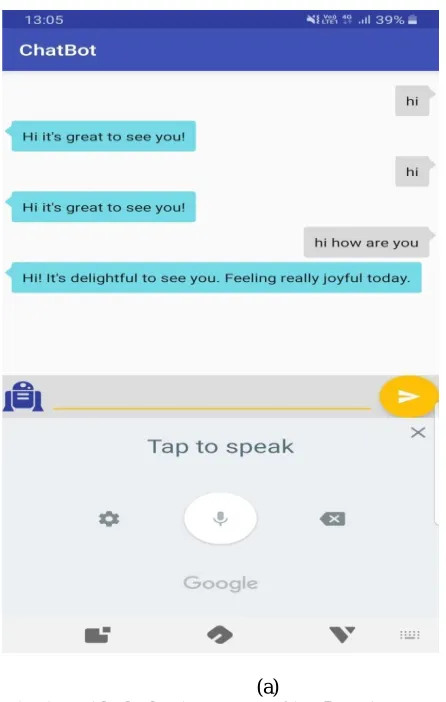
(a)
ISSN (Online): 2319-8753 ISSN (Print) : 2347-6710
I
nternational
J
ournal of
I
nnovative
R
esearch in
S
cience,
E
ngineering and
T
echnology
(A High Impact Factor, Monthly, Peer Reviewed Journal) Visit: www.ijirset.com
Vol. 8, Issue 4, April 2019
(b)
ISSN (Online): 2319-8753 ISSN (Print) : 2347-6710
I
nternational
J
ournal of
I
nnovative
R
esearch in
S
cience,
E
ngineering and
T
echnology
(A High Impact Factor, Monthly, Peer Reviewed Journal) Visit: www.ijirset.com
Vol. 8, Issue 4, April 2019
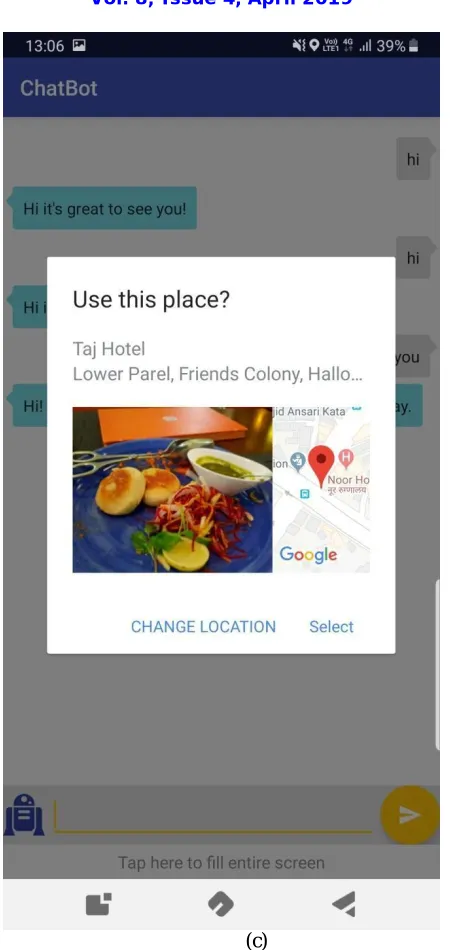
(c)
ISSN (Online): 2319-8753 ISSN (Print) : 2347-6710
I
nternational
J
ournal of
I
nnovative
R
esearch in
S
cience,
E
ngineering and
T
echnology
(A High Impact Factor, Monthly, Peer Reviewed Journal) Visit: www.ijirset.com
Vol. 8, Issue 4, April 2019
(d)
ISSN (Online): 2319-8753 ISSN (Print) : 2347-6710
I
nternational
J
ournal of
I
nnovative
R
esearch in
S
cience,
E
ngineering and
T
echnology
(A High Impact Factor, Monthly, Peer Reviewed Journal) Visit: www.ijirset.com
Vol. 8, Issue 4, April 2019
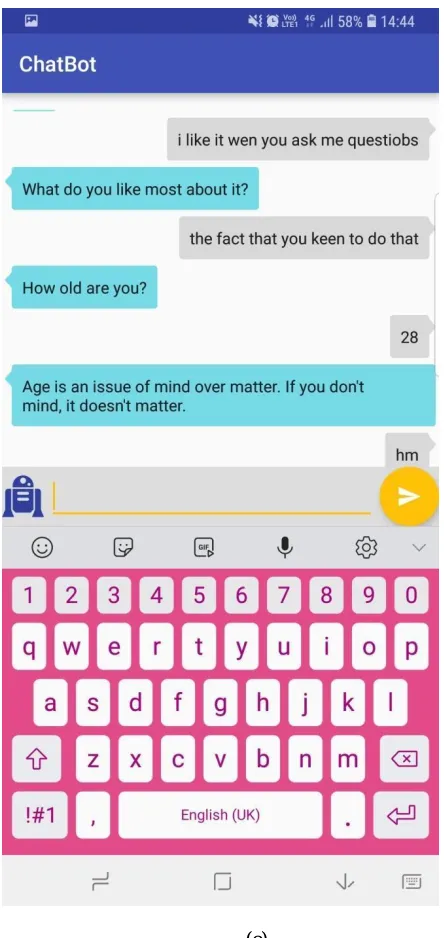
(e)
Fig (e) shows the chatbot have ability to correct the spelling mistakes and understand the shortcut humans
use while sending messages and having conversation. Just like when the user type ”wen” instead of “when”.
ISSN (Online): 2319-8753 ISSN (Print) : 2347-6710
I
nternational
J
ournal of
I
nnovative
R
esearch in
S
cience,
E
ngineering and
T
echnology
(A High Impact Factor, Monthly, Peer Reviewed Journal) Visit: www.ijirset.com
Vol. 8, Issue 4, April 2019
(f)
ISSN (Online): 2319-8753 ISSN (Print) : 2347-6710
I
nternational
J
ournal of
I
nnovative
R
esearch in
S
cience,
E
ngineering and
T
echnology
(A High Impact Factor, Monthly, Peer Reviewed Journal) Visit: www.ijirset.com
Vol. 8, Issue 4, April 2019
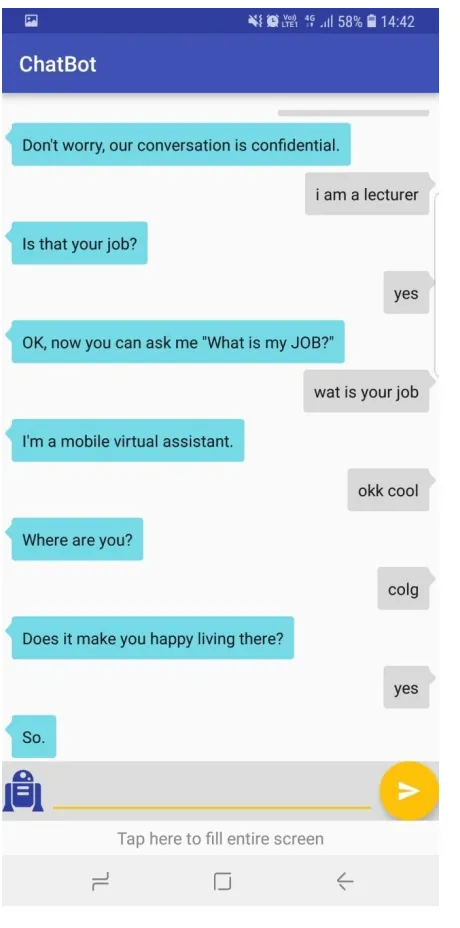
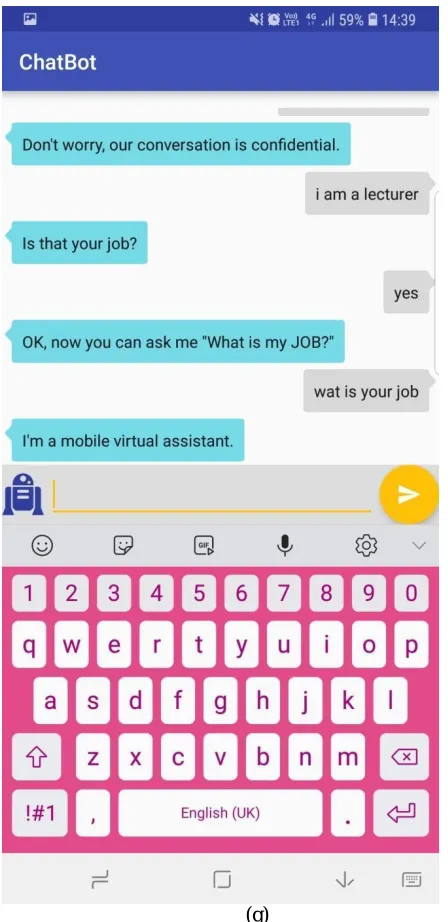
(g)
Fig (g) shows the chatbot will also provide the questions to the user if it figured out that the conversation is
lagging behind somewhere or user is not much interested or have difficulties to ask the questions to the
ISSN (Online): 2319-8753 ISSN (Print) : 2347-6710
I
nternational
J
ournal of
I
nnovative
R
esearch in
S
cience,
E
ngineering and
T
echnology
(A High Impact Factor, Monthly, Peer Reviewed Journal) Visit: www.ijirset.com
Vol. 8, Issue 4, April 2019
(h)
ISSN (Online): 2319-8753 ISSN (Print) : 2347-6710
I
nternational
J
ournal of
I
nnovative
R
esearch in
S
cience,
E
ngineering and
T
echnology
(A High Impact Factor, Monthly, Peer Reviewed Journal) Visit: www.ijirset.com
Vol. 8, Issue 4, April 2019
(i)
ISSN (Online): 2319-8753 ISSN (Print) : 2347-6710
I
nternational
J
ournal of
I
nnovative
R
esearch in
S
cience,
E
ngineering and
T
echnology
(A High Impact Factor, Monthly, Peer Reviewed Journal) Visit: www.ijirset.com
Vol. 8, Issue 4, April 2019
(j)
ISSN (Online): 2319-8753 ISSN (Print) : 2347-6710
I
nternational
J
ournal of
I
nnovative
R
esearch in
S
cience,
E
ngineering and
T
echnology
(A High Impact Factor, Monthly, Peer Reviewed Journal) Visit: www.ijirset.com
Vol. 8, Issue 4, April 2019
(k)
ISSN (Online): 2319-8753 ISSN (Print) : 2347-6710
I
nternational
J
ournal of
I
nnovative
R
esearch in
S
cience,
E
ngineering and
T
echnology
(A High Impact Factor, Monthly, Peer Reviewed Journal) Visit: www.ijirset.com
Vol. 8, Issue 4, April 2019
(l)
ISSN (Online): 2319-8753 ISSN (Print) : 2347-6710
I
nternational
J
ournal of
I
nnovative
R
esearch in
S
cience,
E
ngineering and
T
echnology
(A High Impact Factor, Monthly, Peer Reviewed Journal) Visit: www.ijirset.com
Vol. 8, Issue 4, April 2019
(m)
ISSN (Online): 2319-8753 ISSN (Print) : 2347-6710
I
nternational
J
ournal of
I
nnovative
R
esearch in
S
cience,
E
ngineering and
T
echnology
(A High Impact Factor, Monthly, Peer Reviewed Journal) Visit: www.ijirset.com
Vol. 8, Issue 4, April 2019
(n)
ISSN (Online): 2319-8753 ISSN (Print) : 2347-6710
I
nternational
J
ournal of
I
nnovative
R
esearch in
S
cience,
E
ngineering and
T
echnology
(A High Impact Factor, Monthly, Peer Reviewed Journal) Visit: www.ijirset.com
Vol. 8, Issue 4, April 2019
(o)
Fig (o) shows the replies like “I can really feel your smile today”, makes the user feel good. The reply for
each “Hi” won’t be the same from chatbot.
ISSN (Online): 2319-8753 ISSN (Print) : 2347-6710
I
nternational
J
ournal of
I
nnovative
R
esearch in
S
cience,
E
ngineering and
T
echnology
(A High Impact Factor, Monthly, Peer Reviewed Journal) Visit: www.ijirset.com
Vol. 8, Issue 4, April 2019
the database, a default response is generated. The input and output can be customized according to the user. Based on
the developer or the user, the required requests and responses can be stored in the database. Since own database can
be created, it allows the user to understand how the response is generated. This Chatbot can be used for the
entertainment purpose. Whenever a person is bored, he can chat with the bot for entertainment. It can also be used to
provide information by modifying the program as needed by the user.
VI.
CONCLUSION
A chatbot is one of the simple ways to transport data from a computer without having to think for proper keywords
to look up in a search or browse several web pages to collect information; users can easily type their query in
natural language and retrieve information. In this paper, information about the design, implementation of the
chatbot has been presented. From the survey above, it can be said that the development and improvement of chatbot
design grow at an unpredictable rate due to variety of methods and approaches used to design a chatbot. Chatbot is
a great tool for quick interaction with the user. They help us by providing entertainment, saving time and answering
the questions that are hard to find. The Chatbot must be simple and conversational. Since there are many designs
and approaches for creating a chatbot, it can be at odds with commercial considerations. Researchers need to
interact and must agree on a common approach for designing a Chatbot. In this project, we looked into how
Chatbots are developed and the applications of Chatbots in various fields. In addition comparison has been made
with other Chatbots. General purpose Chatbot must be simple, user friendly, must be easily understood and the
knowledge base must be compact. Although some of the commercial products have recently emerged,
improvements must be made to find a common approach for designing a Chatbot.
REFERENCES
[1] R. S. Russell, “Language Use, Personality and True Conversational Interfaces”, Project Report of AI and CS- University of Edinburgh, Edinburgh, pp.1-80, 2002.
[2] Y. Zhou, X. Ziyu, A. W. Black, A. I. Rudnicky, “Chatbot Evaluation and Database Expansion via Crowdsourcing”, Proc. of the Chatbot Workshop of LREC, US, pp. 16-19, 2016.
[3] C. R. Anik, C. Jacob, A. Mohanan, “A Survey on Web Based Conversational Bot Design”, JETIR, Vol.3, Issue.10, pp. 96-99, 2016.
[4] R. P. Schumaker, H. Chen, “Leveraging Question Answer Technology to Address Terrorism Inquiry”, Decision Support Systems, Vol.4, Issue.3, pp. 1419-1430, 2007.
[5] B. P. Kiptonui, “Chatbot Technology: A Possible Means of Unlocking Student Potential to Learn How to Learn, Educational Research”, Vol.4, Issue.2, pp. 218-221, 2013.
[6] S. Ghose, J. J. Barua, “Toward the Implementation of a Topic Specific Dialogue Based Natural Language Chatbot as an Undergraduate Advisor”, International Conference on Informatics, Electronics & Vision, India, pp. 1-5, 2013.
[7] J. Jia, “The Study of the Application of a Keywords-based Chatbot System on the Teaching of Foreign Languages”, Report of University of Augsburg, Augsburg, , pp.1-36
[8] AIML: "AIML 2.0 draft specification released". alicebot.org. 2013-01-16
[9] Weizenbaum, Joseph (1976).,“ELIZA”,Computer Power and Human Reason: From Judgment to Calculation. New York: W.H. Freeman and Company. pp. 2,3,6,182,189. ISBN 0-7167-0464-1.
[10] Takahashi, Dean (February 17, 2011). "IBM researcher explains what Watson gets right and wrong". VentureBeat. Retrieved February 18, 2011.