Identifying Rhetorical and Contextual Intelligence in Artificially Intelligent Programs and Devices. (Under the direction of Jason Swarts).
As artificially intelligent products become ubiquitous with twenty-first century life, the need arises to understand these devices, specifically as to when and why humans deem them useful and necessary. Little research currently exists that rhetorically explores the relationship between AI and human beings. As such, two studies were conducted for this dissertation that integrate an operationalized definition of rhetorical situation with that of context. The first, a rhetorical analysis of advertisements for commercially available
by
Christin Ann Gulick Phelps
A dissertation submitted to the Graduate Faculty of North Carolina State University
in partial fulfillment of the requirements for the degree of
Doctor of Philosophy
Communication, Rhetoric, and Digital Media
Raleigh, North Carolina 2014
APPROVED BY:
_______________________________ ______________________________
Jason Swarts Carolyn Miller
Committee Chair
________________________________ ________________________________
R. Michael Young Kelly Albada
Dedication
Biography
Acknowledgements
This dissertation is the result of a journey that began long before I set foot on the NCSU campus. This journey took many twists and turns but was ultimately full of support from many different people. I must first and foremost thank my parents (Janice and Joe), my husband (Ed), my children (Abby and Wesley), my extended family (Mike, Crystal, Monica, Adele, Warner), and my friends for their endless love, patience, and understanding
throughout my entire education at NC State. I could not have done this without my cheering section!
I also must thank those that taught me the skills I needed to succeed in this program. The expert tutelage of Rob, Leah, Mini, Marlene, and all of the other faculty members at Guilford College left me not only with the ability to succeed academically but also with the knowledge of how to be responsible with the education I receive. I thank them for this immeasurable gift, as well as my inevitable inability to refer to professors by anything but their first name.
Table of Contents
List of Tables ... vi
List of Figures... vii
Chapter 1 Introduction ... 1
Understanding the Machine: A Closer Examination of Where Rhetoric Can Fit In ... 10
Beyond Semantics: Situation versus Context ... 16
Overview and Chapter Outline ... 20
Implications and Conclusion ... 23
Chapter 2 Contrasting context and situation: A review of the literature ... 25
Audience, Exigence, and Constraints: Understanding the Rhetorical Situation... 27
The 10,000 Faces of Context: Narrowing It Down ... 38
Historical, Social, and Environmental: Understanding Context in Computer Science ... 44
A New Look At Turing and Seale ... 55
Chapter 3 Representing the in-between: A rhetorical analysis of AI advertisements ... 63
Video Game Ad: When a Little Action Means a Lot ... 79
Robot Ads: Replacing the Human with the Artificial... 85
Conclusion ... 92
Chapter 4 Study Methodology... 93
Which Is Which: Procedural Definitions of Context and Rhetorical Situation... 94
Meet the AI ... 100
Participant Interaction... 106
Chapter 5 Interview Data Analysis... 113
Automated Customer Service Agent ... 117
Video Game ... 127
Automated Vacuum Cleaner... 141
Comparison Across Products... 149
Chapter 6 Conclusion... 155
The Research Questions: Conclusions Reached... 164
Limitations ... 168
Implications and Applications ... 169
References... 174
Appendices... 186
Appendix A: Demographic and Screening Questionnaire... 187
List of Tables
Table 1: Examples of Contextual Components That Appear In the Literature ... 41
Table 2: Comparison of AI ... 101
Table 3: User Testing Order ... 108
Table 4: Total answer counts without justifications ... 116
List of Figures
Figure 1: Relationship between Context and Rhetorical Situation... 39
Figure 2: Reference to Anna in Ikea 2012 Catalog (Ikea Catalog, 2013) ... 66
Figure 3: iPhone 4S ad (Apple, 2013) ... 70
Figure 4: Droid Ad (Google, 2010) ... 76
Figure 5: Skyrim Screenshot Ad (Bethesda, 2011) ... 80
Figure 6: iRobot Female Ad (iRobot Bees, 2012) ... 86
Figure 7: iRobot Male Ad (iRobot Elastic, 2012) ... 86
Figure 8: Screenshot from Elder Scrolls IV Oblivion (Amazon, n.d.) ... 102
Figure 9: Screenshot of chat window for Anna ... 104
Figure 10: iRobot Model 440 (iRobot, n.d.) ... 105
Figure 11: Self-reported computer proficiency level of participants... 114
Figure 12: Contextual versus rhetorical justifications for AI (Anna) versus human preference ... 121
Figure 13: Contextual versus rhetorical justifications for Anna’s intelligence ... 122
Figure 14: Contextual versus rhetorical justifications for Anna’s intelligence compared to humans ... 124
Figure 15: Contextual versus rhetorical justifications for ranking of Anna’s intelligence... 125
Figure 16: Contextual versus rhetorical justifications for ranking of NPC's intelligence .... 132
Figure 17: Contextual versus rhetorical justifications in comparing NPCs’ intelligence to humans ... 135
Figure 18: Contextual versus rhetorical justifications for ranking of NPCs intelligence... 137
Figure 19: Contextual versus rhetorical justifications for NPC versus human preference... 138
Figure 20: Contextual versus rhetorical justifications for ranking of the iRobot's intelligence ... 144
Figure 21: Contextual versus rhetorical justifications for ranking of the iRobot's intelligence compared to humans ... 146
Figure 22: Contextual versus rhetorical justifications for ranking of the iRobot's intelligence ... 147
Figure 23: Average ranking of intelligence across all three forms of AI ... 150
Chapter 1 Introduction
In 1991, Lynette Hunter published an article entitled “Rhetoric and Artificial Intelligence.” In the article, she argues that the study and development of Artificial Intelligence (AI) is ripe for rhetorical criticism and analysis. She provides numerous examples of where arguments made for, within, and about AI can be, should be, and have been to minor degrees studied by rhetorical scholars. Indeed, she suggests that in the same way that rhetoric insists on context, the scholars and scientists that build and study artificially intelligent machines also have an inherent need to understand context (Hunter, 1991).
However, if their understanding of context is incomplete in such a way that it does not
acknowledge the rhetorical elements found within certain interactions between AI and human beings, then they inhibit the AI to only certain forms of interaction or, ultimately, to failure in more advanced discourse with humans.
interlocutors in our lives to such a degree that they have begun to engage us in ways that are apparently rhetorical. Thus, Hunter’s suggestion that rhetorical scholars direct some attention towards AI becomes even more pertinent, relevant, and important. In the 22 years since Hunter published her article, few rhetorical scholars have answered her charge. The scholars that do address AI in rhetorical research do so primarily by examining the arguments that the scientists who develop AI create rather than by analyzing the AI itself (see, for example, Zdenek, 2003). The reverse, where AI scholars begin incorporating rhetorical studies into their own research, has been addressed more since Hunter first made her argument (see Boden, 1998; Guerini et al., 2004; Moore and Paris, 1998; Ramchurn et al., 2003; Verheij, 2009). Many of these articles draw from rhetorical scholarship in an attempt to understand argumentation; however they do so in a very limited way by testing their theories using only artificial agents as the interlocutors and/or by restricting the rhetorical theories they
reference.
Not only is this definition extremely limiting, but also by disregarding the behavioral aspect of persuasion the researchers are removing a primary and central component of rhetoric. Anyone can force someone to move, for example, in one direction using methods that are distinctly not rhetorical but contextual, such as bumping elbows on a crowded subway platform. Such an act would not be rhetorical because the intent by such an act would not involve the “art of persuasion” (see Burton, 2007). By divorcing behavior from action, I would argue you miss a significant component in understanding the rhetorical situation, as Bitzer (1968) defines it, and are relying on contextual, not rhetorical, factors in making your argument.
Guerini, Stock, and Zancanaro (2004) attempt to separate behavior and action
because their purpose is to model, in graphical and algorithmic forms, persuasion. However, the rhetorical situation cannot and should not be turned into a modeled tree, where one action or statement leads to one branch and another to a different branch. The behavior of the rhetor and audience will be so dynamic that modeling it would be (and should be) impossible.
Rhetoric is, as Burton (2007) describes it, an art, and rhetorical situations will not follow the same preset path each time, even if those paths are intended to be dynamic. The rhetor, audience, and constraints – the three components of the rhetorical situation, according to Bitzer (1968) – will change, leading to different outcomes and different forms of
involved (see Consigny, 1974; Crowley et al., 2002; Davis et al., 2004; Dey, 2001; Hyland, 1998; Lucas, 1988; Maskery and Meads, 1992; Maskery et al., 1992; Schilit & Theimer, 1994; Schilit et al., 1994; Smeulders et al., 2000; Vatz, 1973). These factors will often remain the same from one similar context to the next. When you have an interaction in a kitchen, similar contextual elements will likely recur from one context to another. There will likely be a sink, lighting of some variety, tasks will often consist of preparing some sort of meal, etc. These elements, and corresponding related actions (using a knife to apply peanut butter to bread, for example) could be predicted and incorporated into a programmable understanding of what might occur contextually within a kitchen.
The research conducted by both rhetoricians and computer scientists has been limited in its applicability and scope. By engaging in a more involved rhetorical inquiry into AI, researchers and scientists would be able to examine in greater depth the situations within which AI and humans interact than has been done before, thereby providing greater
understanding of the rhetorical relationship between the machine and the human, and what roles certain elements in that interaction play.
social. So, they hoped that Apple would keep expectations realistic, since Siri “can’t answer esoteric questions, despite the fact that it can find you a good sushi restaurant nearby” (Blunsom as quoted by Aron, 2011, p. 24). Unfortunately, the expectations did exceed Siri’s capabilities, as articles such as “Siri, why aren’t you smarter?” (Pogue, 2012) and the
headline at gadget site Gizmodo, “Siri Is Apple's Broken Promise” (as cited in Pogue, 2012) so aptly point out. Users challenged the intelligence of Siri not because she couldn’t locate a building nearby, but because “she” didn’t meet expectations. In other words, how Siri was perceived and judged by users ultimately determined the success of the iPhone 4S, not where Siri’s intelligence originated from or even the fact that her software marked a massive
improvement in the world of commercially available artificially intelligent virtual assistants. The interaction between the user and Siri ultimately proved to be unsatisfying, perhaps on both sides, demonstrating that there is more to the interaction between a human being and an AI than interface and computation.
examining the connection between rhetoric and context and, correspondingly, rhetorical intelligence (which will be defined more specifically in Chapter 2, but broadly can be
considered the ability to act and react rhetorically) and contextual intelligence (similarly, the ability to act and react to one’s context). It will emphasize that the ability to act rhetorically and to possess rhetorical intelligence not only differs from the ability to recognize context and possess contextual intelligence, but that these abilities are crucial to the interaction between a human being and an AI and should be researched further. The results of this study suggest that users must either readjust their expectations with regards to the AI, or (less likely) that the AI must be able to possess and exhibit rhetorical intelligence in order for users to feel that the AI was able to successfully assist them and/or complete its task. Understanding and recognizing the human-AI relationship must be made before any debate over whether or not AI is capable of engaging in rhetorical discourse, which is ultimately outside the scope of the research being discussed here but will be acknowledged in the concluding comments.
Science research involving context lacks. Existing research covering human-AI interaction often concentrates heavily on whether the AI or interaction works rather than why it works (see Blow et al., 2006; Burgard, 1999; Cornett, 2004). Although this approach is useful, it misses a crucial factor – the human factor – in the interaction. For example, Blow et al. (2006) studied human perception of artificial faces. They use Mori’s (1970) “uncanny valley” theory, which argues that there is a point at which too much realism in an AI robot becomes disturbing to a human being, to analyze approval ratings of smiles given by an artificial face. They did not ask why their participants considered the smiles pleasing, but rather analyzed the data based upon how wide a smile the AI presented to the human being. In other words, they analyzed satisfaction with the AI against physical, measurable features rather than social norms or standards involved with the discourse. The analysis assumed physical justifications sufficient to explain responses to the AI’s smile and did not factor in emotional ones. What both Blow et al. fail to recognize is that situations where an individual is attempting to show joy to another individual can, in many cases, be considered rhetorical in nature. What else is going on in these situations? Could it be that the uncanny valley results not just from the person being uncomfortable with a machine being so lifelike and yet not lifelike enough, but also because the AI has begun a rhetorical interaction with the human and fails to meet expectations? Could the AI be recognizing and responding to contextual clues, but not to rhetorical ones, thereby acting at times inappropriately towards the human?
Clifford Nass and Byron Reeves (the media equation) as well as Byron Fogg (persuasive technology) attempt to understand computers as social actors, and have to varying degrees succeeded in understanding how users treat computers socially. These scientists are attempting to ask questions very similar to those posed within this dissertation, but their research, however, fails to acknowledge anything rhetorical about the interactions between AI and human beings. Thus, the research, though relevant and informative to computer scientists, doesn’t really provide a complete understanding of the interaction.
A gap, then, exists between social AI research and its practical, operationalized application. AI scientists and programmers understand that computers can be treated socially, but actually applying this knowledge to algorithms and in practice is lacking. Ultimately, then, when these scientists report results of studies of user interactions with AI, this knowledge and theoretical backing is largely overlooked or ignored. This may be because although Nass, Reeves, and Fogg all acknowledge the connection between human beings as social creatures and the attempt to mold AI to fulfill a social role to meet the basic human need to interact socially, they fail to draw the connection between this need to be social, the persuasive role of technology, and rhetoric. Social actors being persuaded to act a certain way because of some need that arises is, by definition, a rhetorical situation (see Bitzer, 1968). Therefore, the fact that none of the research that addresses AI from a social or
social and persuasive elements as a secondary concern, spending more time on whether the AI works from a technical perspective than on understanding the interpersonal interaction between the human and the machine (see Hayes-Roth et al., 1999; Weizenbaum, 1966). If, however, they understand that these social and persuasive elements exist within a rhetorical situation which itself exists within the context they are already studying, more research involving rhetoric and AI should and will be conducted. Simply put, although context remains relevant to AI research, conflating the two terms context and situation assumes too much about certain elements such as the physical environment and too little about the abilities of the AI, its audience, and the interaction between them. For example, when someone asks a friend for their opinion on what they should do for fun this weekend, that friend is going to base their response on a myriad of factors amassed over a series of
they know about the asker, something that a contextually based approach would be incapable of doing.
Understanding the Machine: A Closer Examination of Where Rhetoric Can Fit In Hubert Dreyfus argues in What Computers Still Can’t Do (his follow-up to the controversial What Computers Can’t Do) that the pursuit of artificial intelligence is a fruitless endeavor because experience is contextual. He explains that “intelligence requires understanding, and understanding requires giving a computer the background of common sense that adult human beings have by virtue of having bodies, interacting skillfully with the material world, and being trained into a culture” (Dreyfus, 1992, p. 3). Computers, especially those in the form of desktop computers due to their immobility, cannot engage the world like their human counterparts. Consequently, the software installed on those computers is limited in its knowledge of the world and of the individuals who might interact with it. In response, “recent developments in AI and robotics ... [take] to heart arguments to the effect that embodiment, rather than being coincidental, is a fundamental condition for intelligence” (Suchman, 2007, p. 230).
entertainment, an assistant, etc. Suchman herself states that “the common rhetorical positioning of software agents [is] as assistants to their human counterparts” (Suchman, 2007, p. 216). This role is often assigned to the AI purposefully since many users desire AI not for companionship but rather to assist them in achieving certain goals or completing certain tasks (Dautenhahn et al., 2005).
This reasoning suggests a series of questions supported by the literature on technology and artificial intelligence. For example, if we believe that “actions are always situated in particular social and material circumstance”then, “the situation is crucial to action’s interpretation” (Suchman, 2007, p. 176). Suchman then goes further, stressing that we must understand that “action is an emergent property of moment-by-moment interactions between actors and between actors and the environments of their action” (Suchman, 2007, p. 177). The interactions between actors Suchman describes here can be interepred as a
reference to the rhetorical situation, whereas the interaction between actors and the
her to plan out a meal for dinner, and she can’t do it herself as she lacks the rhetorical intelligence to understand how to creatively create a delicious dish in response to the taste preferences of the diners – but she can find you a website on how to do it. Miller explains that “expert systems ... commodify … expertise as a programmable combination of
knowledge and reasoning, detaching both from the expertise and judgment of human experts and making them impersonal, portable, reproducible” (Miller, 2004, p. 204). To a human, AI’s benefit lies not in its ability to repeat a given task, but in its ability to complete a given task to the expectation and satisfaction of the user. For an AI developer, thus, the goal becomes more than just understanding the task before the machine, but also the expectations and reception of the human and the ability to respond to both.
Herein lies the inherent disconnect behind AI research and practice and the understanding of how human beings interact with the AI. When studying the interaction between an AI and a human being, traditional computer science approaches will grant an understanding of the completion of the task (most likely as a series of complex
computations), but provide very little insight into the expectations and satisfaction of the user. Recognizing this interaction as a series of computations and as a rhetorical situation, however, will allow researchers to study the interaction more thoroughly. It may contribute, I believe, especially to the discussion of strong versus weak AI.
she explains, “sought to predict the arrival of a singular event – the surpassing of human by machine intelligence – and to elevate the public’s view of AI by causing them to see its research within that frame” (Warnick, 2004, p. 152). Kurzweil succeeded in doing so, but in part resulting from the debate the book sparked rather than his actual argument. Kurzweil faced the problem of overcoming the rhetoric surrounding the term ‘artificial’ at the time – namely that it “is nearly always opposed to the ‘real’” (Warnick, 2004, p. 153). Warnick explains that “throughout the first four chapters of his book, Kurzweil works to reframe his readers’ perceptions of the conceptual relationship between human intelligence and AI” (Warnick, 2004, p. 154). He does so by associating “certain attributes with either human intelligence or AI and, by means of those associations, seeks to either diminish human intelligence or elevate artificial intelligence” (Warnick, 2004, p. 154). In other words,
Kurzweil argued that artificial intelligence and human intelligence are two distinctly separate entities. To Kurzweil, artificial intelligence is superior in just about every way to human intelligence – it can adapt more easily, evolve faster, and be more efficient. Artificial intelligence research should not seek to reproduce human intelligence, but to create something better than human intelligence.
“perfect” customer service agent, an agent Zdenek points out is usually female. These agents attempt to recreate human-based customer service in an expert form – to create expert systems for interpersonal interaction and assistance. Kurzweil would argue this represents an improvement over a human actor in a similar role because the AI can be more focused in its task than a human. However, something Zdenek points out specifically, but Kurzweil seems to forget, is that even though these agents recreate the role a human being would normally fulfill, users treat them more as tools. Instead of being thought of as an improvement over the human, and in spite of the computer’s expert intelligence within this particular context, the computer is treated as inferior to the human (assuming, of course, that a human is superior to a tool). Warnick points out that “Kurzweil’s examples remind his readers that whether one considers a phenomenon to be intelligent and conscious depends on how one looks at it” (2004, p. 156). We can understand why this is the case if we consider the human-AI
tailored recommendation and convince the customer to purchase the product. In the first case, the customer presumably treats the AI as a tool whereas in the second the same AI is
presumably treated as a human. The AI will successfully answer the customer’s question in the first example (weak AI), but likely fail to do so in the second (strong AI).
Kurzweil looks at AI as being superior to human intelligence because it is able to detach itself from the human experience and look at the world from a new vantage point. However, other scholars would argue that AI could not improve on human intelligence because human beings establish and frame that vantage point. As Feigenbaum and
McCorduck explain, “these so-called intelligent machines won’t be as smart as humans ... they can’t possibly be; humans are teaching them everything they know” (Feigenbaum & McCorduck, 1983, p. 41). In other words, because human beings create artificial agents, and embed with them their own knowledge, these agents cannot be more intelligent than a human being. Scientists who adopt the “weak AI” philosophy don’t strive to recreate human
intelligence because they believe that AI cannot “be” intelligent, in such a way that Kurzweil argues. Rather, these scholars argue that AI can act intelligently, to some degree mimicking a human being. However, if one is to act intelligently, one must convince his or her audience of the performance. Anyone who has ever seen a bad movie will agree that not all actors are capable of giving convincing performances, and the same applies to AI.
Kurzweil’s argument; this is one reason why the research proposed here will be important. Both the “strong AI” and “weak AI” positions indicate a stance toward the rhetorical nature of machine intelligence because they measure it against human intelligence, which is often rhetorical in its implementation. Yet Zdenek and Warnick argue that the goal of creating intelligence superior to that of a human should be less desirable than creating intelligence appropriate to the expectations and desires of the humans who will interact with it.
Beyond Semantics: Situation versus Context
The discussion of situation and context is a complicated one, but one worthy of consideration at the center of this dissertation. Most computer scientists will argue that in order for AI to be or to mimic intelligence, it must be context-aware. If, however, their concern lies with whether or not an AI “works” technologically within a given context, their research largely ignores a very important factor – the user. As Hunter points out, “the Turing test is not really a test for machine intelligence but a test for what human beings are willing to recognize as intelligence” (Hunter, 1991, p. 326). Miller (2001) agrees, explaining that “the Turing test is not a test of intelligence, as it has been taken to be in the computer community, but a test of rhetorical ethos, that quality of discourse by which we infer the character of our interlocutor” (p. 255). I would argue for taking Hunter’s statement a step further. The Turing test is not just for recognition, but rather for the construction of
and/or perform an action based upon his or her perception of the AI. In other words, I would argue, and indeed this dissertation will argue, that the interaction between a human being and an artificially intelligent device exists within rhetorical situations, not just contexts. Although many individuals conflate the two terms, context and situation, there are distinct differences between the two that make BOTH valuable contributes to AI research.
Context is referenced by computer scientists to create the “intelligence” within AI (although there is much debate over what the term, in fact, refers to, as will be discussed further in Chapter 2). In essence, AI gathers information about its physical surroundings and whatever words may have been spoken to it (if the AI is capable of natural language
a rhetorical interlocutor to the extent that an AI can do so. This dissertation is, in part, examining what this process may look like.
This dissertation will also attempt to show how the interaction between an individual and artificial intelligence (in both physical and software form) exists within a given context but also contains all the components of a rhetorical situation, thereby deeming the
recognition of contextual elements for the AI insufficient. The purpose will be to examine what this distinction between context and situation means for practitioners of AI
development and rhetorical scholars. For example, a programmer and/or designer will be able to better understand the interaction between an artificially intelligent device/software and users and, as a result, why a particular AI may have succeeded or failed in its
implementation. For rhetorical scholars, understanding the nature of the interaction between AI and human beings will open up greater opportunities to research and discuss technology from a rhetorical perspective. This dissertation, essentially, replaces traditional variables in the concept of the rhetorical situation (a human audience, for example) with artificial ones (an artificially intelligent, mechanical audience, for example). Rhetorical scholars could, theoretically, do the same with other theories, methodologies, or practices with numerous practical and theoretical benefits as a result.
This dissertation, thus, will attempt to expand our understanding of human-AI
classification of AI within different contexts and situations within both rhetorical studies and AI research:
RQ 1: What expectations and preconceived notions do users have of AI? RQ 2a: Do users rely on historical, social, and environmental contextual factors in explaining or making their attributions of intelligence to artificial systems?
RQ2b: If so, how?
RQ3a: Do users rely on information about audience, exigence, or constraint in explaining or making their attributions of intelligence to artificial systems? RQ3b: If so, how?
RQ4: How do users balance and/or associate contextual factors (RQ2a) and rhetorical factors (RQ3a) when explaining or making attributions of
intelligence to artificial systems?
Overview and Chapter Outline
This dissertation makes the case that the interaction between an AI and a human being is a rhetorical one, constituting a rhetorical situation as defined by Bitzer (1968). I suggest how and why we should recognize the interaction between AI and a human being as a rhetorical situation through an examination of the way individuals talk about AI and how they judge that AI’s intellectual capabilities. This is done in three different ways to
triangulate the argument. First, I show how classic AI experiments and arguments actually represent examples of the conflation of the terms context and situation and how when we separate the two within these experiments, we can actually see how two different forms of intelligence (contextual and rhetorical) exist or fail to exist within the AI. I then examine recent advertisements on commercially available AI to show how they visually and
metaphorically represent the rhetorical situation present when AI and human beings interact, and how they visually represent the need of the AI to respond rhetorically in given situations. This analysis and critique also provides the framework for evaluating the results of the interviews discussed later in the dissertation. It will suggest instances where rhetorical intelligence may not be necessary for the AI and where it is critical, which was then tested in the interviews. Finally, I discuss the results of a controlled experiment wherein individuals were asked to interact with different forms of AI and then participate in an interview to discuss their experience. Through an analysis of these interviews, I show how certain
The following chapter overviews provide more specific details on how this paper will progress:
Chapter 2 (Literature Review). This chapter examines the existing literature on the rhetorical situation, context, and seminal works in AI. It begins by establishing an
understanding of the rhetorical situation and its various components: exigence, audience, and constraints (Bitzer, 1968, p. 6). It then discusses several definitions of context and how those definitions and their usage would change when we consider a rhetorical situation as being a part of those contexts. Finally, it shows how seminal experiments and arguments in AI research, such as the Turing Test and Searle’s Chinese Room argument, provide examples of when AI exemplifies contextual intelligence but not rhetorical intelligence.
Chapter 3 (Rhetorical Analysis). This chapter offers a rhetorical critique of
Chapter 4 (Design and Methodology). This chapter offers a brief explanation of the rhetorical approaches used within this study throughout chapters 4 and 5. I then detail the design of the study and procedures of the experiment and interviews conducted, including a discussion of prior published research that influenced the development and design of this study. The chapter concludes with a brief description of the AI involved in the test and basic demographic information about the participants.
Chapter 6 (Conclusion). This chapter connects the results from the four prior chapters into one coherent conclusion and understanding of the rhetorical nature of human-AI interactions. It suggests potential implications for this conclusion, including limitations, and offers suggestions for ways to apply the knowledge gained both theoretically and practically, such as ideas for future studies and ways in which programmers and designers can draw from the findings to improve the AI they create.
Implications and Conclusion
The results of this study will have far-reaching implications. I foresee great benefits for practical application. The study will provide an example of where rhetorical analysis can be used to better understand users of artificially intelligent devices and software. Specifically, by understanding the interaction between the two as a rhetorical situation, designers will be better prepared to understand users and their complaints about existing or future devices and be better able to make appropriately interactive AI. Additionally, designers and builders may be able to create or adjust documentation for AI to more appropriately address the users’ needs.
these theories. Research in human-computer interaction and usability studies, which often relies on the interface more than the user, may find the same benefits. Those in rhetorical studies, on the other hand, will see another way to extend their research into more technical arenas.
Of course, these implications are mere conjecture at this point and the true
Chapter 2
Contrasting context and situation: A review of the literature
distinguishing between the two terms, we can identify examples wherein an individual AI possesses a contextual intelligence but not a rhetorical intelligence and, subsequently, extrapolate what that may mean.
This chapter, thus, will first begin by laying forth an understanding of the rhetorical situation and the debate surrounding Bitzer’s (1968) definition. It will then discuss the various uses of context and how each approach to the term relates to rhetorical situation. It will attempt to tease out aspects of the rhetorical situation that may have been encapsulated by the definition of context being examined and discuss how that definition changes when the rhetorical components are identified. Rhetorical situations do not exist independently of context, as the terms are related, but to assume that the two are the same is to ignore
significant and valuable information about a given interaction. In fact, a strict denotative parsing of the terms would be impossible as rhetorical responses do rely upon the
acknowledgement of various contextual components. Thus, this discussion will not attempt to separate context and rhetorical situation into distinct, unrelated entities; it will identify and clarify the relationship between the two.
I will then apply the results of this discussion to a comparison of contextual
capabilities of artificial systems, also show how these two forms of intelligence appear simultaneously. I will also show how the true possession of both forms of intelligence may not be necessary as long as the machine can compensate for its lack of rhetorical intelligence by recognizing its limitations in certain interactions with humans or, more plausibly, if marketers recognize the limitations of their AI and manage expectations accordingly.
Audience, Exigence, and Constraints: Understanding the Rhetorical Situation
these references places the term context in contrast to the rhetorical situation, in such a way that multiple types of contexts are seen as coming together to engulf and result in the rhetorical situation. Rhetorical situations, then, result from one or multiple contexts. This viewpoint complicates the idea of context within Computer Science, as the term is never referenced plurally but as a single context with many forms. In practice the two approaches are almost identical. The description of a “historic context,” for example, means basically the same thing with both approaches; with one, the historic context is its own entity coexisting with other contexts, with the other it is a part of a larger single context. For simplicity’s sake, I will be adopting the later approach.
finite universe of variables since they are all located within a finite and definable reality. For computer scientists, the ability to identify and assign value to variables that the AI will encounter in the real world is essential for developing artificial intelligence and expertise. However, Bitzer’s understanding of situation, though important, is overly simplistic in explaining the interaction between AI and human beings (or two or more human beings).
the rhetorical situation and context as Bitzer argues. However, Consigny (1974) directs us to a happy medium; one that I believe is more conducive to what this dissertation is examining. The context surrounding a given rhetorical situation does indeed shape, to some degree, the actions of the rhetor. It provides the means and tools that the rhetor may use to form his or her argument – the context provides the constraints for the situation. The rhetor’s own creativity and free will then allows him or her to pick and choose from the available means within a given context to form his or her argument, one that is unique to the rhetor, the audience, and the exigence present. Since a single context can result in multiple exigences and, hence, multiple rhetorical situations, the rhetor’s creativity also allows him or her to choose which exigence (if multiple are present) and corresponding rhetorical situation to respond to.
This discussion would be remiss not to acknowledge the valid points within Vatz’s (1973) and A. B. Miller’s (1972) arguments. However, neither argument makes a significant enough stride to discount completely the concept of the rhetorical situation as Bitzer
something that does constrain the rhetoric within a given situation, but we should also recognize and acknowledge the creativity of the rhetor to respond in an individual, creative way. As such, rhetorical intelligence, as I alluded to earlier, is defined as the capacity to recognize, identify, and creatively respond, within a set of constraints, to an exigence and audience in a rhetorical situation as a rhetor.
The next component of the rhetorical situation is audience. The term audience has been debated and discussed throughout the literature (see Aikin, 2008; Crosswhite, 1989; Ede and Lunsford, 1984; Gibson, 1950; Gross, 1999; Jørgensen, 2009; Ong, 1975; Park, 1982). This heavy discussion of audience is understandable, given that “the rhetor alters reality by bringing into existence a discourse of such a character that the audience, in thought and action, is so engaged that it becomes mediator of change” (Bitzer, 1968, p. 4). Audience, it seems, may be the most important component of a rhetorical situation; ultimately, the audience determines the success or failure of the rhetor and it is the audience that the rhetor seeks to move to action.
the argument being made. In other words, for Perelman and Olbrechts-Tyteca, audience is more than just a passive recipient of rhetorical discourse. Rather, the audience actively chooses to act or not act based upon the rhetor’s argument.
In 1950, Walker Gibson wrote discussing what he referred to as “mock readers,” or the “fictitious reader,” whose role an audience must occupy in order to receive, understand, and comprehend a text. Although primarily concerned with textual audiences, Gibson’s concept of a mock reader can also be applied as well to communication beyond the written word. He explains that, “a bad book, then, is a book in whose mock reader we discover a person we refuse to become, a mask we refuse to put on, a role we will not play” (Gibson, 1950, p. 268). Similarly, audiences of visual and/or oral arguments can evaluate speeches as “poor” or visual artifacts as “not working” using the same principle. Whenever an audience declines to undertake the role set for it by the author, creator, or speaker, then that rhetorical argument can be seen as a failure. Walter Ong (1975) offered a description of audience very similar to that of Gibson. This audience, referred to as a “fictitious audience,” consists of imagined individuals that the writer and/or speaker creates (1975, p.12). A writer must imagine and establish in his/her mind an audience, and actual readers must then take on the role as a member of that audience that the writer has created (1975, p.12).
address. Basically, “the term audience refers not just to the intended, actual, or eventual readers of a discourse, but to all those whose image, ideas, or actions influence a writer during the process of composition” (Ede & Lunsford, 1984, p. 168). Rhetors explore, through research or other means, who they believe their audience to be, and then use the results to create an audience to which they direct their discourse. For the purposes of this dissertation, I will be using Ede and Lunsford’s combined definition of audience as it lends itself well to a study involving an artificial rhetor, given that AI relies on the gathering of information to understand and process its world. This definition of audience, although not identical to Bitzer’s concept where “the rhetorical audience must be capable of serving as mediator of the change which the discourse functions to produce” (1968, p. 8), does not conflict with it either.
The final component of the rhetorical situation consists of constraints: “persons, events, objects, and relations which are parts of the situation because they have the power to constrain decision and action needed to modify the exigence” (Bitzer, 1968, p. 8).
Unsurprisingly, Bitzer doesn’t spend much time discussing the different possible constraints of any given rhetorical situation, namely because they could be too numerous to list or describe in any concise form. Bitzer does, however, credit Aristotle with identifying the two classes of constraints: those that stem from “the rhetor and his method” and others or
facts, traditions, images, interests, motives and the like” (1968, p. 8), and the literature describes additional constraints such as genre (see Jamieson, 1973; 1975) and ideology (see Solomon, 1988), with more constraints mentioned throughout most studies on rhetorical situations. These constraints are determined by the context(s) of rhetorical action, and therefore will change from one context to another. Of all the elements of the rhetorical situation, constraints most closely relate to context since many, if not all, of them rely upon and stem from the context surrounding a rhetorical situation. The rhetor chooses and/or adapts to which contextual elements he or she will address through his or her actions and words, thereby transforming those elements into rhetorical constraints. In other words, one context may result in multiple rhetorical situations, whereas a rhetorical situation exists within a specific, single context.
Given the interrelated nature of context and situation, then, it’s understandable that scientists (and, perhaps on occasion, rhetorical scholars) could conflate the two terms. Indeed, we have seen how debate exists within rhetorical research over the components of a rhetorical situation and the role and autonomy of the rhetor and his or her audience.
term “indeterminate” in both cases is, I believe, a deliberate one. It contrasts the distinctly deterministic nature of Bitzer’s argument; however, Consigny carefully points out that not all of Bitzer’s points were incorrect in that the rhetor does not independently create a rhetorical situation to fit his or her needs. He or she acts and speaks within a given space and time and engages with an audience outside himself or herself. The rhetorical situation, then, “must be concretely engaged in a particular experiential context” (Consigny, 1974, p. 183). An exigence forms within an indeterminate context – the rhetorical situation – that becomes defined (and, importantly, measurable) based upon a given audience and the actions of the rhetor.
Thus, if we consider this discussion of situation with regards to artificial intelligence and context, we can see not only why the term context has been used incorrectly as an all-encompassing term, but also where and why AI devices fail in their interactions with human beings.
recognize exigence? This is, of course, highly debatable. If an AI could theoretically have at its disposal detailed records of thousands (perhaps millions) of rhetorical acts, could it then parse from that information what an exigence might be? This would be the first hurdle, and one unlikely that many current commercially available AI devices would be capable of. This being said, let’s assume, for argument’s sake, that AI could identify or structure an exigence. It must then, as the research discussed shows, identify and create within its own
programming an appropriate rhetorical audience with which it plans to interact. It must also identify the constraints present. Finally, as a result of this information gathered and
developed, it must develop an artistic response to the audience, one that is both socially acceptable and technically appropriate to the given situation. Depending on the nature of the interaction between AI and human beings, the AI may also need to recognize that the
audience of this rhetorical response may not consist of just the individuals within the immediate physical vicinity of the AI, especially if the communication is text-based. Other individuals may need to make decisions based upon the statements the AI makes, and those other individuals may influence the person or person(s) directly interacting with the AI. The AI may also need to recognize both the audience addressed and audience invoked as Ede and Lunsford (1984) describe them, a task made more difficult for a machine whose
understanding of situation and context relies upon programming confined to preset algorithms and processes.
contextual factors, such as physical elements within an environment, and responding to just contextual factors, is not the same as being aware of rhetorical factors, such as which physical elements can or must be used in the formulation of a rhetorical argument, and responding to those as well. The key difference, it seems, stems from the transience of rhetorical situations (resulting directly from the timeliness of the exigence) and the intent of the rhetor in referencing the various rhetorical components of the situation. Additionally, devices face disapproval by human users when they fail to create, as Consigny argues, rhetorical art when presented with a rhetorical exigence. This failure, I am arguing, results from the inability to recognize rhetorical situations. If AI researchers can identify rhetorical situations, then to some degree (which can be debated), the ability for the AI to produce a creative rhetorical act becomes increasingly more probable.
The 10,000 Faces of Context: Narrowing It Down
on the context that surrounds it for its existence and formation. Although an
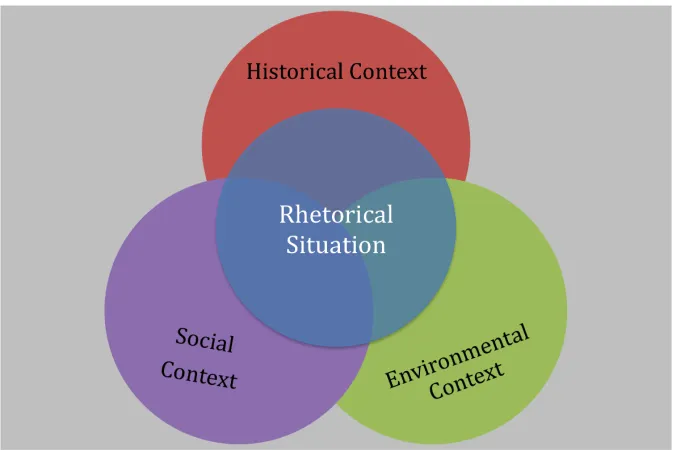
oversimplification of the complexity of this relationship, we could symbolically represent this relationship as follows:
Figure 1: Relationship between Context and Rhetorical Situation
Importantly, this means that the rhetorical situation cannot exist outside of a context, and that it is not technically incorrect to include components of the rhetorical situation in one’s description of context. However, I would liken this to what happens if a component inside your car breaks. Most drivers conceptually know how a car works: press the pedal, car moves. Most drivers do not understand, though, how all of the parts inside the car work together, just that the car works, i.e. they do not understand the relationship between
that failed because they don’t understand how it connects to all of the other parts in the car. Similarly, an AI wouldn’t understand why it failed in a given interaction if it didn’t
understand how all of the components of a rhetorical situation exist within a context. However, in the case of a rhetorical situation, the driver would not be able to know in advance what any of the parts were or what they responded to – in other words, they would be indeterminate components of an overall system that he or she would need to understand, and in the case of a rhetor – play a creative part in building, in order to figure out why the part failed.
This being said, when we attempt to pinpoint what exactly context, for rhetoricians, consists of the task becomes a bit more complicated. This difficulty in pinpointing a
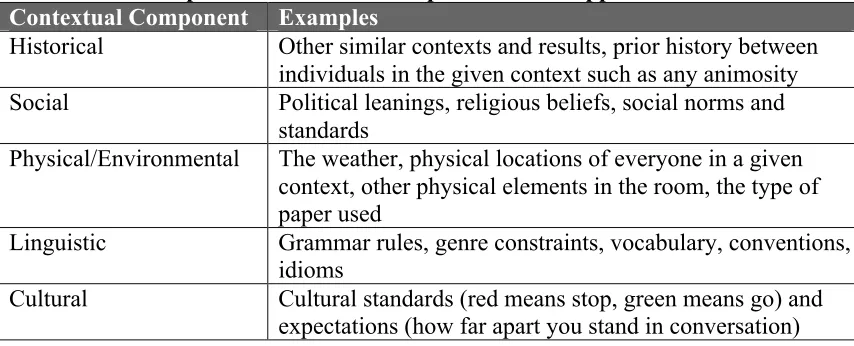
Table 1: Examples of Contextual Components That Appear In the Literature
Contextual Component Examples
Historical Other similar contexts and results, prior history between individuals in the given context such as any animosity Social Political leanings, religious beliefs, social norms and
standards
Physical/Environmental The weather, physical locations of everyone in a given context, other physical elements in the room, the type of paper used
Linguistic Grammar rules, genre constraints, vocabulary, conventions, idioms
Cultural Cultural standards (red means stop, green means go) and expectations (how far apart you stand in conversation)
Stephen Lucas essentially attempts to do just this. When describing the role of context within textual criticism, he identifies three different types of context: social, linguistic, and textual. Social context he describes as being composed of several different “factors”: “the political, religious, economic, intellectual, and institutional forces that condition both the development of the text and its internal operations” (Lucas, 1988, p. 248). The linguistic context he defines as being related to the actual words used by the author or speaker. These words, he states, constantly evolve and change with the times – at any given point, a
linguistic context would consist of “its own vocabulary, conventions, idioms, and patois” (1988, p. 249). He relates this form of context to the blurring of the boundaries between text and context; however, he also points out that the third type of context, textual context, does so to an even greater extent:
Based on the understanding that rhetorical discourses are temporal
time and is processed by a listener or reader. Meaning and effect are
produced, not by the text as a static entity, but by the progressive interaction of the audience with the temporal flow of ideational, dispositional, stylistic, and syntactical elements in the discourse. (1988, p. 249)
Although Lucas is concentrating heavily upon the textual components of analysis (likely because his primary focus is on a close reading of texts), his attempt to define context as consisting of three different types of context speaks to the attempts made by computer scientists as well. Lucas’ definition does not identify clearly the individual components of a particular context and, indeed, he even mentions that the components of each type of context change over time. However, he sets forth a scaffolding, so to speak, that rhetoricians use (or could use) when attempting to identify context within a close reading of a rhetorical text. Context, we can determine, is crucial in understanding and creating any rhetorical act or work, but to many scholars the understanding of context has become implicit and not
outwardly defined. However, by comparing the two we can see some common points when it comes to identifying a given context – both emphasize a historical component, both
emphasize the social situation, and both, to some degree mention the physical environment or surroundings (other words on the page or the actual, three-dimensional physical
environment).
environmental factors, and in this way the exigence will be shaped by the context within which it is found. However, we can see that it does not exist in any one of these three factors individually. The rhetor’s own experience – historically, socially, and environmentally – will influence his or her ability to “manage” the exigence, as Consigny (1974) puts it. The
audience most clearly can be seen as a social element, but the history behind the rhetor and his or her audience certainly should be seen as an important factor in the resulting rhetorical discourse. Additionally, if we consider that the audience a rhetor directly addresses is not necessarily the individuals directly in front of him or her, but an idealization of those individuals in the mind of the rhetor (or Ede and Lunsford’s (1984) audience invoked – a distinctly difficult problem for AI to tackle), influenced by those in front of him or her, then we must also consider audience to be something at once inside a given context but
additionally outside of it, on a z-axis of sorts. Finally, the constraints that Consigny and Bitzer emphasize as being influential to the rhetor can and should be found within the contextual environment that surrounds any given rhetorical situation. However, only those elements that will have a direct impact on the actions and discourse of the rhetor and that the rhetor invokes should be considered a part of the rhetorical situation within the context. For example, when trying to convince a friend to try a new dish at a familiar restaurant,
fixtures the restaurant uses or the political affiliation of the friend are likely not going to become important elements in the rhetorical argument the rhetor develops.
Ultimately, any piece of contextual information that the rhetor decides to creatively use when developing his or her argument will become a part of the rhetorical situation, with all other information remaining solely contextual. Turning this understanding into an operational definition of context and situation that can be used within computer science, however, would be difficult, but not impossible. We know that the rhetorical situation results from an exigence that is rooted in an indeterminate context. The actions of the rhetor (and to a limited degree his/her audience) makes a context determinate and, thus, measurable and identifiable and suited for usage in the research of Computer Science. The field of Human-Computer Interaction to a degree takes up this charge, measuring the interactions between humans and machines for elements such as human satisfaction, word choice on the part of the AI or human, physical mannerisms, etc.
searches, the location from which he or she accesses the site and other identifiable
information. There are numerous other examples that represent the importance of context. For many computer programs, recognizing a user’s context is critical in ensuring the “success” of the program (it’s hard to have a robot shake your hand if the robot can’t see it, for example). One study of the role of context in application design explains how knowing the context of an AI “reduces information needed in dialogue ... reduces cognitive
load/human memory load ... takes advantage of recognition ... resolves ambiguity ... [and] captialises [sic] on existing knowledge and previous experience of the agents,” among other reasons (Maskery et al., 1992, p. 25).
Identifying a single definition of context throughout the literature, however, seems to be nearly impossible. The use of the term context within studies examining devices or software such as those mentioned above seems to imply a tacit understanding of the term; however in practice it seems the term takes on varying definitions. In fact, Dey argues that many definitions of context used in computer science or AI studies “are too specific” (2001, p. 5). They are designed to fit the mold of the study at hand. Instead, he suggests a broader, unspecific use of the term. Thus, Dey defines context as: “…any information that can be used to characterize the situation of an entity. An entity is a person, place, or object that is
Meads (1992) and Maskery, Hopkins, and Dudley (1992) discuss the results of these workshops, held at the Computer-Human Interaction (CHI) 1989 and 1990 conferences, respectively, where scholars in the fields of human-computer interaction and AI research gathered to pinpoint a definition of context for use in studies within the fields.
Maskery and Meads (1992) recall the results of the first workshop, held at the CHI 1989 conference, wherein the discussion was restricted to the interactions between a human and a computer-based system. In the report of the results, Maskery and Meads asked
members of the various groups within the workshops to write position papers or summaries of the conclusions reached by the various groups. Preston Ginsburg's position paper, for example, described how his group concluded that, “the context of a thing defines our understanding of it” (as quoted in Maskery and Meads, 1992, p. 16). Summarizing the
opinion of one group within the workshop, Jim Carter also states that “each entity involved in an interaction has its own context, which may or may not be consistent with parts of the contexts of other entities” (as quoted in Maskery and Meads, 1992, p. 17). In the end, the general conclusion that seemed to permeate the workshop was that context could not easily be pinned down, nor does it remain consistent. Indeed, as one group concluded, “context is a conceptual ideal which can only be approximated by models” (Jim Carter, as quoted in Maskery and Meads, 1992, p. 17).
environment that provides meaning to an agent” and (2) “Perceptual context was defined as being the presentational issues related to context, the giving of visual, and perhaps audible, cues to the user to clue them into the context ... all those things from the 'environment', system, task and individuals, which create the mental framework for the user's cognitive activities” (Maskery et al., 1992, p. 23), in other words, things in the environment and what they mean. Importantly, they also concluded that the conceptual context, as defined, drives the perceptual context (Maskery et al., 1992, p. 24).
However, after scholars at the conference reached these conclusions, multiple
technically-oriented term, user. Naturally, this would be easier to identify and program responses to because it would not require a response to an exigence as none would (again, presumably) exist, however it also highlights the inherent error in approaching human-AI interactions this way. Attempting to constrain the interaction into a non-rhetorical task ignores the natural and actual ways that humans interact with AI in different contexts and situations.
Indeed, as will be seen later in the discussion of users’ interactions with various forms of AI, in well-structured tasks such as vacuuming the floor that require only limited discourse between the AI and human, users did not hold the same social and interpersonal expectations of the AI as they did in situations where the user (or the audience) interacted on a much more social level, such as when the AI is attempting to fulfill a customer service role. In other words, in situations where the human presented himself or herself as someone who needed decision making assistance, more social and interpersonal expectations existed than when the human requested the AI to engage in a menial task. One could infer, then, that the “good context” that Maskery et al. (1992) seem to strive for would be impossible to identify in a predominately social interaction without also incorporating an understanding of the rhetorical situation, and it may even be impossible in that scenario as well.
context. In linguistics, they state, “context refers to the meaning that must be inferred from the adjacent text” (Crowley et al., 2002, p. 118). However, this definition is not adequate when applied to AI: “Purely symbolic context is now recognized as inadequate for
intelligence. Intelligence requires the ability to perceive and to act” (Crowley et al., 2002, p. 119). Simply examining the context by looking at what surrounds the individuals within it, or examining the environment, is insufficient. Instead, “an ontology for context awareness requires both top-down and bottom-up components. Bottom-up components are tied to whatever the system can sense and interpret. The top-down elements are derived from users and their tasks” (Crowley et al., 2002, p. 120). In other words, in their model, all aspects of the relationships between the various physical components in the system must be examined.
One of these aspects is the goals of the user. Crowley et al. consider this to be crucial in their model since users, they argue, are driven by goals that usually do not involve directly interacting with the system (Crowley et al., 2002, p. 120). Most users consider the AI to be a tool used in attempting to satisfy a goal. This works well with the weak AI approach
Context (U, T) ! {Role1, Role2, ... Rolen; Relation1, ... Relationm} (Crowley et al., 2002, p.
127). Addressing the use of the term “situation” used above, Crowley et al. stipulate that “the user's situation is a particular assignment of entities to roles completed by a set of relations between the entities. Situation may be seen as the ‘state’ of the user with respect to his task ... In a similar manner, the system's situation is the assignment of entities to roles, and the relations between these entities” (Crowley et al., 2002, p. 127-128).
Crowley’s definition resembles that of rhetoricians in that certain elements of a given context make up (determine) the elements of a rhetorical situation. Indeed, if we re-examine Table 1, we see that many of the elements considered contextual can also be considered rhetorical constraints. The difference, it seems, is the lack of an “individual” category in Table 1. The key, important, difference between context and rhetoric lies not in the
identification, acknowledgement, and recognition, rhetorical intelligence requires processing, response, and interaction.
Dey (2001) attempts to produce an operationalized definition of context in order to propose the need to increase the recognition of context by AI systems. In it, he describes the first instance of the term “context-aware” in an article by Schilit and Theimer (1994) where context referred to the “location, identities of nearby people and objects, and changes to those objects” (Dey, 2001, p. 4-5). Schilit and Theimer’s (1994) purpose was to create a mapping tool, so their definition is understandable. Their concern within the program was for objects within a physical environment, but not necessarily for the relationship between the user of the program and those objects. Their definition of context satisfied their needs to describe, at a more geographic level, the environment within which the AI would engage with the human in their study. However, as Dey (2001) then points out, definitions such as these that define based upon a particular case (or example) can be difficult to apply within other studies. He believes the same for definitions of context referring to synonyms, such as environment or situation.
A case in point can be found in one of Schilit’s other studies published the same year, where he and his colleagues expand the definition of context used previously in Schilit’s own studies (Schilit et al., 1994). Although the components did not change, he and his colleagues describe them differently:
communication costs, communication bandwidth, and even the social situation: e.g., whether you are with your manager or with a co-worker (1994, p. 85).
All of these are both observable and measurable, which allows them to be transferred to the digital realm (relatively) easily because they can be understood on an algorithmic level. However, while a rhetor may look at each of these factors in developing and constructing an argument or response to a situation, the appropriateness of the response is determined by more than just summarizing the available data or drawing conclusions from the information provided by the surrounding environment.
Furthermore, the inclusion of the “social situation” at the end of Schilit et al.’s
definition drastically changes the scope of what to include in data gathering when attempting to identify a given context. The social situation is an integral part of context when developing context-aware systems that adapt and react to a given location, nearby population, adjacent devices, and environment over time. As they describe it, “people's actions can often be predicted by their situation. There are certain actions we regularly take, some of which are social, when in the library, kitchen, or office. Contextual information and commands aim to exploit this fact” (Schilit et al., 1994, p. 87). In order to exploit it, though, they must
understand it, which can be difficult. Although human beings typically engage in repetitive and known tasks in these locations (such as washing dishes in the kitchen), we can never be completely certain when an individual walks into a room why he or she is there. The
though, Schilit et al.’s use of the term “situation.” Here, Schilit and his group are NOT referring to a rhetorical situation. Bitzer (1968) carefully points out that a situation is not rhetorical unless change is possible through rhetoric. When we remark to someone in the break room that it’s hot outside, this is not necessarily a rhetorical situation as the individual speaking may not expect or even desire an answer, making the situation not necessarily a rhetorical one, even though it may be a social one. For many computer scientists, context is necessary for the AI to both physically navigate its environment and to respond to the individuals in an environment because the AI has a limited understanding of the world. The AI must be pre-programmed to understand certain actions or key words, much like Siri, in order to fulfill a specific purpose, such as that of a personal assistant in Siri’s case.
attributes of an object that make it identifiable (for example, eyes, nose, and mouth being present for a face) that most advanced AI, like the one utilized in Davis et al.’s study, can overcome. The semantic gap consists of the descriptions human beings give to, in this case, a photograph that the AI is incapable of constructing outside of human input (Davis et al., 2004). They overcome the semantic gap through what they refer to as “contextual metadata,” or human input which is recorded at the time of image capture and analyzed on-the spot. The study concluded that there were, “statistical regularities in the spatio-temporal-social contexts of both individual and group phototaking that can be leveraged to infer media content” (Davis et al., 2004, p. 193). For computer scientists, contextual understanding is a critical hurdle for AI to overcome in order to mimic human intelligence and automate typically human tasks. Focusing on a specific component of context, as the Davis et al. study did, allows the researcher to delve deeper into the role of context in the given study.
input to annotate and identify the social situations (Davis et al., 2004), thereby assigning meaning to the situations present in the provided images. Although the device could identify the context at hand, which in this case meant simply physical characteristics of the human body, signifying contextual intelligence, it did not possess the rhetorical intelligence
necessary to attribute meaning to the image as is evident by the fact that the system relied on human beings to mark up similar images so that the AI could understand what the symbols in the photograph represent (such as what an unhappy bride might signify). It is likely that the semantic gap that the authors of this study identified was, to some degree, the ability for the AI to recognize a rhetorical situation.
If we look at classic examples of computer science theory and experimentation, we can see how identifying the differences between the rhetorical situation and context, and indeed rhetorical intelligence and contextual intelligence, would better inform how AI could and should be developed.
A New Look At Turing and Seale
In 1950, Alan Turing asked, “Can machines think?” Turing noted that the question is a nearly impossible one to answer in any feasible or definitive way and so he invented a test, the now-infamous Turing test. In Turing’s original version of the test, a human user (what Turing calls an interrogator) engages in a game, first with a man and a woman and then with another human and a seemingly “intelligent” machine. Through a written question and