Computer Intraction Based on Hand Gestures
Suresh.D
1, Subash.P
2, F.Noorullah Khan
3UG Student, Dept. Of ECE, IFET College Of Engineering, Villupuram, TN, India1,2
Assistant Professor, Dept. Of ECE, IFET College Of Engineering, Villupuram, TN, India3
ABSTRACT:The increasing use of computing devices in day to day life, the need of user friendly interfaces has lead towards the evolution of different type of interfaces for human computer interaction and real time vision based hand gesture recognition affords users the ability to interact with computers in more natural and intuitive ways. Direct use of hands as an input device is an attractive method which can communicate much more information by itself in comparison to mice, joysticks a greater number of recognition system that can be used in a variety of human computer interaction applications.
KEYWORDS: HCI, hand gestures.
I.INTRAODUCTION
Hand gesture recognition is one of the most active areas of research in computer vision. Hand gesture recognition system received great attention in the recent few years because of its manifoldness applications and the ability to interact with machine efficiently through human computer interaction. Hand gesture recognition system provides us an innovative, natural, user friendly way of interaction with the computer which is more familiar to the human beings. Gesture recognition has a wide area of application including human machine interaction, sign language, and immersive game technologies.
II.METHODS
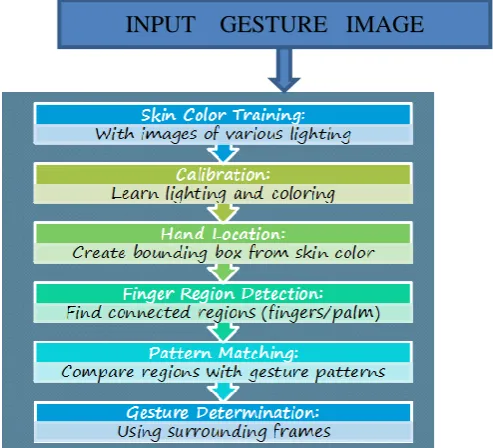
There are several methods for hand gesture recognition. In this method steps are given below and basic diagram of hand gesture is shown fig 1.
Figure 1.Hand gesture recognition steps.
III. SYSTEM MODEL
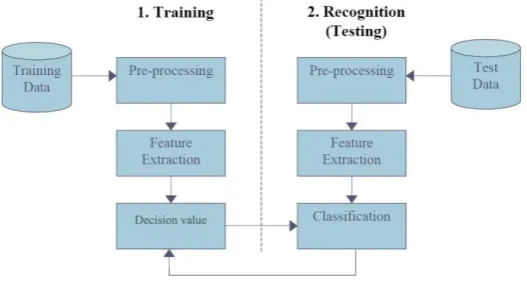
The system flow diagram is shown in figure 2. Initially the system acquires images captured from a webcam. The output of the webcam is basically a video sent to the system. A system will acquire video in the form of sequences of frames. Mat lab has an efficient image acquisition toolbox for this purpose. After acquiring an image, it will be color segmentation. Then edges of a segmented hand are detected using canny edge detection algorithm and the noise is removed. From the segmented hand, fingertips can be found by any of three given approaches. Music player and virtual mouse are two applications based on these approaches.
Figure 2 architecture diagram
A.FEATURE EXTRACTION
The recognition rate of the whole system depends on the quality of features, without which the recognition process even cannot execute. The selection of features directly affects the design, property and ultimate recognition rate of a classifier. Thus it is very important to choose appropriate features. However, in practical problems, it is very difficult to choose and extract the most representative features from object. Besides the features of certain mages will change along with the alternation of circumstance, which makes the problem of feature extraction more difficult and complicated. There are a variety of describing approaches to characterize images and each of them has its own advantages and disadvantages. Although there is no universal and optimal method to characterize image of hand gesture, a good set of features should with the quality of reliability, distinguishability, and independence of small number and low computation. In our approach Hu Moment invariants are employed as the features of images of hand gesture.
Feature extraction involves simplifying the amount of resources required to describe a large set of data accurately. When performing analysis of complex data one of the major problems stems from the number of variables involved. Analysis with a large number of variables generally requires a large amount of memory and computation power or a classification algorithm which over fits the training sample and generalizes poorly to new samples. The feature is defined as a function of one or more measurements, each of which specifies some quantifiable property of an object, and is computed such that it quantifies some significant characteristics of the object.
B.SEGMENTATION
Segmentation subdivides the images into its constituent objects. The goal of segmentation is to simplify and/or change the representation of an image into something that is more meaningful and easier to analyze. Image segmentation is typically used to locate objects and boundaries like lines and curves in images. More precisely, image segmentation is
the process of assigning a label to every pixel in an image such that pixels with the same label share certain visual characteristics.
Figure 3 SVM classifications.
C.CLASSIFICATION
The design of a classifier is the most important part of a vision based human interactive system because it directly decides the recognition rate which represents the reliability, and the recognizing time which represents the real-time ability. The Support Vector Machine (SVM),as a burgeoning and universal learning algorithm, has found a wide application in the fields of approximation of function, data mining and pattern recognition. In this chapter first the basic principle of SVM is introduced. Then the linear and non-linear algorithm of SVM is expounded in terms of optimal hyperplane.Thirdly the classifying performance of multi-class algorithms of one-to-one, one-to-many and Directed Acyclic Graph (DAG) is analysed. Finally the posterior probability based SVM algorithm is proposed towards the situation that a particular gesture is classified as multi-classes
D.PREPROCESSING
As mentioned in the introduction the main purpose of the pre-processing stage is to extract the hand and features of the hand from the input image and pass them on to the pattern recognition stage, which we discuss in the next section. The pre-processing stage is of great importance to the success of the classification, if we fail to extract a proper hand figure and relevant features of the hand from the input image, the pattern recognition algorithm won’t be able to achieve the desired results. Furthermore, it is vital that the pre-processing part will be as robust as possible so environment changes such as background, noise and lighting won’t affect the classification result. We will now explain the methods we took to insure that the pre-processing stage will produce robust and accurate results. A diagram of the system is shown in figure 4.
1.1Color Normalization
Figure5 Color normalization
1.2 Image Segmentation Based On Color
By default, an image is represented in an RGB format, meaning that for each pixel in the image each of the colors Red, Green and Blue has a value stating the intensity of that color in the pixel. Since different people have different hand colours (e.g. Black hands vs. white hands) we cannot rely on the intensity of any one of the colors in order to extract the hand and its features. Therefore we converted the RGB representation to a Hue-Saturation-Value (HSV) representation, meaning that now for each pixel in the image there are three values – Hue, Saturation and Value.
Figure 6 – HSV image segmentation
1.3Filtering
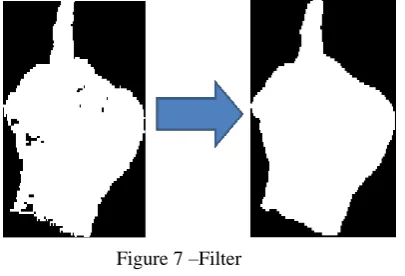
We explained the extraction of the BW picture from the original picture. Even though the above process extracts the hand successfully, it may still create holes or rough edges. We use a median filter in order to fill these holes and sharpen the edges. A median filter is a filter that assigns each pixel with the median value of its neighbours. In a black and white picture it gives the pixel the same color as the majority of that pixel’s neighbours. The results of this filtering can be seen in figure
Figure 7 –Filter
V.APPLICATION
Virtual Mouse
control mouse position and motion, “Centroid Tracking” is used. The centroid of binary hand is passed to class mouse. Mouse Move(x,y). Hence the mouse pointer is moved according to the centroid motion. Other tasks are performed by identifying the different gestures in the current frame. If the System does not detect any figure (fist), it will only track the hand, and when it detects five fingers it performs “click” function. Figure 8shows the live video snapshot of virtual mouse using Drive selection.
Figure 8 Hand gesture input Figure 9 Output for hand gesture file select.
VI. CONCLUSION
Hand gesture recognition is one of the most important research subjects in the field of intelligent human-computer interaction. Because vision based hand gesture recognition utilizes web camera to capture information of gestures, it is not required to purchase expensive devices. In addition, it is much more natural and convenient than other traditional human-machine interactive systems such as keyboard and mouse, which has increased computer usage and engaging the older generation and has further thrust human computer interaction to a new level of sophistication. Thus it has pivotal theoretical value and tremendous application prospect.
REFERENCES
[1] Javeria Farooq, Muhaddisa Barat Ali,” Real Time Hand Gesture Recognition for Computer Interaction” Department of Electronic Engineering, Balochistan University of Information Technology Engineering & Management Sciences Quetta, Pakistan April 2014.
[2] Ankit Chaudhary, J. L. Raheja , Karen Das , Sonia Raheja, “ Intelligent Approaches to interact with Machinesusing Hand Gesture Recognition in Natural way”. International Journal of Computer Science & Engineering Survey (IJCSES) Vol.2, No.1, Feb 2011.
[3] Lee D. and Park Y. ” Vision-Based Remote Control System by Motion Detection and Open Finger Counting, IEEE Transactions on Consumer Electronics”, Vol. 55, issue 4, Nov 2009, pp. 2308-2313.
[4] J.H.Kim,N.D.Thang and T. S. Kim, “3-D hand motion and gesture
recognition using a data glove,” in IEEE Int. Symp. Industrial Electronics, 2009, pp.1013-1018.
[5] P.Premaratne and Q. Nguyen, “Consumer electronics control system
based on hand gesture moment invariants,” IET Computer Vision, vol.1, no.1, pp.35-41, Mar. 2007.
BIOGRAPHY
Suresh.D Studying bachelor of Engineering in Electronics and Communication Engineering, IFET College of Engineering, Villupuram , TamilNadu, India. His areas of interest are Digital Image Processing and Embedded Systems.
Suresh.D Studying bachelor of Engineering in Electronics and Communication Engineering, IFET College of Engineering, Villupuram , TamilNadu, India. His areas of interest are Digital Image Processing and Computer networking.