Abstract
PARTHEEPAN, RAJASOORIYAR. Hybrid Genetic Algorithms. (Under the direction of Dr. S. Ranji Ranjithan ) Genetic algorithms (GAs), a class of evolutionary algorithms, emerging to be a promising
procedure for solving engineering optimization problems. As GAs are able to conduct global
search with minimal simplifying assumptions about the problem as well as the corresponding
decision space, they offer a good alternative to the many gradient-based nonlinear local search
procedures. While the underlying operators of a typical GA are designed for global search, their
ability to search locally by exploiting information in the vicinity of apparently good solutions is
relatively weak. This results in rapid convergence to a relatively good solution followed by slow
improvements to that good solution, making GA computationally inefficient. To alleviate this
deficiency, GAs can be integrated with local-search procedures such that the strengths of both
global and local search approaches are embedded into a hybrid search procedure. One approach
is to couple sequentially a GA-based global-search with a local-search procedure. Alternatively,
local-search steps can be integrated within the GA operators to potentially refine the solutions
throughout the global-search steps in the GA. This research investigates four hybrid search
procedures, one based on a sequential approach and the others as local-search-based operators
within a GA. These methods and a simple GA are evaluated using a set of test problems, and
their performance (in terms of solution quality and computation time) is compared. These
performance comparisons are conducted for multiple random trials. These methods are also
applied and tested on a realistic urban runoff control problem. Compared to a simple GA, all
methods perform well in terms of solution quality and number of fitness evaluations (used as a
surrogate for computational resource needs). One of the local-search-based operator methods
outperforms others consistently and exhibits a robust performance, indicating a promising hybrid
Biography
Rajasooriyar Partheepan was born in Jaffna, Srilanka on December 21, 1974. He was raised with
his two brothers and two sisters. He graduated from University of Peradeniya in July 2000 with
BSc. (Hons) in Civil Engineering. He started his masters program in August 2001 at North
Carolina State University. He worked as a research assistant under Dr S. Ranji Ranjithan during
his masters program. His research interests are developing decision support tools, design and
development of evolutionary algorithms for environmental engineering problems and software
Acknowledgement
I express my sincere gratitude to Dr Ranji S. Ranjithan at North Carolina State University for
investing so much of his time and energy to attain my educational goals. This thesis would not
have been possible without his help. I would also like to thank Dr. Downey Brill and Dr. G.
Mahinthakumar for agreeing to be on my committee.
I am particularly grateful to Dr. G. Mahinthakumar for his valuable guidance throughout my
masters program.
In addition, thanks to my graduate student friends Emily, Sunil and Siva and my roommates
Satta, Bala and Vijay for the great time both in school and out.
Table of Contents
List of Figures v
List of Tables vi
1. Introduction 1
2. Background 2
2.1 Sequential Hybrid Procedures 2
2.2 Local-search-based GA operators 3
3. Methodology 4
3.1 Hybrid Method 1: Sequential GA-NM Procedure 5 3.2 Hybrid Method 2: Local-search-based Operator:
ElitePatternMove Procedure 6
3.3 Hybrid Method 3: Local-search-based Operator:
Simplex GA Procedure 7
3.4 Hybrid Method 4: Local-search-based Operator:
Simplex Crossover 9
4. Evaluation using test problems 10
4.1 Comparison of Results: Sequential GA-NM vs. Simple GA 10 4.2 Comparison of Results: Local-search-based Operators vs. Simple GA 11 5. Application to an urban runoff control problem 18
6. Summary and Final remarks 24
List of Tables
Table 1 : Test problems and known optimal solutions 10 Table 2 : Comparison of Sequential GA-NM method
and Simple GA for Ackley function (for 30 random trials) 11 Table 3 : Comparison of Sequential GA-NM method
and Simple GA for Rosenbrock function (for 30 random trials) 11 Table 4 : Comparison of Sequential GA-NM with
List of Figures
Figure 1: Flow Chart for the Sequential GA-NM hybrid procedure 5 Figure 2: Pseudo code for the Elite Pattern Move hybrid procedure 6 Figure 3: Formation of a new population using the Simplex GA
hybrid procedure 7 Figure 4: Weighted Centroid & Reflection Operation (solution c
is better than solution b, which is better than solution a) 8 Figure 5: Pseudo code for the Simplex GA hybrid procedure 8 Figure 6: Pseudo code for the Simplex Crossover hybrid procedure 9 Figure 7: Comparison of local-search-based operators with
Simple GA for Rastrigin function 12 Figure 8: Comparison of local-search-based operators with
Simple GA for Ackley function 13 Figure 9: Comparison of local-search-based operators with
Simple GA for Schwefel function 14 Figure 10: Comparison of convergence (for a single random seed)
of Simplex GA and of Simple GA for Rastrigin function. 15 Figure 11: Comparison of convergence (based on 30 random trials)
of Simplex GA and of Simple GA for Rastrigin function 16 Figure 12: Comparison of convergence (for a single random seed)
of ElitePatternMove and of Simple GA for Rastrigin Function 16 Figure 13: Comparison of convergence (based on 30 random trials)
of ElitePatternMove GA and of Simple GA for Rastrigin function 17 Figure 14: Comparison of convergence (for a single random seed)
of SimplexCrossover and of Simple GA for Rastrigin function 17 Figure 15: Comparison of convergence (based on 30 random trials)
of SimplexCrossover GA and of Simple GA for Rastrigin function 18 Figure 16: The catchment areas ((a) existing condition, and
(b) after improvement) and sewer flows ((c) existing conditions, and (d) after improvement) corresponding to the hypothetical
low development (LID) case study. 20 Figure 17: Comparison of local-search-based operators with Simple GA
for low impact development problem 22 Figure 18: Comparison of convergence (based on 25 random trials)
of Simplex GA and of Simple GA for LID Problem 22 Figure 19: Comparison of convergence (based on 25 random trials)
of ElitePatternMove GA and of Simple GA for LID Problem 23 Figure 20: Comparison of convergence (based on 25 random trials)
Chapter 1
Introduction
Genetic algorithms (GAs), a class of evolutionary algorithms, emerging to be a promising
procedure for solving search problems associated with engineering systems analysis. Real-world
applications of GAs in an array of engineering problems are frequently reported in the literature.
As GAs are able to conduct global search with minimal simplifying assumptions about the
problem as well as the corresponding decision space, they offer a good alternative to the many
gradient-based nonlinear local search procedures. While the operators (such as selection and
recombination) in a typical GA are designed for global search, their ability to search locally by
exploiting information in the vicinity of apparently good solutions is relatively weak. Thus GAs
are generally good at globally searching the decision space to quickly identify relatively better
solutions, but are not efficient at making local refinements to improve upon the good solutions.
This is characterized by typical GA performance where the algorithm rapidly converges to a
relatively good solution but becomes slow to make any significant improvement to that good
solution. This behavior, especially during the latter stage after the initial rapid convergence,
makes GAs highly compute intensive as the models that represent the problem space need to be
executed multiple instances over the iterations of the algorithm.
Recognizing these convergence properties of GA-based search procedures, studies have been
conducted to integrate GAs with local-search procedures such that the strengths of both global
and local search approaches are embedded into a hybrid search procedure. This expectedly
improves not only the quality of the solution, but also the convergence time. Most studies
examined hybrid approaches that employ sequentially a GA-based global-search with a
local-search procedure (Yen et al. 1995). Among the several existing sequential hybrid procedures, a
typical approach uses a GA-based search initially to conduct a global search, and then improves
that solution by using a local-search technique. Alternatively, a few hybrid search procedures
investigated ways to integrate the local-search steps within the GA operators to potentially refine
the solutions throughout the global-search steps in the GA (Yen et al 1995, Renders and Bersini
1994). While these preliminary studies show promising results, more investigations are needed to
the overall search capabilities of a GA Further, additional study is needed to conduct a more
comprehensive comparison of performance of these hybrid procedures.
This paper reports several new hybrid search procedures and their evaluations using several test
problems. These hybrid procedures use a GA for the global search, and Nelder-Mead (NM)
simplex technique as well as the steps from the Hooke and Jeeves method for local-search. The
applicability of these new hybrid procedures is also demonstrated for a realistic urban runoff
control problem. The following section provides a background to the existing hybrid methods,
followed by a section that describes the new hybrid search procedures. The subsequent section
reports and compares the results associated with the test problems. Then the description of the
urban runoff control problem and the application of the new hybrid procedures to that problem
are presented. The last section presents a summary of the findings and final remarks.
Chapter 2
Background
This section provides a brief background to the main categories of hybrid procedures that are
reported in the literature. The two main categories are: sequential hybrid procedures, and
local-search-based GA operators.
2. 1 Sequential Hybrid Procedures
The sequential procedures are the most commonly investigated GA-based hybrid techniques.
They employ a global-search procedure and a local-search procedure in tandem or sequence to
conduct the search. These hybrid techniques can be further categorized into two main types:
1. local-search procedure preceded by a global-search procedure
2. local-search procedure followed by a global-search procedure.
Procedures in type 1 typically use a local-search procedure to generate the initial population for
the global-search method. For example, Okamoto et al. (1998) apply repeatedly a local-search
method to a random initial GA population to locally improve each solution. The locally refined
set of solutions is then used as the starting population for the GA-based global-search procedure.
improve the population of solutions. For example, Mathias et al. (1994) apply a local-search
procedure at the beginning of each generation to make local refinements to the population of
solutions. The GA-operators are then applied as in a typical GA to the set of refined solutions.
While these procedures may hold some promise for some class of problems, the rationale for
generally conducting local search prior to global search appears to be weak and potentially
inefficient. Since a global search step makes large moves to explore the decision space, resulting
in macro changes in the set of solutions, refinements made a priori via a local-search procedure
are likely to be ineffective during the macro changes.
Alternatively, the second type of procedures use the global-search methods to first narrow the
search space down to a few good regions, and then apply a local-search procedure to make
refinements based on information local to those few good regions. As this results in the macro
moves being conducted prior to the local search, the benefits of the subsequent local refinements
can potentially be effective unlike in type 1 procedures. For example, Lobo and Goldberg
(1996) and Chelouah and Siarry (2003) report hybrid approaches where the solution found by a
GA is then used as the starting point for a local-search method.
As a GA-based search procedure results in a population of solutions, it is possible to use not just
the best solution but also a set of nearly good solutions from the final population as starting
points for a local search. One potential approach is to take a set of the good solutions from the
final population of the GA and use them as separate starting points for the local search. This
result in multiple instances of the local-search algorithm being implemented simultaneously,
which increases the computational burden associated with conducting multiple local searches.
Alternatively, the final GA population (or a subset of good solutions) that characterizes the good
regions of the decision space can be used collectively to represent the starting conditions for a
local search. One such approach that is investigated in this paper uses the Nelder-Mean simplex
local-search procedure that uses a subset of nearly good solutions from the GA population to
form the starting simplex for local search.
2.2 Local-search-based GA operators
Instead of applying the local search in sequence with a GA, the local search steps can be
throughout the global search. The primary goal of this category of procedures is to conduct local
search starting from intermediate solutions as a GA continues to search the decisions space. An
example of this is a method proposed by Xu et al. (2001) where a Hooke & Jeeve’s
method-based local-search procedure is applied to a small set of the population within the context of a
micro GA. Starting from each solution in the small population of the micro GA, local
refinements are made. As the population is small in a micro GA, the computational burden
associated with the local search is limited. A new approach developed in this paper presents an
alternative in which the Hooke and Jeeve’s local-search step is applied to the best solution (or the
elite solution) at any time during the GA-based search. This approach not only instills into the
GA population local improvement to the best GA solution at every generation, but also keeps the
computational needs manageable since the local search is limited to just one solution.
An alternative approach is to apply the local refinement concurrently with the GA operators,
resulting in some solutions undergoing a local-search step while the others are subjected to the
typical GA steps. For example, Yen et al. (1995) applied the Nelder-Mead simplex-like local
search to a small number of solutions in the GA population to generate new solutions during the
GA crossover operation. The rest of the solutions underwent the normal GA crossover operator.
Another approach is to conduct the crossover operator in a GA using a local-search-based
operator to generate a locally modified new solution. Using such a local-search-based operator,
the parent solutions are used to generate offspring solutions that replace them in the new
generation. In contrast to the previous approach where the local-search step is applied in a
greedy manner (i.e., accept only improved solutions), the local modification is not checked for
improvement in the solution before adding it to the new population. For example, Render and
Bersini (1994) proposed a simplex-crossover operator that takes a set of solutions from the GA
population to generate a fraction of the offspring solutions.
Chapter 3
Methodology
The following four different hybrid search methods were developed and investigated in this
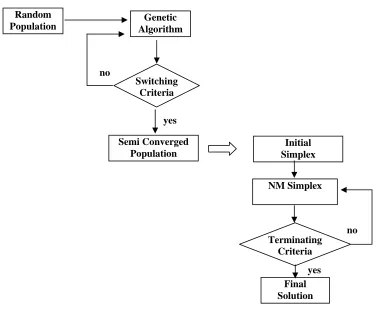
3. 1 Hybrid Method 1: Sequential GA-NM Procedure
The first step in this method is a global search using a GA. The population of solutions at
convergence is then used to construct the starting condition for a Nelder-Mead-based local
search procedure. The convergence is defined based on the degree of improvement in the best
solution during the GA-based global search. For example, the GA search is terminated when the
improvement in the fitness of the best solution is less than a prespecified value. While other
convergence criteria (e.g., population diversity, maximum number of generation, fitness
distribution of the GA population, etc.) could be used, the non-improvement criterion was found
to be simpler to set up and less dependent on the problem characteristics. At convergence,
instead of using only the best solution, a set of good solutions from the converged GA population
is used to form the initial simplex. The key steps of this procedure are shown in Figure 1.
Figure 1– Flow chart for the Sequential GA-NM hybrid procedure
Random
Population Algorithm Genetic
Switching Criteria
yes no
Semi Converged Population
NM Simplex
Terminating Criteria
Final Solution
Initial Simplex
yes
performElitism () {
if(currentBest(Xc) > previousBest(Xp)){ X1 = Xc + 1.0* (Xc – Xe)
X2 = Xc + 0.5* (Xc – Xe)
ConstraintHandling:
If genes of X1 and X2 > upper bound or < lower bound then
set those genes to respective bound values
if(X1 > population.worst1)
replace worst1 with X1
if(X2 > population.worst2)
replace worst2 with X2
} }
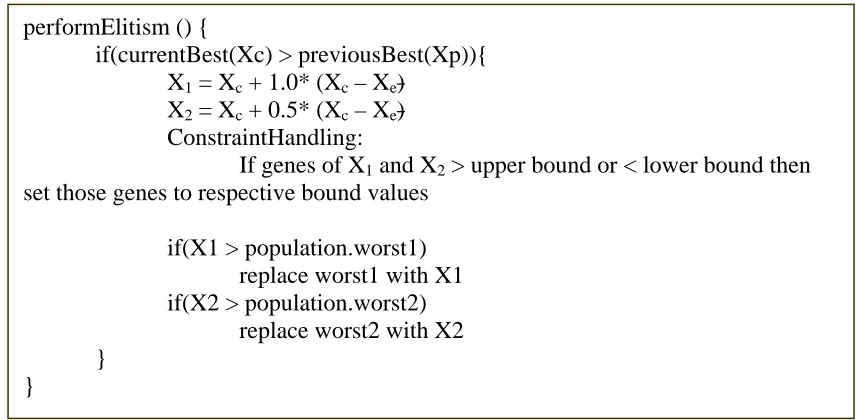
3.2 Hybrid Method 2: Local-search-based Operator – ElitePatternMove Procedure
In this procedure, a local-search step is applied within the GA as an additional operator. Similar
to the approach suggested by Xu et al. (2001), this operator combines the “pattern move” in the
Hooke and Jeeve’s local-search method with the “explorative moves” conducted by the GA.
Typically the best (or the elite) solution found by the GA is stored at each intermediate
generation. This set of elite solutions represents the outcome of the explorative steps of a GA.
In a standard Hooke and Jeeve’s local-search procedure, an exploration move is combined with a
pattern move to search the decision space. Instead, in this hybrid procedure a pattern move is
applied to the elite solutions as the GA continues to explore the decisions space. The pattern
move is applied based on the last elite solution and the current best solution to generate a new
solution. If Xe is the elite solution and Xc is the current best solution, then a new solution Xn =
Xc + α (Xc – Xe) is generated for an arbitrary value of the α parameter that represents the size of
the local step. The results presented in this paper are based on the values 0.5 and 1.0 for this
parameter. This pattern move represents a line search in the direction of local improvements.
The resulting new solution is incorporated into the subsequent GA population. If the resulting
new solution violates a constraint, then it is set to a point on the constraint boundary. Figure 2
shows the pseudo code for this procedure.
Ranked Population Population Best
Worst
Elitism Weighted NM Simplex
Simple GA
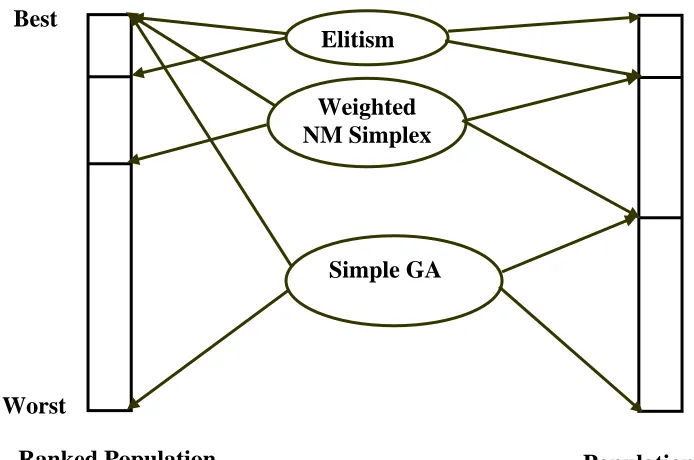
3.3 Hybrid Method 3: Local-search-based Operator – Simplex GA Procedure
This procedure introduces an alternative crossover operator that is applicable with the standard
GA crossover operators. Similar to the GA crossover operators, this operator is applied to a
subset of parent solutions to generate offspring solutions. This alternative operator is designed
based upon a Nelder-Mead simplex method to perform local search. For example, (n+1) parent
solutions, where n is an arbitrary value > 2, are selected from the GA population, and the best
among these solutions is taken through the typical Nelder-Mead simplex steps (e.g., reflection,
expansion, and contraction for local improvement based upon the simplex formed by the other n
solutions (Figure 3).
Figure 3 – Formation of a new population using the Simplex GA hybrid procedure
Unlike in the standard Nelder-Mead simplex method, the new operator defines the centroid of
simplex by weighting each corner of the simplex by its fitness value. This result in a
fitness-weighted centroid that is then used in the reflection, expansion and contraction steps (Figure 4)
a
c
b
Simplex GA {
While (termination criteria is not true){ Evaluate the population () Sort population ();
Elitism()
Create two populations:
Pop1: 0.1 * population size: top solution from the size of the simplex Pop2: 0.9 * population size : size of the simple GA , arbitrarily picked. Pop1: Simplex search
Pop2: Simple GA search }
Figure 4- Weighted Centroid & Reflection Operation (solution c is better than solution b, which
is better than solution a)
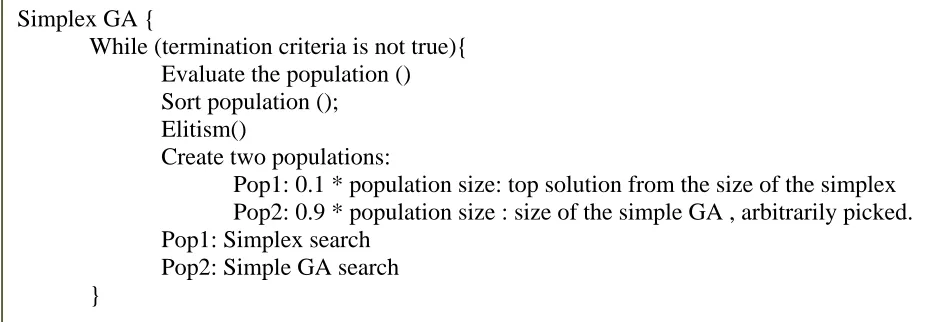
The proposed Simplex GA procedure employs this local-search-based crossover operator on a
randomly selected portion of the GA population, and the rest of the population undergoes the
typical GA crossover operators that are designed for global exploration of the decision space.
The fraction that defines the portion of the population to which the new operator is applied is
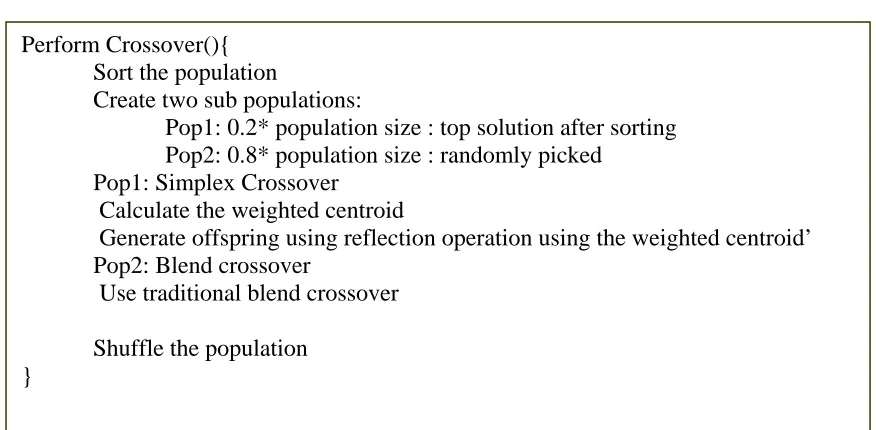
treated as a new algorithmic parameter. Figure 5 shows the pseudo code for Simplex GA.
Perform Crossover(){ Sort the population
Create two sub populations:
Pop1: 0.2* population size : top solution after sorting Pop2: 0.8* population size : randomly picked
Pop1: Simplex Crossover Calculate the weighted centroid
Generate offspring using reflection operation using the weighted centroid’ Pop2: Blend crossover
Use traditional blend crossover
Shuffle the population }
3.4 Hybrid Method 4: Local-search-based Operator – Simplex Crossover
Similar to the previous method, this procedure (Figure 6) introduces a Nelder-Mead simplex
method-based crossover operator. The primary difference is that only the reflection step is
applied. Unlike the standard Nelder-Mead simplex method, the new solution found after the
reflection step is not evaluated to determine if the expansion or contraction steps are to be
applied. Instead, the solution found after this local move is included into the GA population, and
the subsequent selection step in the GA will evaluate and appropriately propagate that solution.
This is analogous to the typical GA crossover operator where the offspring solutions are
incorporated into the population, which then eventually undergoes evaluation and selection to
determine the survivability of those solutions in the next generation. As in the previous method,
this simplex crossover operator is applied to a randomly selected portion of the population, and
the rest is subjected to the standard GA crossover operator. While this new approach eliminates
the need for additional fitness evaluations, it is relatively less “greedy” in making local
refinements.
Chapter 4
Evaluation using test problems
The four hybrid procedures described above were evaluated using several test problems for
which the optimal solutions are known. These problems and the corresponding optimal solutions
are shown in Table 1. The performance of each new method is compared with that of a simple
GA with only the standard GA operators. To examine the robustness of these methods, 30
random trials were conducted for each method and for each instance of the problem.
Table 1 – Test problems and known optimal solutions
Problem Mathematical Formulation Optimal Solution
Ackley
( )
768 . 32 768 . 32 10 1 2 cos 1 exp 10 1 2 1 2 . 0 exp 20 20 ) ( Min ≤ ≤ − ⎟⎟ ⎠ ⎞ ⎜⎜ ⎝ ⎛ ∑ = − ⎟ ⎟ ⎠ ⎞ ⎜ ⎜ ⎝ ⎛ ∑ = − + + = i x i i x n i i x n e x f π 0 ) ( 0 = ∀ = x f i xi
Rosenbrock
(
)
(
)
048 . 2 048 . 2 1 100 ) ( Min 10 1 2 2 2 1 ≤ ≤ ⎟ ⎠ ⎞ ⎜ ⎝ ⎛ − + − =∑
= + i i i i i x x x x x f 0 ) ( 1 = ∀ = x f i xi Rastrigin 12 . 5 12 . 5 10 1 20 2 100 ) ( Min ≤ ≤ − ∑ = − + = ⎜⎝⎛ ⎟⎠⎞ i xi xi xi x f π 0 ) ( 0 = ∀ = x f i xi Schwefel 500 500 10 1 sin ) ( Min ≤ ≤ − ∑ = − = ⎟ ⎠ ⎞ ⎜ ⎝ ⎛ i x i i x i x x f 829 . 4189 ) ( 9687 . 420 = ∀ = x f i xi
4.1 Comparison of Results: Sequential GA-NM vs. Simple GA
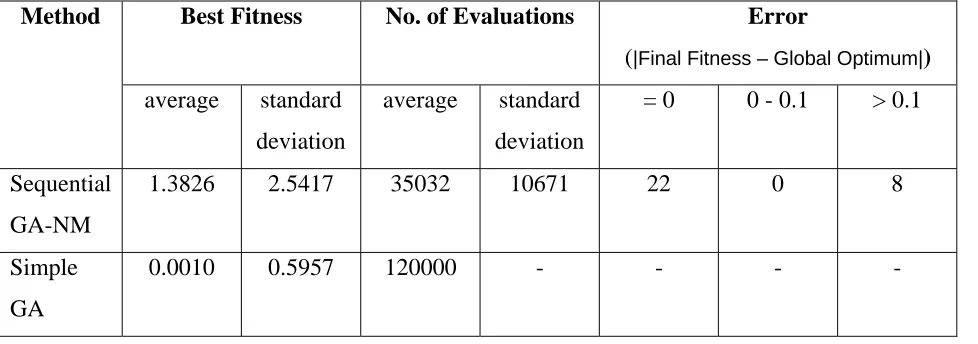
Tables 2 and 3 compare the performance (i.e., the average and standard deviation of fitness,
which is being minimized, as well as the number of function evaluations based on 30 random
trials) of the sequential GA-NM method with that of a simple GA for the Ackley function and
Table 2 – Comparison of Sequential GA-NM method and Simple GA for Ackley function (based
on 30 random trials)
Best Fitness No. of Evaluations Error
(|Final Fitness – Global Optimum|) Method
average standard
deviation
average standard
deviation
= 0 0 - 0.1 > 0.1
Sequential
GA-NM
0.5140 0.874 23081 8840 16 5 9
Simple
GA
0.0001 0.0059 120000 - - - -
Table 3 – Comparison of Sequential GA-NM method and Simple GA for Rosenbrock function
(based on 30 random trials)
Best Fitness No. of Evaluations Error
(|Final Fitness – Global Optimum|) Method
average standard
deviation
average standard
deviation
= 0 0 - 0.1 > 0.1
Sequential
GA-NM
1.3826 2.5417 35032 10671 22 0 8
Simple
GA
0.0010 0.5957 120000 - - - -
4.2 Comparison of Results: Local-search-based Operators vs. Simple GA
The hybrid methods 2-4 were applied to the Rastrigin, Schwefel, and the Ackley functions for 30
random seeds, and their results are compared with each other and as well as with the results
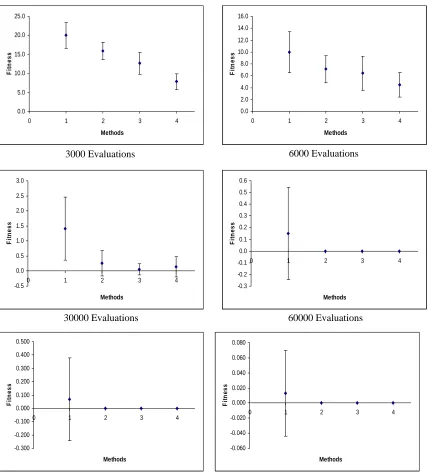
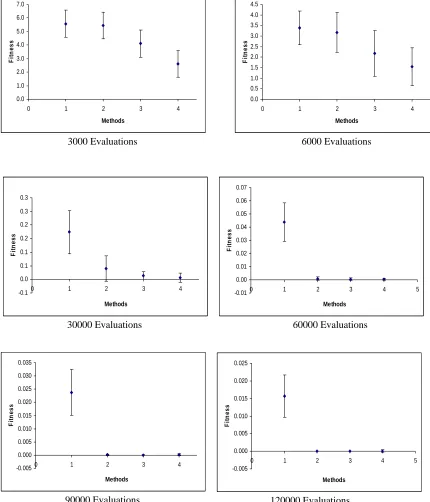
obtained using the simple GA. Figures 2, 3, and 4 compare the average and +/- one standard
deviation of the fitness, which is being minimized, and number of fitness evaluations at different
3000 Evaluations 0.0 5.0 10.0 15.0 20.0 25.0
0 1 2 3 4
Methods Fi tn e s s 0.0 2.0 4.0 6.0 8.0 10.0 12.0 14.0 16.0
0 1 2 3 4
Methods Fi tn e s s 6000 Evaluations 30000 Evaluations -0.5 0.0 0.5 1.0 1.5 2.0 2.5 3.0
0 1 2 3 4
Methods Fi tn e s s -0.3 -0.2 -0.1 0.0 0.1 0.2 0.3 0.4 0.5 0.6
0 1 2 3 4
Methods F it n ess 60000 Evaluations 90000 Evaluations -0.300 -0.200 -0.100 0.000 0.100 0.200 0.300 0.400 0.500
0 1 2 3 4
Methods F it n ess -0.060 -0.040 -0.020 0.000 0.020 0.040 0.060 0.080
0 1 2 3 4
Methods Fi tn e s s 120000 Evaluations
Figure 7 – Comparison of local-search-based operators with Simple GA for Rastrigin function
Figure 8 – Comparison of local-search-based operators with Simple GA for Ackley function
(1 – Simple GA, 2 – Simplex Crossover, 3 – ElitePatternMove, 4 – Simplex GA)
3000 Evaluations 0.0 1.0 2.0 3.0 4.0 5.0 6.0 7.0
0 1 2 3 4
Methods Fi tn e s s 0.0 0.5 1.0 1.5 2.0 2.5 3.0 3.5 4.0 4.5
0 1 2 3 4
Methods Fi tn e s s 6000 Evaluations -0.1 0.0 0.1 0.1 0.2 0.2 0.3 0.3
0 1 2 3 4
Methods
F
it
n
ess
30000 Evaluations 60000 Evaluations
-0.01 0.00 0.01 0.02 0.03 0.04 0.05 0.06 0.07
0 1 2 3 4 5
Methods F it n ess -0.005 0.000 0.005 0.010 0.015 0.020 0.025 0.030 0.035
0 1 2 3 4
Methods Fi tn e s s
90000 Evaluations 120000 Evaluations
-0.005 0.000 0.005 0.010 0.015 0.020 0.025
0 1 2 3 4 5
30000 Evaluations
-4240.0 -4200.0 -4160.0
-4120.00 1 2 3 4
Methods Fi tn e s s -4189.86 -4189.82 -4189.78 -4189.74 -4189.70 -4189.66
0 1 2 3 4
Methods F it n ess 60000 Evaluations -4189.84 -4189.83 -4189.82 -4189.81 -4189.80 -4189.79
0 1 2 3 4
Methods F it n ess 90000 Evaluations -4189.832 -4189.828 -4189.824 -4189.820 -4189.816 -4189.812
0 1 2 3 4
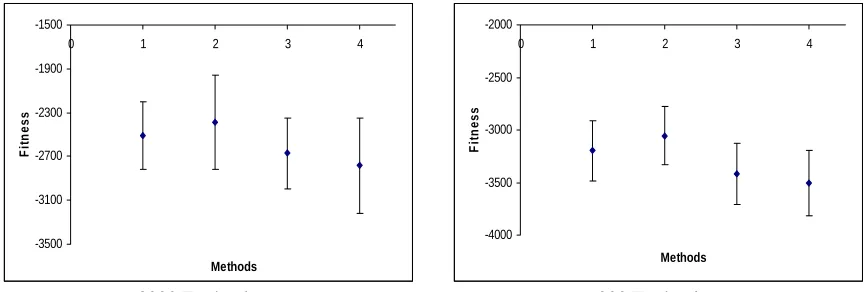
Methods F it n ess 120000 Evaluations 3000 Evaluations -3500 -3100 -2700 -2300 -1900 -1500
0 1 2 3 4
Methods F it n ess -4000 -3500 -3000 -2500 -2000
0 1 2 3 4
Methods Fi tn e s s 6000 Evaluations
Figure 9 – Comparison of local-search-based operators with Simple GA for Schwefel function
0.0 20.0 40.0 60.0 80.0 100.0 120.0
18060 36060 54060 72060 90060 108060
Evaluations
Fi
tn
e
s
s SimpleGA
SimplexGA
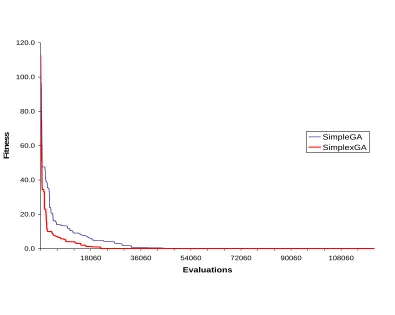
The typical convergence behavior of the hybrid method Simplex GA is represented in Figures 5
and 6 that show the convergence for a typical random trial and an aggregate representation of all
30 random trials, respectively, for the Rastrigin function. Similar comparisons are made for the
other hybrid methods in Figures 7-10
Figure 10 – Comparison of convergence (for a single random seed) of Simplex GA and of
0.0 20.0 40.0 60.0 80.0 100.0 120.0 140.0
0 1000 2000 3000 4000 5000 6000
Evaluations
F
it
n
ess
SimpleGA SimplexGA
0.0 20.0 40.0 60.0 80.0 100.0 120.0
18060 36060 54060 72060 90060 108060
Evaluations
F
it
n
ess SimpleGA
ElitePatternMove
Figure 11 – Comparison of convergence (based on 30 random trials) of Simplex GA and of
Simple GA for Rastrigin function
Figure 12 – Comparison of convergence (for a single random seed) of ElitePatternMove Method
0.0 20.0 40.0 60.0 80.0 100.0 120.0 140.0
0 1000 2000 3000 4000 5000 6000
Evaluations
F
it
n
ess
SimpleGA ElitePatternMove
0.0 20.0 40.0 60.0 80.0 100.0 120.0
18060 36060 54060 72060 90060 108060
Evaluations
Fi
tn
e
s
s SimpleGA
SimplexCrossover
.
Figure 13 – Comparison of convergence (based on 30 random trials) of ElitePatternMove
Method and of Simple GA for Rastrigin function.
Figure 14 – Comparison of convergence (for a single random seed) of Simplex Crossover
0.0 20.0 40.0 60.0 80.0 100.0 120.0 140.0
0 1000 2000 3000 4000 5000 6000
Evaluations
F
it
n
ess
SimpleGA SimplexCrossover
Figure 15 – Comparison of convergence (based on 30 random trials) of Simplex Crossover
Method and of Simple GA for Rastrigin function.
Chapter 5
Application to an urban runoff control problem
The conversion of land from its natural state to the various residential and commercial uses
changes the landscape dramatically, effectively reducing the pervious area. These land-use
changes impact the hydrologic cycle of the watershed or the drainage basin. In general, these
modifications to the landscape result in increased rainfall runoff relative to its undisturbed state.
The excess runoff is conveyed via drainage networks to prevent localized flooding during rain
events. Often this drainage network consists of a dendritic conduit-node network consisting of
The increased rainfall runoff due to unmanaged land use development often has a deleterious
impact on downstream receiving water bodies. For example, increased stream velocities erode
natural channel banks, smothering aquatic organisms with eroded sediment. Low Impact
Development (LID) is a guiding principle to be applied during the land use development process
where one seeks to mimic predevelopment site hydrology as much as possible. LID involves
designing techniques that promote storage, infiltration, and evaporation to reduce the amount of
runoff from a watershed area. Using the Storm Water Management Model (SWMM), one may
simulate practices associated with LID by treating the watershed pervious and impervious
detention storage parameters. The following scenario seeks to identify the optimal spatial
allocation of additional depression storage (through LID that affects the pervious & impervious
areas) necessary in a small watershed (Figure 11) consisting of eight sub-catchments and 16
conduits, such that the conduits design capacity is not exceeded.
This optimization problem is represented mathematically as follows:
xi = Pervious destore coefficient
x0 = Initial pervious destore coefficient
yi = Impervious destore coefficient
y0 = Initial impervious destore coefficient
ai = Pervious area of the catchment.
bi = Impervious area of the catchment
Vj = Maximum capacity of the pipe
vj = Flow in the pipe
The flow in pipe vj is estimated by running the Storm Water Management Model (SWMM) that
simulates these values for a design rainfall event. The objective (Eqn. 1) of this optimization
model is to minimize the additional storage that is required to meet the primary set of constraints
(Eqn. 2) on the flow in the pipes. Constraint violations are handled through penalty functions.
(a) (b)
(c) (d)
The fitness of a solution is calculated using normalized values of the objective function and the
penalty functions.
All four hybrid techniques were applied to this problem and the results are compared based on 25
random trials. Figure 11(b) shows the condition of the watershed after improvement via LID
corresponding to a typical optimal solution that represents the least increase in depression
storage. Also Figure 11(c) and (d) shows the energy profiles during the design peak runoff for
the existing and improved conditions. The improved conditions result in flows in pipes to stay
below full to avoid flooding.
Figure 16– The catchment areas ((a) – existing condition, and (b) – after improvement) and
sewer flows ((c) – existing conditions, and (d) – after improvement) corresponding to the
The Table 4 compares the performance (in terms of the best objective function value and the
number of fitness evaluations needed to achieve the best solution) of the Sequential GA-NM
method with that of the Simple GA. The results are reported in terms of the average and standard
deviation obtained based on the 25 random trials.
Table 4 – Comparison of Sequential GA-NM method and Simple GA for the LID Problem
(based on 25 trials)
The results corresponding to the local search base operators are summarized and compared in
Figure 12. As presented for the test function results, this figure compares the average and the
standard deviation of the fitness (i.e., minimum additional storage) at different stages of the
search (as represented by the different numbers of fitness evaluations). The convergence
behaviors for these methods are also compared in Figures 18-20. Minimum Additional
Storage
No. of Evaluations Method
average standard
deviation
average standard
deviation
Sequential GA-NM 0.4256 0.0172 16111 5444
0.37 0.42 0.47 0.52 0.57 0.62 0.67 0.72
0 500 1000 1500 2000 2500 3000 3500 4000
Evaluations F it n ess SimpleGA SimplexGA
Figure 17 – Comparison of local-search-based operators with Simple GA for the LID problem
(1 – Simple GA, 2 – Simplex Crossover, 3 – ElitePatternMove, 4 – Simplex GA)
Figure 18 – Comparison of convergence (for 25 random trials) of Simplex GA and of Simple GA
for the LID problem
0 .3 7 0 .4 2 0 .4 7 0 .5 2 0 .5 7
0 1 2 3 4
M e th o d s
Fi tn e s s 400 Evaluations 0.37 0.42 0.47 0.52 0.57
0 1 2 3 4
Methods Fi tn e s s 1000 Evaluations 0.37 0.42 0.47 0.52 0.57
0 1 2 3 4
Methods Fi tn e s s 2000 Evaluations 0.37 0.42 0.47 0.52 0.57
0 1 2 3 4
0.37 0.42 0.47 0.52 0.57 0.62 0.67 0.72
0 10 20 30 40 50 60 70 80 90 100
Evaluations
F
it
n
ess
SimpleGA ElitePatternMove
0.37 0.42 0.47 0.52 0.57 0.62 0.67 0.72
0 500 1000 1500 2000 2500 3000 3500 4000
Evaluations
F
it
n
ess
SimpleGA SimplexCrossover
Figure 19 – Comparison of convergence (for 25 random trials) of ElitePatternMove Method and
of Simple GA for the LID problem
Figure 20 – Comparison of convergence (for 25 random trials) of Simplex Crossover Method
Chapter 6
Summary and Final remarks
Several hybrid search methods that combine the power of genetic algorithms and local-search
procedures were presented. While one method is built on the standard approach of applying a
global search and local procedure sequentially, the others innovatively combine the key
algorithmic steps in global and local search methods to explore efficiently the decision space.
Using several test functions, the performance of these hybrid methods was compared with each
other as well as with that of a simple GA. This comparison was conducted based on the quality
of the solutions and the number of fitness evaluations (used as a surrogate for computational
need). While all hybrid procedures show improvement over the simple GA-based search, the
Simplex GA hybrid method shows the best overall performance. The ElitePatternMove operator
method requires relatively a smaller number of additional fitness evaluations and yields good,
but not necessarily the best, quality of solutions. The Simplex Crossover operator method shows
the least improvement in the quality of solutions although it requires the least increase in the
number of fitness evaluations. The sequential hybrid method quickly converges to a good
solution but not necessarily to the best solution compared to that obtained using the Simple GA.
In comparison, the sequential hybrid method typically required about half the number of
evaluations to get a solution of similar quality.
These hybrid methods were also applied to an illustrative urban watershed management problem
involving a hypothetical, but realistic, optimal runoff control scenario. The flow conditions in
the watershed were simulated using SWMM, which was coupled to the hybrid search methods in
evaluating the fitness of each solution. The performance of the hybrid methods as well as a
simple GA was compared. The trends in the performance were similar to those found for the test
problems—the Simplex GA showed the most robust performance.
While consistent observations regarding the relative performance of these hybrid methods were
made in this study, more testing is required. Such a testing should include a broader class of test
problems, including different levels of constraints, with varying degree of difficulty. Additional
hybrid methods for more complex scenarios of the watershed management problem, application
to different types of real problems is required to make a more comprehensive conclusion about
the effectiveness of each of these hybrid methods.
Reference
1. Yen, J., Liao, J.C., Randolph, D., Lee, B., A hybrid approach to modeling metabolic systems
using genetic algorithm and simplex method, In Proceedings of the 11th IEEE Conference on
Artificial Intelligence for Applications, pp. 277—283, 1995.
2. Renders, R., Bersini, H., Hybridizing genetic algorithms with hill-climbing methods for
global optimization: Two possible ways, In Proceedings of the First IEEE Conference on
Evolutionary Computation, pp312-317, 1994
3. Xu, Y.G., Li, G.R., Wu, Z.P., A Novel Hybrid Genetic Algorithm using local optimizer
based on heuristic pattern move. Applied Artificial Intelligence vol. 15, pp. 601-631, 2001
4. Chelouah, R., Patrick, S., Genetic and Nelder-Mead algorithms hybridized for a more
accurate global optimization of continuous multi-minima functions, European Journal of
Operational Research, vol. 148, pp. 335-345, 2003.
5. Whitley, L., D., Winter, G., P'eriaux, J., Gal'an, M., Cuesta, P., Modeling hybrid genetic
algorithms. Genetic Algorithms in Engineering and Computer Science, pp. 191--201, 1995.
6. Lobo, F., G., Goldberg, D., E., Decision making in a hybrid genetic algorithm, Illegal report
No. 96009, 1996.
7. Tsutsui, S., Goldberg, D., E., Simplex Crossover and Linkage Identification: Single-Stage
Evolution Vs Multi Stage Evolution, Illegal Report No. 2002001. 2002.
8. Mathias, K., E., Whitley, L., D., Stork,C., Kusuma, T., Staged hybrid genetic search for
seismic data imaging, In Proceedings of the First IEEE Conference on Evolutionary
Computation, pp. 356-361, 1994.
9. Lim, M., H., Yuan, Y., Omatu, S., Extensive testing of a hybrid genetic algorithm for solving
quadratic assignment problems, Computational Optimization and Applications, vol. 23(10),
pp. 47-64, 2002.
10.Li, M, Tam, H., Y., Hybrid evolutionary search method based on clusters, IEEE Transactions
11.Fleurent, C., Ferland, J., A., Hybrid genetic algorithms for combinatory optimization,
Rairo-Recherche Operationnelle-Operations Research, vol. 30 (4), pp. 373-398, 1996.
12.Richard, Y., K., Jiafu, T., Dingwei, W., Extension of a hybrid Genetic algorithm for
nonlinear programming problems with equality and inequality constraints, Computers &
Operations Research, vol. 29, pp. 261-274, 2002.
13.Duan, Q., Gupta, V., Sorooshian, S., Shuffled complex evolution approach for effective and
efficient global minimization, Journal of Optimization. Theory Application, vol. 76 (3), pp.
501-521, 1993
14.Michalewicz, Z., Genetic Algorithms + Data structures = Evolutionary Programs, Springer,
Berlin. 1992.
15.Okamoto, M., Nonaka, T., Ochiai, S., Tominaga, D., Nonlinear numerical optimization with
the use of a hybrid Genetic Algorithm incorporating the Modified Powel, Applied