ISSN(Online): 2320-9801
ISSN (Print): 2320-9798
I
nternational
J
ournal of
I
nnovative
R
esearch in
C
omputer
and
C
ommunication
E
ngineering
(An ISO 3297: 2007 Certified Organization) Vol. 3, Issue 6, June 2015
Performance Evaluation and Simulation of
Network Parameters for NoC Architecture
Using NS2
Kalpana Pandey, Dr.M.A.Gaikwad
M.Tech Student, Department of Electronics, BDCE, Sevagram, Wardha, Maharashtra, India Professor, Department of Electronics, BDCE, Sevagram, Wardha, Maharashtra, India
ABSTRACT: Network on Chip (NoC) architecture attempts to address different component level architectures with
specific interconnection network topologies and routing techniques, some of the topologies are CLICHE, Folded Torus, BFT. In this paper we proposed link state routing and compares (CLICHÉ, Folded Torus, BFT) NoC architectures to evaluate their performance using simulating tool NS-2. The 3x3,4x4 and 5x5 CLICHÉ, Folded torus, BFT topologies of NoC are examined. Best one topology is folded torus by comparing various parameters.
KEYWORDS: Network on Chip, Different Topologies and topology parameter.
I. INTRODUCTION
Network on Chip (NOC) is one solution for designing communication among components in the soc circuits with several billion transistors that will reach the market in approximately 5-10 years from now. Different topologies having various advantages according to their applications. This paper present brief idea about topologies depending on parameter.
Some of the topologies are discussed below:
(i) CLICHE architecture, (ii) Folded torus architecture, (iii) Butterfly fat tree architecture.
CLICHE: All switches are connected to the four closest switches and the target resource block, except those on the edge of the layout. The simplicity of such a mesh architectural layout allows for the division of the chip into processing or resource regions.
Folded torus: In folded torus architecture the long wrap around connection may result in excessive delay & this problem can be avoided by folding the torus.
BFT (Butterfly fat tree): The layout is modeled in the form of a tree. Each node in the tree is represented by a set of coordinates (level, position) where level is the level in the tree and position is the spot in right-to left-ordering. Each switch is allocated two parent ports, and four child ports, or connections. In this paper we compare the performance parameters (Latency, Packet delivery ratio and throughput) of topology networks and evaluation of these parameters using NS2 simulator.
II.LITERATURE SURVEY
ISSN(Online): 2320-9801
ISSN (Print): 2320-9798
I
nternational
J
ournal of
I
nnovative
R
esearch in
C
omputer
and
C
ommunication
E
ngineering
(An ISO 3297: 2007 Certified Organization) Vol. 3, Issue 6, June 2015
topology. Evaluation results show that source routing gives higher latency and throughput performance as compared to corresponding distributed routing.[2]
Lalit Kishore Arora, Rajkumar have analyze the packet loss during the link down in mesh interconnection network topology with source routing using simulation. They have analyzed 2D Mesh performance on the one down link for one second, and they have changed two parameters packet size and time interval and found that the ratio of packet loss on CBR traffic generator over UDP agent is constant in both cases.[4]
Pratiksha Gehlot, Shailesh singh Chouhan have compared five different topologies using distance vector routing algorithm. The SPIN and Octagon providing higher throughput and lower latency but it also has much higher drop probability which gives trade-off between low latency, high throughput and drop probability. BFT has lowest drop probability but also has lowest throughput.
In CLICHÉ (mesh) and Folded Torus has moderate value all parameters so here again a trade-off between latency, throughput and drop probability .[5]
Jie Cen and Cheng Li,Paul Gillared have described a simulation framework for mesh interconnection network has been designed, where the packet loss during the link down has been analyzed. Analysis and evaluation has been done on mesh interconnection networks on different traffic patterns using simulation on NS2. [6] Topologies such as mesh, torus, octagon, SPIN, BFT etc. according to various parameters and it gives comparatively study of delay parameter. So the work is to compare different topologies using delay parameter .[7] Source routing, i.e., the source node determines only its neighboring nodes that are involved in message delivery. For the tree-based architectures (SPIN and BFT) the routing algorithm applied is the least common ancestor (LCA) and, for CLICHE and Folded Torus, apply the e-Cube (dimensional) routing .In the case of Octagon, adopt the hierarchical address-based routing. BFT, CLICHE, and Folded Torus provide lower throughput than SPIN and Octagon.[8]
III.NOC TOPOLOGIES
Topology refers to the shape of the network. The different nodes in a network are connected to each other and how they communicate is determined by the topology.
ISSN(Online): 2320-9801
ISSN (Print): 2320-9798
I
nternational
J
ournal of
I
nnovative
R
esearch in
C
omputer
and
C
ommunication
E
ngineering
(An ISO 3297: 2007 Certified Organization) Vol. 3, Issue 6, June 2015
IV.SIMULATION ENVIRONMENT
The simulation were carried out in NS2 simulator.NS-2 is an object-oriented, discrete event driven network simulator written in C++ and OTcl . It implements network protocols such as TCP and UPD; traffic source behaviour such as FTP, Telnet, Web, CBR and VBR; router queue management mechanism such as Drop Tail, RED and CBQ; routing algorithms.
For performance evaluation of Network on chip architecture following evaluation parameters has been selected.
1.Latency: It define as how much time it takes for a packet of data to get from source to destination and say that latency measures the amount of time between the start of an action and its completion.
2. packet delivery ratio: The ratio of the number of delivered data packet to the destination. This illustrates the level of delivered data to the destination.
3. Throughput: It is the number of packets/bytes received by source per unit time.
V.EXPERIMENTAL RESULT AND ANALYSIS
The simulation results are summarized in tables and graphs which shows various parameters. Figure 2 shows the 3x3 topologies output generated via codes. Table 1 and figure 3 shows the result and graph of 3x3 topologies (CLICHÉ, Folded Torus, BFT).In this the CLICHÉ has maximum latency 499.05ms, lower packet delivery ratio 0.572 and throughput 163.48Mbps.Folded torus topology providing moderate value of latency 47.76ms, higher packet delivery ratio 0.733 and higher throughput 211.09Mbps. BFT has lower latency17.02ms, moderate packet delivery ratio 0.608 and throughput 173.91Mbps.
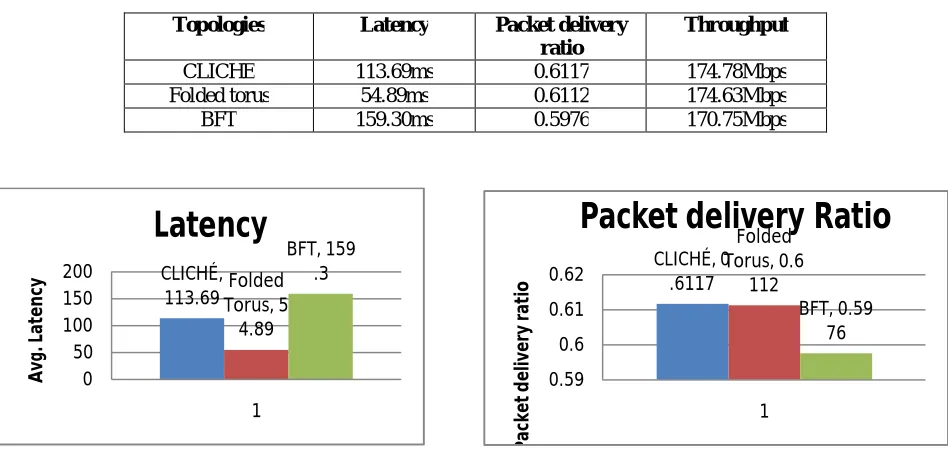
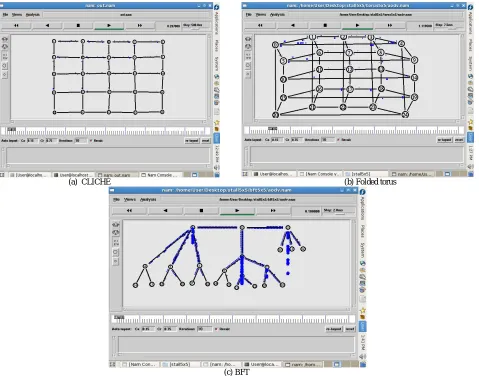
Figure 4 shows the 4x4 topologies output generated by codes. Table 2 figure 5 shows the result and graph of 4x4 topologies. CLICHÉ topology providing moderate value of latency 113.69ms, higher packet delivery ratio 0.6117 and higher throughput174.78Mbps. Latency is lower 159.30ms with moderate packet delivery ratio0.6112 and throughput 174.63Mbps. BFT providing higher latency 159.30ms, lower packet delivery ratio 0.597 and throughput 170.75Mbps. Figure 6 shows the 5x5 topologies output generated via codes.
Table 3 and figure 7 explain results and graph for 5x5 topologies. CLICHE topology has minimum latancy31.78ms with maximum packet delivery ratio and 0.627 and throughput 179.15Mbps. Folded torus has moderate values of latency 63.05ms, packet delivery ratio0.578, and throughput 165.15Mbps.BFT topology providing higher latency 83.72ms, lower values of packet delivery ratio 0.568 and throughput 162.326Mbps.
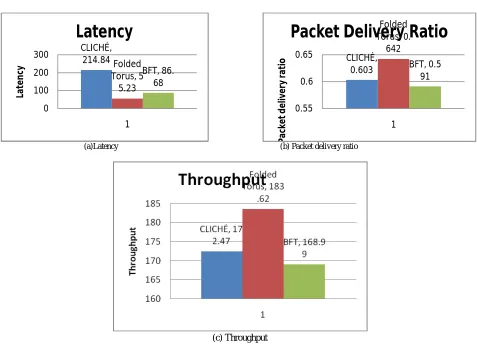
Table 4 and figure 8 shows average result of 3x3,4x4 and 5x5 topologies. From the result it is clear that the folded torus topology is better than CLICHÉ and BFT topology. Here CLICHÉ providing maximum latency 214.84ms with moderate throughpu172.47Mbps and packet delivery ratio 0.603.BFT has moderate value of latency 86.68ms, lower packet delivery ratio 0.591 and throughput 168.99Mbps. Folded torus topology has minimum latency 55.23ms with maximum packet delivery ratio0.642 and maximum throughput 183.62Mbps
ISSN(Online): 2320-9801
ISSN (Print): 2320-9798
I
nternational
J
ournal of
I
nnovative
R
esearch in
C
omputer
and
C
ommunication
E
ngineering
(An ISO 3297: 2007 Certified Organization) Vol. 3, Issue 6, June 2015
(a) CLICHE (b) Folded torus
(c) BFT(Butterfly fat tree
Figure2.3x3 topologies (a) CLICHÉ, (b) Folded torus, (c) BFT
TABLE1.Performance evaluation parameter of 3x3 topologies
Topologies Latency Packet delivery ratio Throughput
ISSN(Online): 2320-9801
ISSN (Print): 2320-9798
I
nternational
J
ournal of
I
nnovative
R
esearch in
C
omputer
and
C
ommunication
E
ngineering
(An ISO 3297: 2007 Certified Organization) Vol. 3, Issue 6, June 2015
(b) Packet delivery ratio
(c) Throughput
Figure3. Graph (a) Latency, (b) Packet delivery ratio, (c) Throughput
(a) CLICHE (b) Folded Torus
CLICHÉ, 113.69 Folded Torus, 54.89 BFT, 15 9.3 0 100 200 1 A vg . L at en cy
Latency
CLICHÉ, 0.572ISSN(Online): 2320-9801
ISSN (Print): 2320-9798
I
nternational
J
ournal of
I
nnovative
R
esearch in
C
omputer
and
C
ommunication
E
ngineering
(An ISO 3297: 2007 Certified Organization) Vol. 3, Issue 6, June 2015
(c) BFT
Figure 4.4x4 topologies (a) CLICHÉ, (b) Folded torus, (c) BFT
TABLE2.Performance evaluation parameter of 4x4 topologies
Topologies Latency Packet delivery
ratio
Throughput
CLICHE 113.69ms 0.6117 174.78Mbps Folded torus 54.89ms 0.6112 174.63Mbps BFT 159.30ms 0.5976 170.75Mbps
(a) Latency (b) Packet delivery ratio CLICHÉ,
113.69Torus, 5Folded 4.89
BFT, 159 .3
0 50 100 150 200
1
A
vg
. L
at
e
n
cy
Latency
CLICHÉ, 0 .6117
Folded Torus, 0.6
112
BFT, 0.59 76
0.59 0.6 0.61 0.62
1
P
ac
ke
t
d
e
liv
e
ry
r
at
io
ISSN(Online): 2320-9801
ISSN (Print): 2320-9798
I
nternational
J
ournal of
I
nnovative
R
esearch in
C
omputer
and
C
ommunication
E
ngineering
(An ISO 3297: 2007 Certified Organization) Vol. 3, Issue 6, June 2015
(c) Throughput
Figure 5. Graph (a) Latency, (b) Packet delivery ratio, (c) Throughput
(a) CLICHÉ (b) Folded torus
(c) BFT
Figure 6. 5x5 topologies (a) CLICHÉ, (b) Folded torus, (c) BFT
CLICHÉ, 174.78
Folded Torus, 1 74.63
BFT, 170 .75
168 170 172 174 176
1
Th
ro
u
gh
p
u
t
ISSN(Online): 2320-9801
ISSN (Print): 2320-9798
I
nternational
J
ournal of
I
nnovative
R
esearch in
C
omputer
and
C
ommunication
E
ngineering
(An ISO 3297: 2007 Certified Organization) Vol. 3, Issue 6, June 2015
TABLE3.Performance evaluation parameter of 5x5 topologies
Topologies Latency Packet delivery ratio Throughput
CLICHE 31.78ms 0.627 179.15Mbps Folded torus 63.05ms 0.578 165.15Mbps BFT 83.72ms 0.568 162.32Mbps
(a) Latency (b) Packet delivery ratio
(c) Throughput
Figure 7. Graph (a) Latency, (b) Packet delivery ratio, (c) Throughput
TABLE4. Comparative performance evaluation for average values of parameter for 3x3,4x4,5x5 topologies
Topologies Latency Packet delivery ratio Throughput
CLICHE 214.84ms 0.603 172.47Mbps Folded torus 55.23ms 0.642 183.62Mbps BFT 86.68ms 0.591 168.99Mbps
CLICHÉ, 31.78 Folded Torus, 6 3.05 BFT, 83. 72 0 50 100 1 La te n cy
Latency
CLICHÉ, 0.627 Folded Torus, 0.578 BFT, 0.568
0.5 0.55 0.6 0.65 1 P a ck e t d e liv er y ra ti o
Packet Delivery Ratio
CLICHÉ, 17 9.15
Folded Torus, 165
ISSN(Online): 2320-9801
ISSN (Print): 2320-9798
I
nternational
J
ournal of
I
nnovative
R
esearch in
C
omputer
and
C
ommunication
E
ngineering
(An ISO 3297: 2007 Certified Organization) Vol. 3, Issue 6, June 2015
(a)Latency (b) Packet delivery ratio
(c) Throughput
Figure 8. Graph (a) Latency, (b) Packet delivery ratio, (c) Throughput
VI.CONCLISION
Performance of CLICHE, Folded Torus, BFT topologies for various figure of merits (latency, throughput and packet delivery ratio) has been summarized. This comparison give interesting performance of parameters . The BFT has lowest Packet delivery ratio 0.591 and also has lowest throughput 168.99 Mbps. CLICHÉ has moderate throughput172.47Mbps and packet delivery ratio 0.603, higher latency 214.84ms and Folded Torus has lower latency 55.23ms and higher packet delivery ratio 0.642 and throughput183.62. From this result with the parameters the Folded torus is better topology than CLICHÉ and BFT.
REFERENCES
1. Wang Zhang, Ligang Hou, Lei Zuo, Zhenyu Peng, ” A Network on Chip Architecture and Performance Evaluation” Wuchen Wu.2010 Second International Conference on Networks Security, Wireless Communications and Trusted Computing
2. Saad Mubeen1,2 and Shashi Kumar,” Designing Efficient Source Routing for Mesh Topology Network on Chip Platforms“2010 13th Euromicro Conference on Digital System Design: Architectures, Methods and Tools
3. Minghua Tangl, Chunhui, “A New Method of Designing NoC Routing Algorithm”2012 IEEE
4. Lalit Kishore Arora, Rajkumar, “Simulation and Analysis of Packet loss in Mesh Interconnection Networks” National Conference on Development of Reliable Information Systems, Techniques and Related Issues (DRISTI) 2012 Proceedings published in International Journal of Computer Applications® (IJCA)
5. Pratiksha Gehlot,Shailesh singh Chouhan, “Performance evaluation of network on chip architecture” ‘2009 International Conference on Emerging Trends in Electronic and photonic devices & Systems(ELECTRO-2009)
6. Simulation and Analysis of Packet loss in Mesh Interconnection Network with Source Routing,International Journal of Advanced Research in Computer Science and Software Engineering Volume 2, Issue 6, June 2012 .
CLICHÉ, 214.84 Folded
Torus, 5 5.23
BFT, 86. 68
0 100 200 300
1
La
te
n
cy
Latency
CLICHÉ, 0.603
Folded Torus, 0. 642
BFT, 0.5 91
0.55 0.6 0.65
1
P
a
ck
et
d
e
liv
e
ry
r
a
ti
o
ISSN(Online): 2320-9801
ISSN (Print): 2320-9798
I
nternational
J
ournal of
I
nnovative
R
esearch in
C
omputer
and
C
ommunication
E
ngineering
(An ISO 3297: 2007 Certified Organization) Vol. 3, Issue 6, June 2015
7. A Comparative Study of Different Topologies for Network-On-Chip Architecture International Journal of Computer Applications (0975 – 8887) “Recent Trends in Engineering Technology-2013
8. Partha Pratim Pande, Cristian Grecu, Michael Jones,Andre´ Ivanov, and Resve Saleh, “Performance Evaluation and Design Trade-Offs for Network-on-Chip Interconnect Architectures” IEEE2005
9. Haytham Elmiligi, Ahmed A. Morgan, M. Watheq El-Kharashi, Fayez Gebali, “A Delay-Aware Topology-based Design for Network-on-chip Applications”.IEEE transaction, 2009.
10. M. Mirza-Aghatabar+,S.Koohi+, S. Hessabi*, M. Pedram†, ” An Empirical Investigation of Mesh and Torus NoC Topologies Under Different Routing Algorithms and Traffic Models”, IEEE International Conference on Digital System DSD 2007.
11. L. Benini and D. Micheli, Networks on Chips: A New SoC Paradigm, IEEE Computer, 35 p.70 (2002).
12. B. H. Meyer, J.J. Pieper, J.M. Paul, J.E. Nelson, S. M. Pieper and A.G.Rowe, “Power-performance simulation and design strategies for single-chip heterogeneous multiprocessors,” IEEE transactions on Computers, vol.54, no. 6, pp.684-697, Jun 2005.
13. M. Palesi, R.Holsmark, S. Kumar, and V. Catania, “ Application specific routing algorithms for network on chip,” IEEE Transactions on Parallel and Distributed Systems, vol. 20, no3 pp. 316-339,2009.
14. Khalid Latif, Tiberiu Seceleanu, Hannu Tenhunen, Power and Area Efficient Design of Network-on-Chip Router Through Utilization of Idle Buffers.