ISSN(Online): 2320-9801 ISSN (Print): 2320-9798
I
nternational
J
ournal of
I
nnovative
R
esearch in
C
omputer
and
C
ommunication
E
ngineering
(An ISO 3297: 2007 Certified Organization)
Vol. 3, Issue 6, June 2015
PAPR Improvement In MIMO-OFDM System
Using Partial Transmit Sequence Method And
Clipping With Restoration Method
Khushboo A Desai 1,Hitesh L. Desai 2
M.E.Student, Dept of EC, SPCE, Vishnagar, Gujarat, India1
Assistant Professor, Dept of EC, SPCE, Visnagar, Gujarat, India 2
ABSTRACT: Recently MIMO-OFDM is very interested topic. Orthogonal Frequency Division Multiplexing as well as Multiple Input Multiple Output are the multicarrier techniques. Multiple Input Multiple Output system and Orthogonal Frequency Division Multiplexing jointly give many advantageous effects, but they have one common drawback called high Peak to Average Power Ratio. The verse effect of PAPR is that power amplifiers are manufactured to have large input power back-offs but practically it is not possible. To overcome the verse effect of high PAPR we have studied different PAPR improvement techniques. Among them we have implemented Partial Transmit Sequence method and Amplitude Clipping method. But due to clipping method being loosy PAPR reduction method, performance of BER is decreased. Our aim is to reduce PAPR and also improve the performance of BER. To overcome the drawback of Clipping technique we had proposed one method called Restoration method, which is combinable used with Clipping technique to improve the PAPR and BER as well.
KEYWORDS: OFDM; MIMO; PAPR; PTS technique; Clipping technique; Restoration technique; BER.
I. INTRODUCTION
OFDM[1] divides the single data stream into the multiple number of small data stream due to this bandwidth efficiency is increased, spectral efficiency is increase, Inter Symbol Interference is Reduced. while Multiple Input Multiple Output is nothing but having multiple transmit and receive even though there is no interference among signals. MIMO-OFDM can jointly give many advantages, also many of a communication system require high data rate but common problem of high data rate communication system like MIMO-OFDM system[2] are high Peak to Average Power Ratio This prevents the use of High Power Amplification (HPA) which is high-efficiency amplification devices and it results in Non linearity.
To overcome the verse effects of PAPR, some PAPR reduction methods like Partial Transmit Sequence, Amplitude Clipping and restoration methods are used to reduce PAPR. For the better result of PAPR reduction we have applied PTS technique due to which PAPR is reduced but BER performance is not improved and also we further need to reduce PAPR that’s why we used Clipping technique which reduce PAPR at higher level but BER performance is verse and to improve the effect of BER, we use the restoration process at transmitter in clipping loop to know about which carrier is having peak value higher than average that is clipped. This value is marked and displayed.
ISSN(Online): 2320-9801 ISSN (Print): 2320-9798
I
nternational
J
ournal of
I
nnovative
R
esearch in
C
omputer
and
C
ommunication
E
ngineering
(An ISO 3297: 2007 Certified Organization)
Vol. 3, Issue 6, June 2015
II. LITERATURE SURVEY
In [1]Author had attempts to explain the drawback of multicarrier modulation technique. They have explain some problems of PAPR like it require high resolution for receiver A/D convertor which cause complexity & it is not possible in practical constrain that’s why some reduction techniques are introduces like signal distortion techniques signal scrambling techniques & coding techniques. Author also attempts to introduce some PAPR reduction techniques and criteria for selection of PAPR reduction techniques.
In[2] author proposed Modified PTS method ,author had compared both methods results and author obtained that proposed modified PTS technique achieves more reduction in the PAPR, specially for =4,Reason behind this is circular shifting approach exploits the extra degree of freedom provided by MIMO, therefore it is not appropriate for SISO OFDM. Author also describe that the performance of PTS depends on the chosen group partitioning. so, the partitioning is chosen according to compromise between implementation complexity and capability of PAPR reduction. In[3] paper the author introduce the multicarrier transmission system & its different advantages which have made the multicarrier transmission more convenient, some drawbacks also explained by author & it is high PAPR. Author also discusses the CCDF of PAPR. Author also illustrates different PAPR reduction with examples. Like clipping & filtering, tone reservation, tone injection, partial transmission sequence (PTS), selected mapping (SLM). This technique achieves PAPR reduction but at the loss of transmit signal power increase, bit error rate (BER) increases, data rate loss, computational complexity increases.
In[7] paper author had explained the importance of multicarrier signals. Like OFDM, here OFDM is multicarrier technique in which large carrier is divided into small number of multicarrier channels, & they are situated orthogonally so, intercarrier interference in lower down. In this paper author also describe the effects of clipping & filtering on the OFDM signals by giving different simulation results.
Orthogonal frequency division multiplexing works on the concept that large band width in divided into number of small sub channels and they transmit parallelly. OFDM contain large number of sub channels that’s why it have high peak to mean envelope power ration (PMEPR) or large crest factor (CF). when this signal passed through non/linear devices, signal suffer significant spectral spreading & in band distortion.
III. PAPR (PEAK TO AVERAGE POWER RATIO)
PAPR[1],[2] is nothing but peak to average power ratio which is very critical for OFDM system as well as MIMO system. PAPR can rise with the number of sub carriers N. Hence, PAPR in MIMO-OFDM system is higher[2],[3]. In MIMO-OFDM system the effect of high PAPR is due to IFFT operation (data symbols can add up to produce high PAPR).
Mathematically PAPR[3] is define as
(1.1)
n
x is signal after IFFT operation.
A. Why we need to Reduce PAPR?[1]
When considering a system with Transmitting power amplifier, Nonlinear Distortion and peak amplitude limiting introduced by the high power Amplifier will produce inter modulation between the different carriers and introduce additional interference into the system. This additional interference leads to increase in Bit Error Rate (BER) of the system.
One way to avoid such nonlinear distortion and keep a low BER is by forcing the amplifier to work in its linear region. Unfortunately, such solution is not power efficient and thus not suitable for wireless communication. Hence there is a need to reduce PAPR of transmitting signal.
2
2 max n n average peak x E x P P
ISSN(Online): 2320-9801 ISSN (Print): 2320-9798
I
nternational
J
ournal of
I
nnovative
R
esearch in
C
omputer
and
C
ommunication
E
ngineering
(An ISO 3297: 2007 Certified Organization)
Vol. 3, Issue 6, June 2015
B. Effects of High PAPR[1]
A major obstacle is that the OFDM signal exhibits a very peak to average power ratio (PAPR). Therefore, RF power amplifiers should be operated in a very large linear region. Otherwise, the signal peaks get into a non linear region of the power amplifier causing signal distortion. This signal distortion introduces inter modulation among the sub carriers and out of band radiations. Thus the power back-offs. On the other hand, this leads to very inefficient amplification and expensive transmitters. Thus, it is highly desirable to reduce the PAPR.
IV. SYSTEM MODEL AND IMPLEMENTED METHODS
. As shown in Figure 1, modulation [4] starts with transmitted signal and it is obtained by performing QPSK[5] modulation of input data, the obtained sequence is convert into time domain by performing the IFFT. For the better result of PAPR reduction we have applied PTS[5] technique due to which PAPR is reduced but BER[6] performance is not improved and also we further need to reduce PAPR that’s why we used Clipping technique which reduce PAPR at higher level but BER performance is verse and to improve the effect of BER we use the restoration process at transmitter in clipping loop to know about which no. of bit having peak value higher than average or the bit which is clipped and display its value. Transmitted signal is send through the Communication channel[4] called Rayleigh channel and here AWGN noise is add in the signal and at the channel end. Demodulation[4] starts with FFT of the Received signal after channel end, QPSK de-modulation is performed. At last BER is calculated. Figure 1 shown below is the diagram of system model which simply represents the flow of the work.
Fig.1. block diagram of system mode
A. Partial transmit sequence method[3][5]
ISSN(Online): 2320-9801 ISSN (Print): 2320-9798
I
nternational
J
ournal of
I
nnovative
R
esearch in
C
omputer
and
C
ommunication
E
ngineering
(An ISO 3297: 2007 Certified Organization)
Vol. 3, Issue 6, June 2015
measured from the resulting sequence and the signal containing lowest PAPR is transmitted. Below figure shows the block diagram of PTS technique. Serial data contains the data information in frequency domain, separated by non-overlapping sub blocks V of size N. Every sub block has N/V non zero elements rest all are set to zero.
Figure.2. block diagram of PTS method
If sub block vectors having same size and no gap between each other then mathematically it can be explained as
=∑ (1.2) Where, X is input data block it is partitioned in X1,X2…….XN as displayed in figure also.
Step 1 For the phase rotation weighting factor used are , which is given as
= ( [ 2 ]) { = 1,2, … … . } (1.3) Where, bv is complex phase factor it is partitioned in b1,b2…….bN as displayed in figure also
Step 2 IFFT of signal
The IFFT operation is applied for the frequency domain signal to be converted into time domain signal. (1.4)
Step 3 Selection of weighted factor
selection of weighted factor combination for optimism results. The weighted factor combination are (1.5)
After selection of weighted factors are multiplied with IFFT signal and sum the signal. the result obtained is selected for transmission due to which PAPR performance is improved.
B. Clipping Method[7]
The Clipping techniques is distortional technique. It is used to reduce PAPR by Clipping the high peak of the OFDM (Multicarrier )signals by limit peak amplitude value to the threshold value. Amplitude above threshold value is clipped and information is lost. Due to the Non-linear operation, clipping causes the in band distortion and out of band radiation. Due to in-band distortion BER performance is reduced. Following figure shows the Block diagram of Clipping method.
Mathematically Clipping[2] is define as
v V
v v v
V
v
vIFFT X b x
b X
IFFT
x
1 1
) ( )
(
ISSN(Online): 2320-9801 ISSN (Print): 2320-9798
I
nternational
J
ournal of
I
nnovative
R
esearch in
C
omputer
and
C
ommunication
E
ngineering
(An ISO 3297: 2007 Certified Organization)
Vol. 3, Issue 6, June 2015
=
− ,
,
,
(1.6)
Fig.3. block diagram of clipping method C. Proposed restoration method
In clipping method reduces PAPR but BER performance reduces. this is due to loss of information at Transmitter end due to clipping. We suggest, if we can restore the lost information at receiver by some means BER performance increases. In order to restore information at receiver, we need to store the bits at transmitter, while clipping and same needs to sent along with data/information to receiver. At receiver end considering the clipping information as received along with data/information. We need to restore the clipped data. By doing these we are able to decrease the PAPR at transmitter and also increase the BER performance by restoring original data but as we have to send additional information about clipped data overall throughput may reduce. This additional information is sent through separate, secure and Reliable channel. For an example if any data having the high peak value may be at 0.3 and its index is 7th bit .for the restoration method the data is clipped at average value say 0.2 then high peak value of 7th bit is become 0.2 from 0.3 due to which information is lost and BER is verse. At receiver side restoration method used can receive the information about the index bi that is 7th bit and original value of 7th bit that is 0.3 so value is reassign at receiver side by its original value. Due to which information is regained and BER performance is improved.
V. SIMULATION AND RESULTS
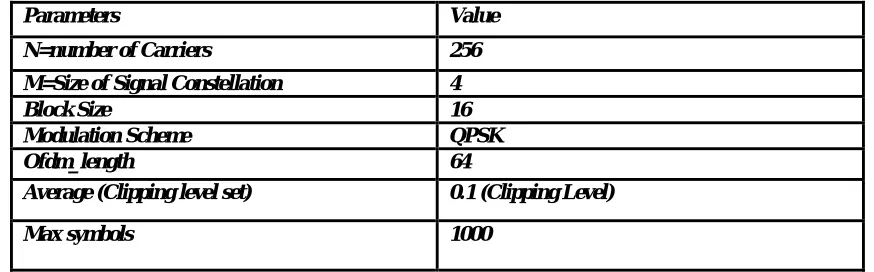
Some simulation parameters are N=No. of carriers which is set as 256,we have used QPSK modulation technique and M=size of signal constellation is 4.Block size and OFDM length are 16 and 64 simultaneously. Maximum symbols are 1000.we have used Rayleigh channel with AWGN noise.
Table 1.Simulation Parameters
Parameters Value
N=number of Carriers 256
M=Size of Signal Constellation 4
Block Size 16
Modulation Scheme QPSK
Ofdm_length 64
Average (Clipping level set) 0.1 (Clipping Level)
ISSN(Online): 2320-9801 ISSN (Print): 2320-9798
I
nternational
J
ournal of
I
nnovative
R
esearch in
C
omputer
and
C
ommunication
E
ngineering
(An ISO 3297: 2007 Certified Organization)
Vol. 3, Issue 6, June 2015
A. PAPR reduction in MIMO-OFDM System with using PTS method
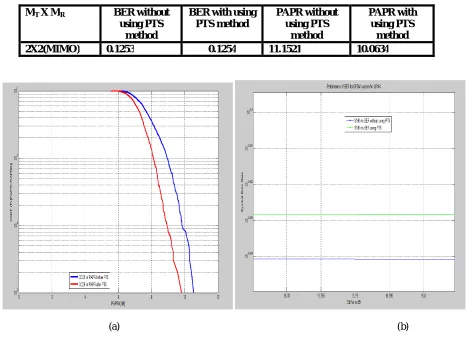
PAPR reduction in MIMO-OFDM is very challenging, we have applied PTS technique due to which PAPR is reduced by 11.1521 to 10.0634 but BER is increased by 0.1253 to 0.1254.figure 4 shows result of PTS method, where figure 4(a) shows PAPR without/with using PTS method and 4(b) shows BER without/with using PTS method.
Table 2 BER PAPR result with using pts method
MT X MR BER without
using PTS method
BER with using PTS method
PAPR without using PTS
method
PAPR with using PTS
method
2X2(MIMO) 0.1253 0.1254 11.1521 10.0634
(a) (b)
Fig.4 (a) PAPR of MIMO-OFDM System with using PTS method (b) BER of MIMO-OFDM System with using PTS method
B. PAPR reduction in MIMO-OFDM System with using Clipping restoration method
ISSN(Online): 2320-9801 ISSN (Print): 2320-9798
I
nternational
J
ournal of
I
nnovative
R
esearch in
C
omputer
and
C
ommunication
E
ngineering
(An ISO 3297: 2007 Certified Organization)
Vol. 3, Issue 6, June 2015
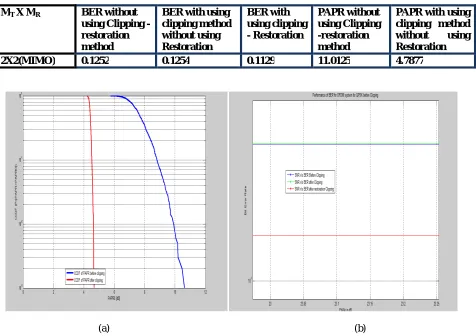
Table 3 BER PAPR result with using clipping and restoration method
MT X MR BER without
using Clipping -restoration method
BER with using clipping method without using Restoration
BER with using clipping - Restoration
PAPR without using Clipping -restoration method
PAPR with using clipping method without using Restoration
2X2(MIMO) 0.1252 0.1254 0.1129 11.0125 4.7877
(a) (b)
Fig.5 (a) PAPR of MIMO-OFDM System with using Clipping restoration without using PTS
(b) BER of MIMO-OFDM System with using Clipping restoration without using PTS
VI. CONCLUSION
MIMO-OFDM systems have many advantages but also have some limitations or disadvantage that is High PAPR and Carrier frequency offset sensitivity among them high PAPR (Peak to Average Power Ratio) is very sensitive and can ruin all the positive effects of that system. We have Implemented PTS technique for the better result of PAPR reduction due to which PAPR is reduced but BER performance is not improved. Further to Improve the performance of PAPR at higher level we had implemented Clipping technique to improve the PAPR performance. But there is reduction in performance of BER because of information is lost due clipping of the signal. Further to improve the performance of both PAPR and BER, we have proposed one method called the Restoration which is jointly used with clipping to improve the performance of BER.
REFERENCES
[1] Gurpreet Singh Walia, charanjit Singh “comparative study of peak-to-average power ratio reduction techniques for OFDM system”, International Journal of Engineering Research and Applications (IJERA) ISSN: 2248-9622 Vol. 2, Issue 3, pp.2594-2598, May-Jun 2012. [2] Sally S. Hassaneen, khairy A. Elbarbary and Adel E. Elhennawy, “ Reducing the Peak-to-Average Power Ratio in MIMO OFDM System”,
ISSN(Online): 2320-9801 ISSN (Print): 2320-9798
I
nternational
J
ournal of
I
nnovative
R
esearch in
C
omputer
and
C
ommunication
E
ngineering
(An ISO 3297: 2007 Certified Organization)
Vol. 3, Issue 6, June 2015
[3] Seung Hee Han and Jae Hong Lee “An Overview of Peak-to-Average Power Ratio Reduction Techniques for Multicarrier Transmission” IEEE Wireless Communications April 2005.
[4] S.S.Ghorpade and S.V.Sankpal, “Behaviour of OFDM System using MATLAB Simulation”,International Journal of Advanced Computer Research (ISSN (print):2249-7277 ISSN (online):2277-7970) Volume-3 Number-2 Issue-10 June-2013.
[5] Aarathi Gokulan, J Friska, “Peak to Average Power Ratio Reduction in MIMO-OFDM using QPSK based on Partial transmit sequence Method”,International Journal of Engineering Research and Applications(IJERA),ISSN:2248-9622,Inter national conference on Humming Bird(1st match 2014).
[6] Allanki sanyasi Rao, S. Srinivas, “A New BER and SNR calculations for MIMO system”, International Journal of Inventive Engineering and Science (IJIES), ISSN: 2319-9598, Volume-2, Issue-8, July-2014