Performance Analysis of Gaussian Filter with
Different Kernel Sizes in Removing Gaussian
Noise
Dr.T.Sudha1, P.Nagendra Kumar2
Professor, Department of Computer Science, Sri Padmavathi Mahila Visvavidyalayam, Tirupati,Chittoor District,
Andhra Pradesh, India1
Research Scholar, Department of Computer Science, Vikrama Simhapuri University, SPSR Nellore District,
Andhra Pradesh, India2
ABSTRACT:Image processing has become one of the most prominent areas of research. Images are usually affected by different types of noises such as Gaussian noise, Salt and Pepper noise, Speckle noise, Poisson noise etc. The present work analyses the performance of Gaussian Filter with different kernel sizes in removing Gaussian Noise. Mean Squared Error and Peak Signal-to-Noise Ratio have been considered as parameters for analysing the performance of Gaussian Filter in the context of removing Gaussian noise. The results obtained show that for a kernel of size n×n pixels, when applied with Gaussian Filter to Gaussian noise corrupted images, the Mean Squared Error obtained between the original image and the filtered image remains same for all n when n is odd and it is also evident that the Mean Squared Error obtained between the original image and the filtered image remains same for all n when n is even.
KEYWORDS: Kernel, Gaussian Noise, Gaussian Filter
I. INTRODUCTION
An image is a two dimensional representation of a picture. Digital images are prone to different types of noise. Noise is the result of errors in the image acquisition process that result in pixel values that do not reflect the true intensities of the real scene. There are several ways that noise can be introduced into an image, depending on how the image is created. If the image is scanned from a photograph made on film, the film grain is a source of noise. Noise can also be the result of damage to the film, or be introduced by the scanner itself. If the image is acquired directly in a digital format, the mechanism for gathering the data can introduce noise. Electronic transmission of image data can introduce noise. Images are easily susceptible to different types of noise such as Gaussian noise, Poisson noise, Salt and pepper noise, Speckle noise etc. Gaussian noise is statistical noise having a probability density function equal to that of Gaussian distribution. Gaussian distribution is also known as Normal distribution. The Gaussian distribution is defined
by the following equation:
2
2
2
1
2
x
Y
e
where x is a normal random variable, μ isthe mean, σ is the standard deviation, π is approximately 3.14159, and e is approximately 2.71828. Principal sources of Gaussian noise in digital images arise either during acquisition or transmission.
locations relative to that pixel, which is called the center pixel. A kernel is a small matrix useful for blurring, sharpening, embossing, edge-detection etc. A Gaussian filter is a filter whose impulse response is a Gaussian function.
Gaussian filters have the properties of having no overshoot to a step function input while minimizing the rise
and fall time. In one dimension, the Gaussian function is given by
2
2
2
1
2
x
G
x
e
.In twodimensions, the Gaussian function is given by
2 2
2 2
1
,
2
2
x
y
G x y
e
Gaussian filtering is used to removenoise. It is more effective at smoothing images. It has its basis in the human visual perception system. It has been found that neurons create a similar filter when processing visual images. The Gaussian function is used in numerous research areas. In Image processing, Gaussian functions are used for Gaussian blurs. In Signal Processing, Gaussian functions are used to define Gaussian filters. In Mathematics, Gaussian functions are used to solve heat equations and diffuse equations.
Mean Squared Error and Peak Signal-to-Noise Ratio have been considered as parameters for performance evaluation of Gaussian filter with different kernel sizes.
Mean Squared Error (MSE) is defined as the cumulative squared error between the original image and the noise corrupted image. It is given by the following formula.
21 1
0 0
1
,
,
m n
i j
MSE
mn
I i j
K i j
whereI i j
,
is the original image andK i j
,
is theNoise corrupted image.
Peak Signal-to-Noise Ratio (PSNR) is defined as the ratio between the maximum possible power of a signal and the power of corrupting noise that affects the fidelity of its representation. It is measured in decibels. It is given by the following formula.
2
10 log10
MAX
IPSNR
MSE
where
I
MAX
is the maximum possible pixel value of the image andMSE
is the Mean Squared Error.
II. EXPERIMENTAL RESULTS
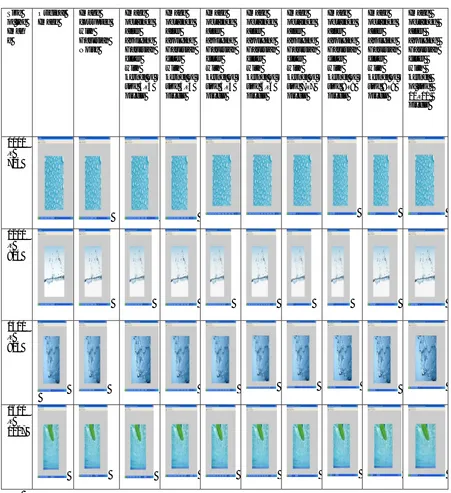
Table-1: Analysis of the Quality of Images obtained after applying Gaussian Filter with different
kernel sizes on Gaussian noise corrupted images
Size of the Image in pixels
Original Image
Image corrupted with Gaussian Noise
Image obtained after applying Gaussian filter with kernel of size 3×3 pixels
Image obtained after applying Gaussian filter with kernel of size 4×4 pixels
Image obtained after applying Gaussian filter with kernel of size 5×5 pixels
Image obtained after applying Gaussian filter with kernel of size 6×6 pixels
Image obtained after applying Gaussian filter with kernel of size 7×7 pixels
Image obtained after applying Gaussian filter with kernel of size 8×8 pixels
Image obtained after applying Gaussian filter With kernel of size 9×9 pixels
Image obtaine d after applyin g Gaussi an filter with kernel of size 10×10 pixels 250×
224
400× 324
700× 524
Table -1: Continued
Size of the Imag e
Original Image
Image corrupted with Gaussian Noise
Image obtained after applying Gaussian filter with kernel of size 3×3 pixels
Image obtained after applying Gaussian filter with kernel of size 4×4 pixels
Image obtained after applying Gaussian filter with kernel of size 5×5 pixels
Image obtained after applying Gaussian filter with kernel of size 6×6 pixels
Image obtained after applying Gaussian filter with kernel of size 7×7 pixels
Image obtained after applying Gaussian filter with kernel of size 8×8 pixels
Image obtained after applying Gaussian filter with kernel of size 9×9 pixels
Image obtained after applying Gaussian filter with kernel of size 10×10 pixels
1000 × 724
1200 × 824
1400 × 924
Table-2: Analysis of Mean Squared Error obtained from the original image and the filtered image
which was obtained from Gaussian noise corrupted image by applying Gaussian Filter with
different kernel sizes
Size of the Image in pixels MSE obtained from the original image and the filtered image which was obtained by applying Gaussian filter with kernel of size 3×3 pixels MSE obtained from the original image and the filtered image which was obtained by applying Gaussian filter with kernel of size 4×4 pixels MSE obtained from the original image and the filtered image which was obtained by applying Gaussian filter with kernel of size 5×5 pixels MSE obtained from the original image and the filtered image which was obtained by applying Gaussian filter with kernel of size 6×6 pixels MSE obtained from the original image and the filtered image which was obtained by applying Gaussian filter with kernel of size 7×7 pixels MSE obtained from the original image and the filtered image which was obtained by applying Gaussian filter with kernel of size 8×8 pixels MSE obtained from the original image and the filtered image which was obtained by applying Gaussian filter with kernel of size 9×9 pixels MSE obtained from the original image and the filtered image which was obtained by applying Gaussian filter with kernel of size 10×10 pixels
250×224 0.0041 0.0043 0.0041 0.0043 0.0041 0.0043 0.0041 0.0043
400×324 0.0034 0.0043 0.0034 0.0043 0.0034 0.0043 0.0034 0.0043
700×524 0.0038 0.0027 0.0038 0.0027 0.0038 0.0027 0.0038 0.0027
850×624 0.0035 0.0042 0.0035 0.0042 0.0035 0.0042 0.0035 0.0042
1000×724 0.0039 0.0028 0.0039 0.0028 0.0039 0.0028 0.0039 0.0028
1200×824 0.0032 0.0031 0.0032 0.0031 0.0032 0.0031 0.0032 0.0031
1400×924 0.0039 0.0029 0.0039 0.0029 0.0039 0.0029 0.0039 0.0029
1600×1027 0.0040 0.0028 0.0040 0.0028 0.0040 0.0028 0.0040 0.0028
Table-3: Analysis of Peak Signal-to-Noise Ratio obtained from the original image and the filtered image
which was obtained from Gaussian noise corrupted image by applying Gaussian Filter with different
kernel sizes
Size of the Image in pixels PSNR obtained from the original image and the filtered image which was obtained by applying Gaussian filter with kernel of size 3×3 pixels PSNR obtained from the original image and the filtered image which was obtained by applying Gaussian filter with kernel of size 4×4 pixels PSNR obtained from the original image and the filtered image which was obtained by applying Gaussian filter with kernel of size 5×5 pixels PSNR obtained from the original image and the filtered image which was obtained by applying Gaussian filter with kernel of size 6×6 pixels PSNR obtained from the original image and the filtered image which was obtained by applying Gaussian filter with kernel of size 7×7 pixels PSNR obtained from the original image and the filtered image which was obtained by applying Gaussian filter with kernel of size 8×8 pixels PSNR obtained from the original image and the filtered image which was obtained by applying Gaussian filter with kernel of size 9×9 pixels PSNR obtained from the original image and the filtered image which was obtained by applying Gaussian filter with kernel of size10×10 pixels
250×224 72.0473 71.7955 72.0473 71.7955 72.0473 71.7955 72.0473 71.7955
400×324 72.8413 71.7785 72.8413 71.7785 72.8413 71.7785 72.8413 71.7785
700×524 72.2860 73.8513 72.2860 73.8513 72.2860 73.8513 72.2860 73.8513
850×624 72.7019 71.8877 72.7019 71.8877 72.7019 71.8877 72.7019 71.8877
1000×724 72.2276 73.6593 72.2276 73.6593 72.2276 73.6593 72.2276 73.6593
1200×824 73.0342 73.2431 73.0342 73.2431 73.0342 73.2431 73.0342 73.2431
III. CONCLUSION
Images are easily susceptible to different types of noise either during acquisition or transmission. Images are often corrupted with Gaussian noise. Filtering is used to remove noise from the images. The present work analysed the performance of Gaussian Filter with different kernel sizes in the context of removing Gaussian noise. The results obtained show that for a kernel of size n×n pixels, when applied with Gaussian Filter to Gaussian noise corrupted images, the Mean Squared Error obtained between the original image and the filtered image remains same for all n when n is odd and it is also evident that the Mean Squared Error obtained between the original image and the filtered image remains same for all n when n is even. Similarly the results obtained show that for a kernel of size n×n pixels, when applied with Gaussian filter to Gaussian noise corrupted images, the Peak Signal-to-Noise Ratio obtained between the original image and the filtered image remains same for all n when n is odd and it is also obtained that the Peak Signal-to-Noise Ratio obtained between the original image and the filtered image remains same for all n when n is even.
REFERENCES
[1] Sonali R. Mahakale & Nileshsingh V. Thakur, “A Comparative Study of Image Filtering on Various Noisy Pixels” International Journal of Image Processing and Vision Sciences ISSN (Print): 2278 – 1110, Volume-1, Issue-2, 2012, pp.69-77
[2] Zinat Afrose, “A Comparative Study on Noise Removal of Compound Images using Different Types of Filters”International Journal of Computer Applications ,Volume 47– No.14, June 2012, pp.45-48
[3]
Ayushi Gupta and Yugshakti Kaushik,“Comparative Study of Noise Removal Techniques” International Journal of Current Engineering and Technology, Vol.4, No.6 (Dec 2014),pp.3904-3907
[4] Anisha S.R, Dr J Venugopala Krishnan, “Comparison of Various Filters for Noise Removal in MRI Brain Image”, International Conference on Futuristic Trends in Computing and Communication (ICFTCC-2015), pp.68-73
[5] Sukhjinder Kaur, “Noise Types and Various Removal Techniques” International Journal of Advanced Research in Electronics and Communication Engineering (IJARECE), Volume.4, Issue 2, February 2015, pp: 226-230.
[6] Dr. V. Kavitha, Mrs. C. Mythili, “Efficient Technique for Color Image Noise Reduction”, The Research Bulletin of Jordan ACM,Volume.II (III), pp: 41-45.
[7] Prabhdeep Singh and Aman arora, “Analytical Analysis of Image Filtering Techniques”, International Journal of Engineering and Innovative Technology (IJEIT), Volume 3, Issue 4, October 2013,pp: 29-32.