ABSTRACT
—
in this paper, analysis thehuman emotions of EEG
(Electroencephalogram) with different incidents. The different feature extraction methods like DWT, HOC, STFT, SB are used to extract the particular emotion related features and classify those emotions using various classify methods like NN, SVM, KNN, LDA. The emotions are classified into different group like arousal (positive and negative) valence (calm and excite).Based on these emotions group we have to analysis the performance and accuracy for the classification.
Keywords:
EEG, Feature Extraction, Classification, arousal and valence.
1.INTRODUCTION
Human emotions play in important role in affective computing and Human Machine Interaction. The emotions may be happy, sad, surprise, angry etc, which are used to find the mental stress and mental disorders. In human brain each and every cell performs a specific function. Each and every function is used to analysis the decision making for a particular problem. The emotions can be identified by using past experience. Emotion has determined by various ways. First kind focus on analysis the Facial expressions or speech. The audio –visual based techniques used to detect the emotion. The Second
.
Kind of approaches focuses on peripheral physiological signal.
Fig 1: Brain Configuration
Different emotional state has identified by using the Electrocardiogram, Skin Conductance. Third approach uses EEG signal. The EEG based emotions are very accurate.EEG power has decreased during the sad emotion and increased happiness. The region that shows the difference between sadness and happiness is the frontal pole with left CBF being higher during sadness and lower during happiness. In order to stimulate the emotion of interest, the user calmly sat in front of a computer and is viewing an image to inform him/her which type of emotion she has to think of. EEG has measured by using electrode which was placed on the scalp with the help of the Ag/Al the recording was carried out for each and every brain activity. The impedance of the electrodes was kept below 5KΩ.The International Affective Picture System related images and videos are used to find
A Survey on EEG Based Emotion Analysis using
various Feature Extraction Techniques
J. Preethi, Assistant Professor, Department of Computer Science, Anna University Regional Centre Coimbatore.
M. Sreeshakthy, P.G Scholar, Department of Computer Science, Anna University Regional Centre, Coimbatore.
A.Dhilipan, P.G Scholar, Department of Computer Science, Anna University Regional Centre, Coimbatore.
the EEG recordings. EEG data have collected from desirable subjects. Each and every EEG signal has different kind of bands like Alpha, Beta, Gamma, Theta, Mu. Each band stores the particular information about the emotions.
Table I -EEG- Different Band Levels
The base of this band the different emotions and related frequency are recorded and classify using different classification method and compare one to another analysis the performance & accuracy of the particular method. The following section describes the different feature extraction techniques, classification, method and different level of emotions.
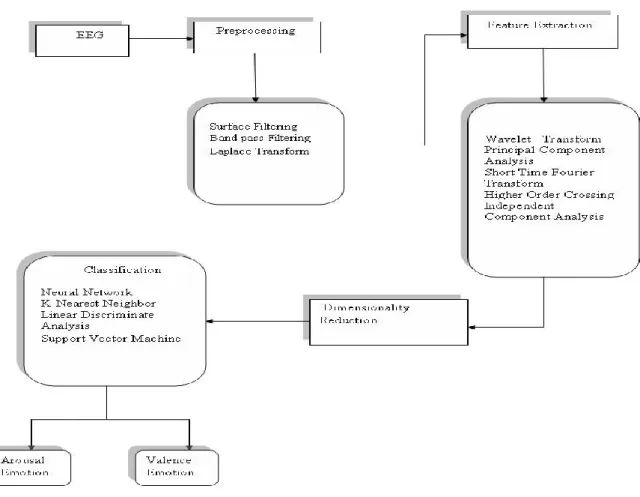
OVERALLSTRUCTURE
Fig 2: Overall structure
2.RELATEDWORK
There are several work exists related to human emotion analysis. In [1] Relate the different kind of emotions and their EEG features and find the exact feature for emotions, identify the accuracy for the emotion using different machine learning techniques like WT, SVM. Here the emotions are grouped based on enjoyment and disagreeable. The basic emotions like happy and sad are used to extract the other emotions [2] the emotions can be identified using LDA, KNN. The features are extracted using discrete wavelet Transform and SAM. It deals with both symmetric and asymmetric levels of emotions. [3] The emotions can be identified by using the signal segmentation and extract the feature using HOC and Cross correlation method. SVM are used to classify those emotions into different group like negative and positive emotions. By using this method we have to get the best accuracy of emotions and multidimensional data also used. [4] Emotion classified from different optimized techniques and those emotions are related to the human machine interaction and other activities, which are used in the affective computing. The features are extracted from EEG using HOC. It supports different feature extraction techniques and provides better accuracy result. [5] The emotions are identified using short term assessment and particular time related emotions only extract using STFT and MI and classify those emotions using SVM, RVM. These all the techniques and methods are implemented using MATLAB and different type of people EEG are used to analysis the emotions. The EEG signal record of healthy persons without having any psychotic disease.
3.METHODS
The EEG data were analyzed using several procedures, including signal preprocessing, feature extraction, dimensionality reduction, and classification methods are used to find the emotions
.
BAND FREQUENCY
RANGE
LOCATION
DELTA 0-4Hz Frontal Lobe
THETA 4-7Hz Midline Temp ALPHA 8-13Hz Frontal Occipital MU 8-12Hz Central BETA 13-30Hz Frontal Central GAMMA 30-100Hz
3.1 EEG PREPROCESSING
Before processing the EEG signal have to remove the noise and unwanted details by using the spectral filtering and surface Laplace transformation. 4 to 40Hz frequencies are used to extract the emotion related features. The following Feature Extraction Techniques are used.
3.2 FEATURE EXTRACTION
Feature Extraction is the process of identifying the particular information from EEG, which was measured by brain activity. In this paper focuses on several feature techniques like,
Discrete wavelet Transformation Higher Order Crossing
Principal Component Analysis Nonlinear Dynamic Analysis Independent Component Analysis
Short Time Fourier Transform and Mutual Information
Statistical Based Feature
The Features may be extracted based on the time and frequency attribute.
A. WAVELET TRANSFORM
DWT is a linear signal processing which is
applied to the particular data. The data has the same length, and then apply these techniques to data reduction. It has the following steps..
The Length of L, input vector must power of 2
Apply data smoothing (sum or weighted average) and perform a weight difference which gives detail feature about particular data
After applying this function the resulting output is L/2 which has low frequency or high frequency respectively.
These functions applied to the resulting dataset obtain the length of 2.
Select values from data obtained apply to the coefficient of transformation.It provide the better result and used in analyze the time series data.
B. PRINCIPAL COMPONENT ANALYSIS
PCA is a statistical technique that has used for
face recognition, image compression, and it is common techniques for finding patterns in data of huge dimension. It has used some mathematical terminology like mean, standard deviation, variance, co-variance, covariance matrix, matrix algebra, Eigenvector, Eigen value. It has the following steps..
Gather the input data Calculate mean vector
Computing co-variance Matrix
Find corresponding Eigen Vector and Eigenvalue.
Ranking and Choosing K Eigenvector and generate the new feature vector
Transform the samples on the new subspace.
New Data=Row Feature vector*Row Data Adjust
C.NON-LINEARDYNAMIC ANALYSIS
It is used for biological time series analysis in the complex data. It has to be used for identifying the particular hidden important features. It has the following steps...
First, find the entropy of a time series Find the standard heavy side function (r)
Finally fixed the approximate entropy It is used for characterizing the non stationary behavior of EEG epochs. These features have been used to analysis the EEG and identify the physiological functions
.
D. HIGHER ORDER CROSSING
All the feature extraction techniques are used
in the particular time series progresses. This shows that the finite zero means series; level zero can express through the zero count. Thus zero crossing count is referred as HOC. This can be combined with spectral and discriminate analysis to extract the particular feature.
Fig 3: Various approaches in emotion classification-feature extraction methods
E. STATSTICAL BASED FEATURE
It was applied to the physiological signals. It has to be follow some of the mathematical steps.
Mean of Raw signal Standard Deviation
Mean of absolute values of the first different raw signal
Mean of the absolute value of second different raw signal
Mean of the absolute value of second standard signal. Based on these steps the exact patterns are extracted from EEG.F. SHORT TIME FOURIER
TRANSFORMATION & MUTUAL INFORMATION
STFT is used to extract from the each electrode sliding window of 512 samples and its overlapping between two consecutive windows. Mutual Information is based on how each and every electrode pair’s and how those statistical
dependencies the features are extracted which are used for emotion analysis
.
G. INDEPENDENT COMPONENT AN ALYSIS
It converts the multivariate signal to signal
having component, which are independent. It removes all the noise from the EEG signal and extracts the particular feature which is not related to another. Suppose the signal X (t) assume vector has zero mean then,
P(x(t))=∑p(xi(t)) (1)
3.3 CLASSIFICATION TECHNIQUES
After extracting the feature classification is
used to group the related emotions. The following methods are used for classification.
1. Neural Network 2. K-Nearest Neighbor 3. Support vector Machine 4. Linear Dynamic Analysis
3.3.1 NEURAL NETWORK
ANN is a biological way of work to store the information in Neurons. Connection and Interconnection between the neurons are used to pass the information from one node to another node. Neurons are called as the Elements. NN has the input layer, hidden layer and output layer.
Fig 4: Neural Networks
It has following features
,
Computer Based Learning, Ability to arrange nodes itself, Real Time Processing, Ability to with stand in failure. Neural network used to find the pattern to analysis the particular emotion. There are three types of learning from the neural network. Which are Supervised Training, Unsupervised Training, and Reinforcement Training. For Supervised Learning there is a target class which is used to find the output exactly we want. Unsupervised Training there is no target class we have to find the output, which is related to the problem. Reinforcement is the combination of both. Based on these NN we have to find a particular pattern for emotion.3.3.2 K-NEAREST NEIGHBOR
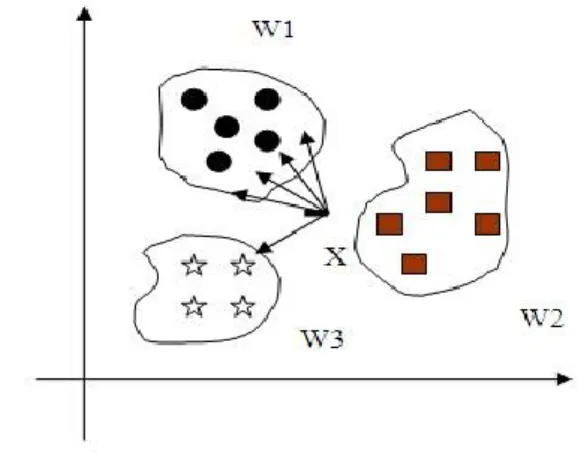
Nearest-neighbor classifiers are based on
learning by comparing test tuple with training tuples that are similar to it. When tuple is not familiar then k-nearest-neighbor classifier searches the pattern space for the k training tuples that are closest to the unknown tuple. These k training tuples are the k “nearest neighbors” of the unknown tuple. The closeness is defined by using Euclidean distance. The Euclidean space between two points or tuples, say, X1 = (x11, x12... x1n) andX2 = (x21,
x22,.. x2n), is
Dist (X1, X2) = (2)
Fig 5: K-Nearest Neighbor
3.3.3 SUPPORTVECTOR MACHINE
SVM is used for classifying both linear and
non-linear data. It uses a non-linear mapping to transform the original training data into higher dimension. The new dimension, it searches the linear optimal hyper plane that is decision boundary. It is used; separate the one class from another one. The SVM finds the hyper plane using support vectors and margin.
Fig 6: Small Margin using SVM
3.3.4 LINEAR DISCRIMINANT ANALYSIS
LDA methods used in statistics,
recognition of pattern and regularities in data, artificial intelligence to find a linear combination of features which separates two or more classes of objects. It is similar to regression analysis. The main concept of searching for a linear combination of variables the best separates two targets. It is extremely fast computation of unknown inputs performed by distance calculation between the new sample data and training data. It is used to find the optimal hyper plane to separate five classes of emotion like happy, sad, fear, surprise, etc. LDA does not require any external parameter to classify the emotions.
3.4 ADVANTAGES AND DISADVANTAGES OF FEATURE EXTRACTION TECHNIQUES
This table explains that different feature extraction method and its advantages, disadvantages, which is help to know how the feature extract from the EEG signal and analyze the emotion related features. By using this table we can identify the particular characteristic of the methods and also identify the method is extracting the particular features with better result during the extraction techniques.
S.NO METHOD ADVANTAGE DISADVANTAGE CITATIONS
1 WT
1. Analyze the signal with variable window
2. Analysis both time and frequency data
1. Lacking of specific method. 2. Perform limited Heisenberg uncertainty [1] 2 PCA 1. Analysis is reducing the dimensionality without loss of information 1. Data is complicated PCA fails to process those data’s.
[2]
3 ICA
1. Computationally efficient for large data.
2. Decompose signal into temporal data.
1. Require more computation 2. Not works with determinate cases
[3]
4 STFT
1. Easy to understand 2. Fixed slide window length.
1. Cannot denoising 2. Trade off between time and frequency.
[4] 5 HOC 1. Performance should be high 2. Provide Optimized result 1.Difficult to choose
3.5 ADVANTAGES AND DISADVANTAGES OF CLASSIFICATION METHOD
This table explains that different feature classification method and its advantages, disadvantages, which is help to know how the feature extract from the EEG signal and analyze the emotion related classes.
Based on the feature extraction, classification, method the accuracy of the emotion detection is identified
3.6 ANALYSIS ACCURACY AND PERFORMANCE:
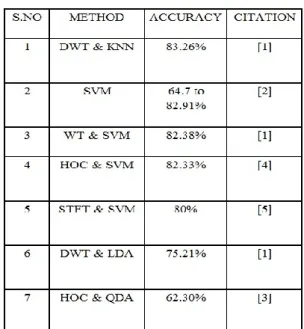
The emotions are identified by EEG signal with different feature extraction techniques and classification methods. The emotions accuracy may be varied from one extract technique to another. Different extraction techniques that combine with the classification method provide better results. The below table shows that the various accuracy levels of feature extraction and classification methods during the emotion identification process. This accuracy level used to analyze which method is used to extract classify the EEG signal and analyze the emotions of the particular persons.
S.NO METHO
D
ADVANTAGE DISADVANTAGE CITATIONS
1 LDA 1. Extremely Fast. 2. Low Requirement. 3. Good Result 1. Fail to discriminate functions like variety of features 2. Complex structure [1] 2 SVM 1.Good Generalization 2. More Performance 1. Computational complexity, high [2],[3],[4],[5] 3 KNN 1. Easy to understand 2. Easy to implement 1. Poor runtime performs 2. Sensitive to irrelevant and redundant features. [3] 4 NN 1. Easy to train. 2. Accurate Pattern classification. 1. Needs training to operate. 2. Requires high processing time for large network
Table II: Accuracy of Methods
4. RESULT
A Clear representative of the particular analysis the Support Vector Machine will provide the higher accuracy of emotion with combined different kind of feature extraction techniques.
5. CONCLUSION
An Emotion’s can be identified by extracting the different kind of feature from the signal after preprocessing the signal it has to be smooth and optimized the particular feature, using different optimization techniques like GA, PSO, etc. after getting the optimized result apply to the Neural Network or SVM it will provide the high accuracy of emotions in any situation. These emotions will used for Human Computer Interaction, Affective Computing and Robotics etc.
6. REFERENCE
[1] Murugappan, N. Ramachandaran, and Y. Sazali, Mohd “Classification of Human Emotion from EEG discrete wavelet” J. Biomed. SCI. Eng., vol. 3, pp-390-396, Apr-2010
[2] Xiao-Wei Wang, Dan Nile, “Emotional State Classification from EEG data using machine Learning Approach” in 2013 Elsevier.
[3] C. Petrantonais, “Adaptive Emotional Information Retrieval from EEG signals in the Time Frequency Domain” in 2012 IEEE.
[4] C. Petrantonais, “Emotion recognition from EEG using higher order” vol. 14, pp-390-396 in 2010 IEEE.
[5] Mohammed Soleymani, “Short term Emotion assessment in a recall paradigm” in 2009 Elsevier. [6] S. Karpagachelvi, Dr. M.Arthanari, M. Sivakumar, “ECG Feature Extraction Techniques – A Survey Approach,” IJCSIS, vol. 8, no. 1, April 2010.
[7] M. Ungureanu, C. Bigan, R. Strungaru, V. Lazarescu,“Independent Component Analysis Applied in Biomedical Signal Processing,” Measurement Science Review, vol. 4, section 2, 2004.
[8] Yuan-Pin Lin, Chi-Hong Wang, Tien-Lin Wu, Shyh-Kang Jeng,“Support Vector Machine for EEG signal classification during listening to emotional music,” Multimedia Signal Processing, IEEE 10th Workshop, 2008.
[9] Xiao-Wei Wang, Dan Nie, and Bao-Liang Lu. “EEG-Based Emotion Recognition Using Frequency Domain Features and Support Vector Machines”, 2011.
[10] Ali S. AlMejrad. “Human Emotions Detection using Brain Wave Signals: A Challenging”, 2010. [11] Garrett, D., Peterson, D. A., Anderson, C. W., & Thaut, M. H.“Comparison of linear, nonlinear, and feature selection methods for EEG signal classification”. Neural Systems and Rehabilitation Engineering, IEEE Transactions on, 11(2), 141-144, 2003.
[12] Yuen, C. T., San, W. S., Seong, T. C., & Rizon, M. “Classification of Human Emotions from EEG Signals using Statistical Features and Neural Network”. International Journal of Integrated
Engineering, 2011
[13] P.C. Petrantonakis and L. J. Hadjileontiadis, “EEG-Based Emotion
Recognition Using Hybrid Filtering and Higher Order Crossings”, Proc. 3rd International
Conference on Affective Computing and Intelligent Interaction (ACII) and Workshops: IEEE, 2009,