40 IT Pro January/February 2010 P u b l i s h e d b y t h e I E E E C o m p u t e r S o c i e t y 1520-9202/10/$26.00 © 2010 IEEE
MOBILE COMMUNICATIONS
Clinton M. Banner
Alcatel-Lucent
The proliferation of messaging systems presents users with a
challenging task: how to effectively use and manage many separate
messaging systems. Unified messaging provides simplified management
of different messaging systems through a single, unified interface.
D
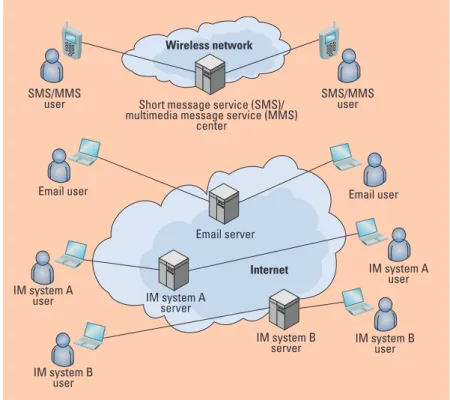
o you want to send an SMS (shortmes-sage service) mesmes-sage to a friend? You’ll most likely use an SMS client on your mobile phone to send it. Would you like to use instant messaging (IM) to find out if a coworker is available for an impromptu meeting? Chances are you’ll use a specific IM client on your laptop or desktop computer to start an IM session. Do you find yourself trying to remember which messaging system a person you need to communi-cate with uses—whether they prefer text messag-ing, email, or one of the many available IM systems? The proliferation of different messaging sys-tems gives us more choices than ever to create and share messages. It also creates a new prob-lem: How do we access and manage each of the messaging systems we use throughout the day? Many of us have become so used to working with multiple stratified messaging systems (see Figure 1) that we don’t consider it at all unusual to start our work day by
• checking for voicemail using a telephone or
dedicated interface,
• logging into one or more email systems to check
for messages,
• starting up one or more IM systems in different
desktop windows, and
• checking for new SMS or multimedia message
service (MMS) messages on a mobile device. We hardly even notice as we hop between messag-ing interfaces and devices throughout the work day, choosing the appropriate system to meet each messaging need. Have we become so used to working with multiple messaging interfaces that we don’t expect anything easier to use?
Unified messaging (UM) seeks to solve this problem by providing an interface that unifies all of these messaging systems. With UM, you need only remember who you wish to communicate with; UM will help you choose the appropriate messaging system. The UM interface will provide you with the set of valid communications options (for example, text messaging, email, or IM) based on the current service capabilities of a selected contact. In some cases, the user will specify the preferred communication method. In other cases,
Understanding
the UM system itself will determine the best way to deliver the message to its ultimate destination.
The Multiple Messaging
Systems Problem
The UM vision is complicated by the fact that many existing messaging systems have unique characteristics that reflect the communications do-mains for which these systems were developed.
Voicemail was developed for fixed and mobile telephony systems. It’s usu-ally invoked when a user is unavailable for a voice session. A user must often dial a special access number to access and retrieve voicemail messages. More sophisticated systems support visual voicemail interfaces and speech-to-text conversion.
SMS/MMS was developed for mo-bile telephony systems. Short text mes-sages are sent asynchronously to the destination user via a telephone num-ber or short code. MMS lets users add rich content (such as URLs, graphics, photos, or videos) to their messages.
Email was first developed for fixed and later for mobile computer
termi-nals. Email systems send messages asynchro-nously to an email address (usually in the form of user@domain_name.com) and let users attach or embed rich content.
IM was developed first for fixed and later for mobile computer terminals. IM systems use (or emulate) a session-based model to support tex-ting and the sharing of rich content between
us-ers. Many IM systems also incorporate presence
capabilities, which provide information about re-mote users’ availability and willingness to com-municate prior to a user initiating an IM session.
Often, these messaging systems are available primarily on the type of device for which they were originally developed—for example, SMS and MMS are the most prevalent messaging tems on mobile devices, and email and IM sys-tems are ubiquitous on computer desktops and laptops (although mobile device platforms have recently begun supporting them). The increas-ing popularity of mobile devices that support
email and IM functionality (Blackberries, smart phones, and so on) shows there’s a market for messaging systems that operate on both mobile and desktop devices. But, do these products pro-vide a true UM solution?
Multiple messaging systems can reside on a sin-gle device without providing a UM experience. For example, the desktop interface you use to compose and send email probably differs from the one you use to chat with your friends in an IM system. Be-cause of this interface fragmentation, users must often work with multiple windows open on their desktops—one or more email clients, desktop or Web clients for Skype and Google Talk, and a cor-porate voice-messaging system client. When using a mobile device, users are often required to close the current application or switch between applica-tions, limiting them to interacting with only one messaging interface at a time. Consequently, if you can’t see all of your messaging interfaces, you’re surely missing some messages.
SMS/MMS
user Short message service (SMS)/ SMS/MMSuser multimedia message service (MMS)
center Wireless network
Email user Email user
Email server IM system A server IM system A user IM system A user IM system B server IM system B user IM system B user Internet
Figure 1. A typical stratified communications system. Users can communicate with others using the same system, but they can’t send messages to users on different systems. For example, an SMS user can send a message to another SMS user, but not to an IM system user. Many commercial IM systems can’t communicate with each other. In the figure, IM system A users can’t communicate with IM system B users. The SMS, email, and IM system A and B users might be the same person; however, they must use different devices and interfaces for each system.
42 IT Pro January/February 2010
MOBILE COMMUNICATIONS
UM aims to replace these separate messaging interfaces without losing functionality. The UM client provides a single inbox view that includes messages from different messaging systems in a unified list. The UM interface could be available on your desktop, laptop, PDA, cable box, or mo-bile device. It can also provide a user phone book/ directory from which you can send any kind of message to other users, regardless of the messag-ing system they use. You could synchronize this directory with each of your UM-capable devices. In UM, presence information helps determine the best way to communicate with members on your contact list. Presence information can tell both the user viewing the list and the UM appli-cation which types of communiappli-cations systems
are currently available for a specific user. This in-formation leverages the current set of messaging and communications services supported by each device in use. Presence information can also indi-cate a user’s willingness to communiindi-cate. If you’re busy—say, in a meeting—you can use presence information to notify others that you don’t wish to be disturbed. Most IM systems offer such presence information, and many other messaging systems are also beginning to integrate presence capabilities. For example, Microsoft is manifest-ing its UM vision in the tight integration of ad-dress book and calendar information with its email and IM clients, using the display of pres-ence information throughout common interfaces.
Benefits of UM Functionality
UM has a tangible value proposition. For the con-sumer market, the business case for UM might include the following possible benefits:
• less complexity because consumers deal with
only one messaging interface;
• device convergence, whereby users can get all
messages (email, IM, SMS, and so on) on each of their devices; and
• greater convenience through a single sign-in to
a converged interface and a converged message repository.
Enterprise customers enjoy these same benefits, but they also benefit from increased productiv-ity (a difficult benefit to quantify), a converged enterprise directory, and improved employee communications.
Service providers benefit not only from mes-saging revenues, but also from ownership of the UM portal, which means that users see the service provider’s logo and ads rather than a competitor’s. In addition, offering UM sets the service provider apart from others that don’t offer this service and can help build a customer base or maintain loyalty.
Finally, a UM system benefits the system admin-istrator by providing centralized message system administration capabilities. The system admin-istrator has greater control over messaging traf-fic because all messages traverse the UM server, rather than multiple separate message servers, which might not all be under the system adminis-trator’s control. This also provides a single control point to support a centralized message repository for message back up and to meet regulatory re-quirements. A UM system can increase system security by reducing the use of out-of-band, un-authorized messaging systems and increasing the visibility of previously out-of-band messages.
Continual updates and changes to deployed messaging systems, along with the inevitable ap-pearance of new messaging systems, complicates the task of keeping deployed UM solutions up to date. Such changes might require vendors to constantly update their own UM systems. Popu-lar or new proprietary messaging systems might be unwilling to integrate their systems with an external UM solution. The owners of these sys-tems might be content with their market share and see no benefit in integrating with a UM solu-tion that could draw customers (or informasolu-tion) away from their messaging portals.
It’s unlikely that any single UM solution will ever establish interoperability with every possible type of stratified messaging system. From a prac-tical perspective, a UM system’s success depends on the wise selection of specific messaging sys-tems to integrate. From the user’s perspective, this decision has a significant impact; users will
In UM, presence information
helps determine the best way to
communicate with members on
your contact list.
detect the lack of support for a prevalent messaging system and perceive this lack as a functionality gap. Because consumers and enterprises have different messaging system requirements, the specific needs of your UM solution’s targeted market should drive this selection.
IM has become an increasingly im-portant means of communication in the
workplace.1 Thus, a successful enterprise
UM solution must support IM capabili-ties. One or more IM systems might al-ready be in widespread use within a given enterprise. The proliferation of specific messaging system brands—such as AOL, MSN, Skype, Yahoo, and Google—com-plicates the integration of IM systems into the UM solution. Each of these IM system brands presents its own set of UM inte-gration and interoperability issues. For-tunately, many of these systems already have, or are now developing, functional-ity to interoperate with other IM systems. The desire for interoperability across IM systems has contributed to the development of the Extensible Messaging and Presence Protocol (XMPP). How-ever, many key IM systems still use proprietary interfaces and don’t support standards-based in-terface specifications.
UM provides much more than a simplified interface for messaging users. IT professionals constantly face new challenges resulting from the proliferation of stratified messaging systems, and UM can be an important tool in dealing with these challenges. Your organization undoubt-edly has policies to prevent the use of unauthor-ized messaging systems and to maintain official records. These policies’ effectiveness can vary greatly across and within organizations. A server-based UM system can increase the ways in which users communicate while providing mechanisms to control and record messaging traffic that previ-ously bypassed organizational controls. Your or-ganization must still clearly identify the messaging systems authorized for official communications. Obviously, UM won’t prevent determined users from using unauthorized messaging systems.
Client- and Server-Based UM Solutions
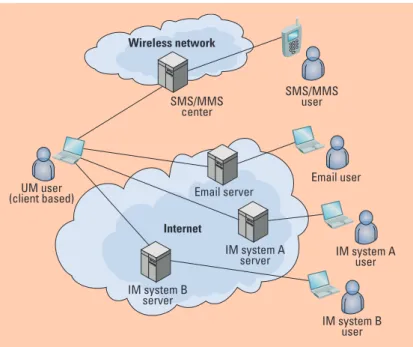
Figure 2 shows a client-based UM solution. In this system, the client provides a single
inter-face from which the user can access all the mes-saging systems. The client-based UM solution accomplishes this by emulating the client func-tionality required for each messaging system. The UM client must therefore have the nec-essary credentials (account and password) and the functionality (protocol and server address-es) required to log into each messaging system server. As its name implies, a client-based UM solution places the burden of integration on the client—that is, a client-based UM solution pro-viding access to four messaging systems must have four sets of sign-in credentials, four mes-saging servers, four paths along which messag-es can flow, and four source phone books. A client-based system might have to handle more client-to-network traffic (multiple sign-ins, reg-istrations, connection maintenance methods, presence information, and so on) than a server-based UM approach.
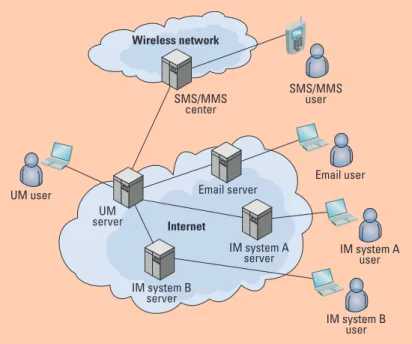
Figure 3 shows a server-based UM solution. Unlike a client-based solution, the server-based solution needs only one set of credentials at the messaging client for accessing the UM server. The UM server, which maintains the credentials and other information required for server-to-server interoperability, interacts with any external messaging systems. All messaging traffic from the UM client traverses the UM server in the
SMS/MMS user SMS/MMS center Wireless network UM user (client based) Email user Email server IM system A
server IM system Auser IM system B
server
IM system B user Internet
Figure 2. A client-based unified messaging system. In this system, a single client must interact with multiple messaging servers using interfaces that are unique to each messaging system.
44 IT Pro January/February 2010
MOBILE COMMUNICATIONS
network. Therefore, the UM server offers a cen-tralized message-management and storage capa-bility that can provide visicapa-bility and some level of control over multiple messaging systems.
Corporate entities have several strong busi-ness- and regulatory-based requirements driv-ing the need for a more centralized capability to manage and control messaging traffic. Thus, a server-based UM model will probably most ben-efit enterprise applications.
In all likelihood, client-based, server-based, and hybrid (using both client- and server-based components) UM systems will become available in the foreseeable future.
What’s Available Now
Now for the reality check: there’s no single UM system under development that will take over the messaging market. Mobile messaging systems such as SMS and MMS are expanding in the US (US users sent more than 1 trillion SMS
messag-es in 20082) and will remain a significant force in
the mobile messaging market for years to come. In addition, we can’t assume that the variety of email and IM systems will decrease. New mes-saging systems will likely continue to be devel-oped and deployed.
Until recently, many corporate messaging sys-tems were relatively simple and centered on email communications. Although email-based systems
are being extended to mobile devices (for example, using Microsoft Exchange on Blackberry devices), these solutions don’t provide a fully converged mobile messag-ing experience. Users might be able to send and receive both email and SMS messages from a mobile device through a single in-box; however, they often can’t do the same from their laptop computer, cable box, or Web page. Relatively few PC-based sys-tems support unified IM, SMS, MMS, and voicemail messaging. A hallmark of true UM capability will be full convergence of messaging systems across different mes-saging device types.
Several products available now advertise UM capability. Each of these products ap-pears to focus on combinations of different messaging systems, devices, and markets. A detailed analysis of the differences be-tween these products is beyond this arti-cle’s scope.
Pidgin (http://pidgin.im/about) and Meebo (www.meebo.com/about) are examples of client-based UM solutions that provide a unified user interface with connectivity to multiple popular IM systems. Both are primarily for computer desktop environments using a client or Web page. Fring (www.fring.com) is a similar client-based UM so-lution that was developed for mobile devices.
Alcatel-Lucent’s Rich Communications Man-ager, Microsoft’s Exchange Server, and Cisco’s Unity are examples of more sophisticated UM solutions that integrate multiple messaging and communications systems through a unified mes-saging interface using network-based UM servers or other specialized network-based components.
Future Directions
UM work is proceeding across two fundamen-tally different paths: vendor-specific proprietary implementations and open standards-based implementations.
Vendors will continue to develop proprietary server- and client-based UM solutions. Many of these solutions will leverage suites of services that are already in widespread use within an enterprise or the consumer market. All the UM systems I’ve mentioned are proprietary to some degree. These proprietary UM implementations will likely exhibit an increasing level of sophistication, functionality,
SMS/MMS user SMS/MMS center Wireless network UM user Email user Email server IM system A
server IM system Auser IM system B server IM system B user Internet UM server
Figure 3. A server-based unified messaging system. The UM user and client communicate only with the UM server; the UM server interacts with all other messaging servers.
and interoperability. Server-based UM solutions will continue to be focused on enterprise solutions; UM solutions targeting consumers will likely only be offered through medium to large service pro-viders. Client-based UM solutions requiring little or no specialized network support will continue to gain share in the consumer market.
A great deal of work seeks to define UM func-tionality based on open standards. For example, Converged IP Messaging is a Session Initiation Protocol (SIP)-centric approach to UM managed by the Open Mobile Alliance (OMA). CPM’s stat-ed goal is to define an enabler “to allow for both the consolidation of present and the creation of future interpersonal interactive multimedia communication services which accommodate different user experiences such as deferred and Immediate Messaging, session-based
messag-ing, and half duplex/full duplex conferencing.”3
The CPM effort aligns with other standards to include OMA standards as well as the IP Mul-timedia Subsystem (IMS) specifications defined by the Third-Generation Partnership Projects
(3GPP and 3GPP2.)3
Enhanced messaging (EM) is another ex-ample. It’s a SIP-centric approach focused on messaging for mobile 2G devices defined by the CTIA’s Wireless Internet Caucus Enhanced Messaging Action team. EM leverages some OMA standards work, but it focuses on inte-grating mobile messaging with IP-based mes-saging systems across mobile carriers (see www. ctia.org/business_resources/wic/index.cfm/AID/ 11506).
Both CPM and EM define requirements and standards that are moving the industry toward an open, comprehensive UM solution. There’s hope that UM will indeed encourage industry movement toward open standards and increased interoperability, and away from a fragmented and proprietary messaging future.
J
ack Santos observes in CIO Magazine: “UC[unified communications, which includes unified messaging] is still a vision and long-term strategy—really the recognition of an overall trend with communications … vendors take the UC moniker and run with it (any sur-prises there?) to sell products that may or may not be ready for prime time. The reality is
uni-fied communications will only be real when ap-plications are developed based on the underly-ing technologies—and so far there has been no
‘killer app.’”4
This is an important perspective. As UM- related development and standards mature, more sophisticated UM products will appear on the market. Investigate and assess these emerg-ing UM capabilities with a critical eye, and en-sure that applications touted as providing UM capabilities do in fact give meaningful value and ROI. Learn the capabilities of available UM sys-tems so you can choose the right system for your organization.
In the meantime, continue managing your exist-ing messagexist-ing systems. Ensure that you know the risks of using stratified or unauthorized messaging systems. As an IT professional, it’s your job to de-velop and enforce clear policies to increase aware-ness and reduce your vulnerabilities. But as a user, you have a lot of messaging systems to manage be-fore the perfect UM solution comes along.
References
1. E. Isaacs et al., “The Character, Functions, and Styles of Instant Messaging in the Workplace,” Proc. Conf. Computer-Supported Cooperative Work (CSCW), ACM Press, 2002, pp. 11–20.
2. Y. Zhang et al., “A Novel Method for the Short Mes-sage or Multimedia MesMes-sage Synchronization,” Proc. Int’l Multi-Conference Computing in the Global Information Technology, IEEE CS Press, 2006, p. 75.
3. Open Mobile Alliance, “Converged IP Messaging Architecture Draft Version 1.0,” OMA-AD-CPM-V1_0-20080418-D, Apr. 2008.
4. J. Santos, “Unified Communications and the CIO,”
CIO New Zealand, 14 Apr. 2008; http://cio.co.nz/ cio.nsf/tech/BAC0A77B98F90374CC257422001 A5C28?Opendocument&HighLight=2,unified, communications.
Clinton M. Banner is a business development manager for IP- and IP multimedia subsystem-based communica-tions systems at Alcatel-Lucent and a doctoral student in technology management at Indiana State University. As a chief warrant officer in the US Army, he participated in multiple combat and humanitarian operations in the Mid-dle East, Africa, and the Balkans. Banner has an MS in technology systems from East Carolina University. He’s a senior member of the IEEE. Contact him at clint.banner@ alcatel-lucent.com.