European Telecommunications Standards Institute
ETSI Guide
Telecommunications Security;
Trusted Third Parties (TTP);
Requirements for TTP services
Reference
DEG/SEC-003000 (9sc00ide.PDF)
Keywords
ISDN, multimedia, security
ETSI Secretariat Postal address
F-06921 Sophia Antipolis Cedex - FRANCE
Office address
650 Route des Lucioles - Sophia Antipolis Valbonne - FRANCE
Tel.: +33 4 92 94 42 00 Fax: +33 4 93 65 47 16 Siret N° 348 623 562 00017 - NAF 742 C Association à but non lucratif enregistrée à la
Sous-Préfecture de Grasse (06) N° 7803/88
X.400
c= fr; a=atlas; p=etsi; s=secretariat
Internet
[email protected] http://www.etsi.fr
Copyright Notification
No part may be reproduced except as authorized by written permission. The copyright and the foregoing restriction extend to reproduction in all media.
© European Telecommunications Standards Institute 1997. All rights reserved.
Contents
Intellectual Property Rights...6
Foreword ...6
Introduction ...6
1
Scope ...7
2
References...7
3
Definitions and abbreviations ...10
3.1 Definitions ... 10
3.2 Abbreviations... 11
4
General aspects ...12
4.1 Use of a TTP... 12
4.2 Delimitation of security services for confidentiality and digital signatures ... 12
4.3 Establishing trust in a TTP scheme... 13
4.4 TTP management ... ... 14
4.5 User interactions with TTPs... 14
4.5.1 Communication relationship between TTP and user ... 14
4.5.1.1 Off-line TTPs... 14
4.5.1.2 On-line TTPs ... 14
4.5.1.3 In-line TTPs... 15
4.5.2 Initial user registration with TTPs... 15
4.5.3 TTP authentication and access control ... 15
4.5.4 TTP service interface ... 15
4.6 TTP services, functions and applications... 15
4.6.1 Services ... 16
4.6.2 Applications ... 16
5
TTP services and functions...16
5.1 Key management services for symmetric cryptosystems ... 16
5.1.1 Secret key generation ... 16
5.1.2 Secret key distribution... 16
5.1.3 Secret key revocation ... 16
5.1.4 Secret key storage and retrieval... 17
5.1.5 Secret key archival ... 17
5.2 Key management services for asymmetric cryptosystems... 17
5.2.1 Public/private key pair generation... 17
5.2.2 Public key certification... 17
5.2.3 Public/private key pair distribution ... 18
5.2.4 Public/private key pair revocation... 18
5.2.5 Public/private key pair storage and retrieval ... 18
5.2.6 Public/private key pair archival... 18
5.3 Key escrow/recovery services... 19
5.4 Identification and authentication support services ... 19
5.4.1 On-line authentication services ... 19
5.4.2 Off-line authentication services... 19
5.4.3 In-line authentication services ... 20
5.5 Access control support services ... 20
5.5.1 Generation of certificates for access control ... 20
5.5.2 Distribution of certificates for access control... 20
5.5.3 Revocation of certificates for access control ... 20
5.5.4 Archival of certificates for access control ... 20
5.6 Non-repudiation services ... 21
5.6.1 Evidence generation ... 21
5.6.2 Evidence recording... ... 21
5.6.4 Dispute resolution ... 21
5.7 Auxiliary support services ... 22
5.7.1 Time-stamping ... 22
5.7.2 Audit... ... 22
5.7.3 Delivery authority... 22
5.8 Functions against services... 23
6
TTP interfaces...24
6.1 Types of interface ... 24
6.2 Interface requirements ... 25
6.2.1 User interface ... 25
6.2.2 Key escrow/recovery interface ... 26
6.2.3 Inter-TTP interface (T-I) ... 27
6.2.4 Application interface ... 28
7
Legal aspects ...28
7.1 Liability... 28
7.2 Legal basis for digital signatures... 29
7.3 Protection of privacy and personal data ... 29
7.4 Export control ... 29
7.5 Lawful interception ... 30
7.6 Lawful access... 31
8
Commercial issues ...31
8.1 Competition and openness ... 31
8.2 Scope and flexibility ... 32
8.3 Licensing and accreditation ... 32
Annex A:
Basis for a standardized TTP scheme...33
A.1
General standardization requirements...33
A.2
Security requirements for a TTP scheme...34
A.3
TTP functional and interface requirements to be standardized ...35
Annex B:
Examples of the use of TTP services...37
B.1
TTP based security services...37
B.2
Certification Authority...37
B.3
Key escrow/recovery centre...38
B.4
Trusted key distribution centre ...39
B.5
Fraud detection centre...39
B.6
Legal services...39
B.7
Guaranteed date and time stamping ...40
B.8
Negotiable document transaction...40
B.9
Storage of electronic information ...40
Annex C:
National and international policies ...41
C.1
European Union ...41
C.2
France...41
C.3
Germany ...42
C.4
Netherlands ...42
C.5
United Kingdom...42
C.6
OECD...42
C.7
United States of America ...43
Intellectual Property Rights
ETSI has not been informed of the existence of any Intellectual Property Right (IPR) which could be, or could become essential to the present document. However, pursuant to the ETSI Interim IPR Policy, no investigation, including IPR searches, has been carried out. No guarantee can be given as to the existence of any IPRs which are, or may be, or may become, essential to the present document.
Foreword
This ETSI Guide (EG) has been produced by ETSI Technical Committee Security (SEC).
An ETSI Guide (EG) is an ETSI deliverable, containing informative elements, adopted for publication by the ETSI membership.
Introduction
Achieving the appropriate level of user confidence in the application of IT systems for processing and communicating information is closely related to the need for practical and appropriate technical and legal controls to protect this information. Users across a wide range of industrial sectors and user communities need to have confidence that such systems can be relied upon to support their business obligations and commitments, and to provide a level of trust in the protection of their information.
There is a need to facilitate the growing importance and development of electronic commerce, the European Information Infrastructure (EII) and the Global Information Infrastructure (GII) by the introduction of suitable measures to safeguard the integrity and confidentiality of electronic information. The provision of Trusted Third Party (TTP) services to satisfy this user need, and the requirement to be compliant with national legislation, is of major importance to establish the appropriate level of user assurance.
TTP services can be considered as value-added communication services available to users that need to enhance the trust in the services used. By signing up to a licensed or accredited TTP, the user will be able to communicate securely with every user of every TTP with whom his TTP has an agreement (or shares a common root in the case of a hierarchical infrastructure of TTPs). Therefore, TTPs could be able to offer value with regard to integrity and confidentiality of the electronic information being carried by these communications. A TTP has been defined by ISO/IEC as a security authority or its agent, trusted by users with respect to security-related activities, e.g. to support the use of digital signatures and confidentiality services. The role of TTPs may include providing assurance that:
- messages and transactions are being transferred to the right recipient at the right location;
- messages are received in a timely, secure and accurate manner from the claimed originator/sender;
- for any business dispute that arises, there are appropriate mechanisms for establishing and presenting evidence of what happened.
This document has been prepared by the ETSI Technical Committee SEC, to define the requirements for TTPs.
Annex A provides an executive summary of the requirements for TTP services. Annex B provides some examples of the use of TTP services and annex C presents information on international and national policies in this field.
1
Scope
The present document describes the requirements for TTP services, as might be needed to support the growing demand for measures to safeguard the integrity and confidentiality of electronic information. In particular, these requirements include provision for TTP based key management, key certification and key escrow/recovery, authentication, access control and non-repudiation services.
The general aim of this standardization work is towards:
- a Europe-wide solution to aid the development of a TTP network, whilst recognizing the broader need for international solutions and interoperability;
- the provision of a range of TTP services to be offered to a variety of industrial sectors and other user communities; and
- providing compatibility with a range of communications systems, interfaces and protocols (e.g. internet/intranet, mobile networks, public networks, private networks).
The present document covers a set of general requirements for a TTP scheme, more specific technical requirements related to TTP services and functions, and interfaces. These take in account some of the requirements relevant to the commercial and legal environment.
Annex A of the present document provides a summary of the requirements for a TTP scheme, both general and specific. Annex B provides some examples of the use of TTP services and annex C provides some information on international policies.
The requirements given in the present document (see annex A for a summary) will be translated into a number of technical specifications for TTP functions and interfaces and these will be the subject of a set of standards.
2
References
References may be made to:
a) specific versions of publications (identified by date of publication, edition number, version number, etc.), in which case, subsequent revisions to the referenced document do not apply; or
b) all versions up to and including the identified version (identified by "up to and including" before the version identity); or
c) all versions subsequent to and including the identified version (identified by "onwards" following the version identity); or
d) publications without mention of a specific version, in which case the latest version applies.
A non-specific reference to an ETS shall also be taken to refer to later versions published as an EN with the same number.
[1] Jefferies N, Mitchell C and Walker M: "A Proposed Architecture for Trusted Third Party Services" In Dawson E and Golic J (Eds.), Lecture Notes in Computer Science 1029, Cryptography; Policy and Algorithms Conference pp 98-104, Springer Verlag, 1996.
[2] Howard P and Mitchell C: "Requirements for Trusted Third Parties", ASPeCT Project, ACTS Programme, 29 May 1996.
[3] Howard P and Mitchell C: "Trusted Third Party Services", ASPeCT Project, ACTS Programme, 21 June 1996.
[4] Denning, D.E and Branstad, D.K.: "A Taxonomy for key escrow encryption systems", Comms. of the ACM 39, No. 30, pp 33-40, March 1996.
[5] ISO/IEC JTC1/SC27 N1358 (Working Draft 14516-1): "Guidelines for the use and management of Trusted Third Party Services - Part 1: General Overview", May 1996.
[6] ISO/IEC JTC1/SC27 N1360 (Working Draft 14516-2): "Guidelines for the use and management of Trusted Third Party Services - Part 2: Technical Aspects", May 1996.
[7] ISO/IEC 7498-2: 1988, Information technology - Open systems interconnection - Basic reference model - Part 2: Security Architecture.
[8] ISO/IEC 9594-8: "Information technology - Open systems interconnection - The directory authentication framework", November 1993.
[9] ISO/IEC 9798: "Information technology - Security techniques - Entity Authentication - Part 1: General Model", 1996.
[10] ISO/IEC 10181: "Information technology - Security frameworks in open systems": Part 1: Security Framework.
Part 2: Authentication Framework. Part 3: Access Control Framework. Part 4: Non-repudiation Framework.
[11] ISO/IEC 11770: "Information technology - Security techniques - Key Management": Part 1: Framework.
Part 2: Mechanisms using symmetric techniques. Part 3: Mechanisms using asymmetric techniques.
[12] ISO/IEC CD 13888: "Information technology - Security techniques - Non-repudiation": Part 1: General Model.
Part 2: Using Symmetric Techniques. Part 3: Using Asymmetric Techniques.
[13] Draft amendments DAM 4 to ISO/IEC 9594-6, DAM 1 to ISO/IEC 9594-7, and DAM 1 to ISO/IEC 9594-8 on Certificate Extensions (X.509 v3), July 1995.
[14] ECMA-219: "Authentication and Privilege Attribute Security Application with related key distribution functions", 2nd edition, March 1996:
Part 1: Overview and Functional Model. Part 2: Security Information Objects. Part 3: Service Definitions.
[15] ECMA-235: "The ECMA GSS-API Mechanism", March 1996.
[16] Directive 95/46/EC of the European Parliament and of the Council on the protection of individuals with regard to the processing of personal data and the free movement of such data.
[17] Directive of the European Parliament and of the Council concerning the processing of personal data and the protection of privacy in the telecommunications sector, in particular in the Integrated Services Digital Network (ISDN), and in the digital mobile networks.
[18] Council Decision of 19 December 1994 on the joint action adopted by the council on the basis of Article J.3 of the Treaty on European Union concerning the control of exports of dual-use goods, 94/942/GBVB (Pb Nr. L 367), 31 December 1995.
[19] Council Regulation (EC) Nr. 3381/94 of 10 April 1995 setting up a Community regime for the control of exports of dual-use goods (Pb. Nr. L 90), 21 April 1995.
[20] The Wassenaar Arrangement on Export Controls for Conventional Arms and Dual-Use Goods and Technologies.
[21] Draft Model EDI Agreement K.U. Leuven and ICRI in association with the Belgium National Chambers of Commerce Federation (B).
[22] German Digital Signature Law (Gesetz zur digitalen Signatur, December 1996).
[23] Excerpt from IDA, Legal Aspects of the interchange of data between administrations, Final report, February 1996.
[24] Bangemann Report, "Europe and the Global Information Society, Recommendations to the European Council", Brussels, 26 May 1994.
[25] Sixth Strategic Review Committee, "Final Report on European Information Infrastructure", May 1995.
[26] Eurobit, ITI and JEIDA, "Global Information Infrastructure (GII)", January 1995.
[27] Proceeding from EDITT, TEDIS EDI Trusted Third Party Workshop, 2nd Edition, Barcelona, Spain 8-10, February 1995.
[28] Housley R., Ford W. and Solo D.: "Internet Public Key Infrastructure: Part I - X.509 Certificate and CRL Profile", Internet Draft, 3 November 1996.
[29] Farrell S., Adams D. and Ford W.: "Internet Public Key Infrastructure: Part III - Certificate Management Protocols", Internet Draft, June 1996.
[30] "Federal Public Key Infrastructure (PKI) Technical Working Group Specifications": Part A: Requirements for the Federal PKI, TWG96- (January 1996).
Part B: Technical Security Policy, TWG96-001 (January 1996). Part C: Concepts of Operation, TWG95-108 (November 1995). Part D: Interoperability Profiles.
Part E: X.509 Certificate and CRL Extensions Profile. [31] IEEE P1363: "Standard for Public Key Cryptography".
[32] National Institute of Standards and Technology, FIPS Publication 185: Escrowed Encryption Standard, February 1994.
[33] Baum M.: "Federal Certification Authority Liability and Policy", NIST-GCR-94-654, June 1994.
[34] INFOSEC Reports, 1992-95, European Commission/DGXIII.
[35] ETSI ETR 331 (DTR/NA-002310): "Definition of User Requirements for Lawful Interception of Interception of Telecommunications Requirements of the Law Enforcement Agencies", September 1996.
[36] Architecture for Public-Key Infrastructure, The Open Group, August 1996.
[37] Final Text of ITU-T X.509 | ISO/IEC 9594-8 DAM 2 1996 The Directory - Authentication Framework - Amendment 2 on Enhancement of Directory Operational Security; ISO/IEC JTC 1/SC 21 and ITU-T Q15/7 Collaborative Editing Meeting on the Directory, Phoenix, October 1996.
[38] Blakley B. and the APKI Working Group: "Architecture for Public-Key Infrastructure", Internet Draft, November 1996.
[39] Koops Bert-Jaap: "A Survey of Cryptography Laws and Regulations", The Computer Law and Security Report, November-December 1996.
[40] Resolution of the Council of the European Union: "International Requirements on the Lawful Interception of telecommunications", 17 January 1995.
3
Definitions and abbreviations
3.1
Definitions
For the purposes of this document, the following definitions apply:
access control: The prevention of unauthorized use of a resource, including the prevention of use of a resource in an unauthorized manner. (ISO 7498-2 [7])
asymmetric cryptographic technique: A cryptographic technique that uses two related transformations, a public transformation (defined by a public key) and a private transformation (defined by a private key). The two
transformations have the property that, given the public transformation, it is computationally infeasible to derive the private transformation. (ISO 11770-1 [11]).
NOTE 1: A system based on asymmetric cryptographic techniques can either be an encipherment system, a signature system, a combined encipherment and signature system, or a key management system. With asymmetric cryptosystems there are four elementary transformations: sign and verify for signature
schemes, encipher and decipher for encipherment systems. The signature and decipherment transformation are kept private by the owning entity, whereas the corresponding verification and encipherment
transformation are published.
NOTE 2: If the same cryptosystem is used for different services, then keys used for confidentiality services should not be used for integrity services.
attribute certificate: A set of attributes of a user together with some other information, rendered unforgeable by the digital signature created using the private key of the certification authority which issued it. (ITU-T X.509 |
ISO/IEC 9594-8 DAM 2 [8])
authentication: The provision of assurance of the claimed identity of an entity. (ISO/IEC 10181-2 [10])
certificate: An attribute certificate, public key certificate or privilege attribute certificate.
Certification Authority (CA): An authority (e.g. a TTP) trusted by one or more users to create and assign certificates. Optionally the certification authority may create the user's keys. (ISO/IEC JTC1/SC27 N1358 [5] and N1360 [6]) Certificate Revocation List (CRL): A list of certificates which are no longer valid. A CRL is generated and distributed by a TTP. (ISO/IEC JTC1/SC27 N1358 [5] and N1360 [6])
digital signature: Data appended to, or a cryptographic transformation of, a data unit that allows a recipient of the data unit to prove the source and integrity of the data unit and protect against forgery, e.g. by the recipient. (ISO 7498-2 [7]) evidence: Information that either by itself or when used in conjunction with other information is used to establish proof about an event or action. (ISO/IEC 13888 [12])
key distribution: This is a set of procedures to provide key management information objects securely to authorized entities. (ISO/IEC 11770-1 [11])
key escrow/recovery system: A key escrow/recovery system is an encryption system with a backup decryption
capability that allows authorized persons (users, officers of an organization or law enforcement authorities) under certain prescribed conditions, to decrypt ciphertext with the help of key escrow/recovery information supplied by one or more trusted parties who hold special data recovery keys. (reference [4])
key management: The administration and use of the generation, registration, certification, deregistration, distribution, installation, storage, archiving, revocation, derivation and destruction of keying material in accordance with a security policy. (ISO/IEC 11770-1 [11])
Law Enforcement Agency (LEA): An organization authorized by a lawful authorization, based on a national law, to receive the results of telecommunication interceptions. (ETR 331 [35])
lawful authorization: Permission granted to a LEA under certain conditions to intercept specified telecommunications and requiring co-operation for a network operator or service provider. Typically this refers to a warrant or order issued by a lawfully authorized body. (ETR 331 [35])
lawful interception: The action (based on the law), performed by a network operator or service provider, of making available certain information and providing that information to a Law Enforcement Monitoring Facility. (ETR 331 [35]) non-repudiation service: A security service which counters the threat of repudiation.
Privilege Attribute Certificate (PAC): A set of privilege attributes issued by a security authority or TTP, that is protected by integrity and data origin authentication, and includes an indication of a time period of validity. (ECMA-219 [14])
private key: That key of an entity's asymmetric key pair which should only be used by that entity. (ISO/IEC 9798-1 [9], ISO/IEC 11770-1 and 3 [11])
privilege attributes: Attributes associated with a security subject that, when matched against control attributes of a security object, are used to grant or deny access to that security object. (ECMA-219 [14])
public key: That key of an entity's asymmetric key pair which can be made public. (ISO/IEC 9798-1 [9], ISO/IEC 11770-1 and 3 [11])
public key certificate: Public key information of an entity signed by the certification authority and thereby rendered unforgeable. (ISO/IEC 9798-1 [9], ISO/IEC 11770-1 and 3 [11])
repudiation: Denial by one of the parties involved in a communication of having participated in all or part of the communication (ISO 7498-2 [7])
secret key: A key used with symmetric cryptographic techniques and usable only by a set of specified entities. (ISO/IEC 11770-1 and 3 [11])
security token: A set of security relevant data that is protected by integrity and data origin authentication from a source which is not considered a security authority. (ISO/IEC 10181-1 [10])
symmetric cryptographic technique: A cryptographic technique that uses the same secret key for both the originator's and the recipient's transformation. Without knowledge of the secret key, it is computationally infeasible to compute either the originator's or the recipient's transformation. (ISO/IEC 9798-1 [9], ISO/IEC 11770-1 [11])
3.2
Abbreviations
For the purposes of this document, the following abbreviations apply:
A-I Application Interface
CA Certification Authority
CRL Certificate Revocation List
DTS Digital Time-stamping Service
EDI Electronic Data Interchange
EII European Information Infrastructure
GII Global Information Infrastructure
I&A Identification and Authentication
IT Information Technology
KER-I Key Escrow/Recovery Interface
LEA Law Enforcement Agency
PAC Privilege Attribute Certificate
T-I Inter-TTP Interface
TTP Trusted Third Party
4
General aspects
4.1
Use of a TTP
A trusted third party (TTP) can be described as an entity trusted by other entities with respect to security-related services and activities. A TTP would be used to offer value added services to users wishing to enhance the trust and business confidence in the services they receive and to facilitate secure communications between business trading partners. TTPs need to offer value with regard to integrity, confidentiality and assurance of the services and information involved in the communications between business applications. In addition, users will require TTP services to be available when they need them within the terms of the agreed service contract.
Typically, a TTP will be an organization, licensed or accredited by a regulatory authority, which will provide security services, on a commercial basis, to a wide range of bodies, including those within the telecommunications, finance and retail sectors.
The initiatives such as the European Information Infrastructure (EII) and the Global Information Infrastructure (GII), which aim to facilitate the development of electronic commerce, are good examples where there is a need for security services and TTPs. This is an important part of the motivation to use TTPs to support secure communications in commercial systems and a variety of industry sectors. For example, a TTP could be used to support the provision of digital signatures to secure the integrity of documents. In addition, they could provide end-to-end encryption services to users, and incorporate e.g. key escrow/recovery functionality to support a recovery or backup function for a key to enable recovery if the key is lost (typically for documents and files that have been encrypted by employees) or to support the demand for lawful interception.
The use of TTPs is dependent on the fundamental requirement that the TTP is trusted by the entities it serves to perform certain functions. However, the TTP can also assure the user of the trustworthiness of another of its clients to the extent that it is who it claims to be and providing that the other TTP client also trusts the TTP to perform the required
functions. This has the advantage that trust between any two entities in a TTP domain can be established without having to set up individual bilateral agreements.
In practice, TTPs could exist in both public and corporate domains, at the local, national and international level. TTPs should have trust agreements arranged with other TTPs to form a network, thus allowing a user to communicate securely with every user of every TTP with whom his TTP has an agreement. However, users might not have to communicate with other TTPs other than their own to enable such secure communications to take place. Any TTP scheme should also allow for both national and international operation, allowing users in any country, where an appropriate TTP resides, to communicate securely. Online communications between TTPs should not be required. However, in some circumstances response times may necessitate on-line communications between TTPs.
A TTP scheme should ensure that any attempted abuse by a user can be detected, and in addition those with lawful authorization to have access to information cannot fabricate false evidence.
A TTP service can be composed of a number of services, each provided by independent organizations on a commercial basis. For example, a notary service provider can sub-contract the CA and directory services to other organizations. A TTP architecture might have a modular design and interfaces to allow for flexible configuration of the system according to the needs of different roles and organizations.
Any TTP standards should not restrict the form of electronic communication that can be supported.
4.2
Delimitation of security services for confidentiality and
digital signatures
In order for an international network of TTPs to be fully effective it will be necessary for governments of participating TTPs to resolve a number of policy issues relating to the regulation and certification of key holders or key management systems, mutual recognition of digital signatures, permissible cryptographic algorithms and conditions for authorized access by another nation. Whilst it is not within the competence of this document to advise on these issues, it is
appropriate to recommend that there should be no key escrow/recovery used solely for authentication purposes except at the request of the user.
4.3
Establishing trust in a TTP scheme
A TTP will be an organization, which may be licensed or accredited by a national authority or regulatory body, which will provide security services to a range of users, including those within the telecommunication, financial, retail and manufacturing sectors. These security services will be provided to users on a commercial basis. The user should have the possibility to choose a TTP from those available. Depending on the TTP functions to be supported, accreditation of the service and trust by the users should be based on evidence regarding:
- trust in the organization and its regulation: that the integrity of the organization carrying out the TTP role can be relied upon and it can be checked and verified;
- the accredited quality of the operations, processes and working practices involved: that they are well defined, implemented and carried out correctly both in the administrative and in the technical sense;
- compliance with widely adopted standards and certification of the TTP against agreed codes of practice in the area of operations;
- compliance with laws and regulations;
- the existence of a legally binding contract between the user and the third party and between co-operating TTPs; - liability of fraud and misuse and insurance to cover it;
- timeliness, the TTP performs its functions according to agreed time parameters, for example response times or frequency of delivery or update;
- statement and correct implementation of a security policy, covering technical, administrative and organizational requirements for security with special emphasis on the following requirements:
- system integrity, that is assurance that the TTP performs its function in such a way that it cannot be impaired or harmed;
- integrity of user data, that it is complete, unmodified and that its source and origin can be verified;
- availability, that is that authorized users are ensured access to services and information they are entitled to; - confidentiality, when the TTP is entrusted with information that is sensitive and private to an entity; - procedures established to audit the TTP's system security.
The aim of the security policy is:
- to form the basis of trustworthiness with regard to security as seen by co-operating TTPs and users; - to form the basis of detailed security specifications for the procurement of technical systems and for the
implementation of procedures;
- to ensure consistency among administrative, organizational and technical security requirements. In general, high-level security requirements for TTPs are concerned with the:
- traceability of operations and transactions; - availability of services and information; and - integrity of users and co-operating actors.
Security requirements at a more detailed level are summarized in clause A.2.
It is foreseen that different business areas and applications will require different levels of trust, which may demand different strength for the applied protection mechanisms and procedures.
Security services and mechanisms will be specified as integral parts of the profiles to be defined for different TTP services.
4.4
TTP management
The commitment of a TTP to provide a security related service should take the form of a documented security policy. The policy shall identify all relevant targets, objects and threats related to the services provided. It should provide the rules, directives and procedures regarding how the specific security services and the associated security level are assured (see references [5] and [6]).
A TTP shall take responsibility of liability within defined limits as stated in a formal contract. The liability of a TTP needs to be managed against the specific functions it supports. The contract shall also cover legal aspects regarding the operation of a TTP (e.g. such as its use in providing a key escrow/recovery service). Clause 7 of this document covers the legal and commercial aspects of TTPs.
These requirements are subject to national laws and international treaties and should be interpreted in accordance with applicable national policies.
4.5
User interactions with TTPs
4.5.1
Communication relationship between TTP and user
TTPs can be categorized according to their communication relationships with the users they serve (see references [5] and [6]. The type of relationship adopted will influence the services that it will be capable of fulfilling. A TTP may provide its services through a combination of the different modes for different parts of its service.
4.5.1.1
Off-line TTPs
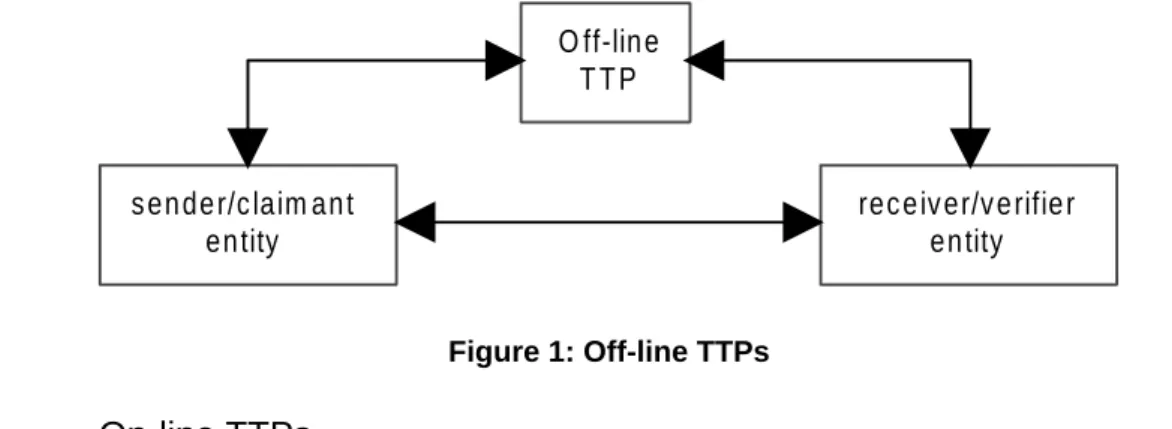
An off-line TTP (see figure 1) does not interact with the user entities during the process of the given security service. Instead the interaction to provide, or register, security-related information is carried out off-line as a separate interaction.
O ff-lin e
T T P
rec e iv er/v e rifie r
en tity
s en de r/c laim an t
en tity
Figure 1: Off-line TTPs
4.5.1.2
On-line TTPs
An on-line TTP (see figure 2) is requested by one or both entities in real-time to provide, or register, security-related information. Such a TTP is not in the communications path between the two entities.
O n -lin e
T T P
rec e iv er/v e rifie r
en tity
s en de r/c laim an t
en tity
4.5.1.3
In-line TTPs
An in-line TTP (see figure 3) is positioned in the communication path between the entities. Such an arrangement allows the TTP to offer a wide range of security services directly to users. Since the TTP interrupts the communication path, different security domains can exist on either side of it.
In-line
T T P
rec e iv er/ve rifier
en tity
s en de r/c laim an t
en tity
Figure 3: In-line TTPs
4.5.2
Initial user registration with TTPs
A user may need to initially register with a TTP before being able to receive its services and this requirement will be dependent on the TTP functions supported. This may involve a binding contract between the user and the TTP. On the initial registration, the TTP would be responsible for correctly identifying users, issuing the user with registration information including the provision of certificates and keys and, where appropriate, carrying out credit checks on whether the user can pay for the services to be provided.
4.5.3
TTP authentication and access control
The requirement for authentication and access control depends on the TTP service. When a user requests services from his TTP, the TTP and user should authenticate each other to guard against masquerade attacks. When the TTP and user have authenticated each other, the TTP should protect against unauthorized access to the TTP's resources. This will be provided through an appropriate access control mechanism, where only authorized users are allowed to access or invoke certain services. The access control mechanism may be provided by physical means for off-line TTPs. However, where users communicate with on-line TTPs there is likely to be a requirement for an automatic means of control, e.g. through the use of a secure computer operating system.
4.5.4
TTP service interface
Typically the user will send requests for a particular service to a TTP. The TTP will then respond appropriately by providing the user with the specified service. Whatever their individual roles, capabilities or operating environment, TTPs may need to be able to interoperate via a set of common interfaces. These interfaces will be described in the ETS on TTPs.
4.6
TTP services, functions and applications
TTP services can be categorized using a functional scheme which categorizes TTP services according to the user's perspective. The functional classification used in this document is restricted to TTP security services, which includes the use of TTPs to support cryptographic technologies.
4.6.1
Services
TTP services are split into six general categories as listed below: - key management services for symmetric cryptosystems; - key management services for asymmetric cryptosystems; - key escrow/recovery services;
- identification and authentication support services; - access control support services;
- non-repudiation services.
The services are composed of a common set of core TTP functions which will be implemented as a set of internal components providing services through external interfaces. Alternatively, these functions can be implemented by different TTPs depending on the nature of the application environment. These six categories are discussed in detail in clause 5.
4.6.2
Applications
The six general categories attempt to classify all possible security services that may be offered by TTPs. These services may be used in specific applications of a TTP. The TTP applications may provide services from any one or more of the six general categories in order to fulfil a particular role or requirement. For example, an application of a TTP may be to support a digital signature infrastructure by acting as a certification authority for public keys, or to act as a trusted key distribution centre. Annex B describes some of the potential applications of TTPs.
5
TTP services and functions
5.1
Key management services for symmetric cryptosystems
TTPs that support the management of secret keys for use in symmetric cryptosystems may offer a wide range of security services including authentication, integrity protection, confidentiality, non-repudiation and access control.
A TTP could offer separate generation and distribution services depending on the requirements. For example, the user may request a TTP to distribute a key generated by some other entity. A TTP may be asked to generate a key but not distribute it.
5.1.1
Secret key generation
A TTP may be required to generate secret keys for secret key cryptosystems. Secret key generation will involve
randomly selecting a key value from all possible values for a given cryptosystem. In this scheme, the user would request the TTP to generate a secret key for a given symmetric cryptosystem. The key may then be used by the TTP itself, distributed to the user or distributed to another entity on the user's behalf.
5.1.2
Secret key distribution
Secret keys generated by a TTP, or provided by a user, may have to be distributed to other entities. This needs to be carried out in a secure way using suitable techniques. In addition, a user may request a TTP to distribute a secret key to another entity on its behalf.
5.1.3
Secret key revocation
A TTP may be needed to revoke a secret key, which has been previously distributed. Key revocation may be required for a number of reasons including suspicion that a particular key has been compromised, or changes in the purpose for which the key was being used.
5.1.4
Secret key storage and retrieval
A TTP may be required, for various reasons, to provide for the storage of keys. This needs to be done in a secure way. For example, such storage should safeguard the confidentiality and integrity for any keys stored. Safeguards to secure the storage of keys include physical, technical, procedural and legal measures, including the use of encipherment. The retrieval of keys needs to be safeguarded against the unauthorized access to such keys. Again these safeguards can include a combination of physical, technical, procedural and legal measures.
5.1.5
Secret key archival
Once a key has come to the end of its operational life, it may have to be archived. In this scheme, a user would request a TTP to archive a secret key. Before storing the key in a storage facility, the TTP should add a time-stamp, integrity protect and/or encrypt the key. Clearly, the TTP should implement suitable access control mechanisms in order to prevent unauthorized parties from retrieving the key.
5.2
Key management services for asymmetric cryptosystems
TTPs that support the management of public/private key pairs for public key cryptosystems may offer a wide range of security services including authentication, integrity protection, confidentiality, non-repudiation and access control. If the same cryptosystem is used for different services, then keys used for confidentiality services should not be used for integrity services.
A TTP could offer separate generation and distribution services depending on the requirements. For example, the user may request a TTP to distribute a key generated by some other entity. A TTP may be asked to generate a key but not distribute it.
The key management for public key cryptosystems is inherently different to that for symmetric cryptosystems. In particular, the distribution of public keys does not require confidentiality protection but does require integrity protection in order to guarantee the key's authenticity.
5.2.1
Public/private key pair generation
A TTP may be required to generate key pairs for public key cryptosystems. Key pair generation will involve randomly selecting a key pair value from all possible values for a given public key cryptosystem. In this scheme, the user would request the TTP to generate a key pair for a given public key cryptosystem. The key pair may then be used by the TTP itself, distributed to the user or distributed to another entity on the user's behalf.
5.2.2
Public key certification
To guarantee the authenticity of the public key, it needs to be certified by a certification authority trusted by users of the public key. In this role, the certification authority is acting as a TTP. The certification process will produce a public key certificate containing essential information about the key including, validity dates for the certificate, the key itself, and a digital signature for the certificate calculated using the certification authority's private key. The digital signature can then be verified by potential users using the certification authority's public key.
5.2.3
Public/private key pair distribution
In asymmetric cryptosystems, the sender may use the public key of the recipient to encrypt data and the recipient may use its corresponding private key for decryption. The sender needs to be sure that the recipient's public key is genuine, otherwise an attacker may have substituted the key for its own public key, thereby allowing the attacker to retrieve the data. Similarly, if the sender uses the private key to sign data, the recipient should be sure that the public key used to verify the signature is genuine.
In this scheme, a user may request the TTP to distribute the key pair, which the TTP has previously generated for the user. This will involve distributing the private key to the user in confidence, and distributing the corresponding public key to the user in the form of a certificate. Alternatively, a user may request a TTP to distribute a key pair to another entity on its behalf. A user may also want a TTP to distribute a public key certificate to a public directory server, where it can be accessed by a large number of potential users. However, it may be convenient for the TTP that generates public key certificates to act as a directory server for them.
5.2.4
Public/private key pair revocation
A TTP may be required to revoke a public or private key, which has previously been distributed. Key revocation may be required for a number of reasons including suspicion that a particular key has been compromised, or changes in the purpose for which the key was being used. When operating as a certification authority, a TTP will be responsible for regularly generating and distributing Certificate Revocation Lists (CRLs), containing a list of certificates which, although not expired, are no longer valid. Where certificates are retrieved in real time from an on-line service, the revocation of a certificate may also be indicated by replacing the valid certificate by one which is marked as being revoked.
Since time may be an important factor when keys have been compromised, a TTP should be able to react quickly to a request for key revocation while still ensuring that only authorized entities may initiate revocation of a key.
5.2.5
Public/private key pair storage and retrieval
A TTP may be required, for various reasons, to provide for the storage of keys. This needs to be done in a secure way. For example, such storage should safeguard the confidentiality and integrity of any private keys stored and the integrity of any public keys stored. Safeguards to secure the storage of keys include physical, technical, procedural and legal measures, including the use of encipherment.
The retrieval of keys needs to be safeguarded against unauthorized access to such keys. Again these safeguards can include a combination of physical, technical, procedural and legal measures.
5.2.6
Public/private key pair archival
Once a key pair has come to the end of its operational life, it may have to be archived, in which case a user may request a TTP to archive a key pair. Before storing the key pair in a storage facility, the TTP should add a time-stamp, integrity protect and/or encrypt the key pair. Clearly, the TTP should implement suitable access control mechanisms in order to prevent unauthorized parties from retrieving the key pair.
5.3
Key escrow/recovery services
Key escrow/recovery services relate to the safeguarding of keys to enable data to be decrypted whether it is data being communicated or in storage (see references [2] and [4]). Typical areas of application include those of lawful interception (see subclause 7.5), lawful access (see subclause 7.6) and user/business access. The main difference between these areas of application are the prescribed conditions under which decryption of ciphertext can take place.
For example an organization may choose to operate a data recovery service to recover business files and company information that have been encrypted by employees. It might simply be that the owner of the file needs to have access to escrowed keys to employ emergency decryption to recover data encrypted by keys that have been lost or damaged. Another example might be that a law enforcement agency has the lawful authorization to receive escrowed keys from a TTP to lawfully access a user's incoming and outgoing communications. This requirement is subject to national law and international treaties and should be interpreted in accordance with applicable national policies.
In a key escrow/recovery system a TTP might combine the roles of a key generation and/or distribution agent for its users, as well being a supplier of user keys. A TTP operating such a system will also need to deal with issues such as key revocation, storage, retrieval and reconstruction. Keys need to be safeguarded against compromise, loss or abuse. This includes reliability and resiliency for protecting keys from compromise and for enabling data recovery. These safeguards can include a combination of physical, technical, procedural and legal measures. For example, this includes safeguards such as the use of encryption, authorization procedures, auditing, separation of duties, split knowledge, two person control, trusted systems.
5.4
Identification and authentication support services
Authentication with respect to the use of TTPs (e.g. for user registration, see subclauses 4.5.2 and 4.5.3) and for the support of TTP services and applications is a fundamental requirement. The TTP will typically be responsible for generating and checking information by which other entities identify a user, and hence will need to take some care in properly identifying a user before issuing that user with newly generated keys, key certificates. and other security related items. A TTP can be used as an authentication server in authentication schemes that involve third parties. The services can be categorized according to whether the authentication server is on-line, off-line or in-line.
5.4.1
On-line authentication services
In symmetric authentication schemes, there is a requirement for every verifier to maintain a secret symmetric key with every claimant (see ISO/IEC 10181 [10]). This may not be practical for end-to-end user authentication. Instead, a trusted on-line authentication server could be introduced. This would share a secret key with every claimant and verifier. Two general approaches to this scheme are outlined below:
- in the first approach, the claimant encrypts or seals a message with its secret key and sends it to the verifier. Since the verifier does not share the claimant's key, it needs to obtain it through a separate exchange with the server. This exchange should be secured using a shared key between the server and the verifier;
- in the second approach, the claimant first obtains a ticket from the server which contains a secret key to be used by the claimant to authenticate itself. The communication with the server is protected using a secret key shared between the server and the claimant. After the exchange, the claimant authenticates itself by encrypting or sealing a message with the secret key it received from the server and sending it to the verifier for checking.
5.4.2
Off-line authentication services
With asymmetric authentication the need for the authentication server to be on-line is removed
(see ISO/IEC 10181 [10]). Instead, verifiers can obtain certified public keys for claimants and certificate revocation lists from an off-line server, prior to or during authentication. This information can be cached and reused to avoid having to communicate with the server each time authentication is initiated. However, if a user wants to be absolutely certain that a certified public key has not been revoked it should verify the status of the certificate or the certificate revocation list with the server.
An off-line authentication server may act simply as a directory server for certificates generated by another TTP acting as a Certification Authority (CA).
5.4.3
In-line authentication services
In-line authentication involves an authentication server positioned in the communication path between claimant and verifier. The authentication is, in effect, split into two sets of interactions. Firstly, the claimant attempts to authenticate itself to the server, which vouches for the identity of the verifier. Secondly, the verifier attempts to authenticate the server, which vouches for the identity of the claimant. This scheme has the advantage that the claimant and verifier may belong to different security policy domains. The server may apply different mechanisms to each domain to realize the different security policies of each domain.
5.5
Access control support services
A TTP can be used to certify privileges for access control (see ISO/IEC 10181 [10]). Certified privileges may be obtained from a TTP either in the form of a Privilege Attribute Certificate (PAC) (see ECMA-219 [14]), an attribute certificate or as additional attributes within a public key certificate (reference [13]). In addition, a TTP may be responsible for access control to information it uses in providing the TTP functions.
NOTE: This is one of the two most common approaches to providing access control services. The other approach is where the resource checks the identity of the user against a privilege list held at the resource. The best approach depends on particular circumstances. However, the use of a TTP only seems applicable to the privilege attribute approach.
The PAC will contain a list of resources that the user may wish to access and the associated privilege level that the user has been assigned. A user will send a request for a given privilege attribute to a TTP, which will then identify and authenticate the user. If the current security policy states that the user is authorized to make the requested access, then the TTP will generate and certify the privilege attribute. The privilege attribute certificate is then distributed by the TTP by publishing it in a directory.
The veracity of privilege information can be checked on demand by anyone who obtains the TTP's public certification key. The PAC may need to be revoked if changes in access control privileges are required, or if a compromise of sensitive information is suspected.
5.5.1
Generation of certificates for access control
A TTP may be required to generate a certificate for access control for a particular user. The first stage of this process would be to authorize the certificate depending on the current security policy within the operating domain. The second step would be to collect the relevant information about the user, the possible addition of a current time-stamp, and the actual generation of the access control information. The final step would be to certify the information by adding a digital signature generated using the TTP's private key.
5.5.2
Distribution of certificates for access control
Once the certificate for access control has been generated for a particular user, the TTP may be required to distribute it to a separate directory server. Note also that the TTP may act as a directory server for certificates it generates
5.5.3
Revocation of certificates for access control
A TTP may be required to revoke a certificate for access control, which has previously been distributed. Certificates for access control revocation may be required for a number of reasons, including changes in security policy. When acting as a server for certificates for access control, a TTP will be responsible for regularly generating and distributing revocation lists, containing a list of certificates for access control which, although not expired, are no longer valid.
5.5.4
Archival of certificates for access control
Once a certificate for access control has come to the end of its active life, it may have to be archived. Typically, a user would request a TTP to archive a certificate for access control. Before storing the certificate for access control in a storage facility, the TTP should add a time-stamp, integrity protect and/or encrypt the key pair. Clearly, the TTP should implement suitable access control mechanisms in order to prevent unauthorized parties from retrieving the certificate for access control.
5.6
Non-repudiation services
Non-repudiation services involve many different aspects including commercial, legal and technical. This document concentrates primarily on the technical aspects. In this respect TTPs have an important role to play in the provision of non-repudiation services. ISO/IEC 10181 [10] describes the application of non-repudiation services in open systems. It identifies non-repudiation mechanisms which involve TTPs. These are listed below:
- non-repudiation involving a TTP security token;
- non-repudiation using a digital signature (the TTP supports digital signatures); - non-repudiation using time-stamping (the TTP carries out time-stamping); - non-repudiation using an in-line TTP;
- non-repudiation using a notary.
In general, a non-repudiation service involves the generation, verification and recording of evidence, and the subsequent retrieval and re-verification of this evidence in order to resolve disputes. Its purpose is to provide evidence about a particular event or action. There are four distinct phases to non-repudiation services:
- evidence generation; - evidence recording; - evidence verification; and - dispute resolution.
TTPs may be involved in all of these phases as described in ISO/IEC 13888 [12] which specifies a number of security techniques for non-repudiation services. However, their involvement depends on the mechanism used. For example, the use of asymmetric cryptographic techniques to generate and verify evidence may or may not require the involvement of a TTP, whereas the use of symmetric cryptographic techniques in evidence generation and verification requires a TTP.
NOTE: This standard uses the term ‘evidence’ to address the technical instrument to provide proof. This use of the word evidence should not be confused with the more formal legal use of the word.
5.6.1
Evidence generation
Evidence generation follows an invocation of the service by a non-repudiation service requester. Relevant evidence may include the identities of the entities involved, the communicated data, and the date and time. Additional information that may be required could comprise mode of transfer, location of entities or creator of data. The evidence may be generated by the evidence subject, perhaps in conjunction with a TTP, or by a TTP alone.
5.6.2
Evidence recording
A TTP may also have to record evidence in a non-repudiation role so that it can be retrieved by an evidence user or adjudicator. The evidence to be recorded will typically be received via an interface with the network over which the communication entities are sending messages. The recording process may involve the addition of a time-stamp and certain user-related information.
5.6.3
Evidence verification
The purpose of evidence verification is to provide the evidence user with the confidence that the supplied evidence will be adequate in the event of a dispute arising. The evidence verifier may be the evidence user, or a TTP trusted by the evidence user.
5.6.4
Dispute resolution
In dispute resolution, an adjudicator is responsible for collecting evidence from the disputing parties and possibly a TTP in order to make a decision which will resolve the dispute.
5.7
Auxiliary support services
The following services, which are not part of the four distinct phases described in subclause 5.6, are identified below. These are also important non-repudiation services which may be offered by a TTP:
- time-stamping; - audit;
- delivery authority.
5.7.1
Time-stamping
A TTP may be required to certify that it has affixed a signature to a data item at a particular time. This is an important function, e.g. in certification, and non-repudiation evidence recording services. The time-stamping function will involve the receipt of information to be time-stamped, the addition of a time-stamp and a signature, and the transmission of the signed, time-stamped information back to the requester.
5.7.2
Audit
A TTP may act as an on-line authority which would carry out audit functions (e.g. logging, analysis, and reporting). In this role, the TTP would monitor the transfer of data and provide evidence about what was monitored. This is an important function, e.g. in non-repudiation evidence recording services.
The audit function will involve the reception of audit information, the storage of audit information, and the supply of audit information when required.
5.7.3
Delivery authority
A TTP may act as an on-line authority that interacts with the intended recipient of data and releases the data if, and only if, correct proof of delivery is provided by the recipient. The delivery authority function will involve the receipt of information to release once appropriate evidence is received, the receipt and verification of evidence, and the release of information.
5.8
Functions against services
Table 1 provides an example of the TTP functions that may be used in combination to provide the various TTP services as detailed in subclauses 5.1 to 5.7: Table 1 TTP services TTP Functions Symmetric key management Asymmetric key management Key escrow/ recovery I&A Access Control Non-Repudiation Key generation Key distribution Key revocation Key archival Key storage/retrieval (see note 2) Key reconstruction Public key certification Certification for access control Claimant/verifier exchanges Evidence generation Evidence recording Evidence verification Dispute resolution Time-stamping Audit Delivery authority
NOTE 1: For each TTP service indicated not all of the TTP functions that are marked by "ticks" are necessary. The specific implementation of the TTP service will dictate which of these functions are optional and which are necessary.
NOTE 2: Not all schemes will need to provide key storage.
The TTP services and functions described in this subclause may be combined in a variety of ways according to the security requirements to be satisfied, for example, to meet the need for confidentiality or integrity. It should be noted that this is not a definitive table but that it does relate the major services and functions a TTP might support.
The standards and specifications referenced in [1] to [15], and [28] to [36], inclusive, provide more background information and details on many of the functions given in this subclause. They also provide most of the definitions and terminology used here.
6
TTP interfaces
6.1
Types of interface
A number of interfaces are needed to support the working and interoperability of a TTP, and the users and applications it serves. The following types of interfaces may be required to support the list of functions identified in clause 5:
- User Interface (U-I);
- Key Escrow/Recovery Interface (KER-I); - inter-TTP Interface (T-I);
- Application Interface (A-I).
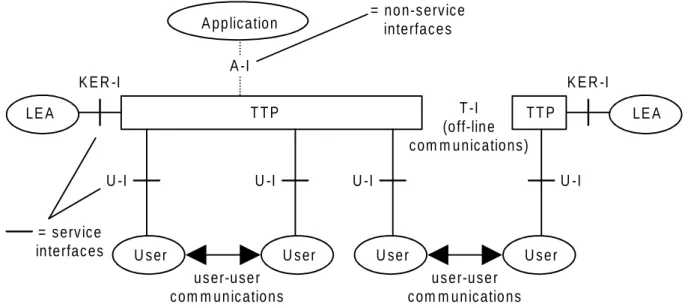
The four interfaces can be logically split into two service interfaces (user and key escrow/recovery) over which the TTP offers its services, and two non-service interfaces (inter-TTP and application) which are used to support the services offered by the TTP.
A pp lic ation
A -I
= no n-s ervic e
interfac e s
T T P
LE A
T -I
(o ff-lin e
c om m u nic atio ns )
K E R -I
U -I
U s er
= s erv ic e
in terfac es
U -I
U -I
U s er
U se r
U s e r
U -I
T T P
LE A
K E R -I
u s er-u se r
c om m un ic atio ns
u s er-u se r
c om m un ic atio ns
Figure 4: General interface configuration
Figure 4 shows a general configuration containing all four interfaces. The selection of services and functions to be supported by a TTP will determine the extent to which all these interfaces need to be supported and the specific configuration to be implemented. In the case of the interface, KER-I, a Law Enforcement Agency (LEA) is given in this example as the entity interacting with the TTP. This entity may however be any authorized user in accordance with the definition of key escrow/recovery (see subclause 3.1).
Secure administration and operation of the TTP also involve the operator interface which is not covered in detail in this specification. The operator interface shall be implemented in a way which supports secure operation of the TTP. The operator interface might be a human or administrator interface.
6.2
Interface requirements
6.2.1
User interface
The User Interface (U-I) is the means by which a user interacts with a TTP in order to request and receive a TTP service. The user interacts with the TTP in different ways depending on what type of service is being offered. The TTP services involving the user interface are listed below together with a description of the role of the user interface in providing that service:
a) key management services:
- for key management the user can request the generation, distribution, archival or escrow/recovery of various cryptographic keys via the user interface. In addition, the TTP can act as a certification authority for public keys which it generates and distributes. Certification is done using the TTP's secret key. The management of public key certificates involves the TTP providing certificate revocation lists to users via the user interface; NOTE: The TTP may be lawfully obliged to provide this service whether or not the user has requested it
according to national laws.
- the user can request all or just some of the above actions to be carried out. Each action can be qualified with certain parameters, e.g. to indicate which key to distribute and where to distribute it to. Users should be able to update their keys, where possible, according to the requirements of their own security policies;
- in case the TTP generates a private/public key pair for the user, the private key shall not be distributed across the user interface. The authenticity and security of the private key are assured through the inherent security provided by the physical means of communication such as registered mail;
- users can verify public key certificates distributed by the TTP using the TTP's public key. It is assumed that this public key is not distributed across the user interface since there will be no means to verify its authenticity cryptographically. Instead, the authenticity of the public key is assured through the inherent security provided by physical means of communication such as registered mail;
b) identification and authentication services:
- in on-line or off-line identification and authentication the user can request the generation, distribution or archival of cryptographic keys or authentication tokens via the user interface. Again, these actions can be qualified with parameters;
- the user can use the cryptographic keys or authentication tokens when he wants to authenticate himself to another user. The other user can also interact with a TTP in a similar manner in order to be able to verify the identity of the claimant. Although the above scheme deals with unilateral authentication, it could be easily extended to cope with mutual authentication;
- in the case of in-line authentication the TTP is positioned between two users who wish to authenticate each other. In the scheme the verifier sends a request to authenticate the claimant to the TTP, via the user interface. The TTP responds by authenticating the claimant on behalf of the verifier via the user interface. Conversely, the verifier authenticates the TTP via the user interface where the TTP is vouching for the identity of the claimant;
c) access control services:
- in access control the user can request the generation, distribution or archival of privilege attribute certificates via the user interface. The TTP acts as a certification authority for privilege attributes that it issues. Such privilege attributes are certified using the TTP's secret key. The management of privilege attribute certificates can involve the TTP providing certificate revocation lists to users via the user interface. Each action can be qualified with certain parameters to indicate what is to be accessed and what privileges are required; - users can verify privilege attribute certificates distributed by the TTP using the TTP's public key. Again, it is
d) non-repudiation services:
- non-repudiation services can make use of a TTP indirectly in order to generate, distribute or archive various cryptographic keys which are used to support the non-repudiation service. Such requests are made via the user interface. Again, actions can be qualified with parameters;
- non repudiation services can involve the TTP directly. The user can request that the TTP generate, transfer, store, retrieve or verify evidence. The TTP responds by sending or gathering appropriate information via the user interface. Here, the requests can be qualified with information to indicate what information should be collected;
- the user can request that the TTP time-stamps certain information as part of a non-repudiation service. In addition, a TTP can be requested to act as a delivery authority for a particular user. Again for both these interactions, the user interface will be important;
- the user can request that the TTP resolve a dispute which has arisen between himself and another user. The TTP responds with a decision and supporting evidence. This can involve interaction with other TTPs and/or an adjudicator.
6.2.2
Key escrow/recovery interface
The KER-I is the means by which a law enforcement agency can request and receive from a TTP escrowed information for confidentiality purposes, to enable encrypted communications lawfully intercepted to be decrypted. It can also be used as part of an organization's data recovery service or for lawful access (see subclause 5.3).
This interface can be used in TTP services which involve the generation and distribution of cryptographic keys intended to be used for encryption. As such, this interface is only used in providing TTP supported key management services. Moreover, the presence and usage of this interface depends on the particular legal requirements which exist in the TTP's operating environment.
When acting as a key management server the TTP can generate and distribute an encryption key to a particular user. The TTP may be legally obliged to escrow information which will enable a law enforcement agency to decrypt data which has been encrypted. This can include releasing a secret key to be used in a symmetric algorithm, or releasing a private key to be used in an asymmetric algorithm.
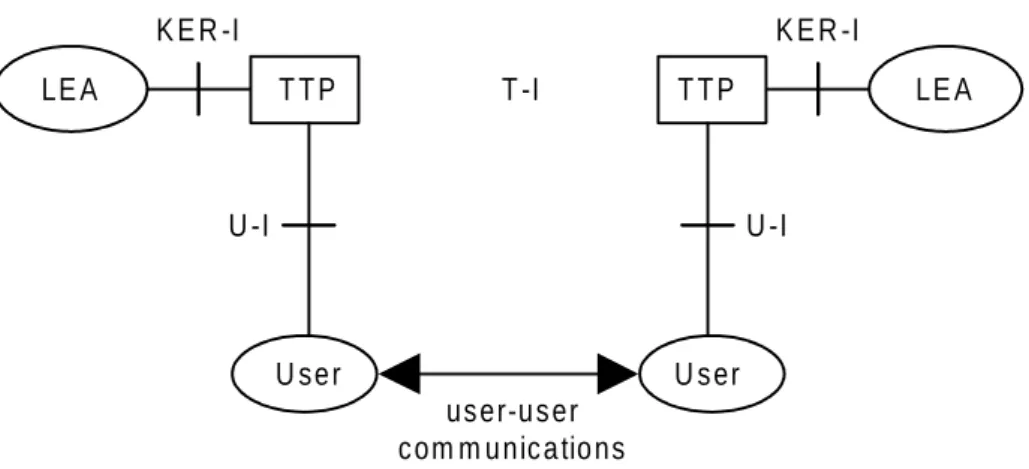
Any TTP scheme will need to provide escrowed confidentiality information to enable access to a user's incoming and outgoing communications. In the general case (see reference [2]), where the communicating users have two separate TTPs (TA and TB) and the communication is two-way, four scenarios might exist (where the first two correspond to what seem to be the most likely scenarios):
- the TTP TA is required by a lawful authorization to provide access to keys relating to outgoing communications from a user for which it acts;
- the TTP TB is required by a lawful authorization to provide access to keys relating to incoming communications to a user for which it acts;
- the TTP TA is required by a lawful authorization to provide access to keys relating to incoming communications (from a user for which it acts) to a user for which it does not act;
- the TTP TB is required by a lawful authorization to provide access to keys relating to outgoing communications (to a user for which it acts) from a user for which it does not act.
In each scenario the TTP provides the LEA with the relevant escrowed information. This will involve use of the interface KER-I and may involve interaction with another TTP via the inter-TTP interface (T-I).