Lauren McCreanney
1321968
MSc Psychology (Conversion)
PS7112 Research Dissertation
2016/2017
University of Chester
The Effect of Individual Differences on the
Ability to Accurately Detect Deception.
Declaration
This work is original and has not been submitted in relation to
any other degree or qualification.
With thanks to my supervisor Dr Clea Wright for her assistance and support with this piece of research.
Department of Psychology
Research Module Meeting Log 2016/2017
NAME: Lauren McCreanney
SUPERVISOR: Dr Clea Wright
Date
Discussion topics
01/02/2017 Discussion of potential project briefs. 21/03/2017 Meeting to discuss chosen project.
28/03/2017 Meeting to discuss first draft of ethics form and receive feedback. 04/04/2017 Meeting to discuss amendments made to ethics form.
03/05/2017 Meeting to collect resources needed for study.
31/08/2017 Meeting to discuss first full draft of dissertation and receive feedback.
SIGNED
STUDENT __________________________________ DATE: ___________
Table of contents
Declaration 1
Acknowledgements 2
Supervision log 3
Table of content 4 List of tables and figures 5
1. Abstract 6
2. Introduction 7
2.1Emotional intelligence 13
2.2Emotional Contagion 16
2.3Facial Emotion Recognition 18 2.4Hypothesis and Rationale 21
3. Method 23
3.1. Participants 23
3.2. Measures 23
3.3. Procedure 26
3.4. Analysis and design 27
4. Results 29 5. Discussion 31 5.1Findings 31 5.2Implications 36 5.3Limitations 37 6. Conclusion 38 7. References 40 8. Appendices 66
Appendix 1 Email Text 66
Appendix 2 Ethics Application Form 67 Appendix 3 Emotional Intelligence Scale 77 Appendix 4 Emotional Contagion Scale 79 Appendix 5 Participant Information Sheet 80
Appendix 6 Consent Form 83 Appendix 7 Pictures of Facial Affect 84 Appendix 8 Pictures of Facial Affect Sheet 86 Appendix 9 Video Clip Check Boxes 87 Appendix 10 Debrief Sheet 88 Appendix 11 SPSS Output – CD attached to rear cover
List of Tables
Tables
Abstract
Deception detection ability is an area that is not short of research, yet there is currently no definitive explanation for why some people are better than others at spotting a liar. This study surrounds individual differences in deception detection ability of high-stakes lies, and focuses on emotional intelligence level, susceptibility to emotional contagion and facial emotion recognition ability as variables. As these individual differences are all related to emotion-processing, and due to the often emotional nature of high-stakes lies, it is hypothesised that a relationship will be found between deception detection ability and each of these variables. Participants (n=60) completed the Schutte Self-Report Emotional Intelligence Test [SSEIT] (Schutte et al., 1998), the Emotional Contagion Scale (Doherty, 1997), and Ekman and Friesen’s (1976) Pictures of Facial Affect test, before viewing ten video clips of real life footage of individuals making televised pleas for the safe return of their relative or significant other. Participants were asked to make a veracity judgement of the appealer in each clip. The data was analysed through a standard multiple regression, though no statistically significant results were found to indicate relationships between the variables, conflicting with previous research. Further research is required to gain a greater insight in to each of these variables, though this study has
Introduction
Deception is a common feature of social interaction (Baker, ten Brinke & Porter, 2012), and often serves to promote social cohesion (Vrij, 2008),
therefore psychologists have been interested in deception for decades (Vrij & Verschuere, 2013). This interest has resulted in a large investigation, which has focused on the intentions, characteristics and behaviour of the deceiver (Seiter, Bruschke & Bai, 2002), as well as the ability of those around them, including laypersons and professionals, such as police officers, to detect deception (Elaad, 2009; Ekman & O’Sullivan, 1991; Strömwall & Granhag, 2003).
Research studies have been undertaken with the aim of finding new methods for deception detection, specifically in relation to law enforcement and
intelligence agencies (Frank & Feeley, 2003; Hartwig, Granhag, Strömwall & Kronkvist, 2006), whilst research hasalso led to the development of theories surrounding deception and deception detection (Buller & Burgoon, 1996; Levine, 2014; Street, 2015).
Deception researchers have been investigating the notion of nonverbal cues to deceit for over a century (Bond, Howard, Hutchison & Masip, 2013), resulting in the publication of numerous studies with conflicting findings (Vrij, 2008). However, it is now widely believed that the connection between deception and nonverbal cues is weak (DePaulo et al., 2003; Sporer &
Schwandt, 2006, 2007), as meta-analyses have revealed that people can only slightly detect deception from the observation of behaviour alone (Bond & DePaulo, 2006). Further, cue training to detect deception has not been successful in improving accuracy levels (Hauch, Sporer, Michael & Meissner,
2014). Despite this, lay observers still believe that nonverbal behavioural cues can reveal deception and often focus on these when making a veracity
judgement (Bond et al., 2013; Hartwig & Bond, 2011), potentially providing an explanation for why people do not generally have high accuracy in deception detection (Bond & DePaulo, 2008).
To assess deception detection accuracy, psychologists have tested people’s ability to classify statements as either truths or lies (Bond & DePaulo, 2006). Considering that a 50% rate of deception detection accuracy would be expected by chance, research illustrates that overall rates of lie/truth
discrimination average approximately 54%, which is slightly but significantly above chance level (Aamodt & Mitchell, 2006; Bond & DePaulo, 2006). People vary in levels of trust (Levine & McCornack, 1991), therefore it would be
expected that some people would be more likely than others to detect
deception, though lie detection failure has been attributed to the psychological benefits of trust and socialisation to overlook lies (Ekman, 2001). Research suggests that truthful messages are judged correctly more often than deceptive messages (Bond & DePaulo, 2006), whilst there is evidence of a truth bias in laypeople when making a veracity judgement (Vrij, 2008). However,
professional lie catchers tend to show a deception bias (Baker, ten Brinke & Porter, 2012), and professional lie catching is associated with an inflated confidence in judgement decisions (Meissner & Kassin, 2002). Yet, both truth and deception biases negatively influence deception detection ability (Vrij, Granhag & Porter, 2011).
On average, people lie twice each day (DePaulo, Kashy, Kirkendol, Wyer & Epstein, 1996), with common motives including altruism, impression
management and direct personal advantage of the deceiver (Seto, Khattar, Lalumiere & Quinsey, 1997; Vrij, 2008). All deception judgements have consequences (Granhag & Strömwall, 2004), whether they are correct or incorrect (Bond et al., 1992). Yet high-stakes, real-world deceivers have a lot to lose or gain depending on how they are judged (Frank & Ekman, 1997), and incorrect judgements surrounding high-stakes lies may result in a criminal not being appropriately punished or an innocent person being found guilty of a crime that they did not commit. For every day, low-stakes lies there are few behavioural signs to inform an observer’s veracity decision (Hartwig & Bond, 2011), though high motivation to appear credible, alongside the complexity of creating and maintaining a consequential lie, can lead to increased cognitive load and, consequently, greater leakage of behavioural signals (DePaulo, Kirkendol, Tang & O’Brien, 1988; Vrij, Fisher, Mann & Leal, 2008), therefore it may be reasonable to assume that this could result in a greater likelihood of detection. However, research suggests that this is not the case, as high-stakes lies often go undetected by professional lie catchers (Vrij & Mann, 2001).
Researchers have proposed the existence of deception detection ‘wizards’ who have the ability to consistently and accurately detect deception (O’Sullivan & Ekman, 2004), yet this has led to controversy, with criticism being made about the methodology used within the study, leading to the ‘deception detection wizards’ being termed as statistical flukes (Bond & Uysal, 2007). Deception detection ability has been researched in relation to individual
differences, as it has been proposed that all individuals differ from one another in lie detection ability, with no wizardry necessary (Aamodt & Mitchell, 2006; Bond & DePaulo, 2008; Porter, Woodworth & Birt, 2000; Vrij & Graham, 1997). It has been hypothesised that deception detection accuracy depends on the receiver’s decoding skills (Buller & Burgoon, 1996), sensitivity to deception (Malone & DePaulo, 2001), extraversion (Peace, Porter & Almon, 2011) or Machiavellianism (Zuckerman, DePaulo & Rosenthal, 1981). However, it has been argued that people vary little in their detection skills (Kraut, 1980), and this argument is supported by research that found no positive relationship between a person’s ability to accurately identify lies and their ability to accurately identify truths (Levine, Park & McCornack, 1999). Further, evidence suggests that a person’s success at spotting women’s lies is independent of their success at spotting men’s lies (DePaulo & Rosenthal, 1979), and researchers have found no relationship between an individual’s accuracy in judging one person and the same individual’s accuracy in judging a second person (Bond & DePaulo, 2008; Kraut, 1978). Though, it has been found that participants with experience of deceiving, such as criminal offenders, are better at detecting deception than those with limited experience (Hartwig, Granhag, Strömwall & Andersson, 2004).
Baker, ten Brinke and Porter (2012) believe that individual differences could impair or facilitate an observer’s ability to discriminate true or false stories, specifically those that are emotional, such as narratives associated with criminal activity, missing people or murder. This is due to the emotional content of the story, which interacts with the emotional functioning of the receiver, influencing
their judgement of credibility (Campbell & Porter, 2002). This belief is supported by research that found certain personality factors, such as those outlined within the Five-Factor Model (Digman, 1990; John, 1990; McCrae & John, 1992), may influence an individual’s ability to accurately make judgements of credibility. Firstly, Peace, Porter and Almon (2011) found that the personality factor of openness to experience was positively associated with accuracy, supporting findings that suggest that people high in openness to new experience have many features required for veracity determinations, such as; divergent and effortful thinking, adaptation of skills and creation of solutions to suit new situations and complex problems (Colquitt, Hollenback, Ilgen, LePine & Sheppard, 2002; Flynn, 2005). Further, neuroticism facilitates effective lie detection (Campbell & Porter, 2002; Peace, Porter & Almon, 2011), yet on the other hand, socially anxious individuals appear to have a disadvantage in the detection of deception (DePaulo & Tang, 1994), and evidence suggests that participants who scored high in sociability and trust were less accurate at detecting false versus genuine accounts of childhood experiences (Campbell & Porter, 2002). Additionally, a negative correlation has been found between extraversion and accuracy (Peace, Porter & Almon, 2011), and this finding may be supported by previous research that observes introversion to be related to use of more stringent decision-making criteria, more detailed processing of stimuli and lower distractibility on tasks (Aron & Aron, 1997; Koelega, 1992; McCrae, 1987). However, it has been argued that personality characteristics may actually influence decision making rather than deception detection accuracy (Baker, ten Brinke & Porter, 2012), and research suggests that skill
level and characteristics of the deceiver override any potential individual differences in the skills of deception detectors (Bond, Omar, Mahmoud & Bonser, 1990).
The majority of deception detection studies have examined lies surrounding non-emotional events, such as a mock crime scenario (Lui & Rosenfeld, 2008; Mertens & Allen, 2008; Park, Suk, Hwang & Lee, 2013), or someone erasing a chalkboard (Vrij, Edward, Roberts & Bull, 2000), whereas few have examined powerful emotional lies associated with high-stakes real-life situations that require the processing of affective information. Subjective ratings of sensory and contextual details of a narrative are higher for negative, relative to positive, events (Barnier, Sharman, McKay & Sporer, 2005). Further, Peace and Sinclair (2012) found evidence of an emotive truth bias, whereas emotional stories tend to be inherently believed, potentially resulting in the quality of the deception detection judgement being influenced by the emotional content and intensity of the lie. Additionally, the emotion aroused in the receiver is often used when making a truthfulness judgement (Semmler & Brewer, 2002), as receivers commonly assess credibility based on the presence of emotional content (Vrij, 2008). Based on this evidence, it is clear that a good evidence base of deception detection research focusing on emotional, high-stakes lies is necessary, in order to provide a comprehensive understanding of deception and deception detection ability as a whole.
Historically, the influence of individual differences has been overlooked within psychological theory, yet it has been argued that individual differences must be considered during the construction of new psychological theory
(Underwood, 1975). Over the past century, the study of individual differences in relation to behaviour, thought and ability has grown in popularity and is now one of the largest sub-disciplines of psychological science (Marsh & Boag, 2013), as psychologists seek to discover why and how people differ (Revelle, Wilt & Condon, 2010). This study will focus on three individual differences; emotional intelligence, emotional contagion and facial emotion recognition.
Emotional Intelligence
The study of intelligence, which long focused solely on cognition (Piaget, 1972; Wechsler, 1939), has adapted, and the experience and expression of emotion is now largely considered a domain of intelligence (Gardner, 1983; Goleman, 1995; Sternberg, 1988). Emotional intelligence [EI] refers to the ability to identify, express and understand emotions, comprehend emotions in thought and regulate both positive and negative emotions in the self and others
(Goleman, 1996; Matthews, Zeidner & Roberts, 2002; Mayer, Salovey & Caruso, 2009). Some psychologists argue that EI is more important than IQ level (Goleman, 1996), and longitudinal research has shown that childhood social and emotional abilities such as being able to control emotions, handle frustration and get along with other people has a greater impact on participants’ overall life success in comparison to IQ level (Feist & Barron, 1996; Snarey & Vaillant, 1985). Further, research also suggests that emotional and social skills may improve cognitive functioning (Shoda, Mischel & Peake, 1990).
A core attribute of EI is the ability to integrate emotional and cognitive information (Matthews, Zeidner & Roberts, 2002), and it is argued that this attribute is essential for detecting conflict between verbal and nonverbal cues
(Wojciechowski, Stolarski & Matthews, 2014). Individuals with high EI have the ability to use emotions and emotional knowledge to enhance thought (Mayer, Roberts & Barsade, 2008), which may have an impact on accuracy in detecting emotional, high-stakes lies. The relationship between deception and EI has been researched yielding interesting, yet often contradictory, results (Porter, ten Brinke, Baker & Wallace, 2011; Ono, Sachau, Deal, Englert & Taylor, 2011; Warren, Schertler & Bull, 2009).
Firstly, research has found that high EI is positively related to accuracy in detecting emotional, but not unemotional lies (Warren, Schertler & Bull, 2009). Ekman and O’Sullivan (1991) investigated the deception detection ability of a variety of groups, ranging from students to clinical psychologists and Secret Service agents. The results indicated that all groups performed at chance level, with the exception of the Secret Service agents, who were the best performing group (Ekman & O’Sullivan, 1991). The authors of this study speculate that this is due to their greater emotional understanding, a component of EI, and focus on non-verbal cues such as facial emotion information (Ekman & O'Sullivan, 1991). These findings may also be supported by evidence that has found that individuals with psychopathic personalities who focused on structural rather than emotional cues did not have high accuracy in discriminating true and false emotional narrative transcripts (Peace & Sinclair, 2012). Further, evidence suggests that EI positively predicts job performance among criminal
investigators (Ono et al., 2011), however it may be useful to note that criminal investigators receive little feedback on the accuracy of their judgements.
Wojciechowski, Stolarski and Matthews (2014) found that individuals high in EI were better able to identify inconsistent facial and verbal stimuli, and the authors conclude that this may result in an advantage for detecting real life emotional deception. Additionally, emotionally intelligent individuals were found to have emotional expertise for adopting deceptive facial expressions in
comparison to individuals with low EI (Porter, ten Brinke, Baker & Wallace, 2011). It has been suggested that expertise in deceiving may translate in to enhanced deception detection skills (Fiori, 2009; O’Sullivan, 2005), thus it may be concluded from the research conducted by Porter et al., (2011) that high EI also translates to enhanced deception detection skills.
On the other hand, EI is strongly related to the agreeableness factor of the Five-Factor Model (Digman, 1990; John, 1990; McCrae & John, 1992). Therefore, individuals with high EI may be overly compassionate which could compromise their deception detection ability. Further, individuals with high EI are often more sympathetic to deceptive pleaders, particularly those telling highly emotional lies, which heightens their gullibility (Baker, ten Brinke & Porter, 2012). In addition to this, research suggests that emotionally intelligent
individuals may be unable to be analytical of emotional pleas due to an inability to suppress their emotion-focused processing (Baker, ten Brinke & Porter, 2012), whilst it has also been found that high EI individuals empathised with the emotional turmoil associated with deceptive pleas, and perceived all emotional facial expression as genuine (ten Brinke & Porter, 2011).
If EI is found to reliably predict deception detection ability in this study, this may provide evidence to suggest the value of using EI measures when
selecting legal jurors and professionals such as police officers and judges in the future.
Emotional Contagion
It has long been considered that emotions are contagious, and this is evident within psychological and other scientific research (Darwin, 1872; Fowler & Christakis, 2008; Hatfield, Cacioppo & Rapson, 1994; Howes, Hokanson & Lowenstein, 1985; Pugh, 2001; Reik, 1948). Emotional contagion [EC] is defined as the tendency to automatically mimic and synchronise facial, vocal and postural expressions with those of another person’s causing them to merge emotionally (Fischer, Shaver & Carnochan, 1990; Hatfield, Cacioppo & Rapson, 1994), and it has been termed a basic form of empathy (Preston & de Waal, 2002; Singer, 2006).
Emotional contagion involves aspects of cognitive, psychophysiological, behavioural and social phenomena (Hatfield, Bensman, Thornton & Rapson, 2014) and as EC can be produced by both innate and acquired stimulus
features, as well as mental simulations or emotional imagery, it is considered to be a multiply determined process (Hatfield, Cacioppo & Rapson, 1994). EC is also considered to be a multilevel phenomenon, as the precipitating stimuli from one individual is acted upon by another, or several other, individuals and
produces corresponding emotions in these individuals, consequently initiating an emotional, attentional and behavioural synchrony (Hatfield et al., 2014). Further, EC represents a family of phenomena, as it manifests in a complex of responses, for example the stimulus of an angry face, may spark an angry voice
as well as an angry face in another person (Hawk, 2010; Hawk, Fischer & van Kleef, 2012).
Whilst early theorists attributed emotional contagion to imagination and conscious reasoning (Allport, 1961), primitive emotional contagion is considered to be an automatic, uncontrollable and unintentional process that is inaccessible to conversant awareness (Dezecache et al., 2013). Observers rapidly and automatically mimic other people’s emotional expressions (Lishner, Cooter & Zald, 2008) resulting in faster emotion recognition (Stel & Van Knippenberg, 2008). Different areas of the brain process the various aspects of emotion, yet the brain integrates the emotional information it receives, therefore each of the emotional components acts on and is acted upon by other people (Hatfield, Cacioppo & Rapson, 1994).
Individuals differ in their susceptibility to emotional contagion (Sonnby-Borgstrom, 2002) and this susceptibility can be measured through self-report questionnaires (Doherty, 1997). People with higher susceptibility to EC are more empathetic, have a higher self-esteem and are more sensitive to others, compared to those with low EC (Doherty, 1997). Further, research has found that those high in EC are better able to discriminate sincere and faked
enjoyment expressions (Manera, Grandi & Colle, 2013), yet there is currently no research of this nature that focuses on negative expressions, such as those expected to be depicted in emotional missing person appeals.
There is currently no research available that focuses on emotional
contagion in relation to deception detection. Yet, similarly to individuals with high EI, those with high susceptibility to EC have higher empathy and are better able
to experience the emotions of others (Doherty, 1997), therefore it may be reasonable to assume that they would be more likely to perceive someone as genuine and consequently may have higher gullibility to deception.
Facial Emotion Recognition
Facial expressions act as communicatory signals to convey feeling and provide information about the emotional state of others (Haxby, Hoffman & Gobbini, 2002) and, to date, facial expression is considered to be the leading source of information about emotions (Ekman, 2009). The “basic emotion” model theorises that facial expressions are evolutionarily prepared and automatically recognised, requiring little conceptual processing from the perceiver (Ekman, 1973; Ekman & Cordaro, 2011; Levenson, 2011). Further, according to this model, perceivers are able to reflexively decode emotions from visual information alone, as emotion concepts are epiphenomenal to facial emotion perception (Ekman, Friesen & Hager, 2002; Russell, Bachorowski & Fernandez-Dols, 2003).
For successful deception, the verbal message of a lie must be coherent with the nonverbal signals, such as facial expression (Ekman & Friesen, 1971). It has been argued that humans are able to alter their facial expressions to facilitate deception (Livingstone Smith, 2004), and are least likely to show deception in the face, relative to other parts of the body, as people have more ability and motivation to control the face (Ekman & Friesen, 1969). However, the inhibition hypothesis (Ekman, 2003) inspired by Darwin’s (1872) “The
described as the beginning of the science of psychology (Ekman, 2009), does not support this argument. Darwin (1872) suggested that certain facial muscle actions associated with emotion cannot be completely supressed, regardless of efforts by the emotion bearer. Additionally, Darwin (1872) proposed that
attempts to contract certain facial muscles to simulate emotion would fail (ten Brinke, Porter & Baker, 2012). Nonverbal leakage of lie-related emotions may be due to affective experiences associated with the content of the deception, or to emotions aroused by the act of lying itself (Ekman, 2001). Providing support for the inhibition hypothesis, research has found that involuntary leakage of emotions is ubiquitous, though subtle leakages of emotion are more likely to occur during falsified, in comparison to genuine, expressions (Porter & ten Brinke, 2008). Further, research illustrates that genuine emotion is especially difficult to suppress and more likely to be revealed through facial expression, when it is a strong, relative to a weak, emotional state (Porter, ten Brinke & Wallace, 2011).
Individual differences are considered to effect recognition of facial emotion. Firstly, research surrounding age differences in the recognition of emotion has found that older adults are less accurate at recognising negative emotions, such as anger, sadness and fear (Brosgole & Weisman, 1995; Calder et al., 2003; Isaacowitz et al., 2007; Malatesta, Izard, Culver & Nicolich, 1987; McDowell, Harrison & Demaree, 1994; Sullivan & Ruffman, 2004), though findings suggest age-related stability in recognition of happiness and surprise (Borod et al., 2004; MacPherson, Phillips & Della Sala, 2002; Phillips, MacLean & Allen, 2002).
In addition to the demographic of age, facial emotion recognition research has also focused on the demographic of gender as an individual difference. A common belief across cultures is that women are more emotional, and therefore are expected to experience and express emotions more often than men (Adams, Hess & Kleck, 2015). Thus, it is also assumed that women are superior to men at recognising emotional facial expressions (Hampson, van Anders & Mullin, 2006; Montagne, Kessels, Frigerio, de Haan & Perrett, 2005). Yet, current evidence regarding female superiority in facial emotion recognition is mixed (Wells, Gillepsie & Rotshtein, 2016). It is hypothesised that women have higher empathising capacity (Baron-Cohen, 2002), which may provide an advantage to the recognition of the expressions of others (Hall, Hutton & Morgan, 2010). Wojciechowski, Stolarski and Matthews (2014) found that females scored higher than males on a facial emotion processing task, however the authors of this study argue that this is due to a higher level of EI. Further, it has been argued that female superiority may only occur when the amount of visual information is limited, through the manipulation of expression intensity (Hall & Matsumoto, 2004; Hoffman, Kessler, Eppel, Rukavina & Traue, 2010; Montagne et al., 2005) or the duration of exposure (Hampson, van Anders & Mullin, 2006). Therefore, it may be argued that the female superiority effect may be more reliably associated with response time, rather than differences in accuracy (Rahman, Wilson & Abrahams, 2004; Vassallo, Cooper & Douglas, 2009).
Research suggests that processing facial emotion is important in the detection of deception, as deception is one of the main contexts in which
inconsistent microexpressions are conveyed, due to the emotional leakage that often accompanies lying (Ekman, 2003; Matsumo & Hwang, 2011; Porter & ten Brinke, 2008; Warren, Schertler & Bull, 2009). For example, ten Brinke & Porter (2011) found that deceptive murderers were more likely to express disgust when attempting to express sadness during public appeals. However, it has been argued that, for accurate lie detection, people must avoid misinterpreting the idiosyncrasies of others and making assumptions (Ekman, 2001). Yet, if individuals can detect incongruence between facial and verbal messages, those who have high accuracy in facial emotion recognition may also have high accuracy in detecting deception.
Hypothesis & Rationale
High-stakes lies in a forensic context are likely to be emotional, due to the sensitive nature that surrounds criminal behaviour and the impact that this can have on those effected by the consequences of the lie. Failed detection of deception in forensic and legal settings can have great consequences, therefore an understanding of the type of person that is best able to detect emotional high-stakes lies is vital. As is evident from the literature discussed, individual differences in high-stakes deception detection is an area that is not short of research. Yet, although EI, EC and facial emotion recognition ability are all individual differences relating to emotional processing, a process that may be relevant to detection of high-stakes emotional lies, there does not appear to be a study that incorporates these three individual differences as variables.
This study was undertaken with the intention of providing clarity to an area which consists of evidence that is considered sparse and often
contradictory (Manera, Grandi & Colle, 2013). Based on the current literature, three hypotheses are proposed. Firstly, it is hypothesised that there will be a positive correlation between facial emotion recognition and deception detection ability. However, the researcher hypothesises that individuals with high
emotional intelligence and high susceptibility to emotional contagion may have higher gullibility, resulting in a reduced ability to accurately detect deception. Therefore, it is hypothesised that there will be a negative relationship between deception detection ability and EI, and deception detection ability and EC. The aim of this study is to find evidence that may provide some clarity to this
Method Participants
There were 63 participants in total. This research did not require information related to the demographic details of participants, such as age or gender, therefore these details were not collected. The participants were
recruited through email (Appendix 1) and word of mouth, and were all known to the researcher. The research complied with the ethical code of the British Psychological Society (British Psychological Society, 2014) and had received ethical approval from the Ethics Committee at the University of Chester (Appendix 2).
Three participants agreed to take part but could not be included in the research. One participant stopped the research partway and two others
returned incomplete datasets, therefore their responses could not be included, making the total number of participants who completed the research 60.
Measures
Emotional intelligence was measured using the Schutte Self-Report Emotional Intelligence Test [SSEIT] (Schutte et al., 1998). The SSEIT is a 33-item scale that assesses the utilisation of emotions in solving problems, as well as the appraisal, expression, perception and regulation of emotion in the self and others. For each of the 33 statements, participants were asked to mark their response by acknowledging their level of agreement on a five-point Likert scale, ranging from one, strongly disagree to five, strongly agree. A total score is derived from summing up the item responses, though the scale does include three items that are reverse-scored (Petrides & Furnham, 2000). For the
purpose of this study, the original scale (Schutte et al., 1998) was altered to allow for a ‘prefer not to answer’ option (Appendix 3). It is considered that the SSEIT is a homogeneous construct of emotional intelligence (Petrides &
Furnham, 2000), though this assumption has received criticism from those who believe that emotional intelligence is a cognitive ability that should be assessed through problem-solving exercises (Mayer, Salovey & Caruso, 2000). There are multiple EI measures available (Conte, 2005), yet the SSEIT has shown good internal reliability (Jonker & Vosloo, 2008), validity and discriminant validity (Schutte et al., 1998), whilst group differences in score and correlations with other measures have been found to be in accordance with theoretical
expectations (Ciarrochi, Chan & Bajgar, 2001; Saklofske, Austin & Minski, 2003). Further, although a lack of stability over time is commonly considered a limitation of self-report measures (Engel & Schutt, 2012), the SSEIT has shown two-week test-retest reliability (Schutte et al., 1998), hence why the SSEIT was chosen for this study.
For this study, the Emotional Contagion [EC] Scale (Doherty, 1997) was used to measure individual differences in the susceptibility of catching the emotions of others. This is a 15-item scale that focuses on five basic emotions; happiness, love, fear, sadness and anger (Doherty, 1997). For each of the 15 statements, participants were asked to select the most appropriate response from a four-point Likert scale (Never, Rarely, Often and Always). This scale was also amended to include a ‘prefer not to answer option’, and a total score can be calculated by summing up each item response (Appendix 4). To avoid acquiescence bias, positively-worded and negatively-worded statements are
included in the scale (Cronbach, 1960). Comparisons with other psychological measures demonstrate the EC Scale’s construct validity (Doherty, 1997), and it is considered to be the only self-report measure that assesses susceptibility to emotional contagion cross-culturally (Kevrekidis, Skapinakis, Damigos &
Mavreas, 2008). The EC Scale has proven reliability and can be used effectively across a wide range of settings, samples and studies (Doherty, 1997).
Ekman and Friesen’s (1976) pictures of facial affect (Ekman & Friesen, 1976) can be used to assess recognition of facial expression and consist of images of faces demonstrating six different emotions: happiness, sadness, fear, anger, disgust and surprise, as well as a neutral facial expression. The Ekman and Friesen (1976) pictures of facial affect are the most extensively used and validated photograph series in facial expression research (Diehl-Schmid et al., 2007). Of 110 available images, 28 were selected for this study, with four different images representing each of the seven emotions, depicted by eight Caucasian models (four male and four female). Previous researchers that have utilised Ekman and Friesen’s (1976) pictures of facial affect have presented the images to participants for a limited time, such as 200 milliseconds (Matsumoto et al., 2000), 3 seconds (Sprengelmeyer et al., 1996) or 5 seconds (Young, Perrett, Calder, Sprengelmeyer & Ekman, 2002), however for this study, no time limit was set.
To assess high-stakes deception detection ability, real life footage of individuals making televised pleas for the safe return of their relative or
significant other, similar to those broadcast during televised news reports, were utilised. Appeals were used as it is expected that the emotional content and
context involved in appeals would produce emotion in the appealer. Ten video clips,ranging from 17 to 67 seconds in length, involving appealers asking for information about a missing relative were shown to participants. Each
videotaped individual made an appeal for the missing person to make contact, for the public to assist in the search or provide information, or for the (assumed) perpetrator to release the person. Five of the clips involved an appealer that is being truthful, whilst five involved an appealer that is being deceptive. After viewing each clip, participants were asked to indicate whether they believed that the appealer was being truthful or deceitful.
Procedure
Participants who were interested in taking part in the research were provided with an information sheet detailing the nature of the research (Appendix 5) and if they were willing to participate, were asked to sign a
consent form (Appendix 6). Although included within the participant information sheet, participants were also verbally informed of the potentially upsetting nature of the study and advised to not take part if they felt that this was likely to cause any distress. The researcher was alone with the participant in a quiet setting, and participants were informed that they could withdraw from the research at any time.
Firstly, participants were asked to complete the SSEIT (Schutte et al., 1998), followed by the EC Scale (Doherty, 1997). Participants were informed that they could select the ‘prefer not to answer’ option if they did not feel
comfortable answering any questions on either scale. Following this,
participants were shown 28 of the Ekman and Friesen (1976) pictures of facial affect (Appendix 7) aspreviously discussed, and were asked to indicate which emotion they thought was evident by marking a tick box labelled against the appropriate emotion (Appendix 8). As discussed, participants were not set a time limit during this part of the study, and they controlled the speed at which they made decisions regarding the facial expressions.
For the second part of the study, participants were shown ten short video clips, as previously discussed. After viewing each clip, participants were asked to answer one question; “Do you think that the appealer is telling the truth and is not involved in the person’s disappearance or is being deceptive and is
involved?”. To answer the question, participants were asked to tick one of three boxes; one stating that the appealer is being truthful, one stating that the
appealer is being deceptive and one stating that the participant has seen this clip before or is familiar with the case (Appendix 9). During the study, nine of the participants indicated that they were familiar with video clip 3, though this will be discussed further. Once the participants had completed the study, all materials were collected by the researcher and participants were provided with a debrief sheet (Appendix 10) which provided further information about the study and contact information for services that could offer support if they had found the research distressing. Participants were not provided with any payment for partaking in the study and, as none of the participants were University of Chester students, no RPS credits were provided.
The design of this quantitative study was correlational. The criterion variable was deception detection score and the predictor variables were
emotional intelligence score, emotional contagion score and recognition of facial emotion score. A standard multiple regression was used to analyse the data and the information was processed using IBM SPSS Statistical software package, version 22.
For this study the alpha level was set at .05. The emotional intelligence scale has a minimum score of 33 and a maximum score of 165 which denotes a high level of emotional intelligence, whilst the highest possible emotional
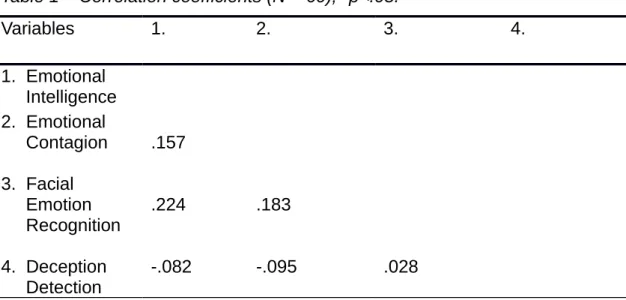
contagion score was 75, with the minimum score being 15 when all questions were answered. Scores for ability to recognise facial emotion and deception detection were converted in to percentages. Table 1 illustrates the correlation coefficients of the variables.
Table 1 – Correlation coefficients (N = 60), *p<.05.
Additionally, a test was undertaken to discover if the data met the
assumption of collinearity. The results of this test indicated that multicollinearity was not a concern (Emotional Intelligence Score, Tolerance = .936, VIF = 1.07; Emotional Contagion Score, Tolerance = .952, VIF = 1.05; Facial Emotion Recognition, Tolerance = .927, VIF = 1.08).
Emotional intelligence, emotional contagion and facial emotion
recognition were entered together in to a standard multiple regression but were
Variables 1. 2. 3. 4. 1. Emotional Intelligence 2. Emotional Contagion 3. Facial Emotion Recognition 4. Deception Detection .157 .224 -.082 .183 -.095 .028
not found to predict a significant amount of variance in explaining deception detection ability, F(3, 59) = .331, p = .803, Adj, R2 = -.035. Further, the
coefficient results illustrate that emotional intelligence (β = -.081, t = -.594, p = . 555), emotional contagion (β = -.094, t = -.694, p = .491) and ability to recognise facial emotion (β = .064, t = .465, p = .644) were not significant predictor
variables of deception detection ability. The SPSS output for the results is depicted in Appendix 11.
Discussion Findings
The aim of this study was to test three hypotheses with the objective of exploring the effect of individual differences on deception detection ability. Firstly, it was predicted that there would be a positive correlation between facial emotion recognition and deception detection. Secondly, it was hypothesised that there would be a negative correlation between deception detection ability and EI, and finally there would be a negative correlation between deception detection ability and EC. However, the regression analysis found no significant relationships between the variables, consequently resulting in the rejection of the three hypotheses.
The first hypothesis of this study must be rejected, as no statistically significant relationship was found between deception detection accuracy and facial emotion recognition. This contradicts with research that found that the examination of facial cues to direct credibility assessments was not significantly related to deception detection ability (Baker, ten Brinke & Porter, 2012), and studies concluding that accuracy in identifying microexpressions is correlated with accuracy in deception detection (Ekman & O’Sullivan, 1991). Baker, ten Brinke & Porter (2012) utilised a similar methodology to the present study, involving video clips of public appeals, whereas Ekman and O’Sullivan’s (1991) research did not involve high-stakes lies, rather it involved deception regarding the discussion of a film. This may provide an explanation for why the two aforementioned studies found differing results, though it does not explain why
the present study contradicts both of these studies. As discussed, inconsistent microexpressions are often conveyed during deception and are considered a nonverbal leakage cue (Ekman, 2003; ten Brinke & Porter, 2011).
Microexpressions may appear for as little as a fraction of a second (Fiori, 2009), and previous researchers have used the masking paradigm, displaying pictures representing facial expressions of the basic emotions for 200 milliseconds, followed by the same person’s neutral expression for one second (Ekman & O’Sullivan, 1991; Matsumoto et al., 2000). The present study allowed
participants to view the pictures of facial affect (Ekman & Friesen, 1976) with no time limit, yet manipulating the exposure duration of the facial expression may have provided a more real-life context, and consequently could have yielded different results that are more generalisable to a real-world setting. Further, this may explain why no relationship was found, as it may be argued that allowing participants to view the facial expression with no time limit provides an
advantage that would otherwise not exist. Therefore, this study may appear to involve participants with a seemingly high ability to recognise facial emotion, whereas if this study had followed the masking paradigm, as discussed above, these participants may have actually received a low score for this aspect of the study.
As discussed, no relationship was found between deception detection ability and EI during this study. Therefore, the results of this study do not support findings that depict a relationship between high EI and enhanced deception detection skills surrounding emotional lies (Ekman & O’Sullivan, 1991; Warren, Schertler & Bull, 2009) or those that have associated EI with an
impairment in evaluating sincerity (Baker, ten Brinke & Porter, 2012; ten Brinke & Porter, 2011).
One of the studies that found a negative relationship between EI and deception detection, as mentioned previously, was conducted by Baker, ten Brinke and Porter (2012). This study also utilised video clips of public appeals, however participants were shown 20 video clips, double the amount used in the current study. Additionally, to assess emotion intelligence level, participants in the aforementioned study completed the Trait EI Questionnaire – Short Form [TEIQue-SF] (Cooper & Petrides, 2010; Petrides & Furnham, 2006), rather than the SSEIT (Schutte et al., 1998). However, as both studies in discussion used similar methodology, though with different measures and number of stimuli, it would be expected that similar results would be reached. It may be considered that the reason for the different results achieved may be within the measures used. The SSEIT has been found to have three factors (Austin, Saklofske, Huang & McKenney, 2004; Saklofske, Austin & Minski, 2003), whilst the TEIQue-SF has a four-factor structure (Furnham & Petrides, 2003; Petrides, Frederickson & Furnham, 2004). This difference may have impacted the results of the self-report results and, consequently, the results of the studies discussed, thus potentially providing an explanation for a difference in results.
On the other hand, Warren, Schertler and Bull (2009) found a positive relationship between performance on an emotional labelling task, indicating high EI, and ability to detect emotional lies. The present research utilised a trait measure of EI, rather than an ability measure such as an emotional labelling task. Ability measures of EI are considered to have greater accuracy in
gathering a representation of an individual’s emotional aptitude, as trait measures can be vulnerable to misleading and overconfident responses
(Petrides, Pérez-González & Furnham, 2007), which may explain why this study yielded results that conflict with the present study. Additionally, these
researchers also used videos, however the deception aspect of their study involved an individual watching a clip of a surgical procedure and describing their reaction as if they were viewing a picturesque scene, or viewing a pleasant scene and describing their reaction as if they were viewing an unpleasant surgical procedure. This study was modelled on a previous research procedure developed by Ekman (Ekman & Friesen, 1974; Ekman, Friesen & O’Sullivan, 1988). Ekman’s research involved nursing students as the encoders creating the deception. Ekman argued that the deception was emotional, as it involved an unpleasant surgical procedure that may create arousal in the viewer, and that it was high-stakes as the encoders were told that the ability to hide negative affective reactions would be later related to job performance in the nursing profession (Ekman & Friesen, 1974; Ekman, Friesen & O’Sullivan, 1988). However, Warren, Schertler and Bull (2009) did not do this, therefore although the lie itself may promote emotional arousal, it may not be considered high-stakes, potentially providing an explanation for why the results of this study contradict with those found by Warren et al., (2009).
The results of this study suggest that there is no relationship between EC and deception detection ability. Though there are no studies currently available focusing on EC and deception detection ability as variables, the findings of this study contradict with assumptions that individuals with high susceptibility to EC
may be more gullible to deception due to the increased empathy and sensitivity to others associated with this individual difference (Doherty, 1997). Further, research has found that those high in EC are better able to discriminate sincere and faked enjoyment expressions (Manera, Grandi & Colle, 2013), yet no research has been undertaken focusing on sincere and faked negative
expressions, such as worry or distress, as wold be expected from the relative of a missing person. However, the results of this study may provide evidence to suggest that level of EC does not have a direct impact on ability to discriminate sincere and faked negative expressions. Further, although the results of this study were not statistically significant, it can be concluded that there is no relationship between emotional contagion level and deception detection ability, as there is currently no research available to suggest otherwise.
As discussed, previous research has found a truth bias in laypeople making a veracity judgment (Peace & Sinclair, 2012; Vrij, 2008). All of the participants in my study were laypeople, however, a truth bias was not found as, on average, participants stated that less than half of the appealers were being truthful (M=4.34), even though the participant information sheet stated that of the ten appealers, five were being deceptive whilst five were genuine (see Appendix 5). This may provide evidence to suggest that there is in fact no truth bias in laypeople when making veracity judgements. However, it is theorised that receivers are more likely to perceive a person as truthful if they are
interacting with that person, rather than seeing the person on videotape (Bond & DePaulo, 2006).
Implications for future research
This study required participants to make immediate veracity judgements of an unacquainted sender’s statement based on behavioural information alone. It is believed that veracity judgements made about real-life lies told outside of a research context are typically based upon contextual rather than behavioural information (Park et al., 2002). Further, experimental research suggests that contextual information has greater superiority in comparison to behavioural cues when judging veracity (Blair, Levine & Shaw, 2010; Bond et al., 2013). Therefore, in relation to future research, it may be beneficial to provide contextual information alongside the video clip, such as the relationship between the appealer and the individual in discussion.
As discussed, this study found no relationship between EC and deception detection ability, yet there is currently no other research that has focused on these two variables. Therefore, further research is needed to either provide support for the current findings, or provide an alternative insight in to the relationship between these two variables. This study also found no relationship between deception detection and EI and facial emotion recognition ability, respectively. However, other researchers have presented findings that
contradict these results, as discussed. Therefore, further research conducted through studies with a larger sample size or utilising a different methodology may provide a greater insight in to these two variables, and could yield findings that either support or contradict the results of this study.
Limitations
The results of this study may have been impacted by the following limitations. Firstly, EI and EC were assessed through self-report measures (Doherty, 1997; Schutte et al., 1998), therefore responses may have been impacted by self-report bias (Arnold & Feldman, 1981). Social desirability has been termed a threat to the validity of research involving multi-item scales (King & Bruner, 2000) and has been shown to decrease validity of participant
responses in multiple studies (Borkenau & Ostendorf, 1989; Ganster, Hennessey & Luthans, 1983). The tendency of individuals to deny socially undesirable behaviours (Chung & Monroe, 2003) and to give positive self-description (Palhus, 2017), may be an issue for the emotional contagion scale in particular as it focuses on an individual’s reaction to emotion in others and requires users to rate themselves on socially desirable traits such as empathy (Doherty, 1997). This issue may have been heightened further as all of the participants were known to the researcher. However, although self-reports of behaviour, attitudes and beliefs are prone to social desirability bias (van de Mortel, 2008), it is believed that there are no alternative means of measurement of constructs such as EC (Kimberlin & Winterstein, 2008).
Real-life lies are usually detected in familiar people long after they have been told (Park et al., 2002), therefore it may be argued that low accuracy rates derived from experimental research that involves deceivers unfamiliar to the participant can be attributed to this. Considering this as an issue, it may be concluded that results from laboratory experiments in this area may not be generalisable to real-life contexts.
In comparison to other large studies in this research area, the present study involved a sample of just 60 participants, therefore the issue of statistical power could provide an explanation for the results of this study not being
significant. Additionally, a small sample of stimulus materials was utilised in this study, with just ten video clips being shown to participants. Further, as
mentioned previously, 15% of participants (n=9) were all familiar with one of the ten video clips. The high-profile case depicted in this clip was from 2002 and involved a British family, and the quite recent nature of this case may provide an explanation for why such a large proportion of participants stated that they were familiar with the video clip. Therefore, it may have been beneficial to ensure that all of the clips involved appeals of cases from other countries or, if surrounding British cases, involved cases that were not as a high-profile and from a time that may not be as memorable to participants.
Conclusion
The aim of this study was to provide clarity to the research area of deception detection through the exploration of individual differences in
emotional intelligence, emotional contagion and facial emotion recognition. The study found no significant regression between the variables. However, this study adds to the previous literature in this area, and though the researcher acknowledges that this study conducted on a greater scale, with a larger
sample of both stimuli and participants, may have produced different results, the findings discussed offer the possibility that there may in fact be no relationship between deception detection ability and individual differences in EI, EC and
facial emotion recognition respectively. Additionally, this study provides a new insight in to the study of emotional contagion, an area that is short of research, and specifically in relation to deception detection ability, this study appears to be the first of its kind.
References
Aamodt, M. G., & Mitchell, H. (2006). Who can best catch a liar? A meta-analysis of individual differences in detecting deception. Forensic Examiner, 15, 6-11.
Adams, R. B., Hess, U., & Kleck, R. E. (2015). The intersection of gender-related facial appearance and facial displays of emotion. Emotion Review, 7(1), 5-13. http://dx.doi.org/10.1177/1754073914544407 Allport, G. W. (1961). Pattern and growth in personality. New York, NY: Holt,
Rinehart and Winston.
Arnold, H. J., & Feldman, D. C. (1981). Social desirability response bias in self-report choice situations. Academy of Management Journal, 24(2), 377-385. http://dx.doi.org/10.2307/255848
Aron, E. N., & Aron, A. (1997). Sensory-processing sensitivity and its relation to introversion and emotionality. Journal of Personality and Social
Psychology, 73(2), 345–368. http://dx.doi.org/10.1037//0022-3514.73.2.345
Austin, E. J., Saklofske, D. H., Huang, S. H. S., & McKenney, D. (2004).
Measurement of trait emotional intelligence: Testing and cross-validating a modified version of Schutte et al.’s (1998) measure. Personality and Individual Differences, 36, 555–562. http://dx.doi.org/10.1016/s0191-8869(03)00114-4
Baker, A., ten Brinke, L., & Porter, S. (2012). Will get fooled again: Emotionally intelligent people are easily duped by high-stakes deceivers. Legal and Criminological Psychology, 18 (2), 300-313.
http://dx.doi.org/10.1111/j.2044-8333.2012.02054.x
Barnier, A. J., Sharman, S. J., McKay, L., & Sporer, S. L. (2005). Discriminating adults’ genuine, imagined, and deceptive accounts of positive and negative childhood events. Applied Cognitive Psychology, 19(8), 985-1001. http://dx.doi.org/10.1002/acp.1139
Baron-Cohen, S. (2002). The extreme male brain theory of autism. Trends in Cognitive Sciences, 6(6), 248-254. http://dx.doi.org/10.1016/s1364-6613(02)01904-6
Blair, J. P., Levine, T. R., & Shaw, A. S. (2010). Content in context improves deception detection accuracy. Human Communication Research, 36(3), 423-442. http://dx.doi.org/10.1111/j.1468-2958.2010.01382.x
Bond, C. F., Omar, A., Mahmoud, A., & Bonser, R. N. (1990). Lie detection across cultures. Journal of Nonverbal Behaviour, 14(3), 189-204. http://dx.doi.org/10.1007/bf00996226
Bond, C. F., Omar, A., Pitre, U., Lashley, B. R., Skaggs, L. M., & Kirk, C. T. (1992). Fishy-looking liars: Deception judgment from expectancy
violation. Journal of Personality and Social Psychology, 63(6), 969-977. http://dx.doi.org/10.1037/0022-3514.63.6.969
Bond, C. F., & DePaulo, B. M. (2006). Accuracy of deception judgments.
Personality and Social Psychology Review, 10(3), 214-234. http://dx.doi.org/10.1207/s15327957pspr1003_2
Bond, C. F., & DePaulo, B. M. (2008). Individual differences in judging
deception: Accuracy and bias. Psychological Bulletin, 134(4), 477-492. http://dx.doi.org/10.1037/0033-2909.134.4.477
Bond, C. F., Howard, A. R., Hutchison, J. L., & Masip, J. (2013). Overlooking the obvious: Incentives to lie. Basic and Applied Social Psychology, 35(2), 212-221. http://dx.doi.org/10.1080/01973533.2013.764302
Borkenau, P., & Ostendorf, F. (1989). Descriptive consistency and social desirability in self- and peer-reports. European Journal of Personality, 3(1), 31-45. http://dx.doi.org/10.1002/per.2410030105
Borod, J. C., Yecker, S. A., Brickman, A. M., Moreno, C. R., Sliwinski, M., Foldi, N. S., … & Welkowitz, J. (2004). Changes in posed facial expression of emotion across the adult life span. Experimental Aging Research, 30(4), 305–331. http://dx.doi.org/10.1080/03610730490484399
British Psychological Society. (2014). Code of human research ethics. Leicester, United Kingdom: Author.
Brosgole, L., & Weisman, J. (1995). Mood recognition across the ages.
International Journal of Neuroscience, 82(3-4), 169–189. http://dx.doi.org/10.3109/00207459508999800
Buller, D. B., & Burgoon, J. K. (1996). Interpersonal deception theory.
Communication Theory, 6, 203-242.
http://dx.doi.org/10.1002/9781118540190.wbeic170
Calder, A. J., Keane, J., Manley, T., Sprengelmeyer, R., Scott, S., Nimmo-Smith, I., & Young, A. W. (2003). Facial expression recognition across the adult life span. Neuropsychologia, 41(2), 195–202.
http://dx.doi.org/10.1016/s0028-3932(02)00149-5
Campbell, M. A., & Porter, S. (2002). Pinpointing reality: How well can people judge true and mistaken emotional childhood memories? Canadian Journal of Behavioural Science, 34(4), 217-229.
http://dx.doi.org/10.1037/h0087174
Chung, J., & Monroe, G. S. (2003). Exploring social desirability bias. Journal of Business Ethics, 44(4), 291-302.
http://dx.doi.org/10.1023/a:1023648703356
Ciarrochi, J., Chan, A. Y. C., & Bajgar, J. (2001). Measuring emotional
intelligence in adults. Personality and Individual Differences, 31(7), 1105-1119. http://dx.doi.org/10.1016/s0191-8869(00)00207-5
Colquitt, J. A., Hollenbeck, J. R., Ilgen, D. R., LePine, J. A., & Sheppard, L. (2002). Computer-assisted communication and team decision-making performance: The moderating effect of openness to experience. Journal of Applied Psychology, 87(2), 402-410. http://dx.doi.org/10.1037//0021-9010.87.2.402
Conte, J. M. (2005). A review and critiques of emotional intelligence measures.
Journal of Organizational Behaviour, 26, 433-440. http://dx.doi.org/10.1002/job.319
Cooper, A., & Petrides, K. V. (2010). A psychometric analysis of the Trait Emotional Intelligence Questionnaire – Short Form (TEIQue-SF) using Item Response Theory. Journal of Personality Assessment, 92, 449-457. http://dx.doi.org/10.1080/00223891.2010.497426
Cronbach, L. J. (1960). Essentials of psychological testing (2nd ed.). New York,
NY: Harper.
Darwin, C. (1872). The expression of the emotions in man and animals.
Chicago, IL: University of Chicago Press.
DePaulo, B. M., & Rosenthal, R. (1979). Telling lies. Journal of Personality and Social Psychology, 37(10), 1713-1722. http://dx.doi.org/10.1037//0022-3514.37.10.1713
DePaulo, B. M., Kirkendol, S. E., Tang, J., & O’Brien, T. P. (1988). The motivational impairment effect in the communication of deception:
Replications and extensions. Journal of Nonverbal Behavior, 12(3), 177– 202. http://dx.doi.org/10.1007/bf00987487
DePaulo, B, M., & Tang, J. (1994). Social anxiety and social judgement: The example of detecting deception. Journal of Research in Personality, 28(2), 142-153. http://dx.doi.org/10.1006/jrpe.1994.1012
DePaulo, B. M., Kashy, D. A., Kirkendol, S. E., Wyer, M. M., & Epstein, J. A. (1996). Lying in everyday life. Journal of Personality and Social
Psychology, 70(5), 979-995. http://dx.doi.org/10.1037//0022-3514.70.5.979
DePaulo, B. M., Lindsay, J. J., Malone, B. E., Muhlenbruck, L., Charlton, K., & Cooper, H. (2003). Cues to deception. Psychological Bulletin, 129(1), 74-112. http://dx.doi.org/10.1037//0033-2909.129.1.74
Dezecache, G., Conty, L., Chadwick, M., Phillip, L., Soussignan, R., Sperber, D., & Grѐzes, J. (2013). Evidence for unintentional emotional contagion beyond dyads. PloS ONE, 8(6), e67371.
http://dx.doi.org/10.1371/journal.pone.0067371
Diehl-Schmid, J., Pohl, C., Ruprecht, C., Wagenpfeil, S., Foerstl, H., & Kurz, A. (2007). The Ekman 60 Faces Test as a diagnostic instrument in
frontotemporal dementia. Archives of Clinical Neuropsychology, 22(4), 459-464. http://dx.doi.org/10.1016/j.acn.2007.01.024
Digman, J. M. (1990). Personality structure: Emergence of the five-factor model.
Annual Review of Psychology, 41(1), 417-440. http://dx.doi.org/10.1146/annurev.psych.41.1.417
Doherty, R. W. (1997). The emotional contagion scale: A measure of individual differences. Journal of Nonverbal Behaviour, 21, 131-154.
https://dx.doi.org/10.1037/t07987-000
Ekman, P., & Friesen, W. V. (1969). The repertoire of nonverbal behaviour: Categories, origins, usage, and coding. Nonverbal Communication, Interaction, and Gesture, 1, 49-98.
Ekman P., & Friesen, W. V. (1971). Constants across cultures in the face and emotion. Journal of Personality & Social Psychology, 17(2), 124-129. http://dx.doi.org/10.1037/h0030377
Ekman, P. (1973). Cross-cultural studies of facial expression. In P. Ekman (Ed.), Darwin and facial expression: A century of research in review (pp. 169–222). New York, NY: Academic.
Ekman, P., & Friesen, W. V. (1974). Detecting deception from the body or face.
Journal of Personality and Social Psychology, 29(3), 288–298. http://dx.doi.org/10.1037/h0036006
Ekman, P., & Friesen, W. V. (1976). Pictures of facial affect. Palo Alto, CA: Consulting Psychologists Press.
Ekman, P., & O’Sullivan, M. (1991). Who can catch a liar? American Psychologist, 46(9), 913-920. http://dx.doi.org/10.1037//0003-066x.46.9.913
Ekman, P., Friesen, W. V., & O’Sullivan, M. (1988). Smiles when lying. Journal of Personality and Social Psychology, 54(3), 414–420.
http://dx.doi.org/10.1037//0022-3514.54.3.414
Ekman, P. (2001). Telling lies: Clues to deceit in the marketplace, politics, and marriage. (3rd ed.). New York, NY: Norton.
Ekman, P., Friesen, W. V., & Hager, J. C. (2002). Facial action coding system.
Ekman, P. (2003). Darwin, deception and facial expression. In P. Ekman, & R. Davidson, & F. DeWaals (Eds.), Annals of the New York Academy of Sciences, Vol. 1000. (pp. 205–221). New York, NY: New York Academy of Sciences.
Ekman, P. (2009). Darwin’s contributions to our understanding of emotional expressions. Philosophical Transactions of the Royal Society of London, Series B, Biological Sciences, 364(1535), 3449-3451.
http://dx.doi.org/10.1098/rstb.2009.0189
Ekman, P., & Cordaro, D. (2011). What is meant by calling emotions basic.
Emotion Review,3(4), 364–370.
http://dx.doi.org/10.1177/1754073911410740
Elaad, E. (2009). Lie-detection biases among male police interrogators, prisoners, and laypersons. Psychological Reports, 105(3), 1047-1056. http://dx.doi.org/10.2466/pr0.105.f.1047-1056
Engel, R. J., & Schutt, R. K. (2012). The practice of research in social work. (3rd
ed.) Thousand Oaks, CA: Sage.
Feist, G. J., & Barron, F. (1996, June). Emotional intelligence and academic intelligence in career and life success. Paper presented at the Annual Convention of the American Psychological Societ, San Francisco, CA. Fiori, M. (2009). A new look at emotional intelligence: A dual-process
framework. Personality and Social Psychology Review, 13(1), 21–44. http://dx.doi.org/10.1177/1088868308326909
Fischer, K. W., Shaver, P. R., & Carnochan, P. (1990). How emotions develop and how they organise development. Cognition and Emotion, 4(2), 81-127. http://dx.doi.org/10.1080/02699939008407142
Flynn, F. J. (2005). Having an open mind: The impact of openness to
experience on interracial attitudes and impression formation. Journal of Personality and Social Psychology, 88(5), 816–826.
http://dx.doi.org/10.1037/0022-3514.88.5.816
Fowler, J. H., & Christakis, N. A. (2008). Dynamic spread of happiness in a large social network: Longitudinal analysis over 20 years in the Framingham Heart Study. BMJ, 337, 1-9.
http://dx.doi.org/10.1136/bmj.a2338
Frank, M. G., & Ekman, P. (1997). The ability to detect deceit generalises across different types of high-stake lies. Journal of Personality and Social Psychology, 72(6), 1429-1439. http://dx.doi.org/10.1037//0022-3514.72.6.1429
Frank, M. G., & Feeley, T. H. (2003). To catch a liar: Challenges for research in lie detection training. Journal of Applied Communication Research, 31,
58-75. http://dx.doi.org/10.1080/00909880305377
Furnham, A., & Petrides, K. V. (2003). Trait emotional intelligence and happiness. Social Behaviour and Personality, 31, 815–823. http://dx.doi.org/10.2224/sbp.2003.31.8.815
Ganster, D. C., Hennessey, H. W., & Luthans, F. (1983). Social desirability response effects: Three alternative models. Academy of Management Journal, 26(2), 321-331. http://dx.doi.org/10.2307/255979
Gardner, H. (1983). Frame of mind: The theory of multiple intelligences. New York, NY: Basic Books.
Goleman, D. (1995). Emotional intelligence. New York, NY: Bantam Books. Goleman, D. (1996). Emotional intelligence: Why it can matter more than IQ.
Learning, 24(6), 49-50. http://dx.doi.org/10.1037/h0095822
Granhag, P. A., & Strömwall, L. A. (2004). The detection of deception in forensic contexts. New York, NY: Cambridge University Press.
Hall, J. A., & Matsumoto, D. (2004). Gender differences in judgements of emotions from facial expressions. Emotion, 4(2), 201-206.
http://dx.doi.org/10.1037/1528-3542.4.2.201
Hall, J. K., Hutton, S. B., & Morgan M. J. (2010). Sex differences in scanning faces: Does attention to the eyes explain female superiority in facial expression recognition? Cognition & Emotion, 24(4), 629–637. http://dx.doi.org/10.1080/02699930902906882
Hampson, E., van Anders, S. M., & Mullin, L. (2006). A female advantage in the recognition of emotional facial expressions: Test of an evolutionary hypothesis. Evolution and Human Behaviour, 27(6), 401-416. http://dx.doi.org/10.1016/j.evolhumbehav.2006.05.002
Hartwig, M., Granhag, P. A., Strömwall, L. A., & Andersson, L. O. (2004). Suspicious minds: Criminals’ ability to detect deception. Psychology,
Crime and Law, 10, 83–95.
http://dx.doi.org/10.1080/1068316031000095485
Hartwig, M., Granhag, P. A., Strömwall, L. A., & Kronkvist, O. (2006). Strategic use of evidence during police interviews: When training to detect
deception works. Law and Human Behaviour, 30, 603-619. http://dx.doi.org/10.1007/s10979-006-9053-9
Hartwig, M., & Bond, C. F. (2011). Why do lie-catchers fail? A lens model meta-analysis of human lie judgments. Psychological Bulletin, 137(4), 643-659. http://dx.doi.org/10.1037/a0023589
Hatfield, E., Cacioppo, J. T., & Rapson, R. L. (1994). Emotional contagion. Cambridge, United Kingdom: Cambridge University Press.
Hatfield, E., Bensman, L., Thornton, P. D., & Rapson, R. L. (2014). New perspectives on emotional contagion: A review of classic and recent research on facial mimicry and contagion. Interpersona: An International Journal on Personal Relationships, 8(2), 159-179.
http://dx.doi.org/10.5964/ijpr.v8i2.162
Hauch, V., Sporer, S. L., Michael, S. W., & Meissner, C. A. (2014). Does training improve the detection of deception? A meta-analysis. Communication Research, 43(3), 283-343. http://dx.doi.org/10.1177/0093650214534974 Hawk, S. T. (2010). Changing channels: Flexibility in empathetic emotion
processes. New York, NY: Paragon.
Hawk, S. T., Fischer, A. H., & van Kleef, G. A. (2012). Face the noise: Embodied responses to nonverbal vocalisations of discrete emotions. Journal of