University of Kentucky
UKnowledge
Information Science Faculty Publications
Information Science
3-1-2017
Efficient Revocable ID-Based Signature With
Cloud Revocation Server
Xiaoying Jia
South-Central University for Nationalities, China
Debiao He
Wuhan University, China
Sherali Zeadally
University of Kentucky, [email protected]
Li Li
Wuhan University, China
Right click to open a feedback form in a new tab to let us know how this document benefits you.
Follow this and additional works at:
https://uknowledge.uky.edu/slis_facpub
Part of the
Computer Sciences Commons
,
Digital Communications and Networking Commons
,
and the
Library and Information Science Commons
This Article is brought to you for free and open access by the Information Science at UKnowledge. It has been accepted for inclusion in Information Science Faculty Publications by an authorized administrator of UKnowledge. For more information, please [email protected].
Repository Citation
Jia, Xiaoying; He, Debiao; Zeadally, Sherali; and Li, Li, "Efficient Revocable ID-Based Signature With Cloud Revocation Server" (2017).Information Science Faculty Publications. 47.
Notes/Citation Information
Published in
IEEE Access
, v. 5, p. 2945 - 2954.
© 2017 IEEE
The copyright holder has granted the permission for posting the article here.
Digital Object Identifier (DOI)
https://doi.org/10.1109/ACCESS.2017.2676021
SPECIAL SECTION ON FUTURE NETWORKS: ARCHITECTURES, PROTOCOLS, AND APPLICATIONS
Received February 1, 2017, accepted February 21, 2017, date of publication March 1, 2017, date of current version March 28, 2017. Digital Object Identifier 10.1109/ACCESS.2017.2676021
Efficient Revocable ID-Based Signature
With Cloud Revocation Server
XIAOYING JIA1, DEBIAO HE2,3, SHERALI ZEADALLY4, AND LI LI5
1School of Mathematics and Statistics, South-Central University for Nationalities, Wuhan 430074, China 2State Key Lab of Software Engineering, School of Computer, Wuhan University, Wuhan 430072, China
3Guangxi Key Laboratory of Cryptography and Information Security, Guilin University of Electronic Technology, Gulin 541000, China 4College of Communication and Information, University of Kentucky, Lexington, KY 40506, USA
5International School of Software, Wuhan University, Wuhan 430072, China
Corresponding author: L. Li ([email protected])
This work was supported in part by the National Natural Science Foundation of China under Grant 61402339, Grant 61572379,
Grant 61501333, and Grant 61603419 and in part by the Fundamental Research Funds for the Central Universities under Grant CZY15018.
ABSTRACT Over the last few years, identity-based cryptosystem (IBC) has attracted widespread attention
because it avoids the high overheads associated with public key certificate management. However, an unsolved but critical issue about IBC is how to revoke a misbehaving user. There are some revocable identity-based encryption schemes that have been proposed recently, but little work on the revocation problem of identity-based signature has been undertaken so far. One approach for revocation in identity-based settings is to update users’ private keys periodically, which is usually done by the key generation center (KGC). But with this approach, the load on the KGC will increase quickly when the number of users increases. In this paper, we propose an efficient revocable identity-based signature (RIBS) scheme in which the revocation functionality is outsourced to a cloud revocation server (CRS). In our proposed approach, most of the computations needed during key-updates are offloaded to the CRS. We describe the new framework and the security model for the RIBS scheme with CRS and we prove that the proposed scheme is existentially unforgeable against adaptively chosen messages and identity attacks in the random oracle model. Furthermore, we monstrate that our scheme outperforms previous IBS schemes in terms of lower computation and communication costs.
INDEX TERMS Identity-based signature, revocation, cloud computing, outsourcing.
I. INTRODUCTION
Digital signature is a critical feature of public key cryptogra-phy that provides user identification, authentication and non-repudiation. In traditional public key infrastructure (PKI), users’ public keys used to verify signatures are bound with their certificates. Certificate authorities (CAs) are responsible for issuing, maintaining and revoking certificates. In identity-based cryptosystems, however, a user’s identity information is the public key. It is a challenge to verify if a user has been revoked or not. In 2001, Boneh and Franklin [1] suggested that the key generator center (KGC) updates secret keys for all non-revoked users periodically. The idea was adopted by many identity-based encryption schemes to realize revocation functionality. Unfortunately, there are two drawbacks with their proposals. First, the KGC must kept online, which brings out some security threats. Second, the overhead at the KGC will dramatically increase as the number of users increases.
With the rapid development of cloud computing, many organizations tend to outsource computation tasks to some
powerful cloud based server. In fact, it is not rare in the history of cryptography to outsource heavy computation tasks to a third party. Quite recently Li et al. [2] introduced an approach to outsource the key-updating tasks to a Key Update Cloud Server Provider (KU-CSP) and proposed an efficient revocable identity-based encryption (IBE) scheme. We adopt their approach and apply it to identity-based signature (IBS) settings. A trivial idea is to offload all key-updating tasks to the cloud server. However, there are some security issues we must take into account: the cloud server is not always trusted. So we split the signing key of a user into an initial identity key and a time update key. The former is a long-term key bound to the user’s identity and issued by the KGC, and the latter is a short-term key related not only to the user’s identity, but also to the current time period. The time update key is issued and updated by a cloud revocation server (CRS) periodically. The CRS cannot forge a signature because it does not hold the complete signing key. To revoke users, the KGC simply notifies the cloud server to stop issuing new time update keys
VOLUME 5, 2017
2169-35362017 IEEE. Translations and content mining are permitted for academic research only. Personal use is also permitted, but republication/redistribution requires IEEE permission. See http://www.ieee.org/publications_standards/publications/rights/index.html for more information.
for them. With this technique, many existing IBS schemes can be improved to be revocable.
A. RELATED WORK
We discuss a few recently proposed IBS schemes
below.
Shamir first introduced the idea of identity-based cryp-tosystem (IBC) [3], after that Fiat and Shamir [4] presented a construction of IBS scheme based on the factoring problem. Since then, several other proposals based on factoring have been developed [5]–[7].
The first fully practical implementation of identity-based setting emerged in 2001, when Boneh and Franklin [1] pro-posed an IBE scheme using Weil pairing on elliptic curves. Since then many solutions for IBS schemes with bilinear pairings have been proposed. Sakaiet al.[8] presented an IBS scheme based on bilinear pairings but no security analysis was given. Choon and Cheon [9] proposed an IBS scheme by utilizing gap bilinear Diffie-Hellman (GDH) groups. Paterson [10] presented another efficient IBS scheme and reduced the security of their scheme to a non-IBS scheme. Hess [11], [12] developed an efficient IBS scheme and extended it to a generic framework, from which several variations can be exported (include ElGamal variations and Schnorr version).The author also considered the key escrow by extending the system to multiple trust authorities. Galindo and Garcia [13] also proposed a Schnorr-like lightweight IBS scheme without pairings. Bellareet al.[14] provided a
frame-work for security proof of IBS schemes. Zhang et al.[15]
proposed an efficient IBS scheme secure under the k-CAA
assumption. Barreto et al.[16] presented an identity-based
signcryption (IBSC) scheme with bilinear pairings. Based on Water’s IBE scheme [17], Paterson and Schuldt [18] pre-sented an efficient IBS scheme and proved its security in the standard model. In recent years, many IBS schemes such as those based on ring signatures, blind signatures, proxy signatures, group signatures etc. were proposed [19]–[22].
There are several efficient proposals of IBS schemes with or without bilinear pairings which have been proposed. However, only a few of them discussed the revocation of misbehaving users. Boneh and Franklin [1] developed a gen-eral approach to implement the revocation functionality in identity-based cryptosystems. That is, the KGC generates new secret keys for each non-revoked user periodically, and it simply stops to issue new private keys for the revoked users. Based on this idea, various revocable IBE schemes were proposed [23]–[27] in the past.
The first revocable IBS scheme was proposed by Tsai et al. [28], which adopted the revocation technique employed in [27]. The authors proved the security of their scheme in the standard model. Based on their scheme, Hung et al. [29] proposed another RIBS scheme with improved security. Sunet al.[30] presented an efficient RIBS scheme without pairing but no security proof was given.
Recently, Wei et al. [31] proposed a forward secure RIBS
scheme employing the complete subtree (CS) method where
the KGC must maintain a binary tree on which each node represents a user.
In the above RIBS schemes [28]–[31], the KGC is respon-sible not only for issuing the initial identity key for each registered user, but also for renewing the time update keys for non-revoked users periodically, which brings two drawbacks. First, the KGC needs to be kept online which is not secure. Second, with the increasing in the number of system users, the computation and communication overheads at the KGC also increase quickly. In this case, the KGC will become the security and performance bottleneck of the whole cyrptosys-tem.
B. OUR CONTRIBUTIONS
In this work, we propose the first RIBS scheme with a cloud revocation server. We describe the framework of a RIBS scheme with outsourced revocation and formalize the security model. Then we describe our proposed scheme in detail and analyze its security. We prove that our scheme is existentially unforgeable against adaptive chosen message and identity attacks in the random oracle model. Neither a revoked user nor a curious cloud server can forge a valid signature even if they collude with other non-revoked users in the system. We also provide a performance evaluation of our scheme and we compare its performance with other IBS schemes. C. ORGANIZATION
The rest of the paper is organized as follows. We present preliminary works in Section II. Section III describes the framework of a RIBS scheme with outsourced cloud revo-cation server and formalizes its security model. Section IV describes our proposed RIBS scheme in detail. We present the security analysis of our scheme in Section V. Section VI presents the performance evaluation results of our scheme. Section VII concludes the paper.
II. PRELIMINARY
A. IDENTITY-BASED SIGNATURE
A typical IBS scheme involves three parties: the KGC, the signer and the verifier. There are four algorithms in an IBS scheme defined as follows.
• Setup:(MSK,PP)←Setup(λ).KGC takes as input the security parameterλ, and outputs the master system key
MSK and system public parameters PP including the
system public keyPpub.
• Initial Key Extraction: SID ← KeyExt(MSK,ID).
KGC generates a private key for each user. It takes as
input MSK and a user’s identity ID, and returns the
private keySID.
• Signing: σ ← Sign(m,SID,PP). The signer takes as
input his/her private key SID, the message m and the
public parameters, and outputs a signatureσ.
• Verification:Accept/Reject ←Ver(σ,ID,m,PP).The
verifier takes as input the signature σ, the identity ID
of the signer, the messagem andPP , and returns an
‘‘Accept’’ or a ‘‘Reject’’ to demonstrate if the signature is valid or not.
X. Jiaet al.: Efficient Revocable ID-Based Signature With Cloud Revocation Server
The consistency of an IBS scheme requires that for anySID
generated by algorithmKeyExt when givenIDas input, and
for anyσ =Sign(m,SID,PP),Ver(σ,ID,m,PP)="Accept"
holds.
B. BILINEAR PAIRINGS AND COMPUTATIONAL ASSUMPTIONS
LetGbe an additive cyclic group, whose order is a large prime
q.Pis a generator ofG.GT is a multiplicative cyclic group
of the same orderq. The mapeˆ:G×G→GT is said to be
an admissible bilinear map if it satisfies:
• Bilinearity: For all P,Q ∈ G, x,y ∈ Zq∗, there is
ˆ
e(xP,yQ)= ˆe(P,Q)xy;
• Non-degeneracy: There exists P,Q ∈ G such that
ˆ
e(P,Q)6=1GT;
• Computability: For any elementP,Q ∈ G, there is an
polynomial time algorithm to computeeˆ(P,Q)∈GT.
Next we present the mathematical assumption used in our scheme.
Computational Diffie-Hellam Problem (CDH): Given a triple (P,aP,bP) for some unknowna,b ∈Zq∗, we compute
abP.
The CDH assumption says that there is no polynomial time algorithm which can solve the CDH problem with non-negligible probability.
III. SYSTEM FRAMEWORK AND SECURITY MODEL
In this section, we describe the system framework of an outsourced RIBS scheme and its security model.
A. SYSTEM FRAMEWORK
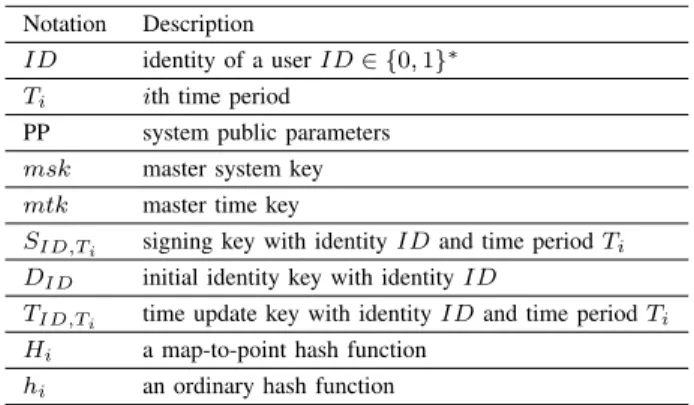
A RIBS scheme involves three parties: the KGC, the CRS and users (signers and verifiers). At the beginning of the system initialization, the KGC generates and publishes some common parameters and sends a secret master time key to the CRS. Then the KGC issues the initial identity key for each user with its master system key when the user is reg-istered. The CRS issues and updates the users’ time update keys according to the revocation user list received from the KGC. If a user is in the revocation user list, then the CRS refuses to update the time update key for the user. We present the framework of our system in Fig. 1. Table 1 shows the notations used in the proposed RIBS scheme.
There are five algorithms in a RIBS scheme: system ini-tialization algorithm (Setup), initial key extraction algorithm (InitKeyExt), time key updating algorithm (TimeKeyUpd), signing algorithm (Sign), verification algorithm (Ver). The KGC maintains a revocation list (RL) which contains the identities of revoked users and the RL is updated periodically.
• Setup(1λ) :The KGC takes a security parameterλand
outputs a master system keymsk, a master time keymtk, a time period listT = (T0,T1, . . .) and system public
parametersPP. KGC keepsmskfor itself, and sendsmtk
to the CRS securely.PPis published to all users in the system.
FIGURE 1. Identity-based signature with (cloud) outsourced revocation.
TABLE 1.Summary of notations.
• InitKeyExt(PP,msk,ID) : On receiving a register
request from the user with identity ID, the KGC runs
this algorithm to issue a secret identity keyDIDwith the
inputPP,msk, a user’s identityID, and sendsDIDto the user securely.
• TimeKeyUpd(PP,mtk,ID,Ti):On receiving an update request from a user, the CRS first checks if the user is in the RL. If it is, the CRS rejects the update request. If not, the CRS runs the algorithm and generates a new time keyTKID,Tifor the user with the inputPP,mtk, the
user’s identityIDand current time periodTi.
A user’s signing keySID,Ticonsists of two parts:SID,Ti =
(DID,TKID,Ti).
• Sign(PP,m,ID,Ti,SID,Ti) : To sign a messagem, the
signer runs this algorithm with input PP, m, his own
identityID, current time periodTiandSID,Ti, and outputs
the signatureσ.
• Ver(PP,m, σ,ID,Ti) :To verify a signatureσ on
mes-sagemwith the signer’s identityIDand time periodTi, the verifier runs the algorithm withPP,m,σ,IDandTi, and outputs an ‘‘Accept’’ or ‘‘Reject’’ according to the validity of the signature.
The consistency criterion states that for
any message m, any identity ID and any
time period Ti, if σ = Sign(PP,m,ID,Ti,SID,Ti), where
SID,Ti = (InitKeyExt(msk,ID),TimeKeyUpd(mtk,ID,Ti)),
then we haveVer(PP,m, σ,ID,Ti)=‘‘Accept00with a high probability.
B. SECURITY MODEL
Bellare et al. [14] first formalized the security of an
IBS scheme in 2004, namely, security against existen-tial forgery on adaptively chosen message and identity attacks (EUF-CMA). Based on this formalization, we first consider the following two types of adversaries.
• Type I adversary AI. AIis a revoked user. SupposeAIhas
identityIDand was revoked at time periodTi.AIintends
to produce valid signatures after time periodTi.AI still
owns the initial identity keyDID, and we assume thatAI
can collude with other legal users to obtain their identity keys and time update keys at arbitrary time periods.
AI cannot know is its own time update keys after time
periodTi.
• Type II adversary AII.Type II adversary can be seen as a curious CRS who tries to create a valid signature in the name of a system user. Since the CRS holds the master time key, so it can obtain the time update key of any user
at any time. We also assume thatAII can collude with
other users to obtain their identity keys. In this case, the adversary cannot know the target user’s identity keyDID.
We define the security model of an outsourced RIBS scheme through the following two games between a chal-lenger and one of the above two types of adversaries. The game betweenAIand a challengerSIis defined below.
Game 1:
• Setup.SI runs theSetupalgorithm with input security
parameterλ, and outputsmsk,mtk andPP as defined
in the system framework.SI keepsmsk,mtksecret and
sendsPPtoAI.
• Query.AImakes a series of queries toSIadaptively, and
SIresponds to each type of queries in the following way.
- Initial key extract query (ID). AI issues this query
to get the initial key of some user with iden-tity ID. SI runs InitKeyExt algorithm with input
(PP,msk,ID), and returns the resultingDIDtoAI.
- Time key update query (ID,Ti). AIissues this query
to get the time update key of some user with identity
ID on time period Ti. SI runs the TimeKeyUpd
algorithm with input (PP,mtk,ID,Ti), and returns the resultingTKID,Ti toAI.
- Signing query(m,ID,Ti).WhenAIissues a signing
query with a messagem, the identityIDand time
period Ti, SI runs Sign algorithm and outputs a
signatureσ toAI.
• Forgery.At last AI outputs a tuple (m∗,ID∗,T∗ i , σ
∗)
with the following two constraints:
1) AI does not issue any time key update query on
(ID∗,Ti∗).
2) σ∗ is not returned by a signning query on input
(m∗,ID∗,Ti∗) issued byAI.
It is said that AI succeeds in attacking the scheme if
Ver(PP,m∗, σ∗,ID∗,Ti∗) ="Accept".AI ’s advantage
AdvAI(λ) is defined as AdvAI(λ)=Pr[Ver(PP,m
∗,
ID∗,Ti∗)="Accept"].
The game between adversaryAII and a challengerSII is
defined as follows.
Game 2:TheSetupandQueryphases are the same as in
Game I.
Forgery.At the end of theQueryphase,AIIoutputs a tuple (m∗,ID∗,Ti∗, σ∗) with the following two constraints:
1) AIIdoes not issue anyinitial key extract queryon input
ID∗.
2) σ∗ is not returned by a signning query on input
(m∗,ID∗,Ti∗) issued byAII.
It is said that AII succeeds in attacking the scheme if
Ver(PP,m∗, σ∗,ID∗,Ti∗) = "Accept". AII ’s advantage AdvAII(λ) is defined as
AdvAII(λ)=Pr[Ver(PP,m
∗, σ∗,ID∗,T∗
i )="Accept"].
From the above games we have the following security definition of a RIBS scheme.
Definition 1 (EUF-RID-CMA): A RIBS scheme with out-sourced revocation is said to be existentially unforgeable against adaptive chosen message and identity attacks if there is no probabilistic polynomial time adversary that has a non-negligible advantage in either Game I or Game II .
IV. PROPOSED RIBS SCHEME
In this section, we describe our proposed outsourced RIBS scheme. The scheme is composed of the following five algo-rithms, as defined in Section III-B.
• Setup(λ):The KGC runs the algorithm as follows.
1) Choose two cyclic groupsGandG1with the same
prime orderq. LetPbe a generator of groupG, and
ˆ
e:G×G→ G1be a bilinear map. We compute
g= ˆe(P,P).
2) We randomly choose two secret valuess,t ∈ Zq∗, wheresis the master identity key andtis the maser time key. Then, we computePpub =sP,Pt =tP.
Keepssecret and transformtto the CRS in a secure way.
3) We select three hash functions as follows:
H1: {0,1}∗→G,
H2: {0,1}∗× {0,1}∗→G,
h: {0,1}∗×G→Zq∗.
4) We publish the system parameters
PP=(q,G,G1,P,Ppub,Pt,H1,H2,h).
• InitKeyExt(PP,s,ID) :For a user with identityID, the
KGC sets
X. Jiaet al.: Efficient Revocable ID-Based Signature With Cloud Revocation Server
and sends the initial identity keyDIDto the user through a secure channel.
• TimeKeyUpd(PP,t,ID,Ti):Upon receiving an update
request from a userIDat the time periodTi, the CRS
computes
QID,Ti =H2(ID,Ti), TID,Ti =tQID,Ti,
and sendsTID,Ti to the user.
• Sign(PP,m,ID,Ti,DID,TID,Ti) : Given a message m
and time periodTi, a signer with identityIDproduces
the signature formusing the identity keyDIDand time
update keyTID,Ti as follows. We randomly chooser ∈ Zq∗, and compute:
α=gr, v=h(m, α),
U =rP+v(DID+TID,Ti).
The signature for the messagemat the time periodTiis σ =(U, α).
• Ver(PP,m, σ,ID,Ti) :On receiving a signature σ =
(U, α) on message m and time periodTi, the verifier computes
v=h(m, α), and verifies if
ˆ
e(U,P)=αeˆ(QID,Ppub)veˆ(QID,Ti,Pt) v.
holds. The verifier outputs "Accept" if it does, or "Reject" if not.
We demonstrate the consistency of the scheme as follows:
ˆ e(U,P)= ˆe(rP+v(DID+TID,T i),P) = ˆe(rP,P)ˆe(DID,P)veˆ(TID,Ti,P) v = ˆe(P,P)reˆ(sQID,P)veˆ(tQID,Ti,P) v =greˆ(QID,sP)veˆ(QID,Ti,tP) v =αˆe(QID,Ppub)veˆ(QID,Ti,Pt) v. V. SECURITY ANALYSIS
In this section, we analyze the security of the pro-posed scheme in terms of the security model defined in section III-B. We employ the forking lemma technique intro-duced in [32].
Lemma 1: If there is a type I adversary who makes at most qH1,qH2,qh, ,qe,qu,qs queries to the hash functions
H1,H2,h, initial key extract oracle, time key update oracle
and signing oracle respectively and breaks the proposed RIBS scheme with non-negligible probabilityI, then there exists
a probabilistic challenger who can solve the CDH problem with advantage 0 I≥(1− 1 q) 1 qH2I − qh q.
Proof: SupposeAI is a type I adversary who wins the
attack game with advantage I. We construct an algorithm
SI who uses AI as a subroutine to solve the CDH problem.
SupposeSI is given a CDH instance (P,Pa=aP,Pb=bP), wherePis a generator of an additive cyclic groupGof order
q, anda,b is unknown toSI. To compute Pab = abP,SI
simulates a challenger for the adversary as follows.
• Setup.SI randomly choosess ∈ Zq∗ and setsPpub = sP,Pt =Paand sends (P,Ppub,Pt) to the adversaryAI. SI chooses an l ∈ {1,2, . . . ,qH2}and maintains three listsL1,L2andL3which are initially empty.SIanswers AI’s queries as follows.
• Query.
– Hash query. We assume thatAIhas already queried
the corresponding hash oracles before it makes fur-ther queries.SI answers three kinds of hash queries as follows.
∗ H1-query. IfAIissues aH1-query on identityID,
SI first checks if there is an entry in the listL1.
If yes, SI returns that entry, else SI randomly
choosesx ∈ Zq∗ and returnsH1(ID) = xPand
adds (ID,x,H1(ID)) into the listL1.
∗ H2-query. Suppose thatAI issuesi-thH2-query
on identityIDiand time periodTj,SIfirst checks
if there is an entry in the listL2. If so,SI returns
that entry, else it randomly choosesy∈ Zq∗and sets
H2(IDi,Tj)=
yP i6=l yPb i=l
SIadds (IDi,Tj,y,H2(IDi,Tj)) into listL2ifi6=
l, else it adds the entry (IDi,Tj ⊥,H2(IDi,Tj)),
and setsID∗=IDiandT∗=Tj.
∗ h-query. On receiving ah-query on input (m, α),
SI first checks if there is an entry in the list L3. If there is, SI returns the entry, else it
returns a randomly chosen v ∈ Zq∗, and adds
(m, α,h(m, α)) into listL3.
– Initial key extract query. On receiving such a query on identityID,SI searches listL1to find the entry
(ID,x,H1(ID)), and responds withDID=xPpub.
– Time key update query. IfAI issues a query onIDi
and Tj, SI first checks if (IDi,Tj) = (ID∗,T∗). If not, SI searches the list L2 to find the entry
(IDi,Tj,y,H2(ID)), and responds with TIDi,Tj = yPt, elseSI setsTIDi,Tj =⊥.
– Signing query. If AI issues a signing query on
identity IDi, Tj and message m, SI searches the
list L1,L2, to find the corresponding H1(ID) and
H2(ID,Ti).SI then randomly choosesU ∈ G,v∈ Zq∗and computes
α= ˆe(U,P)eˆ(Ppub,H1(IDi))−veˆ(Pt,H2(IDi,Tj))−v.
SI searches the list L3, if there is an entry
(m, α,h(m, α)) andh(m, α)6=v, thenSIaborts, else SI returns the signatureσ = (U, α) toAI. In this
case,σ is a valid signature.
• Forgery. Finally, the adversary AI outputs a
signa-ture σ∗ = (U∗, α∗) on ID0, T0, and message m∗.
If (ID0,T0) = (ID∗,T∗) and Ver(PP,m∗,ID∗,T∗) =
"Accept", then outputσ∗ = (U∗, α∗). Otherwise, the output "fail" is issued.
Now we apply the forking lemma technique.
SI runs the above simulated game again with the same
random coins, but responds to hash queries issued byAIwith
different random values. By the General Forking Lemma,
AI will output a different forgery σ0 = (U0, α0) on the
same messagem∗, identityID∗and time periodT∗with non-negligible probability (the probability would be 1/9 for some appropriate chosen parameters. A more in-depth description
is given in [32]. Here we assume that AI always outputs
another valid forgery without loss of generality). Since SI
runs the game with the same random tape, we have α∗ =
α0=grfrom somer∈Z∗
q, while the underlying hash values
corresponding to the two forged signatures are different. We assume that in the signature (U∗, α∗),
H1(ID∗)=x∗P, H2(ID∗,T∗)=y∗Pb, h(m∗, α∗)=v∗.
While in the signature (U0, α0),
H1(ID∗)=x0P, H2(ID∗,T∗)=y0Pb, h(m∗, α0)=v0.
Since the hash values are randomly chosen, sox∗6=x0,y∗6=
y0andv∗6=v0with high probability.
On the other hand, since both (U∗, α∗) and (U0, α0) are valid signatures, we have
ˆ
e(U∗,P)=α∗eˆ(Ppub,x∗P)v∗eˆ(Pt,y∗Pb)v∗ (1)
ˆ
e(U0,P)=α0eˆ(Ppub,x0P)v0eˆ(Pt,y0Pb)v0 (2) By dividing the above two equations, and the condition
α∗=α0, we have ˆ e(U∗−U0,P)= ˆe(Ppub,P)x∗v∗−x0v0eˆ(Pt,Pb)y∗v∗−y0v0 = ˆe(sP,P)x∗v∗−x0v0eˆ(Pa,Pb)y∗v∗−y0v0 = ˆe(P,sP)x∗v∗−x0v0eˆ(P,Pab)y ∗v∗−y0v0 , then ˆ e(P,Pab)y ∗ v∗−y0v0 = ˆe(P,U∗−U0)eˆ(P,sP)x0v0−x∗v∗ = ˆe(P,U∗−U0)eˆ(P,(x0v0−x∗v∗)sP) = ˆe(P,(U∗−U0)+(x0v0−x∗v∗)sP) So ˆ e(P,Pab)= ˆe(P,(U∗−U0)+(x0v0−x∗v∗)sP)(y ∗v∗−y0v0)−1 = ˆe(P,(y∗v∗−y0v0)−1(U∗−U0 +(x0v0−x∗v∗)sP))
From the above equation we obtain:
Pab=(y∗v∗−y0v0)−1(U∗−U0+(x0v0−x∗v∗)sP).
So we get the solution of the challenging CDH instance.
Now we analyze the probability thatSI succeeds. In the
Setup and Query phase, the simulation is perfect except
the following two events happen. First, SI issues a query
(ID∗,T∗) to H2 oracle, which has a probability of qH2/q.
Second, SI returns a signature (U, α) on (m,IDi,Tj) and
h(m, α) has already been in the list L3 and h(m, α) 6= v,
wherevis randomly chosen bySI. This event occurs with
a probability of qh/q. If the simulation process is
exe-cuted smoothly, then in theForgery phase, AI will output
a valid forgery (ID0,T0,m∗, σ∗) with an advantage of I.
Note that sinceH2is a random oracle, the probability that
(ID0,T0,m∗, σ∗) is valid without any query ofH2(ID0,T0) is
1/q. So (ID0,T0) has been asked to H2 oracle in theQuery
Phase with a probability of 1− 1
q. Moreover,l is randomly
chosen from {1,2, . . . ,qH2}. Thus (ID
0,T0) = (ID∗,T∗)
holds with a probability of (1−1
q)
1
qH2. So the probability that Ver(ID0,T0,m∗, σ∗) =accept and (ID0,T0)= (ID∗,T∗) is (1−1 q) 1 qH2I− qh q.
From the above analysis we can see thatSIsolves the CDH
problem with probability (1−1
q)
1
qH2I− qh
q.
Lemma 2: If there is a type II adversary who makes at most qH1,qH2,qh, ,qe,qu,qs queries to the hash functions
H1,H2,h, initial key extract oracle, time key update oracle
and signing oracle respectively and breaks the proposed RIBS scheme with a non-negligible probabilityII, then there exists
a probabilistic challenger who can solve the CDH problem with advantage 0 II ≥(1− 1 q) 1 qH1 II− qh q.
Proof:SupposeAII is a type II adversary who wins the
attack game with advantageII. We construct an algorithm
SII, who usesAIIas a subroutine to solve the CDH problem.
SupposeSIIis given a CDH instance (P,Pa=aP,Pb=bP),
wherePis a generator of an additive cyclic groupGof order q, anda,b is unknown toSII. To computePab = abP,SII
simulates a challenger for the adversary as follows.
• Setup.SII randomly chooset ∈ Zq∗, and setsPpub = Pa,Pt = tP and sends (P,Ppub,Pt) to the adversary AII.SIIthen randomly choosesl ∈ {1,2, . . . ,qH1}.SII maintains three lists L1,L2 andL3 which are initially
empty, and answersAII’s queries as follows.
• Query.
– Hash query. We assume that the adversary has already queried the corresponding hash oracles before it makes further queries.
∗ H1-query. On receiving the i-th H1-query on
identityIDi,SIIfirst checks if there is an entry in
the listL1. If there is,SII returns the entry, else SIIrandomly choosesx∈Zq∗and sets
H1(IDi)=
xP i6=l xPb i=l
SII returns H1(IDi) to AII and adds (IDi,x, H1(IDi)) into the listL1ifi6=l, otherwise it adds
(IDi,⊥,H1(IDi)) into listL1and setID∗=IDi.
∗ H2-query. On receiving aH2-query onIDi and
Tj, SII first checks if there is an entry in the list L2. If yes, SII returns as the same, else
it randomly chooses y ∈ Z∗
X. Jiaet al.: Efficient Revocable ID-Based Signature With Cloud Revocation Server
H2(IDi,Tj) = yP. SII then adds (IDi,Tj,y,
H2(IDi,Tj)) into listL2.
∗ h-query. On receiving ah-query on input (m, α),
SII first checks if there is an entry in the list L3. If yes, SII returns as the same, otherwise it
returns a randomly chosen v ∈ Zq∗, and adds
(m, α,h(m, α)) into listL3.
– Initial key extract query. IfAII issues such a query
on identityID,SII first checks ifID=ID∗. If not, SIIsearches listL1to find the entry (ID,x,H1(ID)),
and responds with DID = xPpub, else SII returns
a⊥.
– Time key update query. On receiving such a query on IDi andTj,SII searches the listL2 to find the
entry (IDi,Tj,y,H2(IDi,Tj)), and responds with
TIDi,Tj =yPt.
– Signing query. IfAIIissues a signing query onID,Ti
and messagem,SII first searches the listL1,L2,L3
to find the corresponding H1(ID) and H2(ID,Ti).
SII then randomly chooses U ∈ G,v ∈ Zq∗ and
computes
α= ˆe(U,P)eˆ(Ppub,H1(ID))−vˆe(Pt,H2(ID,Ti))−v.
SII searches the list L3, if there is an entry
(m, α,h(m, α)) and h(m, α) 6= v, thenSII aborts, elseSII returns the signatureσ =(U, α) toAII. In this case,σ is a valid signature.
• Forgery. The adversary AII outputs a forgery σ∗ =
(U∗, α∗) on identityID0, time periodT0, and message
m∗. IfID0 = ID∗andVer(PP,m∗,ID0,T0) = accept,
SIIoutputs (U∗, α∗) as the forgery else it outputs ‘‘fail.’’
SII runs the simulated game twice with the same random
coins, but responds the hash queries with different random
values. By the General Forking Lemma, AII will output a
different forgeryσ0=(U0, α0) on the same identityID∗, mes-sagem∗and time periodTi∗with non-negligible probability.
We haveα∗ = α0 = gr, and assume that in the signature
(U∗, α∗),
H1(ID∗)=x∗Pb, H2(ID∗,Ti∗)=y ∗P
t, h(m∗, α∗)=v∗.
While in the signature (U0, α0),
H1(ID∗)=x0Pb, H2(ID∗,Ti∗)=y 0
Pt, h(m∗, α∗)=v0.
Since the hash values are randomly chosen, sox∗6=x0,y∗6=
y0andv∗6=v0with overwhelming probability.
On the other hand, since both (U∗, α∗) and (U0, α0) are valid signatures, we have
ˆ e(U∗,P)=α∗eˆ(Ppub,x∗Pb)v ∗ ˆ e(Pt,y∗P)v ∗ (3) ˆ e(U0,P)=α0eˆ(Ppub,x0Pb)v 0 ˆ e(Pt,y0P)v 0 (4) By dividing the above two equations, and the condition
α∗=α0, we have ˆ e(U∗−U0,P)= ˆe(Ppub,Pb)x∗v∗−x0v0eˆ(Pt,P)y∗v∗−y0v0 = ˆe(aP,bP)x∗v∗−x0v0ˆe(tP,P)y∗v∗−y0v0 = ˆe(P,Pab)x ∗v∗−x0v0 ˆ e(P,tP)y∗v∗−y0v0,
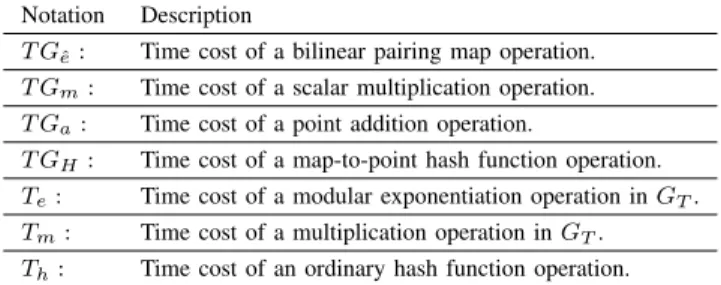
TABLE 2.Notations of computation costs.
TABLE 3.Computation time for operations.
then ˆ e(P,Pab)x ∗v∗−x0v0 = ˆe(P,U∗−U0)eˆ(P,tP)y0v0−y∗v∗ = ˆe(P,U∗−U0)eˆ(P,(y0v0−y∗v∗)tP) = ˆe(P,(U∗−U0)+(y0v0−y∗v∗)tP). So ˆ e(P,Pab)= ˆe(P,(U∗−U0) +(y0v0−y∗v∗)tP)(x∗v∗−x0v0)−1 = ˆe(P,(x∗v∗−x0v0)−1((U∗−U0) +(y0v0−y∗v∗)tP))
From the above equation we can see that
Pab=(x∗v∗−x0v0)−1((U∗−U0)+(y0v0−y∗v∗)tP). The analysis of SII’s advantage is just the same as SI’s
advantage in the simulated Game I. We note that at the end
of simulated Game II,AII will output a valid signature on
identityID∗with a probability of (1−1
q)
1
qH1II
−qh q, which
is exactly the advantage thatSIIsucceeds. This concludes the proof.
From Lemma 1 and Lemma 2 we get the following theo-rem.
Theorem 1: The proposed RIBS scheme with outsourced revocation is existence unforgeable against adaptive chosen identity and message attack under the CDH assumption.
VI. PERFORMANCE EVALUATION
In this section we present the performance evaluation of the proposed scheme, including computation and communication
costs. We choose the Ate pairing eˆ : G × G → GT
generated by a point on a super singular eppliptic curve
TABLE 4. Comparisons of computation costs.
over a finite fieldE(Fp), whereG,GT are groups of prime
order q. To ensure an appropriate security level, p and q
are large prime numbers with a length of 512 and 160 bits respectively. Table 2 lists the notations used to describe the computation costs of the operations used in the related schemes.
Previous implementations have showed that compared with the computation costs of time-consuming bilinear pairing map, map-to-point hash, scalar multiplication and modular exponentiation operations, the computation costs
of point addition, multiplication in GT and the ordinary
hash operations are trivial. Therefore, we only consider
TGeˆ,TGH,TGm,Tewhen we evaluate the performance.
We evaluate the costs of the above basic operations using MIRACL library [33] on the elastic compute service (ECS) host provided by the Alibaba Cloud platform. The operating system of the host is Ubutu 14.04 for 64 bit with an Intel(R) Xeon(R) CPU E5-2630 0 @ 2.30GHz, and equipped with 1GB RAM. Table 3 lists the computational time for related operations on the host.
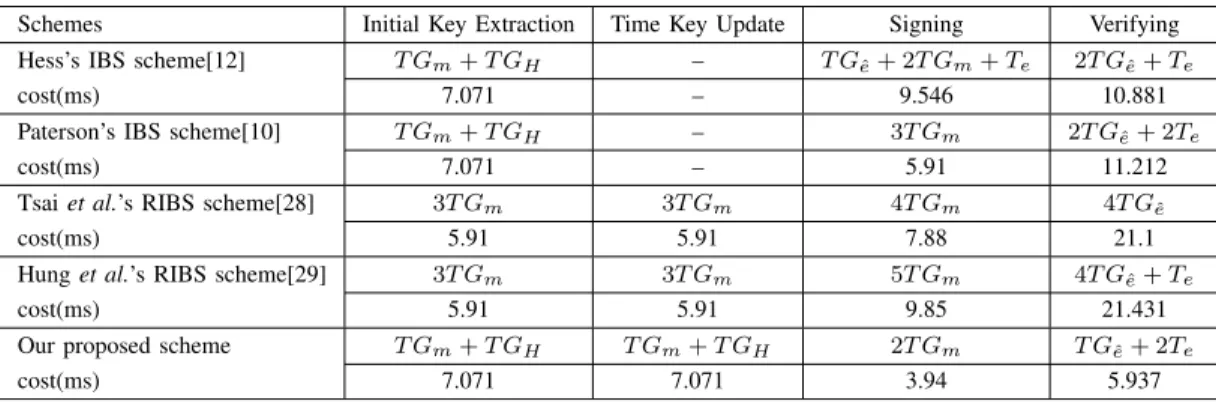
Since there is no other RIBS scheme with CRS based on pairings and proven secure in the random oracle model, we therefore compared the performance of our scheme with some IBS schemes with bilinear pairings but without revo-cation functionality, and we also compared the performance of our scheme with two RIBS schemes that are secure in the standard model. Table 4 lists the comparisons among
the schemes of Hess [12], Paterson [10], Tsai et al. [28],
Hung et al. [29] and ours in terms of computation costs for the initial key extraction, time key update, signing and verification.
There is no revocation in Hess’s and Paterson’s schemes, but we can extend their schemes to be revocable by using the framework we proposed in section III-A. Tsai and Hung have included revocation functionality in their schemes, but the schemes are designed in the standard model, which means that the hash functions they used are much more inefficient than those used in the random oracle model. In the com-parisons, although we omit most of the computation costs of specific, hash operations, the comparison results are still meaningful and referential. We also take into account the
operations which can be precomputed in all the schemes to achieve the best performance from them.
For the computation cost in the initial key extraction,
Hess’s scheme requires TGm + TGH (7.071ms), same as
Paterson’s and our scheme. Tsai’s and Hung’s schemes both
require 3TGm (5.91ms). As for the time key update, our
scheme requiresTGm+TGH (7.071ms). Tsai’s and Hung’s
schemes require 3TGm (5.91ms). There is no such
oper-ations in Hess’s and Paterson’s scheme, but if we extend their schemes using the technique we propose, the compu-tation costs of time key update of their schemes will be
same as ours, namely, TGm + TGH (7.071). As for the
signing process, Hess’s scheme requires TGeˆ + 2TGm +
Te (9.546ms). Paterson’s scheme requires 3TGm (5.91ms).
Tsai’s scheme requires 4TGm (7.88ms). Hung’s scheme
requires 5TGm (9.85ms) while our scheme only requires
2TGm (3.94ms). For the verification process, although there
are three bilinear maps that need to be evaluated for each sig-nature in our scheme, but some of them can be precomputed. Hess’s scheme requires 2TGeˆ+Te(10.881ms). Paterson’sS
scheme requires 2TGeˆ + 2Te (11.212ms). Tsai’s scheme
requires 4TGˆe(21.1ms). Hung’s scheme requires 4TGeˆ+Te
(21.431ms). Our scheme requires TGeˆ + 2Te (5.937ms).
Although our scheme seems a little more time consuming than Tsai’s and Hung’s schemes in the initial key extraction and time key update process, it is worth pointing out that there are several point addition brevity. Moreover, the initial key extraction and time key update process would not be executed frequently, so there is impact on the overall performance. As for the signing and verification process, our scheme outper-forms the other schemes.
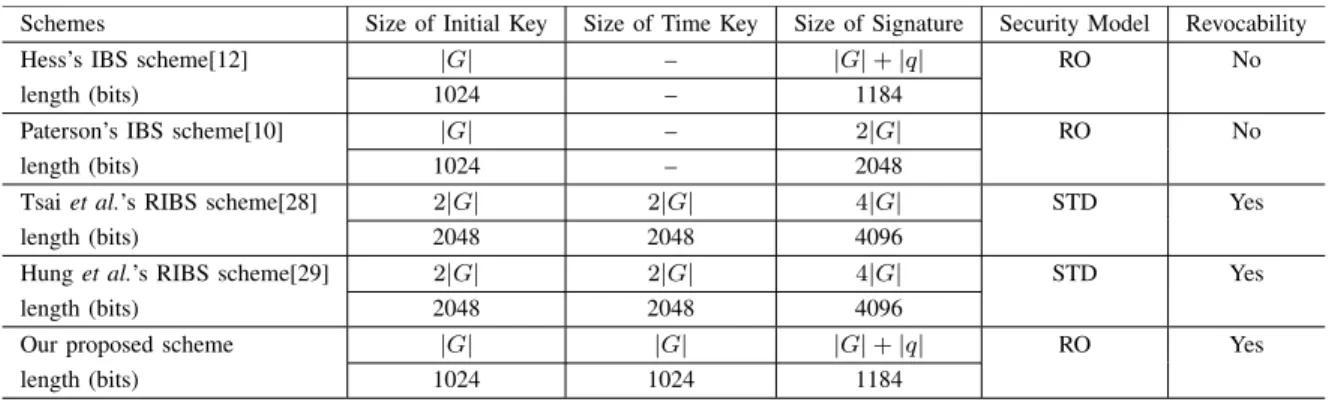
Table 5 presents the comparisons of communication costs in terms of the size of initial identity key, time update key and signature. Let|G|denote the size of each element in group
G. If Gis a elliptic curve on finite field Fp, where p is a 512 bit prime number, then|G|denotes the size of a point inG, which is 1024 bits.|q|denotes the bit length ofq, which is, for example, 160 bits to achieve an appropriate security level. The initial identity key has a length of|G|(1024 bits) in schemes of Hess, Paterson and ours, and has a length of 2|G|(2048 bits) in the schemes of Tsaiet al.and Hunget al..
X. Jiaet al.: Efficient Revocable ID-Based Signature With Cloud Revocation Server
TABLE 5. Comparison of communication costs.
The time update key has the same length as the initial identity key in each scheme except for Hess’s and Paterson’s schemes. For the size of the signature, Hess’s scheme has a length of
|G|+|q|(1184 bits), which is same as ours. Paterson’s scheme
has a length of 2|G| (2048 bits). Both Tsai’s and Hung’s
schemes has a length of 4|G|(4096 bits). We observe that the communication costs of Hess’s scheme and ours are lower than the other schemes. We also present the security model and revocability of the target schemes in table 5.
VII. CONCLUSION
In this paper, we propose an efficient RIBS scheme with CRS based on bilinear pairings. To eliminate the computation and communication costs of the KGC, revocation functionality is outsourced to a cloud revocation server. We present the framework of the outsourced revocation RIBS scheme and formalize the security model. Our scheme is proven to be secure against existential forgery on adaptively chosen mes-sages and identity attacks in the random oracle model. The performance comparisons show that our scheme has lower computation costs and shorter signature size than previously proposed RIBS schemes thereby demonstrating its suitability for resource-constrained resources such as wireless sensor networks.
ACKNOWLEDGMENT
The authors would like to thank the anonymous reviewers for their constructive comments which helped us improve the quality and presentation of this paper.
REFERENCES
[1] D. Boneh and M. Franklin, ‘‘Identity-based encryption from the weil pairing,’’ inProc. Annu. Int. Cryptol. Conf., 2001, pp. 213–229. [2] J. Li, J. Li, X. Chen, C. Jia, and W. Lou, ‘‘Identity-based encryption with
outsourced revocation in cloud computing,’’IEEE Trans. Comput., vol. 64, no. 2, pp. 425–437, Feb. 2015.
[3] A. Shamir, ‘‘Identity-based cryptosystems and signature schemes,’’ in
Proc. Workshop Theory Appl. Cryptograph. Techn., 1984, pp. 47–53. [4] A. Fiat and A. Shamir, ‘‘How to prove yourself: Practical solutions to
identification and signature problems,’’ inProc. Adv. Cryptol., 1999, pp. 420–426.
[5] L. C. Guillou and J. J. Quisquater,A ‘Paradoxical’ Indentity-Based Sig-nature Scheme Resulting from Zero-Knowledge, New York, NY USA: Springer, 1990, pp. 216–231.
[6] T. Okamoto,Provably Secure and Practical Identification Schemes and Corresponding Signature Schemes. Berlin, Germany: Springer, 1992. [7] H. Tanaka, ‘‘A realization scheme for the identity-based cryptosystem,’’
Electron. Commun. Jpn., vol. 73, no. 5, pp. 340–349, 1990.
[8] R. Sakai, ‘‘Cryptosystems based on pairing,’’ inProc. Symp. Cryptogr. Inf. Secur. (SCIS), Jan. 2001, pp. 26–28.
[9] J. C. Choon and J. H. Cheon, ‘‘An identity-based signature from gap diffie-hellman groups,’’ inProc. Int. Workshop Theory Pract. Public Key Cryptogr., Public Key, 2002, pp. 18–30.
[10] K. G. Paterson, ‘‘ID-based signatures from pairings on elliptic curves,’’
Electron. Lett., vol. 38, no. 18, pp. 1025–1026, Aug. 2002.
[11] F. Hess, ‘‘Exponent group signature schemes and efficient identity based signature schemes based on pairings,’’ 2002.
[12] F. Hess,Efficient Identity Based Signature Schemes Based on Pairings. Berlin, Germany: Springer, 2003.
[13] D. Galindo and F. D. Garcia, ‘‘A schnorr-like lightweight identity-based signature scheme,’’ inProc. 2nd Int. Conf. Cryptol. Africa Prog. Cryptol.-AFRICACRYPT, Gammarth, Tunisia, Jun. 2009, pp. 135–148.
[14] M. Bellare, C. Namprempre, and G. Neven, ‘‘Security proofs for identity-based identification and signature schemes,’’J. Cryptol., vol. 22, no. 1, pp. 1–61, 2009.
[15] F. Zhang, R. Safavi-Naini, and W. Susilo, ‘‘An efficient signature scheme from bilinear parings and its applications,’’ inProc. Int. Workshop Theory Pract. Public Key Cryptogr., Singapore, Mar. 2004, pp. 277–290. [16] P. S. L. M. Barreto, B. Libert, N. Mccullagh, and J. J. Quisquater,Efficient
and Provably-Secure Identity-Based Signatures and Signcryption From Bilinear Maps. Berlin, Germany: Springer, 2005.
[17] B. Waters,Efficient Identity-Based Encryption Without Random Oracles. Berlin, Germany: Springer, 2005.
[18] K. G. Paterson and J. C. N. Schuldt,Efficient Identity-Based Signatures Secure in the Standard Model. Berlin, Germany: Springer, 2006. [19] F. Zhang and K. Kim,Efficient ID-Based Blind Signature and Proxy
Signature From Bilinear Pairings. Berlin, Germany: Springer, 2003. [20] X. Chen, F. Zhang, D. M. Konidala, and K. Kim, ‘‘A new id-based group
signature scheme from bilinear pairings,’’ inProc. Int. Workshop Inf. Secur. Appl., vol. 3348. 2003, pp. 585–592.
[21] J. H. Cheon, Y. Kim, and H. J. Yoon, ‘‘A new id-based signature with batch verification,’’ inProc. Cryptol. Eprint Arch. (IACR), 2004, p. 131. [22] G. U. Wei-Na, ‘‘A new id-based group signature scheme,’’Comput.
Mod-ernization, 2010.
[23] A. Boldyreva, V. Goyal, and V. Kumar, ‘‘Identity-based encryption with efficient revocation,’’ inProc. ACM Conf. Comput. Commun. Secur. (CCS), Alexandria, VA, USA, Oct. 2008, pp. 417–426.
[24] B. Libert and J.-J. Quisquater, ‘‘Efficient revocation and threshold pairing based cryptosystems,’’ inProc. 22nd Annu. Symp. Principles Distrib. Comput., 2003, pp. 163–171.
[25] J. H. Seo and K. Emura, ‘‘Revocable identity-based encryption revisited: Security model and construction,’’ inProc. Public-Key Cryptogr.-PKC, 2013, pp. 216–234.
[26] J. H. Seoa and K. Emurab, ‘‘Revocable hierarchical identity-based encryp-tion,’’Theoretical Comput. Sci., vol. 542, pp. 44–62, Jul. 2014. [27] Y.-M. Tseng and T.-T. Tsai, ‘‘Efficient revocable ID-based encryption with
a public channel,’’Comput. J., vol. 55, no. 4, pp. 475–486, 2012.
[28] T. T. Tsai, Y. M. Tseng, and T. Y. Wu, ‘‘Provably secure revocable id-based signature in the standard model,’’Secur. Commun. Netw., vol. 6, no. 10, pp. 1250–1260, 2013.
[29] Y. H. Hung, T. T. Tsai, Y. M. Tseng, and S. S. Huang, ‘‘Strongly secure revocable id-based signature without random oracles,’’Inf. Technol. Con-trol, vol. 43, no. 3, pp. 264–276, 2014.
[30] Y. Sun, F. Zhang, L. Shen, and R. Deng, ‘‘Revocable identity-based sig-nature without pairing,’’ inProc. Int. Conf. Intell. Netw. Collaborat. Syst., 2013, pp. 363–365.
[31] J. Wei, W. Liu, and X. Hu, ‘‘Forward-secure identity-based signature with efficient revocation,’’Int. J. Comput. Math., vol. 93, pp. 1–23, 2016. [32] D. Pointcheval and J. Stern, ‘‘Security arguments for digital signatures and
blind signatures,’’J. Cryptol., vol. 13, no. 3, pp. 361–396, 2000. [33] M. Scott, ‘‘Miracl library,’’ (2011). [Online] Available: http://www.
shamus.
XIAOYING JIA received the B.S. and M.S. degrees from PLA Information Engineering Uni-versity in 1999 and 2004, respectively, and the Ph.D. degree from the State Key Laboratory of Information Security, Graduate University of Chinese Academy of Sciences, in 2012. She is currently a Lecturer with South-Central University for Nationalities. Her research interests include applied cryptography, cloud computing, and net-work security.
DEBIAO HEreceived the Ph.D. degree in applied mathematics from the School of Mathematics and Statistics, Wuhan University, in 2009. He is cur-rently an Associate Professor with the State Key Laboratory of Software Engineering, Computer School, Wuhan University. His main research interests include cryptography and information security, in particular, cryptographic protocols.
SHERALI ZEADALLY received a bachelor’s degree from the University of Cambridge, United Kingdom, and his doctorate degree from the Uni-versity of Buckingham, United Kingdom, both in computer science. He is an associate professor in the College of Communication and Information, University of Kentucky, Lexington, USA. He is a Fellow of the British Computer Society and a Fellow of the Institution of Engineering Technol-ogy, United Kingdom.
LI LI received the Ph.D. degree in computer science from the School of Computer, Wuhan University, in 2004. She is currently an Associate Professor with the International School of Soft-ware, Wuhan University. Her research interests lie in the area of security and privacy, including privacy protection, embedded security, and data security.