1
EXTERNAL SUPPLY CHAIN FLEXIBILITY AND PRODUCT INNOVATION PERFORMANCE: A STUDY OF SMALL- AND MEDIUM-SIZED UK-BASED
MANUFACTURERS Abstract Purpose:
This study examines the effect of external supply chain (SC) flexibility on the product innovation performance of small and medium sized firms (SMEs), and the contingent role of informal control mechanisms in moderating such an effect.
Design/methodology/approach:
This study conducts a cross-sectional questionnaire survey of 236 UK-based SME manufacturers.
Findings:
Inbound supplier flexibility (ISF) has a stronger positive effect on SMEs’ product innovation performance than outbound logistics flexibility (OLF), and that the strength and direction of both effects depend on informal control mechanisms. Lead supplier influence negatively moderates the relationship between ISF and product innovation performance, but positively moderates the relationship between OLF and product innovation performance. Normative integration positively moderates the relationship between ISF and product innovation performance.
2
This study enriches SC flexibility studies by focusing on understanding the differential effects of ISF and OLF on product innovation performance, as well as the role that contingency factors play in these relationships in the SME context.
Practical implications:
To promote product innovation performance, SME managers should focus on building good relationships with their suppliers rather than their logistics service providers. SME managers should be particularly aware of the different types of informal control mechanisms that govern their SC relationships and adjust their managerial approaches accordingly.
Originality/value:
This study distinguishes between ISF and OLF and examines their impacts on SMEs’ product innovation performance. This study investigates the differential effects of lead supplier influence and normative integration on the relationship between external SC flexibility and SMEs’ product innovation performance.
Keywords: Inbound supplier flexibility; Outbound logistics flexibility; Product innovation; Lead supplier influence; Normative integration
3
INTRODUCTION
Supply chain (SC) flexibility is a critical source of competitive advantage for the focal firm1 in the fast-paced business environment (Malhotra and Mackelprang, 2012; Sánchez and Pérez, 2005). A flexible SC allows the focal firm in this industry to introduce new products in order to cope with the market demand and survive environmental jolts (Liao et al., 2010; Stevenson and Spring, 2007). For example, the fashion industry’s product ranges and styles must be constantly renewed to meet the end-customers’ ever changing tastes. When treating SC flexibility as an entire system, Malhotra and Mackelprang (2012) distinguish two facets of SC flexibility: internal manufacturing flexibility and external SC flexibility. Internal
manufacturing flexibility captures the focal firm’s capacity to adjust various manufacturing processes (i.e. mix, routing, etc.) effectively (Sánchez and Pérez, 2005; Stevenson and Spring, 2007). External SC flexibility reflects the extent to which the (external) SC partners (i.e. suppliers) are willing and able to make changes in order to accommodate the focal firm’s unanticipated requests (Hartmann and De Grahl, 2011; Omar et al., 2012). The current research focuses on the relationship between external SC flexibility and product innovation by addressing three unresolved issues in the extant literature.
First, external SC flexibility relates to the flexibility of the focal firm’s SC partners, such as suppliers (inbound) and logistics service providers (outbound). Inbound supplier flexibility (ISF) involves the extent to which the focal firm’s suppliers are willing and
capable of providing manufacturing inputs in a responsive fashion (Liao et al., 2010; Omar et al., 2012). Outbound logistics flexibility (OLF) refers to the extent to which the focal firm’s logistics service providers are willing and able to accommodate its special, non-routine requests to deliver manufacturing outputs (Hartmann and De Grahl, 2011; Malhotra and Mackelprang, 2012). Scholars have recognized the linkages between ISF (or OLF) and the focal firm’s product innovation activities (e.g. Bowersox et al., 1999; McCutcheon et al.,
4
1997). However, little is known about the relative effects of ISF and OLF in contributing to the performance on product innovation. This study defines product innovation performance as the extent to which the focal firm can outperform its competitors in developing and
introducing new products over a time period (Madrid-Guijarro et al., 2009; Terziovski, 2010). Second, flexible SC partners are willing and able to adjust the initial agreement with the focal firm in order to bring it into line with the environmental conditions (Han et al., 2014; Ivens, 2005). Informal control mechanisms refer to the use of relational norms to regulate all firms’ behavior in the SC (Luo et al., 2011). The presence of informal control mechanisms allows the focal firm to access multiple potential sources and reduce opportunism in the SC network (Luo et al., 2011; Young and Wilkinson, 1989), which may make having a
relationship with certain flexible SC partners more/less beneficial for the focal firm. However, little is known about the contingent role of informal control mechanisms in this situation. This study examines two types of informal control mechanism: lead supplier influence and normative integration. Lead supplier influence is the extent to which the most influential supplier affects every firm’s actions within the SC (Gooner et al., 2011). Normative
integration is the extent to which every firm in the SC values openness and trust within their SC relationship (Schleimer and Pedersen, 2013). It remains unclear how these two types of informal control mechanisms interact with external SC flexibility to affect product innovation performance.
Third, field researchers have long recognized the critical role that product innovation plays in small and medium sized firms’ (SMEs’) business success (Terziovski, 2010). However, according to the UK Innovation Survey 20152, SMEs are still less innovative than larger businesses. This is possibly due to their limited resources making engagement in innovation risky (Madrid-Guijarro et al., 2009; Terziovski, 2010). External SC flexibility is an important strategic option for mitigating such a risk, because it allows the focal SME to
5
leverage its SC partners’ resources to overcome the internal resources constraints when conducting innovation-related activities (Sánchez and Pérez, 2005). However, no studies have empirically examined the impact of external SC flexibility on product innovation performance in the SME context.
To address these research gaps, this study builds on the extended resource-based view (ERBV) and governance literature to develop and test a framework (see Figure 1). This study aims to make three key contributions to the literature. First, unlike previous studies (e.g. Bowersox et al., 1999; McCutcheon et al., 1997), the research demonstrates empirically the differential effects of ISF and OLF on product innovation performance. Second, while
previous studies failed to examine the informal control mechanisms as contingent factors that influence the impact of external SC flexibility (e.g. Hartmann and De Grahl, 2011; Omar et al., 2012), this study shows how lead supplier influence and normative integration affect the relationship between external SC flexibility (ISF and OLF) and product innovation
performance. Finally, this study builds and tests the theory from the SMEs’ perspective. Although anecdotal evidence suggests that the SC relationship plays an important role in the focal SME’s product innovation performance (Arend and Wisner, 2005), insufficient research relates to the SME context (Fantazy et al., 2009; Stevenson and Spring, 2007).
THEORY AND HYPOTHESES Literature Background
The system view of SC flexibility includes internal manufacturing flexibility and external SC flexibility (Malhotra and Mackelprang, 2012). Prior studies have extensively investigated the influence of internal manufacturing flexibility (see review articles: Vokurka and O'Leary-Kelly (2000); Beach et al. (2000)) on the firm’s strategy development. Few studies have focused on the role of external SC flexibility in enabling the focal firm to
6
formulate strategy and overcome environmental uncertainty (e.g. Hartmann and De Grahl, 2011; Liao et al., 2010).
Particularly regarding the strategy development related to product innovation, several researchers have assessed how internal manufacturing flexibility enables firms to achieve product innovation outcomes. For example, Camisón and Villar-López (2010) suggest that manufacturing flexibility can affect the focal firm’s product innovation activities (as well as process and organizational innovation activities), thereby leading to superior performance. Oke (2013) found that the interaction between mix and labour flexibility influences product innovation. In comparison, there is a lack of research on the role of external SC flexibility as a driver of product innovation. Few notable exceptions either only theoretically discuss how external SC flexibility affects product innovation (e.g. Bowersox et al., 1999) or empirically examine the impacts of only one specific type of external SC flexibility on product design (e.g. McCutcheon et al., 1997). This study aims to advance this study stream by providing a comprehensive picture with concrete empirical evidence of how external SC flexibility affects product innovation.
Theoretical Background
The resource-based view considers that the focal firm’s unique internal resources, that are valuable, rare, and inimitable, give it a competitive advantage (Hartmann and De Grahl, 2011). A recent extension of the resource-based view, known as “ERBV” (Lewis et al., 2010), posits that the focal firm’s resources lie beyond its organizational boundaries, residing in its relationships with certain SC partners (i.e. suppliers) who are important sources of resources for the focal firm (Squire et al., 2009). By combining the (external) resources of certain SC partners with its own internal resources, the focal firm can engage in value creating activities
7
(such as product innovation) that are difficult for its competitors to copy (Lewis et al., 2010). Thus, its relationships with certain SC partners are valuable to the focal firm (Jin et al., 2014).
Although the ERBV explains that the relationship between the focal firm and certain SC partners can generate a competitive advantage, it contains insights into the contingency factors that might affect the value of this relationship. According to the governance literature, control mechanisms can regulate all firms’ behavior in a SC network and serve as guidelines for how to manage these relationships (Luo et al., 2011; Young and Wilkinson, 1989). As a result, control mechanisms allow the focal firm to access multiple potential sources and reduce opportunism in the SC network, which can affect the value of the focal firm’s
relationship with certain SC partners (Ghosh and John, 2005). This contingent view suggests that the value of the relationship between the focal firm and certain SC partners may depend on the control mechanisms. Building on the insights from both ERBV and the governance literature, this study develops the theoretical framework for this study.
“Insert Figure 1 about Here”
External Supply Chain Flexibility and Product Innovation Performance
Product innovation performance serves as the dependent variable in the framework. According to ERBV, their mutual relationship enables the focal firm to combine its internal resources with its exchange partners’ resources, which can be used to implement a specific strategy (Lewis et al., 2010). This mixture of internal and external resources is unique and difficult for competitors to copy, which provides a basis for the focal firm to generate
favourable outcomes as a result of implementing such a strategy (Jin et al., 2014; Squire et al., 2009). This study focuses specifically on the performance outcomes from the implementation of product innovation strategy over a period. For SMEs, continuously investing in product innovation often relates to their survival and it may take varying lengths of time to complete different product innovation projects (Terziovski, 2010).
8
This study conceptualizes external SC flexibility as an independent variable in the framework. This consideration also builds on ERBV, which argues that the focal firm’s relationship with certain SC partners is an important resource for the focal firm (Squire et al., 2009). External SC flexibility relates to this type of relationship-based resource, for two reasons. First, external SC flexibility is a relationship that exists between the focal firm and certain SC partners. All participants consider their connections with one another to be valuable and important, and so are willing to accommodate each other’s needs beyond their existing agreement (Han et al., 2014; Ivens, 2005). Second, SC external flexibility constitutes an important component of the focal firm’s competitive advantage. Flexibility, enables the focal firm to request sudden, unscheduled support from certain SC partners, that is unique and difficult for others to imitate (Hartmann and De Grahl, 2011; Liao et al., 2010). As a result, the focal firm can better cope with environmental uncertainty and adjust its position in the marketplace more effectively than its competitors (Omar et al., 2012). This study
distinguishes between two types of external SC flexibility: ISF and OLF. ISF arises from the focal firm’s relationship with suppliers that source manufacturing inputs (i.e. material/parts). OLF arises from the focal firm’s relationship with logistics service providers that distribute manufacturing outputs (i.e. finished products). Previous studies have emphasized the strategic importance of the focal SME’s relationship with its suppliers and logistics service providers (Arend and Wisner, 2005; Quayle, 2003). Because this adds flexibility to the core processes, such as sourcing and delivery, and so can enhance the focal SME’s ability to combat market uncertainty (Fantazy et al., 2009).
Drawing on ERBV, this study anticipates a connection between external SC flexibility and product innovation performance. Successful product innovation usually means that a firm can effectively execute two activities: product development and product launch (Bowersox et al., 1999). ISF can lead to product innovation performance by allowing the focal SME to
9
perform product development tasks more effectively. The development of a new product often involves the addition or replacement of new manufacturing inputs (Terziovski, 2010). For example, if an SME wishes to develop a new version of a product for a specific group of end-customers (i.e. a luxury version), it may wish to use a new material (i.e. precious metal) to make this product. As end-customer’s reaction to the early version of the product is hard to predict, an SME may need to adjust its offer. Accordingly, the focal SME must request a modification to the existing agreement with its suppliers. Whether or not the focal SME has a relationship with the flexible suppliers will affect its ability to perform product development tasks effectively, because most SMEs have limited resources to stock a variety of different materials and parts to use to develop new products (Madrid-Guijarro et al., 2009; Terziovski, 2010). Thus, ISF is an important driver of the focal SME’s product innovation performance.
OLF can also lead to product innovation performance by allowing the focal SME to perform product launch tasks more effectively. When the product is new, the focal SME will have very little information available to facilitate accurate forecasts of future market demand. As a result, the focal SME will usually organize its operational efforts for manufacturing ramp-up and load the channel with anticipated inventory stock levels to ensure product availability and avoid unplanned out-of-stock-related problems (Bowersox et al., 1999). This means that the focal SME must commit significant resources to maintaining the “appropriate” inventory level during new product launches. It also means that the focal SME, with limited resources, will be less likely to have spare resources to support other product innovation projects (Madrid-Guijarro et al., 2009). In comparison, having a relationship with more flexible logistics service providers enables the focal SME to produce products in response to the actual market needs rather than anticipating demand via inventory (Bowersox et al., 1999; Calantone and Di Benedetto, 2012). This means that the focal SME needs to only make a limited resource commitment of inventory in the early stage of product introduction and then
10
rapidly responds to the demand for products subsequently (Calantone and Di Benedetto, 2012). Accordingly, the focal SME will probably have spare resources to support multiple product innovation projects. Thus, OLF is an important driver of the focal SME’s product innovation performance.
This study also expects that ISF will have a stronger positive effect on product innovation performance than OLF. OLF contributes to product innovation performance by enhancing the focal SME’s ability to launch products. The emerging e-commerce provides the focal SME with new tools to reach its end-customers directly (Murillo, 2001). This allows the focal SME to implement the principles of response-based logistics (Bowersox et al., 1999) by itself, without requiring a relationship with flexible logistics service providers. In other words, logistics service providers’ level of flexibility in the SC will not affect the focal SME’s decision to engage in produce innovation activities. For example, the focal SME can gather pre-order requests online. Once the level of demand emerges, the focal SME can adjust its manufacturing activities to respond to the market needs. Finally, the focal SME can use any logistics service providers to deliver the products to the end-customer directly.
On the other hand, ISF contributes to product innovation performance by enhancing the focal SME’s ability to perform product development activities. Having a relationship with flexible suppliers suggests that a coordination mechanism exists for easily communicating ideas and collaborating on problem solving (Liao et al., 2010). This can improve the focal SME’s capacity to undertake effective product development (Fantazy et al., 2009), since it can easily obtain the necessary information (i.e. materials availability) from flexible suppliers when designing new products. The development of such a mechanism requires both parties to commit resources over a long period of time (Kwon and Suh, 2005). Hence, it is hard to replace. Combining the above arguments, this study proposes:
11
Hypothesis 1: Inbound supplier flexibility has a stronger positive effect on the focal SME’s product innovation performance than outbound logistics flexibility
Moderating Role of the Informal Control Mechanisms
Control mechanisms, that regulate the conduct of the parties during an exchange, can affect the value of the focal firm’s relationship with its SC partners in terms of supporting the implementation of a specific strategy (Krapfel et al., 1991; Luo et al., 2011). There are two general types of control mechanism. Formal control mechanisms focus on formalized rules and clauses, while informal control mechanisms emphasize the use of relational norms to govern exchange relationships (Luo et al., 2011; Young and Wilkinson, 1989). This study focuses on informal control mechanisms because external SC flexibility reflects that: (1) the focal firm and its SC partners consent to modify the existing formal contract, and (2) the SC partners’ activities beyond the scope of the formal contract upon the focal firm’s request (Han et al., 2014; Ivens, 2005). Previous studies on SC management in the SME context have highlighted the influence of informal control mechanisms on the interactions that occur within the relationship between the focal firm and its SC partners (Luo et al., 2011). The focal SME, with its limited resources, tends to have little influence on the existing informal control mechanisms’ design or modification. Thus, informal control mechanisms could be important contingency factors that influence external SC flexibility’s impact in the SME context. This study focuses on two informal control mechanisms as moderating variables in this framework: lead supplier influence and normative integration.
The concept of lead supplier influence emerged from the retail operations
management literature, and relates to the influence of the most influential “supplier” on the individual retailer’s business decisions (Gooner et al., 2011; Morgan et al., 2007). This study broadens its original scope from the supplier-retailer relationship to the entire SC relationship.
12
This perspective builds on the prior research, which emphasizes the lead supplier’s role in shaping all SC parties’ behavior (Morgan et al., 2007). This study expects that lead supplier influence will negatively moderate the relationship between ISF and product innovation performance. Flexible suppliers willingly put forward their own resources to help the focal SME to ease the pressure arising from stocking manufacturing inputs (i.e. materials) by adjusting the initial supply agreement upon request. As such, having a relationship with flexible suppliers creates an environment that allows the focal SME to bolster its product innovation efforts. Greater lead supplier influence leads to a larger pool of resources within the SC, which can replace the function of flexible suppliers in supporting the focal SME’s product innovation activities. The lead supplier influence affects the lead supplier’s
willingness to deploy resources to support the SC’s general operations and strategic plan, so firms within the SC will cede significant managerial decision-making authority in return for access to the lead supplier’s resources (Ghosh and John, 2005; Gooner et al., 2011). The presence of strong lead supplier influence improves the resource availability within the SC, which creates a favourable environment for the focal SMEs to access the necessary resources and engage in product innovation activities. In such a situation, the focal SME relies less on having a relationship with flexible suppliers when engaging in product innovation activities. Therefore,
Hypothesis 2: Lead supplier influence negatively moderates the relationship between inbound supplier flexibility and the focal SME’s product innovation performance
In contrast, this study expects the effect of OLF on product innovation performance to increase when the level of lead supplier influence is high. Having a relationship with flexible logistics service providers enables the focal SME to test customer acceptability regarding new products quickly (Bowersox et al., 1999). The end-customer’s initial reaction to new
13
products will be closely tracked by the focal SME, as it organizes manufacturing activities based on the actual needs, due to having a relationship with flexible logistics service providers. This enables the focal SME to modify and introduce future versions of the new product, if necessary, based on market acceptance. However, the focal SME will be unable to capitalize on this advantage fully if it lacks the necessary support from the supplier-side of the SC operations for product development. The presence of a strong lead supplier influence means that the lead supplier is more willing to deploy its own resources to support the execution of the SC’s operation and strategic plan (Gooner et al., 2011; Morgan et al., 2007). In such a situation, the focal SME can access the necessary resources from the lead supplier to aid its product innovation initiatives to develop future versions of the new product. The value accrued from having a relationship with flexible logistics service providers appears more salient when the lead supplier influence is strong. Thus,
Hypothesis 3: Lead supplier influence positively moderates the relationship between outbound logistics flexibility and the focal SME’s product innovation performance
The concept of normative integration emerged from the international management literature, and describes relational norms associated with trust and openness as the most appropriate behavior for governing the parent company and its subsidiaries’ interactions (Schleimer and Pedersen, 2013). Scholars have used this concept to study inter-firm governance (e.g. Stephen and Coote, 2007). This study focuses on the role of normative integration in influencing inter-firm SC relationships. A high level of normative integration improves the flow of quality information between the focal SME and its SC partners because there is no fear that the counter-party will wrongfully use information out of self-interest (Stephen and Coote, 2007). When the level of trust is high, both the focal SME and its SC partners will feel more confident that the other party will not behave opportunistically (Kwon
14
and Suh, 2005). Openness also reduces the likelihood of opportunistic behavior, because the potential cost of this increases when the parties can easily detect each other’s movements (Stephen and Coote, 2007). Thus, firms do not need to conceal sensitive, strategically important information from each other when a high level of normative integration exists in the SC relationship. Although not every firm in the SC will encounter the end-customers directly, all of them will acquire details about the end-customers either directly (via market research) or indirectly (via networks) (Zhou and Benton Jr, 2007).
Having a relationship with flexible suppliers allows the focal firm to capitalize on the flow of end-customer information derived from a high level of normative integration. When the SC had a high level of normative integration, the focal firm will be more likely to detect changes in the end-customers’ needs by analysing information supplied by its SC partners (Kwon and Suh, 2005; Young and Wilkinson, 1989). However, the focal firm is less likely to address such changes unless its suppliers are willing to modify their existing manufacturing inputs supply agreement (Liao et al., 2010; McCutcheon et al., 1997). Having a relationship with flexible suppliers suggests that the focal firm can easily obtain the necessary
manufacturing inputs from its suppliers in a responsive manner, and use these to develop products that address the end-customers’ new needs. This means that normative integration enhances the value of this kind of relationship. Thus,
Hypothesis 4: Normative integration positively moderates the relationship between inbound supplier flexibility and the focal SME’s product innovation performance.
Similarly, this study expects that normative integration will positively moderate the relationship between OLF and product innovation performance. A high level of normative integration improves the SC partners’ willingness to share information about the customers. By analysing this information, the focal firm can detect the changes in the
end-15
customers’ needs, and launch new products to address their needs. However, the focal firm will have little incentive to do so if the logistics service providers are less willing to adjust the existing delivery agreements (Bowersox et al., 1999; Hartmann and De Grahl, 2011). Having a relationship with flexible logistics service providers allows the focal firm to capitalize on the end-customer information flow derived from normative integration. In other words, the value of such a relationship may increase with level of normative integration within the SC relationship. Thus,
Hypothesis 5: Normative integration positively moderates the relationship between outbound logistics flexibility and the focal SME’s product innovation performance.
RESEARCH METHOD Sampling and Data Collections
The unit of analysis for this study is the firm. Data was obtained from a
cross-sectional questionnaire survey of SME manufacturers in the UK. This study adopted a survey data collection design because: (1) no secondary data are available for the key constructs relevant to the test model (see Figure 1) and (2) this allows the development of a
generalisable conclusion about a specific behavioral pattern by assessing a large number of respondents across different categories (Hair et al., 2010).
This study collaborated with a marketing company that specialized in business-to-business data management and marketing and obtained contact information for UK-based manufacturers with fewer than 250 employees. According to the UK government, SMEs are firms with fewer than 250 employees (Rhodes, 2017), so this study selected firms of this nature for the sample. The marketing company initially supplies 6,000 SME records and contact information. From which, 1,500 firms are randomly selected using Microsoft Excel’s random number generating function. To ensure one contact per focal firm, the researchers
16
made sure that none of the selected firms had the same e-mail address, business address or telephone number. A cover letter was sent to the CEO of each firm to ask him/her to complete the questionnaire on behalf of their firm, and a total four email waves was
employed to increase the response rate. 236 (a 15.733% response rate) usable responses were obtained.
Table 1 shows that most of respondents are either micro or small-sized firms (91.1%). In contrast, medium-sized firms only represent 8.9% of the sample, which is unsurprising, since these account for only a small percentage of the UK SME population (Rhodes, 2017). In terms of firm age, most of the SME in the sample are 10-20 years of age (48.3%). In terms of business area within the manufacturing sector,3 “material and metal” manufacturers and “machinery and equipment” manufacturers combined represent over 50% of the firms (56.3%) in the sample. In terms of the perceptions of the competitive intensity, the majority of SMEs (25.4% strongly agree and 45.5% agree) in the sample suggest that they face a high degree of competition within the industry. Similarly, in terms of perceptions of market turbulence, the majority of SMEs (25.8% strongly agree and 58.1% agree) in the sample suggest that the degree of variability and unpredictability of customer preferences and expectations is high. On comparing the answers between the early and late respondents, this study found that the probability of non-response bias was minimal (Armstrong and Overton, 1977).
“Insert Table 1 about Here”
Measures
All of the variables were measured using multi-item, Likert-type scales (for the measurement items, see appendix 1). The researchers first selected a few highly regarded studies and adopted all of their measurement items (including both repeated and different items) to form the initial survey design. To enhance the content and face validity of the
17
measurement, a pilot study was organized by obtaining comments from five SME
manufacturer CEOs with extensive SC management and innovation knowledge. The pilot study asked them to verify the relevance and completeness of the measurement by answering all of the survey items and providing feedback. Refinement of questions, instructions, and terminology in light of their suggestions were conducted to finalize the survey.
For ISF and OLF, this study adapted and modified the measurement items from Malhotra and Mackelprang (2012), Liao et al. (2010), and Hartmann and De Grahl (2011) to assess the (focal) SME CEO’s perceptions of their suppliers and logistics service providers’ flexibility, respectively. More specifically, this study used Malhotra and Mackelprang’s (2012) assessment of external SC flexibility as the basis for the survey design, which consists of six items for assessing ISF and OLF (3 items each). For ISF, this study also incorporates Liao et al.’s (2010) idea of suppliers’ willingness and ability to accommodate “firms’ (special) requests” for changes, rather than Malhotra and Mackelprang’s (2012) “customer request” item, in designing the scales, to ensure clarity. For OLF, this study followed Hartmann and De Grahl’s (2011) use of the term “logistics service providers” rather than Malhotra and Mackelprang’s (2012) “logistics systems”, as this is more in line with this study’s focus. Regarding the survey instruction, this study asked respondents to reflect on their company’s experience of its SC partners’ behavior compared with other SCs that they know about, when answering these six questions. Furthermore, this study asked the
participants to refer to their firm’s suppliers of manufacturing materials/parts inputs when answering the questions regarding ISF, and their firm’s logistics service providers of manufacturing outputs when answering the questions regarding OSF.
Regarding lead supplier influence, this study adapted and modified the measurement items developed by Gooner et al. (2011) and Morgan et al. (2007) to assess the SME CEOs’ perceptions of the lead supplier’s influence on every firm’s decisions and actions within the
18
SC. The five items used by Gooner et al. (2011) were adopted from Morgan et al.’s (2007) earlier works. Since the original purpose of these items was to access the most influential supplier’s influence on the retailer’s managerial actions, this study modified them to fit this study’s focus. In particular, this study deleted two items from Gooner et al.’s (2011) work that focus on retailers’ decisions, such as store-brand stock-keeping units and category input decisions, while retaining the three items that emphasize the lead supplier’s influence on “strategy execution”, “goal setting”, and “planning”. Lastly, this study amend Gooner et al.’s (2011) statements in order to fit the study’s context. In addition, the CEOs’ insightful
comments during the pilot study helped to modify these constructs. This study instructed respondents to refer to the most influential supplier who provides material/parts to their firm’s SC when responding to these three items.
For normative integration, this study adopted and modified Schleimer and Pedersen (2013) and Jaworski and Kohli’s (1993) measurements to assess the SME CEOs’ perceptions of the extent to which trust and openness are the most appropriate behavior within the SC relationship. Schleimer and Pedersen (2013) used the four items, adopted from Jaworski and Kohli (1993), to assess the relational behavior between the parent company and its
subsidiaries. This study modify these to assess the SC relationship. For example, this study modified one of Schleimer and Pedersen’s (2013) items, that emphasizes the information shared between the parent company and its subsidiaries, to focus on assessing the information shared among the SC firms. The CEO’s comments during the pilot study assisted
modification. Furthermore, the CEOs in the pilot study also suggested to delete one of the original items (that focused on evaluating whether one’s ideas and inputs are heeded by others) because this did not fit the context of the study. Finally, this study had three items through which to assess normative integration within the SC relationship. This study asked the participants to consider the degree of inter-firm connectedness between different
19
companies within the SC and the SC management, compared to other SCs that they knew about, when answering these questions.
For product innovation performance, this study adapted and modified Wang and Bansal’s (2012) measurement items to assess the SME CEOs’ perceptions of the novelty and quantities of new products that the firms had introduced over the past three years. In
particular, this study changed the question (i.e. how much did these new lines of
products/services differ from other companies’ products/services?) into a proposition (i.e. many new product lines that differ from those of major competitors have been introduced), in order to measure each item using a Likert-type scale. Furthermore, Wang and Bansal (2012) used the term “products/services” to describe firms’ innovation output, but the CEOs in the pilot study suggested the usage of the term “products” only. Thus, the change is made accordingly. This study asked the participants to rate the survey questions with reference to this variable, referring to their own firm’s product innovation performance.
Finally, firm size (revenue), age, business area (within the manufacturing sector), competitive intensity, and market turbulence are used as the control variables. Log
transformation is applied for the firm’s size and age. An SME’s resource, which translated into the size of the firm, is critical for its continued investment in innovation activities (Madrid-Guijarro et al., 2009). Prior research also reports that an SME’s age can affect its innovation activities. For example, older SMEs show lower innovation probabilities (Huergo and Jaumandreu, 2004). Business area dummies are created using “others” as the benchmark group. Previous studies have provided evidence that business areas’ differences present SMEs with different propensities to engage in innovation (e.g. De Jong and Vermeulen, 2006). Finally, an SME’s innovation strategy and intention strongly affect its perception of the business environment (Madrid-Guijarro et al., 2009; Terziovski, 2010). This study adopted and modified a single item to assess competitive intensity (“the competition in our
20
industry is cutthroat”), and market turbulence (“the end-customers tend to look for new products all the time”) of Hult et al. (2007).
Validity and Reliability
The validity and reliability of the measurements are assessed using the following approaches. First, a principal component analysis for the factor extraction method with a varimax rotation using SPSS 19 statistical software is used to assess the factor loading (Hair et al., 2010). The results from both the Kaiser-Meyer-Olkin test (KMO = 0.753) and
Bartlett’s Test of Sphericity (approx. X2 = 1462.879; df = 91; p < 0.001) show the adequacy of this study’s factor model. The factor loadings for all of the items are above 0.700 (lowest value = 0.761, see Appendix 1), which demonstrates adequate convergent validity.
Furthermore, the correlations among the five main variables in the model (see Figure 1) are all below 0.700 (see Table 2), which demonstrates adequate discriminant validity. To assess the reliability of constructs, the Cronbach’s Alpha was calculated. The findings show that the value of the Cronbach’s Alpha is greater than 0.70, which confirms the construct validity and reliability (Hair et al., 2010). Furthermore, Eisinga et al. (2013) suggest that, for constructs with only a two-item assessment, such as product innovation performance, researchers should report the Spearman-Brown split-half coefficient to ensure its reliability. The calculation suggests that the Spearman-Brown split-half coefficient for product innovation performance is 0.817, which indicates adequate reliability.
Second, confirmatory factor analysis (CFA) model with five factors (ISF, OLF, product innovation performance, lead supplier influence, normative integration) in
hypothesized model (see Figure 1) exhibits an adequate fit (chi-square[X2] = 83.136; degree of freedom [df] = 67; X2/df = 1.241; p-value = 0.000; Comparative Fit Index [CFI] = 0.989; Root Mean Square Error of Approximation [RMSEA] = .031). Table 2 shows that the value
21
of the composite reliability (CR) is greater than 0.70 for all constructs, while that of
composite reliability (AVE) for all constructs exceeded the 0.50 benchmark. The square root value of the AVE for each construct shows that the result for each one was greater than all of its correlations with other constructs (see Table 2). All the results confirm the construct reliability (Hair et al., 2010).
Thirdly, to reduce the risk of potential common method bias, the data collection process protected the anonymity and confidentiality of the respondents (Podsakoff et al., 2012). Furthermore, multiple statistical remedies are used to ensure that common method bias was not an issue for this study (Podsakoff et al., 2012). First, Harman’s single factor test is performed by subjecting all of the items in the study to exploratory factor analysis. The concern about common method bias is high if it is possible to extract a single factor to explain the majority (50%) of the variance of the data. The results show that a single factor only accounts for 29.226% of the variance. Second, CFA techniques are used to compare the model fit between five-factor hypothesized models and one-factor model (by loading all of the items onto a single factor) in CFA. The concern about common method bias is high if the difference between the hypothesized model and the one factor model is not significant. This study’s hypothesized model exhibited a better fit (as reported above) than did the one factor model (X2 = 905.998; df = 77; X2/df = 11.766; p-value = 0.000; CFI = 0.411; RMSEA = 0.214). Both results suggest that common method bias was unlikely to be a serious concern here.
“Insert Table 2 about here”
ANALYSIS AND RESULTS
A moderated multivariate regression analysis with an ordinary least squares is used to test hypotheses because the model contains multiple interaction effects (Aiken and West,
22
1991). The values of variance inflation factors (VIFs) are reported to assess the possibility of multicollinearity (see Table 3). The results show that multicollinearity (VIF < 3) is not a problem in this analysis (Hair et al., 2010). As Table 3 shows, ISF is positively related to product innovation performance (Model 1: β = 0.242, p < 0.001), whereas OLF does not have a significant effect on it (Model 1: β =0.009, p > 0.100). The t-test for the quality of these two coefficients (t = 2.033, p < 0.050) shows that the coefficient of ISF is greater than that of OLF, which supports hypothesis 1.
“Insert Table 3 about here”
To investigate the moderation effects in hypotheses 2-5, this study follows the approach of Aiken and West (1991) by first centering the variables and then calculating the interaction terms before entering all of the main effects and interaction terms into a single regression model. The data reveals that lead supplier influence has a negative moderating effect on the link between ISF and product innovation performance (Model 2: β = -0.119, p < 0.050) and a positive moderating effect on the link between OSF and product innovation performance (Model 2: β = 0.134, p < 0.050). On the other hand, normative integration has a positive moderating effect on the link between ISF and product innovation performance (Model 2: β = 0.190, p < 0.010). Together, the findings support hypotheses 2-4, respectively. Finally, normative integration does not have a moderating effect on the link between OSF and product innovation performance (Model 2: β = 0.070, p > 0.100), and so hypothesis 5 is rejected. Figure 2 represents this graphically.
“Insert Figure 2 about here”
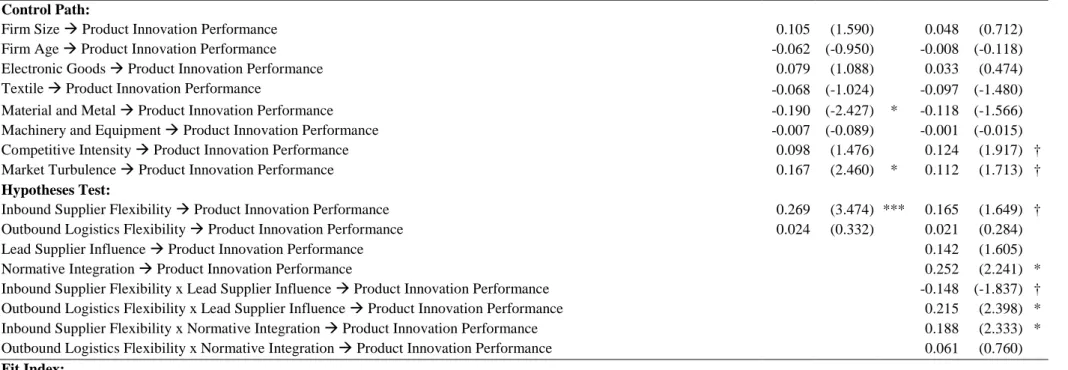
To corroborate the regression results, structural equation modelling analysis is used to ensure the robustness the findings. Table 4 displays the results. Both Models 3 and 4
demonstrate an acceptable fit. In Model 3, there was a positive and significant relationship between ISF and product innovation performance (β = 0.269, p < 0.001), whereas OLF does
23
not have a significant effect on it (β = 0.024, p > 0.100). The t-test for quality also shows that these two coefficients (t = 2.083, p < 0.050) differ significantly. This suggests that ISF has a greater effect on product innovation performance than does OLF. Furthermore, in Model 4, the results show that lead supplier influence negatively affects the relationship between ISF and product innovation performance (β = -0.148, p < 0.100), while positively affecting the relationship between OLF and product innovation performance (β = 0.215, p < 0.050). In contrast, normative integration positively affects the relationship between ISF and product innovation performance (β = 0.188, p < 0.050), while having no significant effect on the relationship between OLF and product innovation performance (β = 0.061, p > 0.100). All of these results are consistent with those found in earlier analyses.
“Insert Table 4 about here”
DISCUSSION AND CONCLUDING REMARKS Theoretical Contributions
First, this study enriches the SC flexibility studies by focusing on understanding the differential effects of ISF and OLF on product innovation performance. Previous studies failed to provide a comprehensive picture, supported by concrete empirical evidence, to explain the linkage between external SC flexibility and product innovation (e.g. Bowersox et al., 1999; McCutcheon et al., 1997). This study found that ISF has a stronger positive impact on product innovation performance. ERBV theory can explain these differential effects. According to ERBV, the relationship between the focal SME and its SC partners constitutes a valuable resource (Lewis et al., 2010). This study builds on the ERBV logic to suggest that ISF and OLF affect product innovation performance in different ways, since these two types of external SC flexibility capture two distinct relationships that a SME develops with
24
relationship between external SC flexibility and product innovation performance. In general, this study’s theoretical logics and empirical findings indicate that researchers must
differentiate between these two types of external SC flexibility to explicate their role in stimulating product innovation performance in the SME context.
Second, this further enriches scholars’ understanding of the relationship between external SC flexibility and product innovation performance by examining the role of
contingency factors. Drawing on the governance literature, this study proposes and tests two informal control mechanisms (lead supplier influence and normative integration) as
contingency factors in the suggested framework (see Figure 1). The results confirm that lead supplier influence weakens the relationship between ISF and product innovation performance, but strengthens the relationship between OLF and product innovation performance, as
predicted. The results also confirm the prediction that normative integration enhances the impact of ISF on product innovation performance. However, this study finds insufficient evidence to support the prediction that normative integration enhances the impact of OLF on product innovation performance. This is contrary to the prediction that the focal SME will capitalize on the flow of end-customer information derived from a high level of normative integration in the SC relationship because it can use flexible logistics service providers to deliver new products to address the end-customers’ needs when sensing changes within these. The focal SME may then be able to use this customer information to “predict” more
accurately the trends in the end-customers’ needs, so that the focal SME can launch a sequence of products in an orderly fashion without requiring the aid of flexible logistics service providers. Therefore, the value of a relationship with flexible logistics service
providers is a prerequisite for product innovation decisions declines. Overall, this study adds to the governance literature (Krapfel et al., 1991; Luo et al., 2011) by using it to identify informal control mechanisms as critical contingency factors. It represents an initial attempt to
25
examine how different informal control mechanisms affect the role of external SC flexibility in enhancing product innovation performance.
Finally, this study attempts to extend the SC flexibility research (on both internal manufacturing flexibility and external SC flexibility) into the SME context. Previous SC flexibility studies have paid insufficient attention to this context (e.g. Fantazy et al., 2009; Stevenson and Spring, 2007), so this study builds and tests a theory regarding the relationship between external SC flexibility and product innovation performance, as well as the
contingencies that may influence this relationship within the SME context. This
contextualisation of the SMEs’ external SC flexibility setting is important in establishing boundary conditions for the theory as well as generating managerial insights for SMEs.
Managerial Implications
First, SMEs often face resource constraints, so their investment in building business relationships with their SC partners must be selective (Arend and Wisner, 2005; Madrid-Guijarro et al., 2009). From a practical perspective, this study suggests with whom SME managers should invest in building relationships, if the focus of the firm is on promoting product innovation. The findings show that ISF has a stronger positive effect on product innovation performance than OLF. As a result, this study suggests that SME managers should allocate resources away from investing in building relationship with flexible logistics services providers. Instead, SME managers should focus on building relationships with flexible
suppliers who can help to foster product innovation performance.
Second, SME managers should adjust their business relationship building strategy according to the dominant information control mechanisms in the SC. The findings show that lead supplier influence negatively moderates the relationship between ISF and product innovation performance, but positively moderates the relationship between OLF and product
26
innovation performance. This means that, when the lead supplier influence is strong in the SC, the focal SME, with the aim of improving product innovation performance, can benefit from having a relationship with flexible logistics service providers but suffer from having a relationship with flexible suppliers. Therefore, if SME managers seek to improve product innovation performance, this study suggest that they should invest more resources in building relationships with flexible logistics service providers and be cautious about investing in developing relationship with flexible suppliers when the lead supplier is very influential in affecting firms’ business decisions within the SC. Furthermore, SME managers also need to adjust their business relationships by building targets that reflect the level of normative integration in the SC. When the informal control mechanisms have a high level of normative integration, the findings show that the relationship between ISF and product innovation performance is stronger. Thus, if SME managers seek to improve product innovation
performance, this study recommends that they should develop a good relationship with their suppliers when there is a high level of normative integration within the SC relationship,
because having a relationship with highly flexible suppliers is very valuable in this situation.
Limitations and Future Research Opportunities
First, the collected data are cross-sectional in nature. Therefore, this study is unable to demonstrate causality and the proposed relationships may potentially operate in opposite directions than hypothesized. Future work might employ a longitudinal research design to confirm this causality empirically. Furthermore, this study measure all of variables based on a single respondent’s perception. Even through this single-respondent design is similar to prior approaches (e.g. Liao et al., 2010; Omar et al., 2012), it might raise concerns about common method bias. In the future, researchers could collect data from multiple respondents to overcome this limitation.
27
Second, this study’s sample consists of only SMEs within the UK manufacturing industry. Different countries vary in terms of their SC infrastructure development for
supporting the manufacturing industry (Quayle, 2003). Besides, SMEs in different countries vary with regard to their intention to pursue innovation as their competitive strategy (Madrid-Guijarro et al., 2009). This study therefore advises caution before generalizing the results to other economies, and further examination of this study’s model in other economies would enrich the theory.
Third, some respondents may have misinterpreted the questions. For example, it is plausible that some SMEs have established relationships with only one type of SC partner. To deal with, this study asks survey respondents to inform the researchers if their firms only have a relationship with one type of SC partner. The researchers did not receive any responses regarding this. It is possible that these firms simply chose not to participate, but there is no way of confirming this. Future research should employ a better sampling method to screen out the SMEs that did not meet this prerequisite. Furthermore, this study’s model may be less effective when the focal SME is a lead supplier.4 To deal with this scenario, the researchers asked survey respondents to state whether their firm was a lead supplier, and they all denied this. Although this is consistent with field researchers’ suggestion that SMEs are less likely to become lead suppliers due to their size and resource constraint (Arend and Wisner, 2005; Terziovski, 2010), a few of the respondents may have misread these instructions. Another example is that the term “collective management style” is used to highlight the openness whereby every firm within the SC can participate in any decision-making process that may affect the SC as a whole, but some respondents may still interpret this as referring to the firm’s internal openness. Future researchers should consider using telephone or in-person surveys to address the above limitations.
28
Fourth, this study instructed participants to answer questions on ISF, OLF, lead supplier influence, and normative integration, based on their experience of working with different partner companies in their SC in general, instead of selecting one important SC relationship on which to base all of their answers (Liao et al., 2010; Malhotra and
Mackelprang, 2012). Because this study focuses on the influence of external SC flexibility and governance at the SC level in general, but it may raise additional concerns. For example, some respondents may have strong feelings about a particular partner company, which may influence his/her judgement regarding the dynamics of the “average” partner companies’ behavior in the SC. Therefore, it may prove difficult to merge the various experiences with different companies in the SC in order to respond coherently.5 Future research may ask the respondents to select and assess multiple partner companies in their SC and then average their scores to achieve assessments that are more accurate.
Finally, this study adopted and modified the two-item assessment directly from Wang and Bansal (2012) to capture the degree and amount of product innovation performance. Although many researchers have adopted the same two-item assessment approach for measuring the central research construct, such as Chatzidakis et al. (2016), this study must recognize that using only two items to identify an underlying construct is problematic. Some scholars suggest that the widely-used reliability measurements, such as Cronbach’s alpha, are inappropriate and meaningless for two-item assessment, while others disagree (Eisinga et al., 2013). To address this limitation, this study follows Eisinga et al.’s (2013) recommendations and calculate the Spearman-Brown split-half reliability coefficient (0.817) in order to
demonstrate further the reliability of the measurement. Nevertheless, future researchers should either find better measurement methods (use more assessment items) or follow the proper procedures to refine this two-item assessment of product innovation performance.
29
Conclusions
Facing an increasingly competitive market environment, an SME with limited internal resources (Madrid-Guijarro et al., 2009; Quayle, 2003; Terziovski, 2010) must learn how to take advantage of relationships with other firms. External SC flexibility arises from the resources derived from having a relationship with flexible SC partners, which allows the focal SME to access its SC partners’ resources in order to engage in value creating activities, such as innovation activities. Simultaneously, the focal SME should also exercise caution when using various types of external SC flexibility under different informal control mechanisms in its SC network. Further research should continue to explore and document external SC flexibility, the governance mechanisms, and their performance implications in the SME context.
30
REFERENCES
Aiken, L. S. and West, S. G. (1991), Multiple Regression: Testing and Interpreting Interactions, Sage Publications, Inc, Newbury Park, CA.
Arend, R. J. and Wisner, J. D. (2005), "Small business and supply chain management: is there a fit?" Journal of Business Venturing, Vol. 20 No. 3, pp. 403-436.
Armstrong, J. S. and Overton, T. S. (1977), "Estimating nonresponse bias in mail surveys"
Journal of Marketing Research, Vol. 14 No. 3, pp. 396-402.
Beach, R., Muhlemann, A. P., Price, D. H. R., Paterson, A. and Sharp, J. A. (2000), "A review of manufacturing flexibility" European Journal of Operational Research, Vol. 122 No. 1, pp. 41-57.
Bowersox, D. J., Stank, T. P. and Daugherty, P. J. (1999), "Lean launch: Managing product introduction risk through response-based logistics" Journal of Product Innovation Management, Vol. 16 No. 6, pp. 557-568.
Calantone, R. J. and Di Benedetto, C. A. (2012), "The role of lean launch execution and launch timing on new product performance" Journal of the Academy of Marketing Science, Vol. 40 No. 4, pp. 526-538.
Camisón, C. and Villar-López, A. (2010), "An examination of the relationship between manufacturing flexibility and firm performance: The mediating role of innovation"
International Journal of Operations & Production Management, Vol. 30 No. 8, pp. 853-878.
31
Chatzidakis, A., Hibbert, S. and Winklhofer, H. (2016), "Are consumers’ reasons for and against behaviour distinct?" European Journal of Marketing, Vol. 50 No. 2, pp. 124-144.
De Jong, J. P. J. and Vermeulen, P. A. M. (2006), "Determinants of product innovation in small firms a comparison across industries" International Small Business Journal, Vol. 24 No. 6, pp. 587-609.
Eisinga, R., Te Grotenhuis, M. and Pelzer, B. (2013), "The reliability of a two-item scale: Pearson, Cronbach, or Spearman-Brown?" International Journal of Public Health,
Vol. 58 No. 4, pp. 637-642.
Fantazy, K. A., Kumar, V. and Kumar, U. (2009), "An empirical study of the relationships among strategy, flexibility, and performance in the supply chain context" Supply Chain Management: An International Journal, Vol. 14 No. 3, pp. 177-188.
Ghosh, M. and John, G. (2005), "Strategic fit in industrial alliances: an empirical test of governance value analysis" Journal of Marketing Research, Vol. 42 No. 3, pp. 346-357.
Gooner, R. A., Morgan, N. A. and Perreault Jr, W. D. (2011), "Is retail category management worth the effort (and does a category captain help or hinder)?" Journal of Marketing,
Vol. 75 No. 5, pp. 18-33.
Hair, J. F., Black, W., C., Babin, B. J. and Anderson, R. E. (2010), Multivariate Data Analysis (7th Edition), Prentice Hall, Upper Saddle River, NJ.
32
Han, S.-L., Sung, H.-S. and Shim, H.-S. (2014), "Antecedents and performance outcomes of flexibility in industrial customer–supplier relationships" Journal of Business Research,
Vol. 67 No. 10, pp. 2115-2122.
Hartmann, E. and De Grahl, A. (2011), "The flexibility of logistics service providers and its impact on customer loyalty: An empirical study" Journal of Supply Chain
Management, Vol. 47 No. 3, pp. 63-85.
Huergo, E. and Jaumandreu, J. (2004), "How does probability of innovation change with firm age?" Small Business Economics, Vol. 22 No. 3, pp. 193-207.
Hult, G. T. M., Ketchen, D. and Arrfelt, M. (2007), "Strategic supply chain management: Improving performance through a culture of competitiveness and knowledge development" Strategic Management Journal, Vol. 28 No. 10, pp. 1035-1052.
Innovation. (2017), "UK Innovation Survey", available at
https://www.ons.gov.uk/surveys/informationforbusinesses/businesssurveys/ukinnovati onsurvey (accessed Oct, 2017).
Ivens, B. S. (2005), "Flexibility in industrial service relationships: The construct, antecedents, and performance outcomes" Industrial Marketing Management, Vol. 34 No. 6, pp. 566-576.
Jaworski, B. J. and Kohli, A. K. (1993), "Market orientation: antecedents and consequences"
Journal of Marketing, Vol. 57 No. 3, pp. 53-70.
Jin, Y., Vonderembse, M., Ragu-Nathan, T. S. and Smith, J. T. (2014), "Exploring relationships among IT-enabled sharing capability, supply chain flexibility, and
33
competitive performance" International Journal of Production Economics, Vol. 153 No. 1, pp. 24-34.
Krapfel, R. E., Salmond, D. and Spekman, R. (1991), "A strategic approach to managing buyer-seller relationships" European Journal of Marketing, Vol. 25 No. 9, pp. 22-37.
Kwon, I.-W. G. and Suh, T. (2005), "Trust, commitment and relationships in supply chain management: A path analysis" Supply Chain Management: An International Journal,
Vol. 10 No. 1, pp. 26-33.
Lewis, M., Brandon-Jones, A., Slack, N. and Howard, M. (2010), "Competing through operations and supply: The role of classic and extended resource-based advantage"
International Journal of Operations & Production Management, Vol. 30 No. 10, pp. 1032-1058.
Liao, Y., Hong, P. and Rao, S. S. (2010), "Supply management, supply flexibility and performance outcomes: An empirical investigation of manufacturing firms" Journal of Supply Chain Management, Vol. 46 No. 3, pp. 6-22.
Luo, Y., Liu, Y., Zhang, L. and Huang, Y. (2011), "A taxonomy of control mechanisms and effects on channel cooperation in China" Journal of the Academy of Marketing Science, Vol. 39 No. 2, pp. 307-326.
Madrid-Guijarro, A., Garcia, D. and Van Auken, H. (2009), "Barriers to innovation among Spanish manufacturing SMEs" Journal of Small Business Management, Vol. 47 No. 4, pp. 465-488.
34
Malhotra, M. K. and Mackelprang, A. W. (2012), "Are internal manufacturing and external supply chain flexibilities complementary capabilities?" Journal of Operations Management, Vol. 30 No. 3, pp. 180-200.
McCutcheon, D. M., Grant, R. A. and Hartley, J. (1997), "Determinants of new product designers' satisfaction with suppliers' contributions" Journal of Engineering and Technology Management, Vol. 14 No. 4, pp. 273-290.
Morgan, N. A., Kaleka, A. and Gooner, R. A. (2007), "Focal supplier opportunism in
supermarket retailer category management" Journal of Operations Management, Vol. 25 No. 2, pp. 512-527.
Murillo, L. (2001), "Supply chain management and the international dissemination of e-commerce" Industrial Management & Data Systems, Vol. 101 No. 7, pp. 370-377.
Oke, A. (2013), "Linking manufacturing flexibility to innovation performance in
manufacturing plants" International Journal of Production Economics, Vol. 143 No. 2, pp. 242-247.
Omar, A., Davis-Sramek, B., Myers, M. B. and Mentzer, J. T. (2012), "A global analysis of orientation, coordination, and flexibility in supply chains" Journal of Business Logistics, Vol. 33 No. 2, pp. 128-144.
Podsakoff, P. M., MacKenzie, S. B. and Podsakoff, N. P. (2012), "Sources of method bias in social science research and recommendations on how to control it" Annual Review of Psychology, Vol. 63 No. 1, pp. 539-569.
Quayle, M. (2003), "A study of supply chain management practice in UK industrial SMEs"
35
Rhodes, C. (2017), Business Statistics, House of Commons Library, London.
Sánchez, A. M. and Pérez, M. P. (2005), "Supply chain flexibility and firm performance: a conceptual model and empirical study in the automotive industry" International Journal of Operations and Production Management, Vol. 25 No. 7, pp. 681-700.
Schleimer, S. C. and Pedersen, T. (2013), "The driving forces of subsidiary absorptive capacity" Journal of Management Studies, Vol. 50 No. 4, pp. 646-672.
Squire, B., Cousins, P. D. and Brown, S. (2009), "Cooperation and knowledge transfer within buyer–supplier relationships: The moderating properties of trust, relationship duration and supplier performance" British Journal of Management, Vol. 20 No. 4, pp. 461-477.
Stephen, A. T. and Coote, L. V. (2007), "Interfirm behavior and goal alignment in relational exchanges" Journal of Business Research, Vol. 60 No. 4, pp. 285-295.
Stevenson, M. and Spring, M. (2007), "Flexibility from a supply chain perspective: Definition and review" International Journal of Operations & Production Management, Vol. 27 No. 7, pp. 685-713.
Terziovski, M. (2010), "Innovation practice and its performance implications in small and medium enterprises (SMEs) in the manufacturing sector: a resource-based view"
Strategic Management Journal, Vol. 31 No. 8, pp. 892-902.
Vokurka, R. J. and O'Leary-Kelly, S. W. (2000), "A review of empirical research on manufacturing flexibility" Journal of Operations Management, Vol. 18 No. 4, pp. 485-501.
36
Wang, T. and Bansal, P. (2012), "Social responsibility in new ventures: Profiting from a
long-term orientation" Strategic Management Journal, Vol. 33 No. 10, pp. 1135-1153.
Young, L. C. and Wilkinson, I. F. (1989), "The role of trust and co-operation in marketing channels: A preliminary study" European Journal of Marketing, Vol. 23 No. 2, pp. 109-122.
Zhou, H. and Benton Jr, W. C. (2007), "Supply chain practice and information sharing"
37
Figure 1. Conceptual framework External Supply Chain
Flexibility
Informal Control Mechanisms
Inbound Supplier Flexibility Control Variables •Size •Age •Business Areas •Competitive Intensity •Market Turbulence Lead Supplier Influence Production Innovation Performance Outbound Logistics Flexibility Normative Integration
38 Characteristics Percentage Firm Size < £2,000,000 (Micro) 41.1% £2,000,000 ~ £10,000,000 (Small) 50.0% £10,000,001 ~ £50,000,000 (Medium) 8.9% Firm Age < 10 Years 10.2% 10 ~ 20 Years 48.3% 21 ~ 30 Years 19.5% > 30 Years 22.0%
Business Areas – Manufacturing Sector
Electronic Goods 9.3%
Textile 3.4%
Material and Metal 27.1%
Machinery and Equipment 29.2%
Others 30.9%
Perceptions on Competitive Intensity*
Strongly agree 25.4%
Agree 44.5%
Neutral 15.3%
Disagree 13.6%
Strongly disagree 1.3%
Perceptions on Market Turbulence**
Strongly agree 25.8% Agree 58.1% Neutral 11.4% Disagree 3.8% Strongly disagree 0.8% Notes: N = 236
* The competition in our industry is cutthroat
** The end-customers tend to look for new products all the time
39 1 2 3 4 5 6 7 8 9 10 11 12 13 1. Firm Size --- 2. Firm Age 0.157 * --- 3. Electronic Goods -0.019 -0.088 --- 4. Textile -0.081 -0.050 -0.060 ---
5. Material and Metal 0.002 -0.016 -0.196 * -0.114 ---
6. Machinery and Equipment 0.145 * 0.157 * -0.206 * -0.120 -0.392 * ---
7. Competitive Intensity 0.006 -0.035 0.080 0.108 -0.044 -0.006 ---
8. Market Turbulence 0.092 0.010 0.001 0.050 -0.009 -0.083 0.011 ---
9. Inbound Supplier Flexibility 0.074 -0.049 -0.112 -0.033 0.079 0.025 -0.015 0.078 ---
10. Outbound Logistics Flexibility 0.173 * -0.029 0.013 -0.079 -0.048 0.034 0.114 0.005 0.076 --- 11. Product Innovation Performance 0.089 -0.107 0.119 0.104 -0.064 -0.099 -0.114 0.010 0.241 * 0.050 --- 12. Lead Supplier Influence 0.077 -0.073 -0.012 0.064 -0.106 0.034 -0.071 0.090 0.106 -0.071 0.238 * --- 13. Normative Integration 0.096 -0.027 0.092 -0.013 -0.115 0.002 0.073 0.167 * 0.486 * 0.002 0.324 * 0.318 * --- Mean 14.589 3.000 0.093 0.033 0.271 0.292 3.792 4.042 3.830 3.940 3.210 3.040 3.530 Standard Deviation 1.249 0.662 0.291 0.181 0.446 0.456 1.012 0.776 0.682 0.659 0.853 0.905 0.773 Cronbach’s Alpha --- --- --- --- --- --- --- --- 0.866 0.814 0.813 0.833 0.828 Composite Reliability (CR) --- --- --- --- --- --- --- --- 0.868 0.818 0.821 0.835 0.833 Average Variance Extracted (AVE) --- --- --- --- --- --- --- --- 0.688 0.602 0.697 0.628 0.625
Square Roots AVE --- --- --- --- --- --- --- --- 0.829 0.776 0.835 0.792 0.791
Notes:
N = 236; *p < 0.050
40
Model 1 Model 2
Dependent Variable: Product Innovation
Performance
Product Innovation Performance
Control Variables: VIF VIF
Firm Size 0.090 (1.386) 1.096 0.043 (0.697) 1.142
Firm Age -0.036 (-0.568) 1.061 0.001 (0.002) 1.076
Electronic Goods 0.068 (1.003) 1.203 0.034 (0.534) 1.240
Textile -0.069 (-1.057) 1.099 -0.090 (-1.477) 1.116
Material and Metal -0.171 (-2.340) * 1.386 -0.115 (-1.680) † 1.425 Machinery and Equipment -0.020 (-0.264) 1.438 -0.001 (-0.019) 1.453
Competitive Intensity 0.080 (1.267) 1.037 0.100 (1.676) † 1.073
Market Turbulence 0.159 (2.525) * 1.027 0.114 (1.910) † 1.075
Independent Variables:
Inbound Supplier Flexibility 0.242 (3.818) *** 1.041 0.162 (2.305) * 1.499 Outbound Logistics Flexibility 0.009 (0.140) 1.064 0.032 (0.522) 1.114
Moderators:
Lead Supplier Influence 0.140 (2.147) * 1.287
Normative Integration 0.194 (2.639) ** 1.637
Interaction
Inbound Supplier Flexibility x Lead Supplier Influence -0.119 (-1.948) * 1.128 Outbound Logistics Flexibility x Lead Supplier Influence 0.134 (2.116) * 1.214 Inbound Supplier Flexibility x Normative Integration 0.190 (3.039) ** 1.186 Outbound Logistics Flexibility x Normative Integration 0.070 (1.151) 1.118
Model Statistics F-value 3.522 5.245 p-value 0.000 0.000 R-square 0.135 0.277 Note: *** p < 0.001; ** p < 0.010; * p < 0.050; † p < 0.100
Standardized Coefficients are reported with t-value in parentheses VIF = Variable Inflation Factor
41
42
Path Relationship Model 3 Model 4
Control Path:
Firm Size Product Innovation Performance 0.105 (1.590) 0.048 (0.712) Firm Age Product Innovation Performance -0.062 (-0.950) -0.008 (-0.118) Electronic Goods Product Innovation Performance 0.079 (1.088) 0.033 (0.474) Textile Product Innovation Performance -0.068 (-1.024) -0.097 (-1.480) Material and Metal Product Innovation Performance -0.190 (-2.427) * -0.118 (-1.566) Machinery and Equipment Product Innovation Performance -0.007 (-0.089) -0.001 (-0.015) Competitive Intensity Product Innovation Performance 0.098 (1.476) 0.124 (1.917) † Market