Decision Support Systems
Tiago Oliveira, Ken Satoh, Paulo Novais, Jos´e Neves, Pedro Le˜ao, and Hiroshi Hosobe
AbstractOne of the main challenges in distributed clinical decision support sys-tems is to ensure that the flow of information is kept. The failure of one or more components should not bring down an entire system. Moreover, it should not impair any decision processes that are taking place in a functioning component. This work describes a decision module that is capable of managing states of incomplete in-formation which result from the failure of communication between components or delays in making the information available. The framework is also capable of gen-erating scenarios for situations in which there are information gaps. The proposal is described through an example about colon cancer staging.
1 Introduction
Computer-Interpretable Guidelines (CIGs) encode medical knowledge and process knowledge in step-by-step algorithms which, in CIG systems, are interpreted by execution engines [10]. They are machine-readable versions of Clinical Practice Guidelines (CPGs) CIG systems are a kind of distributed decision support system that draw information from other information systems, scattered across organiza-tions. This information may be provided by: a human agent, such as a physician
Tiago Oliveira, Paulo Novais and Jos´e Neves
Algoritmi Centre/Department of Informatics, University of Minho, Braga, Portugal, e-mail: [email protected]
Ken Satoh
National institute of Informatics, Sokendai University, Tokyo, Japan e-mail: [email protected] Pedro Le˜ao
ICVS/3B’s - PT Government Associate Laboratory, Braga/Guimar˜aes, Portugal e-mail: [email protected]
Hiroshi Hosobe
Department of Digital Media, Hosei University, Tokyo, Japan e-mail: [email protected]
or a nurse, interacting with the system; or extracted from other clinical information systems. However, if there is no knowledge about the state of a patient, it becomes impossible to respond with actions to medical events. This might be due to de-lays in medical tests or failures in the communication. One of the major issues in these careflow management systems is the occurrence of exceptions or deviations of what is established in the protocols, of which incomplete information is a case. This calls forth the need for higher functions in clinical decision support systems that go beyond the display of information and inference. This work focuses on the development of a Speculative Module for CIG systems that allows them to cope with incomplete information. The decision process treated in the module follows a structure based on a logical framework of Speculative Computation [5], which uses default constraints to advance the computation of decisions. As such, the main contributions of this work are the following: i) a decision module for CIG systems capable of coping with missing information; ii) a default generation method for clin-ical decision criteria; and iii) a procedure for the generation of clinclin-ical scenarios.
2 Related Work
Existing CIG models are mainly task-network models, which means that they orga-nize clinical procedures in networks of mutually dependent tasks. Models such as GLIF3 [2], PROforma [3], and SAGE [13] follow this representation paradigm, al-though with different foci. While GLIF3 is more focused on the procedural logic of CPGs, PROForma is focused on the argumentation of clinical decisions, and SAGE on the contextual elements of unfolding clinical processes. Yet, the execution en-gines for these CIG languages only provide straightforward reasoning and do not provide mechanisms to deal with uncertainty [10]. These mechanisms would allow health care professionals to devise scenarios, to anticipate the specific needs of pa-tients, and to mobilize resources beforehand for the clinical tasks ahead . There are techniques derived from probability theory, such as Bayesian Probabilities [7], Cer-tainty Factors [11], Dempster-Shafer Theory [6], and Fuzzy Sets [12], which pro-vide a way to deal with different types of uncertainty and have been used to some extent in the medical domain. However, incomplete information, which is the object of study in this work, deviates from the type of process uncertainty treated by these techniques. In the setting presented herein, the process is established by the proce-dural logic of CPGs, and a decision module with a logic programming component and a machine learning component is employed to serve as an interface between guideline procedural knowledge and a data-driven default generation method.
3 Setting for Clinical Decision Support
3.1 Clinical Example
The clinical situation used as an example to demonstrate the Speculative Module is that of colon cancer staging and selection of adjuvant therapy. In most cases of
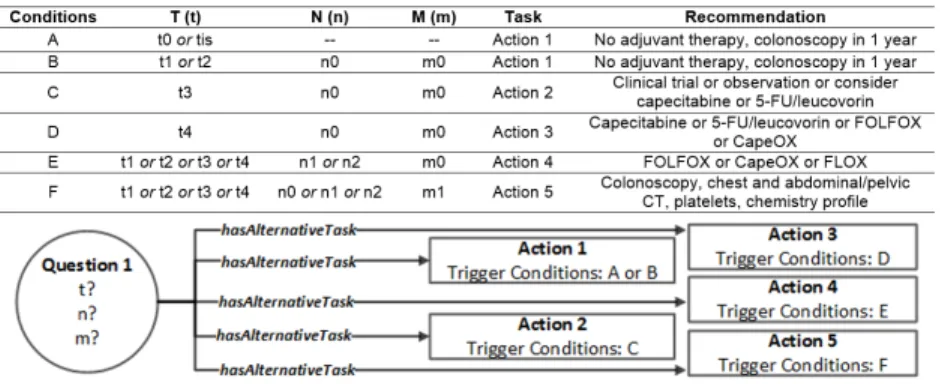
colon cancer, surgery, or more specifically a colectomy, is performed. After surgery, it is necessary to assess the patient based on the most recent findings, which typi-cally occurs in a group appointment of physicians. A decision is made based on the TNM staging system for the classification of malignant tumors, which consists of three criteria: T (tumor), which stands for the degree of tumor invasion into the wall of the colon; N (nodes), the number of metastases in regional lymph nodes; and M (metastasis) represents the detection of distant metastases in other organs such as the liver or the lungs. In Figure 1, the clinical situation described above is represented according to the CompGuide model [9] for CPGs. It is an ontology defined in Ontol-ogy Web Language (OWL) following the task-network model. In Figure 1 first there is aQuestiontask which aims to obtain the values for the T, N and M parameters. This is a data entry point in the guideline for the retrieval of patient information. ThisQuestiontask is linked to five other tasks through thehasAlternativeTask prop-erty, which means that these tasks should be executed alternatively to one another, according to the validation of specific trigger conditions, also represented in Figure 1. The tasks are of theActiontype for they recommend the execution of specific clinical procedures by health care professionals. Depending on the stage of the can-cer, it is necessary to decide the best adjuvant therapy, which involves choosing between different observation and chemotherapy schemes. There are cases in which it is difficult to accurately assess the degree of tumor invasion. Furthermore, to know if there are metastases in regional lymph nodes, it is necessary to wait for a pathol-ogy report which, in turn, depends on the completion of laboratory tests. The same may happen with the evaluation of distant metastases. For these reasons, there may be cases in which the values for T, N and M are unknown. The whole clinical sit-uation was extracted from the Clinical Practice Guideline in Oncology for Colon Cancer from the National Comprehensive Cancer Network [1]. The medical content is greatly simplified for the sake of conveying the key features of the Speculative Module.
Fig. 1 Clinical setting for the example regarding colon cancer represented according to the CompGuide model.
3.2 Structure of the CIG System
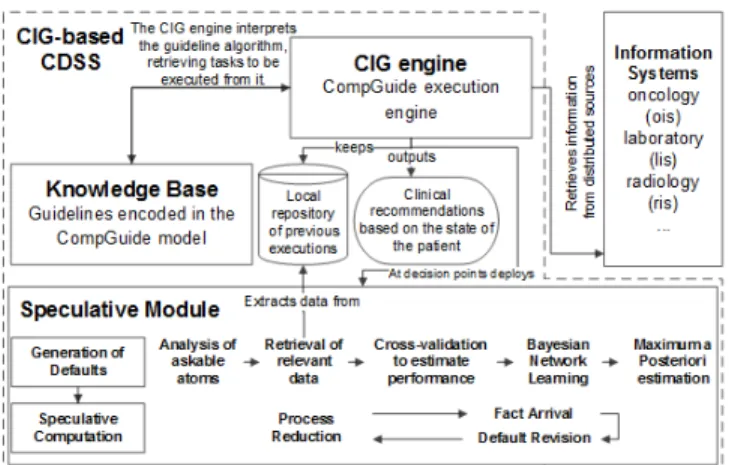
CIG systems have a similar architecture to that of the CompGuide system, repre-sented in Figure 2. The main component is the CIG Engine. It is responsible for ex-ecuting CIGs encoded in the Knowledge Base, containing situations like the one de-scribed in Section 3.1, against patient information retrieved from distributed sources such as other clinical information systems. The system keeps a local repository of previous guideline executions, with patient information fed to the system in previ-ous installments. The CIG Engine is responsible for providing the recommendations about the next clinical task. When there is a decision point, a Speculative Module is deployed to deal with cases of incomplete information. Another cause of incom-plete information might be the failure of communication between the CIG system and the information sources. The setting is the following: (1) the CIG Engine will recommend the next task in the clinical careflow; (2) the transition from one task to another is only possible if the first is connected to the latter through the hasAlter-nativeTaskproperty (just like in the example); (3) to move to one of the alternative tasks, the trigger conditions of such task must be met; (4) the information necessary to verify the trigger conditions will be acquired from an external information source, the oncology information system (ois) in this case; and (6) the system has a Spec-ulative Module which uses default values to continue the execution and generate clinical scenarios in the event that there is no answer from the (ois).
Fig. 2 CompGuide system architecture with its main components:CIG Engine,Knowledge Base, andSpeculative Module.
4 Description of the Speculative Module
4.1 Generation of Defaults
The Generation of Defaults is a part of the Speculative Module and consists in a procedure that seeks to acquire the most likely values for the decision parameters,
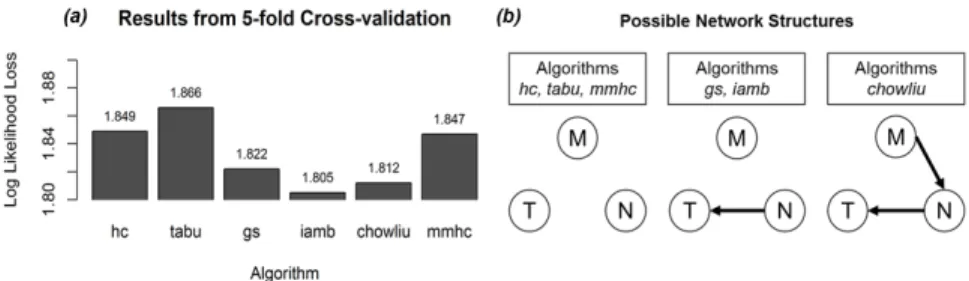
taking into account possible dependence relationships between them. Bayesian Net-works (BNs), for their set of characteristics [15, 14], provide an ideal support for a default generation model. The Generation of Defaults is depicted in Figure 2, inside the Speculative Module. It comprises five sequential stages. The first is the identifi-cation of askable atoms, in which the clinical parameters for the decision are identi-fied and isolated. Next, the module retrieves relevant data about previous guideline executions regarding the isolated parameters from the local repository. In the fol-lowing stage, six different BN learning algorithms are used in cross-validation. The purpose is to select the one with the lowest log likelihood loss (logl), which is a mea-sure of the entropy exported by a model in order to keep its own entropy low [4]. So, low values are synonymous with a good fit between the model and the data. After the best performing algorithm is selected, a BN is generated. The last stage con-sists in a Maximum a Posteriori (MAP) estimation, which is a query to the BN that provides the most likely values for the parameters, given the evidence, along with a probability value [8]. It is possible to perform a MAP query with no evidence, which provides the most likely configuration for all the parameters in the network. Figure 3 shows the results of the procedure when applied to data of 515 patients who received treatment for colon cancer at the Hospital of Braga, Portugal. In Figure 3 (a), it is possible to see that the algorithm that produces the lowestloglis theiamb. Figure 3 (b) also shows the structures learned from the different algorithms. In the chosen structure (the one learned with theiamb) it was only possible to establish a depen-dence relationship between T and N. This is particularly useful for it indicates to the CIG Engine that tumor invasion and local lymph nodes metastases might be corre-lated, but distant metastases are not dependent on the other two parameters. After performing the MAP estimation on the network, the values obtained for T, N, and M were respectivelyT =t3,N=n2, andM=m1, withT,N,MMAP≈0.4395. These values are used as initial defaults in Speculative Computation. MAP queries will be performed as information from the sources arrive in order to adjust the remaining default values. The Generation of Defaults was developed using thebnlearn pack-age for R and theinflibJava library for inference in BNs from the SamIam project.
Fig. 3 (a) Results from 5-fold cross-validation of six structure learning algorithms; (b) Bayesian Network structures for the TNM parameters learned with the different algorithms.
4.2 Speculative Computation
The Speculative Computation part of the Speculative Module is based on a logic programming framework with constraint processing.
4.2.1 Formalization of the Clinical Example According to the Framework A Framework for Speculative Computation in clinical decision support systems which features disjunctive constraint processing is a tuplehΣ,E,∆,Pi. This formu-lation is based on the work presented in [5].Σis a finite set of constants. An element inΣ is a system component identifier, an information source with which the CIG system communicates.E is a set of predicates called external predicates, represent-ing the decision criteria, i.e., the clinical parameters in the trigger conditions. When
Qis an atom with an external predicate andSis the identifier of a remote informa-tion source,Q@Sis called an askable atom.∆ is the default answer set, consisting of set of default rules, obtained from the Generation of Defaults, called default rules with respect toQ@S, of the following form:Q@S←Ck, whereQ@Sis an askable atom andC is a set of constraints called default constraints forQ@S. As for P, it is a constraint logic program of the form:H←CkB1,B2, . . . ,Bn., whereH is a positive ordinary literal called a head of ruleR;Cis a set of constraints; and each
B1,B2, . . . ,Bnis an ordinary literal, or an askable literal. The situation described in Section 3.1 regarding the staging of colon cancer can be represented according to the framework. The predicatent(a,b)indicates thatbis the task that followsaand is used in the initial query in order to know what procedure should be performed next.alt(a,b)indicates thatbis an alternative task linked toa.tcv(b)means that the trigger conditions for taskbare validated. The complete representation is: • Σ={ois}
• E={t,n,m}
• ∆is the following set of rules:t(T)@ois←T∈ {t3} k. n(N)@ois←N∈ {n2} k. m(M)@ois←M∈ {m1} k.
• Pis the following set of rules:
nt(X,F)←kalt(X,F),tcv(F).rule1
tcv(F)←F∈ {action1},T∈ {tis,t0} kt(T)@ois.rule2
tcv(F)←F∈ {action1},T∈ {t1,t2},N∈ {n0},M∈ {m0} kt(T)@ois,n(N)@ois,m(M)@ois.rule3
tcv(F)←F∈ {action2},T∈ {t3},N∈ {n0},M∈ {m0} kt(T)@ois,n(N)@ois,m(M)@ois.rule4
tcv(F)←F∈ {action3},T∈ {t4},N∈ {n0},M∈ {m0} kt(T)@ois,n(N)@ois,m(M)@ois.rule5
tcv(F)←F∈ {action4},T∈ {t1,t2,t3,t4},N∈ {n1,n2},M∈ {m0} kt(T)@ois,n(N)@ois,m(M)@ois.rule6
tcv(F)←F∈ {action5},T∈ {t1,t2,t3,t4},N∈ {n0,n1,n2},M∈ {m1} kt(T)@ois,n(N)@ois,m(M)@ois.rule7
alt(question1,F)←F∈ {action1} k. alt(question1,F)←F∈ {action2} k.
alt(question1,F)←F∈ {action3} k. alt(question1,F)←F∈ {action4} k.
alt(question1,F)←F∈ {action5} k.
Speculative Computation starts with a top goal. The notion of goal is cen-tral for it represents what is necessary to achieve in the computation, or, in other words, it is the outcome of the decision. In the framework, a goal has the form of
←CkB1, . . . ,BnwhereC is a set of constraints and each of B1, . . . ,Bn is either an askable atom or an atom that is unifiable with the head of a rule inP. Dur-ing the computation the framework keeps a set of beliefs about the askable atoms, i.e., the clinical parameters in the decision, in a current belief state (CBS). In the beginning, theCBSassumes the default rules in∆ and, afterwards, the top goal is
reduced according toCBSandP. Goals and the product of their reduction are kept in processes. They are structures that represent the different alternative computa-tions in the framework. In this regard, there are two types of processes: active and suspended. Active processes are those whose constraintsC are contained in, and therefore are consistent with, theCBS. They are regarded as the valid scenarios. Processes that do not fulfill this condition are suspended. In order to keep track of the different processes, active processes are kept in the active process set (APS), whereas suspended processes are kept in the suspended process set (SPS).
4.2.2 Phases of Speculative Computation
Speculative Computation includes: the process reduction phase, the fact arrival
phase, and thedefault revisionphase. Throughout these phases active processes are represented according to the tupleh←CkGS,U Di, whereCis a set of constraints,
GScontains the goals in the form of literals to be proved, andU Dis the set of used defaults. If an atom is reduced through a default, it is added to theU Dof the pro-cess. Suspended processes have a similar structure, they are represented by a tuple
hSP,←CkGS,U Di, whereSPis a set containing the atoms that were responsible for suspending the process and whose constraints are not consistent with theCBS.
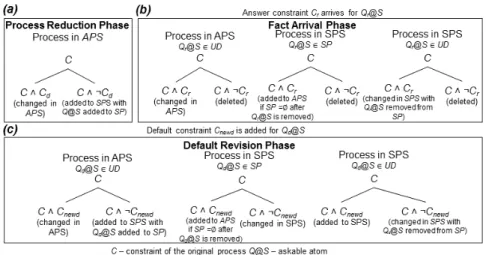
The first phase isprocess reduction, which is depicted in Figure 4 (a). The ini-tial query to the system becomes the iniini-tial goal set in the first active process. The process is further reduced according to its goals. If an atom in the goal set is unifi-able with a rule inP then that atom is replaced in GSwith the body of the rule, and the constraints of the rule are added to the constraints of the process. This orig-inates as many active processes as there are rules with which the atom in GS is unifiable. This ensures that different execution traces are explored, keeping all pos-sible scenarios open. But, if the atom in the goal is an askable atomQ@S, with and attached constraintC, for which there is a default constraintCd, the module verifies the consistency ofC∧Cd andC∧ ¬Cd. IfC∧Cd is consistent, then a new active process is created from the initial process with this constraint, andQ@S is added to
U D. If the same happens withC∧ ¬Cd, a suspended process is created as well, and
Q@Sis added toSP. With this disjoint constraint processing, the objective is not to exclude any possible scenario and keep active only the processes that are consis-tent with theCBS. While this takes place, the real value of the atom is asked from the information source. These procedures are applied to active processes until they have an empty goal set, which means that there is nothing left to prove and they are valid scenarios according to the default constraints.Fact arrivaloccurs when a constraintQr@S←Crkis returned from an information sourceSfor a question regarding an askable atomQr@S. After a step of process reduction is finished, the new constraint replaces the default in theCBSfor the corresponding askable atom. It is then necessary to revise the processes inAPSandSPSthat haveQr@Seither as a used default (inU D) or a suspended atom (inSP). The revision of constraints occurs as shown in Figure 4 (b). Since the replies from the information sources are facts and, thus, regarded as definitive, there are execution traces that are deleted when they are inconsistent with theCBS. The objective with this phase is to remove
scenarios that can no longer occur. Thedefault revisionphase consists in changing all the processes according to the new default rules provided by the method for the Generation of Defaults. The arrival of a new fact may change the remaining default rules. As such, a new MAP estimation is done using the BN with the available facts as evidence. For every changed default,default revisionis performed. Processes in
APSandSPSare revised in order to determine if their constraints are consistent with the new default constraintQd@S←Cnewdk. According to the position of the atom attached to the new default, i.e., if it is a suspended atom (inSP) or a used default (inU D), the existing processes may generate new active and suspended processes, but their execution trace is never erased, unlike what happens in thefact arrival
phase. The revision of processes takes place as shown in Figure 4 (c). This keeps the scenarios coherent and increasingly aligned with the newly arrived facts. It is a dynamic mechanism because it is triggered by changes in the default rules. These changes, in turn, are caused by the arrival of facts from the information sources. The treatment of processes in all of these three phases is implemented in Prolog.
Fig. 4 Diagram of Speculative Computation. Each bifurcation represents two new processes with the displayed constraints.
4.3 Example and Discussion
According to the situation described in Section 3.1 and the formalization in Section 4.2.1, the question to pose to the Speculative Module would bent(question1,F), which seeks to determine which task should followQuestion1in the management of the patient. The initialCBSassumes the values in∆. Then, process reduction oc-curs with the unification of the goals in the GS with the head of rules and facts in P. This will happen through rules 1 and 2. By the time process reduction reaches rules 3, 4, 5, 6, and 7, one will have five active processes representing the five possible alternative tasks. At this point, it becomes necessary to reduce askable atoms. For instance, if the system needs a value for the goal t(T)@ois, since there is only a default constraint for that goal in theCBS, that constraint
is used in process reduction, yielding active processes which are consistent with the default and suspended processes which are not. As such, a process represent-ing action5 is split into two processes, an active process using the default con-straint t(T)@ois←T ∈ {t3} k, and a suspended process using the negation of the default constraint. Meanwhile, a question is sent tooisso as to know the real value oft(T)@ois. The procedure is similar whenever an askable atom is found. By continuing process reduction, it is possible to arrive at a state in which there is a process with an empty goal set, achieved purely by relying on default con-straints. As such, the process is a tentative scenario. By outputting constraintsC
and used defaultsU D, the system provides the task that will most likely follow
question1. In this caseC={F∈ {action5},T ∈ {t3},N∈ {n2},M∈ {m1}}and
U D={t(T)@ois,n(N)@ois,m(M)@ois}, which means thataction5should be the next task, featuring a series of workup exams such as a colonoscopy, an abdomi-nal/pelvic CT, and so forth. Based on this, the health care professional may start preparations. There might be cases in which more than one process with an empty goal set are produced. In such situations, both are presented as scenarios.
Infact arrival, answers from theoistrigger the revision of active and suspended processes. Assuming that the fact (n(N)@ois←N∈ {n0} k)arrives, it becomes the new rule forn(N)@ois in theCBS, and all the processes consistent with this and the remainingCBSbecome active, whereas the others are deleted. Additionally, a new MAP estimation is submitted to the BN with the new fact as evidence. It produces the resultT,MMAP=argmaxT,MP(T,M|N=n0)≈0.9126 withT =t1 andM=m1. The default value fort(T)@oisis the only one that changes. Through
default revision,t(T)@ois←T ∈ {t1} kreplaces the old default in theCBSand all the processes are revised accordingly, but no execution trace is deleted. In the end of these steps there is an active process representing the most likely scenario given the configuration of the information, achieved through fact and default constraints. Outputting constraints and used defaults would giveC={←F∈ {action5},T ∈ {t1},N∈ {n0},M∈ {m1}}andU D={t(T)@ois,m(M)@ois}. Curiously, the sce-nario recommends the same task, but achieved through a different route. In this case, the new default is included in the process andn(N)@oisin no longer inU Dbecause it is not a default anymore. As information arrives for the other askable atoms, these procedures are repeated. The Speculative Module provides a filter for rule-based clinical decision support systems, managing different information states.
5 Conclusions and Future Work
Speculative Computation provides tentative scenarios for the state of a patient and, based on them, the most appropriate clinical task. Speculative Computation is used as an interface to clinical algorithms, bringing to clinical decisions a set of mecha-nisms to reduce and revise scenarios according to facts and newly derived defaults. As such, they ensure a convergence of all the scenarios towards the real state of the patient. This kind of mechanism does not have a parallel in other CIG systems. The computation is dynamic in the sense that it accounts for changes in the original beliefs. As future work, it is necessary to incorporate the probability provided by
the MAP estimation into Speculative Computation so as to provide a measure of the likelihood of the processes holding true.
Acknowledgements This work is part-funded by ERDF - European Regional Development Fund through the COMPETE Programme (operational programme for competitiveness) and by Na-tional Funds through the FCT - Fundac¸˜ao para a Ciˆencia e a Tecnologia (Portuguese Foundation for Science and Technology) within project FCOMP-01-0124-FEDER-028980 and project scope UID/CEC/00319/2013.The work of Tiago Oliveira is supported by a FCT grant with the reference SFRH/BD/85291/ 2012.
References
1. Benson, A., Bekaii-Saab, T., Chan, E., Chen, Y.J., Choti, M., Cooper, H., Engstrom, P.: NCCN Clinical Practice Guideline in Oncology Colon Cancer. Tech. rep., National Comprehensive Cancer Network
2. Boxwala, A.A., Peleg, M., Tu, S., Ogunyemi, O., Zeng, Q.T., Wang, D., Patel, V.L., Greenes, R.A., Shortliffe, E.H.: GLIF3: A Representation Format for Sharable Computer-Interpretable Clinical Practice Guidelines. Journal of Biomedical Informatics37(3), 147–161 (2004) 3. Fox, J., Ma, R.T.: Decision Support for Health Care : The PROforma Evidence Base.
Infor-matics in Primary Care14(1), 49–54 (2006)
4. Hastie, T., Tibshirani, R., Friedman, J., Hastie, T., Friedman, J., Tibshirani, R.: The Elements of Statistical Learning: Data Mining, Inference, and Prediction, 2 edn. Springer-Verlag, New York (2009)
5. Hosobe, H., Satoh, K., Codognet, P.: Agent-Based Speculative Constraint Processing. IEICE Transactions on Information and SystemsE90-D(9), 1354–1362 (2007)
6. Hua, Z., Gong, B., Xu, X.: A dsahp approach for multi-attribute decision making problem with incomplete information. Expert Systems with Applications34(3), 2221 – 2227 (2008) 7. Kononenko, I.: Inductive and bayesian learning in medical diagnosis. Applied Artificial
Intel-ligence7(4), 317–337 (1993)
8. Korb, K., Nicholson, A.: Bayesian Artificial Intelligence, 2 edn. CRC Press, London (2003) 9. Oliveira, T., Novais, P., Neves, J.: Representation of clinical practice guideline components
in owl. In: Trends in Practical Applications of Agents and Multiagent Systems,Advances in Intelligent Systems and Computing, vol. 221, pp. 77–85. Springer (2013)
10. Peleg, M.: Computer-Interpretable Clinical Guidelines: A Methodological Review. Journal of Biomedical Informatics46(4), 744–63 (2013)
11. Shortliffe, E.H., Davis, R., Axline, S.G., Buchanan, B.G., Green, C., Cohen, S.N.: Computer-based consultations in clinical therapeutics: Explanation and rule acquisition capabilities of the mycin system. Computers and Biomedical Research8(4), 303 – 320 (1975)
12. Straszecka, E.: Combining Uncertainty and Imprecision in Models of Medical Diagnosis. In-formation Sciences176(20), 3026–3059 (2006)
13. Tu, S.W., Campbell, J.R., Glasgow, J., Nyman, M.a., McClure, R., McClay, J., Parker, C., Hrabak, K.M., Berg, D., Weida, T., Mansfield, J.G., Musen, M.a., Abarbanel, R.M.: The SAGE Guideline Model: achievements and overview. Journal of the American Medical Informatics Association : JAMIA14(5), 589–98 (2007)
14. Van der Heijden, M., Lucas, P.J.F.: Describing Disease Processes Using a Probabilistic Logic of Qualitative time. Artificial Intelligence in Medicine59(3), 143–155 (2013)
15. Visscher, S., Lucas, P.J.F., Schurink, C.A.M., Bonten, M.J.M.: Modelling Treatment Effects in a Clinical Bayesian Network Using Boolean Threshold Functions. Artificial Intelligence in Medicine46(3), 251–266 (2009)