CLASS RECONSTRUCTION DRIVEN ADVERSARIAL DOMAIN ADAPTATION FOR
HYPERSPECTRAL IMAGE CLASSIFICATION
Shivam Pande
1, Biplab Banerjee
1and Aleksandra Piˇzurica
21
Centre of Studies in Resources Engineering, Indian Institute of Technology Bombay, India
2Department of Telecommunications and Information Processing, Ghent University, Belgium
ABSTRACT
We address the problem of cross-domain classification of hy-perspectral image (HSI) pairs under the notion of unsuper-vised domain adaptation (UDA). The UDA problem aims at classifying the test samples of a target domain by exploit-ing the labeled trainexploit-ing samples from a related but different source domain. In this respect, the use of adversarial train-ing driven domain classifiers is popular which seeks to learn a shared feature space for both the domains. However, such a formalism apparently fails to ensure the i) discriminative-ness, and ii) non-redundancy of the learned space. In general, the feature space learned by domain classifier does not con-vey any meaningful insight regarding the data. On the other hand, we are interested in constraining the space which is deemed to be simultaneously discriminative and reconstruc-tive at the class-scale. In particular, the reconstrucreconstruc-tive con-straint enables the learning of category-specific meaningful feature abstractions and UDA in such a latent space is ex-pected to better associate the domains. Experimental results obtained on benchmark HSI dataset confirm the efficacy of the proposal approach.
Index Terms— Domain adaptation, Adversarial training, Hyperspectral images.
1. INTRODUCTION
The current era has witnessed the acquisition of a large vol-ume of satellite remote sensing (RS) images of varied modal-ities, thanks to several national and international satellite mis-sions. Such images showcase relevance in a range of im-portant applications in areas including urban studies, disas-ter management, national security and many more. One of the major applications in this regard concerns the analysis of i) images of a given area on ground but acquired at differ-ent time instants, and ii) images of differdiffer-ent geographical ar-eas but composed of similar land-cover types. Usually, it is non-trivial to generate training samples for all the images and
Partially supported by the Research Foundation - Flanders (FWO), Belgium, under the grant G.OA26.17N. and SER/2017/000365 (SERB-DST, India). [email protected], [email protected], [email protected]
hence it is a common practice to re-use the training samples obtained from images withsimilarcharacteristics to new im-ages for carrying out the supervised learning tasks. To this end, the paradigm of inductive transfer learning, in particular domain adaptation, is extremely popular.
By definition, the unsupervised domain adaptation (UDA) techniques typically consider two related yet diverse data do-mains: a source domainS equipped with ample amount of training samples, and a target domainT where the test sam-ples are accumulated. Since the data distributions are differ-ent for the two domains:P(S)6=P(T), the classifier trained onSfails to generalize forT following the probably approx-imately correct (PAC) assumptions of the statistical learning theory [1] [2].
Traditional UDA techniques can broadly be classified into categories based on: i) classifier adaptation, and ii) domain invariant feature space learning. In particular, a common fea-ture space is learned where the notion of domain divergence is minimized or a transformation matrix is modelled to project the samples of (source) target domain to the other counter-part [3], [4]. Some of the popular ad-hoc methods in this category include transfer component analysis (TCA) [5], sub-space alignment (SA) [6], geodesic flow kernel (GFK) [7] based manifold alignment etc. Likewise, UDA approaches based on the idea of maximum mean discrepancy (MMD) [8] learn the domain invariant space in a kernel induced Hilbert space. Recently, the idea of adversarial training has become extremely popular in UDA. Specifically, such approaches are based on a min-max type game between two modules: a fea-ture generator (G) and a discriminator (D). WhileDtries to distinguish samples coming from S andT, Gis trained to make the target features indistinguishable from S [9]. The RevGrad algorithm is of particular interest in this respect as it introduces a gradient reversal layer for maximizing the gra-dient of the D loss [10]. This, in turn, directsG to learn a domain-confused feature space, thus reducing the domain gap substantially. Adversarial residual transform networks (ARTN) [11] is another notable approach that uses adversarial learning in UDA. Besides, the use of generative adversarial networks (GAN) have been pre-dominant in the recent past for varied cross-domain inference tasks: image style transfer, cross-modal image generation, to name a few. Some of the
GAN based endeavors in this regard are: DAN [12], Cycle-GAN [13] and ADDA [14].
As the UDA problem is frequently encountered in RS, the aforementioned ad-hoc techniques have already been ex-plored in the RS domain [1]. A recent example [15] proposes a hierarchical subspace learning strategy which considers the semantic similarity among the land-cover classes at multiple levels and learns a series of domain-invariant subspaces. The use of a shared dictionary between the domains is also a pop-ular practise for HSI pairs [16]. As far as the deep learning techniques are concerned, the use of GAN or domain inde-pendent convolution networks are also explored in this regard [17].
In this work, we specifically focus on the domain classi-fier (DC) based adversarial approach towards UDA. Precisely, the DC based UDA approaches simultaneously train the do-main classifier and a source specific classifier using the fea-ture generator-discriminator framework. While the domain classifier is entrusted with the task of making the domains overlapping, the source classifier helps in avoiding any trivial mapping. However, we find the following shortcomings of the standard DC based approaches: i) the learned space does not encourage discriminativeness. In particular, the notion of intra-class compactness is not explicitly taken into account, which may result in overlapping of samples belonging to fine-grained categories. ii) the learned space is ideally unbounded and does not convey any meaningful interpretation.
In order to resolve both the aforementioned issues, we propose an advanced auto-encoder based approach as an ex-tension to the typical DC based UDA. In addition to jointly training the binary domain classifier and the source-specific multi-class classifier, we specifically add a reconstruction constraint on the learned latent space for the source specific samples. Ideally, the reconstructive constraint is directed to reconstruct one sample from another sample from S both sharing the same class label. This essentially captures the classwise abstract attributes better than a typical auto-encoder setup. Further, this loss helps in concentrating the samples fromS at the category level. Optimization of all three loss measures together is experimentally found to better corre-spondSandT. The main contributions of this paper are:
• We introduce a class-level sample reconstruction loss for the samples inSin a typical DC based UDA frame-work. This makes the learned space constrained and bounded.
• Extensive experiments are conducted on the Botswana HSI dataset where improved classification performance onT can be observed.
The subsequent sections of the paper discuss the method-ology followed by the experiments conducted and concluding remarks.
2. METHODOLOGY
In this section, we detail the UDA problem followed by our proposed solution.
Preliminaries: LetXS = {(xsi, yis)} NS
i=1 ∈ XS ⊗YS be the source domain training samples withxsi ∈ Rdandysi ∈
{1,2, . . . , C}, respectively. Likewise, letXT ={(xtj} NT
j=1 ∈
XT be the target domain samples obtained from the same cat-egories as ofXS. However,PS(XS)6=PT(XT). Under this setup, the UDA problem aims at learningfS : XS → YS which is guaranteed to generalize well forXT.
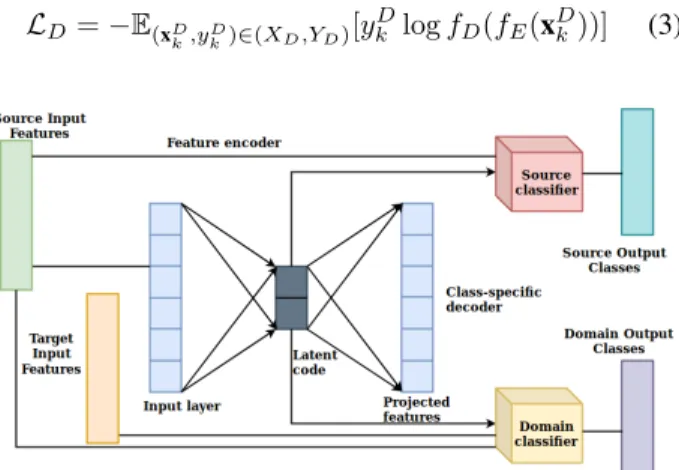
In order to learn an effectivefS, we propose an end-to-end encoder-decoder based neural network architecture compris-ing of the followcompris-ing components: i) a feature encoderfE, ii) a domain classifierfD, iii) a source specific classifierfS, and iv) a reconstructive class-specific decoderfDE. Note that the feature encoder is typically implemented in terms of the fully-connected(fc) layers with non-linearity. For notational con-venience, we denote the encoded feature representation cor-responding to an inputxbyfE(x).
We elaborate the proposed training and inference stages in the following. A depiction of our model can be found in Figure 1.
2.1. Training
Given the encoded feature representations, the proposed loss measure is composed of the losses from the following com-ponents in the decoder:
Source classifierfS: The mapping, fS is a multi-class softmax classifier trained solely onXS. We express the cor-responding loss in terms of the cross-entropy that is defined as the log-likelihood between the training data and the model distribution [18]. Specifically, we deploy an empirical cate-gorical cross-entropy based loss,
LS=−E(xs
i,ysi)∈XS[y
s
i logfS(fE(xsi))] (1) whereEDdenotes the empirical expectation over domainD.
The class-specific source reconstructionfDE: Note that
fS ensures better inter-class separation of the source domain samples in the learned space. However, it does not consider the notion of intra-class compactness which is essential for demarcating highly overlapping categories. In addition, we simultaneously require the learned space to be meaningful and to capture the inherent class-level abstract features of both
SandT.
To this end, let us define two data matricesXS ∈RNS×d
andXˆS ∈ RNS×d fromX
S in such a way that theith row of both the matrices refers to a pair of distinct data points obtained from a given category. Under this setup,fDEaims to reconstructXˆ in the decoder branch givenfE(XS). We formulate the corresponding loss as:
LR= NS X
i=1
kX˜S−XˆSk2F (2) Note thatX˜S denotes the projectedfE(XS)onto the de-coder. Since we perform cross-sample reconstruction in this encoder decoder branch (fE andfDE),fE essentially cap-tures abstract class-level feacap-tures ofXS. Besides,LRfurther ensures within-class compactness. As a whole, the joint min-imization ofLS andLRensures thatfE essentially learns a space which is simultaneously discriminative and meaningful.
Domain classifierfD: The role offD is to project the samples fromS andT onto the shared space modelled by
4fE. Let us assign the domain label 0 to all the source sam-plesXisand label 1 to all the target samplesXit. We define
XD = [XS, XT]andYD = [ ˆYS,YˆT]whereYˆS =0is an all zero vector of sizeNSandYˆT =1of sizeNT. Given that,fD maximizes a typical binary cross-entropy based classification error through a min-max game betweenfEandfDin such a way that the learned space becomes highly domain invariant. Formally we define the loss measure forfDas:
LD=−E(xD
k,ykD)∈(XD,YD)[y
D
k logfD(fE(xDk))] (3)
Fig. 1. Schematic flow of the proposed UDA model.
2.2. Optimization and inference
Based on the equations (1), (2) and (3), the overall loss func-tion can be represented as:
L= min
fS,fE
max
fD
λ1LS+λ2LDE−λ3LD+λ4R (4) whereλs denote the weights of the individual terms and R
defines a regularizer on the learnable parameters. We follow the standard alternate stochastic mini-batch gradient descent approach to optimizeL. We find the order of optimization of the individual terms does not matter in this case.
During testing, the target samples are assigned labels throughfS(fE(XT)).
3. EXPERIMENTS 3.1. Dataset
The benchmark hyper-spectral dataset of Botswana region is considered to validate the efficacy of our approach (Figure 2) [19]. The satellite imagery was acquired by NASA EO-1 satellie in the period 200EO-1-2004 using the Hyperion sen-sor with the spatial resolution of 30 m spanning over 7.7 km strip. The imagery consists of 242 bands that covering the spectral range of 400-2500 nm. However in the current study, a pre-processed version of the dataset is used that comprises 10 bands obtained following a feature selection strategy.
Fourteen classes that correspond to land cover features on the ground are identified for the dataset. Many of the classes are fine-grained in nature with partially overlapping spec-tral signatures, causing the adaptation task extremely difficult (Figure 3). The source dataset (SD), consisting of 2621 pixels and target dataset (TD), containing 1252 pixels are created from spatially disjoint regions within the study area, leading to subtle differences inSandT, respectively.
Fig. 2. Botswana Dataset with (a) colour composite of first three bands and (b) training pixels.
3.2. Protocols
The entire network is constructed in terms of fully-connected neural network layers. In particular,fEhas two hidden layers with the dimensions of the final latent layer being50. On the other hand, a single layer neural network is used for both the source-centric classifier and the domain classifier with the re-quired number of output nodes.Relu(·)non-linearity is used for all the layers. The weights for the loss terms are fixed through cross-validation and Adam optimizer [20] is consid-ered with an initial learning rate of 0.001.
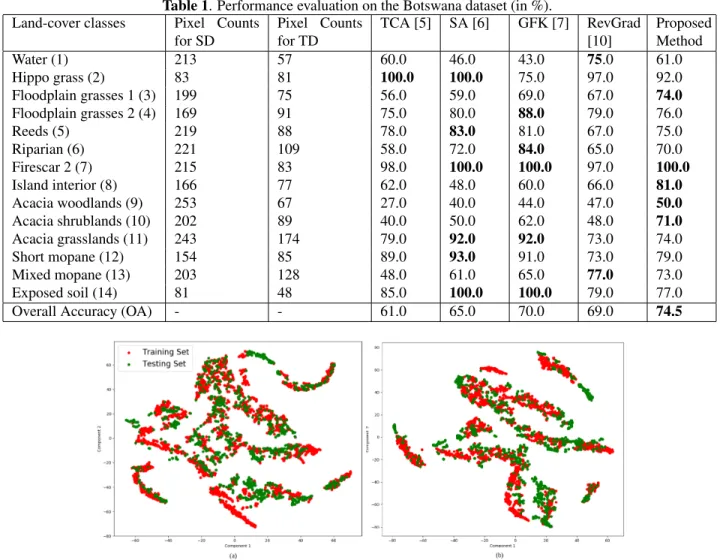
We report the classification accuracy at T and compare the performance with the following approaches from the lit-erature: TCA, SA, GFK, and RevGrad. Note all the consid-ered techniques aim to perform UDA in a latent space and RevGrad acts like the benchmark: it implicitly showcases the advantage of the proposed reconstructive loss termLDE.
Table 1. Performance evaluation on the Botswana dataset (in %). Land-cover classes Pixel Counts
for SD Pixel Counts for TD TCA [5] SA [6] GFK [7] RevGrad [10] Proposed Method Water (1) 213 57 60.0 46.0 43.0 75.0 61.0 Hippo grass (2) 83 81 100.0 100.0 75.0 97.0 92.0 Floodplain grasses 1 (3) 199 75 56.0 59.0 69.0 67.0 74.0 Floodplain grasses 2 (4) 169 91 75.0 80.0 88.0 79.0 76.0 Reeds (5) 219 88 78.0 83.0 81.0 67.0 75.0 Riparian (6) 221 109 58.0 72.0 84.0 65.0 70.0 Firescar 2 (7) 215 83 98.0 100.0 100.0 97.0 100.0 Island interior (8) 166 77 62.0 48.0 60.0 66.0 81.0 Acacia woodlands (9) 253 67 27.0 40.0 44.0 47.0 50.0 Acacia shrublands (10) 202 89 40.0 50.0 62.0 48.0 71.0 Acacia grasslands (11) 243 174 79.0 92.0 92.0 73.0 74.0 Short mopane (12) 154 85 89.0 93.0 91.0 73.0 79.0 Mixed mopane (13) 203 128 48.0 61.0 65.0 77.0 73.0 Exposed soil (14) 81 48 85.0 100.0 100.0 79.0 77.0
Overall Accuracy (OA) - - 61.0 65.0 70.0 69.0 74.5
Fig. 3. (a): Two dimensional t-SNE of source and target datasets before adaptation, (b): Two dimensional t-SNE of source and target domains after adaptation.
3.3. Discussion
Table 1 depicts the quantitative performance evaluation and comparison to other approaches. It can be inferred that the proposed approach outperforms the others with an overall classification accuracy of 74.5%. The RevGrad technique, on the other hand, produces an overall performance of 69%, thus implying that an overall domain alignment (without class) is not suitable for this dataset.
The proposed method produces significant improvement in identifying island interior (OA = 81%), acacia woodlands (OA = 50%) and acacia shrublands (OA = 71%). These classes are difficult to handle having similar spectral proper-ties with other classes and the ad-hoc approaches considered for comparison mostly failed to identify them. For other classes, the results are comparable to the other techniques.
4. CONCLUSIONS
We propose a cross-domain classification algorithm for HSI based on adversarial learning. Our model incorporates an ad-ditional class-level cross-sample reconstruction loss for the samples inS within the standard DC framework in order to make the learned space meaningful and classwise compact. Several experiments are conducted on the Botswana dataset to assess the efficacy of the proposed technique. The results clearly establish the superiority of our approach with respect to a number of existing ad-hoc and neural networks based methods. Currently, our method only relies on the spectral information. We plan to introduce the spatial aspect for im-proved semantic segmentation of the scene by distilling the advantages of convolution networks within the model.
5. REFERENCES
[1] Devis Tuia, Claudio Persello, and Lorenzo Bruzzone, “Domain adaptation for the classification of remote sensing data: An overview of recent advances,” IEEE Geoscience and Remote Sensing Magazine, vol. 4, no. 2, pp. 41–57, 2016.
[2] Kihyuk Sohn, Wenling Shang, Xiang Yu, and Manmo-han CManmo-handraker, “Unsupervised domain adaptation for distance metric learning,” inProceedings of the Interna-tional Conference on Learning Representations (ICLR), 2018.
[3] Hung-Yu Chen and Jen-Tzung Chien, “Deep semi-supervised learning for domain adaptation,” in Proceed-ings of the 25th IEEE International Workshop on Ma-chine Learning for Signal Processing (MLSP), 2015, pp. 1–6.
[4] Shuang Li, Shiji Song, Gao Huang, Zhengming Ding, and Cheng Wu, “Domain invariant and class discrim-inative feature learning for visual domain adaptation,”
IEEE Transactions on Image Processing, vol. 27, no. 9, pp. 4260–4273, 2018.
[5] Sinno Jialin Pan, Ivor W Tsang, James T Kwok, and Qiang Yang, “Domain adaptation via transfer compo-nent analysis,”IEEE Transactions on Neural Networks, vol. 22, no. 2, pp. 199–210, 2011.
[6] Basura Fernando, Amaury Habrard, Marc Sebban, and Tinne Tuytelaars, “Unsupervised visual domain adap-tation using subspace alignment,” in Proceedings of the IEEE international conference on computer vision, 2013, pp. 2960–2967.
[7] Boqing Gong, Yuan Shi, Fei Sha, and Kristen Grauman, “Geodesic flow kernel for unsupervised domain adapta-tion,” inProceedings of the IEEE Conference on Com-puter Vision and Pattern Recognition (CVPR), 2012, pp. 2066–2073.
[8] Hongliang Yan, Yukang Ding, Peihua Li, Qilong Wang, Yong Xu, and Wangmeng Zuo, “Mind the class weight bias: Weighted maximum mean discrepancy for un-supervised domain adaptation,” in Proceedings of the IEEE Conference on Computer Vision and Pattern Recognition (CVPR), 2017, vol. 3.
[9] Ian J Goodfellow, Jonathon Shlens, and Christian Szegedy, “Explaining and harnessing adversarial exam-ples,” arXiv preprint arXiv:1412.6572, 2014.
[10] Yaroslav Ganin and Victor Lempitsky, “Unsupervised domain adaptation by backpropagation,” arXiv preprint arXiv:1409.7495, 2014.
[11] Guanyu Cai, Yuqin Wang, Mengchu Zhou, and Lianghua He, “Unsupervised domain adaptation with adversarial residual transform networks,”arXiv preprint arXiv:1804.09578, 2018.
[12] Yaroslav Ganin, Evgeniya Ustinova, Hana Ajakan, Pas-cal Germain, Hugo Larochelle, Franc¸ois Laviolette, Mario Marchand, and Victor Lempitsky, “Domain-adversarial training of neural networks,” The Journal of Machine Learning Research, vol. 17, no. 1, pp. 2096– 2030, 2016.
[13] Yinpeng Chen, Weiwei Xu, Hari Sundaram, Thanassis Rikakis, and Sheng-Min Liu, “A dynamic decision net-work framenet-work for online media adaptation in stroke rehabilitation,”ACM Transactions on Multimedia Com-puting, Communications, and Applications (TOMM), vol. 5, no. 1, pp. 4, 2008.
[14] Eric Tzeng, Judy Hoffman, Kate Saenko, and Trevor Darrell, “Adversarial discriminative domain adapta-tion,” inProceedings of the Computer Vision and Pat-tern Recognition (CVPR), 2017, vol. 1, p. 4.
[15] Biplab Banerjee and Subhasis Chaudhuri, “Hierarchi-cal subspace learning based unsupervised domain adap-tation for cross-domain classification of remote sensing images,” IEEE Journal of Selected Topics in Applied Earth Observations and Remote Sensing, vol. 10, no. 11, pp. 5099–5109, 2017.
[16] Minchao Ye, Yuntao Qian, Jun Zhou, and Yuan Yan Tang, “Dictionary learning-based feature-level domain adaptation for cross-scene hyperspectral image classifi-cation,” IEEE Transactions on Geoscience and Remote Sensing, vol. 55, no. 3, pp. 1544–1562, 2017.
[17] Mesay Belete Bejiga and Farid Melgani, “Gan-based domain adaptation for object classification,” in Proceed-ings of the IGARSS 2018-2018 IEEE International Geo-science and Remote Sensing Symposium. IEEE, 2018, pp. 1264–1267.
[18] Ian Goodfellow, Yoshua Bengio, Aaron Courville, and Yoshua Bengio, Deep learning, vol. 1, MIT press Cam-bridge, 2016.
[19] Amy L Neuenschwander, Melba M Crawford, and Su-san Ringrose, “Results from the eo-1 experimenta com-parative study of earth observing-1 advanced land im-ager (ali) and landsat etm+ data for land cover mapping in the okavango delta, botswana,” International Jour-nal of Remote Sensing, vol. 26, no. 19, pp. 4321–4337, 2005.
[20] Diederik P Kingma and Jimmy Ba, “Adam: A method for stochastic optimization,” arXiv preprint arXiv:1412.6980, 2014.